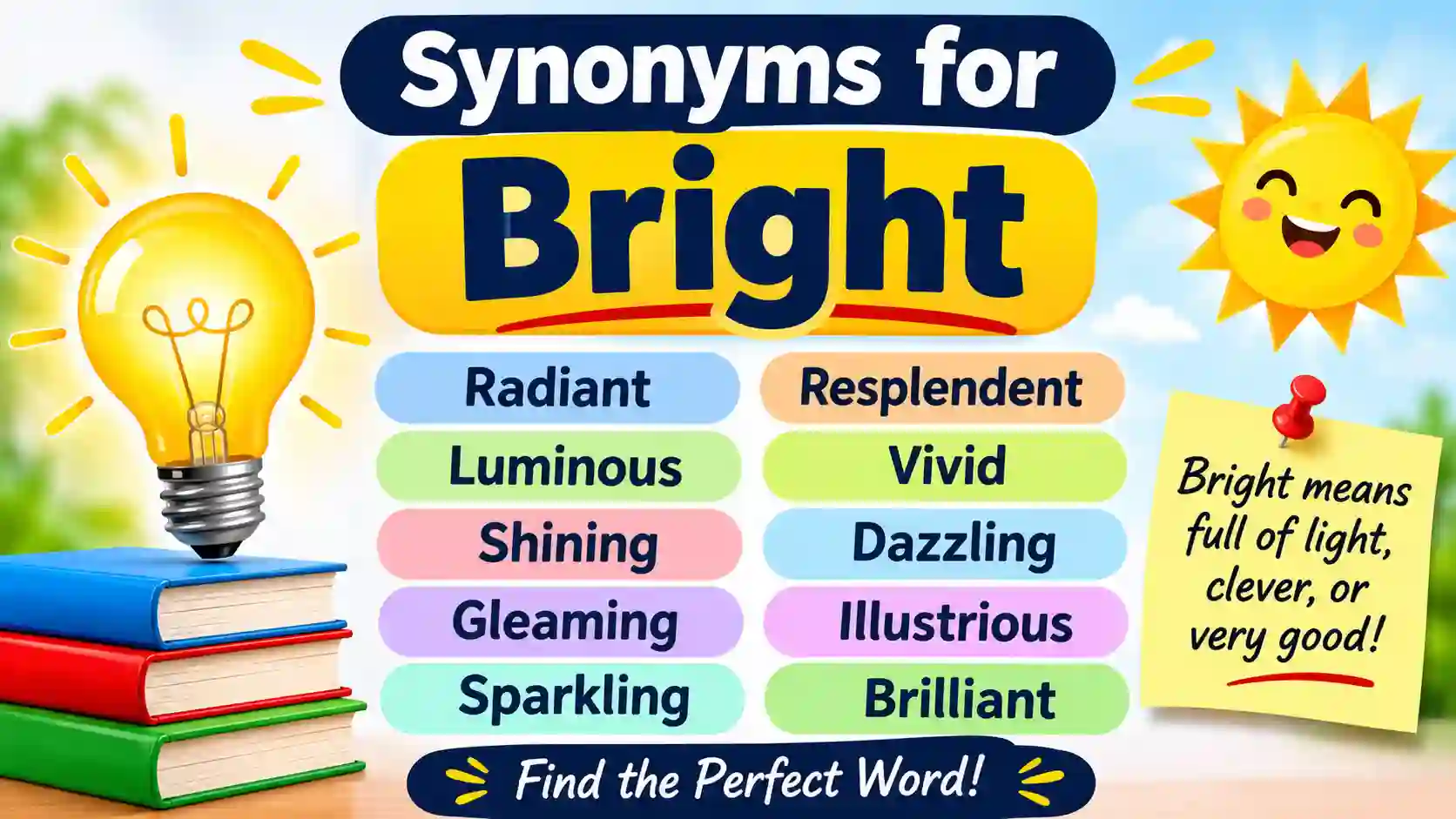
Have you ever used the word bright too many times in your writing? There are many other words you can use.
For example, brilliant describes strong light, intelligent describes a smart person, and vivid describes strong colors.
In this guide, you’ll learn 30 synonyms for bright with simple meanings and examples to help you improve your English vocabulary.
Quick Answer: The best synonyms for bright include brilliant, radiant, luminous, glowing, vivid, vibrant, intelligent, clever, smart, cheerful, and promising. The right alternative depends on the context. Use light-related words for shining objects, intelligence-related words for people, and hopeful words for positive future expectations.
Pronunciation of Bright
IPA: /braɪt/
Pronounced as: BRYTE.
The word rhymes with light, night, and right. It has one syllable.
American and British English use the same standard pronunciation.
Part of Speech
Bright is mainly an adjective. It has several meanings depending on the sentence.
| Part of speech | Usage | Example |
| Adjective | Full of light | The kitchen is bright. |
| Adjective | Strong in color | She wore a bright jacket. |
| Adjective | Intelligent | He is a bright student. |
| Adjective | Happy or hopeful | We have a bright future. |
| Adverb | In expressions of brightness | The stars shine bright. |
| Noun | Informal American plural | He switched on his brights. |
Brightly is the standard adverb form in most ordinary sentences. Brighten is the related verb, meaning to make something brighter or happier.
Word Origin and First Known Use
Bright comes from the Old English word beorht, which meant shining, splendid, or clear. It has Germanic roots and is related to similar words in older Germanic languages.
Dictionary.com records the word before the year 1000. Over time, its meaning expanded from physical light to strong colors, intelligence, happiness, and hope.
The mental meaning appears in English usage from the eighteenth century. Today, the word remains common in everyday and professional communication.
Grammar: How to Use Bright Correctly
Use bright before a noun or after a linking verb.
Common sentence patterns:
- Bright + noun: She bought a bright lamp.
- Be bright: The office is bright.
- Look bright: Your room looks bright.
- Become + bright: The sky became bright after sunrise.
- Bright future: Her career has a bright future.
- Bright with emotion: His eyes were bright with excitement.
Bright or brightly?
Both forms are correct, but they have different grammatical uses.
- The sun shines bright. (An accepted adverbial use, especially in expressive English.)
- The sun shines brightly. (The usual standard adverb form.)
- The brightly lit room looked welcoming. (Adverb modifying the participle lit.)
Common Collocations
| Expression | Meaning |
| Bright light | Strong light |
| Bright colors | Strong, noticeable colors |
| Bright student | Intelligent student |
| Bright idea | Clever or useful idea |
| Bright future | Promising future |
| Bright smile | Cheerful expression |
30 Synonyms for Bright With Examples and Explanations
The following alternatives are grouped by their intended meaning. Some are close synonyms, while others only work in particular situations.
How to read the labels: CEFR levels are approximate learner guidance, not official ratings for every meaning. Frequency labels are qualitative descriptions, not measured corpus counts.
Synonyms for Bright Meaning Full of Light
1. Brilliant
Meaning: Extremely bright, impressive, or highly intelligent.
Examples:
- Brilliant sunshine covered the entire beach.
- The scientist presented a brilliant solution.
Best used when: Describing powerful light, outstanding ideas, or exceptional ability.
Tone: Neutral, academic. CEFR: B2. Frequency: Very common.
Collocations: Brilliant sunshine, brilliant idea, brilliant performance.
When not to use: Avoid it when you mean ordinary or slightly noticeable light. Brilliant often suggests something exceptional.
2. Dazzling
Meaning: So bright or impressive that it attracts great attention.
Examples:
- The dazzling headlights made the road difficult to see.
- Her dazzling performance impressed the audience.
Best used when: Describing unusually powerful light or something spectacular.
Tone: Descriptive, literary. CEFR: C1. Frequency: Common.
Collocations: Dazzling display, dazzling smile, dazzling light.
When not to use: Avoid it for soft, gentle light.
3. Radiant
Meaning: Giving off light or showing strong happiness.
Examples:
- A radiant sunrise appeared above the hills.
- Her radiant face showed how happy she felt.
Best used when: Describing glowing faces, beauty, natural light, or happiness.
Tone: Neutral, literary. CEFR: B2. Frequency: Common.
Collocations: Radiant smile, radiant beauty, radiant light.
When not to use: Do not use it simply to describe an intelligent person.
4. Luminous
Meaning: Giving off light or appearing to glow.
Examples:
- The luminous moon appeared through the clouds.
- Small luminous signs guided visitors through the building.
Best used when: Describing glowing objects, light sources, or visible light effects.
Tone: Formal, scientific, literary. CEFR: C1. Frequency: Less common.
Collocations: Luminous object, luminous glow, luminous display.
When not to use: Avoid it for a normal bright room unless you specifically mean something that glows.
5. Glowing
Meaning: Producing a warm, steady light.
Examples:
- The glowing fireplace warmed the living room.
- Glowing candles made the dinner setting peaceful.
Best used when: Describing warm light, glowing objects, or enthusiastic praise.
Tone: Neutral. CEFR: B2. Frequency: Very common.
Collocations: Glowing embers, glowing skin, glowing reviews.
When not to use: Do not use it for a cold or completely unlit object.
6. Shining
Meaning: Producing or reflecting light.
Examples:
- A shining lamp stood beside the reading chair.
- The shining stars made the night beautiful.
Best used when: Describing steady light or something that reflects it.
Tone: Neutral. CEFR: A2. Frequency: Very common.
Collocations: Shining star, shining light, shining surface.
When not to use: Avoid using it as a direct replacement for intelligent unless the context clearly supports a figurative meaning.
7. Gleaming
Meaning: Reflecting light from a clean or polished surface.
Examples:
- The gleaming windows reflected the morning sky.
- A gleaming bicycle stood near the entrance.
Best used when: Describing polished metal, glass, floors, and other reflective surfaces.
Tone: Neutral, descriptive. CEFR: B2. Frequency: Common.
Collocations: Gleaming floor, gleaming surface, gleaming teeth.
When not to use: A generally well-lit room is not necessarily gleaming.
8. Sparkling
Meaning: Shining with many small flashes of light.
Examples:
- Sparkling water reflected the afternoon sunlight.
- Her sparkling eyes showed her excitement.
Best used when: Describing water, diamonds, stars, and lively expressions.
Tone: Neutral, literary. CEFR: B1. Frequency: Common.
Collocations: Sparkling water, sparkling eyes, sparkling diamonds.
When not to use: Avoid it for a large, steady source of light with no flashing effect.
9. Illuminated
Meaning: Lit up by a source of light.
Examples:
- The illuminated tower could be seen from miles away.
- Soft lamps illuminated the hallway.
Best used when: Describing buildings, signs, streets, and spaces with artificial or directed lighting.
Tone: Formal, technical. CEFR: B2. Frequency: Common.
Collocations: Illuminated sign, illuminated building, illuminated display.
When not to use: Do not use it to describe intelligence or a strong personality.
10. Sunlit
Meaning: Filled with natural sunlight.
Examples:
- We studied in a sunlit classroom.
- The sunlit garden looked beautiful after the rain.
Best used when: Describing rooms, gardens, buildings, and landscapes receiving sunlight.
Tone: Neutral, descriptive. CEFR: B2. Frequency: Common.
Collocations: Sunlit room, sunlit garden, sunlit path.
When not to use: An electrically lit room is not necessarily sunlit.
Synonyms for Bright Meaning Strong in Color
11. Vivid
Meaning: Very strong, clear, and noticeable in color or description.
Examples:
- The artist painted the wall a vivid shade of green.
- Her vivid description helped us picture the event.
Best used when: Describing strong colors, clear memories, or detailed writing.
Tone: Neutral, academic. CEFR: B2. Frequency: Common.
Collocations: Vivid colors, vivid imagination, vivid memories.
When not to use: Do not use it when you only mean that a room contains plenty of light.
12. Vibrant
Meaning: Full of energy, life, or strong color.
Examples:
- Vibrant flowers surrounded the entrance.
- The designer selected vibrant shades for the new website.
Best used when: Describing lively colors, places, communities, and creative designs.
Tone: Neutral, positive. CEFR: B2. Frequency: Common.
Collocations: Vibrant colors, vibrant culture, vibrant atmosphere.
When not to use: Avoid it when describing a simple light source without any sense of color or energy.
13. Intense
Meaning: Very strong or powerful in degree.
Examples:
- Intense sunlight covered the open field.
- The painting used intense shades of orange.
Best used when: Describing powerful light, color, emotion, or experience.
Tone: Neutral, academic. CEFR: B2. Frequency: Very common.
Collocations: Intense light, intense color, intense sunshine.
When not to use: Intense does not automatically mean bright. A dark emotion can also be intense.
14. Colorful / Colourful
Meaning: Having several colors or noticeable colors.
Examples:
- Colorful decorations filled the school hall.
- The artist created a colorful landscape.
Best used when: Describing clothing, artwork, flowers, and visual designs.
Tone: Neutral. CEFR: B1. Frequency: Very common.
Collocations: Colorful artwork, colorful clothes, colorful flowers.
When not to use: Not every colorful object is bright. A painting may contain several dark colors.
Spelling: Colorful is American English; colourful is British English.
15. Rich
Meaning: Strong, deep, or full in color.
Examples:
- The designer selected rich blue shades.
- Rich green leaves surrounded the garden.
Best used when: Describing deep, full colors and attractive visual combinations.
Tone: Neutral, descriptive. CEFR: B1. Frequency: Very common.
Collocations: Rich colors, rich blue, rich green.
When not to use: A rich color may be dark rather than bright. It does not always mean high lightness.
16. Striking
Meaning: Very noticeable or impressive.
Examples:
- The striking yellow sign attracted everyone’s attention.
- Her dress had a striking combination of colors.
Best used when: Describing designs, appearances, colors, and noticeable differences.
Tone: Neutral, professional. CEFR: B2. Frequency: Common.
Collocations: Striking contrast, striking colors, striking appearance.
When not to use: Something can be striking because of its shape or contrast, even when it is not bright.
Synonyms for Bright Meaning Intelligent
17. Intelligent
Meaning: Able to learn, understand, and think well.
Examples:
- The intelligent student solved the difficult problem.
- An intelligent manager listens before making decisions.
Best used when: Describing learning ability, reasoning, and understanding.
Tone: Formal, academic, professional. CEFR: B1. Frequency: Very common.
Collocations: Intelligent person, intelligent decision, intelligent solution.
When not to use: Avoid it for an attractive appearance or a well-lit space.
18. Clever
Meaning: Quick at understanding things and finding solutions.
Examples:
- She found a clever way to organize the files.
- The clever child designed a small toy car.
Best used when: Describing quick thinking, useful ideas, and practical solutions.
Tone: Neutral, conversational. CEFR: B1. Frequency: Very common.
Collocations: Clever idea, clever solution, clever child.
When not to use: In some British English contexts, calling an adult too clever can sound critical or sarcastic.
19. Smart
Meaning: Intelligent or good at making sensible decisions.
Examples:
- He is a smart student who enjoys solving puzzles.
- Buying the equipment early was a smart decision.
Best used when: Describing intelligence, judgment, and practical thinking.
Tone: Neutral, informal, business. CEFR: A2–B1. Frequency: Very common.
Collocations: Smart choice, smart decision, smart student.
When not to use: Do not use it as a direct replacement for bright light. In British English, smart can also mean neat or fashionable.
20. Sharp
Meaning: Quick at thinking, noticing details, and understanding situations.
Examples:
- The sharp student noticed the missing answer.
- Her sharp mind helped the company solve the problem.
Best used when: Describing quick thinking, awareness, and mental alertness.
Tone: Neutral, professional. CEFR: B2. Frequency: Common.
Collocations: Sharp mind, sharp thinking, sharp observation.
When not to use: Avoid it when you mean someone has broad knowledge rather than quick thinking.
21. Gifted
Meaning: Naturally having a special ability or talent.
Examples:
- The gifted musician performed a difficult piece.
- Their school supports gifted young learners.
Best used when: Describing people with unusual ability in a particular field.
Tone: Neutral, academic. CEFR: B2. Frequency: Common.
Collocations: Gifted student, gifted child, gifted artist.
When not to use: A person may be intelligent without having an exceptional natural talent.
22. Quick witted
Meaning: Able to think and respond quickly.
Examples:
- The quick-witted presenter answered every question.
- His quick-witted reply made the entire class laugh.
Best used when: Describing humor, fast responses, and clever conversation.
Tone: Neutral, conversational. CEFR: C1. Frequency: Common.
Collocations: Quick-witted person, quick-witted reply, quick-witted speaker.
When not to use: Do not use it when you mean someone has deep knowledge but responds slowly.
23. Astute
Meaning: Good at understanding situations and making sensible judgments.
Examples:
- The astute business owner noticed a new opportunity.
- Her astute observations improved the report.
Best used when: Describing good judgment, practical intelligence, and professional decisions.
Tone: Formal, business. CEFR: C1. Frequency: Common.
Collocations: Astute decision, astute observer, astute businessman.
When not to use: Avoid this word for simple school-level intelligence or physical light.
24. Perceptive
Meaning: Good at noticing and understanding details.
Examples:
- The perceptive teacher noticed the student’s confusion.
- His perceptive comments helped the team improve its plan.
Best used when: Describing awareness, observation, and emotional understanding.
Tone: Formal, academic. CEFR: C1. Frequency: Common.
Collocations: Perceptive observer, perceptive comment, perceptive insight.
When not to use: Do not use it simply to say that someone knows many facts.
25. Ingenious
Meaning: Very clever at creating original solutions or ideas.
Examples:
- The engineer developed an ingenious water-saving device.
- Her ingenious plan reduced the team’s expenses.
Best used when: Describing creativity, inventions, designs, and clever solutions.
Tone: Formal, professional. CEFR: C1. Frequency: Common.
Collocations: Ingenious design, ingenious idea, ingenious solution.
When not to use: An intelligent person is not automatically ingenious. This word emphasizes invention and creativity.
26. Brainy
Meaning: Very intelligent or interested in intellectual activities.
Examples:
- My brainy brother enjoys science competitions.
- The brainy student completed the puzzle first.
Best used when: Having friendly conversations about someone’s intelligence.
Tone: Informal, spoken English. CEFR: B2. Frequency: Common.
Collocations: Brainy student, brainy friend, brainy child.
When not to use: Avoid it in formal reports, professional evaluations, or academic research.
Synonyms for Bright Meaning Happy, Cheerful or Hopeful
27. Cheerful
Meaning: Happy, positive, and pleasant.
Examples:
- Her cheerful voice made the morning enjoyable.
- The cheerful teacher welcomed every student.
Best used when: Describing moods, voices, personalities, and friendly behavior.
Tone: Neutral, conversational. CEFR: A2. Frequency: Very common.
Collocations: Cheerful smile, cheerful personality, cheerful mood.
When not to use: A cheerful person is not necessarily intelligent or physically bright.
28. Lively
Meaning: Full of energy, activity, or excitement.
Examples:
- The lively children played in the garden.
- A lively discussion helped us understand the topic.
Best used when: Describing active people, conversations, places, and experiences.
Tone: Neutral, conversational. CEFR: B1. Frequency: Very common.
Collocations: Lively discussion, lively atmosphere, lively personality.
When not to use: A person can be lively without being especially happy or intelligent.
29. Hopeful
Meaning: Feeling that something good may happen.
Examples:
- The team remained hopeful after the difficult match.
- We received hopeful news about the project.
Best used when: Describing positive expectations, feelings, and attitudes.
Tone: Neutral, emotional. CEFR: B1. Frequency: Very common.
Collocations: Hopeful outlook, hopeful sign, hopeful attitude.
When not to use: Do not use it to describe a bright lamp or colorful painting.
30. Promising
Meaning: Showing signs of future success or improvement.
Examples:
- The young writer has a promising future.
- The latest results show promising progress.
Best used when: Describing careers, opportunities, projects, and future success.
Tone: Neutral, professional. CEFR: B1. Frequency: Very common.
Collocations: Promising future, promising career, promising results.
When not to use: It does not describe physical light or a person’s current mood.
Choose the Right Synonym: Side by Side Comparisons
Choosing a synonym becomes easier when you compare the purpose of each word.
| Original phrase | Better choice | Reason |
| Bright sunshine | Brilliant sunshine | Strong light |
| Bright window | Sunlit window | Natural sunlight |
| Bright metal | Gleaming metal | Reflected shine |
| Bright colors | Vivid colors | Strong color |
| Bright design | Striking design | Noticeable appearance |
| Bright student | Intelligent student | Learning ability |
| Bright idea | Clever idea | Creative thinking |
| Bright mind | Brilliant mind | Exceptional intelligence |
| Bright smile | Radiant smile | Warm happiness |
| Bright future | Promising future | Future success |
Bright vs. Brilliant vs. Radiant
- Bright: The general word for light, color, intelligence, and hope.
- Brilliant: Suggests exceptional light, skill, or intelligence.
- Radiant: Often suggests light coming from something or someone, especially a happy face.
Bright vs. Vivid vs. Vibrant
- Bright: Strong and easy to see.
- Vivid: Emphasizes strong, clear colors or detailed descriptions.
- Vibrant: Adds a feeling of life, movement, or energy.
Bright vs. Intelligent vs. Clever
- Bright: Often describes someone who learns quickly.
- Intelligent: The broad, more formal word for mental ability.
- Clever: Emphasizes quick thinking and finding solutions.
Synonym Categories
Strongest Synonyms
These are particularly useful close alternatives when their meanings match:
- Brilliant
- Radiant
- Dazzling
- Vivid
- Intelligent
- Clever
- Smart
- Promising
Strong Synonyms
These work naturally in specific contexts:
- Luminous
- Glowing
- Shining
- Gleaming
- Sparkling
- Vibrant
- Sharp
- Gifted
- Quick-witted
- Astute
- Cheerful
Related Words
These share part of the meaning but are not exact replacements in every sentence:
- Illuminated
- Sunlit
- Intense
- Colorful
- Rich
- Striking
- Perceptive
- Ingenious
- Brainy
- Lively
- Hopeful
Remember: A strong synonym is not necessarily a word that can replace bright everywhere. Context decides whether the replacement is correct.
Commonly Confused Words
| Words | Main difference | Example |
| Bright vs. Brilliant | Brilliant often suggests exceptional intensity or quality. | Brilliant sunshine filled the garden. |
| Bright vs. Shiny | Shiny mainly describes reflected light from a surface. | The polished shoes looked shiny. |
| Bright vs. Vivid | Vivid emphasizes strong, clear color. | She wore a vivid green dress. |
| Bright vs. Clever | Clever emphasizes quick thinking or skill. | That was a clever solution. |
| Bright vs. Light | Light can mean pale in color, while bright usually means strong or noticeable in color. | She chose a light blue shirt. |
American vs. British English
The word bright has the same spelling and standard pronunciation in both varieties of English. However, some related vocabulary and expressions differ.
| Feature | American English | British English |
| Main word | Bright | Bright |
| Pronunciation | /braɪt/ | /braɪt/ |
| Color spelling | Color | Colour |
| Word form | Colorful | Colourful |
| Common intelligence word | Smart | Clever |
| Informal headlight term | Brights or high beams | Full beam |
Usage note: American English commonly uses smart for intelligence. British English often uses clever, although both words work in both varieties.
In informal American English, brights can mean a vehicle’s high-beam headlights. In British English, full beam is the usual expression.
Common Mistakes When Using Synonyms for Bright
Common Mistake 1
Mistake: The intelligent sunshine entered the room.
Correction: The brilliant sunshine entered the room.
Explanation: Intelligent describes mental ability, not physical light.
Common Mistake 2
Mistake: She has a luminous mind.
Correction: She has a brilliant mind.
Explanation: Luminous generally describes something that gives off or reflects light.
Common Mistake 3
Mistake: This dress has intelligent colors.
Correction: This dress has vivid colors.
Explanation: Intelligent describes thinking ability, while vivid describes strong colors.
Common Mistake 4
Mistake: He is a colorful student because he learns quickly.
Correction: He is a bright student.
Explanation: Colorful describes colors or variety, not learning ability.
Common Mistake 5
Mistake: The room is bright.
Correction: The room is bright.
Explanation: Bright is an adjective after the linking verb is. Brightly is an adverb.
Writing Tips: How to Use Bright Synonyms Naturally
Choosing the right word can make your writing more expressive. However, you should always consider the reader and purpose.
1. Essays
Use intelligent, perceptive, and promising when discussing people, ideas, or future opportunities.
2. Emails
Use clever, smart, and helpful in friendly emails. Choose more precise professional language when discussing business decisions.
3. Blog Posts
Use vivid, vibrant, and striking to make descriptions more interesting.
4. Stories
Use glowing, gleaming, sparkling, and radiant to create clear visual images.
5. Social Media
Use cheerful, radiant, and brilliant when writing positive captions.
6. Professional Communication
Use astute, intelligent, and perceptive when describing judgment and professional skills.
7. Daily Conversations
Use simple words such as smart, clever, bright, and cheerful.
Writing Tip: Never change a word just to make a sentence sound complicated. A simple, accurate word is better than an impressive word used incorrectly.
Related Vocabulary
Antonyms of Bright
The opposite of bright depends on the intended meaning.
| Meaning | Antonyms |
| Full of light | Dark, dim, gloomy |
| Strong in color | Dull, muted, faded |
| Intelligent | Unintelligent, foolish |
| Cheerful | Sad, gloomy, unhappy |
| Hopeful | Hopeless, unpromising, pessimistic |
Related Expressions
- Bright as a button: Intelligent and quick to understand. Informal British English.
- Bright and early: Very early in the morning.
- Bright idea: A clever or useful suggestion.
- Bright future: A future with good opportunities.
- Look on the bright side: Focus on the positive parts of a difficult situation.
- Bright spot: A positive part of an otherwise difficult experience.
- Bright spark: An intelligent or lively person; sometimes used ironically in British English.
Word Family of Bright
| Word | Part of speech | Meaning |
| Bright | Adjective | Full of light or intelligent |
| Brightly | Adverb | In a bright way |
| Brightness | Noun | The quality of being bright |
| Brighten | Verb | To make brighter or happier |
| Brightened | Verb form | Made brighter or happier |
| Brightening | Verb form | Becoming or making brighter |
Frequently Asked Questions About Synonyms for Bright
1. What are the 10 best synonyms for bright?
Ten useful alternatives are brilliant, radiant, luminous, glowing, shining, dazzling, vivid, intelligent, clever, and smart. Each word serves a different purpose. Choose according to whether you are describing light, color, intelligence, or a positive feeling.
2. What is another word for bright when describing a person?
Use intelligent, clever, smart, sharp, gifted, or quick-witted. Intelligent is suitable for formal writing, while smart and clever sound natural in everyday conversations. Gifted describes someone with an exceptional natural ability.
3. What is another word for bright colors?
Vivid, vibrant, intense, and colorful are useful alternatives. Vivid describes strong, clear colors, while vibrant suggests energy and life. Colorful is suitable for designs containing several noticeable colors.
4. What is a synonym for bright when describing a future?
Promising is one of the best alternatives. Hopeful and encouraging can also work in suitable sentences. For example, “She has a bright future” can become “She has a promising future.” Both expressions suggest good possibilities ahead.
5. What is the difference between bright and brilliant?
Bright is a general word for light, color, intelligence, and happiness. Brilliant often expresses a greater degree of light or excellence. For example, a brilliant scientist suggests exceptional ability, while a bright student describes someone who learns quickly.
6. What is the difference between vivid and vibrant?
Vivid mainly emphasizes strong, clear colors or detailed descriptions. Vibrant adds a feeling of energy and life. A vivid painting may have strong colors, while a vibrant design may feel lively and energetic.
7. What is the opposite of bright?
Common opposites include dark, dim, dull, foolish, gloomy, and hopeless. The correct choice depends on context. Use dark for light, dull for colors, unintelligent for mental ability, and hopeless for future expectations.
8. Is bright a formal or informal word?
Bright is a neutral word. You can use it in everyday conversation, academic writing, professional emails, and school assignments. More specific alternatives, such as astute or luminous, can give a sentence a more formal or descriptive tone.
Vocabulary Practice: Test Your Knowledge
Choose the best answer for each question.
1. Which word best describes a person who learns quickly?
A. Luminous
B. Intelligent
C. Sunlit
D. Gleaming
2. Which word best describes colors that look strong and clear?
A. Hopeful
B. Astute
C. Vivid
D. Cheerful
3. Which synonym describes a surface that reflects light?
A. Gleaming
B. Clever
C. Promising
D. Gifted
4. Which word best completes the sentence: “The young student has a ______ future”?
A. Sparkling
B. Brightly
C. Promising
D. Illuminated
5. Which word describes someone who notices details and understands situations well?
A. Colorful
B. Perceptive
C. Sunlit
D. Radiant
Fill in the Blanks
Choose from: brilliant, cheerful, vibrant, intelligent, promising.
- The designer selected ______ colors for the website.
- She is an ______ student who enjoys science.
- The team has a ______ future after its recent success.
- His ______ smile made everyone feel welcome.
- The ______ sunlight filled the garden.
Sentence Rewriting
Replace bright with a more suitable synonym.
- The bright stars appeared above the mountains.
- He is a bright student.
- The designer used bright colors.
- She has a bright future.
- The children had bright and happy faces.
Matching Activity
Match each word with the correct meaning.
| Word | Meaning |
| A. Radiant | 1. Quick to understand |
| B. Clever | 2. Full of natural sunlight |
| C. Sunlit | 3. Showing strong happiness or light |
| D. Promising | 4. Suggesting future success |
Answer Key
Multiple choice questions:
- B. Intelligent
- C. Vivid
- A. Gleaming
- C. Promising
- B. Perceptive
Fill in the blanks:
- Vibrant
- Intelligent
- Promising
- Cheerful
- Brilliant
Matching activity:
- A → 3
- B → 1
- C → 2
- D → 4
Possible sentence rewrites:
- The shining stars appeared above the mountains.
- He is an intelligent student.
- The designer used vivid colors.
- She has a promising future.
- The children had cheerful faces.
Conclusion
Learning synonyms for bright helps you improve your vocabulary, writing, and speaking skills. Words such as brilliant, radiant, vivid, intelligent, and promising can make your communication clearer when you choose them correctly.
Practice these words in essays, emails, blog posts, and everyday conversations. Remember that understanding a word’s meaning is more important than simply memorizing its synonyms.
References and Verification Sources
The following established dictionaries were used to check definitions, pronunciation, word history, spelling, and usage distinctions.
- Oxford Learner’s Dictionaries: Bright
- Cambridge Dictionary: Bright
- Cambridge Thesaurus: Bright
- Merriam-Webster: Bright
- Collins Dictionary: Bright
- Dictionary.com: Bright

Synonorm is a trusted English vocabulary resource created to help readers find the right words and understand the differences between similar terms. We provide clear explanations of synonyms, meanings, examples, usage, and alternatives. Our content makes vocabulary easier to learn and apply in everyday, academic, and professional English. Synonorm is designed for students, writers, ESL learners, professionals, and anyone who wants to improve their English vocabulary and communicate more clearly.