Quick Answer: What Are Synonyms for Honor?
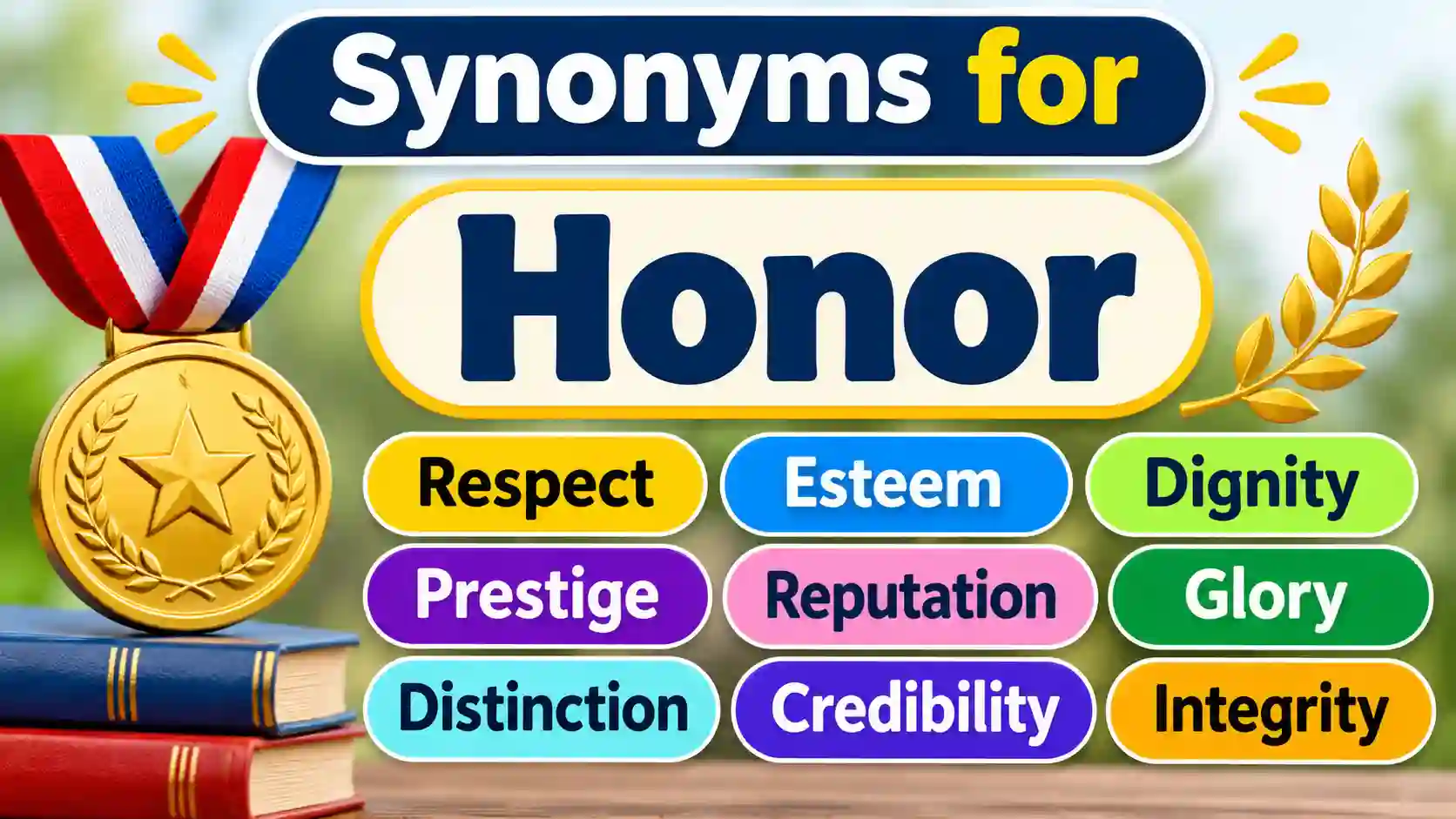
The best synonyms for honor include respect, esteem, admiration, regard, integrity, dignity, reverence, recognition, tribute, and praise. The correct alternative depends on the meaning. Some words describe respect, others describe good character, public recognition, or the act of keeping a promise.
What word can you use instead of honor when you want to describe someone’s good character, achievements, or the respect they deserve?
English offers several useful alternatives, but they do not all mean exactly the same thing. For example, respect describes a positive attitude toward someone, integrity describes honest behavior, and recognition acknowledges an achievement.
Learning synonyms for honor can improve your vocabulary and make your communication more precise. These words are useful in school essays, professional emails, blog posts, speeches, and everyday conversations.
In this guide, you will discover 30 useful alternatives with simple meanings, original examples, pronunciation, grammar guidance, common expressions, and practical writing tips.
Pronunciation of Honor
- American IPA: /ˈɑː.nɚ/
- British IPA: /ˈɒn.ə/
- Syllables: Two
- Pronunciation: ON-er
- Word stress: First syllable
American English uses honor, while British English uses honour. Both spellings have the same basic meaning.
Part of Speech
Honor is mainly a noun and a verb.
Honor as a noun
It means respect, moral character, recognition, or a special privilege.
Example: It was an honor to meet the school principal.
Honor as a verb
It means to show respect, recognize someone’s achievements, or keep a promise.
Example: We honor people who serve their communities.
Related word forms
- Honorable: Adjective meaning deserving respect.
- Honorably: Adverb meaning in an honest or respectable way.
- Honorary: Adjective describing a title given as a mark of respect.
- Honoree: Noun describing someone who receives an honor.
- Dishonor: Noun or verb referring to a loss of respect or bringing shame.
Grammar and Usage of Honor
Here are some common sentence patterns.
| Pattern | Example |
| Honor someone | We honor our teachers. |
| Honor something | She honored her promise. |
| In honor of | A ceremony was held in honor of the volunteers. |
| An honor to do something | It is an honor to represent my school. |
| A person of honor | He is a person of honor. |
| Honor someone for something | They honored her for her bravery. |
Grammar tip: Use “an honor,” not “an honor.” The word begins with a vowel sound.
Remember that the verb honor can also mean to fulfill an agreement, respect a promise, or accept a valid payment request.
30 Synonyms for Honor With Meanings and Examples
The following words are organized by meaning. This is important because some alternatives work for respect, while others fit moral character, awards, or promises.
A. Synonyms for Honor Meaning Respect
These words describe the respect or admiration people have for someone.
1. Respect
Meaning: Respect means treating someone as important because of their qualities, actions, or position.
Examples:
- The students showed respect for their new teacher.
- A fair leader earns respect through honest decisions.
Best used when: You want a natural, everyday alternative for honor.
- Tone: Neutral
- CEFR: A2
- Frequency: Very common
- Collocations: Mutual respect, earn respect, show respect.
- Nuance: Focuses on how people regard someone.
- Avoid when: You specifically mean an official award.
2. Esteem
Meaning: Esteem means having a high opinion of someone’s character or abilities.
Examples:
- Her colleagues hold her in high esteem.
- The teacher earned the esteem of the entire community.
Best used when: You want to express thoughtful and lasting respect.
- Tone: Formal
- CEFR: B2
- Frequency: Common
- Collocations: High esteem, public esteem, hold in esteem.
- Nuance: Suggests a strong positive opinion.
- Avoid when: You need a casual word for everyday conversation.
3. Regard
Meaning: Regard means the respect or positive opinion you have about someone.
Examples:
- The manager has great regard for his employees.
- Her neighbors regard her as a trustworthy person.
Best used when: You want to describe someone’s opinion of another person.
- Tone: Neutral
- CEFR: B1
- Frequency: Common
- Collocations: High regard, mutual regard, hold in high regard.
- Nuance: Often appears in the expression “hold someone in high regard.”
- Avoid when: You mean a formal public award.
4. Reverence
Meaning: Reverence means very deep respect mixed with admiration or awe.
Examples:
- The visitors spoke about the historical leader with reverence.
- The community treated the ancient monument with reverence.
Best used when: You want to describe deep or solemn respect.
- Tone: Formal
- CEFR: C1
- Frequency: Uncommon
- Collocations: Deep reverence, show reverence, sense of reverence.
- Nuance: Stronger and more emotional than ordinary respect.
- Avoid when: You are describing simple politeness.
5. Veneration
Meaning: Veneration means extremely deep respect for someone or something.
Examples:
- The villagers held their founder in veneration.
- The historical teacher was remembered with great veneration.
Best used when: You want to express profound respect for an admired figure.
- Tone: Formal
- CEFR: C2
- Frequency: Rare
- Collocations: Deep veneration, show veneration, object of veneration.
- Nuance: Often carries a solemn or almost worshipful feeling.
- Avoid when: You need a simple everyday alternative.
6. Deference
Meaning: Deference means showing respect because of someone’s authority, experience, or position.
Examples:
- The young lawyer showed deference to the senior judge.
- The team listened to the experienced adviser with deference.
Best used when: You want to describe respectful behavior toward someone in authority.
- Tone: Formal
- CEFR: C1
- Frequency: Uncommon
- Collocations: Show deference, due deference, deferential attitude.
- Nuance: Can suggest accepting another person’s authority.
- Avoid when: You mean equal respect between friends.
7. Admiration
Meaning: Admiration means a strong feeling of respect and approval for someone’s qualities.
Examples:
- I have great admiration for people who help others.
- Her courage earned the admiration of her classmates.
Best used when: You want to express appreciation for someone’s abilities or behavior.
- Tone: Neutral
- CEFR: B1
- Frequency: Common
- Collocations: Deep admiration, earn admiration, mutual admiration.
- Nuance: Includes positive feelings beyond simple respect.
- Avoid when: You specifically mean honesty or moral duty.
B. Synonyms for Honor Meaning Moral Character
These words describe honesty, fairness, and strong personal principles.
8. Integrity
Meaning: Integrity means being honest and following strong moral principles.
Examples:
- Her integrity helped her gain the team’s trust.
- A person with integrity does not cheat to succeed.
Best used when: You want to describe someone’s honest character.
- Tone: Formal
- CEFR: B2
- Frequency: Common
- Collocations: Personal integrity, moral integrity, professional integrity.
- Nuance: Focuses on inner character rather than public recognition.
- Avoid when: You mean a medal or an award.
9. Honesty
Meaning: Honesty means telling the truth and avoiding deception.
Examples:
- Her honesty helped rebuild trust between the friends.
- Customers value honesty in business relationships.
Best used when: You want to emphasize truthfulness.
- Tone: Neutral
- CEFR: A2
- Frequency: Very common
- Collocations: Complete honesty, honesty and integrity, value honesty.
- Nuance: More specific than honor because it focuses on truth.
- Avoid when: You mean public respect or fame.
10. Probity
Meaning: Probity means strong honesty and moral correctness.
Examples:
- The judge was respected for her professional probity.
- The investigation highlighted his probity and fairness.
Best used when: You need a formal word for moral honesty.
- Tone: Very formal
- CEFR: C2
- Frequency: Rare
- Collocations: Personal probity, moral probity, financial probity.
- Nuance: Often appears in discussions of ethics and professional conduct.
- Avoid when: You are writing for beginners or casual readers.
11. Rectitude
Meaning: Rectitude means behaving according to strong moral principles.
Examples:
- The judge was admired for her moral rectitude.
- His rectitude made him a trusted public official.
Best used when: You want to describe strict moral correctness.
- Tone: Formal
- CEFR: C2
- Frequency: Rare
- Collocations: Moral rectitude, personal rectitude, ethical rectitude.
- Nuance: Emphasizes correct moral behavior.
- Avoid when: A simple word such as honesty would communicate the idea better.
12. Uprightness
Meaning: Uprightness means having an honest and morally good character.
Examples:
- Her uprightness made her a trusted community leader.
- People admired his uprightness during difficult times.
Best used when: You want to describe someone who consistently does what is right.
- Tone: Formal
- CEFR: C1
- Frequency: Uncommon
- Collocations: Moral uprightness, personal uprightness, honesty and uprightness.
- Nuance: Focuses on consistent good behavior.
- Avoid when: You are talking about public fame or awards.
13. Virtue
Meaning: Virtue means a good moral quality or behavior.
Examples:
- Patience is an important virtue in teaching.
- The story celebrates the virtues of courage and kindness.
Best used when: You want to describe a positive quality in someone’s character.
- Tone: Formal
- CEFR: B2
- Frequency: Common
- Collocations: Moral virtue, personal virtue, civic virtue.
- Nuance: Names a good quality rather than respect received from others.
- Avoid when: You mean an official award.
14. Decency
Meaning: Decency means behaving in a fair, honest, and acceptable way.
Examples:
- She treated every employee with kindness and decency.
- Basic decency requires us to listen to others.
Best used when: You want to describe fair and respectful behavior.
- Tone: Neutral
- CEFR: B1
- Frequency: Common
- Collocations: Basic decency, human decency, common decency.
- Nuance: Often describes everyday moral standards.
- Avoid when: You mean high public status.
15. Trustworthiness
Meaning: Trustworthiness means being someone others can trust.
Examples:
- Her trustworthiness made her an excellent team leader.
- The company values honesty and trustworthiness.
Best used when: You want to describe reliability and honesty.
- Tone: Neutral
- CEFR: B2
- Frequency: Common
- Collocations: Personal trustworthiness, demonstrate trustworthiness, reputation for trustworthiness.
- Nuance: Focuses on whether people can depend on someone.
- Avoid when: You mean admiration or a public award.
C. Synonyms for Honor Meaning Recognition or Praise
These words describe awards, public respect, and acknowledgment of achievements.
16. Recognition
Meaning: Recognition means acknowledging someone’s work, abilities, or achievements.
Examples:
- The scientist received recognition for her discovery.
- His dedication deserves public recognition.
Best used when: You want to acknowledge someone’s contribution.
- Tone: Neutral
- CEFR: B1
- Frequency: Very common
- Collocations: Public recognition, gain recognition, receive recognition.
- Nuance: Focuses on acknowledgment rather than moral character.
- Avoid when: You mean deep personal respect.
17. Tribute
Meaning: A tribute is an action, speech, or gift that expresses respect or admiration.
Examples:
- The students prepared a tribute to their retiring teacher.
- The memorial was a tribute to the brave rescue workers.
Best used when: You describe an act of showing respect.
- Tone: Neutral to formal
- CEFR: B2
- Frequency: Common
- Collocations: Pay tribute, fitting tribute, moving tribute.
- Nuance: Usually describes an expression of respect.
- Avoid when: You need a word for personal honesty.
18. Homage
Meaning: Homage is an expression of deep respect or admiration.
Examples:
- The filmmaker paid homage to the artists who inspired her.
- The museum created an exhibition as homage to local heroes.
Best used when: You describe a formal or artistic expression of respect.
- Tone: Formal
- CEFR: C1
- Frequency: Uncommon
- Collocations: Pay homage, lasting homage, an homage to.
- Nuance: Often used in art, literature, history, and memorials.
- Avoid when: You mean simple everyday praise.
19. Praise
Meaning: Praise means expressing approval of someone or something.
Examples:
- The coach praised the players for their teamwork.
- Her thoughtful actions received praise from the community.
Best used when: You want to recognize good work or behavior.
- Tone: Neutral
- CEFR: A2
- Frequency: Very common
- Collocations: High praise, receive praise, praise someone for something.
- Nuance: Focuses on positive words or approval.
- Avoid when: You mean deep moral character.
20. Commendation
Meaning: Commendation means formal praise for someone’s good actions or work.
Examples:
- The officer received a commendation for his bravery.
- Her excellent performance earned a formal commendation.
Best used when: You describe official recognition for achievement.
- Tone: Formal
- CEFR: C1
- Frequency: Uncommon
- Collocations: Official commendation, letter of commendation, receive commendation.
- Nuance: Often appears in workplaces, institutions, and official settings.
- Avoid when: You are expressing casual thanks.
21. Acclaim
Meaning: Acclaim means strong public praise or approval.
Examples:
- The author received international acclaim for her novel.
- His performance earned widespread acclaim.
Best used when: You want to describe public appreciation for an achievement.
- Tone: Formal
- CEFR: C1
- Frequency: Common
- Collocations: Critical acclaim, widespread acclaim, win acclaim.
- Nuance: Emphasizes public approval.
- Avoid when: You are describing a private feeling of respect.
22. Accolade
Meaning: An accolade is an award or expression of praise for an achievement.
Examples:
- The young researcher received an accolade for her work.
- Winning the national award was another accolade for the team.
Best used when: You want to describe a special achievement or award.
- Tone: Formal
- CEFR: C1
- Frequency: Common
- Collocations: Receive an accolade, prestigious accolade, numerous accolades.
- Nuance: Usually refers to a specific honor or recognition.
- Avoid when: You mean general respect without an award or achievement.
23. Distinction
Meaning: Distinction means special recognition for achievement or excellence.
Examples:
- She graduated with distinction after years of hard work.
- His research brought distinction to the institution.
Best used when: You want to describe exceptional performance or achievement.
- Tone: Formal
- CEFR: C1
- Frequency: Common
- Collocations: Great distinction, academic distinction, graduate with distinction.
- Nuance: Suggests standing out because of quality or success.
- Avoid when: You mean ordinary politeness.
24. Prestige
Meaning: Prestige means the respect and importance connected with a person, position, or organization.
Examples:
- The university has gained international prestige.
- Winning the award brought prestige to the research team.
Best used when: You want to describe status and public standing.
- Tone: Formal
- CEFR: C1
- Frequency: Common
- Collocations: International prestige, great prestige, social prestige.
- Nuance: Focuses on reputation and status.
- Avoid when: You want to describe honesty or kindness.
25. Glory
Meaning: Glory means great praise or fame earned through an impressive achievement.
Examples:
- The athlete brought glory to her country.
- The team celebrated the glory of its historic victory.
Best used when: You want to describe a major achievement that attracts admiration.
- Tone: Literary
- CEFR: B2
- Frequency: Common
- Collocations: Earn glory, moment of glory, military glory.
- Nuance: More dramatic than ordinary recognition.
- Avoid when: You are describing quiet personal integrity.
26. Credit
Meaning: Credit means recognition or praise given to someone for an achievement.
Examples:
- She deserves credit for organizing the successful event.
- Give the research team credit for its careful work.
Best used when: You want to acknowledge someone’s contribution.
- Tone: Neutral
- CEFR: A2
- Frequency: Very common
- Collocations: Deserve credit, give credit, take credit.
- Nuance: Often identifies who deserves recognition for a result.
- Avoid when: You mean deep reverence or moral character.
D. Synonyms for Honor as a Verb
Honor can also mean showing respect or fulfilling a promise. These alternatives work in specific sentence patterns.
27. Respect
Meaning: Respect means treating someone or something with consideration.
Examples:
- We respect our elders and listen to their advice.
- The school respects every student’s right to learn.
Best used when: You mean to show consideration or regard.
- Tone: Neutral
- CEFR: A2
- Frequency: Very common
- Collocations: Respect someone’s wishes, respect the rules, respect someone’s privacy.
- Nuance: Can refer to people, rights, rules, and wishes.
- Avoid when: You mean to fulfill a financial agreement.
28. Revere
Meaning: Revere means to respect someone very deeply.
Examples:
- Many students revere the teacher who changed their lives.
- The community reveres its historical leaders.
Best used when: You want a stronger, more formal verb than respect.
- Tone: Formal
- CEFR: C1
- Frequency: Uncommon
- Collocations: Deeply revere, revere a leader, widely revered.
- Nuance: Expresses profound admiration.
- Avoid when: You describe ordinary polite behavior.
29. Fulfill
Meaning: Fulfill means to do what you promised or what is required.
Examples:
- The company fulfilled its agreement with the supplier.
- He fulfilled his promise to support the project.
Best used when: Honor means carrying out a promise, duty, or obligation.
- Tone: Neutral
- CEFR: B1
- Frequency: Very common
- Collocations: Fulfill a promise, fulfill an obligation, fulfill a commitment.
- Nuance: Focuses on completing a responsibility.
- Avoid when: You mean to praise or admire someone.
30. Keep
Meaning: Keep means to do what you promised or maintain a commitment.
Examples:
- She always keeps her promises.
- The company kept its agreement with the customers.
Best used when: You need a natural everyday alternative for honoring a promise or agreement.
- Tone: Neutral
- CEFR: A2
- Frequency: Very common
- Collocations: Keep a promise, keep your word, keep an agreement.
- Nuance: More conversational than fulfillment.
- Avoid when: You mean to award or publicly recognize someone.
Quick Synonym Comparison
| If you mean… | Choose… |
| General respect | Respect |
| High opinion of someone | Esteem |
| Honest character | Integrity |
| Truthfulness | Honesty |
| Deep admiration | Reverence |
| A public expression of respect | Tribute |
| Official praise | Commendation |
| A special award | Accolade |
| Public status | Prestige |
| A person’s achievement | Distinction |
| Keeping a promise | Fulfill or keep |
Strongest, Strong, and Related Synonyms
Strongest Alternatives
These are especially useful for the main meanings of honor:
- Respect
- Esteem
- Integrity
- Honesty
- Reverence
- Recognition
- Tribute
- Dignity
Strong Alternatives
These fit particular situations:
- Regard
- Admiration
- Deference
- Virtue
- Decency
- Homage
- Commendation
- Acclaim
- Accolade
- Distinction
- Prestige
Related Words
These words are connected to honor but are not interchangeable in every sentence:
- Glory
- Credit
- Probity
- Rectitude
- Uprightness
- Trustworthiness
- Veneration
- Fulfill
- Keep
- Revere
Commonly Confused Words
| Word | Main difference | Example |
| Honor | Respect, moral worth, or recognition | She received an honor. |
| Honorary | Given as a mark of respect | He received an honorary degree. |
| Honorable | Deserving respect because of good character | She is an honorable person. |
| Honorarium | A payment for a service, often when no fee is required | The guest received an honorarium. |
| Honored | Feeling proud because of recognition | I feel honored to attend. |
Common Mistakes When Using Honor
Mistake 1
Incorrect: She has great honor because she never lies.
Correct: She has great integrity because she never lies.
Explanation: Integrity describes honest moral character.
Mistake 2
Incorrect: I paid a tribute to my teacher.
Correct: I paid tribute to my teacher.
Explanation: The usual expression is “pay tribute,” without an article.
Mistake 3
Incorrect: The company honored its employees by keeping its agreement.
Better: The company fulfilled its agreement with its employees.
Explanation: Fulfill is more precise when discussing an obligation or agreement.
Mistake 4
Incorrect: The university gained integrity after winning the award.
Correct: The university gained prestige after winning the award.
Explanation: Prestige describes public status, while integrity describes moral character.
Mistake 5
Incorrect: She showed reverence to her friend for helping with homework.
Better: She thanked her friend and showed appreciation for the help.
Explanation: Reverence is too strong for ordinary friendship situations.
Writing Tips: How to Use Honor Synonyms Naturally
Essays: Use integrity, virtue, dignity, and respect when writing about moral values.
Example: A fair society depends on honesty, integrity, and mutual respect.
Emails: Use appreciation, privilege, and recognition in professional messages.
Example: It was a privilege to work with your experienced team.
Blog Posts: Use prestige, reputation, and recognition when discussing achievements.
Example: The award increased the institution’s international prestige.
Stories: Use reverence, admiration, homage, and glory to create emotional meaning.
Example: The villagers remembered the brave soldier with reverence.
Social Media: Use respect, appreciation, and tribute for short messages.
Example: A small tribute to the people who make a difference every day.
Professional Communication: Use esteem, commendation, and integrity in formal discussions.
Example: Her integrity and dedication earned the team’s esteem.
Daily Conversations: Use common words such as respect, praise, and admiration.
Example: I really respect people who keep their promises.
Writing Tip: Do not replace every use of honor with another word. Sometimes repeating the correct word is better than choosing an inaccurate alternative.
Related Vocabulary
Antonyms of Honor
- Dishonor: Loss of respect or bringing shame.
- Disgrace: A serious loss of public respect.
- Shame: A painful feeling of guilt or embarrassment.
- Disrespect: Lack of respect.
- Dishonesty: Lack of truthfulness.
- Contempt: A feeling that someone is unworthy of respect.
- Infamy: A reputation for something bad.
- Corruption: Dishonest or improper behavior.
Common Expressions With Honor
In honor of: To show respect for someone.
Example: The school organized a ceremony in honor of its founder.
A matter of honor: Something connected with personal principles.
Example: Keeping his promise was a matter of honor.
On one’s honor: A serious promise.
Example: I give you my word, in my honor.
Honor one’s word: To keep a promise.
Example: A trustworthy person honors their word.
A person of honor: Someone with strong moral principles.
Example: Everyone considered the judge a person of honor.
It is an honor: An expression of respect and gratitude for a special opportunity.
Example: It is an honor to represent my country.
Word Family
| Word | Part of speech | Meaning |
| Honor | Noun/verb | Respect or show respect |
| Honorable | Adjective | Deserving respect |
| Honorably | Adverb | In an honest way |
| Honorary | Adjective | Given as a mark of respect |
| Honoree | Noun | Person receiving an honor |
| Dishonor | Noun/verb | Loss of respect or bring shame |
| Dishonorable | Adjective | Not deserving respect |
Word Origin and Etymology
Honor comes from Latin honor, which referred to dignity, reputation, respect, and public distinction. The word entered English through Anglo-French and Old French forms such as honour and onor.
It appeared in Middle English around the 12th century. Over time, its meaning developed to include moral character, public recognition, respect, and a special privilege.
American English uses honor, while British English generally uses honour. Both forms are correct in their respective spelling systems.
American vs. British English
| American English | British English |
| Honor | Honour |
| Honorable | Honourable |
| Honored | Honoured |
| Honoring | Honouring |
| Honorably | Honourably |
The difference is mainly spelling. The words have the same basic meaning, although pronunciation can vary by regional accent.
Frequently Asked Questions
1. What are the best synonyms for honor?
The best synonyms for honor include respect, esteem, integrity, dignity, admiration, reverence, and recognition. Respect describes how people regard someone, integrity describes honest character, and recognition acknowledges an achievement. Choose the word that matches your intended meaning.
2. What is another word for honor and respect?
Esteem, regard, admiration, and reverence are useful alternatives. Esteem describes a high opinion of someone, while reverence expresses very deep respect. Regard is more general, and admiration includes appreciation for someone’s abilities, actions, or personal qualities.
3. What is a stronger word for honor?
Reverence and veneration can express very deep respect. Esteem is also useful when describing a high opinion of someone’s character or achievements. However, these words are more formal than respect, so choose them according to your sentence and intended tone.
4. What is the difference between honor and integrity?
Honor can refer to respect, recognition, dignity, or good moral character. Integrity specifically describes someone’s commitment to honesty and strong principles. Receiving an award can bring honor, while refusing to cheat demonstrates integrity.
5. What is the opposite of honor?
Common antonyms include dishonor, disgrace, shame, disrespect, and dishonesty. Dishonor describes a loss of respect, disgrace suggests serious damage to reputation, and dishonesty refers to untruthful behavior. The correct opposite depends on how honor is used.
6. Is honor a noun or a verb?
Honor is both a noun and a verb. As a noun, it refers to respect, dignity, recognition, or a special privilege. As a verb, it means to show respect, recognize an achievement, or fulfill a promise.
7. What is the difference between honor and honour?
Honor is the standard American English spelling, while honour is the standard British English spelling. Both have the same basic meaning. Related forms also change, such as honorable and honourable, and honoring and honouring.
8. What does it mean to honor someone?
To honor someone means to show respect, recognize their achievements, or remember their contributions. People can honor others through awards, ceremonies, kind words, or meaningful actions. For example, a school may honor a teacher for years of dedicated service.
Mini Vocabulary Practice
Exercise 1: Fill in the Blanks
Choose the correct word from the following options:
Respect | Integrity | Tribute | Prestige | Fulfill
- A person with ______ always tries to do what is right.
- The university gained international ______.
- The students organized a ______ for their retiring teacher.
- We should show ______ to people who help us.
- The company promised to ______ its agreement.
Exercise 2: Rewrite the Sentences
Replace the bold words with a suitable synonym.
- The scientist received recognition for her discovery.
- The students showed respect for their teacher.
- He demonstrated honesty during the investigation.
- The company must honor its promise.
- The actor received public praise for his performance.
Exercise 3: Match the Words
Match each word with its correct meaning.
- Esteem
- Accolade
- Reverence
- Integrity
- Homage
A. A formal award or expression of praise.
B. Strong moral character.
C. Deep respect or admiration.
D. A high opinion of someone.
E. An expression of respect.
Answer Key
Exercise 1
- Integrity
- Prestige
- Tribute
- Respect
- Fulfill
2: Suggested answers
- The scientist received acclaim for her discovery.
- The students showed regard for their teacher.
- He demonstrated integrity during the investigation.
- The company must fulfill its promise.
- The actor received public acclaim for his performance.
3
- D
- A
- C
- B
- E
Conclusion
Learning synonyms for honor helps you express respect, honesty, achievement, and admiration more clearly. Words such as esteem, integrity, dignity, and recognition can make your writing more accurate and engaging.
Remember that each alternative has its own meaning and context. Practice these words in emails, essays, schoolwork, and daily conversations. Keep learning and choose words that express exactly what you mean.
References
- Oxford Learner’s Dictionaries: Honor and Honour
- Cambridge Dictionary: Honor
- Merriam-Webster Dictionary: Honor
- Collins English Thesaurus: Honor
- Thesaurus.com: Honor Synonyms and Antonyms

Synonorm is a trusted English vocabulary resource created to help readers find the right words and understand the differences between similar terms. We provide clear explanations of synonyms, meanings, examples, usage, and alternatives. Our content makes vocabulary easier to learn and apply in everyday, academic, and professional English. Synonorm is designed for students, writers, ESL learners, professionals, and anyone who wants to improve their English vocabulary and communicate more clearly.