Quick Answer
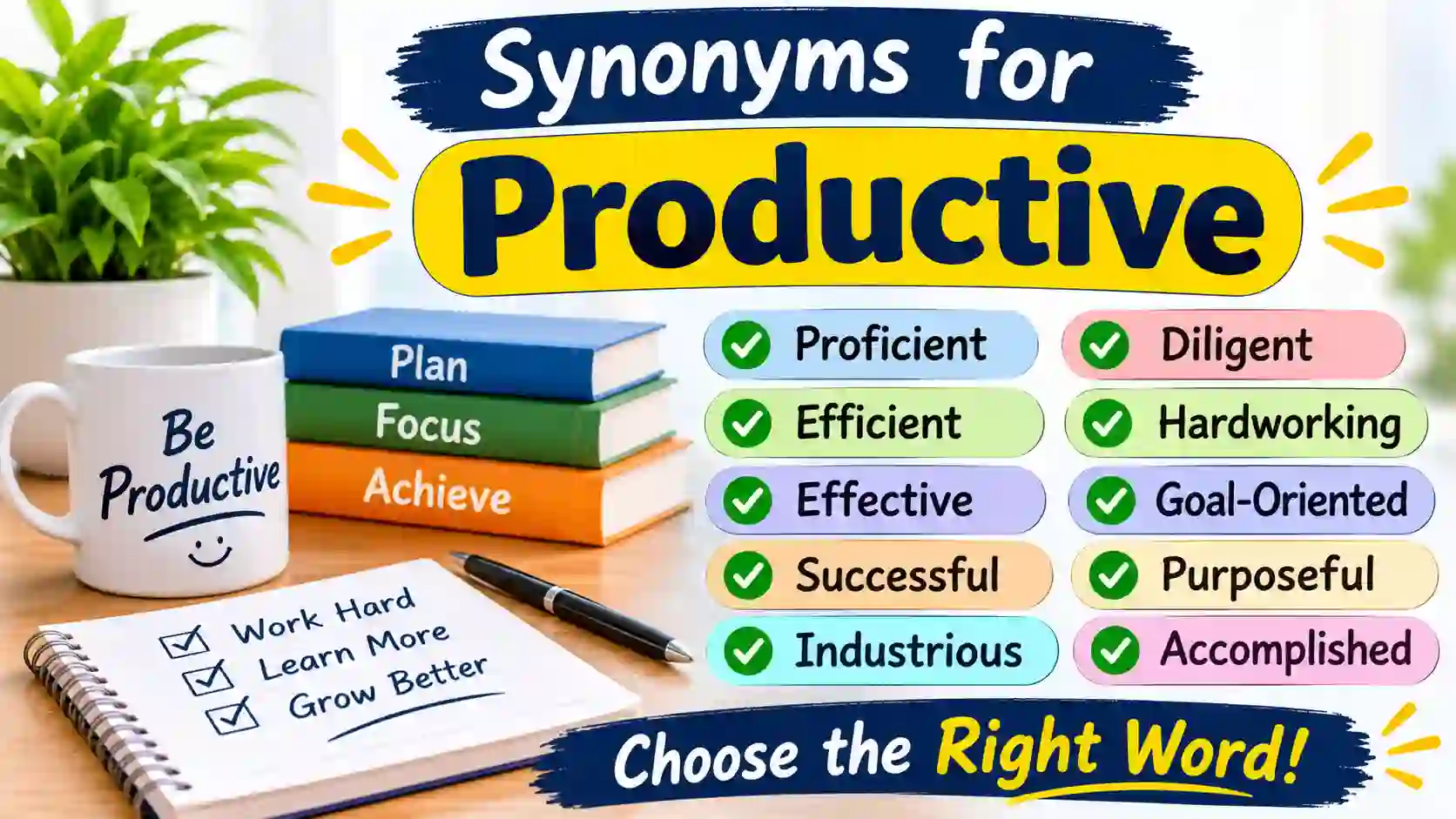
The best synonyms for productive are effective, efficient, fruitful, successful, prolific, industrious, constructive, beneficial, and worthwhile. These words describe different kinds of useful work, positive outcomes, and creative output. The right choice depends on whether you mean achieving results, working efficiently, or producing a large amount of something.
Do you often use the word productive in your essays, emails, or everyday conversations? Using the same word repeatedly can make your writing sound less natural. Learning suitable alternatives helps you express your ideas more clearly.
Productive usually describes someone or something that produces useful results, completes meaningful work, or creates a good amount of output. For example, I had a productive morning because I finished my assignments and prepared for tomorrow.
However, being productive does not mean exactly the same thing as being efficient, successful, or hardworking. Each word has its own meaning and use. This guide explains 30 useful alternatives, with simple definitions, original examples, pronunciation, grammar guidance, and practical tips to help you choose the right word.
Pronunciation of Productive
- IPA (British): /prəˈdʌk.tɪv/
- IPA (American): /prəˈdʌk.tɪv/
- Easy pronunciation: pruh-DUK-tiv
- Syllables: pro-duc-tive
- Word stress: Second syllable, DUC.
- Part of speech: Adjective
- CEFR level: B2 (Cambridge Dictionary classification)
Both American and British dictionaries give the same broad IPA transcription. Actual vowel quality can vary by accent.
What Does Productive Mean?
Productive means producing useful results, making something valuable, or completing a good amount of work.
It has three important uses:
- Useful results: A productive meeting solves problems or creates helpful ideas.
- Large output: A productive writer creates a lot of work.
- Production and growth: Productive land supports good crop production.
In linguistics, productive also describes a word-forming pattern that speakers can use to create new words. For example, the prefix un- is productive because it forms words such as unhappy and unfair.
Part of Speech and Word Family
Productive is mainly an adjective.
| Word | Part of Speech | Meaning |
| Product | Noun | Something made or created |
| Produce | Verb | To make or create |
| Production | Noun | The process of making something |
| Productive | Adjective | Producing useful results |
| Productivity | Noun | The amount or rate of useful output |
| Productively | Adverb | In a useful or effective way |
| Productiveness | Noun | The quality of producing results |
Example: The company increased productivity because its employees worked more productively.
Remember that productive is not normally a verb. Use produce when you want to describe the action of creating something.
Grammar: How to Use Productive in a Sentence
Productive commonly appears in these sentence patterns.
1. Productive + noun
- We had a productive meeting.
- She enjoyed a productive afternoon.
2. Be productive
- The employees are productive.
- I want to be more productive.
3. Productive at + activity
- He is productive at work.
- She is productive at managing daily tasks.
4. Productive for + person or purpose
- This routine is productive for students.
- The new system is productive for our business.
Common collocations:
Productive day, productive meeting, productive discussion, productive employee, productive environment, productive relationship, productive work, and productive process.
Quick Overview: 30 Synonyms for Productive
The following words are grouped by their most useful contexts. Some are close replacements, while others only work in particular situations.
Group 1: Results and useful work
| Synonym | Best Context |
| Effective | Achieving goals |
| Efficient | Saving resources |
| Fruitful | Producing useful outcomes |
| Successful | Reaching a goal |
| Constructive | Creating improvement |
| Useful | Helping with a task |
| Beneficial | Providing advantages |
| Valuable | Offering importance or value |
| Worthwhile | Justifying time and effort |
| Rewarding | Giving satisfaction |
Group 2: Effort and creative output
| Synonym | Best Context |
| Prolific | Producing a lot |
| Industrious | Working hard |
| Diligent | Working carefully |
| Hardworking | Showing strong effort |
| Creative | Producing original ideas |
| Generative | Creating something new |
| Fertile | Supporting growth or ideas |
| Fecund | Producing abundantly |
Group 3: Production, resources, and business
| Synonym | Best Context |
| Abundant | Existing in large amounts |
| Plentiful | Having a large supply |
| Yielding | Producing results or returns |
| Profitable | Producing financial gain |
| Gainful | Providing paid employment |
| Lucrative | Producing substantial income |
| Advantageous | Providing an advantage |
| Active | Taking part in activities |
| Dynamic | Showing energy and change |
| Vigorous | Showing strong energy |
| Busy | Having many tasks |
30 Best Synonyms for Productive With Examples
1. Effective
Meaning: Producing the result that you want.
Examples:
- The teacher introduced an effective way to explain grammar.
- Our new marketing strategy proved effective.
Best used when: You want to emphasize successful outcomes.
Tone: Neutral, professional, academic.
CEFR: B1.
Frequency: Very common.
Collocations: Effective method, effective strategy, effective communication.
Nuance: Effective focuses on whether something works, not how quickly it works.
When not to use: Avoid it when you specifically mean saving time or resources.
2. Efficient
Meaning: Doing something well without wasting time, money, or effort.
Examples:
- The efficient team finished the orders before lunch.
- I found an efficient way to organize my research.
Best used when: Discussing time management, work systems, or resource use.
Tone: Neutral, business, professional.
CEFR: B1.
Frequency: Very common.
Collocations: Efficient system, efficient process, highly efficient.
Nuance: Efficiency focuses on the way work gets done.
When not to use: Do not use it simply because someone works hard.
3. Fruitful
Meaning: Producing useful or valuable results.
Examples:
- Our discussion was fruitful and produced several new ideas.
- The students had a fruitful exchange of opinions.
Best used when: Describing meetings, research, discussions, and cooperation.
Tone: Formal, academic.
CEFR: B2.
Frequency: Common.
Collocations: Fruitful discussion, fruitful meeting, fruitful relationship.
Nuance: Fruitful suggests that an activity leads to something worthwhile.
When not to use: Avoid it when describing someone who works quickly but produces no meaningful outcome.
4. Successful
Meaning: Achieving a goal or getting the result you wanted.
Examples:
- The company completed a successful product launch.
- Her successful campaign attracted new customers.
Best used when: Discussing completed goals, achievements, and positive outcomes.
Tone: Neutral, professional.
CEFR: A2.
Frequency: Very common.
Collocations: Successful project, successful result, successful business.
Nuance: Successful focuses on the outcome rather than the amount of work.
When not to use: Do not assume that every successful process was efficient.
5. Constructive
Meaning: Helping to improve something or find a solution.
Examples:
- We had a constructive conversation about the problem.
- Her constructive feedback helped me improve the article.
Best used when: Talking about feedback, discussions, criticism, and improvements.
Tone: Formal, professional.
CEFR: B2.
Frequency: Very common.
Collocations: Constructive criticism, constructive feedback, constructive approach.
Nuance: Constructive emphasizes positive improvement.
When not to use: It is not an exact replacement for productive when describing the number of tasks completed.
6. Useful
Meaning: Helping someone complete a task or solve a problem.
Examples:
- This guide contains useful advice for beginners.
- The discussion gave our team several useful ideas.
Best used when: Describing tools, advice, information, or resources.
Tone: Neutral, everyday English.
CEFR: A2.
Frequency: Very common.
Collocations: Useful information, useful advice, useful tool.
Nuance: Useful emphasizes practical value.
When not to use: It does not necessarily describe high output or efficient work.
7. Beneficial
Meaning: Producing a positive effect or providing an advantage.
Examples:
- Daily reading is beneficial for language learners.
- The training program had a beneficial effect on employees.
Best used when: Explaining advantages and positive effects.
Tone: Formal, academic.
CEFR: B2.
Frequency: Common.
Collocations: Beneficial effect, beneficial change, mutually beneficial.
Nuance: Beneficial describes what helps someone or something.
When not to use: Do not use it to describe a person who creates a large amount of work.
8. Valuable
Meaning: Having great importance, usefulness, or worth.
Examples:
- The workshop provided valuable information.
- Her research made a valuable contribution to education.
Best used when: Highlighting meaningful contributions or important resources.
Tone: Neutral, formal, professional.
CEFR: B1.
Frequency: Very common.
Collocations: Valuable contribution, valuable experience, valuable information.
Nuance: Valuable focuses on importance and worth.
When not to use: It does not automatically mean that something produces a large quantity of work.
9. Worthwhile
Meaning: Worth the time, effort, or money spent.
Examples:
- Learning another language is a worthwhile goal.
- The extra research made the project worthwhile.
Best used when: Explaining why an activity deserves attention or effort.
Tone: Neutral, conversational.
CEFR: B2.
Frequency: Very common.
Collocations: Worthwhile effort, worthwhile experience, worthwhile investment.
Nuance: Worthwhile evaluates whether the results justify the effort.
When not to use: Avoid it when you specifically mean someone completed many tasks.
10. Rewarding
Meaning: Giving pleasure, satisfaction, or a feeling of achievement.
Examples:
- Teaching young learners is a rewarding experience.
- She found her writing career both challenging and rewarding.
Best used when: Describing work or activities that provide personal satisfaction.
Tone: Neutral, conversational.
CEFR: B1.
Frequency: Common.
Collocations: Rewarding experience, rewarding career, rewarding work.
Nuance: Rewarding highlights emotional satisfaction.
When not to use: Do not use it as a direct replacement for efficiency.
11. Prolific
Meaning: Producing a large amount of work or creative output.
Examples:
- The prolific author published five novels in three years.
- She became a prolific researcher in her field.
Best used when: Discussing writers, artists, researchers, and content creators.
Tone: Formal, literary, academic.
CEFR: C1.
Frequency: Common.
Collocations: Prolific writer, prolific artist, prolific researcher.
Nuance: Prolific emphasizes quantity of output.
When not to use: Do not use it simply to describe someone who finishes a few tasks efficiently.
12. Industrious
Meaning: Working hard and making a steady effort.
Examples:
- The industrious student completed every assignment.
- Our industrious employees prepared the office for the event.
Best used when: Describing people who work consistently and with effort.
Tone: Formal, literary.
CEFR: C1.
Frequency: Common.
Collocations: Industrious worker, industrious student, industrious person.
Nuance: Industrious focuses on the person’s work habits.
When not to use: Do not use it when you want to emphasize the quality of a final result.
13. Diligent
Meaning: Giving careful and steady attention to work.
Examples:
- The diligent researcher checked every reference.
- She was diligent about completing her assignments.
Best used when: Describing careful, responsible, and consistent effort.
Tone: Formal, academic.
CEFR: C1.
Frequency: Common.
Collocations: Diligent student, diligent worker, diligent effort.
Nuance: Diligent emphasizes care and responsibility rather than speed.
When not to use: Avoid it when you mean producing a large quantity of work.
14. Hardworking
Meaning: Putting a lot of effort into work.
Examples:
- The hardworking employees stayed focused during the busy season.
- He is a hardworking student who practices English every day.
Best used when: Describing people who put consistent effort into their duties.
Tone: Neutral, conversational.
CEFR: B1.
Frequency: Very common.
Collocations: Hardworking employee, hardworking student, hardworking team.
Nuance: Hardworking describes effort, not necessarily results.
When not to use: Avoid it when you want to say that someone produces results with very little wasted time.
15. Creative
Meaning: Having the ability to produce original ideas or things.
Examples:
- The creative team developed a fresh advertising idea.
- She found a creative solution to the design problem.
Best used when: Discussing original ideas, writing, art, and problem-solving.
Tone: Neutral, professional.
CEFR: B1.
Frequency: Very common.
Collocations: Creative idea, creative process, creative work.
Nuance: Creative focuses on originality, not necessarily output or results.
When not to use: An original idea is not always a useful or productive one.
16. Generative
Meaning: Having the ability to create or produce something.
Examples:
- The team used a generative process to develop new concepts.
- The workshop encouraged generative thinking among students.
Best used when: Discussing research, creativity, language, and technology.
Tone: Academic, technical.
CEFR: C1 (estimated).
Frequency: Uncommon in everyday English.
Collocations: Generative process, generative thinking, generative model.
Nuance: Generative emphasizes the capacity to create something new.
When not to use: Avoid it as a simple alternative in everyday conversation.
17. Fertile
Meaning: Able to produce plants, crops, or new ideas.
Examples:
- The farmers found fertile soil near the river.
- The discussion created fertile ground for future projects.
Best used when: Talking about land, agriculture, or the ability to develop ideas.
Tone: Neutral, literary.
CEFR: B2.
Frequency: Common.
Collocations: Fertile soil, fertile land, fertile imagination.
Nuance: Fertile refers to the potential to produce or support growth.
When not to use: Do not describe an ordinary office worker as fertile to mean productive.
18. Fecund
Meaning: Capable of producing a large amount of growth, ideas, or creative work.
Examples:
- The fecund soil supported a wide variety of crops.
- Her fecund imagination inspired several stories.
Best used when: Writing about nature, intellectual creativity, or abundant output.
Tone: Literary, academic.
CEFR: C2 (estimated).
Frequency: Rare.
Collocations: Fecund imagination, fecund soil, fecund period.
Nuance: Fecund is a more literary alternative to fertile or prolific in appropriate contexts.
When not to use: Avoid it in everyday emails and beginner-level writing.
19. Abundant
Meaning: Existing in large quantities or amounts.
Examples:
- The region has abundant natural resources.
- The report contains abundant evidence to support its findings.
Best used when: Describing supplies, information, opportunities, and resources.
Tone: Neutral, formal.
CEFR: B2.
Frequency: Common.
Collocations: Abundant resources, abundant evidence, abundant opportunities.
Nuance: Abundant describes quantity, not how effectively something is produced.
When not to use: Do not call an employee abundant when you mean hardworking or productive.
20. Plentiful
Meaning: Available in large amounts.
Examples:
- Fresh vegetables are plentiful during the summer.
- The research team found plentiful evidence.
Best used when: Describing supplies, materials, food, or opportunities.
Tone: Neutral.
CEFR: B2.
Frequency: Common.
Collocations: Plentiful supply, plentiful resources, plentiful opportunities.
Nuance: Plentiful is close to abundant and focuses on availability.
When not to use: It is not a direct alternative for a person who works efficiently.
21. Yielding
Meaning: Producing a result, benefit, or return.
Examples:
- The experiment is yielding useful information.
- Their research yielded several important discoveries.
Best used when: Describing processes, experiments, investments, or efforts that produce results.
Tone: Neutral, formal, academic.
CEFR: B2 (estimated for the basic verb).
Frequency: Common.
Collocations: Yielding results, yielding returns, high-yielding crops.
Nuance: Yielding usually works as part of a sentence describing what something produces. It is not a direct replacement for every use of productivity.
When not to use: Avoid sentences such as “She is a yielding employee” when you mean she is productive.
22. Profitable
Meaning: Producing financial gain.
Examples:
- The company launched a profitable product.
- Their investment became profitable after two years.
Best used when: Discussing business, money, investments, and financial results.
Tone: Business, formal.
CEFR: B2.
Frequency: Common.
Collocations: Profitable business, profitable investment, profitable venture.
Nuance: Profitable focuses on financial returns.
When not to use: Avoid it when describing personal satisfaction or educational progress.
23. Gainful
Meaning: Providing paid employment or income.
Examples:
- The training program helped young people find gainful employment.
- He wanted to build a career through gainful work.
Best used when: Discussing employment and earning a living.
Tone: Formal, business.
CEFR: C1.
Frequency: Uncommon.
Collocations: Gainful employment, gainful occupation, gainful work.
Nuance: Gainful is about paid work rather than general productivity.
When not to use: Do not use it as a replacement for productive in a sentence about schoolwork or personal progress.
24. Lucrative
Meaning: Producing a large amount of money.
Examples:
- The company entered a lucrative market.
- She discovered a lucrative business opportunity.
Best used when: Describing careers, investments, deals, and business opportunities.
Tone: Business, formal.
CEFR: C1.
Frequency: Common.
Collocations: Lucrative opportunity, lucrative business, lucrative career.
Nuance: Lucrative emphasizes high financial returns.
When not to use: A lucrative opportunity is not necessarily efficient or socially beneficial.
25. Advantageous
Meaning: Providing a benefit or helping someone gain an advantage.
Examples:
- The flexible schedule was advantageous for working students.
- The new agreement created an advantageous position for the company.
Best used when: Describing decisions, conditions, and situations that offer benefits.
Tone: Formal, academic, business.
CEFR: C1.
Frequency: Common.
Collocations: Advantageous position, advantageous conditions, advantageous situation.
Nuance: Advantageous focuses on the benefit gained rather than the amount of work completed.
When not to use: Avoid it when you mean a person works quickly or consistently.
26. Active
Meaning: Taking part in an activity or doing things regularly.
Examples:
- She is an active member of the school committee.
- The active team members organized the community event.
Best used when: Describing participation, involvement, and regular activity.
Tone: Neutral, conversational.
CEFR: A2.
Frequency: Very common.
Collocations: Active member, active role, active participant.
Nuance: Active describes participation, not necessarily meaningful results.
When not to use: Being active does not always mean being productive.
27. Dynamic
Meaning: Showing energy, change, or the ability to create progress.
Examples:
- The dynamic team introduced several improvements.
- She developed a dynamic learning environment for her students.
Best used when: Describing energetic teams, leaders, and changing environments.
Tone: Formal, business.
CEFR: B2.
Frequency: Common.
Collocations: Dynamic team, dynamic environment, dynamic leader.
Nuance: Dynamic emphasizes movement, energy, and change.
When not to use: Avoid it when you simply mean that someone completes routine tasks efficiently.
28. Vigorous
Meaning: Showing strong energy, force, or effort.
Examples:
- The researchers conducted a vigorous examination of the results.
- The organization launched a vigorous campaign to support education.
Best used when: Describing strong actions, efforts, discussions, and activities.
Tone: Formal, neutral.
CEFR: C1.
Frequency: Common.
Collocations: Vigorous effort, vigorous activity, vigorous debate.
Nuance: Vigorous emphasizes strength and energy rather than the usefulness of results.
When not to use: Do not use it simply to describe quiet, carefully managed work.
29. Busy
Meaning: Having many things to do or being occupied with work.
Examples:
- I had a busy morning preparing the presentation.
- The office was busy throughout the afternoon.
Best used when: Describing a full schedule or a large number of tasks.
Tone: Informal, neutral.
CEFR: A1.
Frequency: Very common.
Collocations: Busy day, busy schedule, busy office.
Nuance: Busy describes activity and workload, not necessarily useful results.
When not to use: Avoid replacing productive with busy when you want to show that meaningful work was completed.
30. Remunerative
Meaning: Providing payment or financial reward for work.
Examples:
- She accepted a remunerative position at a technology company.
- The project offered remunerative opportunities for experienced consultants.
Best used when: Discussing paid work, salaries, and financial rewards.
Tone: Formal, business.
CEFR: C2 (estimated).
Frequency: Rare in everyday speech.
Collocations: Remunerative employment, remunerative work, remunerative position.
Nuance: Remunerative describes financial compensation, not the amount of useful output.
When not to use: Avoid it when describing academic progress, creative achievements, or an efficient process.
Strongest Synonyms for Productive
These are the most useful choices when you want to replace productive in everyday writing.
- Effective: When something achieves its intended goal.
- Efficient: When work is completed without wasting resources.
- Fruitful: When an activity produces useful results.
- Successful: When a goal is achieved.
- Constructive: When something creates improvement.
- Prolific: When someone produces a large amount of work.
- Industrious: When describing a person who works hard.
- Diligent: When careful and consistent effort matters.
Strong Synonyms for Productive
These alternatives are useful in specific situations:
- Beneficial
- Valuable
- Useful
- Worthwhile
- Rewarding
- Advantageous
- Hardworking
Related Words for Productive
The following words share some meaning with productive but are not universal replacements:
- Creative
- Generative
- Fertile
- Fecund
- Abundant
- Plentiful
- Yielding
- Profitable
- Gainful
- Lucrative
- Active
- Dynamic
- Vigorous
- Busy
- Remunerative
Choose the Right Synonym: Side by Side Comparisons
Choosing the right synonym depends on the exact idea you want to express.
| Word | Main Difference | Natural Example |
| Productive | Useful output | A productive day |
| Efficient | Less wasted effort | An efficient system |
| Effective | Successful results | An effective plan |
| Fruitful | Valuable outcomes | A fruitful meeting |
| Prolific | Large output | A prolific writer |
| Industrious | Steady hard work | An industrious worker |
| Diligent | Careful effort | A diligent student |
| Profitable | Financial gain | A profitable business |
| Rewarding | Personal satisfaction | A rewarding career |
| Constructive | Positive improvement | Constructive feedback |
Productive vs. Efficient
A productive person completes useful tasks. An efficient person completes tasks while using less time, energy, or money.
- Productive: I completed all five assignments.
- Efficient: I completed all five assignments in two hours without wasting time.
Productive vs. Effective
Productive emphasizes useful output. Effective emphasizes whether something achieves its intended result.
- Productive: We had a productive discussion.
- Effective: The discussion helped us solve the problem, so it was effective.
Productive vs. Fruitful
Productive describes useful output in many situations. Fruitful usually emphasizes valuable outcomes from effort, discussion, or cooperation.
Productive vs. Prolific
Productive emphasizes useful work. Prolific emphasizes producing a large quantity, particularly creative or intellectual work.
Productive vs. Industrious
Productive focuses on results. Industrious focuses on steady hard work.
Word Origin (Etymology) of Productive
Productive entered English in the early 17th century. Its history connects to French productif and Medieval Latin productivus, meaning fit for production.
The Latin word is linked to producere, meaning to bring forth or lead forward.
According to Etymonline, the product dates to the 1610s. Collins gives the first-recorded period as 1605–15.
Its original sense is related to the ability to produce something. By around 1706, it also described fertility and abundant production.
Word development:
- Latin: producere
- Medieval Latin: productivus
- French: productif
- English: productive
American vs. British English
Productive has the same standard spelling in American and British English.
| Feature | American English | British English |
| Spelling | Productive | Productive |
| IPA | /prəˈdʌk.tɪv/ | /prəˈdʌk.tɪv/ |
| Main stress | Second syllable | Second syllable |
| Common expression | Productive day | Productive day |
| Noun form | Productivity | Productivity |
Both varieties use the word for useful output, positive results, and production.
American example: We had a productive afternoon at work.
British example: We had a productive afternoon at work.
There is no spelling change between the two varieties. Small pronunciation differences may occur between individual accents.
Common Mistakes When Using Productive Synonyms
Mistake 1: Confusing Busy With Productive
Mistake: I was busy, so I achieved all my goals.
Correction: I was productive, so I achieved all my goals.
Explanation: Busy means having many things to do. Productive means making useful progress.
Mistake 2: Confusing Efficient With Effective
Mistake: This plan achieves the desired result, so it is efficient.
Correction: This plan achieves the desired result, so it is effective.
Explanation: Effective describes successful results. Efficient describes good use of resources.
Mistake 3: Using Prolific for Careful Work
Mistake: My prolific employee checks every document carefully.
Correction: My diligent employee checks every document carefully.
Explanation: Diligent describes careful effort, while prolific describes a large amount of output.
Mistake 4: Using Profitable for Every Benefit
Mistake: Reading books is profitable for students.
Correction: Reading books is beneficial for students.
Explanation: Profitable usually relates to money. Beneficial covers wider advantages.
Mistake 5: Using Productive as a Noun
Mistake: Our productivity increased this month.
Correction: Our productivity increased this month.
Explanation: Productive is an adjective. Productivity is its more common noun form.
Mistake 6: Using Related Words as Exact Synonyms
Mistake: The abundant employee finished the project.
Correction: The hardworking employee finished the project.
Explanation: Abundant describes a large quantity of something. It does not normally describe a person’s work habits.
Writing Tips: How to Use Productive Synonyms Naturally
1. Academic Essays
Choose words that clearly describe research, learning, and results.
- Productive research → Fruitful research
- Productive method → Effective method
- Productive student → Diligent student
2. Professional Emails
Keep your language clear and polite.
- We had a productive meeting.
- Thank you for your constructive feedback.
- Our team developed an effective solution.
3. Blog Posts
Use alternatives naturally without changing the intended meaning.
- A productive writing routine
- An efficient content process
- A worthwhile learning experience
4. Stories
Choose words that add detail to your characters and setting.
- An industrious farmer
- A prolific author
- A flourishing village
5. Social Media
Use familiar and conversational expressions.
- I had a productive day!
- Small steps, big progress.
- Making every hour worthwhile.
6. Daily Conversations
Choose common expressions that sound natural.
- I had a useful day.
- We had an effective meeting.
- I finished my tasks efficiently.
Writing Tip: Never replace every occurrence of productivity with a different word. Repeating the correct word is better than using a synonym that changes the meaning.
Related Vocabulary
Antonyms of Productive
| Antonym | Meaning |
| Unproductive | Producing little useful output |
| Inefficient | Wasting resources |
| Ineffective | Not achieving the desired result |
| Fruitless | Producing no useful outcome |
| Idle | Not working or active |
| Inactive | Not taking part |
| Useless | Having little or no practical value |
| Barren | Unable to produce much |
| Sterile | Unable to support certain types of growth |
| Unsuccessful | Failing to achieve a goal |
Related Expressions
- Make progress
- Get things done
- Produce results
- Meet a target
- Work effectively
- Make good use of time
- Achieve a goal
- Stay focused
- Complete important tasks
- Turn effort into results
Frequently Asked Questions About Synonyms for Productive
1. What are the 10 best synonyms for productivity?
The 10 useful synonyms for productive are efficient, effective, fruitful, successful, prolific, industrious, constructive, beneficial, rewarding, and worthwhile. Each word has a different focus. Some describe the quality of work, while others highlight results, effort, or personal satisfaction.
2. What is a simple word for productive?
Useful is a simple alternative to productivity. Other familiar words include effective, helpful, and successful. For example, you can say, “We had a useful meeting” instead of “We had a productive meeting.” Both expressions suggest that the meeting provided practical value.
3. What is a professional synonym for productive?
Effective, efficient, fruitful, and constructive are useful professional alternatives. Use efficient when discussing processes, effective when describing successful strategies, fruitful when explaining valuable discussions, and constructive when referring to positive feedback or improvements.
4. What is another word for a productive day?
A productive day can also be described as a successful, fruitful, or worthwhile day. You can be successful when you achieve your goals, fruitful when you make useful progress, and worthwhile when the activities justify your time and effort.
5. What is the difference between productive and efficient?
Productive means producing useful work or results. Efficient means achieving results while using time, energy, and resources wisely. A person can be productive without being efficient if they complete many tasks but waste unnecessary time or effort.
6. What is the opposite of productive?
Common opposites include unproductive, inefficient, ineffective, fruitless, idle, and inactive. The best choice depends on the sentence. An unproductive meeting creates little value, while an idle employee is not actively working.
7. What is a synonym for productive in academic writing?
Fruitful, effective, beneficial, valuable, and constructive are useful alternatives in academic writing. For example, researchers may describe a discussion as fruitful or a research method as effective. These words improve clarity while keeping the intended meaning.
8. What is the difference between productive and prolific?
Productive describes work that produces useful results. Prolific describes someone or something that produces a large amount of output, especially creative or intellectual work. A prolific author may publish many books, while a productive author focuses on useful results from their work.
Vocabulary Quiz: Test Your Knowledge
Choose the correct answer to each question.
1. Which word describes completing work without wasting resources?
A. Prolific
B. Efficient
C. Fruitful
D. Rewarding
2. Which word describes a writer who produces many books?
A. Helpful
B. Constructive
C. Prolific
D. Beneficial
3. Which word best describes a discussion that produces useful results?
A. Fruitful
B. Idle
C. Abundant
D. Energetic
4. Which word describes careful and consistent effort?
A. Lucrative
B. Diligent
C. Fertile
D. Successful
5. Which word is mainly connected to financial gain?
A. Constructive
B. Rewarding
C. Profitable
D. Creative
Answer Key:
- B. Efficient
- C. Prolific
- A. Fruitful
- B. Diligent
- C. Profitable
Conclusion
Learning synonyms for productivity can improve your vocabulary, writing, and speaking skills. Words such as efficient, effective, fruitful, and prolific help you express different ideas with greater accuracy.
Practice these alternatives in essays, emails, schoolwork, and everyday conversations. Remember that strong English is not about using difficult words. It is about choosing the right word for the right situation.
References
- Cambridge Dictionary: Productive
- Cambridge Thesaurus: Productive
- Oxford Learner’s Dictionary: Productive
- Collins English Thesaurus: Productive
- Etymonline: Productive
- SIL Glossary: Productive Affix

The Synonorm Editorial Team helps readers improve their English vocabulary with clear synonyms, antonyms, word meanings, and practical examples. Our goal is to make learning new words simple, useful, and enjoyable for students, writers, and English learners.