Quick Answer
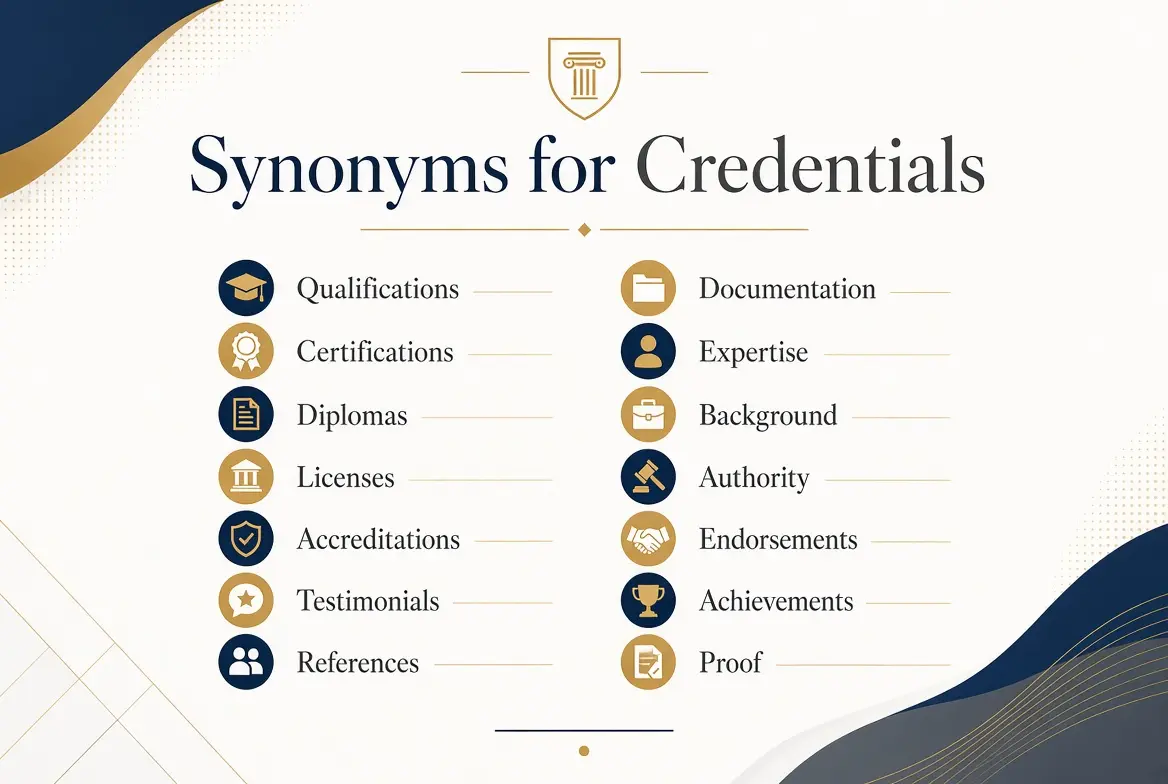
The best synonyms for credentials depend on the meaning. For qualifications or professional ability, use qualifications, expertise, competence, skills, experience, or capabilities. For documents or proof, use certificates, documentation, identification, papers, or references. Words such as accreditation, certification, authorization, and license are more specific and should be used only when the context fits.
What Does “Credentials” Mean?
Imagine you are applying for a job. The employer wants to know why you are qualified. Your education, training, experience, skills, and professional achievements may all help establish your credentials.
The word has two main meanings.
First, credentials can mean the qualities, training, experience, or achievements that show someone is suitable for a job or activity. Oxford gives examples such as professional or academic credentials and notes common patterns such as credentials as and credentials for.
Second, credentials can mean documents that prove who someone is, what they represent, or what qualifications they have. Cambridge and Collins both recognize this documentary meaning.
For example:
She has excellent credentials for the position.
Here, qualifications is a natural alternative.
But:
The journalist showed her press credentials.
Here, press identification or press credentials is more appropriate than qualifications.
That difference is important. A good synonym does not simply have a similar dictionary meaning. It must also fit the context, tone, and intended meaning.
Pronunciation of Credentials
Credentials: /krɪˈdenʃəlz/
Pronounced: krih-DEN-shulz
The singular form is credential:
Credential: /krɪˈdenʃəl/
Cambridge lists essentially the same pronunciation for both UK and US English.
Part of Speech
Credential as a Noun
The main use is as a noun.
Her credentials are impressive.
Credentials as a Plural Noun
When talking about a group of qualifications, achievements, or documents, credentials is normally plural.
His credentials are excellent.
Not:
His credentials are excellent.
Credential as an Adjective
Credential can also appear before a noun in some professional contexts.
She completed a credential program.
Credential as a Verb
The verb credential exists, especially in North American English. It means to provide or establish someone’s credentials or officially recognize someone as qualified.
The organization credentialed the new professionals.
Oxford labels this verb as North American English and commonly passive.
There is no common everyday adverb form.
Grammar and Common Usage
The most useful grammar patterns are:
- credentials as + noun
- credentials for + noun
- have credentials
- establish credentials
- check credentials
- verify credentials
- present credentials
- impressive credentials
- professional credentials
- academic credentials
- business credentials
Examples:
She has excellent credentials as a researcher.
He has all the credentials for the position.
The organization checked her credentials.
These patterns are supported by Oxford’s usage and collocation information.
Credential vs Credentials
Use credential when referring to one qualification, document, or recognized status.
A teaching credential is required.
Use credentials when referring to several qualifications, qualities, or documents.
Her credentials include a degree, certification, and years of experience.
Synonyms for Credentials at a Glance
| Word | Best Meaning | Register | Frequency |
| Qualifications | Education or training that makes someone suitable | Formal/Neutral | Very common |
| Expertise | Advanced knowledge or skill | Professional | Very common |
| Ability | Power or skill to do something | Neutral | Very common |
| Skills | Learned abilities | Neutral | Very common |
| Experience | Practical knowledge gained through doing | Neutral | Very common |
| Competence | Ability to perform effectively | Formal | Common |
| Capability | Ability or potential | Formal/Business | Common |
| Certification | Official recognition or process | Professional | Common |
| Certificate | Document showing an achievement or qualification | Formal/Neutral | Very common |
| Diploma | Qualification awarded after study | Formal | Common |
| Accreditation | Official recognition of standards | Academic/Formal | Common |
| References | Recommendations or supporting information | Professional | Common |
| Background | Education and work history | Neutral | Very common |
| Achievements | Successful results | Neutral | Common |
| Track record | History of performance | Business | Common |
| Proof | Information showing something is true | Neutral | Very common |
| Documentation | Official records | Formal | Common |
| Identification | Proof of identity | Neutral/Formal | Very common |
| Authorization | Official permission | Formal | Common |
| License | Official permission | Formal | Very common |
| Papers | Documents | Informal/Neutral | Common |
| Passport | Official identity/travel document | Neutral | Very common |
| Testimonial | Supporting statement | Formal | Less common |
| Attestation | Formal confirmation | Formal/Legal | Uncommon |
| Letter of credence | Diplomatic document | Diplomatic | Rare |
Direct Synonyms vs Related Words
This is one of the most important distinctions for English learners.
Close synonyms
These can sometimes replace credentials when the meaning is about ability or suitability:
- qualifications
- expertise
- competence
- ability
- capability
Contextual alternatives
These can replace credentials in specific situations:
- certification
- certificate
- diploma
- accreditation
- experience
- skills
- references
- documentation
- identification
- authorization
Related words
These may be part of someone’s credentials but are not exact synonyms:
- education
- achievements
- background
- track record
- training
- proof
This distinction prevents awkward or inaccurate sentences.
1. Qualifications
Meaning: Qualifications are education, training, skills, or experience that make someone suitable for a job or activity.
Examples:
- She has the right qualifications for the teaching position.
- The employer reviewed his qualifications before the interview.
Best Used When: You mean the things that make someone suitable for a position.
Tone: Formal / Neutral
CEFR: B1 learner target
Frequency: Very common
Register: Academic, business, professional
Common Collocations:
- academic qualifications
- professional qualifications
- job qualifications
Nuance: This is probably the best general synonym when credentials means qualifications for a role.
When Not to Use: Do not use it when you specifically mean an identity document.
2. Expertise
Meaning: Expertise means advanced knowledge or skill in a particular area.
Examples:
- Her expertise in finance helped the company solve the problem.
- The team hired him because of his technical expertise.
Best Used When: You want to emphasize deep knowledge.
Tone: Professional / Academic
CEFR: B2
Frequency: Very common
Common Collocations:
- technical expertise
- specialist expertise
- professional expertise
Nuance: Expertise describes what someone knows or can do well. It does not automatically mean they hold a formal qualification.
When Not to Use: Do not use it for a passport, certificate, or other identity document.
3. Ability
Meaning: Ability is the power or skill to do something.
Examples:
- Her ability to explain difficult ideas impressed the students.
- The job requires the ability to work independently.
Best Used When: You want a simple, broad alternative.
Tone: Neutral
CEFR: A2
Frequency: Very common
Common Collocations:
- natural ability
- technical ability
- ability to learn
Nuance: Ability is broader and less formal than credentials.
When Not to Use: Ability does not necessarily prove formal training or qualifications.
4. Skills
Meaning: Skills are abilities that people develop through learning and practice.
Examples:
- Her communication skills helped her succeed.
- The position requires strong computer skills.
Best Used When: Discussing specific abilities.
Tone: Neutral
CEFR: A2
Frequency: Very common
Common Collocations:
- communication skills
- technical skills
- professional skills
Nuance: Skills may form part of someone’s credentials, but skills are narrower.
5. Experience
Meaning: Experience is knowledge or skill gained by doing something.
Examples:
- She has eight years of teaching experience.
- His experience in sales made him a strong candidate.
Best Used When: Talking about practical knowledge gained through work or activity.
Tone: Neutral
CEFR: A2
Frequency: Very common
Common Collocations:
- work experience
- relevant experience
- professional experience
Nuance: Experience is one possible part of credentials.
6. Competence
Meaning: Competence is the ability to perform something successfully and effectively.
Examples:
- The assessment measures professional competence.
- Her competence was clear during the interview.
Best Used When: Discussing reliable professional performance.
Tone: Formal / Academic
CEFR: B2
Frequency: Common
Common Collocations:
- professional competence
- technical competence
- language competence
When Not to Use: Do not use it when you specifically mean a document.
7. Capability
Meaning: Capability is the ability or potential to perform a task.
Examples:
- The company has the capability to handle large projects.
- Her technical capabilities match the needs of the position.
Best Used When: Talking about practical or professional ability.
Tone: Formal / Business
CEFR: B2
Frequency: Common
Nuance: Capability often sounds more formal than ability.
8. Certification
Meaning: Certification refers to the official process or status of being certified.
Examples:
- He earned professional certification in project management.
- The certification confirms that she met the required standard.
Best Used When: Discussing formal professional recognition.
Tone: Formal / Professional
CEFR: B2
Frequency: Common
Certification vs Certificate
This is a common learner problem.
Certification = recognition or the process of certifying.
Certificate = the document.
Oxford describes certification as the act or process of certifying and giving certificates for a course.
9. Certificate
Meaning: A certificate is an official document showing a qualification, achievement, or completion.
Examples:
- She received a certificate after completing the course.
- He showed his training certificate to the employer.
Best Used When: You mean an actual document.
Tone: Formal / Neutral
CEFR: B1
Frequency: Very common
Common Collocations:
- training certificate
- professional certificate
- birth certificate
When Not to Use: Do not use certificates when discussing someone’s complete professional background.
10. Diploma
Meaning: A diploma is a qualification or document awarded after completing a course of study.
Examples:
- She earned a diploma in graphic design.
- His diploma helped him qualify for the position.
Best Used When: Discussing education or formal training.
Tone: Formal / Neutral
CEFR: B1
Frequency: Common
Nuance: A diploma is a specific qualification, not a general synonym for all credentials.
11. Accreditation
Meaning: Accreditation is official recognition that an organization, program, or institution meets certain standards.
Examples:
- The university received professional accreditation.
- Students checked whether the program had proper accreditation.
Best Used When: Discussing recognized educational or professional standards.
Tone: Formal / Academic
CEFR: C1
Frequency: Common in specialist contexts
When Not to Use: Do not use accreditation as a general synonym for a person’s experience.
12. References
Meaning: References are people or statements that provide information about someone’s work, skills, or character.
Examples:
- The employer requested two professional references.
- Her references confirmed her previous work experience.
Best Used When: Someone else is providing supporting information.
Tone: Professional / Formal
CEFR: B1
Frequency: Common
Nuance: References can support credentials but are not necessarily credentials themselves.
13. Background
Meaning: Background includes someone’s education, work history, experience, or preparation.
Examples:
- She has a strong background in biology.
- His business background helped him understand the project.
Best Used When: You want a broad description of someone’s history.
Tone: Neutral / Professional
CEFR: B1
Frequency: Very common
14. Achievements
Meaning: Achievements are things that someone has successfully accomplished.
Examples:
- Her academic achievements strengthened her application.
- His achievements in research earned several awards.
Best Used When: Focusing on results and accomplishments.
Tone: Neutral / Professional
CEFR: B1
Frequency: Common
Nuance: Achievements can strengthen credentials but are not always formal qualifications.
15. Track Record
Meaning: A track record is someone’s history of performance or success.
Examples:
- The company has a strong track record of innovation.
- Her track record made clients trust her judgment.
Best Used When: Discussing proven results over time.
Tone: Business / Professional
CEFR: B2
Frequency: Common
Nuance: This is especially useful when results matter more than certificates.
16. Proof
Meaning: Proof is information that shows something is true.
Examples:
- Please provide proof of your qualification.
- The document serves as proof of identity.
Best Used When: Verification is the main idea.
Tone: Neutral
CEFR: A2
Frequency: Very common
17. Documentation
Meaning: Documentation is a collection of official records or documents.
Examples:
- Applicants must provide supporting documentation.
- The organization checked the documentation carefully.
Best Used When: Referring to several official records.
Tone: Formal / Professional
CEFR: B2
Frequency: Common
18. Identification
Meaning: Identification is something that proves who a person is.
Examples:
- Visitors must show identification at the entrance.
- The officer asked for identification.
Best Used When: Credentials specifically mean proof of identity.
Tone: Neutral / Formal
CEFR: B1
Frequency: Very common
When Not to Use: Do not use it for academic qualifications.
19. Authorization
Meaning: Authorization is official permission to do something.
Examples:
- The employee received authorization to access the records.
- Written authorization was required.
Best Used When: Credentials mean permission or authority.
Tone: Formal / Legal
CEFR: B2
Frequency: Common
20. License
Meaning: A license is official permission to do something.
Examples:
- The doctor must maintain a valid license.
- You need a license to operate the vehicle.
Best Used When: Discussing regulated activities or professions.
Tone: Formal / Neutral
CEFR: B1
Frequency: Very common
American vs British English
In American English, the noun is license.
In British English, the noun is usually licence, while license is used as the verb.
21. Papers
Meaning: Papers can refer informally to official documents.
Examples:
- The traveler showed his papers.
- The officer checked her papers.
Best Used When: Speaking informally about documents.
Tone: Informal / Neutral
CEFR: A2
Frequency: Common
When Not to Use: Use the exact document name in formal writing when possible.
22. Passport
Meaning: A passport is an official document used to prove identity and nationality and to travel internationally.
Examples:
- The officer checked her passport.
- Keep your passport in a secure place.
Best Used When: Credentials specifically refer to travel or identity documents.
Tone: Neutral
CEFR: A2
Frequency: Very common
Nuance: A passport is a type of document, not a general synonym for professional credentials.
23. Testimonial
Meaning: A testimonial is a statement that supports someone’s qualities, work, or character.
Examples:
- The website features testimonials from former clients.
- Her testimonial described his professional abilities.
Best Used When: Someone provides written support or praise.
Tone: Formal / Professional
CEFR: B2
Frequency: Less common
24. Attestation
Meaning: Attestation is formal confirmation that something is true or valid.
Examples:
- The application required an attestation of the documents.
- The official provided written attestation.
Best Used When: Discussing formal verification.
Tone: Formal / Legal
CEFR: C1-C2
Frequency: Uncommon
When Not to Use: Avoid this word in ordinary conversation unless the legal or official context requires it.
25. Letter of Credence
Meaning: A letter of credence is an official diplomatic document that introduces an ambassador to a government.
Examples:
- The ambassador presented his letter of credence.
- The diplomat formally presented her credentials.
Best Used When: Discussing diplomacy and ambassadors.
Tone: Formal / Diplomatic
CEFR: C1-C2
Frequency: Rare
When Not to Use: This is not an appropriate replacement for credentials in an ordinary job application.
Strongest Synonyms for Credentials
When credentials means professional or academic qualifications, the strongest choices are:
- Qualifications
- Expertise
- Competence
- Capability
- Ability
When credentials means documents or proof, the strongest contextual choices are:
- Certificate
- Documentation
- Identification
- Papers
- References
Remember that these are not all interchangeable.
Choose the Right Synonym
| What You Really Mean | Best Word | Example |
| Education and training | Qualifications | She has excellent qualifications. |
| Advanced knowledge | Expertise | He has financial expertise. |
| Practical knowledge | Experience | She has ten years of experience. |
| Specific abilities | Skills | He has strong communication skills. |
| Official recognition | Certification | She earned professional certification. |
| Physical document | Certificate | He showed his certificate. |
| Academic award | Diploma | She earned a diploma. |
| Institutional recognition | Accreditation | The program has accreditation. |
| Past success | Track record | She has a strong track record. |
| Recommendation | Reference | His references were excellent. |
| Identity | Identification | Please show identification. |
| Official permission | Authorization | They received authorization. |
| Regulated permission | License | She has a medical license. |
Commonly Confused Words
| Word | Difference | Example |
| Credentials | Broad proof of qualifications, ability, status, or identity | Her credentials impressed the employer. |
| Qualifications | Education or training that makes someone suitable | She has excellent qualifications. |
| Certification | Official recognition or certification process | He earned certification. |
| Certificate | Document showing an achievement or qualification | She received a certificate. |
| Accreditation | Official recognition that standards are met | The program has accreditation. |
Easy Memory Trick
Qualifications = what makes you suitable.
Certification = official recognition.
Certificate = the document.
Accreditation = recognized standards or status.
Credentials = the broader collection of qualifications, proof, or status.
Common Mistakes
Mistake 1
My credentials is impressive.
Correction:
My credentials are impressive.
Why: Credentials is normally plural when used in this sense.
Mistake 2
She showed her qualifications at the airport.
Better:
She showed her identification at the airport.
Why: The context is identity, not professional suitability.
Mistake 3
He received a certification from the university.
This can be correct in some contexts, but if you mean the actual document, certificate may be more precise.
He received a certificate from the university.
Mistake 4
His passport proves his professional credentials.
This changes the meaning.
A passport proves identity and nationality. It does not normally prove professional qualifications.
Mistake 5
Her experience is the same as her credentials.
Not necessarily.
Experience can be part of someone’s credentials, while credentials can include education, certifications, skills, achievements, and other evidence.
Credentials in Different Contexts
Job Applications
Use:
- qualifications
- experience
- skills
- certifications
- achievements
- professional background
Example:
Her qualifications and experience make her a strong candidate.
Academic Writing
Use:
- qualifications
- expertise
- academic background
- competence
- accreditation
Example:
The researcher’s academic qualifications support her work.
Professional Bios
Use:
- expertise
- experience
- achievements
- qualifications
- track record
Example:
His expertise and track record have earned industry recognition.
Identity and Access
Use:
- identification
- passport
- documentation
- papers
- credentials
Example:
Visitors must present identification at the entrance.
Legal and Official Permission
Use:
- authorization
- license
- permit
- clearance
Example:
Employees need authorization before accessing restricted files.
A Special Meaning: Login Credentials
There is another modern meaning that vocabulary learners should know.
In computing, credentials can mean information used to prove a user’s identity and gain access to an account or system. Cambridge’s entry for credential includes information sent between computers to check a user’s identity or allow access to information.
Example:
Never share your login credentials.
In this context, good alternatives may include:
- login information
- authentication information
- account details
- access information
Do not replace login credentials with qualifications or experience.
American vs British English
Credentials is spelled the same in both American and British English.
The pronunciation is also essentially the same.
However, some related words differ.
| American English | British English |
| license | licence |
| licensed | licensed |
| résumé | CV |
| credentials | credentials |
For example:
American English:
She has a professional license.
British English:
She has a professional licence.
The meaning remains the same.
Word Origin and Etymology
The word credential comes from a history connected with belief, trust, and credibility. Collins traces it to Medieval Latin forms related to credentia and Latin credere, meaning to believe or trust.
Oxford explains that the original use was associated with the idea of giving credence or recommendation, including credential letters or papers, which helps explain today’s connection with proof and authority. Oxford dates the related English use to the late Middle English period and notes credentials from the mid-17th century.
This history helps explain why modern credentials can establish trust, authority, qualification, or identity.
CEFR Learner Guide
CEFR levels can vary across vocabulary systems, so these levels should be treated as practical learning guidance rather than absolute classifications.
A2
- ability
- skills
- experience
- education
- papers
- passport
B1
- qualifications
- certificate
- references
- background
- proof
- achievements
B2
- expertise
- competence
- capability
- certification
- authorization
- track record
C1-C2
- accreditation
- attestation
- letter of credence
For everyday English, learners should first master:
qualifications, experience, skills, expertise, certificate, and references.
Frequency and Register Guide
Very Common
- ability
- experience
- skills
- education
- qualifications
- certificate
- proof
- identification
- passport
Common
- expertise
- background
- certification
- references
- achievements
- capability
- competence
- license
- documentation
- track record
Less Common or Specialist
- accreditation
- testimonial
- attestation
- letter of credence
Register
Spoken English: ability, skills, experience, background
Professional English: qualifications, expertise, certification, track record
Academic English: qualifications, competence, expertise, accreditation
Legal/Official English: authorization, documentation, attestation, license
Diplomatic English: credentials, letter of credence
When Not to Use a Synonym
Do not automatically replace credentials with the first similar word you find.
Use qualifications when education or training is the focus.
Use experience when practical work history is the focus.
Use expertise when advanced knowledge is the focus.
Use certificate when you mean a document.
Use identification when you mean proof of identity.
Use authorization when you mean official permission.
Use track record when you mean a history of successful performance.
Use references when another person is providing supporting information.
This approach makes your English more precise.
Natural Collocations With Credentials
Native speakers commonly use adjectives and verbs with credentials.
Adjectives
- excellent credentials
- impressive credentials
- strong credentials
- impeccable credentials
- professional credentials
- academic credentials
- business credentials
- scientific credentials
- diplomatic credentials
- press credentials
Verbs
- have credentials
- establish credentials
- earn credentials
- check credentials
- examine credentials
- verify credentials
- present credentials
Oxford specifically records patterns involving have, earn, establish, present, check, and examine.
Mini Practice Exercises
Fill in the Blanks
Choose from:
qualifications, certificate, experience, expertise, identification
- The employer reviewed her ________ before the interview.
- Please show your ________ at the entrance.
- He has ten years of work ________.
- She received a training ________.
- His technical ________ made him the best person for the project.
Answers
- qualifications
- identification
- experience
- certificate
- expertise
Sentence Rewriting
Replace credentials with a more precise word.
Sentence 1
She has impressive credentials in medicine.
Possible answer:
She has impressive medical qualifications.
Sentence 2
The guard checked his credentials.
Possible answer:
The guard checked his identification.
Sentence 3
His credentials include ten years of industry experience.
Possible answer:
His professional background includes ten years of industry experience.
Matching Exercise
Match the word with its meaning.
- Expertise
- Certificate
- Track record
- Authorization
- References
A. Official permission
B. Advanced knowledge
C. Document showing an achievement
D. History of performance
E. Supporting recommendations
Answer Key
- B
- C
- D
- A
- E
Vocabulary Quiz
1. Which word is usually best when credentials mean education and training?
A. Passport
B. Qualifications
C. Papers
D. Identification
Answer: B
2. Which word means advanced knowledge or skill?
A. Certificate
B. Expertise
C. References
D. Diploma
Answer: B
3. What is a certificate?
A. A person’s entire work history
B. A document showing an achievement or qualification
C. A type of professional experience
D. A recommendation from an employer
Answer: B
4. Which phrase means a history of successful performance?
A. Track record
B. Identification
C. Documentation
D. Accreditation
Answer: A
5. Which word is best when you mean proof of identity?
A. Expertise
B. Competence
C. Identification
D. Qualifications
Answer: C
Frequently Asked Questions
What is the best synonym for credentials?
The best general synonym is qualifications when credentials means education, training, skills, or experience that make someone suitable for a job. If credentials means official documents, words such as certificate, identification, documentation, or papers may be more accurate.
What are five synonyms for credentials?
Five useful alternatives are qualifications, expertise, experience, certification, and certificates. However, they are not identical. Qualifications describe suitability, expertise describes advanced knowledge, experience describes practical knowledge, certification indicates official recognition, and certificates are documents.
Are credentials and qualifications the same?
Not exactly. Qualifications usually describe education, training, skills, or experience that make someone suitable for a role. Credentials is broader and may include qualifications, achievements, professional status, experience, or documents that establish identity or authority.
What is another word for professional credentials?
Depending on the context, you can use professional qualifications, certifications, expertise, experience, professional background, achievements, or track record. If you mean legal permission to practice a profession, license may be more precise.
What is the difference between credentials and certification?
Credentials is a broad term for qualifications, abilities, achievements, status, or documents that establish credibility or suitability. Certification is narrower and refers to official recognition or the process of certifying that a standard has been met.
What is the difference between a certificate and a credential?
A credential is a broad concept that can include qualifications, experience, skills, status, or proof. A certificate is generally a specific document showing that someone completed a course, earned an achievement, or holds a qualification.
Can experience be a synonym for credentials?
Sometimes, but it is not an exact synonym. Experience can be one part of someone’s credentials. Credentials may also include education, certifications, skills, achievements, and official documents.
What is the opposite of credentials?
There is no single exact opposite of credentials. Depending on the context, possible contrasts include lack of qualifications, inexperience, lack of authorization, unverified status, or disqualification.
Best Synonym by Situation
| Situation | Recommended Word |
| Job application | Qualifications |
| Work history | Experience |
| Advanced professional knowledge | Expertise |
| Specific abilities | Skills |
| Academic preparation | Education |
| Professional recognition | Certification |
| Proof on paper | Certificate |
| Academic award | Diploma |
| Institutional standards | Accreditation |
| Past professional success | Track record |
| Recommendations | References |
| Proof of identity | Identification |
| Official permission | Authorization |
| Regulated professional permission | License |
| Formal verification | Attestation |
| Diplomatic documentation | Credentials / letter of credence |
| Computer access | Login credentials |
Conclusion
Choosing the right synonym for credentials is about meaning, not simply finding another word that looks similar in a thesaurus. Use qualifications for suitability, experience for practical knowledge, expertise for advanced skill, certification for official recognition, and certificate for a document.
For identity, use identification, while authorization works for official permission. Practice these distinctions in essays, emails, résumés, and conversations. Precise vocabulary makes your English clearer, stronger, and more natural.
References
- Oxford Advanced Learner’s Dictionary, “credentials” and “credential.” Oxford provides definitions, pronunciation, grammatical patterns, collocations, and usage examples.
- Cambridge Dictionary, “credentials.” Cambridge distinguishes credentials as abilities and experience from credentials as documents or proof.
- Merriam-Webster Thesaurus, “credentials.” Its thesaurus entry includes close alternatives such as qualification, expertise, capability, ability, competence, proficiency, and related terms.
- Collins English Dictionary, “credentials.” Collins distinguishes previous achievements, training, and background from letters or certificates proving identity or qualifications.
- Cambridge Dictionary, “credential” and pronunciation entry. These sources provide the pronunciation and the additional computing sense involving information used to verify a user’s identity or permit access.

Synonorm is a trusted English vocabulary resource created to help readers find the right words and understand the differences between similar terms. We provide clear explanations of synonyms, meanings, examples, usage, and alternatives. Our content makes vocabulary easier to learn and apply in everyday, academic, and professional English. Synonorm is designed for students, writers, ESL learners, professionals, and anyone who wants to improve their English vocabulary and communicate more clearly.