Quick Answer
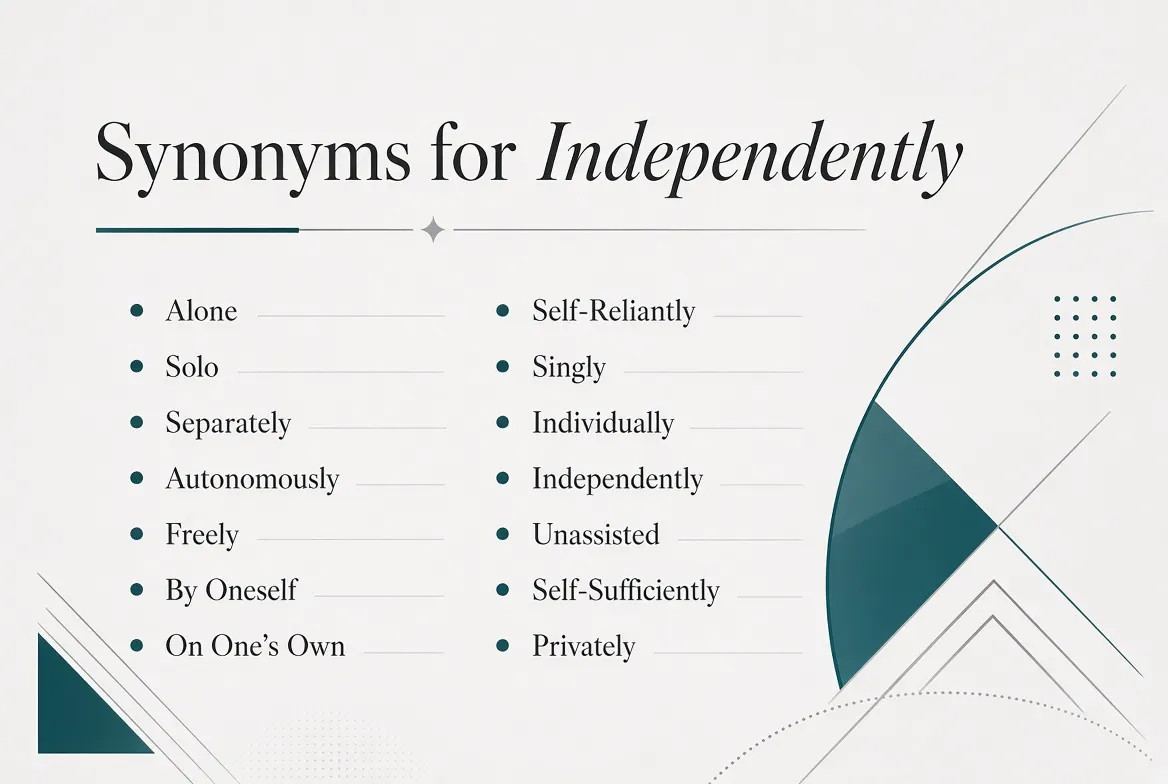
The best synonyms for independently depend on what you mean. Use alone, by yourself, or on your own when someone acts without other people or help. Use separately when things are kept apart, individually when each person or thing is considered separately, and autonomously when someone or something operates without outside control. Other useful alternatives include unaided, unassisted, solo, single-handedly, and singly.
Introduction
Have you ever wanted to replace independently in an essay, email, or sentence but were unsure which word would sound natural? The problem is that English does not have one perfect substitute for every use of it independently.
The word can describe working without help, making decisions without outside influence, operating without control from another organization, or doing something separately from other people. That is why alone, separately, individually, and autonomously can all be useful alternatives, but they do not mean exactly the same thing.
In this guide, you will learn the most useful synonyms for independently, what each one means, where it fits, and when you should avoid it. You will also see examples, collocations, register labels, learner tips, and practice questions.
What Does Independently Mean?
Independently is an adverb meaning without relying on another person or thing, without outside control or influence, or separately from others.
Oxford identifies several important uses, including acting without being influenced by something, being fairly judged by someone outside a situation, acting without needing help, and living without relying on another person for support.
Cambridge likewise gives the core ideas of acting without influence or control and doing something without taking help or money from others.
Three main meanings
1. Without help
She completed the assignment independently.
Meaning: She did it without relying on someone else.
2. Without outside influence or control
The committee operates independently of the government.
Meaning: The committee is not controlled or influenced by the government.
3. Separately
The researchers reached the same conclusion independently.
Meaning: They reached it separately, without coordinating with each other.
This distinction is the key to choosing the right synonym.
Pronunciation
IPA: /ˌɪn.dɪˈpen.dənt.li/
Pronounced: in-di-PEN-dent-lee
Cambridge gives the same standard pronunciation for both British and American English.
Part of Speech
Independently is an adverb.
It modifies a verb, adjective, or another adverb.
- She works independently.
- The results were independently verified.
- The two systems function independently.
Word family
| Word | Part of speech | Example |
| depend | verb | Children depend on adults. |
| dependent | adjective | The child is dependent on her parents. |
| independent | adjective | She is independent. |
| independence | noun | He values his independence. |
| independently | adverb | She works independently. |
Grammar: How to Use Independently Correctly
One of the most useful structures is:
independently + verb
The researchers independently tested the theory.
Another common pattern is:
verb + independently
The students worked independently.
You can also use:
independently of + noun
The two departments operate independently of each other.
Oxford and Cambridge both show independently of as an important structure.
Common collocations
- work independently
- think independently
- live independently
- operate independently
- act independently
- study independently
- research independently
- independently verified
- independently tested
- independently reviewed
- independently produced
- independently owned
These combinations are especially useful in academic, business, and professional English. Cambridge’s Business English material specifically uses patterns such as independently examined, independently verified, independently tested, independently owned, and work independently.
Synonyms for Independently: Quick Comparison
| Synonym | Core meaning | Register | Frequency |
| alone | without other people | Neutral | Very common |
| on your own | without help or company | Neutral/Informal | Very common |
| by yourself | without help or company | Neutral | Very common |
| separately | apart from others | Neutral | Very common |
| individually | one person/thing at a time | Neutral/Academic | Very common |
| unaided | without help | Neutral/Formal | Common |
| unassisted | without assistance | Formal | Common |
| autonomously | without external control | Formal/Technical | Less common |
| solo | alone, especially in an activity | Neutral/Informal | Common |
| single-handedly | through one person’s effort | Neutral | Common |
| singly | one at a time or separately | Formal/Literary | Uncommon |
| severally | separately or individually | Legal/Formal | Rare |
| apart | separated from others | Neutral | Very common |
| one by one | separately in sequence | Neutral | Very common |
| one at a time | separately in sequence | Neutral | Very common |
| of one’s own volition | by one’s own choice | Formal | Uncommon |
| on one’s own initiative | without being told to act | Business/Formal | Common |
| by one’s own efforts | through personal effort | Neutral/Formal | Common |
| under your own steam | through your own effort | Informal, mainly UK | Uncommon |
| go it alone | proceed without others | Informal | Common |
Important: These are not interchangeable in every sentence. The closest synonym depends on the intended meaning.
1. Alone
Meaning: Without another person or group.
Examples:
- Maria traveled alone for the first time.
- He prefers to work alone in the morning.
Best Used When: You want to emphasize that no other person is present.
Tone: Neutral
Register: General and spoken English
CEFR: A1–A2 guidance
Frequency: Very common
Common Collocations:
- live alone
- travel alone
- work alone
Connotation: Simple and direct.
When Not to Use: Do not use alone when the main idea is freedom from control. Someone can work independently while sitting in a room full of people.
2. On Your Own
Meaning: Without help or without relying on another person.
Examples:
- She learned to use the software on her own.
- You can solve the problem on your own.
Best Used When: You want a natural everyday alternative.
Tone: Neutral/Informal
Register: Spoken and general English
CEFR: A2
Frequency: Very common
Common Collocations:
- work on your own
- learn on your own
- live on your own
Connotation: Often suggests self-reliance.
When Not to Use: Avoid it in very formal documents when a more precise term is needed.
3. By Yourself
Meaning: Without help or without another person.
Examples:
- Did you complete the project by yourself?
- He fixed the bicycle by himself.
Best Used When: Speaking directly about someone’s personal effort.
Tone: Neutral
Register: Everyday English
CEFR: A1–A2
Frequency: Very common
Connotation: Friendly and conversational.
When Not to Use: If you mean institutional freedom from control, autonomously or independently may be more accurate.
4. Separately
Meaning: Apart from another person, thing, or group.
Examples:
- The two applications were reviewed separately.
- The departments operate separately.
Best Used When: Separation is more important than self-reliance.
Tone: Neutral
Register: General, academic, business
CEFR: A2–B1
Frequency: Very common
Common Collocations:
- work separately
- pay separately
- review separately
When Not to Use: Do not choose it when you specifically mean “without help.”
5. Individually
Meaning: One person or thing at a time rather than as a group.
Examples:
- Each student was interviewed individually.
- The applications were evaluated individually.
Best Used When: Each person or item receives separate attention.
Tone: Neutral
Register: General, academic, professional
CEFR: B1
Frequency: Very common
Common Collocations:
- assessed individually
- considered individually
- reviewed individually
Important Nuance: Individually does not necessarily mean without help.
6. Unaided
Meaning: Without help or assistance.
Examples:
- The child climbed the stairs unaided.
- She completed the task unaided.
Best Used When: The absence of assistance is important.
Tone: Neutral/Formal
Register: Medical, academic, general
CEFR: B2 guidance
Frequency: Common
Common Collocations:
- walk unaided
- work unaided
- complete unaided
When Not to Use: Avoid it when the issue is independence from an organization or authority.
7. Unassisted
Meaning: Without assistance.
Examples:
- The athlete completed the exercise unassisted.
- He repaired the equipment unassisted.
Best Used When: You want a slightly more formal alternative to “without help.”
Tone: Formal/Neutral
Register: Professional, academic
CEFR: B2 guidance
Frequency: Common
Connotation: Precise and factual.
8. Autonomously
Meaning: Without external control or, in some contexts, without needing another person’s help.
Examples:
- The department operates autonomously.
- The machine can perform several tasks autonomously.
Best Used When: Discussing organizations, systems, technology, or self-directed action.
Tone: Formal
Register: Academic, technical, business
CEFR: C1 guidance
Frequency: Less common in everyday English
Oxford defines autonomously in terms of governing one’s own affairs or acting without help in relevant contexts.
Connotation: Stronger and more technical than alone.
When Not to Use: Do not use it merely because you want a sophisticated synonym. “She ate autonomously” would sound unnatural in ordinary English.
9. Solo
Meaning: Alone, especially when performing or taking part in an activity.
Examples:
- She began a solo career after leaving the band.
- He completed the final stage of the journey solo.
Best Used When: Talking about travel, music, performance, sports, or other activities.
Tone: Neutral/Informal
Register: General, spoken, media
CEFR: B1
Frequency: Common
Common Collocations:
- solo trip
- solo career
- solo performance
10. Single-Handedly
Meaning: Through the effort of one person alone.
Examples:
- She single-handedly organized the entire event.
- He single-handedly rebuilt the website.
Best Used When: One person’s effort is unusually large or important.
Tone: Neutral
Register: General, journalistic
CEFR: B2
Frequency: Common
Connotation: Often praises or emphasizes someone’s achievement.
When Not to Use: Do not use it merely because someone was alone.
11. Singly
Meaning: Separately or one at a time.
Examples:
- The patients entered the room singly.
- The flowers were arranged singly rather than in groups.
Best Used When: You need a formal or literary word for separate units.
Tone: Formal/Literary
Register: Formal, literary
CEFR: C1 guidance
Frequency: Uncommon
Tip: In normal conversation, individually or one at a time is usually clearer.
12. Severally
Meaning: Separately or individually.
Examples:
- The claims were considered severally.
- The parties were questioned severally.
Best Used When: Formal or legal writing requires the idea of separate treatment.
Tone: Formal
Register: Legal
CEFR: C2 guidance
Frequency: Rare
When Not to Use: Avoid it in everyday English.
13. Apart
Meaning: Separate from someone or something.
Examples:
- The two systems can function apart.
- The children sat apart from the main group.
Best Used When: Physical or conceptual separation matters.
Tone: Neutral
Register: General
CEFR: A2
Frequency: Very common
Important: Apart does not automatically mean “without help.”
14. One by One
Meaning: Separately, with one person or thing following another.
Examples:
- The students entered the classroom one by one.
- We checked the answers one by one.
Best Used When: You mean sequential action.
Tone: Neutral
Register: Everyday English
CEFR: A2
Frequency: Very common
When Not to Use: It cannot replace independently when you mean freedom from influence or control.
15. One at a Time
Meaning: Separately, with only one person or thing dealt with at once.
Examples:
- Please answer the questions one at a time.
- The boxes were carried upstairs one at a time.
Best Used When: The order or sequence matters.
Tone: Neutral
Register: General
CEFR: A2
Frequency: Very common
16. Of Your Own Volition
Meaning: Because you personally chose to do something.
Examples:
- She left the organization of her own volition.
- He joined the program of his own volition.
Best Used When: You want to emphasize free personal choice.
Tone: Formal
Register: Legal, professional, formal writing
CEFR: C1–C2 guidance
Frequency: Uncommon
Important Nuance: This means “by your own choice,” not necessarily “without help.”
17. On Your Own Initiative
Meaning: Because you decided to act without being instructed.
Examples:
- She contacted the client on her own initiative.
- He began researching the issue on his own initiative.
Best Used When: Describing proactive behavior at work or school.
Tone: Neutral/Formal
Register: Business, professional
CEFR: B2–C1 guidance
Frequency: Common
Important Nuance: A person can act on their own initiative and still receive help later.
18. By Your Own Efforts
Meaning: Through your personal work rather than relying on another person’s effort.
Examples:
- She earned the qualification by her own efforts.
- He built the business by his own efforts.
Best Used When: Highlighting personal work and achievement.
Tone: Neutral/Formal
Register: Academic, professional
CEFR: B2 guidance
Frequency: Common
19. Under Your Own Steam
Meaning: Through your own effort or without outside assistance.
Examples:
- He traveled around the region under his own steam.
- She completed the course under her own steam.
Best Used When: Informal British English describes self-directed effort.
Tone: Informal
Register: Spoken, mainly British
CEFR: C1 guidance
Frequency: Uncommon
Collins and Cambridge identify this expression as mainly British.
20. Go It Alone
Meaning: To proceed without partners, teammates, or outside support.
Examples:
- After years in the partnership, she decided to go it alone.
- The company chose to go it alone rather than seek investors.
Best Used When: Describing a deliberate decision to operate without others.
Tone: Informal
Register: Spoken, journalism, business
CEFR: B2 guidance
Frequency: Common
Connotation: Often suggests courage, risk, or self-reliance.
Which Synonym Should You Choose?
Use this simple decision guide:
If you mean “without help”
Choose:
- unaided
- unassisted
- by yourself
- on your own
- without help
If you mean “without other people”
Choose:
- alone
- solo
- by yourself
- on your own
If you mean “separate from others”
Choose:
- separately
- individually
- apart
- singly
If you mean “without outside control”
Choose:
- autonomously
- independently
- self-directed
- on one’s own initiative
If you mean “through one person’s effort”
Choose:
- single-handedly
- by your own efforts
If you mean “because you personally chose to”
Choose:
- of your own volition
- voluntarily
But remember that voluntarily is not a general synonym for independently. It describes willingness or choice, not necessarily self-reliance.
Independently vs. Alone
These words are close but not identical.
She worked alone.
This tells us nobody else was working with her.
She worked independently.
This can mean she worked without supervision or without relying on others.
A person can work independently in a team. This is one of the clearest reasons why alone cannot replace independently in every sentence.
Independently vs. Separately
Separately focuses on separation.
The files were stored separately.
Independently can focus on lack of dependence or coordination.
The researchers conducted their studies independently.
The second sentence can mean that the researchers did not coordinate their work.
Independently vs. Individually
Individually means each person or thing is considered separately.
Each student was interviewed individually.
Independently means the students did the action without relying on one another.
The students completed the assignment independently.
The two words can overlap, but their focus is different.
Independently vs. Autonomously
Independently is broader and more common.
Autonomously strongly emphasizes self-control or self-government.
The employee works independently.
The software operates autonomously.
The second sentence sounds technical because autonomously often describes systems, organizations, or controlled processes.
Independently vs. On Your Own
These can often replace one another:
She learned independently.
She learned on her own.
The first sounds more neutral and may fit academic writing better. The second sounds more conversational.
Commonly Confused Words
| Word | Main idea | Example |
| independently | without dependence, help, influence, or control | They worked independently. |
| alone | without other people | She lives alone. |
| separately | apart from others | The files were stored separately. |
| individually | each person or thing separately | Each student was assessed individually. |
| autonomously | without external control | The system operates autonomously. |
Common Mistakes
Common Mistake 1
Mistake: She worked independently because she was alone.
Problem: Being alone and working independently are not necessarily the same thing.
Better: She worked independently because she did not need supervision.
Common Mistake 2
Mistake: Each student worked separately to mean each student received no help.
Better: Each student worked independently.
Why: Separately tells us that students did not work together. It does not necessarily tell us whether they received help.
Common Mistake 3
Mistake: The robot works alone.
Better: The robot operates autonomously.
Why: If you mean that the machine performs tasks without human control, autonomously is more precise.
Common Mistake 4
Mistake: He left independently.
Better: He left of his own volition.
Why: If the important idea is that he chose to leave, of his own volition communicates that idea more precisely.
Writing Tips
For Essays
Use independently, individually, separately, or without external influence according to the exact meaning.
The researchers independently evaluated the results.
This is more precise than repeatedly writing:
The researchers worked alone.
For Professional Emails
Prefer simple, direct language.
Please review the document on your own before the meeting.
For a more formal message:
Please review the document independently before the meeting.
For Academic Writing
Useful collocations include:
- independently verified
- independently assessed
- independently reviewed
- independently conducted
- independently evaluated
These patterns occur naturally in academic and professional English. Cambridge’s corpus examples include researchers, reviewers, coders, and trials being evaluated or applied independently.
For Blog Writing
Use familiar alternatives such as:
- on your own
- by yourself
- without help
- separately
Avoid replacing a simple word with a rare word just to sound sophisticated.
For Business Writing
Independently, autonomously, and on one’s own initiative can be useful, but each has a different meaning.
The branch operates independently of the parent company.
The employee acted on her own initiative.
These sentences communicate different ideas.
American vs. British English
Independently has the same standard spelling in American and British English.
The pronunciation is also essentially the same in the major dictionary pronunciation guides.
Some alternatives show regional preferences:
- on your own — natural in both varieties
- by yourself — natural in both varieties
- solo — common in both
- under your own steam — mainly British
- all on your own — especially common in British usage, though understood elsewhere
Collins identifies under your own steam as a British usage, while Cambridge labels the phrase mainly UK.
Word Origin and Etymology
Independently comes from independent, which developed from in-, meaning “not,” and dependent.
Etymonline dates independent to the 1610s, when it meant “not dependent on something else.” The word was initially used for churches and nations, with reference to people appearing from the 1660s. Later meanings developed around financial self-support and freedom from outside influence.
This history helps explain the modern meanings:
not dependent → self-supporting → free from outside influence → acting independently
The related noun independence is recorded from the 1630s.
Frequency and Learner Guide
If you are an English learner, you do not need to memorize every synonym.
Start with these:
Beginner
- alone
- by yourself
- on your own
- separately
- one by one
Intermediate
- individually
- unaided
- unassisted
- solo
- single-handedly
Advanced
- autonomously
- singly
- severally
- of your own volition
- on your own initiative
This approach is more useful than memorizing a huge thesaurus list.
Related Vocabulary
Antonyms
Depending on context, opposites include:
- jointly
- together
- collectively
- cooperatively
- mutually
- dependently
Merriam-Webster lists jointly, together, mutually, cooperatively, and collectively among the antonyms or near-antonyms of independently.
Related Expressions
- work without supervision
- think for yourself
- rely on yourself
- make your own decisions
- act on your own initiative
- stand on your own feet
- take responsibility for yourself
- work without assistance
Native-Like Collocation Guide
Instead of memorizing isolated synonyms, learn them in natural combinations.
Independently
- independently verified
- independently tested
- independently reviewed
- independently operated
- independently produced
Alone
- live alone
- work alone
- travel alone
Individually
- assessed individually
- reviewed individually
- considered individually
Autonomously
- operate autonomously
- function autonomously
- act autonomously
On Your Own
- learn on your own
- work on your own
- manage on your own
Single-Handedly
- build single-handedly
- organize single-handedly
- save single-handedly
Learning these combinations helps you sound more natural than simply replacing one word with another.
Mini Practice Exercises
Fill in the Blank
Choose the best answer.
1. The two researchers reached the same conclusion ________.
A. alone
B. independently
C. voluntarily
D. one at a time
2. Each application was reviewed ________.
A. individually
B. autonomously
C. solo
D. single-handedly
3. The machine can operate ________ without human control.
A. alone
B. separately
C. autonomously
D. one by one
4. She learned Spanish ________ without taking a formal class.
A. on her own
B. severally
C. apart
D. singly
5. He ________ organized the entire charity event.
A. separately
B. individually
C. single-handedly
D. voluntarily
Sentence Rewriting
Replace independently with a more precise expression.
- She completed the task independently without any assistance.
- The departments operate independently of each other.
- The student learned independently at home.
- The researchers conducted the studies independently.
- He decided to leave independently.
Possible answers
- She completed the task unaided.
- The departments operate separately.
- The students learned on their own.
- The researchers conducted the studies separately or independently, depending on the intended meaning.
- He decided to leave of his own volition.
The last exercise shows why context matters. There is no single synonym that works perfectly everywhere.
Matching Exercise
Match each word with its closest meaning.
| Word | Meaning |
| 1. alone | A. without external control |
| 2. separately | B. without another person |
| 3. individually | C. one person or thing at a time |
| 4. autonomously | D. apart from others |
| 5. unaided | E. without help |
Answers: 1-B, 2-D, 3-C, 4-A, 5-E.
FAQ
What is the best synonym for independently?
There is no single best synonym. Alone works when you mean without other people, unaided when you mean without help, separately when you mean apart from others, and autonomously when you mean without external control.
What are common synonyms for independently?
Common alternatives include alone, separately, individually, on your own, by yourself, unaided, unassisted, solo, autonomously, and single-handedly. The correct choice depends on whether the sentence emphasizes help, separation, personal effort, or freedom from control.
Is alone a synonym for independently?
Sometimes, but not always. Alone usually means without other people, while independently can mean without help, supervision, influence, or control. For example, someone can work independently while still being part of a team.
What is a formal synonym for independently?
Autonomously is a useful formal synonym when the meaning involves freedom from external control. Unaided, unassisted, and individually can also work in formal writing when their specific meanings fit the sentence.
What is the difference between independently and separately?
Independently can mean without dependence, influence, or coordination. Separately mainly means apart from others. Two researchers may work independently because they conduct their research without coordinating, while two files may be stored separately simply because they are kept apart.
Is “on your own” the same as independently?
Often, yes. On your own commonly means without help or support and is especially natural in everyday English. Independently sounds more neutral and can also describe freedom from outside control or influence.
What is the opposite of independently?
Common opposites include jointly, together, collectively, cooperatively, mutually, and dependently. The correct opposite depends on context. For example, independently can contrast with jointly for decisions or with dependently when discussing reliance.
What is a good synonym for independently in academic writing?
Individually, separately, unaided, autonomously, and independently itself can work in academic writing, but the choice should reflect the intended meaning. Phrases such as independently verified and independently assessed are especially natural in research contexts.
Vocabulary Quiz
1. Which word best means “without help”?
A. separately
B. unaided
C. jointly
D. collectively
2. Which word best describes an organization operating without external control?
A. alone
B. individually
C. autonomously
D. one by one
3. Which word means that people or things are considered one at a time?
A. individually
B. freely
C. voluntarily
D. solo
4. Which expression emphasizes personal choice?
A. separately
B. of your own volition
C. singly
D. apart
5. Which expression often emphasizes one person’s unusually large effort?
A. single-handedly
B. individually
C. separately
D. by yourself
Answer Key
- B. unaided
- C. autonomously
- A. individually
- B. of your own volition
- A. single-handedly
Final Takeaway
The best way to learn synonyms independently is to learn their differences, not simply memorize a long list. Choose alone for being without other people, on your own for everyday self-reliance, unaided for acting without help, separately for separation, individually for separate treatment, and autonomously for freedom from external control.
Use these words in essays, emails, reports, conversations, and professional writing. When you match the synonym to the exact meaning, your English becomes clearer, more natural, and more precise.
References
- Oxford Advanced Learner’s Dictionary, independently
- Cambridge Dictionary, independently
- Merriam-Webster Thesaurus, independently
- Collins English Thesaurus, independently
- Thesaurus.com, independently
- Online Etymology Dictionary, independent

Synonorm is a trusted English vocabulary resource created to help readers find the right words and understand the differences between similar terms. We provide clear explanations of synonyms, meanings, examples, usage, and alternatives. Our content makes vocabulary easier to learn and apply in everyday, academic, and professional English. Synonorm is designed for students, writers, ESL learners, professionals, and anyone who wants to improve their English vocabulary and communicate more clearly.