Quick Answer
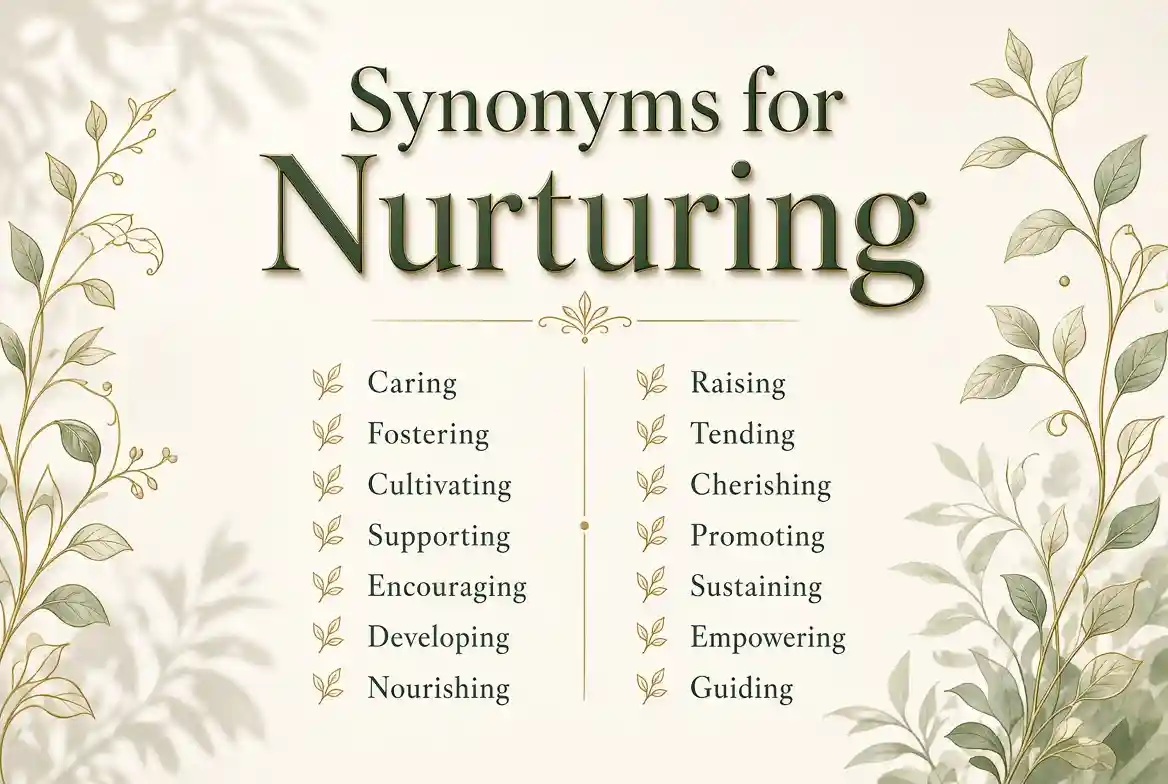
The best synonyms for nurturing include caring, supportive, encouraging, fostering, cultivating, loving, protective, nourishing, developing, guiding, and supportive. However, these words are not exact substitutes in every sentence. Choose caring for kindness, fostering for development, loving for affection, protective for safety, and cultivating for deliberate growth.
What Does Nurturing Mean?
Have you ever wanted to describe a person who helps someone grow but could not decide whether caring, supportive, or encouraging was the best word?
That is where context matters.
Nurturing describes care, support, encouragement, and attention that help a person, relationship, ability, idea, or living thing grow. A nurturing parent cares for a child, a nurturing teacher helps students develop, and a nurturing environment gives people the safety and support they need to grow.
For example:
She created a nurturing environment for young writers.
Here, nurturing means more than simply being kind. The environment also helps the writers develop their skills and confidence.
This guide explains the most useful synonyms for nurturing, including their meanings, tone, CEFR guidance, frequency, collocations, differences, and situations where you should not use them.
Pronunciation of Nurturing
Nurturing
- American English: /ˈnɝːtʃərɪŋ/
- British English: /ˈnɜːtʃərɪŋ/
- Easy pronunciation: NUR-chuh-ring
There is no major spelling difference between American and British English. The main pronunciation difference is the vowel in the first syllable.
Part of Speech
Nurturing can work as both an adjective and a present participle.
As an adjective
It describes someone or something that provides care and encourages growth.
- She is a nurturing mother.
- The school provides a nurturing environment.
As a verb form
It is the -ing form of nurture.
- Parents are nurturing their child’s confidence.
- The company is nurturing new talent.
Related forms
- nurture — verb/noun
- nurtured — past tense/past participle
- nurturing — adjective/present participle
- nurturer — noun
Nurturing Synonyms at a Glance
| Word | Main Idea | Register | Frequency |
| Caring | Showing concern | Neutral | Very common |
| Supportive | Giving help | Neutral | Very common |
| Encouraging | Building confidence | Neutral | Very common |
| Loving | Showing affection | Neutral | Very common |
| Fostering | Helping development | Formal/Academic | Common |
| Cultivating | Carefully developing | Formal | Common |
| Protective | Keeping safe | Neutral | Common |
| Nourishing | Providing what supports growth | Neutral/Literary | Common |
| Developing | Improving or growing | Neutral | Very common |
| Guiding | Giving direction | Neutral | Common |
| Raising | Bringing up children | Neutral | Very common |
| Rearing | Bringing up children/animals | Formal | Uncommon |
| Cherishing | Valuing deeply | Literary | Common |
| Tender | Gentle and caring | Literary | Common |
| Sustaining | Helping something continue | Formal | Common |
| Strengthening | Making stronger | Neutral | Common |
| Caring for | Looking after | Neutral | Very common |
| Looking after | Taking care of | Informal/Spoken | Very common |
Note: Frequency labels are practical learner guidance, not exact corpus rankings.
The Best Synonyms for Nurturing
1. Caring
Meaning: Showing kindness, attention, and concern for someone.
Examples:
- She is a caring teacher who listens to every student.
- The puppy found a caring family.
Best Used When: You want to emphasize kindness and concern.
Tone: Neutral
CEFR: A2–B1
Frequency: Very common
Common Collocations:
- caring parent
- caring teacher
- caring person
Connotation: Warm and positive.
When Not to Use This Word: Do not use caring when you specifically mean developing a skill or idea.
2. Supportive
Meaning: Giving someone help, encouragement, or confidence.
Examples:
- Her supportive teacher helped her overcome her fear of speaking.
- We need a supportive workplace where employees can ask questions.
Best Used When: Someone provides practical or emotional help.
Tone: Neutral, business, academic
CEFR: B1
Frequency: Very common
Common Collocations:
- supportive environment
- supportive family
- supportive manager
Connotation: Helpful and dependable.
When Not to Use This Word: Supportive does not necessarily suggest the deep, long-term care implied by nurturing.
3. Encouraging
Meaning: Giving someone confidence or motivation.
Examples:
- Her encouraging words gave him the courage to try again.
- The teacher gave encouraging feedback after the test.
Best Used When: The focus is motivation.
Tone: Neutral
CEFR: B1
Frequency: Very common
Common Collocations:
- encouraging words
- encouraging feedback
- encouraging response
Connotation: Positive and motivating.
When Not to Use This Word: Avoid it when the main idea is physical care or protection.
4. Fostering
Meaning: Helping something develop or become stronger.
Examples:
- The program is fostering creativity among young students.
- Open communication helps foster trust.
Best Used When: Talking about development, relationships, skills, ideas, or positive qualities.
Tone: Formal, academic, business
CEFR: B2–C1
Frequency: Common
Common Collocations:
- fostering creativity
- fostering innovation
- fostering trust
Connotation: Deliberate and developmental.
The American Heritage Dictionary specifically defines foster as helping growth and development and gives examples involving artistic talent.
When Not to Use This Word: It may sound too formal for simple everyday conversation.
5. Cultivating
Meaning: Developing something carefully over time.
Examples:
- The teacher is cultivating a love of reading.
- The manager is cultivating strong relationships with clients.
Best Used When: Talking about skills, qualities, relationships, habits, or ideas.
Tone: Formal, academic, business
CEFR: C1
Frequency: Common
Common Collocations:
- cultivating relationships
- cultivating talent
- cultivating curiosity
Connotation: Patient and deliberate growth.
When Not to Use This Word: It can sound unnatural when talking about ordinary physical care of a person.
6. Loving
Meaning: Showing strong affection and warmth.
Examples:
- She grew up in a loving family.
- The children received loving care from their grandparents.
Best Used When: Emotional affection is the main idea.
Tone: Neutral, emotional
CEFR: A2
Frequency: Very common
Common Collocations:
- loving family
- loving parent
- loving home
When Not to Use This Word: Loving does not necessarily mean teaching, guiding, or developing someone.
7. Protective
Meaning: Trying to keep someone safe from harm.
Examples:
- Her older brother was very protective of her.
- The mother became protective when her child was ill.
Best Used When: Safety is the main focus.
Tone: Neutral
CEFR: B2
Frequency: Common
Connotation: Usually positive, although it can sometimes suggest excessive control.
When Not to Use This Word: Do not use protective simply to mean kind or encouraging.
8. Nourishing
Meaning: Providing something needed for healthy growth or well-being.
Examples:
- The children need nourishing food.
- Reading can be a nourishing experience for the mind.
Best Used When: You want to emphasize nourishment or sustenance.
Tone: Neutral, literary
CEFR: B2
Frequency: Common
Common Collocations:
- nourishing food
- nourishing meal
- nourishing experience
When Not to Use This Word: Nourishing is not the normal choice for a person who teaches or raises children.
9. Developing
Meaning: Helping something grow, improve, or become more advanced.
Examples:
- The course focuses on developing communication skills.
- The school is developing students’ leadership abilities.
Best Used When: You want to emphasize improvement.
Tone: Neutral, academic, business
CEFR: B1
Frequency: Very common
Connotation: Practical and results-focused.
When Not to Use This Word: Developing does not automatically communicate warmth or affection.
10. Guiding
Meaning: Helping someone choose a direction or make decisions.
Examples:
- Her mentor played an important role in guiding her career.
- Parents can guide children through difficult decisions.
Best Used When: Advice and direction matter most.
Tone: Neutral
CEFR: B1
Frequency: Common
Common Collocations:
- guiding students
- guiding children
- guiding principles
11. Raising
Meaning: Bringing up and caring for a child.
Examples:
- They are raising two children.
- Raising confident children takes patience.
Best Used When: Talking specifically about children or young animals.
Tone: Neutral
CEFR: B1
Frequency: Very common
American vs British English: Raise is common in both varieties. British English also frequently uses bring up.
When Not to Use This Word: Do not use raise as a general replacement for nurturing talent or relationships.
12. Rearing
Meaning: Bringing up a child or young animal.
Examples:
- The book explores different approaches to rearing children.
- The farm specializes in rearing livestock.
Best Used When: Discussing child development, animals, farming, or formal writing.
Tone: Formal
CEFR: C1
Frequency: Uncommon
When Not to Use This Word: Raise or bring up usually sounds more natural in casual conversation.
13. Cherishing
Meaning: Loving and valuing someone or something deeply.
Examples:
- She cherishes the memories of her childhood.
- They spent years cherishing their friendship.
Best Used When: Deep emotional value matters.
Tone: Literary, emotional
CEFR: C1
Frequency: Common
Important Difference: You can cherish something without actively helping it grow. That makes it related to nurturing, not a perfect substitute.
14. Tender
Meaning: Showing gentle care and affection.
Examples:
- The nurse provided tender care to the frightened child.
- He remembered his grandmother’s tender guidance.
Best Used When: The situation has a gentle emotional quality.
Tone: Literary, emotional
CEFR: B2
Frequency: Common
15. Parental
Meaning: Relating to parents or their care and responsibilities.
Examples:
- Children benefit from strong parental support.
- The study examined parental involvement in education.
Best Used When: Writing about parenting in formal or academic contexts.
Tone: Formal, academic
CEFR: B2
Frequency: Common
16. Motherly
Meaning: Having qualities traditionally associated with a caring mother.
Examples:
- She offered motherly advice to the young student.
- Her motherly warmth made everyone feel welcome.
Best Used When: A distinctly maternal quality is important.
Tone: Neutral, emotional
CEFR: B2
Frequency: Common
When Not to Use This Word: Avoid it when gender is irrelevant or when you simply mean caring.
17. Fatherly
Meaning: Having qualities traditionally associated with a caring father.
Examples:
- The coach gave the young player fatherly advice.
- His fatherly support helped the teenager gain confidence.
Best Used When: The relationship has a paternal quality.
Tone: Neutral, emotional
CEFR: B2
Frequency: Common
18. Sustaining
Meaning: Helping something continue or remain strong.
Examples:
- Trust is essential for sustaining a healthy relationship.
- The organization needs funding for sustaining its community programs.
Best Used When: Continuation is more important than initial growth.
Tone: Formal, academic, business
CEFR: C1
Frequency: Common
When Not to Use This Word: It can sound too formal for ordinary conversations about caring for people.
19. Strengthening
Meaning: Making something stronger.
Examples:
- Regular communication is strengthening their friendship.
- The training focuses on strengthening leadership skills.
Best Used When: Something already exists and needs improvement.
Tone: Neutral, business
CEFR: B2
Frequency: Common
20. Caring For
Meaning: Looking after someone or something.
Examples:
- She spends her weekends caring for her older parents.
- Volunteers are caring for abandoned animals.
Best Used When: Direct care is the main idea.
Tone: Neutral
CEFR: A2
Frequency: Very common
21. Looking After
Meaning: Taking care of someone or something.
Examples:
- My sister is looking after the children.
- Can you look after my dog this weekend?
Best Used When: Everyday spoken English.
Tone: Informal, spoken
CEFR: A2
Frequency: Very common
American vs British English: Look after is especially common in British English. American English often prefers take care of.
22. Supporting
Meaning: Giving help, encouragement, or resources.
Examples:
- The school is supporting students who need extra help.
- Her colleagues supported her during the difficult project.
Best Used When: You need a broad and flexible alternative.
Tone: Neutral, business, academic
CEFR: B1
Frequency: Very common
Choosing the Right Synonym for Nurturing
This is the most important part for English learners.
| What you want to express | Best word |
| Kindness and concern | Caring |
| Help and emotional backing | Supportive |
| Motivation | Encouraging |
| Affection | Loving |
| Development | Fostering |
| Careful development | Cultivating |
| Safety | Protective |
| Physical or emotional nourishment | Nourishing |
| Improvement | Developing |
| Advice and direction | Guiding |
| Bringing up children | Raising |
| Deep emotional value | Cherishing |
| Maintaining something | Sustaining |
| Making something stronger | Strengthening |
| Everyday care | Looking after |
Side-by-Side Comparison
Nurturing vs Caring
- Nurturing: caring while helping growth
- Caring: showing concern and kindness
She is a caring teacher.
She is a nurturing teacher who helps students discover their strengths.
Nurturing vs Fostering
- Nurturing: care + support + development
- Fostering: deliberate encouragement of growth
Her parents nurtured her love of music.
The program fosters creativity.
Nurturing vs Cultivating
- Nurturing: broader and often warmer
- Cultivating: deliberate and gradual development
The mentor nurtured his confidence.
The school cultivated a culture of curiosity.
Nurturing vs Supporting
- Nurturing: ongoing care that promotes development
- Supporting: giving help or stability
The teacher supported the student during the exam.
The teacher nurtured the student’s long-term confidence.
Nurturing vs Nourishing
- Nurturing: broad emotional, personal, or developmental care
- Nourishing: supplying what supports health, growth, or well-being
The family provided a nurturing home.
The family prepared nourishing meals.
Strongest Direct Alternatives
If you need a short list of the closest useful alternatives, start here:
- Caring
- Supportive
- Fostering
- Encouraging
- Cultivating
- Nourishing
- Developing
These are closer to the central idea of nurturing than words such as motherly, fatherly, or protective, which describe particular aspects of it.
Related Rather Than Exact Synonyms
Some words appear in thesauruses because they overlap with one sense of nurturing, but they should not be treated as universal replacements.
Related words include:
- loving
- protective
- parental
- motherly
- fatherly
- tender
- cherishing
- sustaining
- strengthening
- raising
- rearing
This distinction matters because dictionaries and thesauruses organize synonyms by sense, not simply by whether two words can replace each other in every sentence. Cambridge, for example, groups nurture around different meanings including care, development, encouragement, and nourishment.
Common Collocations With Nurturing
Native speakers commonly use nurturing with words connected to people, development, relationships, and environments.
People
- nurturing parent
- nurturing teacher
- nurturing mentor
- nurturing caregiver
Environments
- nurturing environment
- nurturing home
- nurturing classroom
- nurturing workplace
Development
- nurturing talent
- nurturing creativity
- nurturing potential
- nurturing confidence
Relationships
- nurturing friendship
- nurturing relationship
- nurturing connection
Ideas and qualities
- nurturing an idea
- nurturing ambition
- nurturing hope
- nurturing curiosity
These patterns reflect the broader dictionary meaning of nurture as helping development rather than simply providing physical care. American Heritage, for example, includes nurturing an idea and developing artistic or intellectual pursuits.
Common Mistakes
Common Mistake 1
Mistake:
She is a nourishing teacher.
Correction:
She is a nurturing teacher.
Explanation:
Nourishing is strongly associated with food and sustenance. Nurturing naturally describes people who provide care and encourage development.
Common Mistake 2
Mistake:
The manager is motherly to the employees.
Correction:
The manager is nurturing the employees.
Explanation:
Motherly is an adjective. It cannot replace the verb nurture.
Common Mistake 3
Mistake:
The school is raising creativity.
Correction:
The school is fostering creativity.
Explanation:
Raise commonly refers to bringing up children or increasing something. Foster naturally describes helping creativity develop.
Common Mistake 4
Mistake:
She cultivated her baby.
Correction:
She nurtured or cared for her baby.
Explanation:
Cultivation is natural for qualities, habits, relationships, skills, and ideas. It is not normally used for ordinary parental care of a baby.
When Should You Use Nurturing?
Use nurturing when you want one word to combine several ideas:
care + encouragement + support + growth
For example:
The school provides a nurturing environment.
This can suggest that the environment is:
- safe
- caring
- encouraging
- supportive
- helpful for development
That is why nurturing can be more expressive than simply saying nice or caring.
When Should You Avoid Nurturing?
Choose another word when you need a more exact meaning.
Use protection when safety is the focus.
Use encouragement when motivation is the focus.
Use loving when affection is the focus.
Use support when assistance is the focus.
Use fostering when development is the focus.
Use cultivating when careful, deliberate development is the focus.
Use raising when you mean bringing up a child.
Use nourishing when you mean providing nourishment.
This makes your writing more precise.
American vs British English
Nurturing has the same spelling in American and British English.
The pronunciation is slightly different:
- US: /ˈnɝːtʃərɪŋ/
- UK: /ˈnɜːtʃərɪŋ/
The biggest useful difference for learners is often the phrase look after.
British English
She looks after her younger brother.
American English
She takes care of her younger brother.
Both varieties understand both expressions.
CEFR Guide for Learners
CEFR levels are best treated as general learner guidance because a word can have different difficulty levels depending on its meaning.
A1–A2
- caring
- loving
- looking after
- caring for
B1
- supportive
- encouraging
- developing
- guiding
- raising
B2
- protective
- nourishing
- strengthening
- parental
- cultivating
C1 and above
- nurturing
- fostering
- rearing
- sustaining
- cherishing
Do not worry if you know a C1 word before an A2 word. CEFR is a learning guide, not a test of intelligence or writing ability.
Word Origin and Etymology
The word nurture has a long history connected with feeding, nursing, and caring.
The word entered Middle English through Old French and ultimately traces back to Latin nutrire, meaning “to nourish” or “to suckle.” The American Heritage Dictionary traces nurture through Middle English and Old French to Late Latin nūtrītūra and Latin nūtrīre.
The modern meaning became broader than physical nourishment. Today, we can nurture a child, nurture talent, nurture creativity, nurture relationships, or nurture an idea.
Merriam-Webster and other major dictionaries likewise connect nurture with helping growth and development.
First known use:
- Noun: 14th century
- Verb: 15th century
Antonyms of Nurturing
Depending on context, useful opposites include:
- neglecting
- ignoring
- discouraging
- abandoning
- undermining
- depriving
- harming
The clearest general opposite is often neglecting, because nurturing involves giving care and attention while neglect involves failing to provide them.
Word Family
| Word | Part of Speech | Meaning |
| Nurture | Verb/Noun | Care for or encourage development |
| Nurtured | Verb/Adjective | Given care or support |
| Nurturing | Adjective/Verb | Providing care and development |
| Nurturer | Noun | A person who nurtures |
Words historically related to the same Latin root include nourish, nutrition, nutrient, nutritious, and nutriment.
Writing Tips
For Essays
Choose precise academic alternatives:
- fostering
- cultivating
- developing
- promoting
- supporting
Example:
Schools play an important role in fostering independent thinking.
This sounds more precise than repeating nurturing several times.
For Professional Emails
Use:
- supportive
- encouraging
- developing
- fostering
Example:
Thank you for creating such a supportive environment for our team.
For Blog Writing
Use the word that best matches your topic.
Parents can create a nurturing environment where children feel safe asking questions.
For Stories
Emotional words work well:
- loving
- tender
- protective
- motherly
- fatherly
- cherishing
For Everyday Conversation
Use simple expressions:
- caring
- supportive
- helping
- looking after
- taking care of
Mini Practice Exercises
Fill in the Blanks
Choose from caring, fostering, protective, cultivating, supportive.
- The teacher created a ______ environment for shy students.
- The organization is ______ creativity among young artists.
- Her older brother is very ______ of her.
- The manager is ______ a culture of trust.
- She is a very ______ person.
Answers
- supportive or nurturing
- fostering
- protective
- cultivating
- caring
Rewrite the Sentence
Replace nurturing with a more precise word.
1. The program is nurturing creativity.
Possible answer:
The program is fostering creativity.
2. She grew up in a nurturing family.
Possible answer:
She grew up in a loving family.
3. The manager has a nurturing approach to employees.
Possible answer:
The manager has a supportive approach to employees.
4. They are nurturing their friendship.
Possible answer:
They are cultivating their friendship.
More than one answer may work if the meaning remains accurate.
Matching Exercise
Match each word with its main idea.
| Word | Meaning |
| 1. Fostering | A. Showing affection |
| 2. Protective | B. Helping development |
| 3. Loving | C. Keeping someone safe |
| 4. Guiding | D. Giving direction |
| 5. Supportive | E. Providing help |
Answers:
1-B, 2-C, 3-A, 4-D, 5-E
FAQ: Synonyms for Nurturing
What is the best synonym for nurturing?
The best synonym depends on the context. Caring is a strong general alternative for people, supportive emphasizes help, fostering emphasizes development, and loving emphasizes affection. No single word completely replaces nurturing in every situation.
What is another word for a nurturing person?
Good alternatives include caring, supportive, loving, encouraging, protective, and compassionate. Caring is the broadest everyday choice. Supportive focuses on help, while loving focuses more strongly on affection.
What is a synonym for a nurturing environment?
Useful alternatives include a supportive environment, caring environment, encouraging environment, and fostering environment. Supportive works especially well in professional and educational writing, while caring gives the phrase a warmer personal feeling.
Is fostering the same as nurturing?
They overlap, but they are not identical. Fostering strongly emphasizes helping something develop or succeed, while nurturing can include care, emotional support, protection, encouragement, and development. For example, both fostering creativity and nurturing creativity are natural.
What is the difference between nurturing and caring?
Caring means showing concern, kindness, or attention. Nurturing usually adds the idea of helping someone or something grow. A person can be caring without actively developing another person’s skills, confidence, abilities, or potential.
What is the opposite of nurturing?
The most direct opposite is usually neglecting. Other context-dependent opposites include ignoring, discouraging, abandoning, undermining, and depriving. The correct choice depends on whether nurturing refers mainly to care, encouragement, protection, or development.
Is nurturing a positive word?
Yes. Nurturing normally has a warm and positive connotation. It suggests care, patience, encouragement, and healthy development. However, context matters. For example, someone can nurture resentment, which means deliberately allowing a negative feeling to continue or grow.
What is a professional synonym for nurturing?
For professional writing, fostering, cultivating, supporting, developing, and promoting are useful choices. For example, fostering innovation sounds natural in business writing. Choose the word according to the exact type of development you mean.
Vocabulary Quiz
1. Which word focuses most on giving emotional or practical help?
A. Protective
B. Supportive
C. Cherishing
D. Rearing
2. Which word is especially suitable for developing creativity?
A. Fostering
B. Raising
C. Motherly
D. Looking after
3. Which word mainly emphasizes safety?
A. Cultivating
B. Developing
C. Protective
D. Encouraging
4. Which phrase is especially natural in everyday British English?
A. Cultivating the children
B. Looking after the children
C. Sustaining the children
D. Promoting the children
5. Which word emphasizes deep emotional value?
A. Developing
B. Promoting
C. Cherishing
D. Supporting
Answers
- B. Supportive
- A. Fostering
- C. Protective
- B. Looking after the children
- C. Cherishing
Conclusion
The best synonyms for nurturing depend on the exact meaning you want to express. Use caring for kindness, supportive for help, encouraging for motivation, loving for affection, fostering for development, and cultivating for careful growth.
Learning these differences will make your essays, emails, conversations, and professional writing more precise. Do not simply replace one word with another. Choose the synonym that expresses your intended meaning naturally.
Trusted References
- Cambridge Dictionary and Thesaurus: definitions and sense-based synonyms for nurture.
- Collins English Thesaurus: contextual synonyms for nurture, including bring up, care for, develop, tend, encourage, and nourish.
- Merriam-Webster Thesaurus: synonyms related to promoting growth and development.
- American Heritage Dictionary: definitions, synonyms, pronunciation, and etymology of nurture.
- Oxford Learner’s Dictionaries: learner-focused definitions and usage information.

Synonorm is a trusted English vocabulary resource created to help readers find the right words and understand the differences between similar terms. We provide clear explanations of synonyms, meanings, examples, usage, and alternatives. Our content makes vocabulary easier to learn and apply in everyday, academic, and professional English. Synonorm is designed for students, writers, ESL learners, professionals, and anyone who wants to improve their English vocabulary and communicate more clearly.