Quick Answer
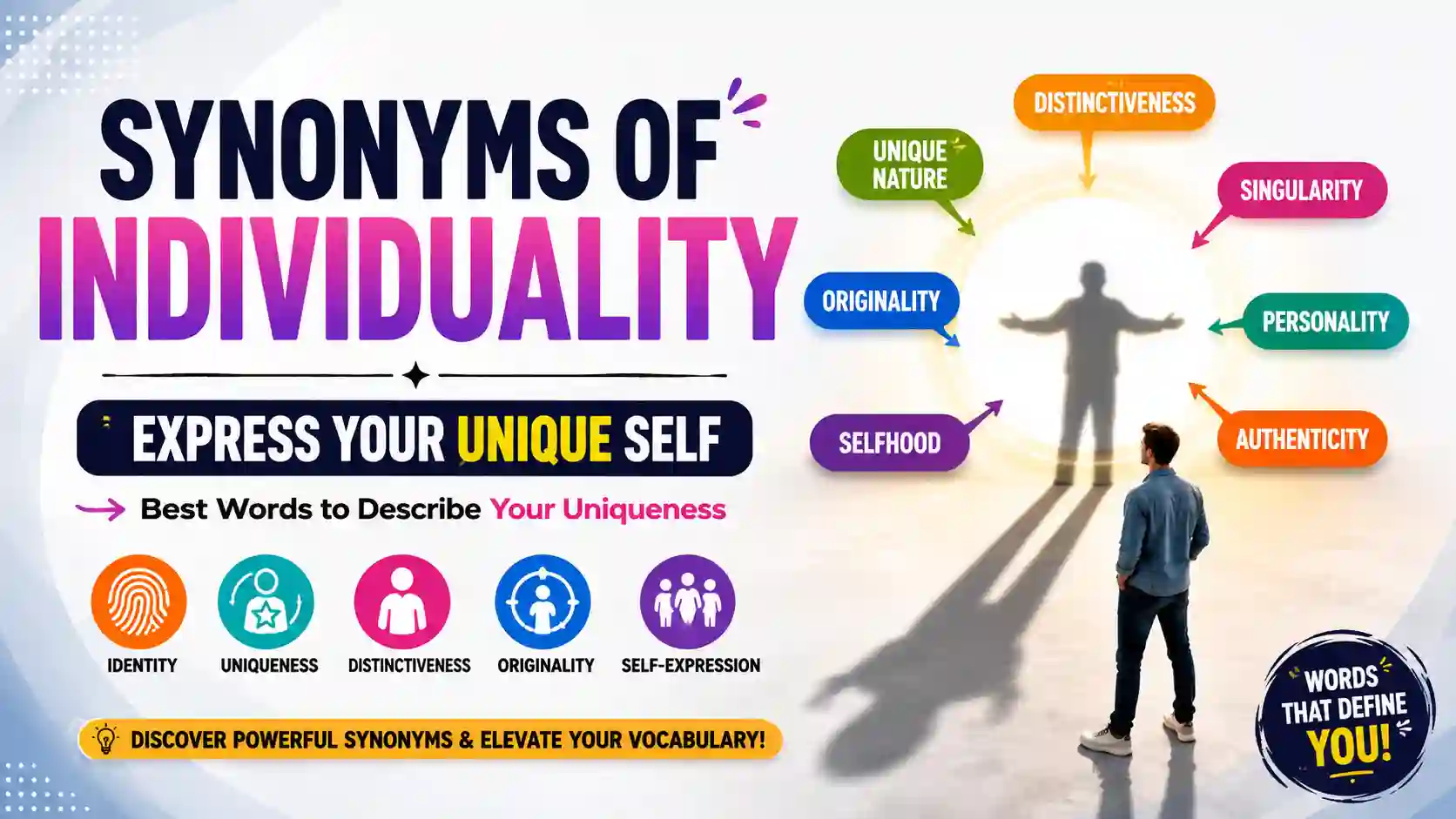
The closest synonyms of individuality are uniqueness, distinctiveness, personality, character, identity, originality, and singularity. However, they are not exact replacements in every sentence. Uniqueness stresses being one of a kind, personality focuses on personal traits, originality highlights creative thinking, and identity describes who someone is.
What Does Individuality Mean?
Have you ever noticed how two people can wear the same clothes but still seem completely different? That difference often comes from their individuality.
Individuality means the qualities that make a person or thing different from others. It can describe someone’s personality, personal style, creative voice, character, or other qualities that make them recognizable as an individual.
For example:
Her individuality is clear in the way she dresses and writes.
You can also use the word for things other than people:
Each room has its own individuality.
This makes individuality useful in essays, stories, business writing, fashion, art, education, and everyday English. Cambridge defines it as the qualities that make a person or thing different from others and marks the word at C2 level.
The important lesson is that not every word connected to individuality is a true synonym. The best choice depends on the exact meaning you want.
Pronunciation
Individuality
- UK IPA: /ˌɪn.dɪ.vɪdʒ.uˈæl.ə.ti/
- US IPA: /ˌɪn.də.vɪdʒ.uˈæl.ə.t̬i/
- Simple pronunciation: in-di-vij-oo-AL-uh-tee
The main stress falls on AL. Cambridge gives separate UK and US pronunciations.
American vs. British English
The spelling is the same in both varieties:
individuality
There is no standard American/British spelling difference. The main difference is pronunciation, especially the middle syllables and the American pronunciation of the t sound.
Part of Speech
Individuality is primarily a noun.
It is usually uncountable when talking about the general quality of being individual:
The school encourages individuality.
It can also be countable in some contexts when referring to distinct individual qualities or entities, although this use is less common:
The different characters have strong individualities.
Oxford lists both uncountable and countable uses.
Related word forms
- individual — noun/adjective
- individually — adverb
- individualistic — adjective
- individualism — noun
- individualize — verb
- individualization — noun
- individuation — noun
Grammar and Common Usage
Some of the most natural combinations with individuality are:
- express individuality
- show individuality
- develop individuality
- retain individuality
- preserve individuality
- celebrate individuality
- embrace individuality
- a sense of individuality
- a strong sense of individuality
- a lack of individuality
- personal individuality
Examples
The designer encourages customers to express their individuality.
The characters have plenty of personality and individuality.
The strict rules left little room for individuality.
Common pattern
express + possessive + individuality
She expresses her individuality through music.
a sense of individuality
Young people often develop a stronger sense of individuality as they grow older.
Synonyms of Individuality at a Glance
| Word | How close? | Main idea | Register |
| Uniqueness | Very close | Being one of a kind | Neutral |
| Distinctiveness | Very close | Being noticeably different | Formal/Neutral |
| Personality | Very close in personal contexts | Personal qualities and behavior | Neutral |
| Character | Close | Defining qualities | Neutral |
| Identity | Close | Who someone is | Neutral/Formal |
| Originality | Close in creative contexts | New or creative qualities | Neutral/Formal |
| Singularity | Close in formal contexts | Unusual uniqueness | Formal/Literary |
| Idiosyncrasy | Contextual | Unusual personal trait or habit | Formal/Neutral |
| Peculiarity | Contextual | Unusual feature | Neutral/Formal |
| Individualism | Related | Independence or individual-centered belief | Academic/Formal |
| Selfhood | Related | Individual sense of self | Academic/Literary |
| Distinctness | Related | State of being clearly different | Formal |
| Separateness | Related | State of being separate | Formal |
| Particularity | Related | A specific distinguishing quality | Formal/Academic |
The Closest Synonyms of Individuality
1. Uniqueness
Meaning: The quality of being unlike anything or anyone else.
Examples:
- The artist’s uniqueness makes her work easy to recognize.
- The product became popular because of its uniqueness.
Best used when: You want to emphasize that someone or something is one of a kind.
Tone: Neutral
CEFR: B2
Frequency: Common
Collocations: personal uniqueness, creative uniqueness, celebrate uniqueness
Nuance: This is one of the safest alternatives when the central idea is “different from everyone else.”
When not to use: Do not use it when you specifically mean someone’s behavior or personality.
2. Distinctiveness
Meaning: The quality of being clearly different and recognizable.
Examples:
- The brand’s distinctiveness comes from its simple design.
- Her voice has a remarkable distinctiveness.
Best used when: You want to emphasize recognizable differences.
Tone: Formal/Neutral
CEFR: C1
Frequency: Common
Collocations: visual distinctiveness, strong distinctiveness, distinctive style
Nuance: This is especially useful for brands, designs, writing, voices, and artistic work.
3. Personality
Meaning: The collection of qualities and behaviors that make a person who they are.
Examples:
- Her lively personality makes conversations enjoyable.
- His personality appears clearly in his writing.
Best used when: Talking about a person’s behavior, attitude, and social qualities.
Tone: Neutral
CEFR: B1
Frequency: Very common
Collocations: strong personality, friendly personality, outgoing personality
Nuance: Personality is a major part of individuality, but it is not always the whole idea.
Merriam-Webster explicitly lists personality among the close synonyms of individuality.
4. Character
Meaning: The qualities that define a person or thing.
Examples:
- Her strong character helped her overcome the challenge.
- The old building has a great deal of character.
Best used when: You mean defining qualities, especially moral or recognizable qualities.
Tone: Neutral
CEFR: B1
Frequency: Very common
Collocations: strong character, personal character, distinctive character
Nuance: Character can refer to moral strength as well as distinctive qualities.
5. Identity
Meaning: The qualities, beliefs, and characteristics that define who someone is.
Examples:
- Music became an important part of his identity.
- The company is trying to build a stronger identity.
Best used when: The focus is on who someone or something is.
Tone: Neutral/Formal
CEFR: B1
Frequency: Very common
Collocations: personal identity, cultural identity, brand identity
Nuance: Identity and individuality overlap, but identity focuses more on who you are, while individuality focuses more on what makes you different.
Merriam-Webster includes identity among the principal synonyms of individuality.
6. Originality
Meaning: The quality of being new, creative, or unlike earlier ideas.
Examples:
- The teacher admired the originality of her argument.
- His originality helped him create a fresh approach to the problem.
Best used when: Talking about writing, art, ideas, inventions, or creative work.
Tone: Neutral/Formal
CEFR: B2
Frequency: Common
Collocations: creative originality, artistic originality, originality of thought
Nuance: Originality is narrower than individuality. It focuses mainly on creative newness.
7. Singularity
Meaning: The quality of being unusual or uniquely distinctive.
Examples:
- The singularity of the design attracted attention.
- Her work has a remarkable singularity.
Best used when: Writing in a formal, literary, or analytical style.
Tone: Formal/Literary
CEFR: C1
Frequency: Uncommon
When not to use: Avoid it in simple everyday conversation when uniqueness or distinctiveness would sound more natural.
Cambridge’s thesaurus places individuality among the meanings related to singularity, including uniqueness and distinctiveness.
Context-Dependent Synonyms
8. Idiosyncrasy
Meaning: A personal habit or feature that is unusual and characteristic of someone.
Examples:
- One of his idiosyncrasies is writing notes in three different colors.
- Her unusual laugh became one of her best-known idiosyncrasies.
Best used when: You mean a particular quirky feature or habit.
Tone: Neutral/Formal
CEFR: C1
Frequency: Common
Important nuance: An idiosyncrasy is usually one unusual trait, not a person’s entire individuality.
9. Peculiarity
Meaning: An unusual or distinctive feature.
Examples:
- The old house has several charming peculiarities.
- His habit of speaking to himself was a harmless peculiarity.
Best used when: You want to point out something unusual.
Tone: Neutral/Formal
CEFR: C1
Frequency: Common
Nuance: It can carry a slightly negative or strange feeling, so it is not always a positive substitute.
10. Individualism
Meaning: A belief in the importance, independence, or freedom of the individual.
Examples:
- The book examines individualism in modern society.
- His strong individualism sometimes made group work difficult.
Best used when: Discussing independence, philosophy, politics, society, or personal freedom.
Tone: Academic/Formal
CEFR: C1
Frequency: Common
Important: Individualism is not the same as individuality.
Merriam-Webster defines individualism in terms of the importance of the individual and individual political or economic rights.
11. Selfhood
Meaning: The condition or experience of being a distinct self.
Examples:
- The novel explores questions of selfhood and belonging.
- The philosopher wrote about the nature of human selfhood.
Best used when: Discussing philosophy, literature, psychology, or personal identity.
Tone: Academic/Literary
CEFR: C2
Frequency: Uncommon
When not to use: It is usually too abstract for everyday conversation.
12. Distinctness
Meaning: The quality of being clearly separate or different.
Examples:
- The distinctness of the two styles is easy to see.
- The design has a visual distinctness that makes it memorable.
Best used when: Discussing clear differences.
Tone: Formal
CEFR: C1
Frequency: Uncommon
13. Separateness
Meaning: The condition of being separate or distinct from others.
Examples:
- The design creates a feeling of separateness between the two areas.
- She wanted to maintain a sense of separateness from the group.
Best used when: The main idea is being separate rather than being creative or personal.
Tone: Formal
CEFR: C1
Frequency: Uncommon
14. Particularity
Meaning: A specific feature or quality that belongs to a person or thing.
Examples:
- The writer pays attention to the particularity of each character.
- The study examines the particularities of regional speech.
Best used when: Writing academically about specific characteristics.
Tone: Academic/Formal
CEFR: C2
Frequency: Uncommon
15. Distinction
Meaning: A quality or feature that makes someone or something different.
Examples:
- The writer’s style has a clear distinction from earlier work.
- The design has a distinction that makes it easy to identify.
Best used when: Talking about a noticeable difference or defining feature.
Tone: Formal
CEFR: B2
Frequency: Very common
Caution: Distinction has several other meanings, including an honor or difference between two things, so context is important.
Words That Are Related, But Not Exact Synonyms
Some thesauruses include words such as temperament, disposition, nature, makeup, mannerism, and individuation. They are useful vocabulary, but they should not be treated as interchangeable with individuality.
Temperament
Describes a person’s natural emotional style.
Her calm temperament helps her deal with pressure.
Disposition
Describes someone’s usual mood or attitude.
He has a cheerful disposition.
Nature
Describes someone’s basic character or qualities.
Her curious nature led her to explore new subjects.
Makeup
Describes the combination of qualities that form a person’s character.
Her emotional makeup makes her highly sensitive.
Mannerism
Describes a particular repeated way of behaving, speaking, or moving.
Tapping his pen was one of his mannerisms.
Individuation
Describes a process of becoming a distinct individual, especially in psychological or academic contexts.
The study examines individuation during adolescence.
These words can contribute to individuality, but they do not all mean individuality itself.
Strongest Synonyms vs. Related Words
Strongest Synonyms
Use these when you want the closest general alternatives:
- uniqueness
- distinctiveness
- personality
- character
- identity
- originality
- singularity
Strong Contextual Synonyms
Use these only when the context matches:
- idiosyncrasy
- peculiarity
- individualism
- selfhood
- distinction
- particularity
Related Words
These are connected ideas rather than direct replacements:
- temperament
- disposition
- nature
- makeup
- mannerism
- individuation
- separateness
Choose the Right Synonym
This is the easiest way to select the correct word.
| What do you mean? | Best choice |
| Being one of a kind | Uniqueness |
| Being noticeably different | Distinctiveness |
| Personal behavior and qualities | Personality |
| Defining or moral qualities | Character |
| Sense of who you are | Identity |
| Creative newness | Originality |
| A strange personal habit | Idiosyncrasy |
| An unusual feature | Peculiarity |
| Independent thinking or philosophy | Individualism |
| A distinct sense of self | Selfhood |
| A formal idea of specific qualities | Particularity |
Compare these sentences
She expresses her individuality through fashion.
She expresses her uniqueness through fashion.
Both work.
But:
She expresses her originality through fashion.
This shifts the meaning toward creativity.
And:
She expresses her identity through fashion.
This shifts the focus toward who she is and how she presents herself.
That small difference is what makes synonym choice important.
Individuality vs. Uniqueness
Individuality describes the collection of qualities that make someone different.
Uniqueness strongly emphasizes being one of a kind.
His individuality is reflected in his music.
The uniqueness of his sound makes it memorable.
They overlap, but they are not identical.
Individuality vs. Personality
Personality focuses on behavior, emotions, attitudes, and social qualities.
Individuality is broader and can include personality, style, creativity, identity, and other distinguishing features.
Her friendly personality attracts people.
Her individuality is visible in her clothes, art, and personality.
Individuality vs. Identity
Identity answers:
Who am I?
Individuality answers:
What makes me different from others?
A person’s identity may include their culture, values, background, beliefs, and roles. Individuality emphasizes their distinctive qualities.
Individuality vs. Individualism
These two words are often confused.
Individuality = the qualities that make an individual different.
Individualism = a belief or approach that emphasizes individual freedom, independence, or interests.
Her individuality is obvious in her personal style.
The essay discusses individualism in modern society.
Merriam-Webster’s definitions make this distinction especially important for learners.
Common Mistakes
Common Mistake Box
Mistake 1
Wrong: His individualism is obvious because he has a unique personality.
Better: His individuality is obvious because he has a unique personality.
Why: The sentence describes a distinctive personal quality, not a philosophy of individual freedom.
Mistake 2
Wrong: Her individuality is her personality only.
Better: Her personality is one part of her individuality.
Why: Individuality is broader than personality.
Mistake 3
Wrong: Every synonym can replace individuality.
Better: Choose a synonym according to context.
Why: Originality, identity, personality, and individualism emphasize different ideas.
Mistake 4
Wrong: His individuality is very unique.
Better: His individuality is distinctive.
Why: In careful writing, unique means one of a kind. Although very unique is common in everyday English, distinctive is often more precise.
Natural Collocations With Individuality
Native English speakers commonly use individuality with verbs such as:
- express individuality
- show individuality
- embrace individuality
- celebrate individuality
- develop individuality
- preserve individuality
- retain individuality
- suppress individuality
- recognize individuality
Common noun phrases include:
- a sense of individuality
- a strong sense of individuality
- personal individuality
- artistic individuality
- individual style
- individuality and creativity
- individuality and freedom
Oxford specifically lists combinations such as express individuality, assert individuality, a sense of individuality, and a feeling of individuality.
Individuality in Different Types of Writing
In Academic Writing
Prefer precise words such as:
- distinctiveness
- identity
- individualism
- originality
- particularity
Example:
The study examines how social pressure can affect personal identity and individuality.
In Business Writing
Use:
- distinctiveness
- uniqueness
- identity
- originality
Example:
Brand distinctiveness helps a company stand out in a competitive market.
In Creative Writing
Use:
- individuality
- personality
- character
- originality
- uniqueness
Example:
The character’s individuality becomes clear through her unusual choices.
In Everyday Conversation
The most natural choices are usually:
- personality
- uniqueness
- character
- identity
Example:
I like her personality because she is not afraid to be herself.
Word Origin and First Known Use
Individuality is formed from individual + -ity.
Oxford gives its origin as early 17th century, from Medieval Latin individualitas.
Merriam-Webster records the first known use of individuality as 1600.
The deeper history connects individuals with Latin individuus, meaning something that cannot be divided. Over time, individuals developed meanings connected with a separate person or thing, while individuality came to describe the qualities associated with being an individual.
CEFR and Learner Guide
CEFR labels should be treated as practical learner guidance rather than absolute rules for every dictionary or language test.
| Word | Approx. level | Learning advice |
| Personality | B1 | Learn early |
| Character | B1 | Very useful |
| Identity | B1 | Very useful |
| Uniqueness | B2 | Useful general synonym |
| Originality | B2 | Useful for writing |
| Distinction | B2 | Useful in formal writing |
| Individuality | C2 | Advanced vocabulary |
| Distinctiveness | C1 | Useful for formal writing |
| Individualism | C1 | Learn its special meaning |
| Idiosyncrasy | C1 | Useful advanced word |
| Peculiarity | C1 | Learn its negative nuance |
| Singularity | C1/C2 | Mostly formal |
| Selfhood | C2 | Mainly academic/literary |
| Particularity | C2 | Mainly formal/academic |
Cambridge classifies individuality itself as C2.
Antonyms of Individuality
Depending on context, possible opposites include:
- sameness
- conformity
- uniformity
- similarity
- commonality
- conventionality
- likeness
Example
The strict rules left little room for individuality.
Here, conformity or uniformity can express the opposite idea.
Thesaurus.com lists words such as likeness, normality, sameness, and similarity among the stronger antonyms.
Word Family
| Word | Part of speech | Meaning |
| individual | noun/adjective | A single person or something distinctive |
| individually | adverb | Separately or one at a time |
| individuality | noun | Distinctive personal qualities |
| individualistic | adjective | Emphasizing independence or individual qualities |
| individualism | noun | Belief in individual freedom or importance |
| individualize | verb | Make something suited to an individual |
| individualization | noun | Process of making something individual |
| individuation | noun | Process of becoming distinct |
Mini Practice Exercises
Exercise 1: Fill in the Blanks
Choose from uniqueness, personality, originality, identity, and individualism.
- Her friendly ________ makes people feel welcome.
- The artist’s ________ is visible in every painting.
- His cultural ________ is important to him.
- The designer’s ________ helped create a fresh style.
- The book discusses ________ and personal freedom.
Answers
- personality
- individuality
- identity
- originality
- individualism
Exercise 2: Choose the Best Synonym
1. The artist’s work is different from everything else.
A. Temperament
B. Uniqueness
C. Disposition
D. Selfhood
Answer: B
2. Her cheerful way of behaving is part of her ________.
A. personality
B. singularity
C. separateness
D. particularity
Answer: A
3. The essay discusses a person’s sense of who they are.
A. peculiarity
B. identity
C. originality
D. mannerism
Answer: B
4. His unusual habit of organizing books by color is an ________.
A. identity
B. individualism
C. idiosyncrasy
D. originality
Answer: C
5. The article discusses freedom and the importance of the individual.
A. personality
B. individualism
C. uniqueness
D. character
Answer: B
Exercise 3: Rewrite the Sentence
Replace individuality with the best alternative.
Sentence 1
The designer’s individuality makes the collection memorable.
Best alternative:
The designer’s distinctiveness makes the collection memorable.
Sentence 2
Her individuality appears in her creative writing.
Best alternative:
Her originality appears in her creative writing.
Sentence 3
His individuality is easy to see when he talks to people.
Best alternative:
His personality is easy to see when he talks to people.
Notice that the best answer changes according to the meaning.
Exercise 4: Match the Word With the Meaning
| Word | Meaning |
| 1. Uniqueness | A. Creative newness |
| 2. Originality | B. Being one of a kind |
| 3. Identity | C. Who someone is |
| 4. Idiosyncrasy | D. An unusual personal habit |
Answer Key
1-B, 2-A, 3-C, 4-D
FAQ: Synonyms of Individuality
What is the best synonym for individuality?
The best general synonym is usually uniqueness or distinctiveness. However, the choice depends on context. Use personality for personal behavior, originality for creative work, and identity for the qualities that define who someone is.
Is uniqueness the same as individuality?
Not exactly. Uniqueness emphasizes being one of a kind, while individuality refers more broadly to the qualities that make someone or something different. A person’s style, personality, character, and creative expression can all contribute to their individuality.
What is a formal synonym for individuality?
Distinctiveness is one of the most useful formal alternatives. Depending on context, singularity, particularity, selfhood, or distinctness may also work. However, these words carry more specific meanings, so they should not automatically replace individuality.
What is another word for individuality in a person?
Common choices include personality, character, uniqueness, identity, and distinctiveness. Personality is best when discussing behavior, while identity is better when discussing someone’s sense of who they are.
Is individualism a synonym for individuality?
They are related but not identical. Individuality describes the distinctive qualities of a person or thing. Individualism often refers to a belief in individual freedom, independence, or the importance of individual interests.
What is the opposite of individuality?
Common opposites include conformity, sameness, uniformity, similarity, and commonality. The best choice depends on the context. Conformity is especially useful when people are expected to behave like others.
Can individuality describe objects?
Yes. Individuality can describe people, objects, rooms, buildings, designs, works of art, writing, brands, and other things with distinctive qualities. Oxford provides examples involving characters, songs, pictures, and buildings.
What is the difference between individuality and personality?
Personality describes the characteristic ways a person thinks, feels, and behaves. Individuality is broader and describes the qualities that make someone distinct from others. Personality can therefore be one important part of individuality.
Final Vocabulary Takeaway
The safest way to remember the main synonyms is:
Individuality → what makes someone different
Uniqueness → being one of a kind
Distinctiveness → being noticeably different
Personality → personal behavior and qualities
Character → defining qualities
Identity → who someone is
Originality → creative newness
Idiosyncrasy → an unusual personal trait
Individualism → independence or individual-centered thinking
Learning these distinctions will help you avoid awkward thesaurus substitutions and make your English more precise.
Conclusion
The best synonyms of individuality depend on what you want to express. Use uniqueness for something one of a kind, distinctiveness for a noticeable difference, personality for personal behavior, identity for a sense of self, and originality for creative ideas.
Do not simply replace a word because a thesaurus lists it. Think about the exact meaning first. Practice these words in essays, emails, blog posts, professional writing, and conversations, and your vocabulary will become clearer, richer, and more natural.
References
- Cambridge Dictionary, Individuality: definition, pronunciation, CEFR level, and corpus examples.
- Merriam-Webster, Individuality: definition, synonyms, first known use, and word history.
- Collins English Thesaurus, Individuality: synonym groupings for character, personality, originality, and peculiarity.
- Thesaurus.com, Individuality: strongest, strong, and weaker synonym groupings and antonyms.
- Oxford Learner’s Dictionaries, Individuality: definition, word origin, usage examples, and collocations.

Synonorm is a trusted English vocabulary resource created to help readers find the right words and understand the differences between similar terms. We provide clear explanations of synonyms, meanings, examples, usage, and alternatives. Our content makes vocabulary easier to learn and apply in everyday, academic, and professional English. Synonorm is designed for students, writers, ESL learners, professionals, and anyone who wants to improve their English vocabulary and communicate more clearly.