Quick Answer
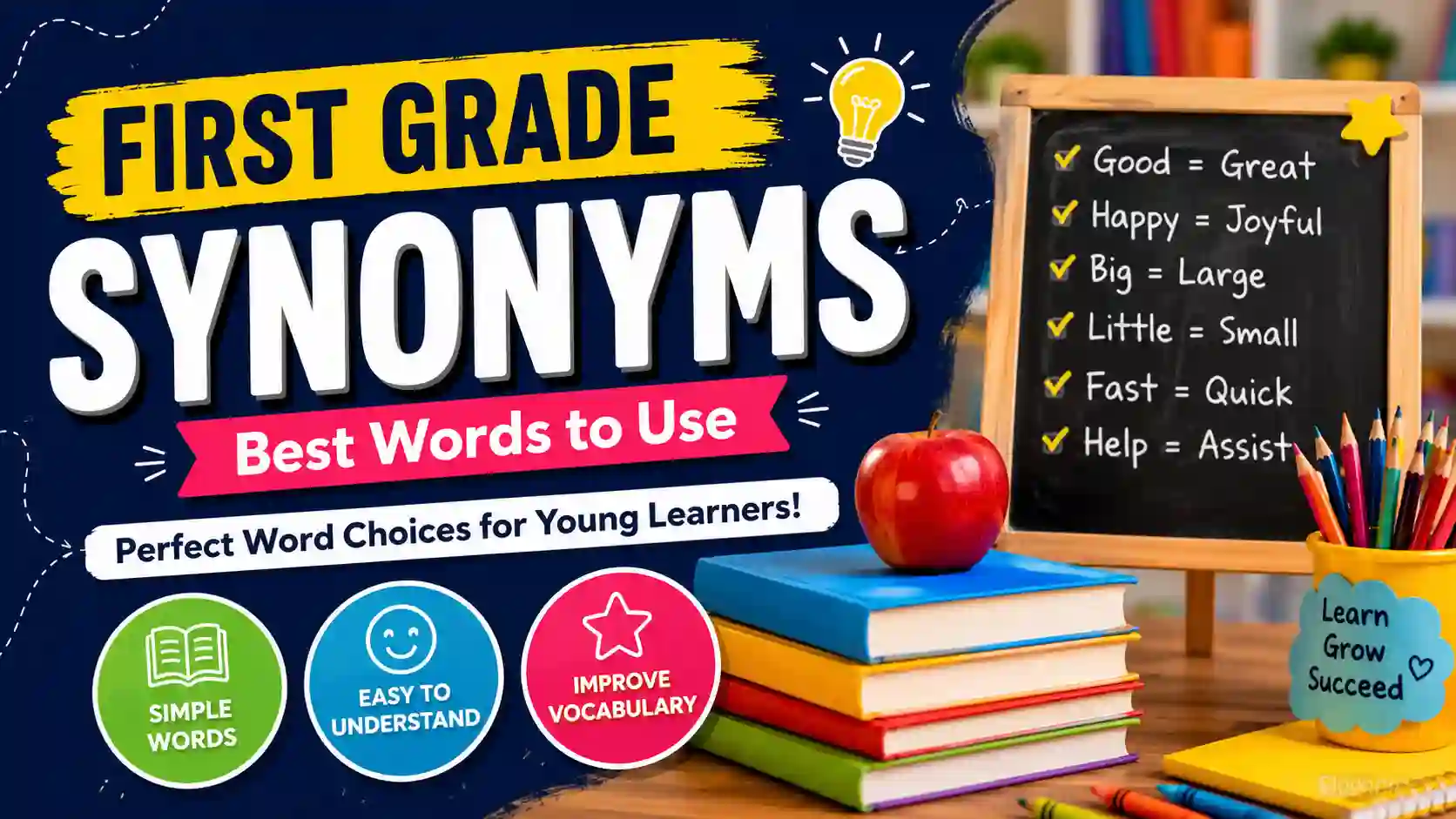
First grade synonyms are easy words that have the same or almost the same meaning. For example, big and large, happy and glad, and fast and quick are common synonym pairs. Learning synonyms helps first graders build vocabulary, understand stories, improve reading, and choose better words when they speak and write.
What Are First Grade Synonyms?
Have you ever used the word big again and again?
You could say:
- a big dog
- a large dog
Both sentences tell us that the dog has a lot of size.
Words like big and large are called synonyms. A synonym is a word that has the same or almost the same meaning as another word.
For first graders, the best synonyms are simple words that children can understand, recognize while reading, and use in everyday sentences.
Some useful examples are:
- big → large
- small → little
- happy → glad
- fast → quick
- angry → mad
- start → begin
- gift → present
- easy → simple
- hard → difficult
- scared → afraid
But there is an important rule:
Synonyms are not always exact twins.
Some words are very close in meaning, while others are only related. That is why this guide explains not just which words are connected, but when each word works naturally.
First Grade Synonyms Word List
Here are 50 useful synonym pairs for young learners.
| Easy Word | Synonym or Close Match | Type |
| big | large | Close synonym |
| small | little | Close synonym |
| happy | glad | Close synonym |
| sad | unhappy | Close synonym |
| fast | quick | Close synonym |
| slow | unhurried | Related |
| angry | mad | Close synonym |
| scared | afraid | Close synonym |
| smart | clever | Near synonym |
| pretty | beautiful | Near synonym |
| funny | amusing | Near synonym |
| easy | simple | Close synonym |
| hard | difficult | Close synonym |
| start | begin | Close synonym |
| end | finish | Related/overlapping |
| gift | present | Close synonym |
| sick | ill | Close synonym |
| quiet | silent | Near synonym |
| loud | noisy | Near synonym |
| little | small | Close synonym |
| jump | leap | Near synonym |
| hop | jump | Related |
| talk | speak | Near synonym |
| shout | yell | Close synonym |
| look | see | Related |
| shut | close | Close synonym |
| choose | pick | Close synonym |
| help | aid | Close synonym |
| child | kid | Near synonym |
| friend | buddy | Near synonym |
| house | home | Related |
| road | street | Related |
| job | work | Related |
| answer | reply | Near synonym |
| ask | question | Related |
| make | create | Near synonym |
| fix | repair | Close synonym |
| buy | purchase | Close synonym |
| get | receive | Related |
| give | offer | Related |
| clean | tidy | Near synonym |
| cold | chilly | Near synonym |
| wet | damp | Near synonym |
| old | aged | Near synonym |
| nice | kind | Related |
| mean | unkind | Related |
| brave | bold | Near synonym |
| afraid | frightened | Close synonym |
| tired | sleepy | Related |
| start | open | Related in some contexts |
Teacher tip: Do not ask children to memorize all 50 words at once. Start with five or six pairs and practice them in sentences.
20 Best First Grade Synonyms With Examples
1. Big → Large
Meaning: Something has a lot of size.
Examples:
- The elephant is big.
- The elephant is large.
Best used when: Talking about size.
Common collocations:
- big dog
- big house
- large animal
Note: These are very close synonyms, but English has fixed phrases where one sounds more natural.
2. Small → Little
Meaning: Something does not have much size.
Examples:
- I found a small shell.
- I found a little shell.
Best used when: Talking about size.
Nuance: Little can sound warmer or more affectionate.
- a small dog
- a little puppy
3. Happy → Glad
Meaning: Feeling good or pleased.
Examples:
- I am happy today.
- I am glad you came.
Best used when: Talking about positive feelings.
Important difference: Glad is especially common when someone feels pleased about something that happened.
4. Fast → Quick
Meaning: Moving or happening at a high speed.
Examples:
- The rabbit is fast.
- The rabbit made a quick move.
Best used when: Talking about speed or something that happens in a short time.
Remember:
Fast often describes speed.
Quick can describe speed or a short action.
5. Angry → Mad
Meaning: Feeling upset or unhappy about something.
Examples:
- Dad was angry.
- Dad was mad about the mess.
American English: Mad commonly means angry.
British English: Mad can also have another meaning related to mental illness or irrational behavior, so anger can be clearer in formal contexts.
6. Scared → Afraid
Meaning: Feeling fear.
Examples:
- The child was scared.
- The child was afraid.
Best used when: Talking about fear.
Natural patterns:
- scared of the dark
- afraid of dogs
- afraid to ask
7. Start → Begin
Meaning: To do something from its beginning.
Examples:
- Let’s start the game.
- Let’s begin the game.
Nuance: Start is more common in everyday speech. Begin can sound a little more formal.
8. Easy → Simple
Meaning: Not difficult.
Examples:
- The puzzle is easy.
- The puzzle is simple.
Important difference: Simple can mean uncomplicated. Easy focuses more directly on difficulty.
9. Hard → Difficult
Meaning: Not easy.
Examples:
- This question is hard.
- This question is difficult.
Best used when: Talking about something that needs effort or thought.
Remember: Hard has many meanings. It can also describe something physically solid.
10. Gift → Present
Meaning: Something given to another person.
Examples:
- I got a gift.
- I got a present.
Both words are common in American and British English.
Common collocations:
- birthday gift
- birthday present
- Christmas gift
- Christmas present
11. Shut → Close
Meaning: To move something into a position where an opening is covered.
Examples:
- Please shut the door.
- Please close the door.
Nuance: Close is usually the safer and more neutral choice. Shut can sound stronger depending on the situation.
12. Sick → Ill
Meaning: Not feeling well or having an illness.
Examples:
- Tom is sick.
- Tom is ill.
Usage: Both are common, but their everyday use varies by region and context.
Remember: Do not treat every meaning of sick and ill as identical.
13. Shout → Yell
Meaning: To speak very loudly.
Examples:
- Do not shout in class.
- Do not yell in class.
These are close synonyms in many everyday situations.
Common collocations:
- shout loudly
- yell loudly
- shout for help
14. Choose → Pick
Meaning: To select one thing from several choices.
Examples:
- Please choose a book.
- Please pick a book.
Nuance: Pick is more conversational. Choose is neutral and works well in school writing.
15. Help → Aid
Meaning: To make something easier for someone.
Examples:
- Can you help me?
- The guide gave aid to the hikers.
Important: Although these words overlap, help is much more natural for first-grade everyday speech.
Teacher tip: Teach help first. Introduce aid later.
16. Smart → Clever
Meaning: Good at thinking and solving problems.
Examples:
- Mia is smart.
- Mia had a clever idea.
Nuance: Clever often suggests that someone found a smart or creative solution.
17. Pretty → Beautiful
Meaning: Nice or pleasing to look at.
Examples:
- She has a pretty dress.
- She has a beautiful dress.
Nuance: Beautiful is often stronger than pretty.
This is a good example of shades of meaning, where two words overlap but are not always equal in strength.
18. Talk → Speak
Meaning: To use words to communicate.
Examples:
- We talk every day.
- We speak every day.
Nuance: Talk is especially common in casual conversation. Speak is often preferred in more formal situations.
Compare:
- Talk to your friend.
- Speak to the teacher.
19. Quiet → Silent
Meaning: Having little or no sound.
Examples:
- The room is quiet.
- The room is silent.
Important difference: Silent is stronger. A silent room has no sound, while a quiet room may have very little sound.
20. Fix → Repair
Meaning: To make something work properly again.
Examples:
- Dad will fix the bike.
- Dad will repair the bike.
Nuance: Fix is the everyday word. Repair sounds more formal and is common when discussing machines, vehicles, or equipment.
Synonyms vs Related Words
This is one of the most important lessons for young learners.
Not every word with a similar idea is a true synonym.
Close synonyms
These can often replace one another:
big → large
happy → glad
start → begin
Near synonyms
These overlap but can have different uses:
smart → clever
pretty → beautiful
talk → speak
Related words
These are connected but are not always interchangeable:
house → home
look → watch
jump → hop
wet → damp
funny → silly
Cambridge defines a synonym as a word with the same or almost the same meaning, which is why context matters.
Shades of Meaning for First Graders
First-grade vocabulary can go beyond simple “same meaning” pairs.
Consider these words:
walk → march → run
They all describe movement, but they do not mean exactly the same thing.
Another example:
look → stare → glare
- look = use your eyes to see
- stare = look for a long time
- glare = look angrily
This idea is called a shade of meaning.
Common Core Grade 1 vocabulary guidance includes understanding word relationships, real-life connections, and differences in meaning among words.
Try This
Put these words in order from gentle to strong:
walk, jog, run, sprint
A possible order is:
walk → jog → run → sprint
This kind of activity helps children understand vocabulary instead of simply memorizing lists.
Commonly Confused Synonyms
| Word Pair | What Is Different? | Example |
| house / home | A house is a building; home has a stronger connection to where someone lives | My house is my home. |
| look / watch | Look can be brief; watch often involves observing for a period | Look at the bird. Watch the bird fly. |
| talk / speak | Both men communicate, but their patterns and formality differ | We talked at lunch. |
| big / large | Usually close, but some expressions strongly prefer one | That was a big mistake. |
| funny / silly | Funny usually causes laughter; silly can mean playful or foolish | The joke was funny. |
Common First Grade Synonym Mistakes
Mistake 1: Thinking every similar word is interchangeable
Wrong idea:
House and home always mean exactly the same thing.
Better understanding:
They are related, but home often carries the idea of belonging or where someone lives.
Mistake 2: Using a stronger word without checking the meaning
Wrong idea:
Cold = freezing.
Better understanding:
Freezing describes extremely cold conditions or temperatures around the freezing point. It is not simply another everyday word for every use of cold.
This is an important correction because some worksheet resources list words such as freezing as a synonym for cold, but that is better understood as a stronger or related expression.
Mistake 3: Using formal words in casual speech
I need assistance.
This is grammatically correct, but:
I need help.
is much more natural for a young learner.
Mistake 4: Replacing words just to avoid repetition
Good writing does not require a different word every time.
For example:
The big dog ran toward the big gate.
You do not have to replace the second big with large just because it appears twice.
Clear writing is more important than forced variety.
First Grade Synonym Activities
Competitors do a good job with matching and fill-in-the-blank activities. Education.com, Twinkl, and Kuraplan all use classroom-friendly exercises such as matching, selecting answers, and completing sentences.
Here are additional activities that build deeper understanding.
Activity 1: Match the Words
Match each word with its close synonym.
- happy
- big
- fast
- start
- scared
A. large
B. begin
C. afraid
D. glad
E. quick
Answers:
1-D, 2-A, 3-E, 4-B, 5-C
Activity 2: Choose the Best Word
1. The elephant is very ________.
A. little
B. large
C. quiet
D. cold
Answer: B
2. Please ________ the door.
A. close
B. large
C. happy
D. quick
Answer: A
3. I am ________ that you came.
A. damp
B. glad
C. difficult
D. silent
Answer: B
Fill in the Blank Practice
Use these words:
large, glad, quick, begin, afraid
- The elephant is very ________.
- I am ________ to see you.
- The rabbit made a ________ jump.
- We will ________ our lesson.
- The little boy was ________ of the dark.
Answers
- large
- glad
- quick
- begin
- afraid
Rewrite the Sentence
Replace the bold word with a close synonym.
- The box is big.
- Sarah is happy.
- The car is fast.
- We will start the lesson.
- The boy was scared.
Possible Answers
- The box is large.
- Sarah is glad.
- The car is quick.
- We will begin the lesson.
- The boy was afraid.
More than one answer can sometimes work. The goal is to choose a word that fits the sentence naturally.
A Simple Way to Teach Synonyms
Parents and teachers can use this four-step method.
Step 1: Start with a familiar word
Example:
big
Step 2: Introduce one new word
large
Step 3: Put both into sentences
The dog is big.
The dog is large.
Step 4: Ask a meaning question
Ask:
Do both sentences tell us that the dog has a lot of size?
If the child says yes, they understand the relationship.
Then move to another pair.
Best Synonyms for First Grade Writing
For early writing, prioritize words children can actually understand and use.
Size
- big
- large
- small
- little
- huge
Feelings
- happy
- glad
- sad
- angry
- mad
- scared
- afraid
Movement
- walk
- run
- jump
- hop
- hurry
Communication
- talk
- speak
- shout
- yell
Actions
- start
- begin
- end
- finish
- choose
- pick
- help
- fix
American vs British English
The phrase first grade is especially common in American English.
British English usually uses Year 1 for the comparable school year.
This means:
American English:
“I am in first grade.”
British English:
“I am in Year 1.”
The vocabulary itself can be used by learners in both varieties of English. The main difference is the school-system terminology.
Synonyms, Antonyms, and Related Words
It is useful to teach these concepts together.
Synonyms
Words with the same or almost the same meaning.
big → large
Antonyms
Words with opposite meanings.
big → small
Related words
Words connected in meaning but not necessarily interchangeable.
house → home
This three-way comparison helps children avoid treating every vocabulary relationship as a synonym.
Easy Antonyms to Learn With Synonyms
| Word | Synonym | Antonym |
| big | large | small |
| happy | glad | sad |
| fast | quick | slow |
| hot | warm | cold |
| easy | simple | hard |
| loud | noisy | quiet |
| start | begin | finish |
| pretty | beautiful | ugly |
| old | aged | young |
| clean | tidy | dirty |
Vocabulary Quiz
1. Which word means almost the same as happy?
A. Glad
B. Angry
C. Cold
D. Small
2. Which word is closest to begin?
A. End
B. Start
C. Finish
D. Stop
3. Which word is more informal?
A. Child
B. Kid
C. Purchase
D. Assist
4. Which pair shows related words rather than exact replacements?
A. big / large
B. happy / glad
C. house / home
D. start / begin
5. Which word means “not difficult”?
A. Hard
B. Simple
C. Angry
D. Loud
Answer Key
- A. Glad
- B. Start
- B. Kid
- C. House / home
- B. Simple
Frequently Asked Questions
What are first grade synonyms?
First grade synonyms are easy words with the same or nearly the same meaning that young learners can understand and use. Examples include big/large, happy/glad, fast/quick, start/begin, and scared/afraid. They help children develop vocabulary, reading comprehension, and writing skills.
What are some easy synonyms for first graders?
Easy synonym pairs include big/large, small/little, happy/glad, fast/quick, angry/mad, scared/afraid, start/begin, gift/present, easy/simple, and hard/difficult. Children should learn these words in sentences because similar words are not always interchangeable.
Why are synonyms important in first grade?
Synonyms help children recognize different ways to express the same basic idea. First-grade vocabulary resources use activities such as matching, selecting words, sentence completion, and vocabulary games to develop these skills.
Are big and large synonyms?
Yes. Big and large are close synonyms when they describe size. For example, “a big dog” and “a large dog” have nearly the same meaning. However, English has fixed expressions where one word may sound more natural than the other.
Are house and home synonyms?
They are closely related, but they are not always interchangeable. House usually refers to a physical building, while home can refer to the place where someone lives and feels a sense of belonging. For example, “This is my house” and “This is my home” can express slightly different ideas.
What is the difference between synonyms and antonyms?
Synonyms have the same or nearly the same meaning, while antonyms have opposite meanings. For example, happy/glad are synonyms, while happy/sad are antonyms. Teaching both relationships helps children understand how words connect.
What is first grade called in British English?
The school year commonly called first grade in the United States is generally called Year 1 in British English. School systems differ, so the exact ages and structures can vary between countries.
How can I teach synonyms to a first grader?
Start with familiar words such as big, happy, and fast. Introduce one close synonym for each, put both words into short sentences, and then use matching, picture activities, sentence completion, and simple rewriting exercises. This gives children repeated practice without making vocabulary feel difficult.
Final Takeaway
Learning synonyms is not about finding the biggest or fanciest word. It is about understanding that English gives us different ways to express similar ideas. Start with easy pairs such as big/large, happy/glad, fast/quick, and start/begin. Then help children notice small differences between related words.
The best first grade synonym lesson is simple: Learn the word. See it in a sentence. Compare it with a similar word. Use it yourself. With regular practice, children can build stronger vocabulary, become better readers, and feel more confident when they write and speak.
Sources Used for Verification
- Cambridge Dictionary, Synonym.
- Merriam-Webster, Synonym and etymology.
- Education.com, 1st Grade Synonyms Resources.
- Twinkl, Grade 1 Synonyms and Antonyms Resources and Common Core L.1.5 guidance.
- Kuraplan, First Grade Synonyms Worksheet.

Synonorm is a trusted English vocabulary resource created to help readers find the right words and understand the differences between similar terms. We provide clear explanations of synonyms, meanings, examples, usage, and alternatives. Our content makes vocabulary easier to learn and apply in everyday, academic, and professional English. Synonorm is designed for students, writers, ESL learners, professionals, and anyone who wants to improve their English vocabulary and communicate more clearly.