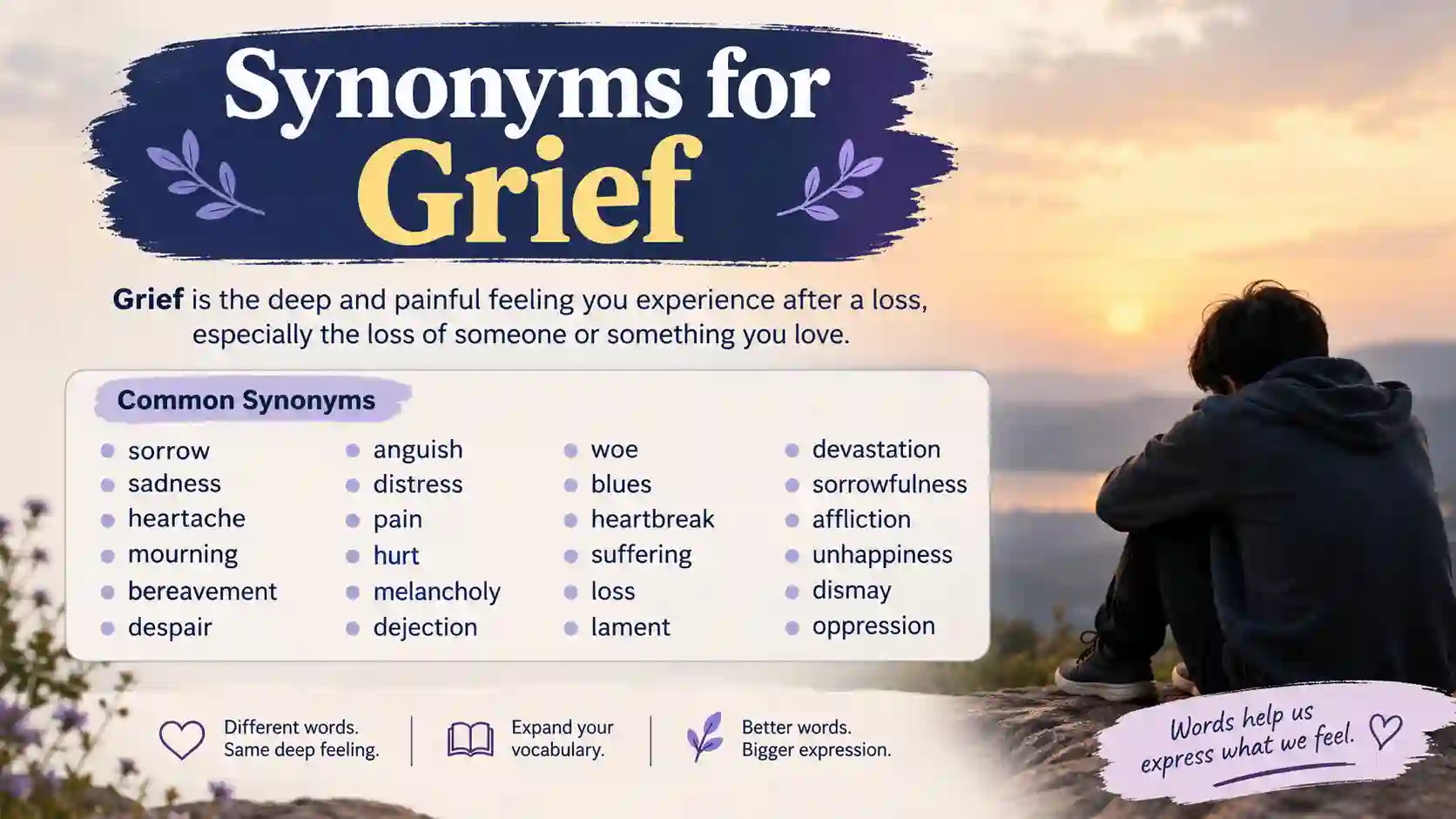
Quick Answer: What Are Synonyms for Grief?
Common synonyms for grief include sorrow, sadness, anguish, heartache, heartbreak, distress, misery, and suffering. Sorrow is a close general alternative, anguish describes intense emotional pain, and heartache often relates to personal loss. Bereavement refers specifically to losing someone through death, while mourning describes the process of expressing grief.
Have you ever struggled to find the right words to describe sadness after losing someone you love? English has many words for emotional pain, but each one expresses a slightly different feeling.
Synonyms for grief help you explain these feelings more clearly. You might feel sorrow after a personal loss, heartache after a painful breakup, or anguish while waiting for news about someone you love.
Choosing the right word also makes your writing more natural. Students can express emotions more precisely in essays. Bloggers can avoid unnecessary repetition, and English learners can improve their speaking and writing skills.
This guide explains 20 useful words related to grief. You will learn their meanings, examples, common expressions, differences, and correct usage. It also includes grammar tips, a vocabulary quiz, and practical exercises.
Pronunciation of Grief
- Word: Grief
- IPA: /ɡriːf/
- Pronunciation: GREEF
- Part of speech: Noun
- Plural: Griefs, although the singular uncountable form is much more common.
Grief means deep emotional pain, especially after a significant loss or someone’s death.
Part of Speech and Grammar
Grief is mainly an uncountable noun.
- Correct: She felt deep grief after her father’s death.
- Correct: He struggled with grief for several months.
- Incorrect: She felt many griefs after the loss.
- Better: She experienced a great deal of grief after the loss.
The related verb grieve means to feel or express deep sorrow. Grieving describes someone experiencing grief or the act of grieving.
| Word | Part of speech | Example |
| Grief | Noun | Her grief was difficult to express. |
| Grieve | Verb | They continue to grieve for their friend. |
| Grieving | Verb form or adjective | The grieving family received support. |
| Grief-stricken | Adjective | His grief-stricken sister sat quietly. |
Common grammar patterns
- Grief over a loss: She spoke about her grief over the loss.
- Grief at the news: They expressed grief at the news.
- Grieve for someone: He continues to grieve for his mother.
- Grieve over something: She grieved over the end of their friendship.
Word Origin and Etymology
The English word grief came through Old French and Middle English. Its history connects it with hardship, injury, or a serious burden. The related Latin word gravis means “heavy” or “serious.”
Over time, grief became strongly associated with deep sorrow and emotional suffering. Historical dictionaries document its development across earlier stages of English, although the earliest recorded date depends on the sense being examined.
Quick Comparison: Synonyms for Grief
| Synonym | Main meaning | Tone |
| Sorrow | Deep sadness | Neutral |
| Sadness | General unhappiness | Neutral |
| Anguish | Intense emotional pain | Formal |
| Heartache | Personal emotional hurt | Neutral |
| Heartbreak | Severe emotional pain | Neutral |
| Distress | Sadness, worry, or upset | Formal |
| Misery | Great unhappiness | Neutral |
| Suffering | Physical or emotional pain | Neutral |
| Despair | Loss of hope | Neutral |
| Melancholy | Quiet, reflective sadness | Literary |
| Agony | Extreme pain | Strong, dramatic |
| Bereavement | Loss through death | Formal |
| Mourning | Process of expressing grief | Neutral |
| Woe | Deep sadness or trouble | Literary |
| Regret | Sadness about something that happened | Neutral |
| Dejection | Sadness after disappointment | Formal |
| Dismay | Shock or disappointment | Neutral |
| Torment | Severe, ongoing suffering | Strong |
| Desolation | Emptiness and deep sadness | Literary |
| Lament | An expression of sorrow | Literary |
These descriptions show typical usage, not a fixed ranking of emotional intensity. Context determines which word fits best.
20 Synonyms for Grief Explained
1. Sorrow
Meaning: Sorrow is deep sadness, often caused by loss or disappointment.
Examples:
- She felt great sorrow after losing her closest friend.
- The old song reminded him of a painful time.
Best used when: You need a natural alternative to grief.
Tone: Neutral, sometimes literary.
Common collocations: deep sorrow, great sorrow, sorrow and loss.
Frequency: Very common.
CEFR guidance: Approximate B1–B2.
Nuance: Sorrow covers many painful experiences, while grief often suggests a major loss.
When not to use it: Avoid it when you mean mild annoyance rather than sadness.
2. Sadness
Meaning: Sadness is the feeling of being unhappy or upset.
Examples:
- She hid her sadness behind a cheerful smile.
- A feeling of sadness filled the room.
Best used when: You need a simple word for everyday conversation.
Tone: Neutral.
Common collocations: deep sadness, overwhelming sadness, feelings of sadness.
Frequency: Very common.
CEFR guidance: Approximate A2.
Nuance: Sadness can be mild or serious. Grief usually relates to a significant loss.
When not to use it: Choose a more precise word when the context involves intense suffering or bereavement.
3. Anguish
Meaning: Anguish is severe mental or emotional pain.
Examples:
- His face showed the anguish he felt after the accident.
- She waited in anguish for news about her missing brother.
Best used when: You want to emphasize intense suffering.
Tone: Formal, expressive.
Common collocations: deep anguish, emotional anguish, anguish over a loss.
Frequency: Common.
CEFR guidance: Approximate C1.
Nuance: Anguish can involve fear, helplessness, and uncertainty as well as sadness.
When not to use it: Avoid it for small disappointments.
4. Heartache
Meaning: Heartache is deep emotional pain, often connected to love or personal loss.
Examples:
- The end of their friendship brought her years of heartache.
- He wrote a poem about the heartache of leaving home.
Best used when: You describe personal hurt or emotional longing.
Tone: Neutral, expressive.
Common collocations: deep heartache, years of heartache, love and heartache.
Frequency: Common.
CEFR guidance: Approximate B2.
Nuance: Heartache feels personal and often relates to close relationships.
When not to use it: Avoid it in formal reports when emotional distress would be more precise.
5. Heartbreak
Meaning: Heartbreak is extreme sadness caused by loss or disappointment.
Examples:
- Their sudden separation caused real heartbreak.
- The team faced heartbreak after losing the final.
Best used when: You want to describe a painful emotional blow.
Tone: Neutral.
Common collocations: deep heartbreak, experience heartbreak, heartbreak and loss.
Frequency: Common.
CEFR guidance: Approximate B2.
Nuance: Heartbreak often suggests a painful personal experience but can also describe grief after a death.
When not to use it: Do not assume it refers only to romantic relationships.
6. Distress
Meaning: Distress is a state of worry, sadness, or emotional pain.
Examples:
- The family showed visible distress after hearing the news.
- Her sudden silence caused distress among her friends.
Best used when: You need a broad term for emotional suffering.
Tone: Formal, academic, professional.
Common collocations: emotional distress, severe distress, cause distress.
Frequency: Very common.
CEFR guidance: Approximate B2.
Nuance: Distress can include fear and worry, not just sorrow.
When not to use it: Do not use it when you specifically mean the process of mourning.
7. Misery
Meaning: Misery is a state of great unhappiness or suffering.
Examples:
- He struggled with misery after losing his home.
- The lonely winter brought her months of misery.
Best used when: You describe prolonged unhappiness or difficult conditions.
Tone: Neutral.
Common collocations: deep misery, living in misery, misery and suffering.
Frequency: Common.
CEFR guidance: Approximate B2.
Nuance: Misery can describe both a painful emotional state and harsh living conditions.
When not to use it: Avoid it if you want a gentle, understated description of someone’s feelings.
8. Bereavement
Meaning: Bereavement is the experience of losing someone through death.
Examples:
- She took time away from work following a bereavement.
- The school offered support to children experiencing bereavement.
Best used when: You discuss death-related loss or support services.
Tone: Formal, professional.
Common collocations: bereavement leave, bereavement support, experience bereavement.
Frequency: Common in relevant contexts.
CEFR guidance: Approximate C1.
Nuance: Bereavement describes the loss or the state of having lost someone. Grief describes the emotional response.
When not to use it: Do not use it for a breakup or a failed examination.
9. Mourning
Meaning: Mourning is the process of expressing sorrow after a death or major loss.
Examples:
- The community spent the week mourning its respected leader.
- He wore black while mourning his grandmother.
Best used when: You discuss remembrance, funeral customs, or expressions of grief.
Tone: Neutral, formal.
Common collocations: public mourning, period of mourning, mourn a loved one.
Frequency: Common.
CEFR guidance: Approximate B2.
Nuance: Mourning often describes an activity, process, or outward expression rather than the emotion alone.
When not to use it: Avoid it for general dissatisfaction unrelated to loss.
10. Despair
Meaning: Despair is a feeling that hope has disappeared.
Examples:
- He fell into despair after several painful setbacks.
- Despite her despair, she continued searching for answers.
Best used when: You want to express hopelessness alongside emotional pain.
Tone: Neutral, expressive.
Common collocations: deep despair, fall into despair, a sense of despair.
Frequency: Common.
CEFR guidance: Approximate B2–C1.
Nuance: Grief can exist alongside hope, but despair emphasizes the feeling that things cannot improve.
When not to use it: Do not use it for every sad feeling.
11. Suffering
Meaning: Suffering is the experience of physical or emotional pain.
Examples:
- Her family supported her during a period of emotional suffering.
- The story describes the suffering caused by war.
Best used when: You describe pain, hardship, or difficult life experiences.
Tone: Neutral, formal.
Common collocations: emotional suffering, human suffering, ease suffering.
Frequency: Very common.
CEFR guidance: Approximate B1–B2.
Nuance: Suffering is broader than grief because it includes physical pain and hardship.
When not to use it: Choose sorrow when you specifically mean sadness.
12. Melancholy
Meaning: Melancholy is a quiet, reflective, or lasting sadness.
Examples:
- A sense of melancholy settled over the empty house.
- The music filled her with gentle melancholy.
Best used when: You describe a thoughtful or subdued mood.
Tone: Literary.
Common collocations: deep melancholy, melancholy mood, feeling of melancholy.
Frequency: Common in literature.
CEFR guidance: Approximate C1.
Nuance: Melancholy often feels reflective, while grief may feel more immediate and intense.
When not to use it: Avoid it when you need to describe an acute emotional crisis.
13. Agony
Meaning: Agony is extreme physical or emotional pain.
Examples:
- Waiting for the final news was agony for the family.
- He felt the agony of saying goodbye to his closest friend.
Best used when: You want to emphasize severe suffering.
Tone: Neutral, dramatic.
Common collocations: emotional agony, in agony, agony of loss.
Frequency: Common.
CEFR guidance: Approximate B2.
Nuance: Agony is stronger and more dramatic than ordinary sadness.
When not to use it: Avoid it for routine disappointment.
14. Woe
Meaning: Woe is deep sadness, trouble, or suffering.
Examples:
- The poem tells of a traveler overwhelmed by woe.
- She shared her woes with a trusted friend.
Best used when: You want an expressive or literary word.
Tone: Literary.
Common collocations: great woe, tales of woe, woes and troubles.
Frequency: Uncommon in everyday speech.
CEFR guidance: Approximate C1.
Nuance: The plural woes often means problems or difficulties.
When not to use it: Avoid it in routine professional emails.
15. Regret
Meaning: Regret is sadness about something you did or something that happened.
Examples:
- She felt regret about the harsh words she had spoken.
- He looked back on the missed chance with regret.
Best used when: You wish something had happened differently.
Tone: Neutral, formal.
Common collocations: deep regret, express regret, regret over a decision.
Frequency: Very common.
CEFR guidance: Approximate B1–B2.
Nuance: Regret focuses on wishing things had been different, while grief focuses on emotional pain after loss.
When not to use it: Do not use it as a substitute for bereavement unless regret is part of the feeling.
16. Dejection
Meaning: Dejection is sadness caused by failure or disappointment.
Examples:
- The students showed dejection after the event was canceled.
- She sat in dejection when her plans fell apart.
Best used when: You describe someone who feels discouraged.
Tone: Formal.
Common collocations: deep dejection, look of dejection, sink into dejection.
Frequency: Uncommon.
CEFR guidance: Approximate C1.
Nuance: Dejection often follows a setback rather than a death.
When not to use it: Avoid it when you need to express profound bereavement.
17. Dismay
Meaning: Dismay is worry, sadness, or disappointment after an unpleasant event.
Examples:
- To her dismay, the family home had been sold.
- The sudden cancellation caused widespread dismay.
Best used when: You describe an upsetting event and the reaction it causes.
Tone: Neutral, formal.
Common collocations: great dismay, to someone’s dismay, express dismay.
Frequency: Common.
CEFR guidance: Approximate B2.
Nuance: Dismay often includes surprise or alarm, while grief can continue long after an event.
When not to use it: Avoid it when the sentence specifically describes ongoing mourning.
18. Torment
Meaning: Torment is severe mental or physical suffering.
Examples:
- Unanswered questions became a torment for the family.
- He lived with the torment of not knowing what happened.
Best used when: You want to describe intense, ongoing pain.
Tone: Neutral, dramatic.
Common collocations: mental torment, emotional torment, live in torment.
Frequency: Common.
CEFR guidance: Approximate B2–C1.
Nuance: Torment often suggests suffering that repeatedly troubles someone.
When not to use it: Avoid it for brief or mild sadness.
19. Desolation
Meaning: Desolation is profound sadness, loneliness, or emptiness.
Examples:
- A sense of desolation followed the family’s departure.
- He looked at the abandoned house with quiet desolation.
Best used when: You describe deep loneliness after a major loss.
Tone: Literary.
Common collocations: deep desolation, sense of desolation, utter desolation.
Frequency: Uncommon.
CEFR guidance: Approximate C1–C2.
Nuance: Desolation emphasizes emptiness and isolation as well as sadness.
When not to use it: Choose sadness or loneliness for ordinary conversation.
20. Lament
Meaning: A lament is an expression of sorrow, often about a loss or tragedy.
Examples:
- The song became a lament for the town’s lost traditions.
- Her letter was a quiet lament for the friendship they had shared.
Best used when: You describe written, spoken, or musical expressions of sadness.
Tone: Literary, formal.
Common collocations: a public lament, a lament for the dead, a song of lament.
Frequency: Uncommon in casual speech.
CEFR guidance: Approximate C1.
Nuance: A lament expresses grief rather than simply naming the feeling.
When not to use it: Do not replace grief with lament when you mean the emotion itself.
Strongest Synonyms, Strong Synonyms, and Related Words
Strongest in emotional intensity
These words often express severe pain or a particularly difficult emotional state:
- Anguish
- Agony
- Despair
- Torment
- Desolation
They are not interchangeable. Despair emphasizes hopelessness, while anguish emphasizes severe emotional pain.
Strong general alternatives
These words work in many everyday and written contexts:
- Sorrow
- Sadness
- Heartache
- Heartbreak
- Distress
- Misery
- Suffering
Related words with more specific meanings
- Bereavement: losing someone through death.
- Mourning: expressing or experiencing sorrow after a loss.
- Regret: wishing something had happened differently.
- Dismay: disappointment or alarm after an upsetting event.
- Lament: an expression of sorrow.
Choose the Right Synonym: Side by Side Examples
| Situation | Best word | Why it fits |
| Losing a parent | Grief | Names the emotional response to a major loss. |
| Losing someone through death | Bereavement | Names the death-related loss itself. |
| Attending a funeral | Mourning | Describes the process of expressing sorrow. |
| Ending a close relationship | Heartache | Emphasizes personal emotional hurt. |
| Waiting for news about a missing relative | Anguish | Highlights intense pain and uncertainty. |
| Feeling that nothing will improve | Despair | Emphasizes the loss of hope. |
| Remembering a difficult time quietly | Melancholy | Suggests reflective sadness. |
| Feeling sorry about a past decision | Regret | Focuses on wishing things had been different. |
Compare these sentences
Original: She felt grief after losing her friend.
- She felt sorrow after losing her friend. This is a close substitute.
- She felt anguish after losing her friend. This emphasizes intense suffering.
- She felt heartache after losing her friend. This emphasizes personal emotional pain.
- She experienced bereavement after losing her friend. This emphasizes the death-related loss, if the friend died.
The final example only fits the intended meaning if the friend died. Context is more important than finding a word that looks similar in a thesaurus.
American vs. British English
Most grief-related synonyms have the same spelling and general meaning in American and British English.
| American English | British English |
| Grief | Grief |
| Sorrow | Sorrow |
| Bereavement | Bereavement |
| Mourning | Mourning |
| Counseling | Counselling |
| Counselor | Counsellor |
The clearest spelling difference in this topic appears in counseling/counselling and counselor/counsellor. The pronunciation of individual words can vary by accent.
Common Mistakes
Mistake 1: She felt bereavement after failing her exam.
Correction: She felt sadness after failing her exam.
Why: Bereavement specifically relates to losing someone through death.
Mistake 2: She grieved for her friend.
Correction: She grieved for her friend.
Why: Use grieve for someone or grieve over a loss.
Mistake 3: He experienced much grief after the loss.
Correction: He experienced a great deal of grief after the loss.
Why: Grief is normally an uncountable noun.
Mistake 4: I felt agony when my favorite pen stopped working.
Correction: I felt disappointed when my favorite pen stopped working.
Why: Agony usually describes extreme pain.
Mistake 5: Grief and depression mean exactly the same thing.
Correction: Grief and depression are different concepts.
Why: Grief is a response to loss. Depression can refer to a mental health condition and should not be treated as an automatic synonym for grief.
Writing Tips for Students and Professionals
In essays
Use sorrow, distress, or suffering when these words fit your point. Define specialized terms when your readers may not know them.
In emails
Choose respectful, simple wording. For example:
“I was sorry to hear about your loss. Please accept my condolences.”
In stories
Use anguish for intense suffering, heartache for personal pain, and melancholy for quiet reflection.
In blog posts
Avoid repeating grief in every sentence, but do not replace it with a less accurate word just to vary the vocabulary.
In daily conversation
Simple language often sounds most sincere. “I feel sad about what happened” may be more natural than a dramatic literary expression.
Antonyms of Grief
An antonym is a word with an opposite or contrasting meaning.
| Antonym | Meaning | Example |
| Joy | Great happiness | Joy filled the room. |
| Happiness | A state of feeling happy | She found happiness in her new home. |
| Delight | Great pleasure | The children shouted with delight. |
| Contentment | Satisfaction with one’s situation | He felt contentment with his quiet life. |
| Relief | Comfort after worry or pain | She felt relief when her brother returned safely. |
| Hope | Belief that something good may happen | Hope helped him face a difficult day. |
Joy is a useful contrast to grief, but a person can feel grief and hope at the same time.
Related Expressions
- A heavy heart: Deep sadness. Example: She left the family home with a heavy heart.
- A broken heart: Intense emotional pain. Example: He tried to heal his broken heart.
- Come to terms with a loss: Gradually accept a painful reality. Example: She needed time to come to terms with her loss.
- A sense of loss: A feeling that something important is missing. Example: He felt a sense of loss when his best friend moved away.
- Grief-stricken: Overwhelmed by grief. Example: The grief-stricken family held each other close.
Frequently Asked Questions
1. What is the closest synonym for grief?
Sorrow is one of the closest general synonyms for grief. Both words describe deep sadness, often after a loss. However, grief commonly refers to the emotional response to losing someone or something important, while sorrow can also describe disappointment, regret, or other painful experiences.
2. What are five synonyms for grief?
Five useful synonyms are sorrow, sadness, anguish, heartache, and distress. Sorrow describes deep sadness, anguish expresses intense emotional pain, heartache emphasizes personal hurt, and distress can include worry or fear. Sadness is the simplest option for everyday conversations and beginner English learners.
3. What is a stronger word for grief?
Anguish, agony, and desolation can express particularly intense or specific forms of suffering. Anguish emphasizes severe mental pain, agony suggests extreme suffering, and desolation conveys emptiness or loneliness. The best choice depends on the situation rather than a fixed ranking of word strength.
4. What is the difference between grief and sorrow?
Grief usually describes deep sadness after a significant loss, especially someone’s death. Sorrow is a broader word for deep sadness and can describe loss, disappointment, or regret. The words overlap, so sorrow can replace grief in many sentences, but not every context.
5. Is bereavement another word for grief?
Not exactly. Bereavement refers to losing someone through death, while grief describes the emotional response to a loss. Someone may experience grief during bereavement. For example, a person might take bereavement leave from work while coping with grief after a family member’s death.
6. What is a poetic word for grief?
Woe, melancholy, desolation, and lament can work well in poetry and expressive writing. Woe suggests deep sadness, melancholy creates a reflective mood, desolation emphasizes emptiness, and a lament expresses sorrow. Choose a word that matches the tone and meaning of your writing.
7. What is the opposite of grief?
Joy is one of the clearest contrasts to grief. Other contrasting words include happiness, delight, and contentment. However, emotions do not always work as simple opposites. Someone can grieve a loss while still experiencing hope, affection, or happiness in other parts of life.
8. How can I use synonyms for grief in an essay?
Choose synonyms according to their exact meaning. Use sorrow for deep sadness, anguish for intense emotional pain, bereavement for loss through death, and mourning for the process of expressing grief. Do not change words merely to avoid repetition when the original word is more accurate.
Vocabulary Quiz
1. Which word specifically refers to losing someone through death?
A. Melancholy
B. Bereavement
C. Regret
D. Dismay
2. Which word most clearly expresses a loss of hope?
A. Despair
B. Contentment
C. Delight
D. Relief
3. Which word describes quiet, reflective sadness?
A. Agony
B. Melancholy
C. Affliction
D. Dismay
4. Choose the correct sentence.
A. She grieved for her friend.
B. He grieves for her friend.
C. She grieved for her friend.
D. He is grieving for her friend.
5. Which word means an expression of sorrow?
A. Lament
B. Bereavement
C. Unhappiness
D. Contentment
Answer Key
- B. Bereavement
- A. Despair
- B. Melancholy
- C. She grieved for her friend.
- A. Lament
Mini Practice Exercises
A. Fill in the blanks
- The family experienced deep ______ after the loss. (sorrow / delight)
- He felt ______ because he believed the situation would never improve. (despair / contentment)
- She took time off work following a family ______. (bereavement / regret)
B. Rewrite the sentences
- She felt very sad after the friendship ended. Use heartache.
- He felt deep sadness and had lost all hope. Use despair.
- The poem expressed sorrow for the people who had died. Use lament.
Answers
A: 1. Sorrow. 2. Despair. 3. Bereavement.
B:
- She felt heartache after the friendship ended.
- He fell into despair because he had lost hope.
- The poem was a lament for those who had died.
Conclusion
Learning synonyms for grief helps you express difficult emotions with greater clarity and care. Words such as sorrow, heartache, anguish, and bereavement each carry a different meaning. Use them in essays, emails, stories, schoolwork, and daily conversations.
Focus on meaning before intensity, and choose words that sound natural in context. With regular practice, you can build a stronger vocabulary and communicate your feelings more accurately.
References
- Cambridge Dictionary: Grief Thesaurus
- Collins English Thesaurus: Grief
- Thesaurus.com: Sorrow Synonyms
- Merriam-Webster: Grief
- Oxford Learner’s Dictionaries: Grief

Synonorm is a trusted English vocabulary resource created to help readers find the right words and understand the differences between similar terms. We provide clear explanations of synonyms, meanings, examples, usage, and alternatives. Our content makes vocabulary easier to learn and apply in everyday, academic, and professional English. Synonorm is designed for students, writers, ESL learners, professionals, and anyone who wants to improve their English vocabulary and communicate more clearly.