Quick Answer
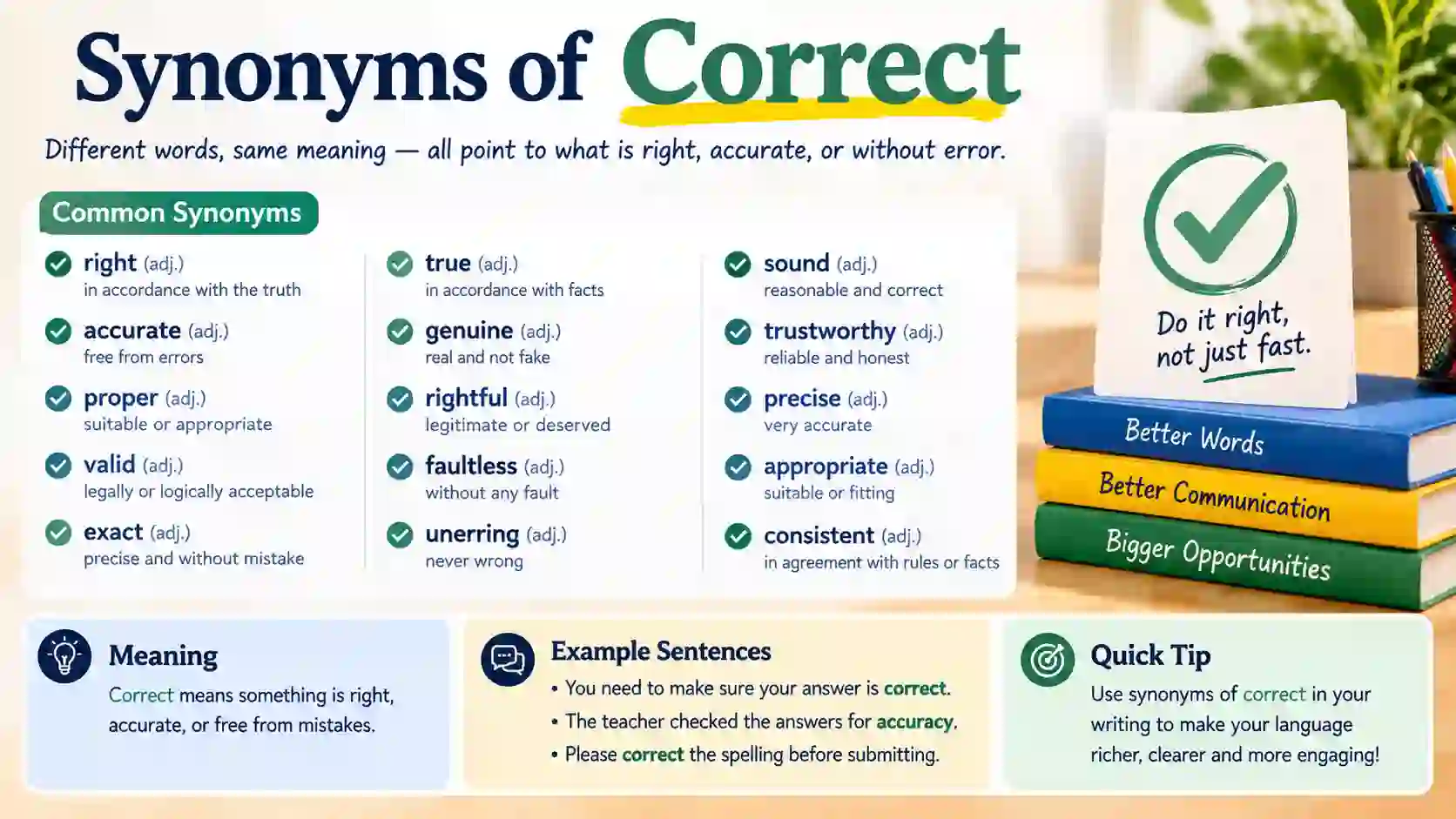
Correct means right, true, or free from mistakes. Got the answer matching the facts? It’s correct. Fixing an error? That’s correct as a verb. The handiest synonyms of correct are right, accurate, exact, true, precise, and proper. Quick rule of thumb: accurate for facts and numbers, proper for behavior, spot-on when you’re chatting with friends.
Let me guess. You’re writing something, maybe an essay or a work email, and you’ve already typed the word “correct” three times in one paragraph. It starts to sound flat. Repetitive. A little robotic, honestly.
I’ve spent years helping students with exactly this problem. They know what they want to say. They just don’t have enough words to say it well. And “correct” is one of those words people lean on way too hard.
Here’s the good news: English gives you plenty of options. Some are casual, some are formal, some fit facts, some fit behavior. In this post I’ll walk you through the best synonyms of correct, with plain meanings, real examples, and honest advice on when each one actually sounds natural. By the end, you’ll never get stuck repeating “correct” again.
Word Origin: Where “Correct” Actually Comes From
Fun little history here. Correct comes from the Latin correctus, from corrigere, which meant “to straighten.” It’s built from com- (together) plus regere (to lead straight, to rule). So the original picture is someone straightening a bent stick. Makes sense, right? Correcting something is basically straightening it out.
People started using it as a verb back in the 1300s (“to set right”), and the adjective showed up in the 1400s (that’s per Merriam-Webster).
Good to Know: You’ll spot that same Latin root in regular, regulated, and direction. They all carry this idea of straightness and order.
Pronunciation
IPA: /kəˈrɛkt/
Say it like: kuh-REKT. Hit that second syllable hard. It rhymes with select and protect.
Quick Tip: Break it down first: “kuh” … “REKT.” Then smash them together fast. You’ll nail it.
American vs British English
Good news: the spelling is identical on both sides of the Atlantic. Pronunciation is nearly the same too. Americans pronounce the “r” clearly (kuh-REKT), Brits soften it a little, but the stress sits on the second syllable either way.
The real difference is in the slang. British speakers love saying spot-on and bang on in casual conversation. Americans lean more toward dead-on or right on. Same idea, different flavor.
CEFR Level
As an adjective, correct is A1. It’s genuinely one of the first thousand words you’ll ever learn in English. The verb form (to correct) lands around A2. The synonyms below stretch from A1 (right, fix) all the way to C1 (impeccable, rectify), so whatever your level, there’s something here for you.
Part of Speech: It’s Two Words in One
As an adjective, correct means right, without mistakes.
“That is the correct answer.”
As a verb, to correct means to fix or improve.
“The teacher corrected our essays.”
What it’s NOT: a noun. There’s no such thing as “a correct” in standard English. Want the noun? Use correction (“I made one correction”) or correctness (“Check your work for correctness”).
The adverb form is correct, meaning in the right way.
“She spelled my name correctly.”
Grammar: How “Correct” Actually Behaves in Sentences
A few patterns you’ll see everywhere:
- correct + noun: a correct decision, the correct time, correct information
- be correct: You are correct. His guess was correct.
- correct + object (verb): correct a mistake, correct someone, correct an error
- Common prepositions: correct in (“She was correct in every detail”), correct about (“You were correct about the bus time”)
- Word forms: corrects, corrected, correcting, correctly, correctness, correction
One thing to avoid: “very correct.” Native speakers don’t say that. Go with completely correct, entirely correct, or absolutely correct instead.
Remember: Correct describes a thing (“a correct answer”). Correctly describes an action (“she answered correctly”). Mix those up and it sounds off immediately.
Synonyms Overview Table: The 30 Second Scan
| Synonym | Strength | Formality | Frequency | CEFR |
| Right | Strongest | Neutral | Very common | A1 |
| Accurate | Strongest | Neutral | Very common | B1 |
| True | Strongest | Neutral | Very common | A1 |
| Exact | Strongest | Neutral | Common | A2 |
| Fix (verb) | Strongest | Neutral | Very common | A1 |
| Precise | Strong | Formal | Common | B2 |
| Proper | Strong | Neutral | Very common | A2 |
| Valid | Strong | Formal | Common | B2 |
| Sound | Strong | Formal | Common | B2 |
| Faultless | Strong | Formal | Uncommon | C1 |
| Flawless | Strong | Neutral | Common | B2 |
| Impeccable | Strong | Formal | Uncommon | C1 |
| Spot-on | Strong | Informal | Common | B2 |
| Error-free | Strong | Formal | Uncommon | B2 |
| Dead-on | Strong | Informal | Uncommon | C1 |
| Amend (verb) | Strong | Formal | Uncommon | C1 |
| Revise (verb) | Strong | Neutral | Common | B1 |
| Rectify (verb) | Strong | Formal | Uncommon | C1 |
| Remedy (verb) | Strong | Formal | Uncommon | C1 |
| Appropriate | Related | Neutral | Very common | B1 |
| Suitable | Related | Neutral | Very common | A2 |
| Fitting | Related | Neutral | Common | B1 |
| Legitimate | Related | Formal | Common | B2 |
| Strict | Related | Formal | Common | B1 |
| Just | Related | Literary | Common | B2 |
| On target | Related | Neutral | Common | B2 |
The Synonyms, One by One
Words for “right” (the adjective side)
Right
Forget the fancy options for a second. Right is the word that actually comes out of people’s mouths. “You got it right.” “That doesn’t feel right.” It’s simple, warm, and it works almost everywhere.
You’ll hear it like this:
- You gave the right answer to every single question.
- She made the right call when she took that job.
Use it when: you’re talking normally. Texts, chats, conversation, casual emails. This is your default.
Skip it when: you’re writing something formal, like a report or an academic paper. There, correct or accurate carry more weight.
Vibe: neutral and friendly. You’ll often hear: the right answer, get it right, do the right thing
Accurate
This is the word for facts. Numbers, measurements, reports, descriptions. If something matches reality point for point, it’s accurate. I tell my students: when numbers are involved, reach for accuracy first.
You’ll hear it like this:
- The weather forecast was accurate. It poured at exactly noon.
- She gave the officers an accurate description of her stolen bag.
Use it when: facts, data, measurements, or detailed reports are involved.
Skip it when: you’re talking about opinions or behavior. Nobody says “accurate manners.”
Vibe: neutral, a little serious. You’ll often hear: accurate information, accurate reading, highly accurate
True
True is about reality versus lies. Is it real? Did it really happen? Then it’s true. It’s one of the first big words kids learn, and it never really leaves your vocabulary.
You’ll hear it like this:
- It’s true, he really does speak four languages.
- The film is based on a true story from the eighties.
Use it when: you’re separating fact from fiction.
Skip it when: you’re talking about small mistakes, like a spelling error. True spelling sounds weird. Say the correct spelling.
Vibe: neutral, honest. You’ll often hear: true story, true friend, true to your word
Exact
Zero difference. Not “close,” not “almost.” Exact means precisely the same, down to the last detail. People love this word when precision matters: times, amounts, copies, quotes.
You’ll hear it like this:
- The exact time of the flight is 6:40 in the morning.
- Those were his exact words. I wrote them down.
Use it when: you want to stress “not a little different, but completely identical.”
Skip it when: you’re just talking about general rightness. “An exact answer” sounds strange unless you mean word-for-word sameness.
Vibe: neutral, sharp. You’ll often hear: exact time, exact copy, exact amount
Precise
Think of precise as exact‘s more careful cousin. It’s about being detailed, clear, and leaving nothing vague. Scientists, engineers, and fussy instruction writers live on this word.
You’ll hear it like this:
- The doctor gave us precise instructions for the medication.
- You need precise tools to measure something that small.
Use it when: you’re describing careful, detailed, methodical work.
Skip it when: you’re just chatting. It can sound stiff over coffee. Exact is the casual pick.
Vibe: formal, careful. You’ll often hear: precise instructions, precise moment, precise wording
Proper
This one’s about rules and expectations. Not “factually true,” but “the right way to do things.” Proper behavior, proper dress, proper procedure. Every culture has its own idea of what’s proper, which makes this word really interesting.
You’ll hear it like this:
- You can’t hike that trail without proper shoes.
- It’s not proper to take calls during dinner at my house.
Use it when: you’re talking about manners, behavior, or doing things “the right way.”
Skip it when: you mean factually true. “A proper answer” sounds like you’re judging manners, not facts.
Vibe: neutral, a bit traditional. You’ll often hear: proper behavior, proper way, proper channels
Valid
Valid is the word of rules, laws, and logic. A ticket is valid. A passport is valid. An argument is valid. It means something holds up when checked against the rules.
You’ll hear it like this:
- This train ticket is valid for the whole month.
- Look, she made a valid point in that meeting.
Use it when: something is officially or logically acceptable.
Skip it when: you’re stating a simple fact. “A valid answer” works, but plain correct is simpler and clearer.
Vibe: formal, official. You’ll often hear: valid reason, valid ticket, valid concern
Sound
I love this word. Sound means solid, sensible, built on good thinking. Sound advice. And Sound judgment. It’s what you say when someone’s reasoning is trustworthy all the way down.
You’ll hear it like this:
- Honestly? That was sound advice. I should’ve listened sooner.
- The building passed every sound engineering check.
Use it when: you’re praising ideas, advice, or decisions as solid and wise.
Skip it when: you’re marking a test. “Sound answer” isn’t a thing. Use correct.
Vibe: formal, dependable. You’ll often hear: sound advice, sound judgment, safe and sound
Faultless
No faults. None. This is praise at full volume. You’d use it for a performance, a piece of logic, a memory that never slips. It’s dramatic, so save it for moments that deserve drama.
You’ll hear it like this:
- Her memory of that night was faultless. Every detail, perfect.
- The young violinist gave a faultless performance.
Use it when: you want to say something completely without errors, and you mean it.
Skip it when: you’re making small talk. It’ll sound over the top. Perfect does the job casually.
Vibe: formal, emphatic. You’ll often hear: faultless performance, faultless logic
Flawless
Similar energy to faultless, but this one lives more in everyday language. Performances, appearance, work quality. “Flawless victory” is even a gaming phrase. It’s strong praise without sounding like a legal document.
You’ll hear it like this:
- Her presentation was flawless. Not a single awkward pause.
- He writes with almost flawless grammar now.
Use it when: you’re describing work, performance, or appearance as perfect.
Skip it when: you’re talking about facts or logic. Accuracy fits better there.
Vibe: neutral, admiring. You’ll often hear: flawless performance, flawless execution, flawless skin
Impeccable
Okay, this is the fancy one. Impeccable means so good you can’t find a single thing to criticize. Manners, taste, timing, service. It’s the word critics and hotel reviewers reach for.
You’ll hear it like this:
- The service at that little family restaurant was impeccable.
- He has impeccable timing. Always says the right thing at the right moment.
Use it when: you’re praising quality, manners, or style at the highest level.
Skip it when: you’re chatting casually. It sounds a bit posh. Just say perfect.
Vibe: formal, polished. You’ll often hear: impeccable manners, impeccable taste, impeccable timing
Spot on
Now we’re talking like real people. Spot-on means exactly right, and it’s pure conversational English. Guesses, predictions, advice, observations. If someone nails it, you tell them they were spot-on.
You’ll hear it like this:
- Your guess about the ending? Totally spot-on.
- Her advice about the interview was spot-on. I got the job.
Use it when: you’re chatting and want to praise someone’s guess or judgment.
Skip it when: you’re writing an essay, a report, or anything formal. Your teacher will not love it.
Vibe: informal, warm. You’ll often hear: spot-on prediction, spot-on call
Error free
This is workplace language. Documents, code, reports, products. When zero mistakes is the actual requirement, error-free says it directly. You’ll see it in job ads and quality checklists.
You’ll hear it like this:
- I need this report error-free by Friday morning.
- The update promises error-free performance on older phones.
Use it when: you’re talking about work that must contain zero mistakes.
Skip it when: you’re in normal conversation. Just say “with no mistakes.”
Vibe: formal, businesslike. You’ll often hear: error-free writing, error-free code
Dead on
Dead-on is spot-on‘s slightly tougher sibling. Exactly right, usually about a guess, a prediction, or an aim. It’s got a bit of swagger to it. Very American, very casual.
You’ll hear it like this:
- His prediction about the match was dead-on. Scary, honestly.
- First shot, dead-on. The whole range went quiet.
Use it when: someone’s guess or aim hits exactly.
Skip it when: you’re writing anything formal. Keep it for speech and casual writing.
Vibe: informal, confident. You’ll often hear: dead-on guess, dead-on prediction
On Target
This one’s about goals and expectations. Sales figures, plans, analyses. If reality matches what you aimed for, you’re on target. Managers love this phrase. You’ll hear it in every quarterly meeting ever.
You’ll hear it like this:
- We’re on target to finish by Thursday.
- Your read of the client was right on target.
Use it when: you’re talking about goals, plans, or expectations being met.
Skip it when: you’re talking about grammar or spelling. That’s correct.
Vibe: neutral, business-casual. You’ll often hear: on target, right on target, stay on target
Appropriate
Appropriate is all about fit. Not “true,” not “perfect,” just… right for this situation, this place, these people. Clothes, gifts, jokes, behavior. Context is everything with this word.
You’ll hear it like this:
- A suit feels appropriate for the interview. Jeans don’t.
- The teacher picked a book appropriate for eight-year-olds.
Use it when: something fits the time, place, or company.
Skip it when: you mean factually true. “An appropriate answer” means a fitting one, not a factually right one.
Vibe: neutral, thoughtful. You’ll often hear: appropriate behavior, appropriate for the occasion, appropriate response
Suitable
Close cousin of appropriate, but suitable leans more toward purpose. Is it good enough for what you need? Then it’s suitable. Jobs, times, movies, candidates. Practical words, practical situations.
You’ll hear it like this:
- This film isn’t suitable for very young kids.
- We finally found a time suitable for everyone.
Use it when: you’re matching something to a need or purpose.
Skip it when: you mean factually true. Use correct for that.
Vibe: neutral, practical. You’ll often hear: suitable for, suitable candidate, suitable time
Fitting
There’s an emotional warmth to fitting that the other words don’t have. A fitting tribute. A fitting end to a great trip. It’s about something feeling right in your gut, not just on paper.
You’ll hear it like this:
- It was a fitting end to the best holiday we’ve ever had.
- The team gave their coach a fitting send-off.
Use it when: something suits an occasion in a way that feels emotionally right.
Skip it when: you’re dealing with facts, tests, or anything technical.
Vibe: neutral, heartfelt. You’ll often hear: fitting tribute, fitting end, fitting farewell
Legitimate
Is it real? Is it legal? And Is it honest? That’s what legitimate asks. Businesses, reasons, concerns, questions. It’s the word you use when something needs to prove it’s the real deal.
You’ll hear it like this:
- I checked. It’s a legitimate company with real reviews.
- He had a legitimate excuse this time, so I let it go.
Use it when: you’re confirming something is genuine, legal, or honest.
Skip it when: you’re stating everyday facts. It sounds heavy and legalistic out of context.
Vibe: formal, serious. You’ll often hear: legitimate business, legitimate concern, legitimate question
Strict
On its own, strict is about rules and discipline. As a synonym of correct, it shows up in phrases like “strict accuracy” or “in the strict sense.” It means exact, no exceptions, no wiggle room.
You’ll hear it like this:
- Lab work demands strict accuracy. One decimal off ruins everything.
- In the strict sense of the word, he wasn’t lying. He just didn’t tell everything.
Use it when: you want to emphasize exactness and discipline.
Skip it when: you’re using it alone. Pair it up: “strictly correct,” “strict accuracy.”
Vibe: formal, no-nonsense. You’ll often hear: strict rules, strict accuracy, in the strict sense
Just
This is the moral one. Just doesn’t mean “true,” it means “fair.” A just decision. A just reward. Just cause. You’ll find it in speeches, literature, and courtrooms way more than in text messages.
You’ll hear it like this:
- The judge was known for just decisions, even unpopular ones.
- After years of hard work, she finally got a just reward.
Use it when: you’re talking about fairness and moral rightness.
Skip it when: you mean factually correct. “A just answer” isn’t a thing.
Vibe: formal, literary, moral. You’ll often hear: just cause, just decision, just reward
Words for fixing things (the verb side)
Fix
The people’s verb. Something’s broken, wrong, or off? You fix it. Chairs, mistakes, problems, situations. It’s the first verb kids learn for this job, and honestly, adults use it just as much.
You’ll hear it like this:
- Can you fix this wobbly table before the guests arrive?
- I fixed four typos in my essay this morning.
Use it when: you’re repairing or correcting anything in daily life.
Skip it when: you’re writing formally about documents. Correct or amend sounds more professional there.
Vibe: neutral, everyday. You’ll often hear: fix a mistake, fix the problem
Amend
Now we’re in official territory. Amend means to change something formally to make it better or more correct. Laws get amended. Contracts get amended. Constitutions get amended. It’s paperwork language.
You’ll hear it like this:
- The law was amended last year to close the loophole.
- We amended the contract twice before signing.
Use it when: you’re changing laws, contracts, or official documents.
Skip it when: you’re just talking. It sounds stiff and legal at the dinner table.
Vibe: formal, official. You’ll often hear: amend the law, amend a motion
Revise
Revise is the student’s verb. You write a draft, you look at it again, you make it better. That’s revising. Essays, plans, prices, strategies. It means improvement through a second look.
You’ll hear it like this:
- Revise your essay once more. It’s good, but it can be better.
- The store revised its prices after the holiday season.
Use it when: you’re improving drafts, plans, or written work.
Skip it when: it’s just a tiny quick fix. Fix or correct is plenty.
Vibe: neutral, studious. You’ll often hear: revise an essay, revised edition
Rectify
Big formal word for fixing something wrong. Companies rectify billing errors. Governments rectify injustices. It carries this sense of “we messed up and now we’re making it officially right.”
You’ll hear it like this:
- The bank rectified the extra charge within two days.
- We need to rectify this misunderstanding before it gets worse.
Use it when: you’re correcting errors in formal or business settings.
Skip it when: you’re chatting. Just say fix. Nobody rectifies a wobbly chair.
Vibe: formal, corporate. You’ll often hear: rectify a mistake, rectify the situation
Remedy
Remedy fixes problems and bad situations, not typos. A parking problem. A customer complaint. An injustice. It’s the word you reach for when something in the world needs putting right, not just something on paper.
You’ll hear it like this:
- The new policy should remedy the overcrowding in that school.
- They offered a full refund to remedy the whole mess.
Use it when: you’re solving problems, complaints, or unfair situations.
Skip it when: you’re talking about grammar or spelling. That’s correct.
Vibe: formal, problem-solving. You’ll often hear: remedy the situation, legal remedy
Choose the Right Synonym: Head to Head
Knowing the words is half the battle. Picking the right one is the other half. Here’s how the trickiest pairs actually differ in real life:
| Words | The real difference | My quick rule |
| Correct vs Right | Right is what you say. Correct is what you write when you want to sound a bit more serious. | “Right answer” with friends, “correct procedure” at work. |
| Accurate vs Exact | Accurate gets close to the truth. Exact leaves zero gap. | Forecasts are accurate. Copies are exact. |
| Precise vs Exact | Precise is careful and detailed. Exactly the same. | Precise instructions. Exact replica. |
| Proper vs Appropriate | Proper follows the rules. Appropriate reads in the room. | Proper uniform. Appropriate joke for the occasion. |
| Fix vs Correct (verb) | Fix is everyday. Correct is what teachers and editors do. | Fix the sink. Correct the essay. |
| Amend vs Revise | Amend changes official documents. Revise improves drafts. | Amend the law. Revise the essay. |
| True vs Correct | True fights lie. Correct fights mistakes. | True story. Correct answer. |
Writing Tip: When two words both fit, pick the one your reader expects. Accurate in an essay, spot-on in a text to your friend. Matching your reader matters more than showing off vocabulary.
Synonym Categories
Strongest Synonyms (closest to “correct”)
- Right — the everyday twin of correct
- Accurate — exactly true, especially with facts and numbers
- True — real, not false
- Exact — zero difference, identical
- Fix (verb) — to make something right again
Strong Synonyms
- Precise — careful, detailed, nothing vague
- Proper — right according to rules and manners
- Valid — holds up against rules, law, or logic
- Sound — solid, sensible, trustworthy
- Faultless — without a single fault
- Flawless — perfect, no weak spots
- Impeccable — so good it’s beyond criticism
- Spot-on — exactly right (casual)
- Error-free — zero mistakes (workplace word)
- Dead-on — exactly right (casual, confident)
- Amend (verb) — change something officially
- Revise (verb) — improve by reviewing again
- Rectify (verb) — fix something formally
- Remedy (verb) — put a bad situation right
Related Words (close, but the meaning shifts a little)
- Appropriate — right for the situation
- Suitable — right for the purpose
- Fitting — right for the occasion, emotionally
- Legitimate — real, legal, genuine
- Strict — exact, no exceptions allowed
- Just — fair and morally right
- On target — hitting the goal as planned
Commonly Confused Words
| The pair | What’s actually different | See it in action |
| Correct vs Right | Right is casual and does triple duty (it also means a direction, and “morally good”). Correct zeroes in on “free from error.” | “Turn right at the lights.” Never “turn correct.” |
| Accurate vs Exact | Accurate means very close to the truth. Exact means identical, no daylight between them. | “An accurate guess” vs “an exact copy.” |
| Proper vs Appropriate | Proper follows the rules. Appropriate fits the moment. | “Proper attire required” vs “appropriate gift for a kid.” |
| Amend vs Emend | Amend changes to official things like laws. Emend fixes errors in a written text. Yes, they’re different words. | “Amend the constitution” vs “amend the manuscript.” |
| Correct vs Correctly | Correct is the adjective (“a correct answer”). Correctly is the adverb (“she answered correctly”). | “His answer was correct” vs “He answered correctly.” |
Mistakes I See All the Time
Common Mistake
What people write: “What is the correctness of this sentence?”
What it should be: “What is the correct version of this sentence?”
Why: Correct is an adjective, not a noun. It can’t stand alone like that. Use correction or correct version.
Common Mistake
What people write: “She did very well on the exam.”
What it should be: “She did very well in the exam.” (Or: “All her answers were correct.”)
Why: “Very correct” just isn’t natural English. Say completely correct or entirely correct, or rephrase.
Common Mistake
What people write: “He corrects my homework.”
What it should be: “He corrects my homework.” (Or: “He corrects my mistakes.”)
Why: Correct takes a direct object. That extra “me” has nowhere to go. Drop it.
Writing Tips: Sound Natural Everywhere
Essays: Lean on accurate, valid, and sound. They sound academic without trying too hard. “The data is accurate” beats “the data is right” in a paper.
Emails: Proper and appropriate are your friends. “Please use the proper format” is polite, clear, and professional.
Blog posts: Right and spot-on keep things friendly. Readers should feel like you’re talking with them, not lecturing them.
Stories: True and just add moral weight. “A true friend” and “a just ruler” hit deeper than “a correct friend” ever could.
Social media: Spot-on and dead-on are made for this. “Your take was spot-on!” reads like a real human wrote it. Because a real human did.
Professional settings: Impeccable for praise, rectify for fixing problems. “We’ll rectify this today” builds trust fast.
Everyday conversation: Honestly? Right and fix cover about 90% of daily life. Master those two first. The fancy ones can wait.
Related Vocabulary Worth Knowing
Opposites of correct: wrong, incorrect, false, inaccurate, mistaken, flawed, erroneous, improper, unsuitable.
Things native speakers actually say:
- On the money — exactly right. (“Your guess was on the money.”)
- Hit the nail on the head — said exactly the right thing.
- Bang on — exactly right. (Very British, very casual.)
- Right on target — matched expectations perfectly.
The word family:
correct (adjective/verb) gives you correctly (adverb), correctness (noun), correction (noun), corrective (adjective), plus the opposites incorrect and incorrect. Learn one, get seven.
FAQ`s
What is the best synonym for “correct”?
For everyday use, it’s right. Nobody will ever look at you funny for saying “right answer.” When facts and numbers are involved, switch to accurate. Writing something formal? Valid or impeccable do the heavy lifting.
What’s the difference between “correct” and “accurate”?
Correct is the big umbrella: free from mistakes, in a general sense. Accurate zooms in on closeness to the truth, usually with facts, numbers, or measurements. The answer is correct. A scale reading is accurate.
Is “right” really a synonym of “correct”?
Yes, in almost every everyday situation. “Right answer” and “correct answer” mean the same thing. Just remember right also means a direction and “morally good,” so in formal writing, correct is the safer pick.
What’s a formal synonym for “correct”?
Accurate, valid, impeccable, and faultless all work beautifully in formal writing. Need the verb? Use rectify or amend in official documents instead of the casual fix.
What’s the verb form? How do I say “to correct” differently?
Fix is what everyone says day to day. Amend and rectify belong in formal and official contexts. Revise specifically means reviewing written work and improving it.
What’s the opposite of “correct”?
Incorrect and wrong are the direct opposites. For finer shades: false (for statements), inaccurate (for data), mistaken (for beliefs), flawed (for work or reasoning).
How do I use “correct” in a sentence?
Adjective: “That’s the correct answer.” Verb: “Please correct my mistakes.” And remember the golden rule: it’s never a noun. “The correctness of the sentence” will make every English teacher wince.
Quiz: Test Yourself
1. “The ___ time is 4 p.m.” Which word fits best?
A) proper
B) exact
C) just
D) sound
2. Which word means “without any mistakes” and suits formal writing?
A) spot-on
B) dead-on
C) faultless
D) fitting
3. “The teacher ___ our essays yesterday.”
A) corrected
B) correction
C) correctly
D) correctness
4. Which verb means “to correct something officially”?
A) fix
B) amend
C) guess
D) try
5. Which sentence is actually correct?
A) “What is the correctness of this?”
B) “She answered correctly.”
C) “His answer was correct.”
D) “He was very correct.”
Answer Key: 1-B, 2-C, 3-A, 4-B, 5-C
Practice Exercises
Fill in the Blanks
- Your prediction was ___ . It happened exactly like you said. (spot-on)
- Please ___ the mistakes in this report before you send it. (correct)
- The scientist took a ___ measurement of the liquid. (precise / accurate)
- Jeans aren’t ___ for a formal dinner. (appropriate)
- The judge made a ___ decision everyone respected. (just)
Rewrite These
- Make it formal: “Your answer is right.” → “Your answer is correct.” (Or accurate.)
- Make it formal: “Fix the error in line 5.” → “Rectify the error in line 5.” (Or amend.)
- Make it casual: “His guess was exactly right.” → “His guess was spot-on.” (Or dead-on.)
Matching
- Impeccable — a. change something officially
- Amend — b. impossible to criticize
- Remedy — c. right for the occasion
- Fitting — d. put a bad situation right
- Valid — e. holds up against the rules
Answers: 1-b, 2-a, 3-d, 4-c, 5-e
Conclusion
Here’s what I really want you to take away: learning synonyms of correctness isn’t about memorizing a list. It’s about having the right word ready when you need it. The word that makes your email clearer, your essay stronger, your conversation smoother.
So practice them. Drop spot-on into a chat. Use rectify in your next formal email. Try impeccable next time something genuinely impresses you. Small steps, used often, that’s how fluent speakers are made. Keep going. Your English is getting better every day.
References
- Oxford English Dictionary — entry for “correct”
- Merriam-Webster — “correct” (etymology and first known use)
- Cambridge Dictionary — entry for “correct”
- Collins Dictionary — “correct” (thesaurus entry)
- Dictionary.com — entry for “correct”

Synonorm is a trusted English vocabulary resource created to help readers find the right words and understand the differences between similar terms. We provide clear explanations of synonyms, meanings, examples, usage, and alternatives. Our content makes vocabulary easier to learn and apply in everyday, academic, and professional English. Synonorm is designed for students, writers, ESL learners, professionals, and anyone who wants to improve their English vocabulary and communicate more clearly.