Quick Answer: What Are Synonyms for Vomit?
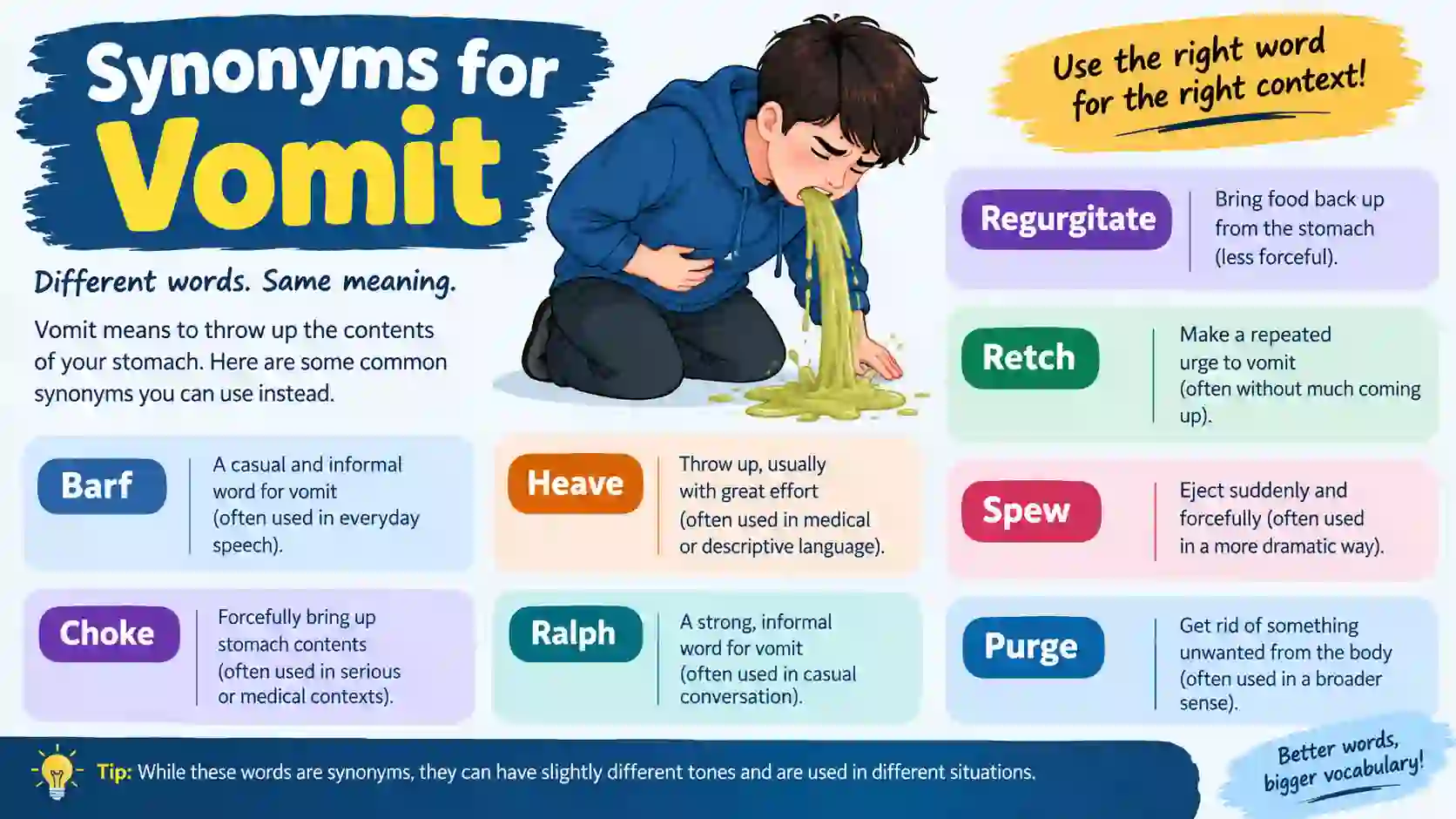
Common synonyms for vomit include throw up, be sick, puke, barf, bring up, spew, and regurgitate. These words describe bringing food or liquid back out through the mouth. Some are casual, while others suit formal or scientific writing. Words such as retch and gag describe related actions, but they do not always mean that someone has actually vomited.
Have you ever needed another word for vomit while writing a story, describing an illness, or speaking English? The right word can help you express your meaning without repeating yourself.
The word vomit means to bring food or liquid from the stomach out through the mouth. For example, you might write, “The passenger vomited during the trip.” In casual conversation, you could say, “The passenger threw up during the trip.”
However, these expressions have different tones. Puke sounds informal, regurgitate sounds technical, and retch describes the movements associated with vomiting. Choosing the right synonym helps you sound natural and communicate clearly.
This guide explains useful alternatives to vomit, including their meanings, examples, common word combinations, regional usage, and differences in formality. It also shows you which words to avoid when you need precise English.
Pronunciation of Vomit
- IPA: /ˈvɑː.mɪt/ in common American pronunciation; /ˈvɒm.ɪt/ in common British pronunciation.
- Say it like: VOM-it.
- Syllables: Two.
- Word stress: The first syllable.
Pronunciation can vary among speakers and accents. The spelling remains the same in American and British English.
Part of Speech and Word Forms
Vomit works as both a verb and a noun.
- Verb: The child vomited after dinner.
- Noun: The nurse cleaned up the vomit.
- Present participle: The patient is vomiting.
- Past tense: Vomited.
- Related adjective: Emetic describes something that causes vomiting.
The verb can take a direct object: “The patient vomited blood.” It can also appear without an object: “The patient vomited.”
Synonyms for Vomit: Quick Comparison Table
| Synonym | Main meaning or nuance | Tone |
| Throw up | Vomit | Informal |
| Be sick | Vomit, especially in British usage | Neutral |
| Puke | Vomit | Informal |
| Barf | Vomit | Slang |
| Bring up | Return food or liquid through the mouth | Neutral |
| Regurgitate | Bring swallowed material back up | Technical |
| Spew | Release something forcefully | Vivid |
| Upchuck | Vomit | American slang |
| Chunder | Vomit | Australian slang |
| Chuck up | Vomit | Informal |
| Spit up | Bring up a small amount | Neutral |
| Retch | Make movements as if vomiting | Neutral |
| Gag | React with throat movements | Neutral |
| Heave | Make forceful movements associated with vomiting | Descriptive |
| Dry heave | Attempt to vomit without bringing up material | Neutral |
| Disgorge | Force something out | Formal or literary |
| Toss your cookies | Vomit | Humorous idiom |
| Lose your lunch | Vomit | Informal idiom |
| Expel | Force something out | Formal |
| Eject | Force something out of a place or body | Technical |
The final two words are broader alternatives, not exact synonyms in every sentence. Likewise, retch, gag, and dry heave describe actions that may happen without actual vomiting.
20 Synonyms for Vomit Explained
1. Throw Up
Meaning: To bring food or liquid out of the stomach through the mouth.
Examples:
- I threw up after the long boat ride.
- The dog threw up beside its bed.
Best used when: You need a natural expression for everyday conversation.
Tone: Informal. Frequency: Very common.
Common collocations: throw up after eating, throw up food, feel like throwing up.
When not to use it: Choose vomit in a formal medical report.
2. Be Sick
Meaning: To vomit, especially in British English.
Examples:
- She was sick after the ferry crossed rough water.
- The boy felt ill and was sick in the bathroom.
Best used when: You want a familiar expression, particularly in British English.
Tone: Neutral. Frequency: Very common.
Common collocations: be sick after eating, feel sick, be sick on a journey.
When not to use it: In American English, being sick can mean simply being ill. Give more context when needed.
3. Puke
Meaning: To vomit.
Examples:
- The spinning ride made him feel ready to puke.
- She nearly puked when she smelled the spoiled food.
Best used when: You are speaking casually or writing informal dialogue.
Tone: Informal and sometimes crude. Frequency: Common in casual speech.
Common collocations: puke everywhere, feel like puking, puke after drinking.
When not to use it: Avoid it in formal essays, professional emails, and medical reports.
4. Barf
Meaning: To vomit.
Examples:
- The child said he might barf on the roller coaster.
- That awful smell almost made me barf.
Best used when: You want a casual, often humorous American English expression.
Tone: Slang. Frequency: Common in informal American speech.
Common collocations: barf everywhere, feel like barfing, barf on something.
When not to use it: Use vomit when the situation calls for a neutral or professional tone.
5. Bring Up
Meaning: To bring food or liquid from the stomach back through the mouth.
Examples:
- She brought up some of her breakfast.
- The patient brought up the liquid shortly after taking it.
Best used when: You want a softer expression or need to mention what came out.
Tone: Neutral. Frequency: Common.
Common collocations: bring up food, bring up stomach contents, bring up liquid.
When not to use it: Remember that bring up also means raising a subject or caring for a child.
6. Regurgitate
Meaning: To bring swallowed material back up from the digestive tract.
Examples:
- The bird regurgitated food for its young.
- The doctor asked about episodes of regurgitation.
Best used when: You need a technical or biological term.
Tone: Formal or scientific. Frequency: Common in specialist contexts.
Common collocations: regurgitate food, regurgitate stomach contents, passive regurgitation.
When not to use it: Do not assume that every instance of regurgitation is identical to forceful vomiting. The term can also mean repeating information without understanding it.
7. Spew
Meaning: To force something out in a strong stream.
Examples:
- The sick passenger spewed into a wastebasket.
- The volcano spewed ash across the surrounding area.
Best used when: You want to emphasize force or an uncontrolled release.
Tone: Vivid and informal in the bodily sense. Frequency: Common.
Common collocations: spew out liquid, spew food, spew ash.
When not to use it: It can sound too dramatic when you simply mean that someone vomited.
8. Upchuck
Meaning: To vomit.
Examples:
- He joked that the ride would make him upchuck.
- She felt so ill that she thought she might upchuck.
Best used when: You want an informal American English expression.
Tone: Slang. Frequency: Less common than throw up.
Common collocations: feel like upchucking, upchuck after eating.
When not to use it: Avoid it in formal writing or serious conversations about illness.
9. Chunder
Meaning: To vomit.
Examples:
- The traveler thought he might chunder during the rough trip.
- He felt seasick and nearly chundered over the side.
Best used when: You are writing dialogue that reflects Australian slang.
Tone: Slang. Frequency: Regional.
Common collocations: feel like chundering, chunder on a trip.
When not to use it: International readers may not recognize this regional expression.
10. Chuck Up
Meaning: To vomit.
Examples:
- He thought the spoiled food would make him chuck up.
- The child chucked up shortly after dinner.
Best used when: You want an informal expression in casual dialogue.
Tone: Informal or slang. Frequency: Regional.
Common collocations: chuck up food, chuck up after eating.
When not to use it: Avoid it in formal reports. Chuck also means to throw something, so context matters.
11. Spit Up
Meaning: To bring a small amount of food or liquid back through the mouth.
Examples:
- The baby spit up a little milk after feeding.
- The infant spit up shortly after drinking.
Best used when: You are describing a small amount of returned food or liquid, especially in babies.
Tone: Neutral. Frequency: Common.
Common collocations: spit up milk, spit up after feeding, spit up a little.
When not to use it: It may understate the event if the person experienced forceful or repeated vomiting.
12. Retch
Meaning: To make the movements or sounds associated with vomiting, sometimes without producing anything.
Examples:
- The strong odor made him retch.
- She retched several times but could not vomit.
Best used when: You want to describe the attempt to vomit rather than the result.
Tone: Neutral. Frequency: Common in descriptive writing.
Common collocations: retch violently, begin to retch, retch at a smell.
When not to use it: Do not use it to confirm that stomach contents came out.
13. Gag
Meaning: To react with throat movements that can occur when something triggers the urge to vomit.
Examples:
- The bitter medicine made him gag.
- She gagged when she smelled the spoiled milk.
Best used when: You are describing a reaction to a smell, taste, or object in the throat.
Tone: Neutral. Frequency: Common.
Common collocations: gag on food, gag at a smell, trigger a gag reflex.
When not to use it: Gagging does not necessarily mean someone has vomited.
14. Heave
Meaning: To make strong physical movements associated with vomiting.
Examples:
- The smell made her heave over the sink.
- He heaved several times but brought nothing up.
Best used when: You want to describe the physical effort involved.
Tone: Descriptive. Frequency: Common in descriptive writing.
Common collocations: heave violently, heave over a sink, heave with nausea.
When not to use it: Heave also means lifting or moving something with effort, so it does not always refer to vomiting.
15. Dry Heave
Meaning: To make the movements of vomiting without bringing up stomach contents.
Examples:
- The odor made him dry heave.
- She began to dry heave but produced nothing.
Best used when: You need to describe an unsuccessful attempt to vomit.
Tone: Neutral. Frequency: Common in descriptive and medical contexts.
Common collocations: begin to dry heave, dry heave repeatedly.
When not to use it: Do not use it as a replacement for actual vomiting.
16. Disgorge
Meaning: To force something out, including swallowed material.
Examples:
- The animal disgorged the food it had swallowed.
- The fictional creature disgorged a mass of foul liquid.
Best used when: You need a formal or vivid word, often in literature.
Tone: Formal or literary. Frequency: Uncommon in everyday speech.
Common collocations: disgorge food, disgorge its contents.
When not to use it: In ordinary conversation, throw up is more natural.
17. Toss Your Cookies
Meaning: To vomit.
Examples:
- The rough boat ride nearly made me toss my cookies.
- He joked that the spinning ride might make everyone toss their cookies.
Best used when: You want a humorous American English idiom.
Tone: Very informal. Frequency: Recognizable, but less common than throw up.
Common collocations: nearly toss your cookies, feel like tossing your cookies.
When not to use it: Avoid it in formal writing and serious medical situations.
18. Lose Your Lunch
Meaning: To vomit, often because of nausea or motion sickness.
Examples:
- The winding road almost made me lose my lunch.
- He thought he would lose his lunch on the spinning ride.
Best used when: You want an informal idiom in a conversation or story.
Tone: Informal. Frequency: Recognizable in American English.
Common collocations: nearly lose your lunch, feel like losing your lunch.
When not to use it: It is not suitable for clinical records or precise academic writing.
19. Expel
Meaning: To force something out of the body or another place.
Examples:
- Vomiting expels stomach contents through the mouth.
- The body can expel material from the digestive tract.
Best used when: You need a broad, formal word to explain the process.
Tone: Formal or scientific. Frequency: Common in technical writing.
Common collocations: expel stomach contents, expel material, forcefully expel.
When not to use it: Expel is not a specific synonym for vomiting. It can also refer to removing a person from a school or organization.
20. Eject
Meaning: To force something out of a place or body.
Examples:
- The body may eject stomach contents during vomiting.
- The machine ejected the damaged part.
Best used when: You need a broad, technical verb for forcing something out.
Tone: Formal or technical. Frequency: Common in technical contexts.
Common collocations: eject contents, eject material, eject from the body.
When not to use it: Do not use eject alone when readers need to know specifically that someone vomited.
Strongest Synonyms, Strong Synonyms, and Related Words
Strongest synonyms
These alternatives directly describe vomiting in common contexts:
- Throw up
- Be sick
- Puke
- Barf
- Bring up
- Regurgitate
Other useful alternatives
These are direct alternatives in certain dialects or situations:
- Spew
- Upchuck
- Chunder
- Chuck up
- Disgorge
- Toss your cookies
- Lose your lunch
Related words, not exact synonyms
These describe associated actions or broader processes:
- Retch
- Gag
- Heave
- Dry heave
- Spit up
- Expel
- Eject
This distinction matters. A person may gag or retch without vomiting, and a machine can eject an object without anything related to illness.
Choose the Right Synonym: Side by Side Comparisons
| Word | What it communicates | Example |
| Vomit | A direct, precise statement | The patient vomited twice. |
| Throw up | Everyday vomiting | I threw up after lunch. |
| Retch | An attempt to vomit | The odor made her retch. |
| Gag | A throat reaction | The bitter taste made him gag. |
| Regurgitate | Return of swallowed material | The bird regurgitated food. |
| Spit up | A small amount coming back up | The baby spit up milk. |
| Feel sick | Nausea or illness | I feel sick on boats. |
Quick tip: Use vomit in formal writing, throw up in everyday conversation, and puke in casual dialogue. Choose retch or gag only when that specific action is what you mean.
Commonly Confused Words
| Word | Difference | Example |
| Nausea | The feeling of wanting to vomit | She experienced nausea during the trip. |
| Retching | Movements associated with trying to vomit | He kept retching but produced nothing. |
| Gagging | A throat reaction to a trigger | The medicine made her gag. |
| Regurgitation | Return of swallowed material | The doctor asked about regurgitation. |
| Spitting up | Bringing up a small amount of food or liquid | The baby spit up after feeding. |
You can feel nauseated without vomiting. You can also gag or retch without bringing anything up. These terms overlap, but they are not interchangeable in every sentence.
Common Grammar Mistakes
Mistake 1: “He did vomit yesterday” when you simply want to report the event.
Better: “He vomited yesterday.”
The first sentence is grammatical, but it adds emphasis. The second is more natural for a plain report.
Mistake 2: “She was nauseated.”
Better: “She felt nauseated” or “She experienced nausea.”
Nausea is a noun. Nauseated is an adjective.
Mistake 3: “He retched all over the floor” when you mean that he brought up stomach contents.
Better: “He vomited all over the floor.”
Retch does not necessarily mean that anything came out.
Mistake 4: “The patient barfed during treatment.”
Better: “The patient vomited during treatment.”
Barfed sounds informal and is less suitable for a medical report.
Mistake 5: “I am vomit.”
Better: “I am vomiting” or “I feel sick.”
Use the correct verb form to describe the action or your physical state.
Writing Tips for Different Situations
- Essays: Use vomit or vomiting for clarity.
- Emails: Say “I became ill and vomited” rather than using slang.
- Blog posts: Use throw up when explaining everyday experiences.
- Stories: Use retch to describe an attempt to vomit, or spew to emphasize force.
- Social media: Puke and barf can work in humorous, casual posts.
- Professional communication: Describe the symptom precisely, such as “The patient reported nausea and two episodes of vomiting.”
- Daily conversation: Throw up is a widely understood option.
Writing tip: Do not replace a word simply to avoid repetition. If you need to state that stomach contents came out, vomit may be more accurate than retch, gag, or heave.
Word Origin and Etymology
The English word vomit came through Latin vomitare, a frequentative form of vomere, meaning “to vomit.” English adopted the word in the late Middle English period. Historical dictionaries give approximate dates that can differ according to whether they record the noun, verb, or a particular sense.
The related word emetic refers to something that causes vomiting. It has a different role from a direct synonym such as throw up.
American vs. British English
The spelling of vomit is the same in American and British English. Pronunciation differs in common accents, and informal expressions can vary by region.
| Feature | American English | British English |
| Common phrase | Throw up | Be sick or throw up |
| Informal alternatives | Puke, barf, upchuck | Puke, chuck up |
| Pronunciation of vomit | Often /ˈvɑː.mɪt/ | Often /ˈvɒm.ɪt/ |
| Regional slang | Upchuck and barf | Chunder is mainly associated with Australian English |
Both varieties use vomit, throw up, and retch. For international audiences, these familiar words are generally clearer than regional slang.
CEFR and Frequency Guide
The levels below are approximate study suggestions, not official CEFR classifications for each word.
| Word | Suggested learner level | Usage |
| Throw up | A2–B1 | Very common, informal |
| Be sick | A2–B1 | Very common, context-dependent |
| Vomit | B1–B2 | Common, neutral |
| Gag | B1–B2 | Common, neutral |
| Bring up | B1–B2 | Common, context-dependent |
| Retch | B2 | Descriptive |
| Heave | B2 | Descriptive |
| Regurgitate | C1 | Technical |
| Disgorge | C1–C2 | Literary or formal |
| Chunder | Advanced regional vocabulary | Australian slang |
Beginners should learn to throw up, feel sick, and vomit first. Advanced learners can then explore technical terms, literary expressions, and regional slang.
Related Vocabulary and Opposite Expressions
There is no perfect direct antonym for vomit. However, these expressions can communicate an opposite result or a contrasting state.
- Keep food down: Retain food without vomiting.
- Retain: Keep something rather than expel it.
- Settle your stomach: Ease stomach discomfort.
- Recover: Return to a healthier state after illness.
Other useful expressions include:
- Feel nauseated: Feel as though you might vomit.
- Have an upset stomach: Experience digestive discomfort.
- Be seasick: Feel ill because of motion on a boat or ship.
- Be carsick: Feel ill during car travel.
- Have morning sickness: Experience nausea and sometimes vomiting during pregnancy.
Frequently Asked Questions
1. What are the most common synonyms for vomit?
The most common alternatives include throw up, be sick, puke, barf, and bring up. Use throw up in everyday conversation and vomit in formal writing. The best choice depends on the tone, audience, and meaning you want to communicate.
2. What is a polite way to say vomit?
You can say you are sick or become ill and vomit. The phrase feel unwell sounds polite, but it does not confirm that vomiting occurred. If clarity matters, “I became ill and vomited” is both respectful and direct.
3. What is a formal synonym for vomit?
Vomit and vomiting are often the clearest choices in formal or medical writing. Regurgitate may suit a technical explanation, while disgorge is more literary. Choose the word that accurately describes the event instead of using a complicated word just to sound formal.
4. Is retch the same as vomit?
No. Retch describes the movements or sounds associated with vomiting, sometimes without producing anything. Vomit means that stomach contents come out through the mouth. Someone can retch without vomiting, so the difference matters in both everyday communication and medical descriptions.
5. What is the difference between puke and barf?
Both words mean to vomit and sound informal. Puke is widely understood in casual English, while barf is particularly associated with informal American speech. Neither is usually suitable for formal essays, professional emails, or serious medical reports.
6. What is the British English word for vomit?
British English commonly uses be sick, throw up, and vomit. The phrase be sick often means to vomit, although it can also mean being ill. For readers from different countries, vomit and throw up are generally clear choices.
7. What is the difference between vomiting and regurgitation?
Vomiting generally involves the forceful return of stomach contents through the mouth. Regurgitation describes swallowed material coming back up and can involve less force. The exact distinction depends on the context, so technical writing should use these terms carefully.
8. What is the opposite of vomit?
There is no exact one-word antonym for vomit. The phrase keep food down expresses the opposite result because a person retains what they have eaten instead of bringing it back up. Recovering and settling your stomach can describe improvement but do not directly mean the opposite action.
Vocabulary Quiz
1. Which expression is most suitable for a formal medical report?
A. Barf
B. Puke
C. Vomiting
D. Toss your cookies
2. Which word describes trying to vomit without necessarily producing anything?
A. Retch
B. Retain
C. Recover
D. Expel
3. Which expression is especially informal in American English?
A. Disgorge
B. Barf
C. Eject
D. Regurgitate
4. What does “keep food down” mean?
A. Eat quickly
B. Avoid all food
C. Retain food without vomiting
D. Feel nauseated
5. Which word can also mean repeating information without understanding it?
A. Gag
B. Heave
C. Regurgitate
D. Chunder
Answer Key
- C. Vomiting
- A. Retch
- B. Barf
- C. Retain food without vomiting
- C. Regurgitate
Conclusion
Learning synonyms for vomit helps you describe illness, understand conversations, and write with greater accuracy.
Start with everyday alternatives such as throw up and be sick, then learn more specific terms such as retch and regurgitate.
Pay attention to context, tone, and regional usage before choosing a replacement. Practice these words in essays, emails, schoolwork, and conversations to build a more natural English vocabulary.
References
- Cambridge Dictionary, Vomit: Synonyms and Antonyms.
- Collins Dictionary, Synonyms of Vomit.
- Thesaurus.com, Vomit Synonyms and Antonyms.
- Collins Dictionary, Retch: Definition and Usage.
- Merriam-Webster, Emetic: Definition.

Synonorm is a trusted English vocabulary resource created to help readers find the right words and understand the differences between similar terms. We provide clear explanations of synonyms, meanings, examples, usage, and alternatives. Our content makes vocabulary easier to learn and apply in everyday, academic, and professional English. Synonorm is designed for students, writers, ESL learners, professionals, and anyone who wants to improve their English vocabulary and communicate more clearly.