Quick Answer
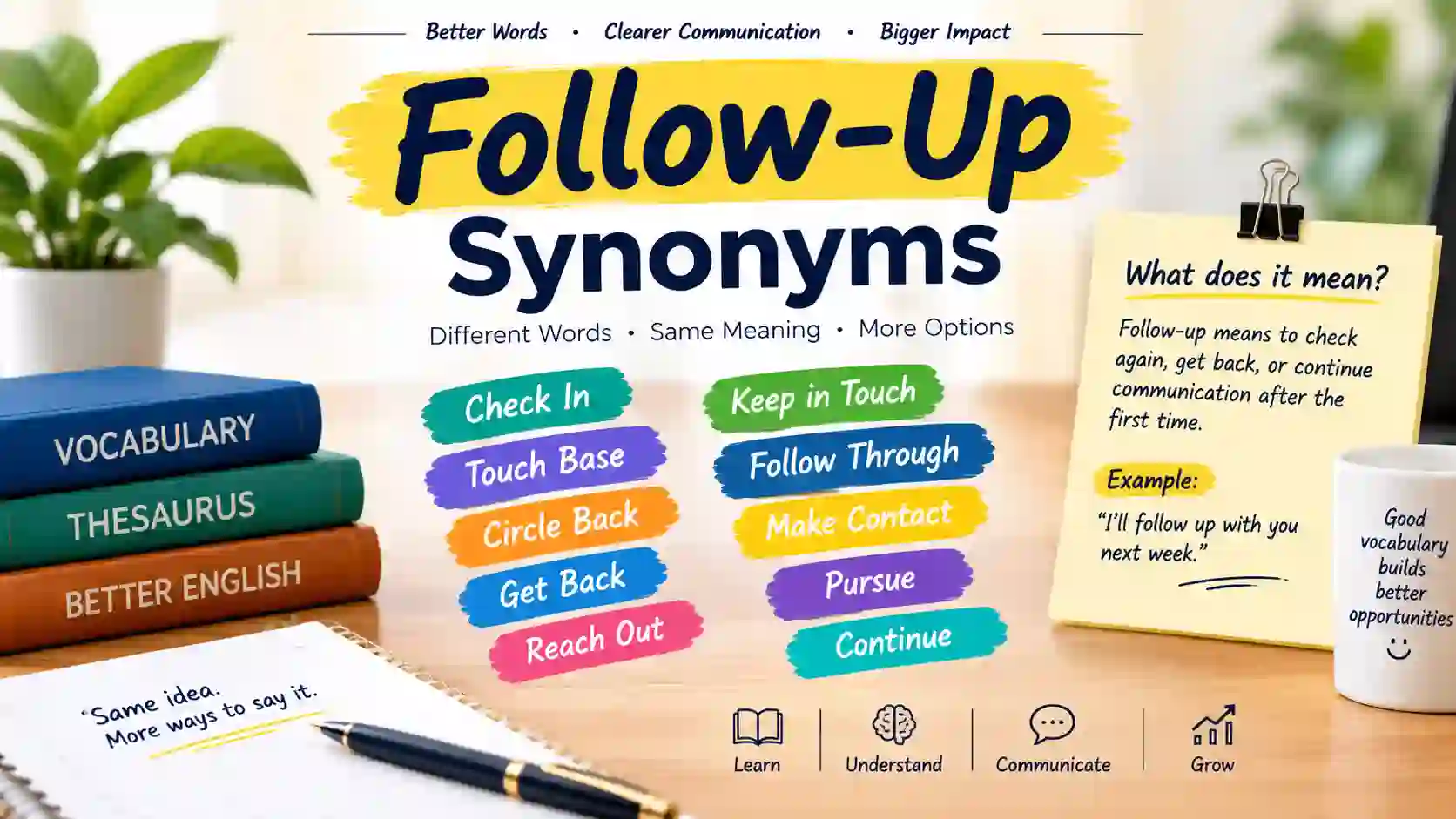
Common follow up synonyms include check on, check in, contact again, look into, investigate, and inquire about. The right choice depends on your goal. Use check on to ask about progress, investigate to examine a problem, and follow through to complete a promise. These phrases are related, but they do not all mean the same thing.
What Does Follow Up Mean?
To follow up means to take another step after an earlier action, message, meeting, request, or event. You might contact someone again, check the status of a task, ask for more information, or act on something that needs attention.
For example, imagine you applied for a job two weeks ago and have not received an answer. You could email the hiring manager to ask about your application. That is following up.
You could also follow up on a customer complaint, follow up with a colleague after a meeting, or follow up a phone call with an email.
Learning different ways to say follow up helps you write clearer emails, improve essays, and speak more naturally. The key is to choose a phrase that matches your purpose rather than replacing every word with a random synonym.
Pronunciation
- American English: /ˈfɑː.loʊ.ʌp/
- British English: /ˈfɒl.əʊ.ʌp/
- Simple pronunciation guide: FAH-loh-up in American English; FOL-oh-up in British English.
The phrase has two main parts: follow and up. The noun and adjective are usually written with a hyphen, as in a follow-up and a follow-up email.
Part of Speech and Grammar
Follow up is a phrasal verb. Its form changes according to the sentence.
| Form | Use | Example |
|---|---|---|
| Follow up | Present or base verb | I will follow up tomorrow. |
| Followed up | Past tense | She followed up yesterday. |
| Following up | Continuous form | We are following up on the request. |
| Follow-up | Noun | We scheduled a follow-up. |
| Follow-up | Adjective | He sent a follow-up email. |
Common Sentence Patterns
Follow up with someone: Contact a person again.
I will follow up with the hiring manager.
Follow up on something: Take further action on a subject, request, or problem.
The team will follow up on the complaint.
Follow something up with something: Add another action after the first one.
She followed the meeting up with a written summary.
Follow up by doing something: Explain the next step.
He followed up by sending the missing documents.
These patterns are useful in everyday and professional English. For definitions and additional examples, consult Oxford Learner’s Dictionaries and Cambridge Dictionary.
20 Useful Follow Up Synonyms
Not every alternative is an exact synonym. Some describe contacting someone, while others describe checking information, investigating a problem, or completing an action.
1. Check On
Meaning: To find out how something or someone is doing.
Examples:
- I will check on the delivery this afternoon.
- The manager checked on the team’s progress.
Best used when: You want a status update without sounding demanding.
Tone: Neutral and friendly.
Common collocations: check on progress, check on an order, check on someone.
When not to use it: Avoid it when you mean to conduct a formal investigation.
2. Check In
Meaning: To contact someone briefly to ask how things are going.
Examples:
- I wanted to check in about the new project.
- Please check in with me after your appointment.
Best used when: You want a friendly update or a brief conversation.
Tone: Friendly and neutral.
Common collocations: check in with a colleague, check in later, check in on progress.
When not to use it: Do not use it when you need to describe a detailed examination of evidence.
3. Contact Again
Meaning: To communicate with someone one more time.
Examples:
- I will contact the supplier again on Monday.
- Please contact the school again if you receive no reply.
Best used when: You need to make another call, email, or message.
Tone: Neutral and professional.
Common collocations: contact the client again, contact the office, contact someone directly.
When not to use it: It does not mean that you have completed the task you discussed.
4. Get Back To
Meaning: To reply to someone after a delay.
Examples:
- I will get back to you after reviewing the figures.
- The customer got back to us with the missing details.
Best used when: You promise to provide an answer later.
Tone: Conversational and common in workplace English.
Common collocations: get back to you, get back to a client, get back with an answer.
When not to use it: Do not use it when you mean to monitor progress without replying to anyone.
5. Look Into
Meaning: To examine a situation to find out more about it.
Examples:
- The support team will look into the payment error.
- We are looking into the cause of the delay.
Best used when: A problem needs attention or an explanation.
Tone: Neutral and professional.
Common collocations: look into an issue, look into a complaint, look into the cause.
When not to use it: Avoid it for a simple reminder when no problem needs investigation.
6. Investigate
Meaning: To examine facts or evidence to discover what happened.
Examples:
- The company will investigate the missing payment.
- The researchers investigated the unexpected result.
Best used when: You need a careful, systematic examination.
Tone: Formal and serious.
Common collocations: investigate a complaint, investigate an incident, investigate a claim.
When not to use it: It can sound too serious for a routine request or friendly email.
7. Inquire About
Meaning: To ask for information about something.
Examples:
- I am writing to inquire about my application.
- She called to inquire about the course schedule.
Best used when: You want to request information politely.
Tone: Formal and courteous.
Common collocations: inquire about an application, inquire about availability, inquire about a position.
When not to use it: In relaxed conversation, ask about may sound more natural.
8. Ask About
Meaning: To request information about a subject or situation.
Examples:
- I asked about the status of my refund.
- He asked about the changes to the timetable.
Best used when: You need a simple, direct way to request an update.
Tone: Neutral and everyday.
Common collocations: ask about progress, ask about an order, ask about a request.
When not to use it: It does not express the idea of completing a task or keeping track of progress by itself.
9. Review
Meaning: To examine something again to understand it or make a decision.
Examples:
- I will review the proposal before Friday.
- The team reviewed the changes after the meeting.
Best used when: You need to reconsider a document, decision, or set of results.
Tone: Neutral to formal.
Common collocations: review a proposal, review the findings, review progress.
When not to use it: Reviewing something does not necessarily involve contacting another person.
10. Monitor
Meaning: To observe or check something over time.
Examples:
- We will monitor website performance this month.
- The team monitors each order until delivery.
Best used when: You need to watch ongoing progress or changes.
Tone: Professional and precise.
Common collocations: monitor progress, monitor performance, monitor changes.
When not to use it: Do not use it for a single email unless you mean continued observation.
11. Track
Meaning: To keep records of the progress or movement of something.
Examples:
- We track each application until a decision is made.
- The project lead tracks unfinished tasks every week.
Best used when: You need to keep up with a task, order, or process.
Tone: Neutral and practical.
Common collocations: track progress, track an order, track a request.
When not to use it: Tracking a task is not the same as contacting someone for an update.
12. Verify
Meaning: To check that information is correct or true.
Examples:
- Please verify the delivery address before shipping.
- The editor verified the figures before publishing.
Best used when: Accuracy matters and you need to confirm details.
Tone: Formal and precise.
Common collocations: verify information, verify a claim, verify details.
When not to use it: Avoid it when you only want a general progress report.
13. Remind
Meaning: To help someone remember something they need to do.
Examples:
- I reminded the team about the deadline.
- Could you remind the client to sign the form?
Best used when: Someone may have forgotten an action or date.
Tone: Neutral; it can sound firm depending on the wording.
Common collocations: remind someone about a meeting, remind someone to reply, remind someone of a deadline.
When not to use it: Use check on instead if you want to learn what has happened rather than remind someone to act.
14. Respond To
Meaning: To reply to a message, request, or situation.
Examples:
- The manager responded to my email this morning.
- Please respond to the request before Friday.
Best used when: You mean answering a message or request.
Tone: Neutral and professional.
Common collocations: respond to an email, respond to a request, respond to feedback.
When not to use it: It is not a direct replacement for follow up if you intend to take an additional step after an earlier action.
15. Revisit
Meaning: To return to a subject or decision and consider it again.
Examples:
- We will revisit the budget after the sales report arrives.
- The teacher revisited the topic in the next lesson.
Best used when: A discussion or decision needs another look.
Tone: Neutral to formal.
Common collocations: revisit a decision, revisit a proposal, revisit an issue.
When not to use it: Do not use it for a simple reminder unless you intend to discuss the subject again.
16. Pursue
Meaning: To continue trying to achieve something or obtain an answer.
Examples:
- The journalist pursued the lead until new facts emerged.
- We will pursue the claim through the proper channels.
Best used when: You intend to keep working toward a result.
Tone: Formal and determined.
Common collocations: pursue a claim, pursue an opportunity, pursue an inquiry.
When not to use it: It may sound forceful when you only want to ask for a friendly update.
17. Follow Through
Meaning: To do what you promised or complete an intended action.
Examples:
- The manager promised to fix the issue and followed through.
- If you agree to send the report, follow through on that promise.
Best used when: You want to emphasize action, responsibility, or completion.
Tone: Neutral to firm.
Common collocations: follow through on a promise, follow through with a plan, follow through on a commitment.
When not to use it: Do not confuse it with sending another message. Following through means carrying out the commitment.
18. Check Back
Meaning: To return or contact someone later to obtain an update.
Examples:
- Please check back next week for the results.
- I will check back with the office if the letter does not arrive.
Best used when: You expect new information to become available later.
Tone: Friendly and neutral.
Common collocations: check back later, check back next week, check back with someone.
When not to use it: Avoid it when you need to describe a formal investigation.
19. Chase Up
Meaning: To contact someone again to obtain information or encourage action.
Examples:
- I will chase up the supplier about the delayed parts.
- She chased up the missing paperwork before the deadline.
Best used when: You need to prompt a response or action, particularly in British workplace English.
Tone: Informal to neutral.
Common collocations: chase up a response, chase up an order, chase up a payment.
When not to use it: In a formal international email, check on or inquire about may sound more neutral.
20. Take Further Action
Meaning: To do more after an earlier step.
Examples:
- We may take further action if the payment remains overdue.
- The department took further action after reviewing the complaint.
Best used when: You need to describe additional steps, especially in formal situations.
Tone: Formal and firm.
Common collocations: take further action, take appropriate action, take immediate action.
When not to use it: Avoid it for a casual message asking whether someone has read your email.
Strongest Synonyms, Strong Synonyms, and Related Words
Strongest Alternatives for Specific Situations
These phrases are strong choices when their meaning matches your intention:
- Investigate: examine facts to discover what happened.
- Look into: examine a problem or situation.
- Pursue: keep working toward an answer or result.
- Follow through: complete a commitment.
- Take further action: move beyond the first step.
There is no universal strongest synonym. The right choice depends on what you want to communicate.
Strong Everyday and Professional Alternatives
- Check on: request a progress update.
- Check in: make brief, friendly contact.
- Contact again: communicate another time.
- Review: examine something again.
- Monitor: observe ongoing progress.
- Track: keep records of progress.
- Chase up: prompt a response or action.
Related Words That Are Not Exact Synonyms
- Remind: help someone remember.
- Verify: check that information is correct.
- Respond to: answer a message or request.
- Revisit: consider a topic again.
- Continue: carry on with an activity.
Use these words only when their specific meanings fit your sentence.
Choose the Right Synonym: Side by Side Comparisons
| Your goal | Best phrase | Example |
|---|---|---|
| Ask about progress | Check on | I will check on the application. |
| Make friendly contact | Check in | I wanted to check in about the project. |
| Reply later | Get back to | I will get back to you tomorrow. |
| Examine a problem | Look into | We will look into the payment error. |
| Search for facts | Investigate | The company will investigate the complaint. |
| Confirm accuracy | Verify | Please verify the figures. |
| Complete a promise | Follow through | She followed through on her promise. |
| Reconsider a proposal | Revisit | We will revisit the proposal next month. |
| Prompt someone to act | Chase up | I will chase up the missing documents. |
| Take additional steps | Take further action | We may take further action if needed. |
Three Phrases That Sound Similar but Mean Different Things
Check on the application: You want to learn its current status.
Investigate the application: You suspect a problem or need to examine the facts.
Follow through on the application: You intend to complete the required steps, although a clearer sentence may specify which steps you mean.
A useful synonym preserves the action and the meaning, not just the general subject.
Commonly Confused Words
| Words | Main difference | Example |
|---|---|---|
| Follow up vs. follow through | Follow up means take another related step; follow through means complete a commitment. | I followed up with the client and followed through on the promised changes. |
| Follow up vs. check in | Follow up can involve a task or investigation; check in often requests a brief update. | I checked in with the designer about the draft. |
| Follow up vs. get back to | Follow up means take another step; get back to means reply later. | I will get back to you after checking the figures. |
| Follow up vs. remind | Follow up may seek information or action; remind means help someone remember. | I reminded the team about the deadline. |
| Follow up vs. investigate | Follow up is broader; investigate means examine facts. | The company investigated the complaint. |
Common Grammar Mistakes
Mistake: I sent a follow up email.
Correction: I sent a follow-up email.
Why: Use follow up as a verb and usually follow-up as a noun or adjective.
Mistake: I will follow up the client.
Correction: I will follow up with the client.
Why: Use follow up with someone when referring to a person.
Mistake: I will investigate your email tomorrow.
Correction: I will respond to your email tomorrow.
Why: Investigate suggests examining facts or a problem. It does not normally mean replying to a routine message.
Mistake: I will monitor you tomorrow.
Correction: I will check in with you tomorrow.
Why: Monitor suggests ongoing observation. Check in sounds more natural when you want to ask how someone is doing.
American vs. British English
The basic phrase follow up is used in both American and British English. Its spelling and core meaning are largely the same.
| Feature | American English | British English |
|---|---|---|
| Verb | Follow up | Follow up |
| Noun | Follow-up | Follow-up |
| Adjective | Follow-up email | Follow-up email |
| Common alternative | Check back, check in | Check back, chase up |
| Inquiry spelling | Inquiry is common | Enquiry is common for a request for information |
Chase up is especially familiar in British workplace English. It is not exclusive to Britain, and usage varies by speaker and setting.
Word Origin and Etymology
The verb follow comes from Old English folgian, meaning to follow or accompany. The phrase follow up developed the idea of taking an additional step after an earlier action.
Dictionary.com dates the noun and adjective uses of follow-up to 1920–25. That date should not automatically be treated as the first recorded use of every form of the phrase.
For further verification, consult Dictionary.com and Oxford Learner’s Dictionaries.
Related Vocabulary and Opposites
There is no single antonym for every meaning of follow up. The best opposite depends on the intended action.
| Word or phrase | Meaning | Example |
|---|---|---|
| Ignore | Pay no attention | He ignored the request. |
| Neglect | Fail to give proper attention | They neglected the complaint. |
| Abandon | Stop working on something | The team abandoned the inquiry. |
| Drop the issue | Stop pursuing a matter | We decided to drop the issue. |
| Leave unresolved | Fail to settle a problem | The dispute remained unresolved. |
Other useful expressions include:
- Touch base: contact someone briefly.
- Circle back: return to a topic later.
- Keep someone posted: continue providing updates.
- Get an update: obtain new information.
- Close the loop: communicate the outcome or finish the communication process.
- Follow-up question: a question asked after an earlier answer.
- Follow-up appointment: a later appointment connected to an earlier visit.
How to Use Follow Up Synonyms in Emails and Writing
Professional Emails
Instead of writing, “I am following up on my previous email,” try one of these alternatives:
Polite: “I wanted to check whether you have had a chance to review my message.”
Direct: “Could you please provide an update on the report?”
Formal: “I am writing to inquire about the status of my application.”
Friendly: “Just checking in to see how the project is coming along.”
Choose a version that suits your relationship with the reader and the urgency of the request.
Essays and Academic Writing
Use examine, investigate, review, or explore when discussing research, evidence, or ideas. For example:
“The study examines the reasons behind the change.”
Do not replace follow up with a formal word just to make a sentence sound more academic. The alternative must still express your intended meaning.
Blogs and Everyday Conversations
Use natural phrases such as check on, check back, ask about, and get back to. In casual conversation, clarity is more valuable than using an unusual word.
Frequently Asked Questions
1. What is the best synonym for follow up?
The best synonym depends on your goal. Use check on to ask about progress, contact again to communicate another time, investigate to examine a problem, or follow through to complete a commitment. No single alternative fits every situation.
2. What is a professional way to say follow up?
In professional writing, use check on the status of, inquire about, request an update on, or review, depending on the situation. For example: “I am writing to inquire about the status of my application.” This sounds polite and clearly explains your purpose.
3. What is another word for follow up in an email?
Useful alternatives include check in, contact again, get back to, and request an update. Write “I wanted to check in about the proposal” for a friendly message, or “Could you provide an update on the proposal?” for a direct professional request.
4. What is the difference between follow up and follow through?
Follow up means taking another related step, such as sending an email or checking progress. Follow through means carrying out a commitment or completing an intended action. You might follow up with a colleague and then follow through by delivering the promised report.
5. Is follow up formal or informal?
Follow up works in both formal and informal English. It is common in workplace emails, education, customer service, and daily conversations. For a more specific tone, use inquire about in a formal request or check in for friendly contact.
6. Is it follow up or follow-up?
Use follow up as a verb: “I will follow up tomorrow.” Use follow-up as a noun or adjective: “We scheduled a follow-up” or “I sent a follow-up email.” The past-tense form is followed up, as in “She followed up yesterday.”
7. How can I follow up without sounding pushy?
Keep the message brief, refer to the earlier conversation, and make a clear request. For example: “I wanted to check whether you have had a chance to review my message. I would appreciate an update when convenient.” This sounds courteous without demanding an immediate reply.
8. What is the difference between follow up on and follow up with?
Use follow up on for an issue, request, task, or question. Use follow up with for a person or further communication. For example: “I will follow up on the application with the admissions officer.”
Vocabulary Quiz
Choose the best answer for each question.
1. Which phrase is best for asking about a project’s progress?
A. Abandon the project
B. Check on the project
C. Ignore the project
D. Investigate the team
2. Which word means examining facts to discover what happened?
A. Remind
B. Continue
C. Investigate
D. Respond
3. Choose the correct sentence.
A. I sent a follow up email.
B. I sent a follow-up email.
C. I sent a followed-up email.
D. I sent a follow uped email.
4. Which phrase means completing a promise?
A. Check in
B. Get back to
C. Follow through
D. Ask about
5. Which sentence uses follow up with correctly?
A. I will follow up with the manager.
B. I will follow up the manager.
C. I will follow with up the manager.
D. I will follow up on the manager.
Answer Key
- B
- C
- B
- C
- A
Conclusion
Learning follow up synonyms helps you communicate more clearly in emails, essays, workplace conversations, and daily life.
Use check on for progress, investigate for problems, get back to for replies, and follow through for commitments. Always choose words that match your meaning and tone.
Practice these expressions in real sentences, and your English will become more natural, precise, and confident.
References
- Oxford Learner’s Dictionaries: Follow up
- Cambridge Dictionary: Follow something up
- Merriam-Webster: Dictionary
- Collins Dictionary: Follow up
- Dictionary.com: Follow-up

Synonorm is a trusted English vocabulary resource created to help readers find the right words and understand the differences between similar terms. We provide clear explanations of synonyms, meanings, examples, usage, and alternatives. Our content makes vocabulary easier to learn and apply in everyday, academic, and professional English. Synonorm is designed for students, writers, ESL learners, professionals, and anyone who wants to improve their English vocabulary and communicate more clearly.