Quick Answer
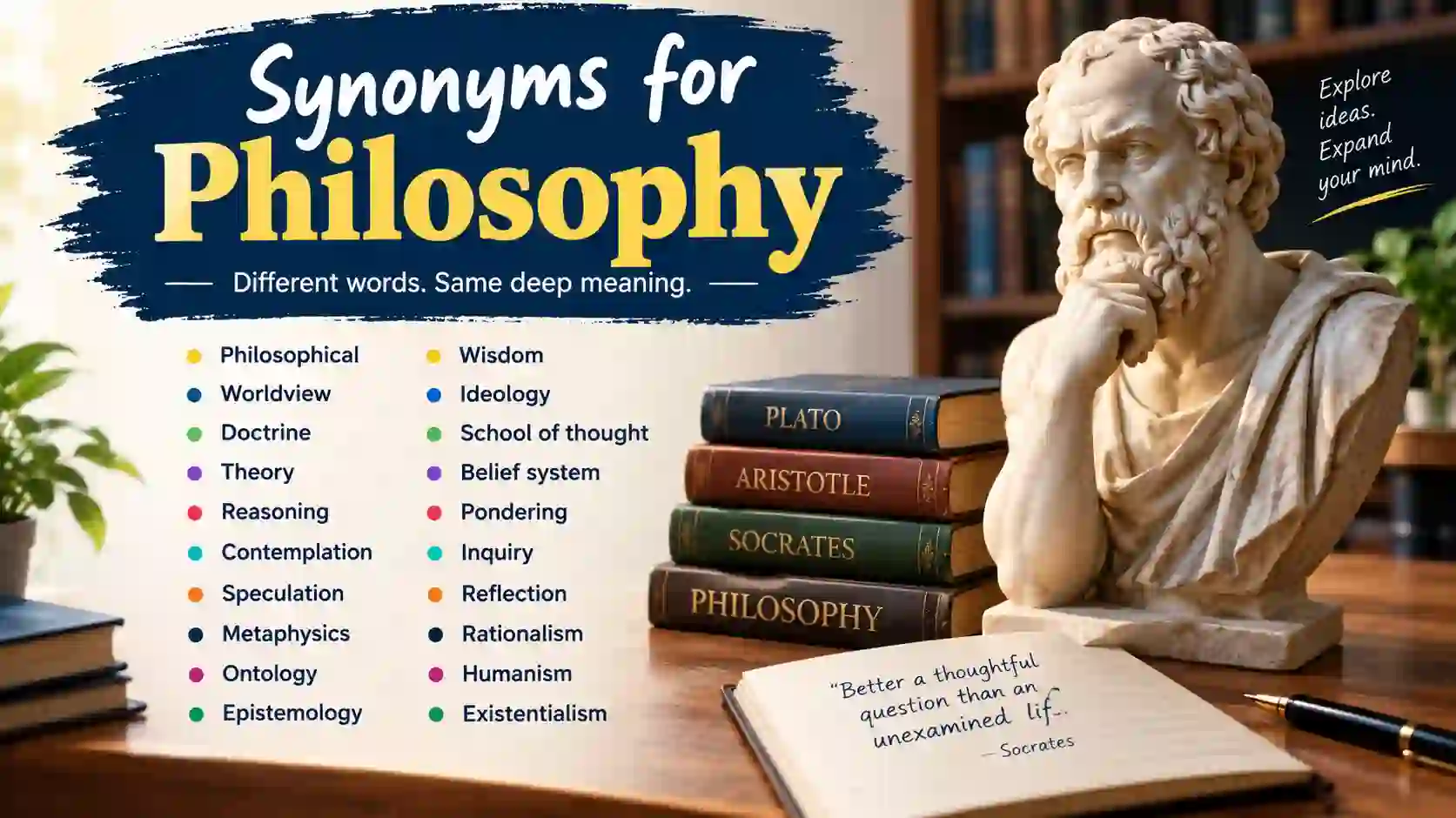
The best synonyms for philosophy depend on the meaning you want. For a personal system of beliefs, use worldview, belief system, outlook, principles, creed, or school of thought. For an organized set of beliefs, doctrine or ideology may fit. Words such as ethics, metaphysics, logic, and Stoicism are related to philosophy but are not general synonyms.
What Does Philosophy Mean?
The noun philosophy has several important meanings.
It can mean the academic study of fundamental questions about knowledge, reality, existence, values, and reason. It can also mean a particular system of ideas or a person’s basic beliefs about how to live or deal with a situation.
For example:
She studies philosophy at university.
Here, philosophy is an academic subject.
But:
His philosophy is to treat everyone with respect.
Here, philosophy means a guiding belief or principle.
This difference is the key to choosing the right synonym.
The Best Synonyms for Philosophy at a Glance
| Alternative | Best Meaning | Register | Frequency |
| Worldview | Overall view of life and reality | Neutral | Common |
| Belief system | Connected set of beliefs | Neutral | Common |
| Outlook | General attitude toward life | Neutral | Very common |
| Principles | Rules or values that guide behavior | Neutral/Formal | Very common |
| Doctrine | Formal set of teachings | Formal | Common |
| Ideology | Organized social or political beliefs | Formal/Academic | Common |
| School of thought | Shared intellectual tradition | Academic | Common |
| Creed | Strongly held guiding beliefs | Formal/Literary | Common |
| Tenets | Core beliefs of a group | Formal | Common |
| Convictions | Strong personal beliefs | Neutral/Formal | Common |
| Perspective | A way of viewing an issue | Neutral | Very common |
| Viewpoint | Particular opinion or position | Neutral | Common |
| Approach | Way of dealing with something | Neutral | Very common |
| Attitude | Way of feeling or thinking | Neutral | Very common |
| Values | Beliefs about what is important | Neutral | Very common |
| Thinking | General intellectual approach | Neutral | Very common |
| Thought | Intellectual ideas or activity | Neutral/Academic | Common |
| Theory | Organized explanation or set of ideas | Academic | Very common |
| System of thought | Organized intellectual framework | Academic | Uncommon |
| Ethos | Character or guiding spirit of a group | Formal | Common |
| Doctrine | Officially taught belief system | Formal | Common |
Important: These words are not all interchangeable. The most accurate choice depends on which sense of philosophy you mean.
1. Worldview
Meaning: A worldview is a person’s broad understanding of life, reality, and the world.
Approximate CEFR: C1
Register: Neutral, academic
Frequency: Common
Examples:
- Traveling changed her worldview.
- His worldview was shaped by his family and education.
Best used when: You mean someone’s overall beliefs about life and reality.
Common collocations:
- personal worldview
- religious worldview
- cultural worldview
Nuance: Worldview is broader than a single opinion. It describes a framework through which someone understands the world.
When not to use it: Do not use worldview as the name of the academic subject.
2. Belief System
Meaning: A belief system is a connected group of beliefs that a person or community holds.
Approximate CEFR: B2
Register: Neutral
Frequency: Common
Examples:
- Culture can strongly influence a person’s belief system.
- Her belief system guides many of her decisions.
Best used when: Philosophy means a connected set of beliefs.
Common collocations:
- personal belief system
- religious belief system
- cultural belief system
Nuance: This is one of the safest alternatives when you want to emphasize beliefs rather than academic study.
When not to use it: It sounds less natural when referring to philosophy as a university discipline.
3. Outlook
Meaning: An outlook is someone’s general attitude toward life or a situation.
Approximate CEFR: B2
Register: Neutral
Frequency: Very common
Examples:
- Her positive outlook helped her through a difficult year.
- The experience changed his outlook on work.
Best used when: You mean a person’s general attitude or view of life.
Common collocations:
- positive outlook
- optimistic outlook
- outlook on life
Nuance: Outlook focuses more on attitude than on a carefully developed system of ideas.
When not to use it: Avoid it when discussing philosophy as an academic discipline.
4. Principles
Meaning: Principles are basic rules or values that guide someone’s actions.
Approximate CEFR: B2
Register: Neutral/Formal
Frequency: Very common
Examples:
- Honesty is one of her strongest principles.
- The company’s principles include fairness and transparency.
Best used when: Philosophy means practical rules or values.
Common collocations:
- guiding principles
- moral principles
- core principles
Nuance: Principles tell us what someone believes should guide behavior.
When not to use it: Do not use principles for the academic subject of philosophy.
5. Doctrine
Meaning: A doctrine is a formal set of beliefs or teachings accepted by a group or institution.
Approximate CEFR: C1
Register: Formal, religious, political, academic
Frequency: Common
Examples:
- The church teaches a particular doctrine.
- Students examined the political doctrine of the period.
Best used when: The beliefs are formally taught or supported by an institution.
Common collocations:
- religious doctrine
- political doctrine
- official doctrine
Nuance: Doctrine often sounds more authoritative and rigid than philosophy.
When not to use it: Do not call an ordinary personal preference a doctrine.
6. Ideology
Meaning: An ideology is an organized set of ideas and beliefs, especially about politics or society.
Approximate CEFR: C1
Register: Formal, academic, political
Frequency: Common
Examples:
- The movement developed a clear political ideology.
- His ideology influenced his views on government.
Best used when: You are discussing organized political, economic, or social beliefs.
Common collocations:
- political ideology
- social ideology
- ideological beliefs
Nuance: Ideology often suggests a structured system shared by a group.
When not to use it: Do not use it for every personal belief. “My ideology is to exercise every morning” sounds unnatural.
7. School of Thought
Meaning: A school of thought is a group or tradition that shares a particular way of thinking.
Approximate CEFR: C1
Register: Academic
Frequency: Common
Examples:
- Two schools of thought disagree on the issue.
- She belongs to a different school of thought.
Best used when: Talking about intellectual or philosophical traditions.
Common collocations:
- major school of thought
- philosophical school of thought
- competing schools of thought
Nuance: This phrase focuses on a shared intellectual tradition, not one person’s private beliefs.
When not to use it: Do not use it for a simple personal opinion.
8. Creed
Meaning: A creed is a set of beliefs that strongly guides a person or group.
Approximate CEFR: C1
Register: Formal, religious, literary
Frequency: Common
Examples:
- Service to others became his personal creed.
- The group’s creed emphasizes compassion.
Best used when: Strong beliefs guide someone’s actions.
Common collocations:
- personal creed
- religious creed
- guiding creed
Nuance: Creed often carries a strong religious or moral feeling.
When not to use it: It can sound too formal for ordinary conversation.
9. Tenets
Meaning: Tenets are important beliefs or principles held by a group.
Approximate CEFR: C1
Register: Formal, academic
Frequency: Common
Examples:
- Equality is one of the movement’s central tenets.
- The book explains the basic tenets of the theory.
Best used when: You want to emphasize the core beliefs within a larger system.
Common collocations:
- core tenets
- central tenets
- fundamental tenets
Nuance: A tenet is normally one belief within a wider system.
When not to use it: It is less natural in simple everyday speech.
10. Convictions
Meaning: Convictions are strong beliefs that someone feels certain about.
Approximate CEFR: B2
Register: Neutral/Formal
Frequency: Common
Examples:
- She remained loyal to her convictions.
- His convictions shaped his political decisions.
Best used when: You want to emphasize strongly held personal beliefs.
Common collocations:
- personal convictions
- moral convictions
- deeply held convictions
Nuance: Convictions suggest strong personal commitment.
When not to use it: A casual opinion is usually not a conviction.
11. Perspective
Meaning: A perspective is a particular way of viewing or understanding something.
Approximate CEFR: B2
Register: Neutral
Frequency: Very common
Examples:
- Studying philosophy gave her a new perspective on justice.
- Travel gave him a wider perspective on life.
Best used when: You mean a way of looking at an issue.
Common collocations:
- different perspective
- new perspective
- philosophical perspective
Nuance: A perspective is usually one angle, not a complete belief system.
When not to use it: Do not use it as a direct substitute for philosophy when referring to a complete intellectual tradition.
12. Viewpoint
Meaning: A viewpoint is a particular opinion or position on an issue.
Approximate CEFR: B2
Register: Neutral
Frequency: Common
Examples:
- The article presents several viewpoints.
- Her viewpoint changed after she read the research.
Best used when: You are talking about someone’s position on a particular subject.
When not to use it: Viewpoint is usually too narrow to replace philosophy when you mean a complete way of life.
13. Approach
Meaning: An approach is a particular way of dealing with something.
Approximate CEFR: B1
Register: Neutral
Frequency: Very common
Examples:
- The teacher uses a practical approach to learning.
- Their approach to leadership is based on trust.
Best used when: Philosophy means a guiding method or way of doing something.
Common collocations:
- practical approach
- philosophical approach
- approach to education
Nuance: Approach focuses on action and method rather than beliefs alone.
14. Attitude
Meaning: An attitude is the way someone thinks or feels about something.
Approximate CEFR: B2
Register: Neutral
Frequency: Very common
Examples:
- His attitude toward failure is positive.
- A calm attitude helped her solve the problem.
Best used when: Philosophy refers to a general mental or emotional position.
When not to use it: An attitude may be temporary. A philosophy is often deeper and more structured.
15. Values
Meaning: Values are beliefs about what is important, good, or desirable.
Approximate CEFR: B1-B2
Register: Neutral
Frequency: Very common
Examples:
- Her values influence the way she treats people.
- The company’s values include honesty and respect.
Best used when: You mean the moral beliefs behind someone’s philosophy.
When not to use it: Values are individual beliefs within a wider system, not necessarily the whole philosophy.
16. Thinking
Meaning: Thinking can describe someone’s general way of considering ideas or problems.
Approximate CEFR: B1
Register: Neutral
Frequency: Very common
Examples:
- His thinking about education has changed.
- Modern thinking challenges some older assumptions.
Best used when: You want a natural word for a person’s intellectual approach.
When not to use it: It is too broad to replace philosophy in precise academic contexts.
17. Thought
Meaning: Thought can refer to ideas, intellectual activity, or a tradition of ideas.
Approximate CEFR: B1
Register: Neutral/Academic
Frequency: Very common
Examples:
- Ancient Greek thought influenced Western philosophy.
- The book explores political thought.
Best used when: Discussing broad intellectual ideas.
When not to use it: Thought is much broader than philosophy.
18. Theory
Meaning: A theory is an organized explanation or set of ideas about a subject.
Approximate CEFR: B2
Register: Academic/Professional
Frequency: Very common
Examples:
- The course introduces several theories of knowledge.
- His theory explains the relationship between language and thought.
Best used when: You mean a specific intellectual explanation.
When not to use it: A theory is not automatically a complete philosophy.
19. System of Thought
Meaning: A system of thought is an organized framework of connected ideas.
Approximate CEFR: C1
Register: Academic
Frequency: Uncommon
Examples:
- The philosopher developed a complex system of thought.
- Different systems of thought offer different answers to the question.
Best used when: You need a precise academic phrase for an organized intellectual framework.
20. Ethos
Meaning: Ethos is the characteristic spirit, values, or beliefs of a person, group, culture, or organization.
Approximate CEFR: C1
Register: Formal/Academic/Business
Frequency: Common
Examples:
- The company’s ethos is based on fairness.
- The school has a strong ethos of cooperation.
Best used when: Philosophy refers to the shared character or values of a group.
When not to use it: Ethos does not normally mean the academic study of philosophy.
21. Credo
Meaning: A credo is a set of beliefs or principles that guides someone.
Approximate CEFR: C1
Register: Formal/Literary
Frequency: Uncommon
Examples:
- “Work hard and stay honest” was his personal credo.
- The team’s credo is simple: respect every customer.
Best used when: You mean a short, strongly held guiding belief.
When not to use it: It can sound literary or formal in casual speech.
Which Words Are True Synonyms?
This is where many online synonym pages become confusing.
Closest alternatives
These can replace philosophy in particular senses:
- worldview
- belief system
- outlook
- doctrine
- ideology
- school of thought
- creed
- principles
- ethos
- credo
Context-dependent alternatives
These can work in some sentences:
- perspective
- viewpoint
- approach
- attitude
- values
- convictions
- thinking
- thought
- theory
Related but NOT general synonyms
These are connected with philosophy but should not normally replace the word:
- ethics
- metaphysics
- epistemology
- logic
- aesthetics
- rationalism
- empiricism
- Stoicism
- existentialism
- ontology
This distinction is one of the most important improvements over generic synonym lists. Cambridge’s own thesaurus results include terms such as logic, rationalism, metaphysics, and aesthetics, but these represent particular philosophical areas or approaches rather than universal substitutes for philosophy.
Choose the Right Synonym
| If you mean… | Use… | Example |
| Overall beliefs about life | Worldview | Travel changed her worldview. |
| General attitude | Outlook | He has a positive outlook. |
| Organized political beliefs | Ideology | The party has a clear ideology. |
| Formal teachings | Doctrine | The doctrine was widely taught. |
| Core beliefs | Tenets | These are the movement’s central tenets. |
| Guiding values | Principles | Honesty is one of my principles. |
| Strong personal beliefs | Convictions | She stood by her convictions. |
| Intellectual tradition | School of thought | It belongs to a major school of thought. |
| Group character and values | Ethos | The company has a strong ethical ethos. |
| Way of dealing with something | Approach | We need a different approach. |
| Opinion on one issue | Viewpoint | I understand your viewpoint. |
| Way of seeing an issue | Perspective | She offered a new perspective. |
Philosophy vs. Ideology vs. Worldview vs. Outlook
These four words are often confused.
| Word | Main idea | Depth | Typical context |
| Philosophy | System of ideas or study of fundamental questions | High | Academic, personal, professional |
| Ideology | Organized beliefs, often social or political | High | Politics, society |
| Worldview | Overall understanding of life and reality | High | Personal, cultural, religious |
| Outlook | General attitude toward life or situations | Medium | Everyday English |
Example
Her philosophy is that education should be accessible.
This emphasizes her guiding ideas.
Her worldview was shaped by education.
This emphasizes her overall understanding of the world.
Her outlook on education is optimistic.
This emphasizes her attitude.
Her political ideology supports equal access to education.
This emphasizes organized political beliefs.
Commonly Confused Words
| Word | What it really means | Example |
| Philosophy | Broad study or system of ideas | He studies philosophy. |
| Ethics | Study of moral questions | She teaches ethics. |
| Metaphysics | Study of reality and existence | He researches metaphysics. |
| Ideology | Organized social or political beliefs | The movement has an ideology. |
| Doctrine | Formal teachings or beliefs | The institution follows a doctrine. |
Remember
Ethics is part of philosophy.
Metaphysics is part of philosophy.
Ideology can be a system of beliefs.
Doctrine is a formal set of teachings.
None of these should automatically replace philosophy.
Common Mistakes
Common Mistake 1
Mistake: Ethics is another word for philosophy.
Correction: Ethics is a branch of philosophy.
Why: Philosophy is the wider field. Ethics focuses specifically on morality and questions of right and wrong.
Common Mistake 2
Mistake: My ideology is to help people.
Better: My philosophy is to help people.
Why: Ideology often suggests a structured political or social system. Philosophy sounds more natural for a personal guiding belief.
Common Mistake 3
Mistake: I study worldview at university.
Correction: I study philosophy at university.
Why: Worldview describes a person’s understanding of life. Philosophy is the name of the academic discipline.
Common Mistake 4
Mistake: Her viewpoint is based on many principles and ideas about how life works, so it is her philosophy.
Better: Her philosophy is based on several principles about how life works.
Why: A viewpoint usually concerns a particular issue. A philosophy can be broader and more systematic.
American vs. British English
The spelling philosophy is the same in American and British English.
American English
/fɪˈlɑː.sə.fi/
British English
/fɪˈlɒs.ə.fi/
The main difference is the vowel sound in the stressed syllable. The meaning and spelling remain the same. Cambridge provides both US and UK pronunciations.
Word Origin and Etymology
Philosophy entered English through Middle English from Anglo-French, ultimately from Latin philosophia and Greek philosophia. The Greek formation is associated with philo-, meaning a love or fondness for something, and sophia, meaning wisdom.
The familiar expression “love of wisdom” therefore reflects the word’s Greek roots.
Historical dictionary sources place English philosophy in use around the late 13th or early 14th century. Merriam-Webster’s historical entry gives a 14th-century date, while etymological sources place English use around c. 1300.
A useful historical point is that the meaning has expanded. The word has been used for learning and knowledge, the pursuit of wisdom, systematic inquiry, philosophical systems, and a person’s basic beliefs or attitudes.
Word Family
| Word | Part of Speech | Meaning |
| Philosophy | Noun | Study or system of ideas |
| Philosopher | Noun | Person who studies or practices philosophy |
| Philosophical | Adjective | Related to philosophy |
| Philosophically | Adverb | In a philosophical way |
| Philosophize | Verb | Think or reason about philosophical matters |
Example
She is studying philosophy.
She hopes to become a philosopher.
The question has a philosophical dimension.
Natural Collocations with Philosophy
Native speakers commonly use philosophy in phrases such as:
- philosophy of life
- philosophy of education
- philosophy of science
- political philosophy
- moral philosophy
- ancient philosophy
- modern philosophy
- philosophical question
- philosophical argument
- philosophical tradition
- philosophical approach
- study of philosophy
- personal philosophy
- teaching philosophy
- business philosophy
These combinations help learners use the word naturally instead of simply memorizing isolated definitions.
When Should You NOT Replace “Philosophy”?
Sometimes the best synonym is no synonym at all.
For example:
I am studying philosophy at university.
Changing this to:
I am studying worldview at university.
would change the meaning.
Likewise:
Kant’s philosophy influenced modern thought.
Replacing philosophy with attitude would make the sentence much less accurate.
Good rule
Do not change a word just because you have used it twice. Change it only when another word expresses the same idea more precisely.
Writing Tips
For essays
Use precise academic terms:
- school of thought
- doctrine
- theory
- worldview
- principles
- perspective
For professional writing
Words such as approach, principles, values, ethos, and outlook often sound natural.
Our business philosophy emphasizes customer service.
Could become:
Our approach emphasizes customer service.
Or:
Our guiding principles emphasize customer service.
For everyday conversation
Choose simple words:
- outlook
- beliefs
- values
- approach
- viewpoint
- attitude
For academic philosophy
Keep philosophy when you mean the discipline itself. Use specialized terms such as ethics, metaphysics, epistemology, logic, or aesthetics only when that specific area is intended.
Related Vocabulary
Philosophy-related words
- wisdom
- reason
- logic
- knowledge
- truth
- reality
- existence
- morality
- values
- beliefs
- principles
- ideas
- argument
- theory
- worldview
Important distinction
Wisdom is closely connected with the history and traditional idea of philosophy, but it is not an exact modern synonym. The Oxford English Dictionary records historical uses of wisdom that overlap with learning and philosophy, showing the strong historical connection between the concepts.
Antonyms and Contrasting Ideas
There is no single exact antonym for philosophy because the word has several meanings.
Depending on context, contrasting ideas can include:
- ignorance
- thoughtlessness
- irrationality
- impulsiveness
- unreason
- lack of principles
These are contextual opposites, not strict dictionary antonyms.
Mini Practice: Choose the Best Word
Choose from:
worldview | ideology | outlook | doctrine | principles
- Her positive ______ helped her stay hopeful.
- The political party’s ______ influenced its economic policies.
- His ______ changed after years of international travel.
- The religious organization follows a specific ______.
- Honesty and fairness are two of her main ______.
Answers
- outlook
- ideology
- worldview
- doctrine
- principles
Sentence Rewriting Practice
Replace philosophy with the most precise alternative.
1.
His philosophy about customer service is simple.
Possible answer: His approach to customer service is simple.
2.
Her philosophy of life was shaped by travel.
Possible answer: Her worldview was shaped by travel.
3.
The movement’s philosophy influenced its political policies.
Possible answer: The movement’s ideology influenced its political policies.
Remember that more than one answer may work when the intended meaning changes slightly.
FAQ: Synonyms for Philosophy
What is the best synonym for philosophy?
There is no single best synonym. Worldview, belief system, outlook, principles, doctrine, ideology, and school of thought can all work in specific contexts. The correct choice depends on whether you mean an academic discipline, a personal way of thinking, or an organized system of beliefs.
What is another word for philosophy of life?
Good alternatives include worldview, outlook on life, personal beliefs, principles, and personal approach to life. Worldview is useful for a broad understanding of life, while outlook focuses more on a person’s general attitude.
Is worldview a synonym for philosophy?
Worldview can be a close alternative when philosophy means a person’s broad understanding of life and reality. It is not a general replacement for philosophy as an academic subject. For example, you study philosophy, but you may develop a particular worldview.
Is ideology the same as philosophy?
No. Ideology usually describes an organized system of social, political, or economic beliefs. Philosophy has a wider range of meanings and can describe academic inquiry, personal beliefs, or a system of ideas. The two overlap in some contexts but are not interchangeable.
What is a simple synonym for philosophy?
For everyday English, try beliefs, outlook, approach, viewpoint, values, or way of thinking. The best choice depends on the sentence. Outlook is especially natural when you mean someone’s general attitude toward life.
What is the difference between philosophy and ethics?
Philosophy is the broader field. Ethics is one branch of philosophy that examines moral questions, including what is right, wrong, good, bad, fair, or responsible. Therefore, ethics can be part of philosophy but cannot replace it in every sentence.
What is the difference between philosophy and doctrine?
A philosophy can be personal, academic, or theoretical and does not necessarily require formal acceptance. A doctrine is usually a set of teachings or beliefs formally supported by a group, institution, religion, or political system.
What are the strongest synonyms for philosophy?
For the meaning of a system of beliefs, strong alternatives include worldview, belief system, doctrine, ideology, school of thought, creed, and tenets. For a personal philosophy, outlook, principles, values, and approach are often more natural.
Vocabulary Quiz
1. Which word best describes someone’s overall understanding of life and reality?
A. Viewpoint
B. Worldview
C. Attitude
D. Theory
2. Which word is most closely associated with organized political beliefs?
A. Outlook
B. Ideology
C. Wisdom
D. Perspective
3. Which word means a formal set of teachings?
A. Doctrine
B. Viewpoint
C. Attitude
D. Outlook
4. Which sentence uses “philosophy” correctly?
A. She philosophy every morning.
B. I study philosophy at university.
C. He bought two philosophies yesterday.
D. She philosophized the problem.
5. Which statement is correct?
A. Ethics is always an exact synonym for philosophy.
B. Metaphysics is the whole field of philosophy.
C. Ethics is a branch of philosophy.
D. Worldview is the official name of the academic subject.
Answer Key
- B. Worldview
- B. Ideology
- A. Doctrine
- B. I study philosophy at university.
- C. Ethics is a branch of philosophy.
Final Takeaway
The best synonyms for philosophy depend on what you are trying to say. Use worldview for a broad view of life, outlook for general attitude, principles for guiding values, doctrine for formal teachings, and ideology for an organized social or political belief system.
Use perspective, viewpoint, and approach when the meaning is narrower. Most importantly, do not treat branches such as ethics or metaphysics as general synonyms. Precise word choice makes your English clearer, stronger, and more natural.
References
- Cambridge Dictionary — Philosophy: Meaning, pronunciation, and thesaurus entries
Cambridge Dictionary – Philosophy - Cambridge Thesaurus — Synonyms and related words for philosophy
Cambridge Thesaurus – Philosophy - Merriam-Webster — Philosophy: Definition and meaning
Merriam-Webster – Philosophy - Collins Dictionary — Philosophy Synonyms and related words
Collins Dictionary – Philosophy Thesaurus - Dictionary.com — Philosophy: Definition, meaning, and word history
Dictionary.com – Philosophy - Encyclopaedia Britannica — Philosophy: Definition and branches
Britannica – Philosophy

Synonorm is a trusted English vocabulary resource created to help readers find the right words and understand the differences between similar terms. We provide clear explanations of synonyms, meanings, examples, usage, and alternatives. Our content makes vocabulary easier to learn and apply in everyday, academic, and professional English. Synonorm is designed for students, writers, ESL learners, professionals, and anyone who wants to improve their English vocabulary and communicate more clearly.