Quick answer: What are the best synonyms for “best team”?
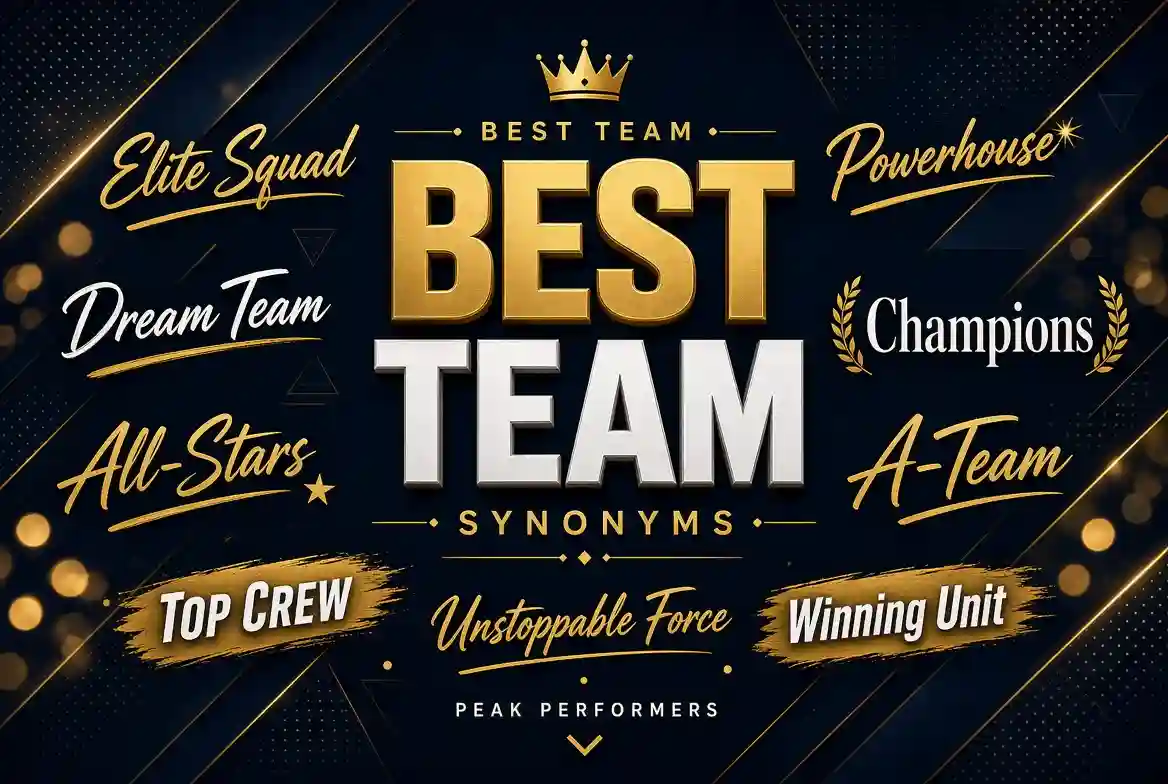
The best alternatives depend on what you want to communicate:
- Top-performing team: a team that achieves excellent results.
- High-performing team: a team that consistently performs well.
- Leading team: a team recognized as a leader in its field.
- Outstanding team: a team that performs exceptionally well.
- Elite team: a highly selected group with exceptional ability.
- Winning team: a team that wins competitions or matches.
- Cohesive team: a team whose members work well together.
- Dream team: a group of people whose combined abilities make them especially desirable.
For professional writing, high-performing teams and top-performing teams are often strong choices. For sports, a winning team or championship-winning team may fit better, provided the facts support the description.
What does “best team” mean?
“Best team” refers to the team considered superior to others according to a particular standard. That standard might be performance, skills, results, teamwork, experience, or competitive success.
The phrase does not always mean the same thing. A team can be the best at solving problems without being the fastest. A sports team might have the best record, while a workplace team might be valued for customer satisfaction.
Example: “Our team is the best” expresses a general opinion. “Our team has the highest customer satisfaction score” explains the specific reason for the claim.
This distinction matters when choosing a synonym. The right phrase should preserve the original meaning rather than simply make the sentence sound more impressive.
Best team synonyms at a glance
| Synonym or phrase | Best use | What it emphasizes |
| Top-performing team | Business, education | Strong results |
| High-performing team | Workplace, management | Consistent performance |
| Leading team | Industry, research | Leadership or prominence |
| Outstanding team | General praise | Exceptional quality |
| Elite team | Sports, specialist groups | High standards and selection |
| Winning team | Sports, competitions | Victories |
| Championship-winning team | Competitive sports | Winning a championship |
| Top-ranked team | Rankings, standings | A verified position |
| Exceptional team | Formal and general writing | Unusually high quality |
| Excellent team | Everyday and professional English | Very good overall quality |
| Skilled team | Technical work | Developed abilities |
| Talented team | Creative work, sports | Natural ability or promise |
| Effective team | Workplace, projects | Achieving its objectives |
| Efficient team | Operations, business | Using time and resources well |
| Cohesive team | Leadership, collaboration | Unity and cooperation |
| Well-coordinated team | Projects, operations | Organized joint action |
| Collaborative team | Workplace, education | Working together |
| Successful team | General use | Achieving goals |
| Strong team | General use | Overall capability |
| Dream team | Informal and promotional writing | An ideal combination of people |
| All-star team | Sports, recognition | Outstanding members |
| First-rate team | General praise | Very high quality |
| Top team | Casual and general use | A leading or excellent group |
| Formidable team | Competition | A team that is difficult to defeat |
| Best-in-class team | Business, marketing | Excellence against a defined standard |
These are not all exact synonyms. Some describe results, others describe how people work, and others make claims about reputation or ranking.
25 best team synonyms explained
1. Top performing team
A top-performing team produces excellent results compared with relevant teams or against a meaningful performance standard. It is a particularly useful phrase in business and professional communication.
Example: “The top-performing team exceeded its quarterly sales target.”
Best for: Business reports, project updates, school competitions, and performance reviews.
Avoid when: You have no results or comparison to support the claim.
2. High performing team
A high-performing team consistently achieves strong results and works effectively toward shared goals. The phrase is common in workplace and management writing.
Example: “Our high-performing team completed the launch without missing the deadline.”
Best for: Leadership articles, team development, business presentations, and professional profiles.
Difference: High-performing focuses on a high level of performance; top-performing more directly suggests comparison with others.
3. Leading team
A leading team is prominent, influential, or ahead in a particular field. It may be known for innovation, expertise, or achievements.
Example: “The leading research team developed a new testing method.”
Best for: Industry reports, research, technology, and professional introductions.
Avoid when: The group is simply good but has no clear leadership position or recognition.
4. Outstanding team
An outstanding team performs exceptionally well or stands out because of its quality, service, or achievements.
Example: “The outstanding team handled every customer complaint with care.”
Best for: Employee recognition, recommendations, awards, and general praise.
Tone: Positive and flexible. It does not necessarily mean the team is ranked first.
5. Elite team
An elite team consists of highly capable people who meet demanding standards or have been selected for exceptional ability.
Example: “Only experienced engineers joined the elite cybersecurity team.”
Best for: Specialist units, competitive sports, advanced research, and highly selective groups.
Avoid when: You simply mean a friendly or cooperative group. Elite suggests a high level of ability or selectivity.
6. Winning team
A winning team is a team that wins matches, contests, or other competitions. In a figurative sense, it can describe a group associated with success.
Example: “The winning team celebrated after the final whistle.”
Best for: Sports, tournaments, games, and competitions.
Avoid when: You want to describe a team that performs well but has not necessarily won anything.
7. Championship winning team
A championship-winning team has won a championship. This is more precise than a general compliment because it states a specific achievement.
Example: “The championship-winning team returned home to a hero’s welcome.”
Best for: Sports reporting, biographies, team histories, and competition summaries.
Important: Do not use this phrase unless the team actually won the championship.
8. Top ranked team
A top-ranked team holds a high position in an established ranking or standings list.
Example: “The top-ranked team entered the tournament as the favorite.”
Best for: Sports rankings, university competitions, company ratings, and research evaluations.
Important: Rankings depend on the source, date, and criteria. Include those details when accuracy matters.
9. Exceptional team
An exceptional team is unusually good in ability, service, results, or problem-solving.
Example: “The exceptional team found a solution before the deadline.”
Best for: Formal writing, employee feedback, recommendations, and performance reviews.
Difference: Exceptional highlights unusual quality but does not necessarily claim that the team is number one.
10. Excellent team
An excellent team is a simple, natural way to describe a group that performs very well.
Example: “We have an excellent team of designers and developers.”
Best for: Emails, everyday conversation, professional introductions, and general praise.
Tone: Clear and widely understood. It is less specific than high-performing or top-ranked.
11. Skilled team
A skilled team has the knowledge and abilities needed to complete a task effectively.
Example: “A skilled team of technicians repaired the equipment.”
Best for: Technical services, construction, healthcare, engineering, and project descriptions.
Difference: Skill describes ability, not necessarily results. A skilled team may still face delays or other challenges.
12. Talented team
A talented team has members with strong natural abilities, creative strengths, or considerable potential.
Example: “The talented team created an original campaign for the new product.”
Best for: Design, entertainment, sports, creative industries, and recruitment.
Difference: Talented emphasizes ability or potential. Success emphasizes achievement.
13. Effective team
An effective team achieves its objectives. It focuses on whether the group gets the right work done.
Example: “An effective team communicates clearly and solves problems quickly.”
Best for: Management, education, project planning, and organizational development.
Difference: Effectiveness is about achieving goals. It does not automatically mean the team uses the least time or money.
14. Efficient team
An efficient team completes work while making good use of time, effort, money, or other resources.
Example: “The efficient team processed the requests without unnecessary delays.”
Best for: Operations, administration, production, and business process improvement.
Difference: An effective team reaches its goals; an efficient team uses resources well. A team can be one without being the other.
15. Cohesive team
A cohesive team has members who feel connected, cooperate, and work toward shared goals.
Example: “The manager helped build a cohesive team through open communication.”
Best for: Leadership, workplace culture, collaboration, and team-building content.
Avoid when: Your main point is that the group won a competition or achieved the highest score. Cohesion alone does not prove superior performance.
16. Well-coordinated team
A well-coordinated team organizes its work so that members, tasks, and timing fit together effectively.
Example: “The well-coordinated team completed the event setup before guests arrived.”
Best for: Event planning, logistics, healthcare, emergency response, and complex projects.
Difference: Coordination focuses on how work fits together, not necessarily on how talented each member is.
17. Collaborative team
A collaborative team actively shares ideas, information, and responsibility.
Example: “The collaborative team invited feedback from every department.”
Best for: Education, product development, research, and cross-functional work.
Difference: Collaboration describes a way of working. It does not automatically mean the group has the best results.
18. Successful team
A successful team achieves important goals or delivers results that matter.
Example: “The successful team launched three products in one year.”
Best for: General writing, business summaries, sports, and case studies.
Avoid when: You need to prove that a team is better than every competitor. Success does not always establish first place.
19. Strong team
A strong team has a combination of abilities, resources, experience, or cooperation that helps it perform well.
Example: “We built a strong team with experience in research, design, and customer support.”
Best for: Everyday English, management, hiring, and professional communication.
Tone: Natural and versatile, though less precise than a phrase that names a specific strength.
20. Dream team
A dream team is an ideal or especially impressive combination of people whose abilities complement one another.
Example: “The company brought together a dream team of designers, engineers, and researchers.”
Best for: Informal conversation, promotional writing, creative projects, and sports.
Avoid when: You need neutral, evidence-based language for a formal report. It is enthusiastic and sometimes promotional.
21. All-star team
An all-star team includes outstanding performers, often selected because of their achievements or reputation.
Example: “The charity assembled an all-star team of volunteers for its annual event.”
Best for: Sports, special projects, recognition, and celebratory writing.
Difference: It suggests standout individuals. It does not necessarily mean the group works together better than any other team.
22. First rate team
A first-rate team is a team of very high quality. The phrase is idiomatic and suitable for general praise.
Example: “The event was supported by a first-rate team of technicians.”
Best for: Reviews, recommendations, service descriptions, and general professional writing.
Tone: Positive, slightly traditional, and less technical than high-performing team.
23. Top team
A top team is a simple, flexible phrase for a team considered excellent or among the leading groups.
Example: “She hopes to join a top team in the industry.”
Best for: Casual writing, job applications, sports, and headlines.
Caution: In formal reporting, explain what makes the team “top” if the claim needs evidence.
24. Formidable team
A formidable team is powerful, capable, or difficult for competitors to defeat.
Example: “Their formidable team combined speed, experience, and tactical discipline.”
Best for: Sports analysis, competitive business writing, and descriptions of strong opponents.
Tone: Strong and dramatic. It often emphasizes the challenge a team presents to others.
25. Best in class team
A best-in-class team is considered among the best within a defined category or standard. It is common in business and marketing languages.
Example: “The company aims to build a best-in-class customer support team.”
Best for: Business proposals, service descriptions, strategy documents, and marketing.
Caution: Because it is a comparative claim, identify the relevant category or evidence when possible. Without support, it can sound like an empty promotional phrase.
Which synonym should you use? A quick decision guide
Use this guide to choose a phrase based on what you actually mean.
If the team achieves excellent results
Choose a top-performing team or high-performing team.
If the team is first in a published ranking
Choose the top-ranked team or number-one team, and make sure the ranking supports it.
If the team works especially well together
Choose a cohesive team, collaborative team, or well-coordinated team.
If the team has won a competition
Choose a winning team or championship-winning team, depending on the result.
If you simply want to praise the group
Choose an excellent team, an outstanding team, or an exceptional team.
If you want a more casual or enthusiastic phrase
Choose a dream team, all-star team, or top team.
Best team synonyms for different situations
In the workplace
For business communication, choose wording that describes performance or a particular strength.
- “We have a high-performing team that consistently meets its targets.”
- “Our well-coordinated team delivered the project on schedule.”
- “The company has an experienced and skilled team of analysts.”
These phrases sound more informative than repeatedly calling the team “the best.”
In sports
Sports writing often needs to distinguish current rankings from wins and overall ability.
- Winning team: a team that wins a particular match or competition.
- Top-ranked team: a team high in an established ranking.
- Championship-winning team: a team that has won the championship.
- Formidable team: a strong opponent that is difficult to defeat.
- All-star team: a group selected for standout players.
For example, “The top-ranked team won the final” is appropriate only if the team held that ranking and won the final.
In resumes and cover letters
When describing a team you worked with, avoid unsupported claims like “I was part of the best team in the world.” Use evidence-based language instead.
- “Collaborated with a high-performing team to meet quarterly targets.”
- “Worked with a cross-functional team to launch a new service.”
- “Supported a well-coordinated team in completing customer requests.”
If possible, include a result, such as meeting a deadline, improving response times, or completing a project.
In school and academic writing
- “The top-performing team received the highest score.”
- “The collaborative team shared research and checked each other’s work.”
- “The winning team represented the school at the regional competition.”
Choose a phrase that matches the evidence, not just the most impressive-sounding words.
In casual conversation
These phrases are natural for everyday speech:
- “We have a great team.”
- “They’re an excellent team.”
- “We make a good team.”
- “They’re a real dream team.”
Note that “we make a good team” usually means two or more people work well together. It is not always interchangeable with “we are the best team.”
“Best team” vs. similar expressions
| Expression | Meaning | Example |
| Best team | Considered superior according to some standard | “They have the best team in the division.” |
| Top-performing team | Produces excellent results | “The top-performing team exceeded its target.” |
| Top-ranked team | Holds a high ranking | “The top-ranked team entered the final.” |
| Cohesive team | Works with unity | “The cohesive team solved the problem together.” |
| Skilled team | Has strong abilities | “A skilled team installed the system.” |
| Effective team | Achieves its goals | “The effective team resolved the issue.” |
| Efficient team | Uses resources well | “The efficient team reduced wasted time.” |
| Dream team | An ideal combination of people | “They assembled a dream team for the project.” |
| Leading team | Has a prominent position or role | “The leading team introduced a new method.” |
The Cambridge and Collins thesauruses organize the word team around different contexts, including sports, groups, and working together. This reinforces an important writing principle: select alternatives according to meaning and situation, rather than treating every related word as interchangeable.
Cambridge English
+1
Common mistakes when using “best team” synonyms
Mistake 1: Using “most best team”
Incorrect: “They are the best team in the league.”
Correct: “They are the best team in the league.”
Best is already the superlative form of good. You do not need to add most.
Mistake 2: Using “top-ranked” without a ranking
Incorrect: “We are the top-ranked team in our industry,” when no ranking supports the claim.
Better: “We are a high-performing team with a strong record of customer satisfaction.”
Use top-ranked when a relevant ranking establishes the position.
Mistake 3: Confusing skill with success
Incorrect: “The team won because it was talented,” when talent is the only known fact.
Better: “The talented team showed promise throughout the competition.”
If the team actually won, you can say it was a winning team. Talent alone does not prove victory.
Mistake 4: Using “cohesive” to mean “number one”
Incorrect: “Our cohesive team ranked first in the country,” when you only know the members cooperate well.
Better: “Our cohesive team works well together.”
Add a ranking claim only when it is supported by evidence.
Mistake 5: Choosing unnatural alternatives to avoid repetition
Not every combination of positive words sounds natural. Expressions such as “optimal ensemble” or “superlative squad” may fit a particular creative context, but they are not usually the clearest choices for everyday business writing. A natural phrase such as excellent team or high-performing team is generally easier to understand.
thecontentauthority.com
+1
Mistake 6: Repeating “best team” in every sentence
Instead of repeating one phrase, describe different aspects of the group:
- “The team achieved excellent results.”
- “Its members communicated effectively.”
- “The group completed the project on time.”
- “Their combined skills helped solve a difficult problem.”
This approach improves clarity because each sentence adds new information.
How to use “best team” alternatives in stronger writing
Follow these simple steps when editing a sentence.
- Identify your meaning. Are you talking about results, ability, ranking, teamwork, or reputation?
- Choose the closest phrase. Use high-performing for results, skilled for ability, and cohesive for unity.
- Check the evidence. If you use top-ranked or championship-winning, confirm that the claim is accurate.
- Read the sentence aloud. Prefer natural English over unusual phrases chosen only to sound impressive.
- Add a specific detail. A real result often communicates excellence better than a vague superlative.
For example:
Original: “We have the best team.”
More specific: “We have a high-performing team that consistently meets its project deadlines.”
The revised sentence explains why the team deserves praise.
Related words and phrases
These expressions are useful when writing about teamwork, collaboration, and achievement, but they are not all direct synonyms for “best team.”
| Word or phrase | Meaning |
| Teamwork | People working together toward a shared goal |
| Team effort | A result achieved through combined contributions |
| Team spirit | A sense of unity, enthusiasm, and shared purpose |
| Team player | A person who works well with others |
| Teammate | A member of the same team |
| Cross-functional team | A team with people from different departments or specialties |
| Dream team | An especially desirable combination of people |
| Winning combination | A combination that produces success |
| Best of the best | The very highest level within a group |
| Collaboration | Working with others to achieve something |
The thesaurus entry for team also includes words such as group, unit, staff, crew, side, and squad. Their suitability depends on context: for instance, side is common in sports, while staff often refers to an organization’s employees.
Cambridge English
+1
Opposites and contrasting expressions
If you want to contrast a strong team with a weak one, consider these phrases:
- Underperforming team: a team performing below expectations.
- Ineffective team: a team that does not achieve its goals.
- Disorganized team: a team that struggles with planning or coordination.
- Poorly coordinated team: a team whose members or tasks do not fit together well.
- Losing team: a team that loses a match or competition.
- Struggling team: a team experiencing difficulties.
These expressions describe different problems. A team can be underperforming without being disorganized, and a losing team in one match may still be highly skilled.
Frequently asked questions
1. What is another word for “best team”?
Useful alternatives include top-performing team, high-performing team, outstanding team, excellent team, and leading team. The best choice depends on your intended meaning. Use top-performing for results, leading for prominence, and cohesive when you want to emphasize cooperation rather than overall superiority.
2. What is a professional synonym for “best team”?
High-performing teams and top-performing teams are strong choices for professional writing. They sound specific and focus on results. If you want to praise the group’s quality without claiming it outperforms every competitor, an excellent team or outstanding team may be more appropriate.
3. What is the best synonym for “best team” in sports?
Winning teams, top-ranked teams, championship-winning teams, and formidable teams can all work in sports writing. Use winning team for a team that wins, top-ranked team for a team with a high ranking, and formidable team to describe a strong opponent.
4. Is “dream team” the same as “best team”?
Not exactly. A dream team is an ideal combination of people, often because their skills complement one another. A best team is considered superior according to some standard. A dream team may be expected to perform exceptionally well, but the expression does not prove that it has achieved the best results.
5. What do you call a team that works well together?
You can call it a cohesive team, collaborative team, or well-coordinated team. Cohesive emphasizes unity and connection, collaborative highlights sharing ideas and responsibility, and well-coordinated focuses on organizing tasks and timing effectively.
6. Can I use “top-ranked team” instead of “best team”?
Yes, if the context supports it. Top-ranked team specifically means a team with a high position in a ranking. The word best can express an opinion or refer to other criteria. If no formal ranking exists, an excellent team or high-performing team may be more accurate.
7. What is a simple synonym for “best team”?
Great teams and excellent teams are simple, natural alternatives. For a more specific phrase, choose a winning team when the group wins, or a skilled team when its members have strong abilities. In casual speech, “We make a great team” is also a common expression.
8. How can I avoid repeating “best team” in an essay?
Choose alternatives based on what each sentence says. You could write a high-performing team when discussing results, a cohesive team when discussing cooperation, and a skilled team when discussing abilities. You can also describe the team’s achievements directly rather than replacing every repetition with another label.
Mini vocabulary quiz
1. Which phrase best describes a team that consistently achieves excellent results?
Cohesive team
High-performing team
Losing team
2. Which phrase requires evidence of a published ranking?
Top-ranked team
Excellent team
Talented team
3. Which phrase emphasizes unity and cooperation?
Winning team
Cohesive team
Elite team
4. Which sentence is grammatically correct?
They are the best team.
They are the bestest team in the league.
5. Which phrase describes a team that uses time and resources well?
Efficient team
Talented team
Dream team
Check answers
Practice exercises
Rewrite each sentence with a phrase that more accurately describes the intended meaning.
1. “Our team is the best because it consistently meets its targets.” Suggested answer: “Our team is a high-performing team because it consistently meets its targets.”
2. “The team members trust one another and work together smoothly.” Suggested answer: “They form a cohesive team.”
3. “The team holds the number-one position in the published league table.” Suggested answer: “The team is top-ranked in the league.”
4. “The team won the national championship.” Suggested answer: “The team is championship-winning.”
5. “The group has strong technical abilities.” Suggested answer: “The group is a skilled team.”
Practice tip: Try writing your own sentence with an outstanding team, efficient team, and dream team. Each phrase should communicate a different idea.
Conclusion
The best synonym for “best team” depends on the message you want to convey. High-performing teams emphasize results, top-ranked teams emphasize ranking, skilled teams emphasize ability, and cohesive teams emphasize cooperation. For general praise, an excellent team and an outstanding team are natural options.
Instead of choosing the most impressive-sounding phrase, choose the one that communicates your meaning accurately. Clear wording, natural examples, and evidence-based claims make your English stronger.
References
These dictionaries and thesaurus resources help verify meanings and context. The examples in this article are original illustrative sentences, not quotations from these sources.
- Cambridge Dictionary: Team synonyms and usage contexts.
Cambridge English - Collins Dictionary: Team synonyms in British and American English.
Collins English Thesaurus - Thesaurus.com: Synonyms and antonyms for team.
thesaurus.com - Merriam-Webster: Team definition and usage.

Synonorm is a trusted English vocabulary resource created to help readers find the right words and understand the differences between similar terms. We provide clear explanations of synonyms, meanings, examples, usage, and alternatives. Our content makes vocabulary easier to learn and apply in everyday, academic, and professional English. Synonorm is designed for students, writers, ESL learners, professionals, and anyone who wants to improve their English vocabulary and communicate more clearly.