Quick Answer
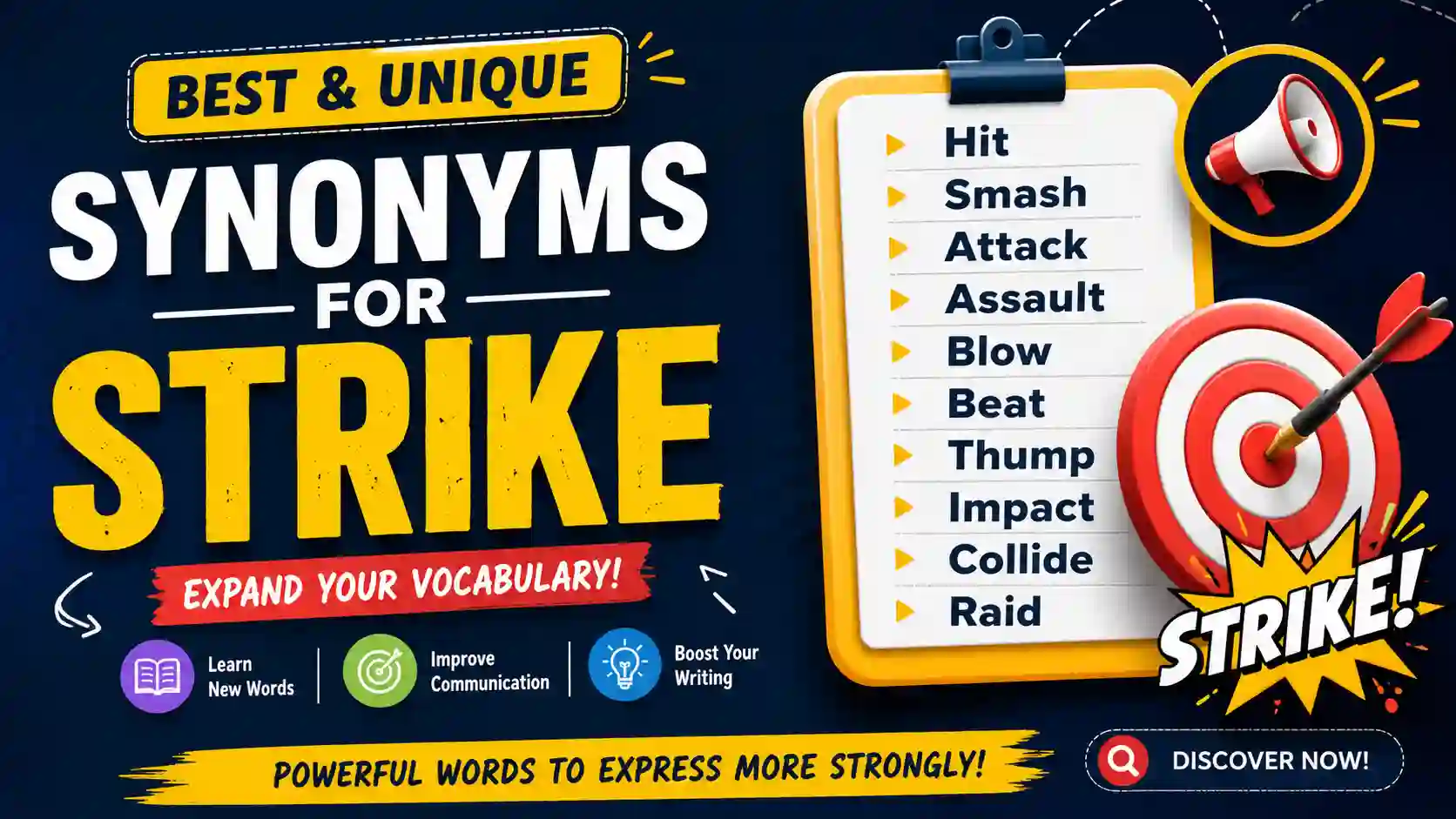
The best synonyms for strike depend on what strike means in your sentence. For physical contact, use hit, smack, punch, slap, bash, whack, or thump. For an attack, use attack or assault. For a workers’ protest, use walkout or work stoppage. Other meanings include discover, affect, impress, remove, reach, and ring.
What Does Strike Mean?
Have you ever written a sentence with a strike and wondered whether another word would sound more natural?
The answer depends on the context.
Strike is a highly flexible English word. It can mean to hit, attack, discover something, affect someone suddenly, impress someone, reach an agreement, remove words, sound a bell, or stop working as a protest.
For example:
- The ball struck the wall. → hit
- The soldiers struck the target. → attacked
- The workers went on strike. → stopped working
- They struck a deal. → reached an agreement
- The explorers struck gold. → discovered something valuable
- Her kindness struck me. → affected or impressed me
This guide explains the best synonyms for strike by meaning, so you can choose the right word instead of simply replacing strike with the first synonym you find.
Strike: Pronunciation, Grammar & Basic Information
IPA: /straɪk/
Pronunciation: stryk
The spelling and basic pronunciation are the same in American and British English.
Part of Speech
Strike is mainly a verb and a noun.
Verb
- strike a ball
- strike a match
- strike a target
- strike a deal
- strike gold
- strike someone as unusual
- strike fear into someone
- strike out
Noun
- a workers’ strike
- a military strike
- a strike in baseball
- a strike against a target
Verb Forms
| Form | Word |
| Base form | strike |
| Third-person singular | strikes |
| -ing form | striking |
| Past tense | struck |
| Past participle | struck / stricken |
Important: Stricken is used in particular meanings and expressions, especially when describing something badly affected or afflicted. Do not treat struck and stricken as interchangeable in every sentence.
The Most Important Meanings of Strike
Before choosing a synonym, identify the meaning.
| Meaning of strike | Best alternatives |
| Hit physically | hit, smack, punch, slap |
| Hit hard | bash, whack, thump |
| Attack | attack, assault, assail |
| Stop working | walk out, go on strike |
| Work stoppage | walkout, work stoppage |
| Discover something | find, discover, uncover |
| Reach an agreement | reach, make, negotiate |
| Affect emotionally | affect, move, touch |
| Impress | impress, amaze, fascinate |
| Give an impression | seem, appear |
| Remove text | delete, erase, remove |
| Sound a bell | ring, toll, chime |
| Collide with | hit, bump into, collide with |
| Cause sudden harm | affect, afflict, devastate |
| Begin a conversation | start, initiate |
This sense-based approach is important because major thesaurus resources also divide strike according to meaning rather than treating every listed word as interchangeable. Cambridge, Merriam-Webster, and Thesaurus.com all show separate synonym groups for different senses.
Synonyms for Strike Meaning “Hit”
1. Hit
Meaning: To touch or hurt someone or something with force.
Examples:
- The ball hit the fence.
- The falling branch hit the roof.
Tone: Neutral
CEFR: A1–A2
Frequency: Very common
Register: Everyday, spoken, general
Collocations:
- hit the target
- hit the wall
- hit someone hard
Nuance: Hit is the safest general replacement for strike when physical contact is intended.
When Not to Use: Do not use it automatically for expressions such as strike a deal or go on strike.
Cambridge lists hit as the primary synonym for this physical sense.
2. Smack
Meaning: To hit with a sharp, usually open-handed blow.
Examples:
- He smacked the ball with his paddle.
- She smacked the table with her hand.
Tone: Informal
CEFR: B1
Frequency: Common
Register: Spoken, informal
Collocations:
- smack someone
- smack the table
- smack against
Nuance: More vivid and informal than hit.
When Not to Use: Avoid it in formal academic writing unless the informal tone is intentional.
3. Punch
Meaning: To hit with a closed hand.
Examples:
- The boxer punched the bag.
- He punched the wall in anger.
Tone: Neutral
CEFR: A2–B1
Frequency: Very common
Register: General
Collocations:
- throw a punch
- punch someone
- punch a bag
Nuance: More specific than strike because it normally identifies a fist.
When Not to Use: Do not use punches for every kind of physical impact.
4. Slap
Meaning: To hit with an open hand.
Examples:
- She slapped the table.
- The wave slapped against the side of the boat.
Tone: Neutral
CEFR: B1
Frequency: Common
Register: General
Collocations:
- slap someone
- slap the table
- slap against
Nuance: Usually suggests an open hand or a flat, sharp impact.
5. Bash
Meaning: To hit something hard.
Examples:
- He bashed his knee against the desk.
- The storm bashed the coastline.
Tone: Informal
CEFR: B2
Frequency: Common
Register: Informal, spoken
Collocations:
- bash into
- bash against
- bash something hard
Nuance: Stronger and rougher than ordinary hits.
When Not to Use: Avoid it in formal reports when hit or strike is more precise.
6. Whack
Meaning: To hit something hard, often in a quick or energetic way.
Examples:
- She whacked the ball across the field.
- He whacked the box with a stick.
Tone: Informal
CEFR: B1–B2
Frequency: Common
Register: Informal, spoken
Collocations:
- whack the ball
- give it a whack
- whack someone
Nuance: Vivid and conversational.
When Not to Use: Avoid it in formal academic or business writing.
7. Thump
Meaning: To hit with a heavy blow, often making a dull sound.
Examples:
- Something thumped against the door.
- He thumped the desk with his fist.
Tone: Neutral
CEFR: B2
Frequency: Common
Register: General
Collocations:
- thump against
- thump the table
- thump heavily
Nuance: Focuses on the heaviness or sound of the impact.
8. Slug
Meaning: To hit someone very hard.
Examples:
- The boxer slugged his opponent.
- He was slugged in the shoulder.
Tone: Informal
CEFR: B2–C1
Frequency: Common
Register: Informal, sports, spoken
Nuance: Strong and often associated with fighting or boxing.
When Not to Use: Avoid it in formal writing.
9. Wallop
Meaning: To hit very hard.
Examples:
- The player walloped the ball into the stands.
- The storm walloped the coast.
Tone: Informal
CEFR: C1
Frequency: Uncommon
Register: Informal, journalistic
Nuance: Strong, energetic, and often dramatic.
Synonyms for Strike Meaning “Attack”
10. Attack
Meaning: To try to hurt, damage, or defeat a person, group, or place.
Examples:
- The army attacked the position.
- The dog attacked the intruder.
Tone: Neutral
CEFR: A2–B1
Frequency: Very common
Register: General, military, academic
Collocations:
- launch an attack
- attack a target
- attack a position
Nuance: Attack describes intention, while strike can simply describe an impact.
When Not to Use: Do not call an accidental collision an attack.
11. Assault
Meaning: To attack someone physically, especially in a serious or unlawful way.
Examples:
- The man was arrested for assault.
- The report described the event as a violent assault.
Tone: Strong
CEFR: B2
Frequency: Common
Register: Legal, formal, news
Collocations:
- physical assault
- assault charge
- assault victim
Nuance: Stronger and more legal than attack.
12. Assail
Meaning: To attack someone or something strongly.
Examples:
- Critics assailed the proposal.
- The fortress was assailed from several directions.
Tone: Formal
CEFR: C1
Frequency: Uncommon
Register: Formal, literary, journalism
Nuance: Can describe physical or verbal attack.
When Not to Use: It sounds too formal for ordinary conversation.
Synonyms for Strike Meaning “Stop Working”
13. Walk Out
Meaning: To leave work as part of a protest.
Examples:
- The employees walked out over pay disputes.
- Hundreds of workers walked out yesterday.
Tone: Neutral
CEFR: B1–B2
Frequency: Common
Register: News, business, everyday English
Collocations:
- walk out of work
- workers walk out
- walk out over pay
Nuance: Focuses on the act of leaving rather than the whole labor dispute.
14. Walkout
Meaning: A protest in which workers stop working or leave their workplace.
Examples:
- The union organized a walkout.
- The walkout lasted several hours.
Tone: Neutral
CEFR: B2
Frequency: Common
Register: News, business
Important: A walkout is closely related to a strike but is not always a perfect one-for-one replacement.
Merriam-Webster lists walkout among the noun synonyms for a work stoppage, while Cambridge uses walk out for employees stopping work collectively.
15. Work Stoppage
Meaning: A period when workers stop working, usually because of a dispute.
Examples:
- The dispute led to a temporary work stoppage.
- The company warned that a work stoppage could delay production.
Tone: Neutral/Formal
CEFR: B2–C1
Frequency: Common
Register: Business, labor, formal
Nuance: More descriptive and less idiomatic than strike.
Synonyms for Strike Meaning “Discover”
16. Discover
Meaning: To find something previously unknown.
Examples:
- The team discovered a new source of water.
- Researchers discovered evidence of an ancient settlement.
Tone: Neutral
CEFR: B1
Frequency: Very common
Register: General, academic, scientific
Collocations:
- discover a resource
- discover evidence
- discover a solution
Nuance: Works especially well when strike means finding something valuable or previously unknown.
17. Find
Meaning: To discover or locate something.
Examples:
- The miners found gold underground.
- Engineers found a new source of gas.
Tone: Neutral
CEFR: A1
Frequency: Extremely common
Register: Everyday English
Nuance: Simpler than discover and often better for beginners.
18. Uncover
Meaning: To discover something hidden or previously unknown.
Examples:
- The investigation uncovered several problems.
- Researchers uncovered new evidence.
Tone: Neutral
CEFR: B2
Frequency: Common
Register: Journalism, academic, professional
Nuance: Suggests that something was hidden and required investigation.
19. Unearth
Meaning: To discover something hidden, especially after searching or digging.
Examples:
- Archaeologists unearthed ancient tools.
- The investigation unearthed new evidence.
Tone: Formal/Literary
CEFR: C1
Frequency: Uncommon
Register: Academic, journalism, literary
Nuance: Often suggests discovery after careful searching.
Collins includes find, discovery, uncovering, and unearthing among alternatives for the noun sense of a valuable discovery.
Synonyms for Strike Meaning “Affect or Impress”
20. Affect
Meaning: To produce a noticeable effect on someone or something.
Examples:
- The news affected everyone in the room.
- The storm affected thousands of homes.
Tone: Neutral
CEFR: B2
Frequency: Very common
Register: Academic, professional, general
Nuance: More analytical than strike.
21. Impress
Meaning: To make someone admire or notice something strongly.
Examples:
- Her confidence impressed the interviewers.
- The student’s progress impressed his teacher.
Tone: Neutral
CEFR: B1
Frequency: Common
Register: General, professional
Nuance: Usually focuses on admiration or strong positive reaction.
Merriam-Webster notes that strike and impress overlap, but impress can emphasize the depth and persistence of the effect.
22. Move
Meaning: To affect someone’s emotions strongly.
Examples:
- Her speech moved the audience.
- The story moved everyone deeply.
Tone: Neutral
CEFR: B1
Frequency: Very common
Register: General
Nuance: More emotional than the general sense of strike.
23. Touch
Meaning: To affect someone’s emotions.
Examples:
- Her kindness touched me.
- The message touched everyone in the room.
Tone: Neutral
CEFR: A2–B1
Frequency: Very common
Register: General
Nuance: Usually suggests a warm, emotional response.
Synonyms for Strike Meaning “Seem”
24. Seem
Meaning: To give the impression of being something.
Examples:
- He struck me as honest.
- He seemed honest.
Tone: Neutral
CEFR: A1–A2
Frequency: Very common
Register: General
Nuance: Seem is usually the simplest replacement when striking someone as it means “give someone the impression.”
25. Appear
Meaning: To seem to be something.
Examples:
- She struck me as confident.
- She appeared confident.
Tone: Neutral/Formal
CEFR: B1
Frequency: Very common
Register: General, formal, academic
Nuance: Slightly more formal than seems.
Collins specifically seems to, appear to, and give the impression for this sense of strike.
Synonyms for Strike Meaning “Reach an Agreement”
26. Reach
Meaning: To successfully arrive at an agreement or decision.
Examples:
- The two sides struck an agreement.
- The two sides reached an agreement.
Tone: Neutral
CEFR: A2
Frequency: Very common
Register: General, business
Collocations:
- reach an agreement
- reach a compromise
- reach a decision
Nuance: One of the most natural replacements for strike in formal writing.
27. Negotiate
Meaning: To discuss terms in order to reach an agreement.
Examples:
- The companies negotiated a new contract.
- The union negotiated better working conditions.
Tone: Neutral/Formal
CEFR: B2
Frequency: Common
Register: Business, professional
Important: Negotiate describes the process, while strike a deal usually emphasizes the successful result.
28. Make
Meaning: To create or reach an arrangement.
Examples:
- They struck a deal.
- They made a deal.
Tone: Neutral
CEFR: A1
Frequency: Very common
Register: General
Nuance: Make a deal is natural and common, but strike a deal can sound slightly more deliberate or formal.
Synonyms for Strike Meaning “Remove”
29. Delete
Meaning: To remove written or digital information.
Examples:
- The editor struck the sentence from the article.
- The editor deleted the sentence.
Tone: Neutral
CEFR: A2–B1
Frequency: Very common
Register: Digital, academic, general
30. Erase
Meaning: To remove writing, marks, or information completely.
Examples:
- She erased the incorrect answer.
- The program erased the damaged file.
Tone: Neutral
CEFR: A2
Frequency: Common
Register: General
Nuance: Often suggests making something disappear completely.
31. Remove
Meaning: To take something away.
Examples:
- The editor removed the sentence.
- Please remove your name from the list.
Tone: Neutral
CEFR: A2
Frequency: Very common
Register: General, formal
Nuance: Broad and safe, but less specific than erase or delete.
Synonyms for Strike Meaning “Make a Sound”
32. Ring
Meaning: To produce a clear sound, especially from a bell.
Examples:
- The clock struck noon.
- The clock rang at noon.
Tone: Neutral
CEFR: A2
Frequency: Very common
Register: General
33. Chime
Meaning: To make a clear ringing sound.
Examples:
- The clock chimed twelve.
- The bells chimed across the town.
Tone: Neutral
CEFR: B1
Frequency: Common
Register: General, descriptive
Nuance: Often suggests a pleasant or repeated bell sound.
34. Toll
Meaning: To ring slowly and repeatedly, especially a large bell.
Examples:
- The church bells tolled at midnight.
- Bells tolled after the ceremony.
Tone: Formal/Literary
CEFR: C1
Frequency: Uncommon
Register: Literary, formal, news
Nuance: Often carries a solemn or mournful feeling.
Strike Meaning “Collide With”
Sometimes strike means to collide with something.
Useful alternatives:
- hit
- collide with
- bump into
- run into
- crash into
Examples:
- The car struck a tree.
- The car hit a tree.
- The car collided with a tree.
Important difference: Collide normally suggests two moving things coming into contact, while hit is broader.
Cambridge specifically lists collide with, bump into, hit, and run into for this sense.
Choose the Right Synonym for Strike
| Your intended meaning | Best choice | Why |
| General physical hit | hit | Simplest and most common |
| Hit with fist | punch | Specifies the action |
| Hit with open hand | slap | More precise |
| Hit hard | bash | Emphasizes force |
| Informal hard hit | whack | Conversational |
| Heavy audible impact | thump | Emphasizes sound |
| Deliberate attack | attack | Emphasizes intention |
| Serious physical attack | assault | Formal/legal |
| Formal attack | assail | Formal and literary |
| Workers stop work | walk out | Describes the action |
| Labor protest | walkout | Noun for the event |
| Work stoppage | work stoppage | Formal description |
| Find something | discover | New knowledge |
| Find hidden evidence | uncover | Investigation implied |
| Find after searching | unearth | Hidden discovery |
| Cause an effect | affect | Analytical |
| Cause admiration | impress | Positive reaction |
| Cause emotion | move | Emotional effect |
| Touch emotions | touch | Emotional nuance |
| Give an impression | seem | Simple alternative |
| Give a formal impression | appear | More formal |
| Reach an agreement | reach | Very natural |
| Discuss terms | negotiate | Process-focused |
| Remove digital text | delete | Precise |
| Remove a mark | erase | Precise |
| Take something away | remove | Broad |
| Make a bell sound | ring | Common |
| Bell sound, descriptive | chime | Clear ringing |
| Solemn bell sound | toll | Formal/literary |
Commonly Confused Words
Strike vs. Hit
Hit is the broad everyday term for physical contact.
Strike can mean hit, but it also has many other meanings.
- The ball hit the wall.
- The ball struck the wall.
Both work.
But:
- They struck a deal. ✓
- They hit a deal. ✗ in standard English
Strike vs. Attack
An attack is normally intentional.
A falling tree can strike a car, but it does not normally attack the car.
Strike vs. Assault
Assault is stronger and often has legal meaning.
Use assault when the context involves a serious or unlawful attack.
Strike vs. Boycott
A strike normally involves workers refusing to work.
A boycott normally involves refusing to buy, use, or support something.
These are related forms of protest but are not exact synonyms.
Strike vs. Discover
Strike can mean discover in expressions such as:
- strike gold
- strike oil
But you cannot replace every use of discover with strike.
Common Mistakes With Strike
Common Mistake Box
Mistake 1
Wrong: They hit a deal yesterday.
Better: They struck a deal yesterday.
Why: Strike a deal is an established expression.
Mistake 2
Wrong: The customers went on boycott.
Better: The customers boycotted the company.
Why: A boycott is usually something people do by refusing to support a product, company, or organization.
Mistake 3
Wrong: The scientist struck a new species.
Better: The scientist discovered a new species.
Why: Strike only has a discovery meaning in particular contexts.
Mistake 4
Wrong: The car attacked the tree.
Better: The car struck the tree.
Why: The collision was not an intentional attack.
Mistake 5
Wrong: The workers made a strike.
Better: The workers went on strike.
Why: Go on strike is the normal expression for workers stopping work as a protest.
Essential Expressions With Strike
Learning common expressions is one of the best ways to master this word.
Strike a deal
Meaning: Reach an agreement.
The two companies struck a deal.
Strike a balance
Meaning: Find a reasonable middle point.
Parents must strike a balance between rules and freedom.
Strike gold
Meaning: Find something valuable or achieve sudden success.
The company struck gold with its new product.
Strike oil
Meaning: Discover oil.
The drillers struck oil after weeks of work.
Strike a chord
Meaning: Create a strong emotional response.
The story struck a chord with readers.
Strike fear into someone
Meaning: Cause someone to feel afraid.
The sudden announcement struck fear into investors.
Strike up a conversation
Meaning: Start a conversation.
She struck up a conversation with the person beside her.
Strike someone as
Meaning: Give someone a particular impression.
He struck me as a thoughtful person.
Strike a match
Meaning: Rub a match against a surface to produce a flame.
He struck a match and lit the candle.
Go on strike
Meaning: Stop working as a protest.
The workers went on strike over wages.
Connotation and Nuance Guide
Not all synonyms create the same feeling.
| Word | Main feeling |
| hit | Neutral |
| smack | Sharp, informal |
| whack | Energetic, informal |
| punch | Physical, aggressive |
| slap | Sharp, personal |
| bash | Rough, damaging |
| thump | Heavy |
| attack | Deliberate aggression |
| assault | Serious/legal |
| assail | Formal/aggressive |
| discover | Neutral |
| uncover | Investigative |
| unearth | Hidden discovery |
| impress | Admiration |
| move | Emotion |
| touch | Emotional warmth |
| negotiate | Deliberate discussion |
| delete | Digital removal |
| erase | Complete disappearance |
| toll | Solemn or literary |
American vs. British English
Strike itself has the same spelling in American and British English.
The main difference appears in some related labor vocabulary.
British English commonly uses expressions such as:
- industrial action
- walk out
- down tools
American English commonly uses:
- strike
- labor strike
- work stoppage
- walkout
Collins provides separate British and American synonym groupings and shows that some alternatives differ in regional frequency and usage.
Pronunciation
Both varieties normally pronounce strike as:
/straɪk/
There is no major American/British pronunciation difference for the word itself.
CEFR Guide
CEFR levels are approximate because vocabulary difficulty depends on context.
| Word | Approx. level | Best for |
| hit | A1–A2 | Beginners |
| find | A1 | Beginners |
| seem | A1–A2 | Beginners |
| attack | A2–B1 | Intermediate |
| punch | A2–B1 | Intermediate |
| remove | A2 | Beginners |
| agree | A1 | Beginners |
| impress | B1 | Intermediate |
| discover | B1 | Intermediate |
| walkout | B2 | Upper-intermediate |
| uncover | B2 | Upper-intermediate |
| negotiate | B2 | Upper-intermediate |
| assault | B2 | Upper-intermediate |
| assail | C1 | Advanced |
| unearth | C1 | Advanced |
| toll | C1 | Advanced |
Frequency Guide
Very Common
- hit
- find
- affect
- attack
- remove
- agree
- seem
- ring
Common
- punch
- slap
- smack
- bash
- thump
- discover
- impress
- negotiate
- uncover
- walkout
Uncommon
- assail
- wallop
- unearth
- toll
- slug
Rare or Highly Contextual
Some traditional thesaurus lists contain highly specialized, archaic, slang, military, or regional alternatives. They may technically relate to strike, but they are poor choices for ordinary ESL writing.
Good rule: Never choose a synonym just because a thesaurus lists it. Choose the word that fits the meaning, audience, and register.
How to Use Strike in Different Types of Writing
Essays
Use precise words instead of unnecessarily dramatic synonyms.
Good choices:
- affect
- influence
- attack
- discover
- remove
Example:
The economic crisis affected millions of people.
Professional Emails
Use neutral vocabulary.
Instead of:
We struck a very complicated arrangement.
You can write:
We reached an agreement.
Blog Posts
Use familiar words unless a more specific word adds meaning.
Hit is usually easier for a general audience than an uncommon word such as wallop.
Stories
Vivid synonyms can make writing more descriptive.
The heavy branch crashed into the roof.
He thumped his fist against the door.
Academic Writing
Prefer precise formal vocabulary:
- affect
- influence
- discover
- uncover
- negotiate
- remove
Avoid slang such as whack or wallop unless you are discussing language itself.
Mini Practice: Choose the Best Word
Exercise 1: Fill in the Blanks
Choose from:
hit, negotiate, uncover, delete, walkout
- Please ______ the duplicate paragraph.
- The two companies need to ______ a new contract.
- The ball ______ the goalpost.
- Investigators managed to ______ new evidence.
- The workers announced a planned ______.
Answers
- delete
- negotiate
- hit
- uncover
- walkout
Exercise 2: Rewrite the Sentence
Replace strike with the best alternative.
- The stone struck the window.
- They struck a deal after three meetings.
- The investigation struck an important problem.
- The workers went on strike.
- The story struck me as unusual.
Suggested Answers
- The stone hit the window.
- They reached a deal after three meetings.
- The investigation uncovered an important problem.
- The workers walked out.
- The story seemed unusual to me.
Exercise 3: Match the Synonym
| Word | Meaning |
| A. punch | 1. discover something hidden |
| B. uncover | 2. hit with a fist |
| C. toll | 3. stop work in protest |
| D. walkout | 4. sound a solemn bell |
| E. negotiate | 5. discuss terms |
Answers
A–2
B–1
C–4
D–3
E–5
Vocabulary Quiz
1. Which word is the most general synonym for physical strike?
A. negotiate
B. hit
C. toll
D. discover
Answer: B
2. Which word specifically suggests hitting with a closed hand?
A. punch
B. slap
C. toll
D. affect
Answer: A
3. Which word best describes employees stopping work as a protest?
A. discover
B. walkout
C. erase
D. impress
Answer: B
4. Which word best replaces strike in “The researchers struck a previously unknown source of water”?
A. punch
B. assault
C. discover
D. slap
Answer: C
5. Which word is most suitable for a solemn bell sound?
A. toll
B. whack
C. bash
D. punch
Answer: A
6. Which sentence is correct?
A. They hit a deal.
B. They struck a deal.
C. They punched a deal.
D. They slapped a deal.
Answer: B
7. Which word is most formal and legal?
A. whack
B. smack
C. assault
D. bash
Answer: C
8. Which word emphasizes discovering something hidden?
A. uncover
B. punch
C. slap
D. attack
Answer: A
Final “Which Word Should I Choose?” Cheat Sheet
If you mean a normal physical hit, choose hit.
If you mean a fist hitting something, choose punch.
If you mean an open-hand hit, choose slap.
If you mean a hard informal hit, choose bash or whack.
If you mean a deliberate attack, choose attack.
If you mean a serious or unlawful attack, choose assault.
If you mean workers stopping work, use go on strike or walk out.
If you mean a labor protest as a noun, use walkout or work stoppage.
If you mean finding something new, use discover.
If you mean finding something hidden, use uncover.
If you mean causing an emotional effect, use move, touch, or affect.
If you mean giving an impression, use seem or appear.
If you mean reaching an agreement, use reach, make, or negotiate, depending on the sentence.
If you mean removing digital information, use delete.
If you mean removing a mark, use erase.
If you mean a normal bell sound, use ring.
If you mean a slow, solemn bell sound, use toll.
Word Origin and Etymology of Strike
The history of strike is much older than many modern learners expect.
The verb comes through Middle English from Old English strīcan, which had meanings connected with moving, passing, stroking, rubbing, or smoothing. The meaning developed over time, eventually producing the modern sense of hitting or delivering a blow.
Merriam-Webster dates the verb to before the 12th century, while historical etymological sources trace its development through Old and Middle English.
The modern word therefore contains several layers of meaning that developed over centuries. This helps explain why one English word can now describe hitting a ball, discovering oil, reaching a deal, sounding a clock, affecting emotions, and stopping work.
Why Strike Has So Many Synonyms
The reason strike has such a large synonym field is simple: it is a polysemous word.
That means one word has several related but different meanings.
For example:
Strike → physical contact
The ball struck the wall.
Strike → attack
The aircraft struck the target.
Strike → discover
The miners struck gold.
Strike → agreement
The companies struck a deal.
Strike → emotional effect
The news struck her deeply.
Strike → labor protest
The workers went on strike.
A thesaurus can therefore show hundreds of words related to strike, but only a small number will be correct in any one sentence. Merriam-Webster currently lists hundreds of related words, but organizes them according to individual meanings rather than suggesting that all are interchangeable.
Related Words and Antonyms
Antonyms for Physical Strike
Depending on context:
- miss
- avoid
- dodge
- evade
Antonyms for Attack
- defend
- protect
- retreat
- surrender
Antonyms for a Work Strike
- work
- resume
- continue
- comply
Antonyms for Remove
- add
- insert
- include
- retain
Frequently Asked Questions
What is the best synonym for strike?
Hit is the best general synonym when strike means making physical contact. However, the correct alternative changes with the context. Attack fits an offensive action, walkout relates to a labor protest, discover fits finding something valuable, and reach can replace strike in an agreement.
What are 10 synonyms for strike?
Ten useful context-dependent alternatives are hit, smack, punch, slap, bash, whack, thump, attack, discover, and walkout. They are not interchangeable in every sentence. Each word represents a particular meaning or type of strike.
What is a synonym for strike meaning hit?
The simplest synonym is hit. Other choices include smack, punch, slap, bash, whack, thump, and slug. The correct choice depends on how the impact happens and how formal the sentence needs to sound.
What is a synonym for strike in an attack?
The most common synonym is attack. Assault is more serious and often has legal meaning, while assail is more formal or literary. For a large or repeated attack, words such as bombardment may be more precise.
What is another word for going on strike?
Common alternatives include walking out, taking industrial action, and stopping work. As a noun, walkout and work stoppage are useful related terms. However, these expressions can differ in scope and regional usage.
What is a synonym for strike meaning discover?
Useful alternatives include discover, find, uncover, and unearth. This meaning is especially common in expressions such as strike gold and strike oil. Uncover suggests that something was hidden, while unearth often suggests careful searching.
Is “hit” always a synonym for “strike”?
No. Hit is a strong synonym for the physical meaning of strike, but it cannot replace every use. You can say strike a deal, strike gold, and go on strike, but replacing strike with hit in these expressions changes or destroys the intended meaning.
Is “walkout” the same as “strike”?
Not always. A walkout is closely associated with workers leaving work as a protest, while a strike is a broader term for collective refusal to work. In some contexts they overlap, but they should not automatically be treated as exact synonyms.
Conclusion
The best way to learn synonyms for strike is to learn them by meaning, not as one long list. Use hit for general physical contact, punch for a fist, attack for deliberate aggression, walkout for a labor protest, discover for finding something new, impress for a strong reaction, and delete for removing digital text.
Once you understand the difference in nuance, register, and context, your vocabulary becomes more precise. Practice these words in essays, emails, conversations, stories, and professional writing, and you will naturally become more confident in choosing the right synonym.
Trusted References
- Merriam-Webster Thesaurus
- Cambridge English Thesaurus
- Collins English Thesaurus
- Thesaurus.com
- Merriam-Webster Dictionary

Synonorm is a trusted English vocabulary resource created to help readers find the right words and understand the differences between similar terms. We provide clear explanations of synonyms, meanings, examples, usage, and alternatives. Our content makes vocabulary easier to learn and apply in everyday, academic, and professional English. Synonorm is designed for students, writers, ESL learners, professionals, and anyone who wants to improve their English vocabulary and communicate more clearly.