Quick Answer
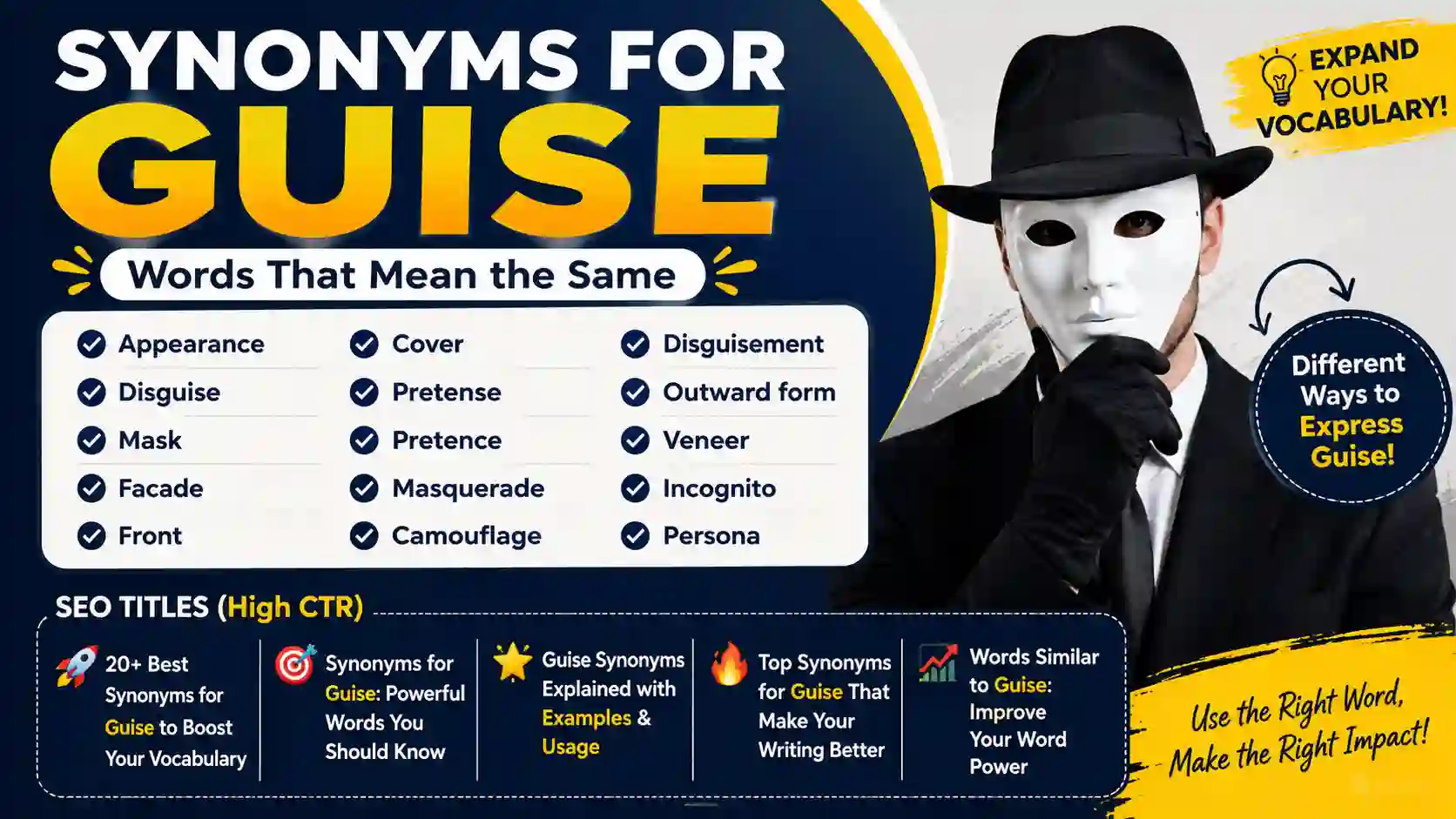
The best synonyms for guise depend on the meaning. Use appearance for an outward look, disguise for a hidden identity, pretense for false behavior, pretext for a false reason, facade for an outward front that hides reality, and form when guise means a different version or form of something. Other close alternatives include semblance, mask, front, pose, masquerade, costume, garb, and attire.
What Does Guise Mean?
What should you say when something looks like one thing but may actually be something else?
The word guise can describe that situation. It is a noun that refers to an outward appearance, form, style of dress, assumed identity, or presentation. In some contexts, it suggests that the appearance hides the truth. In others, there is no deception at all.
For example:
The old idea returned in a new guise.
Here, guise simply means a new form or version. There is no suggestion that anyone is lying.
Compare that with:
The company collected information under the guise of a customer survey.
Here, guise suggests that the stated appearance or purpose may conceal something else.
This difference is important. Many thesauruses list words such as disguise, pretense, appearance, and pretext together, but they do not mean exactly the same thing. Cambridge separates clothing-related words from appearance and deception-related words, while Merriam-Webster gives separate senses for dress, appearance, pretext, and variation.
Guise Pronunciation
IPA: /ɡaɪz/
Pronounced: guyz
It rhymes with:
- size
- wise
- prize
- eyes
The pronunciation is essentially the same in American and British English.
Spelling
The spelling is the same in both varieties:
- American English: guise
- British English: guise
Plural:
- guises
Example:
The same message appears in several different guises.
Part of Speech
Guise as a Noun
The modern standard use of guise is as a noun.
It can refer to:
- outward appearance
- assumed appearance
- deceptive presentation
- style of dress
- form or version
Examples:
The tradition survived in a different guise.
He entered the building in the guise of a delivery driver.
The proposal was presented under the guise of reform.
Guise as a Verb
A rare verb guise is also recorded in dictionaries, meaning to dress or disguise, but this use is uncommon and regional or historical compared with the noun. Dictionary.com records both transitive and regional/intransitive verb uses.
For modern learners, it is much safer to use familiar verbs such as:
- disguise
- dress
- dress up
- present
- appear
Learner tip: Treat guise primarily as a noun in modern standard English.
Grammar and Common Patterns
The most useful grammar patterns are worth learning as fixed phrases.
1. In the guise of + noun
This means appearing as or taking the form of something.
The actor appeared in the guise of a king.
The visitor entered in the guise of a technician.
2. Under the guise of + noun
This often means under the appearance or stated purpose of something, especially when another purpose is suspected.
The money was collected under the guise of charity.
They approached him under the guise of friendship.
3. In a new guise
This means in a new form or version.
The old debate has returned in a new guise.
4. In various guises
This means in several forms or versions.
The idea has appeared in various guises over the years.
5. In its current guise
This means in its present form or version.
The organization has existed in its current guise since 2018.
This last group is especially important because guise does not always mean disguise or deception. Merriam-Webster explicitly gives “a variation on something” as one sense and provides current examples involving a competition in its current guise and a product in near-production guise.
Synonyms for Guise at a Glance
| Word | Main Sense | Strength | Register | Frequency |
| Appearance | outward look | Strong | Neutral | Very common |
| Disguise | hidden identity | Strongest | Neutral | Very common |
| Pretense | false behavior | Strongest | Formal/neutral | Common |
| Pretext | false reason | Strongest | Formal | Common |
| Facade | outward front hiding reality | Strong | Neutral/formal | Common |
| Semblance | appearance suggesting something | Strong | Formal | Common |
| Mask | hidden feelings or identity | Strong | Neutral/figurative | Very common |
| Front | false outward presentation | Strong | Informal/neutral | Common |
| Pose | artificial attitude | Strong | Neutral | Common |
| Masquerade | deceptive performance | Strong | Literary/formal | Uncommon |
| Form | version or type | Related/strong | Neutral | Very common |
| Aspect | particular appearance or side | Related | Formal | Common |
| Costume | clothing for a role | Related | Neutral | Common |
| Garb | style of dress | Related | Formal/literary | Uncommon |
| Attire | clothing | Related | Formal | Common |
| Dress | clothing | Related | Neutral | Very common |
| Apparel | clothing | Related | Formal/business | Common |
| Persona | public identity | Related | Formal/academic | Common |
| Manner | way of behaving | Related | Neutral | Common |
| Mode | way or form | Related | Formal/academic | Common |
| Show | outward display | Related | Neutral | Very common |
| Act | performed behavior | Related | Neutral | Very common |
| Performance | performed behavior | Related | Neutral/formal | Common |
| Portrayal | representation | Related | Formal | Common |
| Image | public impression | Related | Neutral/business | Very common |
Important: “Related” does not mean “perfect replacement.” A synonym should match the meaning and grammar of the original sentence.
The Closest Synonyms for Guise
1. Appearance
Meaning: The way someone or something looks or seems.
Example 1:
The building has the appearance of a small country house.
Example 2:
The policy took on a different appearance after the changes.
Best used when: You mean outward look without necessarily suggesting deception.
Tone: Neutral
Register: Everyday, academic, business
Frequency: Very common
Learner level: Beginner-friendly
Common collocations:
- outward appearance
- physical appearance
- general appearance
When not to use: Do not use appearance when the sentence specifically means a hidden identity or false reason.
2. Disguise
Meaning: A changed appearance used to hide identity or reality.
Example 1:
The detective entered the hotel in disguise.
Example 2:
His friendly manner was a disguise for his real intentions.
Best used when: The idea of concealment is central.
Tone: Neutral, sometimes negative
Register: Everyday, professional, literary
Frequency: Very common
Common collocations:
- wear a disguise
- clever disguise
- disguise one’s identity
When not to use: Do not replace every use of guise with disguise. Guise can mean a simple form or version.
3. Pretense / Pretence
Meaning: False behavior, appearance, or claim intended to make something seem true.
Example 1:
He made a pretense of being interested in the proposal.
Example 2:
Under the pretense of friendship, the stranger asked many personal questions.
Best used when: You want to emphasize pretending rather than appearance alone.
Tone: Often negative
Register: Formal, neutral, literary
Frequency: Common
Spelling note:
Pretense is standard American spelling.
Pretence is standard British spelling.
When not to use: Do not use it simply for an ordinary appearance.
4. Pretext
Meaning: A stated reason used to hide the real reason for an action.
Example 1:
He called on the pretext of discussing the contract.
Example 2:
The inspection became a pretext for entering the building.
Best used when: The focus is a hidden reason or excuse.
Tone: Often negative
Register: Formal, academic, journalism
Frequency: Common
When not to use: A pretext is not simply an appearance or costume.
Guise vs. Pretext
The plan was presented under the guise of reform.
Focus: how the plan was presented.
The meeting was arranged under the pretext of discussing reform.
Focus: the stated reason for arranging the meeting.
5. Facade / Façade
Meaning: An outward appearance that hides a different reality.
Example 1:
Behind his confident facade was considerable uncertainty.
Example 2:
The company’s modern facade hid an outdated system.
Best used when: Something looks respectable, attractive, or strong on the outside but hides another reality.
Tone: Often negative or critical
Register: Neutral, formal, literary, business
Frequency: Common
Common collocations:
- polished facade
- public facade
- maintain a facade
When not to use: Do not use facade as a general synonym for every type of appearance.
6. Semblance
Meaning: An appearance that makes something seem true or real.
Example 1:
The manager tried to maintain a semblance of order.
Example 2:
The negotiations produced a semblance of agreement.
Best used when: Something appears to exist, but the reality may be weaker or different.
Tone: Formal, sometimes skeptical
Register: Academic, formal, literary
Frequency: Common
Common collocations:
- semblance of order
- semblance of normality
- semblance of truth
When not to use: It sounds too formal for many casual conversations.
7. Mask
Meaning: Something that hides a person’s real feelings, character, or identity.
Example 1:
His humor became a mask for his anxiety.
Example 2:
Her calm expression was a mask for her frustration.
Best used when: You are describing hidden emotions or character.
Tone: Figurative, often negative
Register: Everyday, literary
Frequency: Very common
When not to use: Use disguise when you specifically mean clothing or altered appearance used to hide identity.
8. Front
Meaning: A false appearance or respectable cover hiding a different reality.
Example 1:
The small business was allegedly a front for another operation.
Example 2:
His relaxed attitude was only a front.
Best used when: You want a natural, less formal word for a false outward presentation.
Tone: Informal to neutral
Register: Spoken, journalism, business
Frequency: Common
When not to use: Avoid it for a normal, genuine appearance.
9. Pose
Meaning: An artificial attitude or manner adopted for effect.
Example 1:
His confidence was partly a pose.
Example 2:
She adopted a serious pose during the interview.
Best used when: Someone deliberately presents a particular attitude.
Tone: Neutral to negative
Register: Everyday, literary
Frequency: Common
When not to use: A pose does not necessarily hide someone’s identity.
10. Masquerade
Meaning: A false appearance or behavior that hides the truth.
Example 1:
The friendly conversation was a masquerade for a difficult negotiation.
Example 2:
The entire campaign became a masquerade of public concern.
Best used when: You want a strong, literary word for deliberate deception.
Tone: Strongly negative, literary
Register: Literary, formal
Frequency: Uncommon
When not to use: It is too dramatic for ordinary situations.
Guise When It Means Clothing
Not every clothing word is an exact synonym. These words overlap only with the clothing sense of guise.
Costume
Meaning: Clothing worn to look like a particular character, person, or type.
The actor appeared in the costume of a medieval soldier.
Register: Neutral
Frequency: Common
Do not use it: When guise means a hidden purpose.
Garb
Meaning: A particular style of clothing.
The performers wore traditional garb.
Register: Formal/literary
Frequency: Uncommon
Do not use it: In casual situations where clothes or clothing sounds more natural.
Attire
Meaning: Clothing, especially clothing for a particular occasion.
Formal attire is required for the ceremony.
Register: Formal/business
Frequency: Common
Do not use it: When the main idea is deception.
Dress
Meaning: Clothing or a style of clothing.
The travelers wore traditional dress.
Register: Neutral
Frequency: Very common
Do not use it: As a direct replacement when guise means a hidden identity.
Apparel
Meaning: Clothing, especially in formal, commercial, or industry-related contexts.
The company sells sports apparel.
Register: Formal/business
Frequency: Common
Do not use it: For an abstract appearance or pretext.
Guise as Form or Version
This is one of the most important meanings that weaker synonym articles often overlook.
Sometimes guise simply means a form, version, or variation.
Form
The old tradition survives in a modern form.
Version
The idea has returned in a different version.
Mode
The concept appears in a new mode.
Aspect
The city takes on a different aspect at night.
Merriam-Webster explicitly defines guise as “a variation on something,” with the example of a basic recipe appearing in a different guise.
This means that replacing guise with disguise in:
The product is now available in a new guise.
would change the meaning. The sentence does not necessarily suggest deception. It simply means a new version or form.
Strongest Synonyms vs. Related Words
Strongest Matches for Deceptive Guise
- disguise
- pretense / pretence
- facade / façade
- semblance
- pretext
- mask
- masquerade
Strong Matches for Outward Appearance
- appearance
- semblance
- aspect
- facade
- mask
- front
Best Matches for Clothing
- costume
- garb
- attire
- dress
- apparel
Best Matches for Form or Version
- form
- version
- mode
- aspect
- shape
This sense-based organization is more useful than treating every thesaurus entry as an interchangeable synonym.
Guise vs. Disguise vs. Pretense vs. Pretext vs. Facade
| Word | Main idea | Deception required? | Example |
| Guise | outward form or appearance | Sometimes | The idea returned in a new guise. |
| Disguise | hidden identity or nature | Usually | He wore a disguise. |
| Pretense | false behavior or claim | Yes | She made a pretense of confidence. |
| Pretext | false or convenient reason | Usually | He used illness as a pretext. |
| Facade | outward front hiding reality | Usually implied | His confidence was a facade. |
The easiest way to remember them
Guise = appearance or form
Disguise = hidden identity
Pretense = pretending
Pretext = stated reason
Facade = outward front
Common Collocations With Guise
Native English uses guise in several recurring combinations.
Very useful patterns
- under the guise of friendship
- under the guise of research
- under the guise of reform
- under the guise of protection
- under the guise of helping
- in the guise of a teacher
- in the guise of a worker
- in a new guise
- in a different guise
- in various guises
- in its current guise
Why collocations matter
Learning under the guise of is more useful than memorizing ten isolated synonyms.
For example:
The company advertised the program under the guise of environmental protection.
This tells the reader that environmental protection was the stated appearance or purpose, while another purpose may have existed.
American vs. British English
There is no major American/British spelling difference for guise.
| Feature | American English | British English |
| Spelling | guise | guise |
| Pronunciation | /ɡaɪz/ | /ɡaɪz/ |
| Plural | guises | guises |
| Common related spelling | pretense | pretence |
| Formality | Formal | Formal |
The important spelling variation appears with pretense/pretense, not guise itself.
Word Origin and Etymology
Guise comes from Middle English gise/guise, through Anglo-French, with a Germanic origin related to Old High German wīsa, meaning “manner.”
The earliest recorded English use dates to the 13th century. Its older meanings were connected with manner, fashion, style, and dress. The modern word later developed senses involving outward appearance, assumed appearance, and form.
This history helps explain why modern English can use guise for both:
- style or form
- appearance or assumed identity
The deceptive meaning is therefore only one part of the word’s history and modern use.
How Difficult Is the Word Guise?
Guise is not a beginner’s everyday vocabulary word. It is more common in formal writing, literature, journalism, and analytical prose than in casual conversation.
Rather than assigning an unsupported universal CEFR level, it is more useful to think of it this way:
Beginner learners
Learn these first:
- appearance
- form
- look
- disguise
Intermediate learners
Add:
- facade
- mask
- front
- pretense
- pretext
Advanced learners
Study:
- guise
- semblance
- masquerade
- garb
- persona
- mien
This approach helps learners build vocabulary by usefulness rather than by difficulty labels alone.
Connotation and Nuance
Words that look like synonyms can create very different feelings.
Appearance
Usually neutral.
Her appearance changed.
Disguise
Suggests concealment.
He wore a disguise.
Pretense
Suggests deliberate pretending.
His confidence was a pretense.
Pretext
Suggests a possibly false reason.
The meeting was a pretext.
Facade
Suggests a surface hiding reality.
Their friendship was a facade.
Semblance
Often suggests something that only appears to exist.
The negotiations produced a semblance of agreement.
Mask
Often works metaphorically for hidden emotions.
Anger hid behind a mask of politeness.
Masquerade
Suggests a more dramatic or deliberate deception.
The event became a masquerade of respectability.
When Not to Use Guise
Avoid guise when a simpler word is more precise.
Instead of:
I like your guise today.
Say:
I like your outfit today.
Instead of:
She changed her guise for work.
Say:
She changed her clothes for work.
Instead of:
He gave a guise of happiness.
Say:
He gave an appearance of happiness.
Instead of:
The company used a guise as its reason.
Say:
The company used a pretext as its reason.
Rule: Do not use guise simply because it sounds sophisticated. Use it when you mean appearance, assumed form, or version, especially in one of its natural constructions.
Common Mistakes
Mistake 1: Treating Guise and Disguise as Perfect Synonyms
Mistake:
The company released the product in a new disguise.
Better:
The company released the product in a new guise.
Why?
If you mean a new version, guise is correct. Disguise suggests concealment.
Mistake 2: Confusing Guise With Pretext
Mistake:
He called me under the guise of asking about the contract.
Better:
He called me under the pretext of asking about the contract.
Why?
A pretext is a stated reason. The natural phrase is under the pretext of + -ing/noun.
Mistake 3: Using Guise for Normal Clothing
Mistake:
I bought a beautiful guise for the wedding.
Better:
I bought a beautiful outfit for the wedding.
Why?
Guise has a clothing-related historical sense, but outfit, clothing, or attire is much more natural in everyday modern English.
Mistake 4: Assuming Guise Always Means Deception
Mistake in interpretation:
“The same idea returned in a new guise” must mean someone was hiding something.
Correction:
Not necessarily.
Why?
Here guise means a new form or version. Merriam-Webster explicitly recognizes this sense.
Writing Tips for Students and Professionals
Essays
Use guise when discussing ideas, policies, movements, or traditions that appear in different forms.
The argument has returned in a new guise.
This sounds more precise than repeatedly using form.
Academic Writing
Use it when discussing how an idea is presented.
The theory reappeared in a different guise.
For very technical writing, however, form, version, manifestation, or appearance may be clearer.
Business Writing
Use guise sparingly because it can sound formal.
The proposal was introduced under the guise of efficiency.
This works well when you want to question whether the stated purpose is genuine.
Creative Writing
Guise can create a literary tone.
The traveler arrived in the guise of a humble merchant.
Everyday Conversation
Prefer simpler alternatives when possible:
- appearance
- disguise
- outfit
- front
- act
- excuse
Related Vocabulary
Antonyms
Depending on context, possible opposites include:
- reality
- truth
- authenticity
- genuineness
- sincerity
- openness
- honesty
- transparency
There is no single perfect antonym for every sense of guise.
If guise means false appearance, reality or genuineness may be an appropriate opposite.
If it means form or version, an antonym may not exist.
Useful Related Expressions
- false appearance
- outward appearance
- assumed identity
- hidden purpose
- public persona
- false front
- deceptive appearance
- outward form
- new version
- different form
- surface appearance
Mini Practice: Fill in the Blanks
Choose from:
guise, disguise, pretext, facade, form
- The spy entered the building in the ______ of a cleaner.
- The old tradition survived in a new ______.
- His cheerful attitude was only a ______.
- She used a family emergency as a ______ for leaving early.
- The actor wore a clever ______.
Answers
- guise
- form
- facade
- pretext
- disguise
Sentence Rewriting Practice
Rewrite each sentence using the word in parentheses.
1. The idea returned in a new form.
Use: guise
Answer:
The idea returned in a new guise.
2. He hid his identity with different clothing.
Use: disguise
Answer:
He used a disguise to hide his identity.
3. She pretended to be confident.
Use: pretense
Answer:
She maintained a pretense of confidence.
4. The stated reason was only an excuse.
Use: pretext
Answer:
The stated reason was only a pretext.
5. His confident appearance hid his uncertainty.
Use: facade
Answer:
His confidence was a facade that hid his uncertainty.
Matching Exercise
Match each word to its best meaning.
| Word | Meaning |
| 1. Guise | A. False reason |
| 2. Disguise | B. Outward form or appearance |
| 3. Pretext | C. Hidden identity |
| 4. Facade | D. Outward front hiding reality |
| 5. Attire | E. Clothing |
Answer Key
- B
- C
- A
- D
- E
Vocabulary Quiz
1. Which word is best for a false reason?
A. Appearance
B. Pretext
C. Costume
D. Attire
Answer: B
2. Which word most directly means clothing used to hide identity?
A. Disguise
B. Form
C. Aspect
D. Manner
Answer: A
3. What does “in a new guise” usually mean?
A. In secret
B. In disguise
C. In a new form or version
D. In expensive clothing
Answer: C
4. Which word best describes an outward front hiding reality?
A. Facade
B. Mode
C. Dress
D. Role
Answer: A
5. Which sentence uses guise naturally?
A. I bought a new pair yesterday.
B. The idea returned in a new guise.
C. She guided her homework.
D. His guise was very hungry.
Answer: B
Frequently Asked Questions
What is the closest synonym for guise?
There is no single synonym that works in every context. Appearance is closest when guise means outward look, disguise when it means hidden identity, pretense when it means false behavior, pretext when it means a stated reason, and form when it means a version or variation.
Is disguise the same as guise?
Not always. Disguise usually involves hiding identity, appearance, or reality. Guise is broader. It can mean an outward appearance, assumed form, style of dress, or a different version of something. For example, “a new guise” can simply mean “a new form.”
What does under the guise of mean?
Under the guise of means under the appearance or stated presentation of something. It often suggests that the real purpose may be different. For example, “under the guise of friendship” means friendship is presented as the reason or appearance, while another intention may exist.
What is the difference between guise and pretext?
A guise is an outward form or appearance. A pretext is a stated reason used to hide another reason. In “under the guise of friendship,” friendship describes the appearance. In “under the pretext of friendship,” friendship functions as the stated reason.
Is guise a formal word?
Yes. Guise generally sounds more formal or literary than everyday words such as look, appearance, or outfit. It is common in formal writing, journalism, literature, and analytical prose. In casual conversation, simpler words are often more natural.
What is the opposite of guise?
There is no universal opposite because guise has several meanings. When it means a deceptive appearance, possible opposites include reality, truth, authenticity, genuineness, and sincerity. When it means a form or version, there may be no direct antonym.
How do you pronounce guise?
Guise is pronounced /ɡaɪz/, like size or wise. American and British English use essentially the same pronunciation. The plural is guise.
Can guise be used as a verb?
Yes, dictionaries record a verb guise, meaning to dress or disguise, but it is uncommon and has regional or historical uses. For modern standard English, learners should normally use guise as a noun and choose disguise, dress, or dress up when a verb is needed.
The Best Synonym Depends on Your Meaning
Use this quick guide when you are unsure:
| If you mean… | Choose… |
| General outward look | appearance |
| Hidden identity | disguise |
| False behavior | pretense / pretence |
| False stated reason | pretext |
| Outward front hiding reality | facade / façade |
| Appearance that may not be genuine | semblance |
| Hidden emotions | mask |
| False public front | front |
| Artificial attitude | pose |
| Dramatic deception | masquerade |
| Clothing | costume / attire / dress / garb |
| New version | form / version / guise |
| Particular side or appearance | aspect |
Final Takeaway
The most important lesson about synonyms for guise is that no single replacement works in every sentence. Appearance is best for a general outward look, disguise for hidden identity, pretense for false behavior, pretext for a hidden reason, and facade for an outward front that conceals reality. When guise means a new version, form or version may be the better choice.
Learn the common patterns in the guise of, under the guise of, in a new guise, and in various guises. Then practice choosing synonyms by meaning rather than simply memorizing long lists. That approach will make your essays, emails, conversations, and professional writing more natural and precise.
References
- Merriam-Webster Dictionary, “guise”: definitions, senses, pronunciation, etymology, first known use, and current examples.
- Merriam-Webster Thesaurus, “guise”: synonym groups including pretense, facade, disguise, appearance, costume, and related terms.
- Cambridge English Thesaurus, “guise”: clothing-related and appearance/deception-related synonym groups.
- Collins English Dictionary/Thesaurus, “guise”: related senses involving façade, front, mask, appearance, aspect, and form.
- Dictionary.com, “guise”: definitions, American/British usage, pronunciation, etymology, and rare verb usage.

Synonorm is a trusted English vocabulary resource created to help readers find the right words and understand the differences between similar terms. We provide clear explanations of synonyms, meanings, examples, usage, and alternatives. Our content makes vocabulary easier to learn and apply in everyday, academic, and professional English. Synonorm is designed for students, writers, ESL learners, professionals, and anyone who wants to improve their English vocabulary and communicate more clearly.