Quick Answer: What Are the Synonyms of Furthermore?
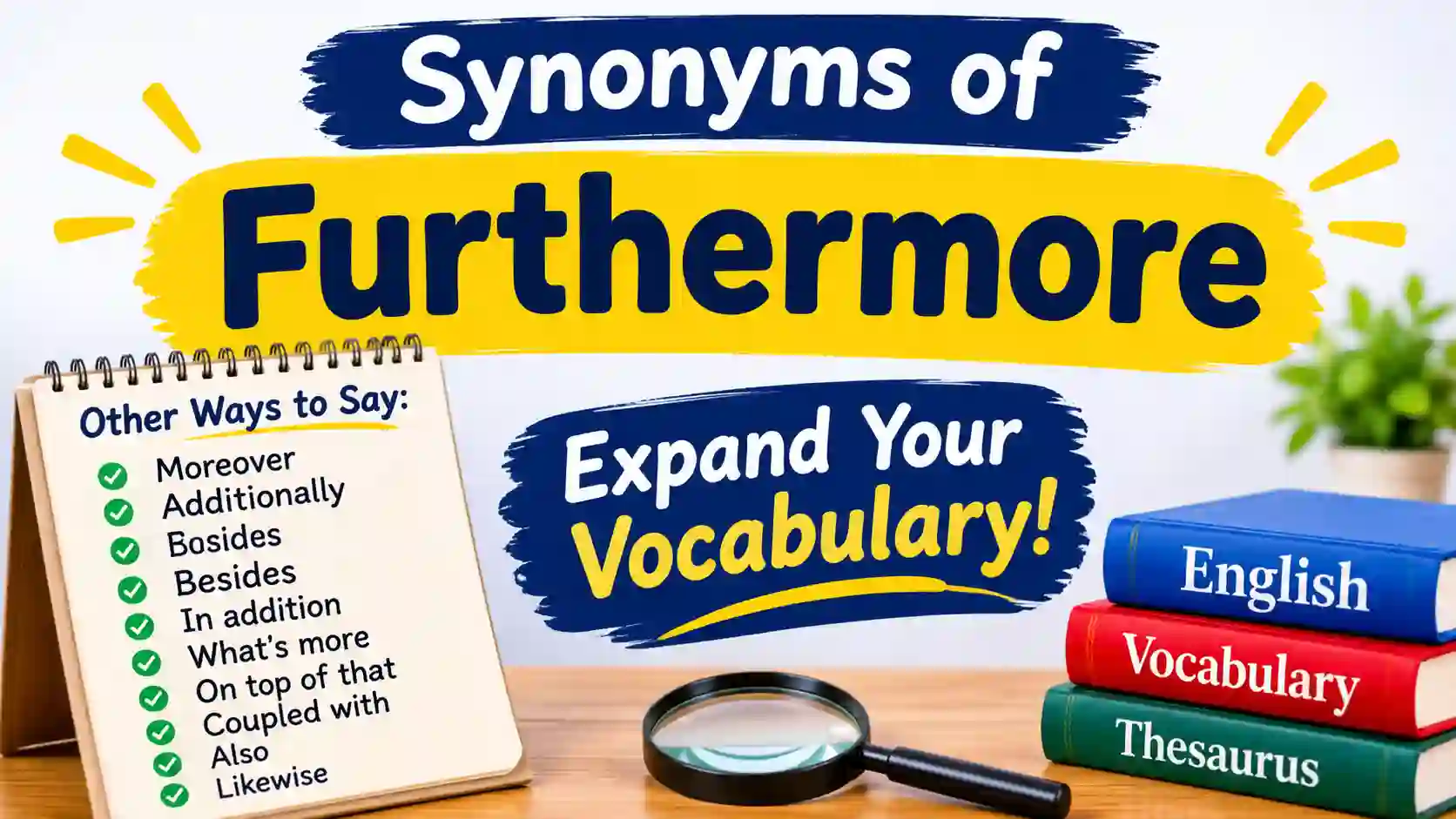
The best synonyms of furthermore include moreover, additionally, in addition, what’s more, besides, and also. These words and expressions introduce extra information, support an earlier point, or add another reason. Moreover and additionally suit formal writing, while also, plus, and what’s more work well in everyday English. The right choice depends on your sentence and intended tone.
Do you often use the word furthermore in essays, reports, emails, or blog posts? This word is useful, but repeating it in every paragraph can make your writing sound dull. Using suitable alternatives helps your sentences flow naturally.
Furthermore means adding another point to something you have already said. For example, “The training program is affordable. Furthermore, it provides practical experience.”
You can express the same general idea with words such as moreover, additionally, and in addition. However, some alternatives have different meanings or levels of formality.
This guide explains 30 useful synonyms and related expressions with definitions, original examples, pronunciation, grammar advice, and practical usage notes. It will help students, teachers, bloggers, professionals, and English learners choose better connecting words.
Pronunciation of Furthermore
- Word: Furthermore
- American IPA: /ˈfɝː.ðɚ.mɔːr/
- British IPA: /ˌfɜː.ðəˈmɔː/
- Easy pronunciation: fur-ther-MORE
- Part of speech: Adverb
- Main stress: The final syllable in the British pronunciation; the first part carries primary stress in the Cambridge American transcription.
Meaning of Furthermore
Furthermore means “in addition to what has already been stated.” Writers use it to introduce another fact, reason, or argument that supports or develops an earlier point.
Example: The new library has thousands of books. Furthermore, it offers free study rooms.
The second sentence adds another benefit of the library.
Part of Speech
Furthermore is an adverb. It does not have standard noun, verb, or adjective forms.
| Word | Part of Speech | Meaning |
| Furthermore | Adverb | In addition to what was stated |
| Further | Adjective / adverb | Additional or beyond |
| Further | Verb | To advance or promote |
| Furtherance | Noun | The act of helping something progress |
Important: Further and furthermore are related words, but they do not always perform the same job in a sentence.
Grammar: How to Use Furthermore
1. At the Beginning of a Sentence
Place a comma after furthermore when it introduces a sentence.
Example: The company provides free training. Furthermore, it offers career guidance.
2. After a Semicolon
Use a semicolon to connect two closely related independent clauses.
Example: The product is affordable; furthermore, it is easy to maintain.
3. Inside a Sentence
Furthermore can also appear within a sentence to add emphasis.
Example: The report is, furthermore, supported by recent research.
Common Grammar Rules
- Do not use furthermore directly before a noun as if it were a preposition.
- Do not combine furthermore and moreover unnecessarily.
- Use a semicolon or a full stop when joining two independent clauses.
- Choose a different transition word when you need to show contrast or cause and effect.
Incorrect: Furthermore the service is reliable.
Correct: Furthermore, the service is reliable.
Incorrect: Furthermore of its benefits, the product is affordable.
Correct: In addition to its benefits, the product is affordable.
Synonyms of Furthermore: Quick Comparison
| Synonym | Meaning | Formality |
| Moreover | Adds a supporting point | Formal |
| Additionally | Adds another fact | Formal |
| In addition | Introduces extra information | Formal / Neutral |
| What’s more | Adds an important point | Neutral |
| What is more | Adds further information | Neutral / Formal |
| Also | Adds information | Neutral |
| Besides | Adds another reason | Neutral |
| As well | Adds another item | Neutral |
| Too | Means also | Informal |
| In addition to that | Adds another point | Neutral |
| On top of that | Adds an extra point | Informal |
| Not only that | Adds emphasis | Neutral |
| More importantly | Adds a more important point | Formal |
| Equally important | Adds an equally important point | Formal |
| Beyond that | Moves to another consideration | Neutral |
| Apart from that | Adds another consideration | Neutral |
| Aside from that | Adds another consideration | Neutral |
| Added to that | Adds another factor | Neutral |
| Along with that | Adds a connected item | Neutral |
| To boot | Adds an extra benefit | Informal |
| Over and above that | Adds something extra | Formal |
| In the bargain | Adds an extra benefit | Neutral |
| Better still | Adds a more favorable point | Neutral |
| Best of all | Introduces the greatest benefit | Neutral |
| Not to mention | Adds another relevant point | Neutral |
| Plus | Adds another point | Informal |
| Another point is | Introduces another argument | Neutral |
| Another consideration is | Introduces another factor | Formal |
| A further point is | Introduces additional information | Formal |
| By the same token | Adds a related argument | Formal |
Some entries are contextual alternatives rather than exact synonyms. Their individual explanations below show when they can and cannot be replaced furthermore.
30 Synonyms of Furthermore with Examples and Explanations
1. Moreover
Meaning: Moreover introduces additional information that supports an earlier statement.
Examples:
- The school has excellent teachers. Moreover, its classrooms have modern equipment.
- The proposal reduces expenses. Moreover, it improves efficiency.
Best used when: You want to strengthen a previous argument.
Tone: Formal | CEFR guide: B2 | Frequency: Common
Collocations: Moreover, the study; moreover, it shows; and moreover.
Nuance: It often gives the new point extra weight.
When not to use: Avoid it in casual conversation when it also sounds more natural.
2. Additionally
Meaning: Additionally means including one more fact or detail.
Examples:
- The application stores your files. Additionally, it creates automatic backups.
- Students receive textbooks. Additionally, they can access online lessons.
Best used when: You introduce another feature, benefit, or requirement.
Tone: Formal / Business | CEFR guide: B2 | Frequency: Common
Collocations: Additionally, users can; additionally, we offer; additionally, the report.
Nuance: It sounds objective and works well in professional documents.
When not to use: Do not use it before a noun in place of “in addition to.”
3. In Addition
Meaning: In addition introduces another related fact or point.
Examples:
- The center offers language classes. In addition, it provides career advice.
- The house has a large garden. In addition, it includes a private garage.
Best used when: You want a clear transition between related statements.
Tone: Formal / Neutral | CEFR guide: B1–B2 | Frequency: Very common
Collocations: In addition, we; in addition to this; in addition to the cost.
Nuance: It is one of the safest alternatives in academic and business writing.
When not to use: Do not confuse “in addition” with “in addition to,” which requires a noun or gerund.
4. What’s More
Meaning: What’s more introduces another point that strengthens the previous one.
Examples:
- The jacket looks stylish. What’s more, it feels comfortable.
- The course is easy to follow. What’s more, it includes practice tests.
Best used when: You want a friendly but effective transition.
Tone: Neutral / Conversational | CEFR guide: B2 | Frequency: Common
Collocations: What’s more, it; what’s more, you can; what’s more, they offer.
Nuance: It often adds emphasis or surprise.
When not to use: Avoid it in highly technical writing if a neutral connector is more suitable.
5. What Is More
Meaning: What is more introduces an additional point, often one that strengthens an argument.
Examples:
- The building is energy-efficient. What is more, it uses recycled materials.
- She completed the project early. What is more, she stayed within budget.
Best used when: You want to add a supporting point in a slightly formal style.
Tone: Neutral / Formal | CEFR guide: B2 | Frequency: Common
Collocations: What is more, the; and what is more; what is more important.
Nuance: This is the full form of what’s more, not a separate meaning.
When not to use: Avoid counting it as a different synonym from what’s more.
6. Also
Meaning: Also means adding another fact or detail.
Examples:
- The website teaches grammar. It also provides vocabulary exercises.
- My cousin enjoys painting. She also likes photography.
Best used when: You need a simple, natural way to add information.
Tone: Neutral | CEFR guide: A1 | Frequency: Very common
Collocations: Also available; also known as; also includes.
Nuance: It is more flexible and less formal than furthermore.
When not to use: Avoid beginning every paragraph with also.
7. Besides
Meaning: Besides introduces an extra reason or consideration.
Examples:
- We should leave early. Besides, the roads may become busy.
- I chose the online course. Besides, it costs less than classroom training.
Best used when: You want to add another reason supporting your opinion.
Tone: Neutral / Informal | CEFR guide: B1 | Frequency: Very common
Collocations: Besides that; besides the cost; besides the fact.
Nuance: It often sounds more conversational than moreover.
When not to use: Do not use it as a replacement when you need a highly formal transition.
8. As Well
Meaning: As well means also or in addition.
Examples:
- The package includes a charger as well.
- She teaches English and writes educational articles as well.
Best used when: You want to add another item or activity naturally.
Tone: Neutral / Conversational | CEFR guide: A2 | Frequency: Very common
Collocations: As well as; included as well; available as well.
Nuance: It commonly appears at the end of a clause or sentence.
When not to use: Do not treat it as a direct sentence-opening replacement in every situation.
9. Too
Meaning: Too means also or in addition.
Examples:
- My brother wants to attend the workshop too.
- The shop sells notebooks and pens too.
Best used when: You add something in everyday conversation.
Tone: Informal / Neutral | CEFR guide: A1 | Frequency: Very common
Collocations: Me too; you too; too expensive.
Nuance: It is short and simple but does not carry the same formal emphasis as furthermore.
When not to use: Avoid opening formal academic paragraphs too.
10. In Addition to That
Meaning: This expression refers to another fact connected to what was previously mentioned.
Examples:
- The hotel offers free parking. In addition to that, it serves breakfast.
- The software protects files. In addition to that, it checks for errors.
Best used when: You want to refer directly to a previous statement.
Tone: Neutral | CEFR guide: B1–B2 | Frequency: Common
Collocations: In addition to that; in addition to these services; in addition to this benefit.
Nuance: It is more explicit and longer than also.
When not to use: Avoid it when a shorter transition would make the sentence clearer.
11. On Top of That
Meaning: On top of that introduces an additional benefit, problem, or situation.
Examples:
- The laptop is lightweight. On top of that, its battery lasts for hours.
- We missed the train. On top of that, it started raining.
Best used when: You want to emphasize an extra point in everyday English.
Tone: Informal | CEFR guide: B1–B2 | Frequency: Common
Collocations: On top of that; on top of everything; on top of the cost.
Nuance: It can introduce either a positive or negative addition.
When not to use: Avoid it in formal research papers.
12. Not Only That
Meaning: Not only that introduces another point for added emphasis.
Examples:
- The teacher explains every topic. Not only that, she provides extra exercises.
- The apartment is near the station. Not only that, it has a beautiful view.
Best used when: You want to emphasize an additional advantage or fact.
Tone: Neutral / Conversational | CEFR guide: B1 | Frequency: Common
Collocations: Not only that, but; not only that, it also.
Nuance: It often creates a stronger effect than also.
When not to use: Do not confuse it with the paired structure “not only … but also.”
13. More Importantly
Meaning: More importantly introduces a point that matters more than the previous one.
Examples:
- The new system saves money. More importantly, it protects customer data.
- She passed the examination. More importantly, she understood the subject.
Best used when: You want to highlight a higher-priority point.
Tone: Formal / Academic | CEFR guide: B2 | Frequency: Common
Collocations: More importantly, the; more importantly, it; and more importantly.
Nuance: It ranks the new information as more important.
When not to use: Do not use it when both points have equal importance.
14. Equally Important
Meaning: Equally important introduces another point with the same level of importance.
Examples:
- Exercise improves physical health. Equally important, it supports mental well-being.
- A good website needs useful content. Equally important, it needs clear navigation.
Best used when: You want to show that two points deserve equal attention.
Tone: Formal / Academic | CEFR guide: B2 | Frequency: Common
Collocations: Equally important is; equally important, the; an equally important factor.
Nuance: It highlights equal value rather than simple addition.
When not to use: Avoid it if the new point is less important than the previous one.
15. Beyond That
Meaning: Beyond that introduces another consideration outside the point already discussed.
Examples:
- The service manages customer calls. Beyond that, it handles appointments.
- The book explains basic grammar. Beyond that, it develops writing skills.
Best used when: You want to move from one consideration to another.
Tone: Neutral | CEFR guide: B2 | Frequency: Common
Collocations: Beyond that, we; beyond that point; beyond that, the company.
Nuance: It can also refer to something outside a limit.
When not to use: Do not use it if the new information has no meaningful connection to the previous point.
16. Apart From That
Meaning: Apart from that introduces another consideration or detail.
Examples:
- The room is small. Apart from that, it is comfortable.
- The application needs an update. Apart from that, everything works well.
Best used when: You want to add a separate consideration, often after mentioning a drawback.
Tone: Neutral | CEFR guide: B1–B2 | Frequency: Common
Collocations: Apart from that; apart from the cost; apart from these issues.
Nuance: It may also mean excluding something, depending on context.
When not to use: Avoid it when you need a strong formal argument transition.
17. Aside From That
Meaning: Aside from that introduces another detail or consideration.
Examples:
- The course is slightly expensive. Aside from that, it offers excellent value.
- The road is narrow. Aside from that, the route is easy to follow.
Best used when: You want to add a consideration after discussing one aspect of a subject.
Tone: Neutral | CEFR guide: B1–B2 | Frequency: Common
Collocations: Aside from that; aside from the price; aside from these details.
Nuance: It can also mean excluding something.
When not to use: Do not assume it always means furthermore.
18. Added to That
Meaning: Added to that introduces another factor in a situation.
Examples:
- The project is behind schedule. Added to that, the team needs more funding.
- The road has several sharp turns. Added to that, poor lighting makes driving harder.
Best used when: You want to show that another factor contributes to the situation.
Tone: Neutral | CEFR guide: B2 | Frequency: Less common
Collocations: Added to that; added to these problems; added to the existing costs.
Nuance: It often appears when several factors build on one another.
When not to use: Choose in addition when you need a simpler formal transition.
19. Along With That
Meaning: Along with that introduces another connected item or activity.
Examples:
- The package includes a computer. Along with that, customers receive a carrying case.
- She studies English. Along with that, she practices public speaking.
Best used when: You want to connect related services, items, or activities.
Tone: Neutral | CEFR guide: B1 | Frequency: Common
Collocations: Along with that; along with the service; along with other benefits.
Nuance: It emphasizes connection or combination.
When not to use: Avoid it when the second idea is completely independent.
20. To Boot
Meaning: To boot means in addition or as an extra feature.
Examples:
- The café serves excellent coffee and offers free internet access to boot.
- The employee is friendly, reliable, and experienced to boot.
Best used when: You want to add an extra benefit with a conversational touch.
Tone: Informal | CEFR guide: Advanced expression | Frequency: Uncommon
Collocations: Free to boot; friendly to boot; inexpensive to boot.
Nuance: It often appears at the end of a sentence.
When not to use: Avoid it in formal academic writing.
21. Over and Above That
Meaning: Over and above that means in addition to something already mentioned.
Examples:
- The job provides a good salary. Over and above that, employees receive paid leave.
- The house has a garden. Over and above that, it includes private parking.
Best used when: You want to emphasize something extra.
Tone: Formal / Neutral | CEFR guide: Advanced expression | Frequency: Uncommon
Collocations: Over and above that; over and above the cost; over and above the basic requirements.
Nuance: It can suggest something beyond an existing amount or level.
When not to use: Avoid it when a simple also would be clearer.
22. In the Bargain
Meaning: In the bargain means in addition to everything else.
Examples:
- The apartment is spacious and has a beautiful view in the bargain.
- The company offers flexible hours and free training in the bargain.
Best used when: You want to add an extra benefit.
Tone: Neutral / Slightly old-fashioned | CEFR guide: Advanced expression | Frequency: Uncommon
Collocations: In the bargain; included in the bargain; an added benefit.
Nuance: It is less common in everyday modern English than plus or what’s more.
When not to use: Avoid it when writing for beginner-level readers.
23. Better Still
Meaning: Better still introduces an even more favorable point.
Examples:
- The course is free. Better still, students can study at their own pace.
- The house is close to work. Better still, it is near public transport.
Best used when: The additional point improves on the previous one.
Tone: Neutral | CEFR guide: B2 | Frequency: Common
Collocations: Better still; better still, you can; better still, it offers.
Nuance: It suggests an improvement, not just another fact.
When not to use: Avoid it when the new information is not actually better.
24. Best of All
Meaning: Best of all introduces the most attractive feature or benefit.
Examples:
- The hotel has clean rooms and friendly staff. Best of all, breakfast is included.
- The program is simple and affordable. Best of all, it works offline.
Best used when: You want to highlight the strongest advantage.
Tone: Neutral / Conversational | CEFR guide: B1–B2 | Frequency: Common
Collocations: Best of all; best of all, it; the best of all options.
Nuance: It ranks the final point above the others.
When not to use: Do not use it for neutral facts that have no special advantage.
25. Not to Mention
Meaning: Not to mention introduces another relevant detail, often one that deserves attention.
Examples:
- The trip will cost a lot, not to mention the time needed to prepare.
- The office needs repairs, not to mention new electrical equipment.
Best used when: You want to add another point that strengthens your statement.
Tone: Neutral | CEFR guide: B2 | Frequency: Common
Collocations: Not to mention the cost; not to mention the time; not to mention the risks.
Nuance: It often introduces something important that might otherwise be overlooked.
When not to use: Avoid it when the added information is unrelated.
26. Plus
Meaning: Plus means adding another fact, reason, or advantage.
Examples:
- The phone is affordable. Plus, it has a powerful camera.
- I enjoy the course. Plus, the teacher explains difficult ideas clearly.
Best used when: You want a short and friendly transition.
Tone: Informal | CEFR guide: A2 | Frequency: Very common
Collocations: Plus, it offers; plus, you get; a major plus.
Nuance: It is energetic and natural in everyday speech and marketing.
When not to use: Avoid it in formal research papers.
27. Another Point Is
Meaning: Another point introduces an additional argument or idea.
Examples:
- The policy reduces expenses. Another point is that it saves time.
- The school has modern classrooms. Another point is that it provides transport.
Best used when: You are presenting several arguments in a clear order.
Tone: Neutral | CEFR guide: B1 | Frequency: Common
Collocations: Another point is that; another important point; one more point.
Nuance: It makes the structure of an argument clear.
When not to use: Avoid repeating it at the beginning of every sentence.
28. Another Consideration Is
Meaning: Another consideration is introducing an additional factor that needs attention.
Examples:
- The design looks attractive. Another consideration is its maintenance cost.
- The plan may increase sales. Another consideration is its effect on existing customers.
Best used when: You are discussing decisions, plans, or complex issues.
Tone: Formal / Business | CEFR guide: B2 | Frequency: Common
Collocations: Another consideration is; an important consideration; practical considerations.
Nuance: It introduces a factor for evaluation rather than merely adding a fact.
When not to use: Avoid it when you are writing a casual message.
29. A Further Point Is
Meaning: A further point introduces another argument or detail.
Examples:
- The study identifies several risks. A further point is the lack of long-term data.
- The website needs better navigation. A further point is its slow loading speed.
Best used when: You want to organize additional arguments in academic or professional writing.
Tone: Formal / Academic | CEFR guide: B2–C1 | Frequency: Common
Collocations: A further point; one further reason; further evidence.
Nuance: It is structured and precise, especially in reports.
When not to use: Avoid it in relaxed conversations.
30. By the Same Token
Meaning: By the same token introduces a related argument or idea based on similar reasoning.
Examples:
- Parents need clear information about school policies. By the same token, teachers need regular updates.
- Businesses should protect customer data. By the same token, they should secure employee information.
Best used when: You want to connect two ideas through similar reasoning.
Tone: Formal | CEFR guide: Advanced expression | Frequency: Less common
Collocations: By the same token; by the same logic; by the same reasoning.
Nuance: It suggests a logical connection, not simply another unrelated fact.
When not to use: Do not use it as a direct replacement for furthermore in every sentence.
Categories of Furthermore Synonyms
Strongest Direct Alternatives
These expressions are closest in meaning to furthermore:
- Moreover
- Additionally
- In addition
- What’s more
- What is more
- Besides
- Also
Natural Conversational Alternatives
Use these in everyday speaking and informal writing:
- Plus
- As well
- Too
- On top of that
- Not only that
- To boot
- Apart from that
Formal and Academic Alternatives
These work well in essays, reports, and professional documents:
- Moreover
- Additionally
- In addition
- Equally important
- More importantly
- A further point is
- Another consideration is
Context-Dependent Expressions
These add a related idea but do not always have the same meaning as furthermore:
- Likewise
- By the same token
- Better still
- Best of all
- Not to mention
- Along with that
Choose the Right Synonym: Side by Side Comparisons
| Expression | Main Purpose | Example |
| Furthermore | Adds a supporting point | The service is reliable. Furthermore, it is affordable. |
| Moreover | Adds a strong supporting point | The service is reliable. Moreover, it has excellent support. |
| Additionally | Adds another fact | Additionally, customers receive free updates. |
| In addition | Introduces related information | In addition, the company offers training. |
| Also | Adds information simply | The service also includes maintenance. |
| Besides | Adds another reason | Besides, we have enough time. |
| Likewise | Shows similarity | Likewise, the second group improved. |
| More importantly | Adds a higher-priority point | More importantly, it protects users. |
| Better still | Introduces an improvement | Better still, the service is free. |
| By the same token | Connects similar reasoning | By the same token, employees need support. |
Which Synonym Should You Choose?
- For an academic essay: Moreover or additionally.
- For a business report: In addition or furthermore.
- For a casual conversation: Also or plus.
- For an extra benefit: What’s more or on top of that.
- For an equally important argument: Equally important.
- For a more important argument: More importantly.
- For a similar idea: Likewise or by the same token.
Commonly Confused Transition Words
| Word | Difference | Example |
| Furthermore | Adds information | Furthermore, the plan saves money. |
| However | Shows contrast | However, the plan has some risks. |
| Therefore | Shows a result | Therefore, we changed the plan. |
| Consequently | Shows a consequence | Consequently, sales declined. |
| Likewise | Shows similarity | Likewise, the second team improved. |
Remember: Furthermore adds information. However introduces contrast, while therefore and consequently show results.
Word Origin and Etymology
Furthermore combines two older English elements: further and more.
- Further: Developed from Old English forms such as furðor and forðor, which referred to moving onward, beyond, or to a greater extent.
- More: Comes from Old English māra, meaning greater or additional.
- Combined meaning: Something additional beyond what has already been mentioned.
Historical word-history references date furthermore to around 1200, during the Middle English period. The older variant furthermore also existed.
The related word moreover developed later. Its history goes back to Middle English expressions combining more and more, with recorded use from the late 14th century.
Understanding this history makes the modern meaning easier to remember: furthermore introduces something additional to an earlier point.
CEFR Levels for Furthermore Synonyms
CEFR means Common European Framework of Reference for Languages. It describes language proficiency from A1 (beginner) to C2 (proficient).
The following are approximate learning suggestions, not official CEFR classifications for every word.
| Word | Suggested Learning Level |
| Also | A1 |
| Too | A1 |
| As well | A2 |
| Plus | A2 |
| Besides | B1 |
| In addition | B1–B2 |
| Additionally | B2 |
| Moreover | B2 |
| What’s more | B2 |
| More importantly | B2 |
| Equally important | B2 |
| By the same token | Advanced |
| To boot | Advanced |
| Over and above that | Advanced |
Learning tip: Start with also, too, and as well. Then practice in addition, besides, and what’s more. Learn more formal expressions when your writing skills improve.
American vs. British English
Furthermore it has the same spelling and general meaning in American and British English.
| Feature | American English | British English |
| Spelling | Furthermore | Furthermore |
| General meaning | In addition | In addition |
| IPA | /ˈfɝː.ðɚ.mɔːr/ | /ˌfɜː.ðəˈmɔː/ |
| Moreover | Common | Common |
| Additionally | Common | Common |
| In addition | Common | Common |
| What’s more | Common | Common |
The most noticeable difference is pronunciation. American English uses a pronounced r sound in words such as further, while standard British English usually does not pronounce the final r unless another vowel follows.
There is no special American or British spelling for furthermore. The main alternatives also work in both varieties.
Common Mistakes When Using Furthermore Synonyms
Mistake 1: Using Furthermore Before a Noun
Mistake: Furthermore the extra benefits.
Correction: In addition to the extra benefits.
Explanation: Furthermore introduces a statement. In addition to introducing a noun phrase or gerund.
Mistake 2: Combining Similar Connectors
Mistake: Furthermore, moreover, the product is affordable.
Correction: Moreover, the product is affordable.
Explanation: Both expressions add information. One is enough.
Mistake 3: Confusing Addition With Contrast
Mistake: The product is affordable. However, it comes with free support.
Correction: The product is affordable. Furthermore, it comes with free support.
Explanation: However introduces contrast. Furthermore introduces an additional point.
Mistake 4: Confusing Addition With Cause and Effect
Mistake: The road was closed. Furthermore, we took another route.
Correction: The road was closed. Therefore, we took another route.
Explanation: Taking another route is the result of the road closure.
Mistake 5: Using Informal Words in Formal Essays
Mistake: The research is useful. Plus, it provides new information.
Correction: The research is useful. Additionally, it provides new information.
Explanation: Plus sounds conversational. Additionally is more appropriate for academic writing.
Writing Tips: How to Use Furthermore Synonyms Naturally
1. In Academic Essays
Use formal connectors to introduce supporting evidence and arguments.
Example: “Reading improves vocabulary. Moreover, it develops critical thinking.”
Recommended words: Moreover, additionally, in addition, equally important.
2. In Business Emails
Choose professional expressions that keep your message clear.
Example: “The report is complete. Additionally, I have attached the supporting documents.”
Recommended words: Additionally, furthermore, in addition.
3. In Blog Posts
Use natural transitions to keep readers engaged.
Example: “This application helps organize your schedule. What’s more, it sends useful reminders.”
Recommended words: What’s more, also, plus.
4. In Stories
Choose connectors that match the narrator’s voice.
Example: “She reached the station early. Besides, she wanted time to buy a ticket.”
Recommended words: Besides, also, what’s more.
5. In Social Media Posts
Keep your message short and conversational.
Example: “Easy to use, affordable, and reliable. Plus, it comes with free support!”
Recommended words: Plus, also, and.
6. In Professional Reports
Use clear expressions that connect facts and findings.
Example: “Customer satisfaction increased this quarter. Furthermore, the company reduced operating costs.”
Recommended words: Furthermore, moreover, additionally.
7. In Daily Conversations
Use simple alternatives instead of overly formal vocabulary.
Example: “I enjoy learning English. I also like practicing with my friends.”
Recommended words: Also, besides, plus, as well.
Writing tip: Do not change a transition word just to avoid repetition. First check whether the alternative expresses the same relationship between your ideas.
Related Vocabulary
Opposite Transition Words
Furthermore does not have one exact antonym. However, the following words introduce a different relationship between ideas.
| Word | Meaning |
| However | Introduces contrast |
| Nevertheless | Shows contrast despite something |
| Instead | Introduces an alternative |
| Conversely | Shows an opposite situation |
| On the other hand | Presents another viewpoint |
| Otherwise | Introduces another possible outcome |
Related Expressions
- In addition to this
- Another important factor
- One more consideration
- Not to mention
- What is more
- Apart from that
- Along with that
- As an extra benefit
Word Family
| Word | Part of Speech | Meaning |
| Further | Adjective / Adverb | Additional or beyond |
| Further | Verb | To advance |
| Furtherance | Noun | Help or promotion of progress |
| Furthermore | Adverb | In addition |
| Furthest | Adjective / Adverb | At the greatest distance or extent |
Frequently Asked Questions
1. What are the best synonyms of furthermore?
The best synonyms of furthermore include moreover, additionally, in addition, what’s more, besides, and also. These expressions add information or support an earlier point. Moreover and additionally are particularly suitable for formal writing, while also and plus are more natural in everyday communication.
2. What is a more professional word for furthermore?
Moreover and additionally are excellent professional alternatives to furthermore. Both introduce extra information in business reports, presentations, formal emails, and academic documents. You can also use in addition when you want a clear and neutral transition between related points.
3. Can I use moreover instead of furthermore?
Yes. Moreover and furthermore have very similar meanings. Both introduce additional information that supports a previous statement. For example, “The software is affordable. Moreover, it is easy to use.” You can replace moreover with furthermore without changing the basic meaning.
4. Is it more formal or informal?
Furthermore is a formal adverb. Writers commonly use it in academic essays, research papers, professional reports, and formal discussions. In casual conversations, alternatives such as also, plus, besides, and what’s more often sound more natural.
5. What is the difference between furthermore and additionally?
Both words introduce extra information. However, furthermore often adds a supporting point to an argument, while additionally commonly introduces another fact, feature, or requirement. For example, “Furthermore, the evidence supports our claim” and “Additionally, the package includes free delivery.”
6. What is the easiest synonym of furthermore?
Also is one of the easiest synonyms of furthermore. It is short, common, and suitable for everyday English. Beginners can also learn too and as well. These expressions help you add information without using complicated vocabulary.
7. Can I start a sentence with furthermore?
Yes. You can begin a sentence with furthermore when you want to introduce another point connected to the previous sentence. For example, “The library offers free books. Furthermore, students can use its computers.” Place a comma after furthermore when it begins the sentence.
8. What words should I avoid using instead?
Avoid words that express a different relationship between ideas. However introduces contrast, while therefore shows a result. Likewise shows similarity. These words can connect sentences, but they do not always communicate the additional-information meaning of furthermore.
Vocabulary Quiz
Test your understanding of the meaning and usage of furthermore and its alternatives.
1. Which word is the closest formal synonym of furthermore?
A. However
B. Moreover
C. Therefore
D. Instead
2. Which expression sounds most natural in casual conversation?
A. Coupled with that
B. Plus
C. Over and above that
D. In addition
3. Which word introduces contrast?
A. Additionally
B. Moreover
C. However
D. Also
4. Which expression introduces a point with equal importance?
A. Equally important
B. To boot
C. Too
D. As well
5. Choose the grammatically correct sentence.
A. Furthermore, it is useful.
B. Furthermore, the service is affordable.
C. Furthermore to the service.
D. Furthermore it is useful.
Answer Key
- B. Moreover
- B. Plus
- C. However
- A. Equally important
- B. Furthermore, the service is affordable.
Additional Practice Exercises
Exercise 1: Fill in the Blanks
Choose from: Moreover, Also, Plus, Additionally, However.
- The hotel offers clean rooms. ______, it provides free breakfast.
- I enjoy reading books. I ______ enjoy writing stories.
- The phone has a large screen. ______, its battery lasts longer.
- The project is interesting. ______, it requires a lot of time.
- The company provides training. ______, employees receive free materials.
Exercise 2: Rewrite the Sentences
Replace the bold transition with a suitable alternative.
- The website is easy to use. Furthermore, it loads quickly.
- The school provides free books. Also, it offers online lessons.
- The product is affordable. What’s more, it comes with a warranty.
Exercise 3: Match the Expressions
| Expression | Meaning |
| 1. However | A. Shows similarity |
| 2. Likewise | B. Adds another point |
| 3. Moreover | C. Shows contrast |
| 4. Therefore | D. Shows a result |
Practice answers:
Exercise 1: 1. Moreover, 2. also, 3. Plus, 4. However, 5. Additionally.
Exercise 2: Answers may vary. Suitable alternatives include moreover, additionally, and in addition.
Exercise 3: 1-C, 2-A, 3-B, 4-D.
Conclusion
Learning synonyms can make your writing clearer, more natural, and more engaging. Words such as moreover, additionally, also, and in addition help you connect ideas without repeating the same expression.
Choose each alternative according to its meaning and tone. Practice these words in essays, emails, schoolwork, and everyday conversations to build a stronger English vocabulary.
References and Further Reading
- Oxford Learner’s Dictionaries: Furthermore and its usage.
- Cambridge Dictionary: Furthermore, meaning, and pronunciation.
- Cambridge Thesaurus: Synonyms and related expressions.
- Etymonline: Historical origin of furthermore and moreover.
- Dictionary.com: Definitions, synonyms, and pronunciation.

The Synonorm Editorial Team helps readers improve their English vocabulary with clear synonyms, antonyms, word meanings, and practical examples. Our goal is to make learning new words simple, useful, and enjoyable for students, writers, and English learners.