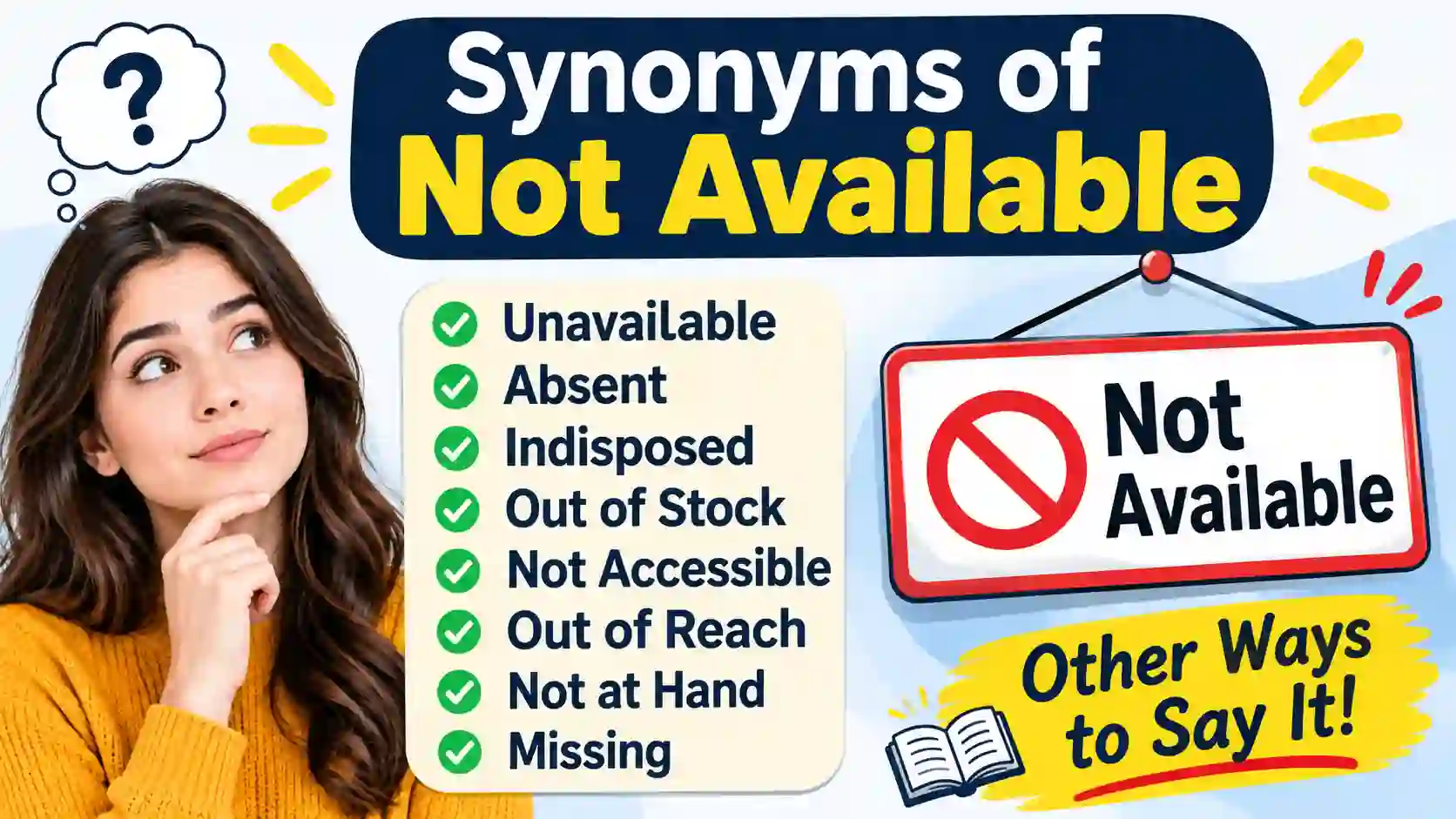
Quick Answer: What Are Synonyms Not Available?
The best synonyms of not available include unavailable, inaccessible, unobtainable, busy, occupied, tied up, out of stock, sold out, and unreachable. Each expression has a slightly different meaning. Use busy for someone who has no free time, out of stock for products, inaccessible for things that cannot be accessed, and unavailable as a general alternative.
Imagine calling a friend who cannot answer, visiting a store that has run out of your favorite product, or trying to open a website that is temporarily down. In each situation, you might say something is not available.
However, repeating the same expression can make your English sound less natural. Learning synonyms of not available gives you more ways to explain these situations accurately.
Some alternatives describe people who cannot meet, while others refer to products, services, information, places, or resources. For example, a manager may be busy, a hotel may be fully booked, and a website may be inaccessible.
This guide explores 30 useful alternatives, their meanings, pronunciation, grammar, examples, and differences. You will also learn which expressions work best in academic writing, professional emails, and everyday conversations.
Pronunciation of Not Available
- American IPA: /nɑːt əˈveɪ.lə.bəl/
- British IPA: /nɒt əˈveɪ.lə.bəl/
- Simple pronunciation: Not uh-VAY-luh-buhl
- Main stress: VAY
The word unavailable is pronounced:
- American and British IPA: /ˌʌn.əˈveɪ.lə.bəl/
The main stress also falls on the syllable VAY.
Meaning and Part of Speech
Not available is an adjective phrase. It describes someone or something that cannot currently be obtained, used, reached, contacted, or accessed.
Examples:
- The manager is not available today.
- This product is not available in our store.
- The information is not available to the public.
The word unavailable is a single-word adjective with the same broad meaning.
Related grammatical forms include:
| Word | Part of speech | Meaning |
| Available | Adjective | Ready to use or obtain |
| Unavailable | Adjective | Not ready or able to use or obtain |
| Availability | Noun | State of being available |
| Unavailability | Noun | State of not being available |
| Avail | Verb / noun | To be useful; usefulness |
Grammar: How to Use Not Available
Use not available after linking verbs such as is, are, was, and were.
1. Subject + be + not available
The conference room is not available.
2. Subject + be + not available + until
The doctor is not available until Friday.
3. Subject + be + not available + to
This service is not available to new customers.
4. Subject + be + not available + for
The equipment is not available for public use.
Important: The phrase unavailable for comment is a common expression in journalism and professional communication.
Overview: 30 Synonyms of Not Available
| Synonym | Meaning | Register |
| Unavailable | Cannot be obtained or used | Neutral |
| Busy | Has no free time | Neutral |
| Inaccessible | Cannot be accessed | Formal |
| Occupied | Already in use | Neutral |
| Tied up | Busy with another task | Informal |
| Engaged | Involved in another activity | Formal |
| Unobtainable | Cannot be obtained | Formal |
| Unreachable | Cannot be contacted or reached | Neutral |
| Out of stock | No remaining shop inventory | Business |
| Sold out | All units have been sold | Neutral |
| Booked up | All appointments or spaces are reserved | Informal |
| Reserved | Kept for someone | Neutral |
| Taken | Already claimed or occupied | Informal |
| Absent | Not present | Neutral |
| Away | Not present at a location | Informal |
| Indisposed | Unable to attend, often due to illness | Formal |
| Unattainable | Cannot be achieved | Formal |
| Out of reach | Difficult or impossible to reach | Neutral |
| Restricted | Access is limited | Formal |
| Off-limits | Access is not permitted | Informal |
| Discontinued | No longer produced or offered | Business |
| Scarce | Available in limited quantities | Formal |
| Depleted | Supply has been used up | Formal |
| Exhausted | Resources have been used up | Neutral |
| Missing | Cannot be found | Neutral |
| Gone | No longer present | Informal |
| Offline | Not connected or operating online | Technical |
| Inoperative | Not functioning | Formal |
| Unusable | Cannot be used | Neutral |
| Out of print | No longer being printed | Publishing |
30 Best Synonyms of Not Available With Examples
1. Unavailable
Meaning: Something or someone cannot be obtained, used, or contacted.
Examples:
- The customer service team is unavailable after 9 p.m.
- This feature is currently unavailable in some countries.
Best Used When: You need a general alternative for not available.
Tone: Neutral | CEFR: C1 estimate | Frequency: Very common.
Collocations: Temporarily unavailable, unavailable for comment, currently unavailable.
When Not to Use: Choose a more specific expression when the reason is known.
2. Busy
Meaning: Someone has work or activities to complete.
Examples:
- My teacher is busy preparing the exam papers.
- I am busy this afternoon, but I can help tomorrow.
Best Used When: A person has no free time.
Tone: Neutral, spoken | CEFR: A1 estimate | Frequency: Very common.
Collocations: Busy schedule, busy at work, busy with meetings.
When Not to Use: Do not use it for products that a shop has run out of.
3. Inaccessible
Meaning: Something cannot be reached, entered, or accessed.
Examples:
- The online records became inaccessible after the update.
- Heavy snow made the mountain road inaccessible.
Best Used When: Describing websites, locations, documents, or resources.
Tone: Formal, academic | CEFR: B2 estimate | Frequency: Common.
Collocations: Inaccessible website, inaccessible information, inaccessible area.
When Not to Use: Avoid it when you simply mean someone is busy.
4. Occupied
Meaning: Someone is busy or a place is already being used.
Examples:
- The meeting room is occupied until lunchtime.
- The receptionist is occupied with another visitor.
Best Used When: A person or space is already in use.
Tone: Neutral | CEFR: B1 estimate | Frequency: Common.
Collocations: Fully occupied, occupied room, occupied with work.
When Not to Use: Do not confuse it with a person being permanently unavailable.
5. Tied Up
Meaning: Someone cannot give attention because of another task.
Examples:
- Our director is tied up in meetings today.
- I am tied up with a client project this morning.
Best Used When: Explaining a temporary work commitment.
Tone: Informal, business | CEFR: B2 estimate | Frequency: Common.
Collocations: Tied up in meetings, tied up with work, completely tied up.
When Not to Use: Avoid it in highly formal academic writing.
6. Engaged
Meaning: Someone is involved in another activity or commitment.
Examples:
- The professor is engaged in important research.
- She is engaged elsewhere this evening.
Best Used When: Describing professional or personal commitments.
Tone: Formal, neutral | CEFR: B2 estimate | Frequency: Common.
Collocations: Engaged in research, engaged in discussion, otherwise engaged.
When Not to Use: Remember that engaged can also mean promised to marry.
7. Unobtainable
Meaning: Something cannot be obtained or acquired.
Examples:
- Original copies of the manuscript are almost unobtainable.
- The replacement component was unobtainable locally.
Best Used When: Talking about rare products, documents, or resources.
Tone: Formal | CEFR: C1 estimate | Frequency: Uncommon.
Collocations: Virtually unobtainable, unobtainable item, unobtainable resource.
When Not to Use: Do not use it for something that is simply temporarily out of stock.
8. Unreachable
Meaning: Someone or something cannot be contacted or reached.
Examples:
- The technician was unreachable during the outage.
- The remote village became unreachable after the bridge collapsed.
Best Used When: Discussing communication or physical access.
Tone: Neutral | CEFR: B2 estimate | Frequency: Common.
Collocations: Unreachable by phone, currently unreachable, unreachable location.
When Not to Use: A busy person is not necessarily unreachable.
9. Out of Stock
Meaning: A shop has no remaining supply of a product.
Examples:
- The blue jacket is out of stock.
- Our supplier is temporarily out of stock of printer paper.
Best Used When: Discussing retail products and inventory.
Tone: Neutral, business | CEFR: B1 estimate | Frequency: Very common.
Collocations: Temporarily out of stock, out-of-stock product, back in stock.
When Not to Use: Do not use it for a product that a company has permanently discontinued.
10. Sold Out
Meaning: All available units or tickets have been purchased.
Examples:
- Tickets for the concert sold out within an hour.
- The new collection is completely sold out.
Best Used When: Everything offered for sale has been purchased.
Tone: Neutral | CEFR: B1 estimate | Frequency: Very common.
Collocations: Completely sold out, sold-out concert, sold-out event.
When Not to Use: Do not use it when a product was never offered for sale.
11. Booked Up
Meaning: All available appointments, rooms, or spaces have been reserved.
Examples:
- The clinic is booked up until Monday.
- Most hotels are booked up for the holiday season.
Best Used When: Discussing appointments, accommodation, or schedules.
Tone: Informal | CEFR: B2 estimate | Frequency: Common.
Collocations: Fully booked up, booked up for the weekend, completely booked up.
When Not to Use: Do not use it for an ordinary shop product.
12. Reserved
Meaning: Something has been kept for a particular person or purpose.
Examples:
- The front seats are reserved for invited guests.
- This parking space is reserved for staff.
Best Used When: An item or place has already been allocated.
Tone: Neutral | CEFR: B1 estimate | Frequency: Very common.
Collocations: Reserved seat, reserved parking, reserved room.
When Not to Use: A reserved item may still be available to the person who booked it.
13. Taken
Meaning: A seat, position, or opportunity has already been claimed.
Examples:
- Sorry, that chair is taken.
- The appointment slot has already been taken.
Best Used When: Something is no longer free for another person.
Tone: Informal | CEFR: A2 estimate | Frequency: Very common.
Collocations: Seat taken, already taken, position taken.
When Not to Use: Avoid it for inaccessible websites or missing information.
14. Absent
Meaning: Someone or something is not present where expected.
Examples:
- Two students were absent from class.
- The required signature was absent from the form.
Best Used When: Discussing attendance or something missing from a document.
Tone: Neutral, academic | CEFR: B1 estimate | Frequency: Very common.
Collocations: Absent from school, absent from work, absent without permission.
When Not to Use: Someone can be present but still unavailable to speak.
15. Away
Meaning: Someone is not at a particular place.
Examples:
- The manager is away from the office today.
- My colleague is away on a business trip.
Best Used When: Explaining someone’s absence from a location.
Tone: Neutral, informal | CEFR: A1 estimate | Frequency: Very common.
Collocations: Away from work, away on holiday, away from home.
When Not to Use: Away does not necessarily mean a person cannot be contacted.
16. Indisposed
Meaning: Someone cannot attend or participate, often because they are unwell.
Examples:
- The speaker is indisposed and cannot attend the event.
- Our director is temporarily indisposed.
Best Used When: Giving a polite, formal explanation for someone’s inability to attend.
Tone: Formal | CEFR: C1 estimate | Frequency: Uncommon.
Collocations: Temporarily indisposed, feel indisposed, be indisposed.
When Not to Use: Avoid it in casual conversations when busy is more natural.
17. Unattainable
Meaning: Something cannot be achieved or reached.
Examples:
- The original target proved unattainable without additional funding.
- Perfect results are often unattainable.
Best Used When: Discussing goals, standards, or ambitions.
Tone: Formal, academic | CEFR: C1 estimate | Frequency: Common.
Collocations: Unattainable goal, unattainable standard, unattainable dream.
When Not to Use: Do not use it as a replacement for out of stock.
18. Out of Reach
Meaning: Something is too far away or difficult to obtain.
Examples:
- The medicine remains out of reach for many families.
- Keep cleaning products out of reach of children.
Best Used When: Describing physical distance or practical difficulty.
Tone: Neutral | CEFR: B1 estimate | Frequency: Very common.
Collocations: Financially out of reach, beyond reach, out of reach of children.
When Not to Use: Avoid it when a person’s only problem is a busy schedule.
19. Restricted
Meaning: Access or use is limited by rules or conditions.
Examples:
- Access to the database is restricted.
- The building has restricted entry hours.
Best Used When: Explaining controlled access or limited permission.
Tone: Formal, business | CEFR: B2 estimate | Frequency: Common.
Collocations: Restricted access, restricted area, restricted information.
When Not to Use: Restricted does not always mean completely unavailable.
20. Off Limits
Meaning: Something cannot be entered or used because rules forbid it.
Examples:
- The research laboratory is off-limits to visitors.
- Employees cannot enter the storage area because it is off-limits.
Best Used When: Talking about prohibited areas or activities.
Tone: Informal, neutral | CEFR: B2 estimate | Frequency: Common.
Collocations: Off-limits area, strictly off-limits, off-limits to visitors.
When Not to Use: Do not use it for a service that is temporarily down.
21. Discontinued
Meaning: A product or service is no longer being produced or offered.
Examples:
- The company discontinued its older laptop model.
- This phone accessory has been discontinued.
Best Used When: A company has permanently stopped producing or offering something.
Tone: Neutral, business | CEFR: B2 estimate | Frequency: Common.
Collocations: Discontinued product, discontinued model, discontinued service.
When Not to Use: A temporary shortage does not mean a product is discontinued.
22. Scarce
Meaning: Something exists in limited quantities.
Examples:
- Clean drinking water became scarce during the drought.
- Affordable apartments are scarce in this neighborhood.
Best Used When: Discussing shortages or limited supplies.
Tone: Formal, academic | CEFR: B2 estimate | Frequency: Common.
Collocations: Scarce resources, scarce supplies, increasingly scarce.
When Not to Use: Scarce does not mean that absolutely none exists.
23. Depleted
Meaning: A supply or resource has been greatly reduced or used up.
Examples:
- The emergency food supply was depleted after several days.
- The printer’s ink cartridge is nearly depleted.
Best Used When: Discussing resources, supplies, and reserves.
Tone: Formal | CEFR: C1 estimate | Frequency: Common.
Collocations: Depleted resources, depleted supplies, nearly depleted.
When Not to Use: Do not use it for a person who cannot attend a meeting.
24. Exhausted
Meaning: A supply, fund, or resource has been completely used up.
Examples:
- The organization exhausted its emergency budget.
- All available funding was exhausted before the project ended.
Best Used When: Discussing resources that have run out.
Tone: Neutral, formal | CEFR: B2 estimate | Frequency: Very common.
Collocations: Exhausted funds, exhausted supplies, fully exhausted.
When Not to Use: When describing a tired person, exhausted means physically or mentally very tired.
25. Missing
Meaning: Someone or something cannot be found or is not present where expected.
Examples:
- One important document is missing from the application.
- The delivery arrived with a missing component.
Best Used When: Something expected cannot be located.
Tone: Neutral | CEFR: A2 estimate | Frequency: Very common.
Collocations: Missing information, missing document, missing item.
When Not to Use: Missing suggests something is lost or absent, not necessarily unavailable for purchase.
26. Gone
Meaning: Something is no longer present or available.
Examples:
- All the fresh bread was gone by lunchtime.
- The last two tickets were already gone.
Best Used When: Something has disappeared, been used, or been taken.
Tone: Informal | CEFR: A1 estimate | Frequency: Very common.
Collocations: All gone, long gone, gone for good.
When Not to Use: Use sold out in professional retail communication when you specifically mean that all products have been purchased.
27. Offline
Meaning: A digital system is not connected to a network or operating online.
Examples:
- The payment system is temporarily offline.
- Our website went offline during maintenance.
Best Used When: Discussing websites, applications, servers, and digital services.
Tone: Technical, neutral | CEFR: B1 estimate | Frequency: Very common.
Collocations: Temporarily offline, go offline, offline system.
When Not to Use: Offline does not necessarily mean a system is unusable. Some applications work without an internet connection.
28. Inoperative
Meaning: A machine or system is not functioning.
Examples:
- The elevator remained inoperative throughout the morning.
- Several machines became inoperative after the power failure.
Best Used When: Discussing equipment, machines, or technical systems.
Tone: Formal, technical | CEFR: C1 estimate | Frequency: Uncommon.
Collocations: Inoperative equipment, inoperative machinery, rendered inoperative.
When Not to Use: Avoid it for a product that is simply unavailable in a store.
29. Unusable
Meaning: Something cannot perform its intended purpose.
Examples:
- The damaged file became unusable after the computer crashed.
- Heavy rainfall made the sports field unusable.
Best Used When: Describing damaged or unsuitable equipment, files, and resources.
Tone: Neutral | CEFR: B2 estimate | Frequency: Common.
Collocations: Unusable data, unusable equipment, completely unusable.
When Not to Use: Something can be unavailable without being damaged.
30. Out of Print
Meaning: A book or publication is no longer being printed.
Examples:
- Her first novel has been out of print for several years.
- The collector searched for an old edition that was out of print.
Best Used When: Discussing books and other printed publications.
Tone: Neutral, publishing | CEFR: B2 estimate | Frequency: Common in publishing.
Collocations: Out-of-print book, long out of print, out-of-print edition.
When Not to Use: Do not use it for ordinary retail products.
Choose the Right Synonym: Side by Side Comparisons
Choosing a synonym becomes easier when you identify the reason something is unavailable.
| Word | Main idea | Best context |
| Busy | No free time | People |
| Occupied | Already in use | People and places |
| Tied up | Busy with another task | Work and schedules |
| Inaccessible | Cannot be accessed | Websites, places, information |
| Unobtainable | Cannot be acquired | Products and resources |
| Unattainable | Cannot be achieved | Goals and standards |
| Unreachable | Cannot be contacted or reached | People and places |
| Out of stock | No inventory remaining | Retail |
| Sold out | All units purchased | Tickets and products |
| Discontinued | No longer produced | Products and services |
| Restricted | Limited permission | Systems and information |
| Out of print | No longer printed | Books |
Three Important Differences
Unavailable vs. Inaccessible
Unavailable means something cannot be used or obtained. Inaccessible emphasizes the barrier that prevents access.
Example:
- The information is unavailable to the public.
- The information is inaccessible without a password.
Out of Stock vs. Sold Out
Out of stock describes a seller’s current inventory. Sold out emphasizes that all available units have been purchased.
Example:
- The shoes are temporarily out of stock.
- The concert tickets sold out yesterday.
Unattainable vs. Unobtainable
Unattainable usually describes something that cannot be achieved. Unobtainable describes something that cannot be acquired.
Example:
- A perfect score may be unattainable.
- The original manuscript is unobtainable.
Word Origin and Etymology
The word unavailable comes from the prefix un-, meaning not or the opposite of something, and the adjective available.
The word available developed from avail, which relates to usefulness or benefit.
Historical records show that unavailable appeared in English in the 1540s. Its earlier meaning was close to ineffective or unavailing.
The modern meaning, referring to something that cannot be obtained or used, is recorded from around 1855.
This change reflects the development of the meaning of available, which acquired the sense of being at someone’s disposal during the nineteenth century.
Historical reference: Online Etymology Dictionary and Oxford English Dictionary historical evidence.
American vs. British English
Most alternatives have the same spelling and general meaning in American and British English.
However, some expressions differ in everyday use.
| Expression | American English | British English |
| Busy | Very common | Very common |
| Tied up | Common | Common |
| Booked up | Common | Common |
| Have something on | Less common | Common |
| Out of stock | Very common | Very common |
| Sold out | Very common | Very common |
| Unavailable | Very common | Very common |
| Indisposed | Formal | Formal |
A particularly useful British expression is have something on.
Example:
- British: I cannot meet tonight because I have something on.
- American alternative: I cannot meet tonight because I have plans.
There is no major American and British spelling difference among the 30 words in this guide. Some vowel sounds differ by accent, but the words generally remain understandable in both varieties.
Common Mistakes When Using These Synonyms
Mistake 1: Using sold out for a person
Incorrect: The manager is sold out today.
Correct: The manager is busy today.
Why: Sold out describes products, tickets, or places that have all been purchased.
Mistake 2: Using unattainable for a shop product
Incorrect: The phone is unattainable because the store has no stock.
Correct: The phone is out of stock.
Why: Unattainable usually describes goals or achievements.
Mistake 3: Confusing unavailable with discontinued
Incorrect: The product is discontinued until next week.
Correct: The product is temporarily unavailable until next week.
Why: Discontinued means production or sales have stopped, while temporarily unavailable suggests the item may return.
Mistake 4: Using absent when someone is busy
Incorrect: The receptionist is absent because she is helping another customer.
Correct: The receptionist is occupied with another customer.
Why: Absent means not present.
Mistake 5: Using scarce when nothing remains
Incorrect: The entire supply has disappeared, so it is scarce.
Better: The entire supply has been exhausted.
Why: Scarce means limited in quantity, while exhausted means used up.
Writing Tips: How to Use These Words Naturally
Academic essays: Use inaccessible, scarce, restricted, and unattainable when their meanings fit the subject.
Professional emails: Use currently unavailable, otherwise engaged, and tied up politely.
Blog posts: Use different expressions according to the situation rather than replacing every occurrence with a random synonym.
Stories: Use unreachable, absent, and out of reach to describe people, locations, and situations.
Social media: Use short expressions such as sold out, unavailable right now, and back in stock.
Daily conversations: Prefer simple words such as busy, taken, and away.
Business communication: Use out of stock, discontinued, temporarily unavailable, and restricted access when appropriate.
A Simple Writing Tip
Always explain the reason something is unavailable when readers need that information.
Basic: The website is unavailable.
Better: The website is temporarily unavailable because the server is undergoing maintenance.
The second sentence gives readers a clearer explanation.
Related Vocabulary
Antonyms of Not Available
The opposite of not available is available. Other useful alternatives include:
- Accessible
- Obtainable
- Reachable
- Attainable
- Present
- Free
- Ready
- Open
- In stock
- On hand
- Unrestricted
Related Expressions
| Expression | Meaning |
| Currently unavailable | Cannot be used right now |
| Temporarily unavailable | Cannot be used for a limited time |
| No longer available | Cannot be obtained anymore |
| Not on hand | Not immediately in someone’s supply |
| Back in stock | Available for purchase again |
| Out of service | A machine or service is not operating |
| Unavailable for comment | Unable or unwilling to provide a statement |
| Not accepting bookings | No reservations are currently accepted |
| Spoken for | Already claimed or reserved |
| Not up for grabs | Not available for someone to take |
Frequently Asked Questions
1. What is the best synonym for not available?
Unavailable is the best general synonym for not available. It works for people, products, services, and information. However, busy is more natural for someone with no free time, while out of stock is more precise when a shop has no remaining products.
2. What is another professional way to say not available?
Professional alternatives include currently unavailable, otherwise engaged, occupied, and temporarily unavailable. For example, you can write, “I am currently engaged in another commitment.” For a service, you can say, “This service is temporarily unavailable due to maintenance.”
3. What is a polite way to say I am not available?
You can say, “I am currently unavailable,” “I have another commitment,” or “I am tied up at the moment.” These expressions sound polite in conversations and professional emails. You can also suggest another time to show that you are willing to communicate later.
4. What is the opposite of not available?
The direct opposite is available. Depending on the context, other suitable words include accessible, obtainable, reachable, free, ready, and in stock. For example, a person can be free for a meeting, while a product can be in stock.
5. What does temporarily unavailable mean?
Temporarily unavailable means something cannot currently be used, accessed, or obtained but may become available again later. A website undergoing maintenance or a product waiting for new inventory can be described this way. It does not mean the item has been permanently discontinued.
6. Is one word or two words unavailable?
Unavailable is written as one word. It combines the negative prefix un- with available. The expression not available contains two separate words. Both forms are grammatically correct and generally express the same meaning.
7. What is the difference between unavailable and inaccessible?
Unavailable means something cannot currently be used, obtained, or accessed. Inaccessible emphasizes that something cannot be reached or entered. For example, information may be unavailable to the public, while a website may be inaccessible because of a technical problem.
8. How do you say not available in a formal email?
You can write, “I am currently unavailable,” “I am otherwise engaged,” or “I am unable to attend at this time.” For services, use “This service is temporarily unavailable.” Select an expression that clearly communicates your situation.
Vocabulary Quiz
Choose the correct answer for each question.
1. Which expression describes a product that a store has no remaining supply of?
A. Occupied
B. Out of stock
C. Indisposed
D. Absent
2. Which word describes someone who has many tasks to complete?
A. Busy
B. Scarce
C. Discontinued
D. Unobtainable
3. Which expression means all tickets have been purchased?
A. Restricted
B. Offline
C. Sold out
D. Out of reach
4. Which word describes a place that cannot be accessed?
A. Taken
B. Inaccessible
C. Engaged
D. Depleted
5. Which expression describes a book that is no longer being printed?
A. Booked up
B. Out of stock
C. Out of print
D. Occupied
Answer Key
- B. Out of stock
- A. Busy
- C. Sold out
- B. Inaccessible
- C. Out of print
Additional Mini Practice
Fill in the blanks: Use busy, inaccessible, sold out, occupied, or discontinued.
- The website became ______ after the server failure.
- All concert tickets are ______.
- The manager is ______ preparing a report.
- The conference room is currently ______.
- The company has ______ its older product model.
Answers: 1. Inaccessible, 2. Sold out, 3. Busy, 4. Occupied, 5. Discontinued.
Conclusion
Learning synonyms of not available helps you express ideas more clearly in conversations, essays, emails, and professional writing. Words such as busy, inaccessible, unobtainable, and out of stock describe different situations and make your communication more precise.
Practice these alternatives regularly, understand their differences, and use them naturally. Every new word you learn brings you one step closer to confident English communication.
References
- Cambridge Dictionary: https://dictionary.cambridge.org/
- Oxford English Dictionary: https://www.oed.com/
- Merriam-Webster: https://www.merriam-webster.com/
- Collins Dictionary: https://www.collinsdictionary.com/
- Online Etymology Dictionary: https://www.etymonline.com/word/unavailable/

Synonorm is a trusted English vocabulary resource created to help readers find the right words and understand the differences between similar terms. We provide clear explanations of synonyms, meanings, examples, usage, and alternatives. Our content makes vocabulary easier to learn and apply in everyday, academic, and professional English. Synonorm is designed for students, writers, ESL learners, professionals, and anyone who wants to improve their English vocabulary and communicate more clearly.