Quick Answer: What Are the Synonyms of Snitch?
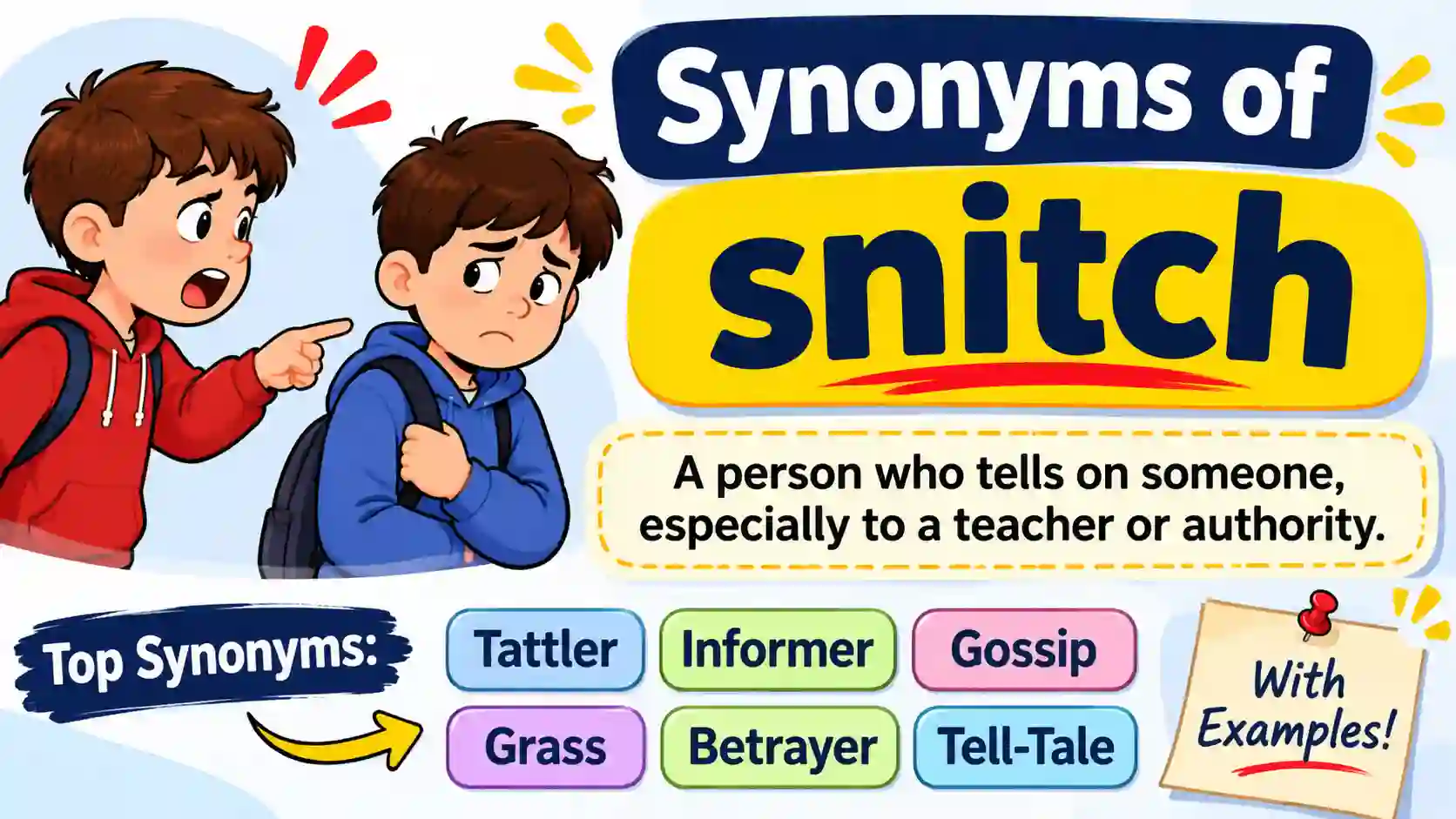
Common synonyms of snitch include informer, informant, tattletale, tattler, squealer, rat, fink, stool pigeon, stoolie, and telltale. Other useful alternatives include tell on, inform on, tattle on, rat on, and grass on. The best choice depends on context: some words describe reporting wrongdoing, while others suggest betrayal, gossip, or revealing secrets.
Have you ever told a teacher that someone broke a classroom rule? Or reported a coworker for sharing confidential information? Someone might call you a snitch.
The word snitch usually describes a person who secretly reports another person’s actions to someone in authority. It can also work as a verb. In informal English, it has another meaning: to steal something quickly or quietly.
However, not every alternative carries the same meaning. An informer may simply provide information, while a rat suggests betrayal. A whistleblower usually exposes serious wrongdoing.
Learning synonyms of snitch helps you choose more accurate words in conversations, essays, emails, and professional writing. This guide explains 30 useful alternatives, their meanings, examples, pronunciation, and differences in American and British English.
1. Pronunciation of Snitch
- Word: Snitch
- American IPA: /snɪtʃ/
- British IPA: /snɪtʃ/
- Pronunciation: Snich
- Syllables: One
- Rhymes: Switch, ditch, pitch, stitch, and which.
The pronunciation is the same in standard American and British English.
2. Part of Speech
Snitch functions as both a noun and a verb.
Snitch as a Noun
A snitch is someone who reports another person’s actions, especially to an authority.
Example: Nobody wanted to be friends with the suspected snitch.
Snitch as a Verb
To snitch means to report someone, often secretly.
Example: He threatened to snitch on his friends.
It can also mean to steal something quickly or quietly in informal usage.
Example: Someone snitched my sandwich from the refrigerator.
Word Forms
| Word | Grammatical Form | Example |
| Snitch | Base noun/verb | Don’t snitch on me. |
| Snitches | Plural/third-person singular | She snitches on everyone. |
| Snitched | Past tense | He snitched on his partner. |
| Snitching | Present participle/gerund | Snitching can damage friendships. |
There is no standard adjective or adverb form of snitch.
3. Grammar and Usage
The most useful grammar patterns are:
| Pattern | Meaning | Example |
| Snitch on someone | Report someone’s actions | He snitched on his brother. |
| Snitch to someone | Tell an authority | She snitched to the teacher. |
| Snitch about something | Report or reveal information | He snitched about the incident. |
| Be a snitch | Describe an informer | Nobody trusts a snitch. |
Important grammar tip: Use snitch on to identify the person being reported and snitch to to identify the person receiving the information.
The word is informal and often negative. In formal writing, consider report, inform, or disclose, depending on the situation.
4. Quick Overview: 30 Synonyms of Snitch
| Synonym | Strength | Formality |
| Informer | Strongest | Neutral |
| Informant | Strongest | Formal |
| Tattletale | Strongest | Informal |
| Rat | Strong | Informal |
| Squealer | Strong | Informal |
| Fink | Strong | Informal |
| Stool pigeon | Strong | Informal |
| Stoolie | Strong | Informal |
| Tattler | Strong | Informal |
| Telltale | Strong | Neutral |
| Sneak | Strong | Informal |
| Ratfink | Strong | Informal |
| Grass | Strong | British slang |
| Narc | Strong | American slang |
| Nark | Strong | British slang |
| Snitcher | Strong | Informal |
| Canary | Related slang | Informal |
| Clype | Regional alternative | Scottish informal |
| Tell on | Strong | Informal |
| Inform on | Strong | Neutral |
| Tattle on | Strong | Informal |
| Rat on | Strong | Informal |
| Grass on | Strong | British slang |
| Squeal on | Strong | Informal |
| Shop | Strong | British slang |
| Dob in | Strong | Australian slang |
| Denounce | Related | Formal |
| Blow the whistle on | Related | Formal |
| Turn someone in | Related | Neutral |
| Report someone | Related | Neutral |
Strength describes how closely a term matches the relevant sense of snitch, not how emotionally strong the word sounds.
5. Detailed Synonyms of Snitch with Examples
1. Informer
Meaning: An informer gives information about another person’s actions, often to an authority.
Examples:
- The informer gave the police details about the robbery.
- Nobody knew the identity of the secret informer.
- Best Used When: Someone provides information to an authority.
- Tone: Neutral, sometimes negative.
- Formality: Neutral.
- CEFR: Approx. B2.
- Frequency: Common.
- Collocations: Police informer, secret informer, confidential informer.
2. Informant
Meaning: An informant provides information, especially to someone investigating a situation.
Examples:
- The detective protected the identity of his informant.
- An informant helped investigators understand the case.
- Best Used When: Discussing police investigations or official information.
- Tone: Neutral.
- Formality: Formal.
- CEFR: Approx. C1.
- Frequency: Common.
- Collocations: Confidential informant, police informant, anonymous informant.
3. Tattletale
Meaning: A tattletale reports another person’s mistakes or rule-breaking, often to a teacher or parent.
Examples:
- My younger brother called me a tattletale.
- The children avoided the classroom tattletale.
- Best Used When: Discussing school, children, or minor complaints.
- Tone: Negative.
- Formality: Informal.
- CEFR: Approx. B2.
- Frequency: Common.
- Collocations: Little tattletale, classroom tattletale, act like a tattletale.
4. Rat
Meaning: A rat is an insulting slang term for someone who betrays others by revealing their secrets or actions.
Examples:
- His friends called him a rat after he exposed their plan.
- Nobody trusted the rat who revealed their secret.
- Best Used When: Expressing anger about betrayal.
- Tone: Strongly negative.
- Formality: Informal.
- CEFR: Approx. B1.
- Frequency: Very common in informal speech.
- Collocations: Dirty rat, call someone a rat, rat on someone.
5. Squealer
Meaning: A squealer reveals information about another person’s wrongdoing, often to the authorities.
Examples:
- The criminals suspected that one of them was a squealer.
- Nobody wanted to be known as the office squealer.
- Best Used When: Someone reveals secrets or reports wrongdoing.
- Tone: Negative.
- Formality: Informal.
- CEFR: Approx. C1.
- Frequency: Uncommon.
- Collocations: Jailhouse squealer, suspected squealer, known squealer.
6. Fink
Meaning: A fink is an unpleasant or disloyal person who betrays others or informs against them.
Examples:
- He called his former friend a fink.
- The group believed a fink had revealed their plans.
- Best Used When: Using American slang to criticize someone.
- Tone: Insulting.
- Formality: Informal.
- CEFR: Approx. C1.
- Frequency: Uncommon.
- Collocations: Dirty fink, call someone a fink, little fink.
7. Stool Pigeon
Meaning: A stool pigeon is someone who secretly gives information about other people, especially to the police.
Examples:
- The gang suspected that a stool pigeon had joined them.
- The detective received information from a stool pigeon.
- Best Used When: Discussing crime stories and police informants.
- Tone: Negative.
- Formality: Informal.
- CEFR: Approx. C2.
- Frequency: Uncommon.
- Collocations: Police stool pigeon, suspected stool pigeon, criminal stool pigeon.
8. Stoolie
Meaning: A stoolie is an informal term for a person who secretly informs the police about others.
Examples:
- The criminals believed their new partner was a stoolie.
- He refused to become a stoolie for the police.
- Best Used When: Discussing crime-related slang.
- Tone: Negative.
- Formality: Informal.
- CEFR: Approx. C2.
- Frequency: Rare.
- Collocations: Police stoolie, suspected stoolie, known stoolie.
9. Tattler
Meaning: A tattler is someone who frequently reports other people’s mistakes or secrets.
Examples:
- The teacher asked the tattler to explain what happened.
- Nobody trusted the classroom tattler with a secret.
- Best Used When: Describing someone who repeatedly tells on others.
- Tone: Negative.
- Formality: Informal.
- CEFR: Approx. C1.
- Frequency: Uncommon.
- Collocations: Classroom tattler, constant tattler, little tattler.
10. Telltale
Meaning: A telltale can describe someone who reveals information or exposes secrets, although it also has other meanings.
Examples:
- The telltale revealed what had happened behind the scenes.
- He did not want to become known as a telltale.
- Best Used When: Describing someone who reveals information.
- Tone: Negative in this sense.
- Formality: Neutral to literary.
- CEFR: Approx. C1.
- Frequency: Uncommon in this personal-noun sense.
- Collocations: Telltale signs, telltale evidence, reveal the truth.
11. Sneak
Meaning: A sneak is a person who behaves secretly or reports another person’s actions in a dishonest way.
Examples:
- He felt betrayed when his friend acted like a sneak.
- The sneak told the manager about the private meeting.
- Best Used When: Describing secretive or dishonest behavior.
- Tone: Negative.
- Formality: Informal.
- CEFR: Approx. B1.
- Frequency: Common.
- Collocations: Little sneak, act like a sneak, sneaky behavior.
12. Ratfink
Meaning: A ratfink is an insulting slang term for a dishonest or disloyal person.
Examples:
- He called the man a ratfink after the betrayal.
- The children jokingly called their brother a ratfink.
- Best Used When: Expressing strong dislike for someone.
- Tone: Insulting.
- Formality: Informal.
- CEFR: Approx. C2.
- Frequency: Rare.
- Collocations: Dirty ratfink, little ratfink, call someone a ratfink.
13. Grass
Meaning: In British slang, a grass is someone who informs the police or authorities about another person’s wrongdoing.
Examples:
- The criminals accused him of being a grass.
- Nobody wanted to be called a grass in their neighborhood.
- Best Used When: Discussing British informal English.
- Tone: Negative.
- Formality: Informal.
- CEFR: Approx. C2.
- Frequency: Recognizable in British slang.
- Collocations: Police grass, turn grass, grass on someone.
14. Narc
Meaning: A narc is an American slang term for a person who informs authorities about illegal activities, especially drug-related activities.
Examples:
- His friends accused him of being a narc.
- The group suspected that a narc had reported them.
- Best Used When: Discussing American slang and drug investigations.
- Tone: Negative.
- Formality: Informal.
- CEFR: Approx. C2.
- Frequency: Uncommon.
- Collocations: Undercover narc, police narc, suspected narc.
15. Nark
Meaning: Nark is a British informal term for an informer, particularly someone who reports another person’s actions to the authorities.
Examples:
- The group believed a nark had shared their secret.
- He was accused of being a nark after speaking to the police.
- Best Used When: Reading or discussing British slang.
- Tone: Negative.
- Formality: Informal.
- CEFR: Approx. C2.
- Frequency: Uncommon.
- Collocations: Police nark, suspected nark, known nark.
16. Snitcher
Meaning: A snitcher is someone who reports another person’s actions to an authority.
Examples:
- The group accused him of being a snitcher.
- Nobody wanted to work with the suspected snitcher.
- Best Used When: Describing someone who snitches.
- Tone: Negative.
- Formality: Informal.
- CEFR: Approx. C2.
- Frequency: Uncommon.
- Collocations: Suspected snitcher, known snitcher.
17. Canary
Meaning: In certain criminal slang contexts, a canary is an informer who gives information to the authorities.
Examples:
- The criminals feared that a canary would reveal their plans.
- The detective received a tip from a suspected canary.
- Best Used When: Reading crime-related slang or older expressions.
- Tone: Negative.
- Formality: Informal.
- CEFR: Approx. C2.
- Frequency: Rare in this sense.
- Collocations: Police canary, suspected canary.
18. Clype
Meaning: Clype is a Scottish informal word for someone who tells tales or reports another person’s actions.
Examples:
- The children called him a clype for reporting every mistake.
- She did not want to be known as a clype.
- Best Used When: Understanding Scottish regional vocabulary.
- Tone: Negative.
- Formality: Informal.
- CEFR: Approx. C2.
- Frequency: Regional and uncommon.
- Collocations: Act like a clype, little clype.
19. Tell On
Meaning: To tell on someone means to report their bad behavior to another person, usually an authority.
Examples:
- My sister told me to break the vase.
- He threatened to tell his classmates.
- Best Used When: Discussing everyday situations and minor wrongdoing.
- Tone: Informal.
- Formality: Informal.
- CEFR: Approx. A2–B1.
- Frequency: Very common.
- Collocations: Tell on a friend, tell on someone, tell on yourself.
20. Inform On
Meaning: To inform on someone means to provide information about their actions, especially to an authority.
Examples:
- The witness refused to inform his colleagues.
- She informed the people involved in the crime.
- Best Used When: Discussing official reports or investigations.
- Tone: Neutral to negative.
- Formality: Neutral.
- CEFR: Approx. B2.
- Frequency: Common.
- Collocations: Inform on someone, inform on a colleague, inform on a criminal.
21. Tattle On
Meaning: To tattle on someone means to report their mistakes or rule-breaking, often in a childish or annoying way.
Examples:
- Stop tattling on your brother.
- The student tattled on his classmates.
- Best Used When: Talking about children, school, or minor complaints.
- Tone: Negative.
- Formality: Informal.
- CEFR: Approx. B2.
- Frequency: Common.
- Collocations: Tattle on a friend, tattle on someone, constantly tattle.
22. Rat On
Meaning: To rat on someone means to betray them by revealing their actions or secrets.
Examples:
- He refused to rat on his friends.
- She ratted on her partner after the investigation.
- Best Used When: Expressing betrayal or disloyalty.
- Tone: Strongly negative.
- Formality: Informal.
- CEFR: Approx. B2.
- Frequency: Common.
- Collocations: Rat on a friend, rat on someone, refuse to rat.
23. Grass On
Meaning: To grass on someone means to report their wrongdoing, especially to the police. It is British slang.
Examples:
- He refused to grass on his friends.
- Someone grassed on the group to the police.
- Best Used When: Writing dialogue or explaining British slang.
- Tone: Negative.
- Formality: Informal.
- CEFR: Approx. C2.
- Frequency: Common in some British contexts.
- Collocations: Grass on a mate, grass on someone, grass on the group.
24. Squeal On
Meaning: To squeal on someone means to reveal information about their wrongdoing, often to an authority.
Examples:
- The criminal threatened to squeal on his partners.
- Nobody expected him to squeal on the group.
- Best Used When: Discussing secrets, criminal activity, or betrayal.
- Tone: Negative.
- Formality: Informal.
- CEFR: Approx. C1.
- Frequency: Uncommon.
- Collocations: Squeal on a partner, squeal on someone, refuse to squeal.
25. Shop
Meaning: In British slang, to shop someone means to report them to the police or authorities.
Examples:
- Someone reported the thief to the police.
- He was afraid that his partner would shop for him.
- Best Used When: Explaining British crime-related slang.
- Tone: Informal, often negative.
- Formality: Informal.
- CEFR: Approx. C2.
- Frequency: Regional slang.
- Collocations: Shop someone to the police, shop a criminal.
26. Dob In
Meaning: To rob someone means to report their wrongdoing to an authority. It is particularly associated with Australian and New Zealand English.
Examples:
- The student decided to dob in the person who stole the money.
- Someone dabbed him into the teacher.
- Best Used When: Discussing Australian or New Zealand informal English.
- Tone: Informal.
- Formality: Informal.
- CEFR: Approx. C2.
- Frequency: Regional.
- Collocations: Dob someone in, dob in a friend, dob someone in to the police.
27. Denounce
Meaning: To denounce someone means to publicly criticize or accuse them of wrongdoing.
Examples:
- The politician denounced the corrupt officials.
- She publicly denounced the company’s dishonest practices.
- Best Used When: Discussing serious accusations or public criticism.
- Tone: Strong and critical.
- Formality: Formal.
- CEFR: Approx. C1.
- Frequency: Common.
- Collocations: Publicly denounce, strongly denounce, denounce wrongdoing.
Nuance: Denounce does not automatically mean secretly informing on someone.
28. Blow the Whistle On
Meaning: To blow the whistle on someone or something means to expose wrongdoing or illegal activity.
Examples:
- The employee blew the whistle on financial fraud.
- She decided to blow the whistle on unsafe working conditions.
- Best Used When: Reporting serious misconduct.
- Tone: Often positive or neutral.
- Formality: Neutral to formal.
- CEFR: Approx. C1.
- Frequency: Common.
- Collocations: Blow the whistle on fraud, blow the whistle on corruption, whistleblower protection.
29. Turn Someone In
Meaning: To turn someone in means to report them to the police or another authority.
Examples:
- The witness decided to turn the suspect in.
- She turned her neighbor in after discovering the illegal activity.
- Best Used When: Someone reports a person to law enforcement.
- Tone: Neutral.
- Formality: Neutral.
- CEFR: Approx. B1.
- Frequency: Very common.
- Collocations: Turn a suspect in, turn someone in to the police, turn yourself in.
30. Report Someone
Meaning: To report someone means to tell an authority about their actions or behavior.
Examples:
- The employee reported his manager for harassment.
- She reported the incident to the school principal.
- Best Used When: Discussing official complaints or workplace and school rules.
- Tone: Neutral.
- Formality: Neutral to formal.
- CEFR: Approx. A2–B1.
- Frequency: Very common.
- Collocations: Report someone to the police, report misconduct, report a violation.
6. Strongest Synonyms, Strong Synonyms, and Related Words
Strongest Synonyms
These words most closely match the idea of an informer or someone who reports another person’s actions:
- Informer
- Informant
- Tattletale
- Tattler
- Squealer
- Rat
- Fink
- Stool pigeon
- Stoolie
- Telltale
- Sneak
- Grass
Strong Synonyms
These alternatives are useful in specific regional or informal contexts:
- Ratfink
- Narc
- Nark
- Snitcher
- Canary
- Clype
Related Words and Expressions
These describe the act of reporting or exposing someone rather than naming the person:
- Tell on
- Inform on
- Tattle on
- Rat on
- Grass on
- Squeal on
- Shop
- Dob in
- Denounce
- Blow the whistle on
- Turn someone in
- Report someone
7. Choose the Right Synonym: Side by Side Comparison
The most accurate word depends on the action, situation, and attitude you want to express.
| Word | Main Difference | Best Situation |
| Informer | Gives information to an authority | Investigations |
| Informant | Provides information, often confidentially | Police and research |
| Tattletale | Reports small mistakes | School |
| Rat | Suggests betrayal | Personal relationships |
| Squealer | Reveals secrets or wrongdoing | Crime-related conversations |
| Whistleblower | Exposes serious misconduct | Workplace |
| Gossip | Spreads personal stories | Social situations |
| Tipster | Provides a useful lead | Journalism and investigations |
Which Word Should You Choose?
- Use tattletale for someone who reports small classroom mistakes.
- Use informant for someone who secretly provides information to investigators.
- Use rat when you want to express strong disapproval of betrayal.
- Use whistleblower for someone who exposes serious wrongdoing.
- Use gossip for someone who spreads personal stories.
- Use a tipster for someone who provides useful information.
8. Commonly Confused Words
| Word | Difference | Example |
| Snitch | Reports someone’s wrongdoing, often secretly | He snitched on his classmate. |
| Betray | Breaks someone’s trust or loyalty | She betrayed her best friend. |
| Gossip | Spreads personal stories | They gossiped about their neighbors. |
| Inform | Gives information to someone | He informed the manager about the problem. |
| Whistleblower | Exposes serious misconduct | The whistleblower exposed the fraud. |
Remember that reporting wrongdoing is not automatically betrayal. The reason for reporting and the nature of the information matter.
9. Common Mistakes When Using Snitch
Mistake 1: Using Whistleblower for Minor Complaints
Mistake: He is a whistleblower because he told the teacher about my homework.
Correction: He is a tattletale because he told the teacher about my homework.
Explanation: A whistleblower usually exposes serious wrongdoing, not minor classroom problems.
Mistake 2: Confusing Gossip with Snitching
Mistake: My friend is a rat because she shared a funny story.
Correction: My friend is a gossip because she shared a personal story.
Explanation: Gossip describes spreading personal stories. Rat suggests betrayal.
Mistake 3: Using the Wrong Preposition
Mistake: She snitched the manager about the issue.
Correction: She snitched to the manager about the issue.
Explanation: Use to for the person receiving the information.
Mistake 4: Confusing an Informer with a Blabbermouth
Mistake: He is an informer because he talks too much.
Correction: He is a blabbermouth because he talks too much and cannot keep secrets.
Explanation: An informer provides information to someone, often an authority. A blabbermouth talks too freely.
10. Writing Tips: How to Use Snitch Synonyms
Essays
Use informant, whistleblower, and denunciation when discussing serious wrongdoing, social problems, or investigations.
Example: The whistleblower exposed serious problems within the organization.
Emails
Use neutral language in professional communication.
Example: An employee reported a violation of company policy.
Blog Posts
Use simple words such as tattletale, informer, and gossip when explaining everyday situations.
Stories
Use words such as rat, betrayer, and squealer to create tension between characters.
Social Media
Informal expressions such as rat, snitch, and fink can fit casual jokes and conversations.
Daily Conversations
Use tell on for everyday situations and tattletale for minor complaints.
Writing Tip: Do not replace every occurrence of snitch with another word just to avoid repetition. Choose an alternative only when it preserves the original meaning.
11. Word Origin and Etymology of Snitch
The exact origin of the snitch is uncertain.
Historical dictionary records show that the word developed several informal meanings. These include stealing something and informing on another person.
The noun meaning an informer and the verb meaning to inform on someone are both recorded in historical English sources.
The stealing sense is also important because it explains why a sentence such as “Someone snitched my wallet” can mean that someone stole it.
The possible connection between the word and an older sense involving the nose has been discussed in etymological references, but the origin is not established with certainty.
For historical verification, consult the Oxford English Dictionary and Etymonline rather than treating an uncertain explanation as fact.
12. American vs. British English
The spelling and pronunciation of snitch are the same in standard American and British English.
| Feature | American English | British English |
| Spelling | Snitch | Snitch |
| IPA | /snɪtʃ/ | /snɪtʃ/ |
| Common slang | Rat, narc, fink | Grass, bark, shop |
| School expression | Tattletale | Tattletale |
| Neutral alternative | Informant | Informant |
| Reporting phrase | Tell on | Tell on |
American English
American speakers commonly use rat, fink, and narc in informal conversations.
Example: His friends called him a narc after he reported the incident.
British English
British speakers may use grass, bark, and shop in informal or crime-related contexts.
Example: He was accused of being a grass.
Important Regional Note
Some expressions have different levels of recognition across regions. For international writing, informant, report, and tell on are usually easier for readers to understand.
13. Related Vocabulary
Antonyms and Opposite Expressions
There is no single perfect antonym for snitch. These words express ideas that contrast with revealing information.
| Word or Expression | Meaning |
| Confidant | A trusted person who receives private information |
| Secret keeper | Someone who protects a secret |
| Loyal friend | Someone who remains faithful |
| Protector | Someone who keeps another person safe |
| Discreet person | Someone careful about sharing information |
| Keep silent | Avoid sharing information |
| Withhold information | Choose not to reveal information |
| Maintain secrecy | Keep something confidential |
Related Expressions
- Keep someone’s secret: Avoid revealing private information.
- Rat someone out: Betray someone by revealing their actions.
- Spill the beans: Reveal a secret.
- Let the cat out of the bag: Reveal something that was supposed to remain secret.
- Break someone’s trust: Damage a relationship by being disloyal.
- Come clean: Tell the truth about something.
- Blow the whistle: Expose serious wrongdoing.
14. Frequently Asked Questions
1. What are the best synonyms of snitch?
The best synonyms of snitch include informer, informant, tattletale, tattler, squealer, rat, fink, and stool pigeon. For verbs, useful alternatives include tell on, inform on, tattle on, and rat on. The best option depends on the situation and the tone you want.
2. What is a professional word for snitch?
Informant is a professional alternative when someone provides information to an authority or investigator. Whistleblower is more suitable when someone exposes serious misconduct, fraud, or illegal activity within an organization. Both sound more professional than the informal word snitch.
3. What is a slang word for someone who snitches?
Common slang words include rat, fink, squealer, stoolie, and grass. American speakers may use rat or narc, while British speakers may use grass or nark. These expressions are informal and can sound insulting, especially when used to describe a friend.
4. What is the difference between a snitch and an informant?
A snitch is an informal and often negative term for someone who reports another person’s actions. An informant is a more neutral word for someone who provides information, often to the police or investigators. An informant does not necessarily betray anyone.
5. Is whistleblower another word for snitch?
Not exactly. A whistleblower reports serious wrongdoing, such as fraud, corruption, or unsafe practices. The word often has a positive meaning because the person may protect the public or an organization. Snitch usually sounds more informal and disapproving.
6. What is the opposite of a snitch?
There is no exact opposite of snitch. However, expressions such as secret keeper, confidant, loyal friend, and someone who keeps quiet can express contrasting ideas. These terms describe people who protect private information instead of revealing it.
7. What does snitch on someone mean?
To snitch on someone means to report their behavior or wrongdoing to another person, usually someone in authority. For example, if a student tells a teacher that another student cheated during an exam, someone might say that the student snitched on them.
8. Is snitch a noun or a verb?
Snitch can be both a noun and a verb. As a noun, it describes someone who reports another person’s actions. As a verb, it means to report someone, often secretly. In informal English, it can also mean to steal something quickly or quietly.
15. Vocabulary Quiz
Test your understanding with these five questions.
Question 1: Which word describes someone who reports serious wrongdoing within an organization?
A. Gossip
B. Whistleblower
C. Tattletale
D. Blabbermouth
Question 2: Which word is commonly used for a child who reports small mistakes?
A. Tattletale
B. Mole
C. Turncoat
D. Leaker
Question 3: Which word describes someone who secretly works inside a group to provide information to another party?
A. Tipster
B. Gossip
C. Mole
D. Informer
Question 4: Which is a common British slang alternative to snitch?
A. Narc
B. Grass
C. Fink
D. Ratfink
Question 5: What does “snitch on someone” mean?
A. Protect someone’s secret
B. Help someone succeed
C. Report someone’s wrongdoing
D. Spread a funny story
Answer Key
- B. Whistleblower
- A. Tattletale
- C. Mole
- B. Grass
- C. Report someone’s wrongdoing
16. Conclusion
Learning synonyms of snitch helps you express ideas more accurately and naturally. Words such as informer, tattletale, rat, and squealer describe different situations and carry different emotions.
Understanding these differences improves your vocabulary, speaking, and writing skills. Practice these alternatives in essays, emails, schoolwork, and daily conversations. Keep learning, and your English will become stronger with every new word!
References
- Cambridge Dictionary: https://dictionary.cambridge.org/thesaurus/snitch
- Collins Dictionary: https://www.collinsdictionary.com/us/dictionary/english-thesaurus/snitch
- Oxford English Dictionary: https://www.oed.com/
- Etymonline: https://www.etymonline.com/
- Merriam Webster: https://www.merriam-webster.com/

Synonorm is a trusted English vocabulary resource created to help readers find the right words and understand the differences between similar terms. We provide clear explanations of synonyms, meanings, examples, usage, and alternatives. Our content makes vocabulary easier to learn and apply in everyday, academic, and professional English. Synonorm is designed for students, writers, ESL learners, professionals, and anyone who wants to improve their English vocabulary and communicate more clearly.