Quick Answer: What Are the Synonyms of You?
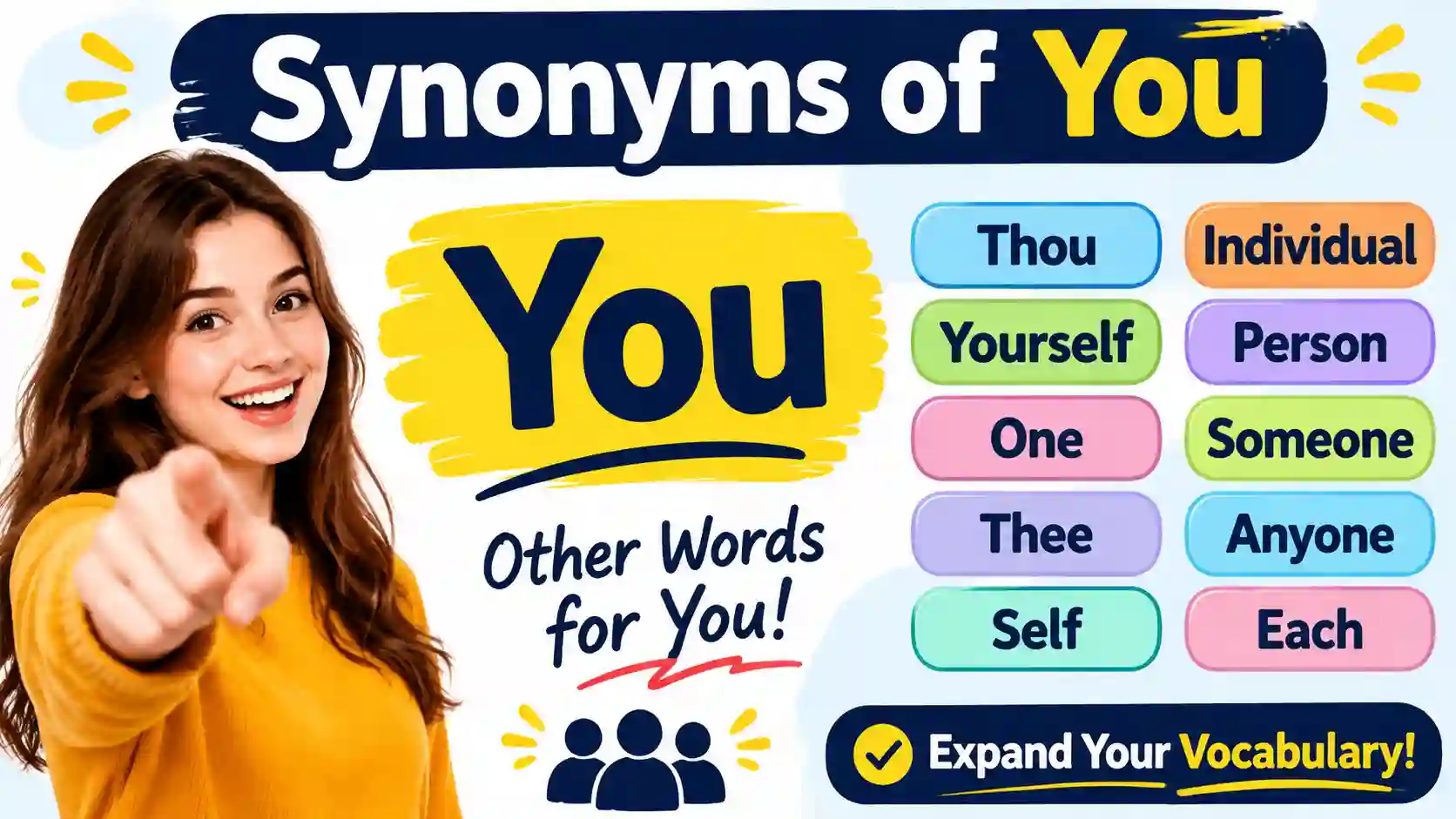
The word you is a second-person personal pronoun used to address one person or a group. It has no perfect synonym that works in every sentence. However, useful alternatives include yourself, one, you all, y’all, you folks, you guys, youse, and thou. Other expressions, such as the reader, the recipient, and the person addressed, can replace it when the sentence is rewritten.
Have you ever repeated the word you several times in an essay, email, or blog post? Finding another way to express the same idea can make your writing more natural.
The word you is one of the most common pronouns in English. We use it when speaking to someone, giving advice, asking questions, or sharing instructions. For example, “You can improve your English by reading every day.”
However, you cannot replace this word with just any person-related expression. Some alternatives address a group, some refer to people generally, and others describe a person’s role in a particular situation.
This guide covers 30 synonyms and context-based alternatives to you. You will learn their meanings, pronunciation, examples, grammatical differences, and appropriate uses. It will also help students, teachers, bloggers, and professionals choose better expressions without changing their intended meaning.
Pronunciation of You
- IPA: /juː/
- Weak pronunciation: /jə/
- Pronounced as: YOO
- Syllables: One
- Part of speech: Personal pronoun
- CEFR level: A1
The pronunciation is generally the same in American and British English. In unstressed speech, the vowel can become weaker.
Part of Speech: What Type of Word Is You?
You is a second-person personal pronoun. It refers to the person or people being spoken or written to.
It is not a noun, verb, adjective, or adverb.
Here are its grammatical forms:
| Grammatical form | Word | Example |
| Subject pronoun | You | You look happy. |
| Object pronoun | You | I called you. |
| Possessive determiner | Your | Your bag is here. |
| Possessive pronoun | Yours | This bag is yours. |
| Singular reflexive pronoun | Yourself | You should trust yourself. |
| Plural reflexive pronoun | Yourselves | You should prepare yourselves. |
An interesting feature of English is that you have the same subject and object form. It also refers to one person or several people.
Grammar Rules for Using You
Understanding the grammar of you helps you choose the right alternative.
1. You as a Subject
Use you when the person being addressed performs an action.
- You speak English clearly.
- You deserve another opportunity.
- You should complete your homework.
2. You as an Object
Use you when the person receives an action or follows a preposition.
- I invited you to dinner.
- She gave you a present.
- This message is for you.
3. You as a General Pronoun
Sometimes you refer to people generally, not a particular listener.
- You never know what will happen tomorrow.
- You learn more when you practice regularly.
In these examples, you can often use one or people instead.
4. You in Plural Sentences
English uses you for both singular and plural subjects.
- Singular: You are my best friend.
- Plural: You are all invited.
If the number of people is unclear, expressions such as you all or y’all can make the plural meaning clearer.
Common Grammar Mistakes
| Incorrect | Correct | Reason |
| You are ready. | You are ready. | You take care. |
| You are welcome. | You are welcome. | You show possession. |
| I trust you. | I trust you. | Use yourself reflexively. |
| You were right. | You were right. | We were with you. |
| Your book is here. | Your book is here. | Your comes before a noun. |
Synonyms of You: Quick Comparison Table
The following expressions have different levels of similarity. Some are pronoun alternatives, while others are ways to rewrite a sentence.
| Alternative | Usage | Formality |
| Yourself | Reflexive or emphasis | Neutral |
| One | General statements | Formal |
| You all | Plural address | Neutral |
| Y’all | Plural address | Informal |
| You guys | Group address | Informal |
| You folks | Group address | Informal |
| You lot | Group address | Informal |
| Youse | Regional plural | Informal |
| Ye | Historical or regional plural | Literary |
| Thou | Historical singular | Archaic |
| Thee | Historical singular object | Archaic |
| All of you | Entire group | Neutral |
| Both of you | Two people | Neutral |
| Each of you | Every group member | Neutral |
| You two | Two people | Informal |
| You three | Three people | Informal |
| Everyone here | Group reference | Neutral |
| Everybody | General group reference | Neutral |
| Anyone | Unspecified person | Neutral |
| Anybody | Unspecified person | Neutral |
| The reader | Written audience | Formal |
| The listener | Spoken audience | Formal |
| The audience | Group receiving a presentation | Neutral |
| The addressee | Person receiving communication | Formal |
| The recipient | Person receiving something | Formal |
| The customer | Person buying a service or product | Neutral |
| The user | Person using a product or service | Neutral |
| The applicant | Person applying for something | Formal |
| The individual | A particular person | Formal |
| People in general | General statements | Neutral |
30 Synonyms and Alternatives for You with Examples
1. Yourself
Meaning: Yourself refers to the person being addressed when they perform an action on their own or when emphasis is needed.
Examples:
- You should believe in yourself before starting a business.
- Please introduce yourself to the new teacher.
Best Used When: You want to refer back to the person addressed or emphasize that person.
Tone: Neutral
CEFR: A2
Frequency: Very common
Common Collocations:
- Believe in yourself
- Introduce yourself
- Help yourself
When Not to Use: Do not replace every occurrence of you with yourself. Say “I trust you,” not “I trust yourself.”
2. One
Meaning: One refers to people generally rather than a particular person.
Examples:
- One should respect other people’s opinions.
- One can improve communication through daily practice.
Best Used When: You want to express general advice in formal writing.
Tone: Formal
CEFR: B2
Frequency: Common
Common Collocations:
- One should
- One can
- One must
When Not to Use: Avoid one in casual conversations where it may sound distant or unnatural.
3. You All
Meaning: You all refer to every person in a group.
Examples:
- I hope you all enjoy the celebration.
- You all need to arrive before the meeting begins.
Best Used When: You want to make it clear that you are addressing several people.
Tone: Neutral
CEFR: A2
Frequency: Very common
Common Collocations:
- You all know
- Thank you all
- You all deserve
When Not to Use: Do not use it when addressing only one person.
4. Y’all
Meaning: Y’all is an informal form of you all, commonly used in Southern American English.
Examples:
- Are y’all coming to the football game?
- I hope y’all have a wonderful weekend.
Best Used When: You are addressing a group in a casual conversation.
Tone: Informal
CEFR: B1
Frequency: Common in regional American English
Common Collocations:
- How are y’all?
- Thank y’all
- Y’all ready?
When Not to Use: Avoid it in formal academic writing unless you are discussing regional speech.
5. You Guys
Meaning: You guys is an informal expression used to address a group.
Examples:
- Are you guys ready for the trip?
- I hope you guys enjoy the new movie.
Best Used When: You are speaking casually to a group of people.
Tone: Informal
CEFR: A2
Frequency: Very common in American English
Common Collocations:
- You guys are
- Thank you guys
- You guys should
When Not to Use: Avoid it in formal documents. You all or everyone may be better choices for an inclusive tone.
6. You Folks
Meaning: You folks refer to a group of people in a friendly way.
Examples:
- Are you folks ready for the presentation?
- I appreciate everything you folks have done.
Best Used When: You want to address a group politely and naturally.
Tone: Informal
CEFR: B1
Frequency: Common
Common Collocations:
- You folks are
- Thank you folks
- You folks can
When Not to Use: Do not use it when addressing only one individual.
7. You Lot
Meaning: You lot is an informal expression used to refer to a group of people, particularly in British English.
Examples:
- Are you coming to the party a lot?
- You lot have done an excellent job today.
Best Used When: You are speaking informally to a group, especially in British English.
Tone: Informal
CEFR: B1
Frequency: Common in British spoken English
Common Collocations:
- You lot should
- What are you doing?
- You lot are
When Not to Use: Avoid it in formal writing. Depending on the speaker’s tone, it can sound impatient or critical.
8. Youse
Meaning: Youse is a regional, nonstandard plural form of you.
Examples:
- Are you coming over tonight?
- I hope you enjoy the match.
Best Used When: You are representing regional or informal speech in places where the expression is used.
Tone: Informal
CEFR: Not officially assigned
Frequency: Regional
Common Collocations:
- Are you coming?
- Youse guys
- Thank youse
When Not to Use: Avoid it in standard academic and professional English.
9. Ye
Meaning: Ye is an older form of the second-person plural pronoun and survives in some regional varieties.
Examples:
- Ye shall receive the message tomorrow.
- I welcome ye to this gathering.
Best Used When: You are writing historical dialogue or studying older English.
Tone: Archaic or literary
CEFR: Not officially assigned
Frequency: Rare in modern standard English
Common Collocations:
- Ye shall
- Ye are
- All ye
When Not to Use: Do not use it as an ordinary modern replacement for you.
10. Thou
Meaning: Thou was the older singular subject form of you.
Examples:
- Thou art welcome here.
- Thou knowest the truth.
Best Used When: You are studying historical English or writing dialogue in an older literary style.
Tone: Archaic
CEFR: Not officially assigned
Frequency: Rare
Common Collocations:
- Thou art
- Thou shalt
- Thou hast
When Not to Use: Do not use thou in everyday modern English.
11. Thee
Meaning: There was the older object form of the singular second-person pronoun.
Examples:
- I shall remember thee.
- My thoughts are with thee.
Best Used When: You are writing historical, religious, or poetic dialogue.
Tone: Archaic and literary
CEFR: Not officially assigned
Frequency: Rare
Common Collocations:
- With thee
- To thee
- Before thee
When Not to Use: Do not confuse thee with thou. Thou was traditionally the subject form, while there was the object form.
12. All of You
Meaning: All of you refers to every person in a group.
Examples:
- All of you should read the instructions carefully.
- I am proud of all of you.
Best Used When: You want to include every member of a group.
Tone: Neutral
CEFR: A2
Frequency: Very common
Common Collocations:
- All of you
- Thank all of you
- Proud of all of you
When Not to Use: Avoid it when speaking to only one person.
13. Both of You
Meaning: Both of you refer to two people being addressed.
Examples:
- Both of you performed well in the competition.
- I need both of you to review this report.
Best Used When: You are speaking to exactly two people.
Tone: Neutral
CEFR: A2
Frequency: Very common
Common Collocations:
- Both of you
- Thank both of you
- I need both of you
When Not to Use: Do not use it for one person or a group of three or more.
14. Each of You
Meaning: Each of you refers to every person in a group individually.
Examples:
- Each of you must complete a separate assignment.
- I want each of you to share an idea.
Best Used When: You want to emphasize individual responsibility within a group.
Tone: Neutral
CEFR: B1
Frequency: Common
Common Collocations:
- Each of you must
- Each of you has
- Each of you should
When Not to Use: Avoid it when you are speaking to only one individual.
15. You Two
Meaning: You two refers to the two people being addressed.
Examples:
- You two make a wonderful team.
- Can you two help me move this table?
Best Used When: You want to identify two people clearly.
Tone: Informal to neutral
CEFR: A2
Frequency: Very common
Common Collocations:
- You two should
- Are you two ready?
- You two can
When Not to Use: Do not use it when addressing more than two people.
16. You Three
Meaning: You three refers to three people being addressed together.
Examples:
- You three can work on the same project.
- Can you three wait outside for a moment?
Best Used When: You want to identify exactly three people.
Tone: Neutral
CEFR: A2
Frequency: Common
Common Collocations:
- You three can
- Are you three ready?
- You three should
When Not to Use: Do not use it for a group with a different number of people.
17. Everyone Here
Meaning: Everyone here refers to all people present in a particular place.
Examples:
- Everyone here should follow the safety rules.
- Everyone here is invited to participate.
Best Used When: You are addressing a group of people who are physically present.
Tone: Neutral
CEFR: A2
Frequency: Very common
Common Collocations:
- Everyone here knows
- Everyone here should
- Welcome, everyone
When Not to Use: Avoid it when referring to someone who is not present.
18. Everybody
Meaning: Everybody refers to every person in a particular group or situation.
Examples:
- Everybody is welcome at the event.
- Everybody should bring a notebook to class.
Best Used When: You are speaking about or addressing an entire group.
Tone: Neutral
CEFR: A2
Frequency: Very common
Common Collocations:
- Everybody knows
- Everybody needs
- Everybody deserves
When Not to Use: Do not use it when you need to identify one specific person.
19. Anyone
Meaning: Anyone refers to any person without identifying a particular individual.
Examples:
- Anyone can learn English with regular practice.
- Anyone interested in the course can register online.
Best Used When: You are making a general statement or referring to an unspecified person.
Tone: Neutral
CEFR: A2
Frequency: Very common
Common Collocations:
- Anyone can
- Anyone interested
- Anyone willing
When Not to Use: Anyone does not directly address a particular listener.
20. Anybody
Meaning: Anybody means any person, without naming a specific individual.
Examples:
- Anybody can join the discussion.
- Is anybody available to help with this project?
Best Used When: You are referring to an unknown person or people generally.
Tone: Neutral
CEFR: A2
Frequency: Very common
Common Collocations:
- Anybody can
- Anybody else
- Anybody interested
When Not to Use: Do not use it when the identity of the person being addressed is already clear.
21. The Reader
Meaning: The reader is the person who reads a particular text, article, or document.
Examples:
- The reader can find more details in the next section.
- This guide helps the reader understand difficult vocabulary.
Best Used When: You are writing articles, educational guides, reports, or books.
Tone: Formal
CEFR: B1
Frequency: Very common
Common Collocations:
- Target reader
- Help the reader
- Reader expectations
When Not to Use: Do not use it when referring to someone listening to a speech.
22. The Listener
Meaning: The listener is the person who hears and pays attention to someone speaking.
Examples:
- The listener should pay attention to the instructions.
- A good speaker understands the needs of the listener.
Best Used When: You are discussing speeches, conversations, presentations, or audio content.
Tone: Neutral
CEFR: B1
Frequency: Common
Common Collocations:
- Active listener
- Intended listener
- Listener feedback
When Not to Use: Do not use it for someone who is only reading written content.
23. The Audience
Meaning: The audience refers to people watching, listening to, or attending an event.
Examples:
- The audience should understand the main message.
- The presentation provides useful information to the audience.
Best Used When: You are discussing public speaking, presentations, performances, or communication.
Tone: Neutral
CEFR: B1
Frequency: Very common
Common Collocations:
- Target audience
- Audience expectations
- Engage the audience
When Not to Use: Avoid it when referring to one person in a private conversation unless that person is being treated as an audience.
24. The Addressee
Meaning: The addressee is the person to whom a message or letter is directed.
Examples:
- The addressee should check the delivery details.
- Write the addressee’s full name on the envelope.
Best Used When: You are discussing letters, formal messages, or communication terminology.
Tone: Formal
CEFR: C1
Frequency: Uncommon
Common Collocations:
- Intended addressee
- Named addressee
- Addressee details
When Not to Use: Avoid it in casual conversations because it sounds technical.
25. The Recipient
Meaning: The recipient is the person who receives something, such as an email, letter, or payment.
Examples:
- The recipient must confirm the delivery.
- The email recipient will receive a notification.
Best Used When: You are writing about emails, applications, deliveries, or official communication.
Tone: Formal
CEFR: B2
Frequency: Common
Common Collocations:
- Intended recipient
- Email recipient
- Recipient details
When Not to Use: Do not use it when the person is sending something rather than receiving it.
26. The Customer
Meaning: The customer is a person who buys goods or services from a business.
Examples:
- The customer can contact support for assistance.
- The company should listen to the customer’s concerns.
Best Used When: You are writing about business, shopping, sales, or customer service.
Tone: Neutral
CEFR: A2
Frequency: Very common
Common Collocations:
- Customer needs
- Customer support
- Customer experience
When Not to Use: Do not use customers unless the situation involves a business relationship.
27. The User
Meaning: The user is a person who uses a product, service, application, or system.
Examples:
- The user can change the account settings.
- This feature helps the user complete the process.
Best Used When: You are writing about technology, websites, software, or digital services.
Tone: Neutral to formal
CEFR: B1
Frequency: Very common
Common Collocations:
- User experience
- User account
- User requirements
When Not to Use: Do not use it for someone in an unrelated personal conversation.
28. The Applicant
Meaning: The applicant is a person who applies for a job, course, or opportunity.
Examples:
- The applicant must provide accurate information.
- The applicant can check the results online.
Best Used When: You are discussing job applications, admissions, or official selection processes.
Tone: Formal
CEFR: B2
Frequency: Common
Common Collocations:
- Successful applicant
- Job applicant
- Applicant details
When Not to Use: Do not use it unless the person has actually applied for something.
29. The Individual
Meaning: The individual refers to one particular person.
Examples:
- The individual must complete the registration form.
- Each individual deserves equal treatment.
Best Used When: You are discussing a particular person in formal, legal, or professional writing.
Tone: Formal
CEFR: B2
Frequency: Very common
Common Collocations:
- Each individual
- Individual needs
- Individual responsibility
When Not to Use: Do not replace you with the individual in a personal conversation. It can sound distant.
30. People in General
Meaning: People in general refers to human beings as a group rather than one particular person.
Examples:
- People in general need time to develop new skills.
- People often make better decisions when they have enough information.
Best Used When: You want to change a sentence about general experiences without directly addressing the reader.
Tone: Neutral
CEFR: A2
Frequency: Very common
Common Collocations:
- People in general
- People often
- People usually
When Not to Use: Do not use it when speaking directly to a particular person.
Choosing the Right Synonym: Side by Side Comparisons
The best alternative depends on your intended meaning. Compare these examples.
| Original | Better alternative | Why it works |
| You should practice daily. | One should practice daily. | Makes the statement general and formal. |
| You are invited. | You all are invited. | Clearly addresses a group. |
| You can do it. | You yourself can do it. | Adds emphasis. |
| You should read carefully. | The reader should read carefully. | Refers to the person reading a document. |
| You need to sign here. | The applicant needs to sign here. | Identifies a specific role. |
| Are you coming? | Are y’all coming? | Uses an informal regional plural. |
| You should check the settings. | The user should check the settings. | Fits a technology-related context. |
| You must confirm the email. | The recipient must confirm the email. | Focuses on the person receiving it. |
How to Replace You Without Changing the Meaning
Follow these steps before choosing an alternative:
- Identify the audience: Are you addressing one person or several?
- Check the sentence: Is you a subject or an object?
- Understand the context: Are you talking to someone or about people generally?
- Choose the register: Does the situation require formal or informal language?
- Check the grammar: Make sure the replacement agrees with the verb and other words.
For example:
- Original: You should protect yourself.
- General: One should protect oneself.
- Plural: You all should protect yourselves.
Each sentence has a different grammatical structure.
Commonly Confused Words Related to You
| Word | Difference | Example |
| Your | Shows possession before a noun. | Your phone is ringing. |
| Yours | Shows possession without the following noun. | This phone is yours. |
| Yourself | Singular reflexive pronoun. | You should trust yourself. |
| Yourselves | Plural reflexive pronoun. | You should prepare yourselves. |
| Thou | Historical singular subject form. | Thou art wise. |
You vs. Your
You refer to the person being addressed. You show that something belongs to that person.
- You are a good student.
- Your answer is correct.
You vs. You’re
You’re is a contraction of you are.
- You are ready.
- You’re ready.
Both sentences have the same meaning.
You vs. Yourself
You is a personal pronoun. Yourself is a reflexive or intensive pronoun.
- I called you.
- You should take care of yourself.
These forms cannot replace each other freely.
American vs. British English: How Alternatives Differ
The standard pronoun you is used in both American and British English. However, regional expressions vary.
| Expression | American English | British English |
| You | Standard | Standard |
| You all | Common | Understood |
| Y’all | Common in Southern regions | Less common |
| You guys | Very common | Also used |
| You lot | Less common | Common informal expression |
| You folks | Used in some regions | Understood |
| Youse | Regional use | Regional use |
Pronunciation: You is generally pronounced /juː/ in both varieties. The weak form /jə/ can occur in unstressed speech.
Word Origin and Etymology of You
The word you has a long history in the English language.
It comes from Old English ēow, which was an object form of the older plural pronoun gē. During the Middle English period, you gradually replaced older forms such as ye, thou, and thee in many uses.
By the 17th century, you had become the standard second-person pronoun for both singular and plural address and for both subject and object positions.
The older forms still appear in historical writing, poetry, religious texts, and some regional speech.
First known use: Its historical roots go back to Old English, long before modern English developed.
Frequency and CEFR Guidance
CEFR levels below are approximate learner guidance. They are not official CEFR ratings assigned to every individual expression.
| Word or expression | Approximate level | Frequency |
| You | A1 | Very common |
| Yourself | A2 | Very common |
| You all | A2 | Very common |
| You guys | A2 | Very common |
| All of you | A2 | Very common |
| Both of you | A2 | Very common |
| Anyone | A2 | Very common |
| Anybody | A2 | Very common |
| Everybody | A2 | Very common |
| One | B2 | Common |
| Each of you | B1 | Common |
| You folks | B1 | Common |
| You lot | B1 | Common in British speech |
| The reader | B1 | Common |
| The individual | B2 | Common |
| The recipient | B2 | Common |
| The addressee | C1 | Uncommon |
| Thou | Historical | Rare |
| Thee | Historical | Rare |
Common Mistakes When Using Alternatives to You
Mistake 1: Using Yourself Instead of You
Mistake: I want you to attend the meeting.
Correction: I want you to attend the meeting.
Explanation: Yourself refers back to the subject. It cannot normally replace you as the object of want.
Mistake 2: Using One With the Wrong Possessive Form
Mistake: One should take care of your own health.
Correction: One should take care of one’s own health.
Explanation: One requires matching forms such as one’s and oneself.
Mistake 3: Using the Wrong Verb With Everyone
Mistake: Everyone is welcome.
Correction: Everyone is welcome.
Explanation: Everyone takes a singular verb in standard English.
Mistake 4: Using You All With an Incorrect Verb
Mistake: You all are invited.
Correction: You all are invited.
Explanation: You all take the same verb form as you.
Mistake 5: Using a Role-Based Noun Without Context
Mistake: The applicant should enjoy your weekend.
Correction: You should enjoy your weekend.
Explanation: Applicant describes someone applying for an opportunity. It does not naturally replace you in a friendly personal message.
Writing Tips: How to Avoid Repeating You
1. In Academic Essays
Academic writing often benefits from a clear and consistent point of view.
Instead of repeatedly addressing the reader, you can use people, students, individuals, or one when making general statements.
Example:
- Direct: You should understand the importance of education.
- Alternative: Students should understand the importance of education.
2. In Professional Emails
Use you when addressing someone directly. Use recipient or applicant when discussing a person’s role.
Example:
- Direct: You can contact our support team.
- Role-based: The recipient can contact our support team.
3. In Blog Posts
Directly addressing readers makes writing feel friendly and engaging.
Example:
- You can follow these steps to improve your vocabulary.
- Readers can follow these steps to improve their vocabulary.
4. In Stories
Use you when speaking directly to a character or reader.
Example:
- You must decide what happens next.
- You yourself must make the final choice.
5. On Social Media
Expressions such as y’all, you guys, and you folks can create a friendly tone when addressing groups.
Example:
“Hope you all have an amazing weekend!”
6. In Business Communication
Use precise role-based expressions when the person’s responsibility matters.
Example:
- You must complete the application.
- The applicant must complete the application.
7. In Daily Conversations
Keep your language natural. You are usually the clearest and shortest option.
Example:
- Can you help me?
- Can you all help me?
Important Writing Tip: Never replace a word just to avoid repetition. Sometimes using you again is clearer and more natural than choosing an awkward alternative.
Related Vocabulary: Antonyms, Expressions, and Word Forms
Antonyms of You
You do not have a direct antonym because it identifies the person being addressed rather than describing a quality or action.
However, other personal pronouns refer to different grammatical persons.
| Pronoun | Meaning |
| I | The speaker |
| Me | The speaker as an object |
| We | The speaker and other people |
| He | A male person being discussed |
| She | A female person being discussed |
| They | Other people or a person whose gender is unknown or irrelevant |
| It | A thing or other entity |
These are contrasts in grammatical person, not true antonyms.
Related Expressions
| Expression | Meaning |
| You bet | Certainly or yes |
| You know | Refers to shared knowledge or maintains conversation |
| You never know | Something unexpected may happen |
| You name it | Anything you can think of |
| You and yours | You and your family or close people |
| Take care of yourself | Look after your health and well-being |
| Be yourself | Act naturally and honestly |
| Help yourself | Take something or serve yourself |
Word Family
| Word | Grammatical use |
| You | Second-person personal pronoun |
| Your | Possessive determiner |
| Yours | Possessive pronoun |
| Yourself | Singular reflexive pronoun |
| Yourselves | Plural reflexive pronoun |
Mini Practice Exercises: Test Your Knowledge
Practice these exercises to understand how different alternatives work.
Exercise 1: Fill in the Blanks
Choose the most suitable word.
- Please introduce ______ to the new teacher.
- ______ should always respect other people’s opinions.
- Are ______ coming over tonight? (Informal Southern American English.)
- The ______ must confirm the delivery.
- I want each of ______ to share an idea.
Exercise 2: Rewrite the Sentences
Rewrite each sentence using the suggested alternative.
- You should take responsibility for your actions. (Use one.)
- You are all welcome to join us. (Use you all.)
- You must complete the application. (Use the applicant.)
- You should believe in yourself. (Use yourself.)
- You should read the instructions carefully. (Use the reader.)
Exercise 3: Match the Expressions
| Expression | Meaning |
| 1. The recipient | A. A person reading a text |
| 2. The reader | B. A person receiving something |
| 3. Yourself | C. Every person in a group |
| 4. Everyone | D. A reflexive form referring to the person addressed |
Answer Key
Exercise 1
- Yourself
- One
- Y’all
- Recipient
- You
2
- One should take responsibility for one’s actions.
- You all are welcome to join us.
- The applicant must complete the application.
- You should believe in yourself.
- The reader should read the instructions carefully.
3
- B
- A
- D
- C
Frequently Asked Questions (FAQs)
1. What are the best synonyms for you?
Some useful alternatives to you include yourself, one, you all, y’all, you guys, you folks, and youse. However, these expressions have different grammatical uses. The best choice depends on whether you are addressing one person, a group, or people generally.
2. What is another word for you in formal writing?
In formal writing, you can sometimes use one, the reader, the recipient, or the individual. However, these expressions are not interchangeable in every sentence. When you are directly addressing someone, the original pronoun you is usually perfectly acceptable.
3. What is the plural form of you?
The standard English word you is used for both singular and plural situations. Expressions such as you all, y’all, you guys, and you folks make the plural meaning clearer. Their suitability depends on the audience, region, and level of formality.
4. Is yourself a synonym for you?
Yourself is related to you, but it is not a direct replacement in every sentence. It is a reflexive or intensive pronoun. For example, “You should trust yourself” is correct, but “I trust yourself” is not correct in standard English.
5. What is a professional way to say you?
A professional alternative depends on the person’s role. You might use the reader, recipient, applicant, customer, or user. However, when speaking directly to a colleague or client, you are usually clear, polite, and natural.
6. Can one replace you in a sentence?
Yes. One can replace generic you when you are talking about people generally rather than a particular listener. For example, “You should always be honest” can become “One should always be honest.” One sounds more formal and less conversational.
7. What is the difference between you and y’all?
You is the standard second-person pronoun for one person or a group. Y’all is an informal expression meaning you all, especially associated with Southern American English. It is useful in casual conversations but is less suitable for formal academic writing.
8. Do you have an antonym?
No, you do not have a direct antonym because it is a personal pronoun rather than a descriptive word. However, pronouns such as I, we, he, she, and they refer to different grammatical persons. They provide contrasts in perspective rather than opposite meanings.
Conclusion
Learning alternatives to you can improve your vocabulary, writing, and communication skills. However, not every alternative has exactly the same meaning. Expressions such as yourself, one, y’all, and the reader serve different purposes.
Choose your words carefully when writing essays, emails, blog posts, and everyday conversations. Keep practicing, and your English will become clearer, more natural, and more confident.
References
- Oxford Learner’s Dictionaries: You. https://www.oxfordlearnersdictionaries.com/us/definition/english/you
- Cambridge Dictionary: You. https://dictionary.cambridge.org/dictionary/english/you
- Cambridge Grammar: Personal Pronouns. https://dictionary.cambridge.org/us/grammar/british-grammar/subject-and-object-pronouns
- Cambridge Grammar: Reflexive Pronouns. https://dictionary.cambridge.org/grammar/british-grammar/reflexive
- Thesaurus.com: Synonyms and Antonyms of You. https://www.thesaurus.com/browse/you

The Synonorm Editorial Team helps readers improve their English vocabulary with clear synonyms, antonyms, word meanings, and practical examples. Our goal is to make learning new words simple, useful, and enjoyable for students, writers, and English learners.