Finding the right synonym can make a sentence sound clearer, more natural, and more precise. The word altered is useful, but it does not always tell the reader exactly how something changed.
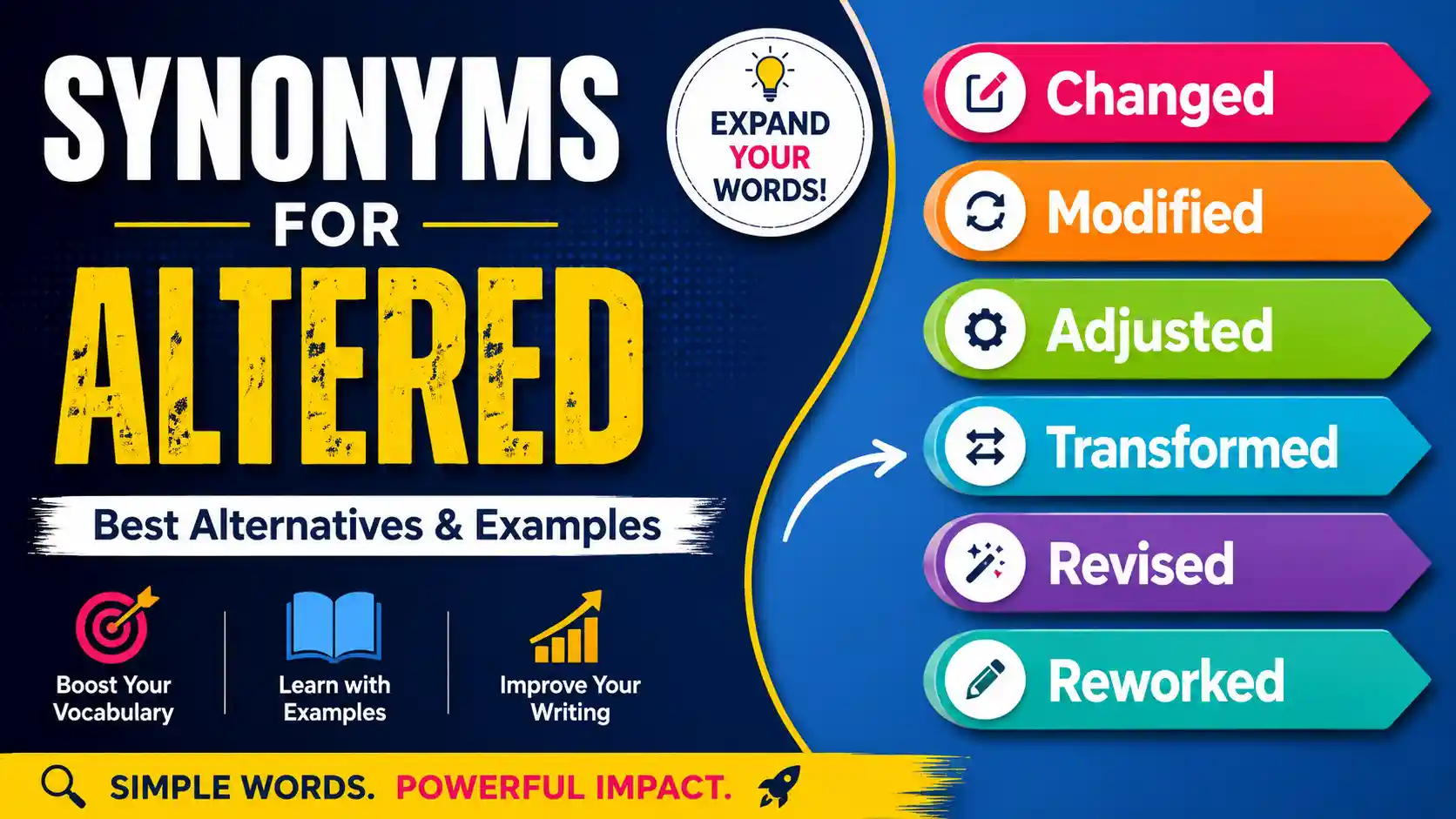
The best alternatives include changed, modified, adjusted, revised, amended, adapted, transformed, reshaped, updated, edited, refined, reworked, converted, rearranged, and replaced. However, these words are not perfect substitutes in every sentence. A small change may be an adjustment, while a major change may be a transformation.
This guide explains the most useful alternatives, their meanings, tone, common collocations, and the situations where native speakers would naturally use them.
Quick Answer
The most common synonym for altered is changed. For more precise writing, use modified for a deliberate change, adjusted for a small change, revised for a document or plan, adapted for a new situation, and transformed for a major change.
What Does Altered Mean?
Altered means that something has been changed from its original condition, appearance, form, or purpose.
For example:
- The designer altered the dress.
- The company altered its plans.
- The photograph was altered digitally.
The important point is that altered is a broad word. It tells us that something became different, but it does not always tell us whether the change was small, large, positive, negative, planned, or accidental.
That is why a more specific synonym can sometimes make your writing stronger.
Pronunciation
Altered
- US: /ˈɑːl.tɚd/
- UK: /ˈɔːl.təd/
- Simple pronunciation: AWL-terd
The pronunciation varies slightly between American and British English, but the meaning is essentially the same.
Part of Speech
Altered is primarily the past tense and past participle of the verb alter.
As a verb
- She altered the dress.
- The storm altered our plans.
As an adjective
It can also describe something that has been changed.
- We received an altered version of the document.
- The artist created an altered image.
Word family
- alter: verb
- altered: past tense/past participle
- altering: present participle
- alteration: noun
- unaltered: adjective
How to Use Altered in a Sentence
The most common pattern is:
Subject + altered + object
Examples:
- The editor altered the article.
- The company altered its policy.
- The teacher altered the lesson.
You can also use the passive form:
Something + was/were + altered
- The schedule was altered.
- The original plans were altered.
Another useful pattern is:
altered by + cause
- The landscape was altered by flooding.
- Her plans were altered by unexpected events.
Quick grammar tip
Use altered when you want to focus on the fact that something is now different. If the exact type of change matters, choose a more specific word.
Quick Comparison of the Best Alternatives
| Word | Main idea | Register | Frequency |
| Changed | Became different | Neutral | Very common |
| Modified | Changed specific features | Formal/technical | Common |
| Adjusted | Changed slightly | Neutral/business | Common |
| Revised | Changed after review | Formal/academic | Common |
| Amended | Changed officially | Formal/legal | Common |
| Adapted | Changed for a new purpose | Neutral/formal | Common |
| Transformed | Changed greatly | Neutral/formal | Common |
| Reshaped | Changed structure or direction | Neutral/formal | Common |
| Updated | Made more current | Neutral/business | Very common |
| Edited | Changed text or media | Neutral/professional | Very common |
| Refined | Improved through small changes | Formal | Common |
| Reworked | Worked on again | Neutral/professional | Common |
| Converted | Changed from one form to another | Neutral/technical | Common |
| Rearranged | Changed order or position | Neutral | Common |
| Replaced | Put something else in its place | Neutral | Very common |
Good to Know: These words overlap in meaning, but they are not interchangeable in every sentence. The best synonym depends on the kind of change.
The Best Alternatives Explained
1. Changed
Meaning: Made different from before.
This is the safest and most general alternative. If you are not sure which synonym fits, change will usually work.
Examples:
- The experience changed his opinion.
- We changed our travel plans because of the weather.
Best used when: You simply want to say that something became different.
Register: Neutral
CEFR: A1–A2
Frequency: Very common
Common collocations:
- changed plans
- changed circumstances
- changed completely
When not to use it: Avoid it when you need to explain the exact type of change.
2. Modified
Meaning: Changed some part or feature of something.
Modified is especially useful in technical, scientific, academic, and professional writing.
Examples:
- The engineer modified the machine to improve its performance.
- The researchers tested a modified version of the device.
Best used when: Someone deliberately changes specific features while keeping the basic thing recognizable.
Register: Formal, technical, academic
CEFR: Around B2
Frequency: Common
Common collocations:
- modified version
- modified design
- modified system
Nuance: Modified often sounds more precise and deliberate than changed.
3. Adjusted
Meaning: Changed slightly to make something work better or fit better.
Examples:
- She adjusted the chair for greater comfort.
- The company adjusted the schedule after receiving feedback.
Best used when: The change is relatively small and has a practical purpose.
Register: Neutral, business
CEFR: Around B2
Frequency: Common
Common collocations:
- adjusted settings
- adjusted schedule
- adjusted price
When not to use it: It is usually too weak for a complete or dramatic transformation.
4. Revised
Meaning: Changed something after reviewing it.
This word works particularly well with writing, plans, policies, estimates, and proposals.
Examples:
- The student revised her essay before submitting it.
- The company released a revised business plan.
Best used when: Someone examines an earlier version and changes it.
Register: Formal, academic, professional
CEFR: Around B2
Frequency: Common
Common collocations:
- revised edition
- revised plan
- revised draft
Nuance: The idea of review and improvement is important here.
5. Amended
Meaning: Officially changed, usually to improve or correct something.
Examples:
- Parliament amended the law.
- The parties signed an amended agreement.
Best used when: Talking about laws, contracts, regulations, policies, or formal documents.
Register: Formal, legal, business
CEFR: Around C1
Frequency: Common
When not to use it: It can sound unnecessarily formal in ordinary conversation.
6. Adapted
Meaning: Changed so that something works in a new situation or for a different purpose.
Examples:
- The teacher adapted the lesson for younger students.
- The novel was adapted for television.
Best used when: Something needs to suit new conditions, people, or purposes.
Register: Neutral, formal, academic
CEFR: Around B2
Frequency: Common
Nuance: The focus is on suitability, not just difference.
7. Transformed
Meaning: Changed greatly into something substantially different.
Examples:
- The renovation transformed the old house.
- The internet has transformed modern communication.
Best used when: The change is large, noticeable, or fundamental.
Register: Neutral, formal
CEFR: Around B2
Frequency: Common
Nuance: This is much stronger than adjusted or modified.
8. Reshaped
Meaning: Change the structure, form, or direction of something.
Examples:
- Social media has reshaped the way people communicate.
- The new policy reshaped the company’s strategy.
Best used when: A change affects the structure, direction, or character of something.
Register: Neutral, formal
CEFR: Around B2–C1
Frequency: Common
Common collocations:
- reshaped society
- reshaped the industry
- reshaped the debate
9. Updated
Meaning: Changed something to include newer information or current features.
Examples:
- Please update your contact information.
- The website was updated this morning.
Best used when: Information, software, websites, records, or documents need to become current.
Register: Neutral, business, technical
CEFR: Around B1
Frequency: Very common
Important difference: An update does not necessarily change the basic structure. It usually makes something more current.
10. Edited
Meaning: Changed written, visual, audio, or video material.
Examples:
- The journalist edited the article before publication.
- The video was edited to remove unnecessary scenes.
Best used when: Someone is preparing or improving content.
Register: Neutral, professional
CEFR: Around B1–B2
Frequency: Very common
Nuance: Edited tells the reader that the change happened as part of a review or production process.
11. Refined
Meaning: Improved something through careful, usually small changes.
Examples:
- The researcher refined the testing method.
- She refined her argument before the meeting.
Best used when: Something is already developed but needs improvement.
Register: Formal, academic, professional
CEFR: Around C1
Frequency: Common
Connotation: Usually positive.
12. Reworked
Meaning: Changed something by working on it again.
Examples:
- The designer reworked the logo.
- The author reworked the final chapter.
Best used when: A creative project, design, piece of writing, or plan needs another round of work.
Register: Neutral, professional
CEFR: Around B2–C1
Frequency: Common
13. Converted
Meaning: Changed something from one form, use, or system into another.
Examples:
- They converted the garage into an office.
- The software converted the file into another format.
Best used when: One form becomes another.
Register: Neutral, technical, formal
CEFR: Around B2
Frequency: Common
Important: Converted is more specific than altered because it usually involves a change of form, function, or system.
14. Rearranged
Meaning: Put existing parts into a different order or position.
Examples:
- We rearranged the furniture in the living room.
- She rearranged the paragraphs to improve the flow.
Best used when: The parts stay the same but their position or order changes.
Register: Neutral
CEFR: Around B1–B2
Frequency: Common
15. Replaced
Meaning: Removed one thing and put another in its place.
Examples:
- The mechanic replaced the damaged tire.
- The company replaced the old computers.
Best used when: One thing is removed and another takes its position.
Register: Neutral
CEFR: A2
Frequency: Very common
Remember: Replaced is related to altered, but it is not an exact synonym. Replacing something means substitution, not simply modification.
16. Tailored
Meaning: Changed or designed to meet particular needs.
Examples:
- The course was tailored to new employees.
- The consultant created a tailored strategy for the client.
Best used when: Something is customized for a person, group, or purpose.
Register: Neutral, business, professional
CEFR: Around B2
Frequency: Common
17. Corrected
Meaning: Changed because something was wrong or inaccurate.
Examples:
- The editor corrected several factual errors.
- She corrected the spelling mistakes in her essay.
Best used when: The original version contains an error.
Register: Neutral, academic, professional
CEFR: B1
Frequency: Very common
When not to use it: Do not use corrections simply because something changed. It specifically suggests that a mistake was fixed.
18. Distorted
Meaning: Changed something so that it no longer accurately represents its original form or meaning.
Examples:
- The image was distorted by the faulty lens.
- The report distorted his original statement.
Best used when: The change produces an inaccurate, misleading, or unnatural result.
Register: Formal, neutral
CEFR: Around C1
Frequency: Common
Connotation: Usually negative.
19. Manipulated
Meaning: Changed or controlled something, often in a deceptive or unfair way.
Examples:
- The photograph had been manipulated digitally.
- The figures were manipulated to support the argument.
Best used when: Intentional control, deception, or unfair influence is part of the meaning.
Register: Formal, professional
CEFR: Around C1
Frequency: Common
When not to use it: Avoid it for an innocent change because the word can suggest dishonesty.
20. Revolutionized
Meaning: Changed something in an extremely important and fundamental way.
Examples:
- The invention revolutionized communication.
- Digital technology revolutionized the publishing industry.
Best used when: The effect is enormous and long-lasting.
Register: Formal, academic
CEFR: Around C1
Frequency: Common
When not to use it: A minor improvement is not a revolution.
Which Synonym Should You Choose?
The easiest way to choose is to ask yourself one question:
What kind of change am I describing?
If the change is general
Use changed.
The situation changed quickly.
If someone made a technical change
Use modified.
The engineer modified the equipment.
If the change was small
Use adjusted.
We adjusted the temperature.
If someone reviewed and improved something
Use revised.
She revised the report.
If an official document changed
Use amended.
The contract was amended.
If something was changed for a new situation
Use adapted.
The program was adapted for beginners.
If the change was dramatic
Use transformed.
The project transformed the neighborhood.
If the information became more current
Use updated.
The website was updated yesterday.
Strongest, Strong, and Related Alternatives
Strongest Alternatives
These suggest a major or powerful change:
- transformed
- revolutionized
- reshaped
Strong Alternatives
These describe deliberate or meaningful changes:
- modified
- revised
- amended
- adapted
- converted
- reworked
Related Alternatives
These describe particular types of change:
- adjusted
- edited
- updated
- refined
- corrected
- rearranged
- tailored
- replaced
Commonly Confused Words
| Word | What makes it different? | Example |
| Altered | Broad term for making something different | The plans were altered. |
| Modified | Changes particular features | The machine was modified. |
| Adjusted | Usually a small practical change | The seat was adjusted. |
| Adapted | Changed to fit a new situation | The lesson was adapted. |
| Transformed | Changed dramatically | The building was transformed. |
A simple rule
Altered = different
Modified = features changed
Adjusted = small practical change
Adapted = made suitable
Transformed = changed greatly
Common Mistakes Learners Make
Common Mistake Box
Mistake 1
Wrong: The company transformed the price by two dollars.
Better: The company adjusted the price by two dollars.
Why? A small price change is an adjustment, not usually a transformation.
Mistake 2
Wrong: The old phone was altered with a new phone.
Better: The old phone was replaced with a new phone.
Why? Replaced means that one item was removed and another took its place.
Mistake 3
Wrong: The student amended her essay.
Better: The student revised her essay.
Why? Amend is normally associated with official or formal changes. Revise is more natural for an essay.
Mistake 4
Wrong: The broken information was adjusted.
Better: The incorrect information was corrected.
Why? Corrected clearly shows that an error was fixed.
How to Use These Words in Your Writing
In Essays
Academic writing benefits from precise vocabulary.
Instead of:
The researchers altered the method.
You might write:
The researchers modified the method to improve accuracy.
The second sentence tells the reader more about the change.
In Emails
Keep the language simple.
I have updated the attached document.
This is usually better than:
I have altered the attached document.
If the purpose was to add current information, updating is more precise.
In Business Writing
Use words such as:
- revised
- adjusted
- amended
- updated
- modified
Example:
We have revised the proposal based on your feedback.
In Creative Writing
Words such as transformed, reshaped, distorted, and reworked can create stronger imagery.
The long journey transformed her understanding of home.
In Everyday Conversation
Keep it natural:
I changed my plans.
You do not always need a sophisticated synonym. Simple English is often the best English.
Writing Tip: Do not replace every occurrence of altered just to avoid repetition. If the original word is accurate, keep it. A good synonym should improve precision, not simply make the vocabulary look more advanced.
Word Origin and Etymology
The English verb alter comes through Middle English and Anglo-French from Late Latin alterare, related to Latin alter, meaning “other” or “another.”
The word has been part of English for centuries. Merriam-Webster gives the altar a first known use in the 14th century.
The related noun alteration also has a long history in English.
The central idea behind the word has remained remarkably stable: to make something other or different.
CEFR Guidance for Learners
CEFR levels can vary between dictionaries, teaching systems, and vocabulary lists, so the following levels are best treated as practical learner guidance, not absolute classifications.
| Word | Approximate level |
| Changed | A1–A2 |
| Replaced | A2 |
| Corrected | B1 |
| Updated | B1 |
| Edited | B1–B2 |
| Adjusted | B2 |
| Modified | B2 |
| Revised | B2 |
| Adapted | B2 |
| Transformed | B2 |
| Converted | B2 |
| Rearranged | B1–B2 |
| Tailored | B2 |
| Amended | C1 |
| Refined | C1 |
| Distorted | C1 |
| Manipulated | C1 |
| Revolutionized | C1 |
For beginners, change is the most useful starting point. As your English improves, learning more precise alternatives helps you communicate exactly what happened.
American and British English
Altered is used in both American and British English.
The pronunciation differs slightly:
- American: /ˈɑːl.tɚd/
- British: /ˈɔːl.təd/
The spelling altered is the same in both varieties.
Some related vocabulary can vary by region. For example, American English commonly uses remodeled for major changes to a home, while British English often uses refurbished or renovated, depending on the type of work.
The core meaning of altered, however, remains the same in both varieties.
Related Vocabulary
Antonyms
Depending on the context, possible opposites include:
- unchanged
- unaltered
- original
- intact
- preserved
- maintained
- unmodified
Example
The document remained unaltered.
Related Expressions
Instead of using the same adjective repeatedly, you can sometimes describe the degree of change:
- slightly altered
- significantly altered
- completely altered
- radically altered
- permanently altered
- substantially altered
These expressions are useful because they tell readers how much something changed.
Natural Collocations
Native speakers commonly use altered with words such as:
- altered version
- altered image
- altered appearance
- altered plans
- altered conditions
- altered behavior
- altered document
- altered circumstances
- significantly altered
- slightly altered
- completely altered
These combinations can help learners understand how the word behaves in real sentences.
For example:
The researchers worked with an altered version of the original model.
The storm created altered conditions on the road.
The evidence significantly altered the investigation.
Mini Practice Exercises
Exercise 1: Fill in the Blanks
Choose from adjusted, revised, adapted, replaced, transformed.
- The teacher ______ the lesson for younger students.
- The editor ______ the article before publication.
- The mechanic ______ the seat for the driver.
- The old battery was ______ with a new one.
- The renovation completely ______ the building.
Answers
- adapted
- revised
- adjusted
- replaced
- transformed
Exercise 2: Choose the Best Word
1. The company made a small change to the schedule.
A. revolutionized
B. adjusted
C. transformed
D. distorted
Answer: B. adjusted
2. The government officially changed the law.
A. amended
B. rearranged
C. edited
D. refined
Answer: A. amended
3. The author changed the first draft after receiving feedback.
A. converted
B. revised
C. replaced
D. distorted
Answer: B. revised
Exercise 3: Rewrite the Sentence
Replace altered with a more precise word.
Sentence 1
The website was altered to include new information.
Better: The website was updated to include new information.
Sentence 2
The machine was altered to improve its performance.
Better: The machine was modified to improve its performance.
Sentence 3
The old factory was altered into modern apartments.
Better: The old factory was converted into modern apartments.
FAQ
What is the best synonym for altered?
The best general synonym is changed because it works in many situations. However, a more precise choice may be better. Use modified for specific features, adjusted for small changes, revised for documents, and transformed for major changes.
What is a stronger word than altered?
Transformation is a stronger alternative when something becomes substantially different. Revolutionization is stronger still when the change has a major and lasting effect on an industry, system, technology, or society.
Is modified the same as altered?
The two words are very close, but modified often suggests that particular features have been deliberately changed. Altered is broader and can describe almost any change in condition, appearance, form, or character.
What is the difference between altered and adjusted?
Altered is a broad term for making something different. Adjusted usually describes a smaller change made to improve fit, accuracy, comfort, timing, or performance. You might adjust a chair, temperature, price, or schedule.
What is the difference between altered and adapted?
Altered simply means changed. Adapted suggests that something was changed so it could work in a new environment, serve a new purpose, or suit a particular group of people.
What is the opposite of altered?
The most direct opposite is unaltered. Other possible opposites include unchanged, intact, original, preserved, and unmodified. The correct choice depends on what kind of change the sentence describes.
Is formal English altered?
Yes. Altered is suitable for everyday, academic, professional, and formal English. It is a flexible word, although more specific alternatives can sometimes make formal writing clearer.
Can change always replace altered?
Not always. Change is the broadest alternative, but it can lose important information. For example, amended tells us that an official document was changed, while transformed tells us that a major change occurred.
Final Takeaway
Good vocabulary is not about using the most complicated word. It is about choosing the most accurate word. Use changed when you need a simple general term. Choose modified for specific changes, adjusted for small practical changes, revised for reviewed material, adapted for new situations, and transformed for dramatic changes.
Once you understand these differences, your writing becomes clearer without sounding forced. Try using one new word in an email, essay, conversation, or piece of creative writing today. Small vocabulary choices can make a big difference.
References
- Cambridge Dictionary: Alter
Definition, pronunciation, grammar, examples, and related vocabulary for alter. - Cambridge Dictionary: Altered
Meaning, pronunciation, and usage information for altered. - Cambridge Thesaurus: Alter
Useful for comparing related words such as change, modify, adjust, adapt, and transform. - Merriam-Webster: Alter
Definition, usage information, word history, and first-known-use information. - Merriam-Webster: Altered
Definition and usage details for altered. - Collins Dictionary: Alter
Additional definitions, examples, and usage guidance.

Synonorm is a trusted English vocabulary resource created to help readers find the right words and understand the differences between similar terms. We provide clear explanations of synonyms, meanings, examples, usage, and alternatives. Our content makes vocabulary easier to learn and apply in everyday, academic, and professional English. Synonorm is designed for students, writers, ESL learners, professionals, and anyone who wants to improve their English vocabulary and communicate more clearly.