Have you ever needed another word for monologue but found that the usual synonym lists did not quite fit your sentence? That is because monologues have several meanings. It can describe a long speech by one person, a dramatic performance, a character’s private thoughts, or even a comedian’s opening routine. The best alternative depends on the situation.
The closest choices include speech, soliloquy, address, oration, discourse, lecture, and talk. Words such as rant, tirade, harangue, and diatribe can also work, but they add a strong negative or emotional meaning.
This guide explains the differences so you can choose a word that sounds natural rather than simply replacing one word with another.
Quick Answer: What Is Another Word for Monologue?
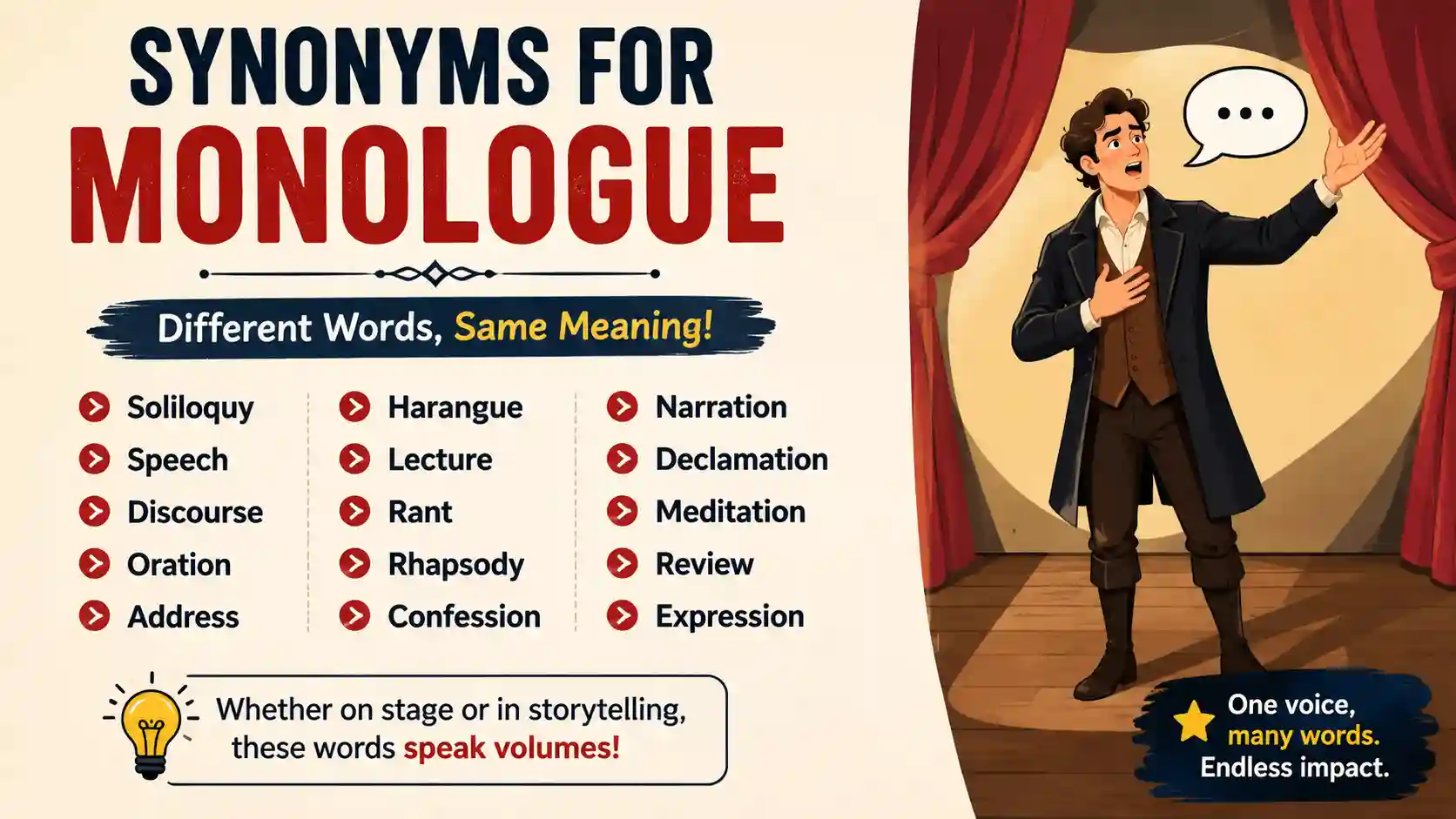
The best general alternatives to monologue are speech, speech-making, address, talk, soliloquy, oration, and discourse, depending on context. For an angry or critical speech, rant, tirade, harangue, or diatribe may be more precise. A soliloquy is especially suitable for a dramatic speech that reveals a character’s private thoughts.
What Does Monologue Mean?
A monologue is a long speech delivered by one person without an equal exchange with another speaker.
The word has several common uses:
- A long speech in a conversation
- A dramatic speech by one actor
- A literary passage expressing a character’s thoughts
- A comedian’s opening routine or comic speech
Merriam-Webster gives all of these senses, including a long speech that dominates a conversation and a routine performed by a stand-up comedian.
For example:
The actor delivered an emotional monologue at the end of the play.
Here, monologue refers to a dramatic speech. But in:
My uncle launched into a long monologue about his new car.
The word suggests that one person talked for a long time, perhaps without giving others much chance to speak.
That difference is important when choosing a replacement.
Pronunciation of Monologue
British English: /ˈmɒnəlɒɡ/
American English: /ˈmɑːnəlɔːɡ/
Simple pronunciation: MON-uh-log
The spelling monologue is standard in both British and American English. Monolog is also used, particularly in American English, but monologue is the safer choice in general writing.
Part of Speech
Monologue is a noun.
Example
- The actress performed a powerful monologue.
- His long monologue made everyone check the time.
Related nouns include:
- monologuist: a person who performs or delivers a monologue
- monologist: another term for such a performer
Merriam-Webster lists both monologist and monologist.
How to Use Monologue in a Sentence
Common patterns include:
- a monologue about something
- a monologue on a subject
- deliver a monologue
- give a monologue
- launch into a monologue
- perform a monologue
Examples
- She delivered a moving monologue about loss.
- He launched into a monologue on modern technology.
- The actor performed a difficult monologue.
Common Grammar Point
Do not use monologue when you really mean a conversation between people. Dialogue or conversation is more appropriate when speakers exchange ideas.
Monologue Synonyms at a Glance
| Word | How close is it? | Main idea | Register |
| Speech | Close | Spoken message by one person | Neutral |
| Soliloquy | Close in drama | Private or reflective dramatic speech | Literary |
| Address | Contextual | Formal speech to an audience | Formal |
| Oration | Contextual | Formal, often impressive speech | Formal |
| Discourse | Contextual | Extended formal discussion | Academic/Formal |
| Lecture | Contextual | Speech designed to teach | Academic |
| Talk | Broad | Spoken presentation or discussion | Neutral |
| Declamation | Contextual | Formal or dramatic delivery | Formal/Literary |
| Rant | Contextual | Angry or emotional speech | Informal |
| Tirade | Contextual | Long angry criticism | Neutral/Formal |
| Harangue | Contextual | Forceful, aggressive speech | Formal |
| Diatribe | Contextual | Bitter verbal attack | Formal |
| Sermon | Contextual | Religious speech | Religious/Formal |
| Screed | Contextual | Long, harsh criticism | Literary/Formal |
| Disquisition | Related | Long scholarly discussion | Academic |
Cambridge’s thesaurus groups words such as soliloquy, speech, oration, discourse, address, lecture, sermon, and screed with monologue. Merriam-Webster also includes terms such as tirade, diatribe, rant, declamation, harangue, talk, and presentation.
1. Speech
Meaning: A speech is a spoken message delivered by one person to an audience.
Examples:
- The principal gave a short speech before the ceremony.
- Her speech encouraged the students to stay focused.
Best used when: You need the broadest, most natural alternative.
Register: Neutral
Approximate CEFR: B1
Frequency: Very common
Common collocations:
- give a speech
- deliver a speech
- opening speech
Nuance: Speech is broader than monologue. A speech usually has an audience and a clear purpose, while a monologue can also describe a dramatic performance or one-sided conversation.
2. Soliloquy
Meaning: A soliloquy is a dramatic speech that expresses a character’s private thoughts.
Examples:
- The prince reveals his doubts through a powerful soliloquy.
- Her soliloquy shows how frightened she has become.
Best used when: Talking about drama, theater, Shakespeare, or literary analysis.
Register: Literary
Approximate CEFR: C1
Frequency: Common in literary contexts
Common collocations:
- dramatic soliloquy
- famous soliloquy
- Shakespearean soliloquy
When not to use it: Do not use soliloquy for every long speech. The word has a narrower meaning than monologue. Merriam-Webster specifically distinguishes the two terms.
3. Address
Meaning: An address is a formal speech given to a group or audience.
Examples:
- The president gave an address to the nation.
- Her opening address welcomed the new students.
Best used when: The setting is official, public, or ceremonial.
Register: Formal
Approximate CEFR: B2
Frequency: Common
Common collocations:
- formal address
- opening address
- public address
Nuance: Address sounds more official than talk.
4. Oration
Meaning: An oration is a formal and carefully prepared speech.
Examples:
- His oration honored the people who built the community.
- The speaker delivered an impressive oration.
Best used when: The speech is formal, ceremonial, or highly polished.
Register: Formal/Literary
Approximate CEFR: C1
Frequency: Uncommon
Common collocations:
- formal oration
- powerful oration
- ceremonial oration
When not to use it: It sounds too grand for a casual conversation.
5. Discourse
Meaning: Discourse is an extended spoken or written discussion of a subject.
Examples:
- The professor gave a detailed discourse on language.
- The book examines political discourse in modern society.
Best used when: Writing in an academic or formal context.
Register: Academic/Formal
Approximate CEFR: C1
Frequency: Common in academic writing
Common collocations:
- public discourse
- political discourse
- academic discourse
Nuance: Discourse is not a perfect replacement for monologue. It focuses more on extended discussion or communication than on one person simply speaking for a long time.
6. Lecture
Meaning: A lecture is a structured talk that teaches or explains a subject.
Examples:
- The professor gave a lecture on ancient history.
- We attended a lecture about climate change.
Best used when: The speaker is teaching or explaining.
Register: Academic/Formal
Approximate CEFR: B1
Frequency: Very common
Common collocations:
- give a lecture
- attend a lecture
- lecture on history
When not to use it: A dramatic speech is not normally called a lecture.
7. Talk
Meaning: A talk is a spoken presentation or informal speech.
Examples:
- She gave a short talk about healthy eating.
- His talk focused on the future of technology.
Best used when: You want a simple, natural everyday word.
Register: Neutral
Approximate CEFR: A2
Frequency: Very common
Common collocations:
- give a talk
- short talk
- informal talk
Nuance: Talk is less specific than monologue. It does not necessarily suggest that the speaker talks continuously.
8. Declamation
Meaning: Declamation is the formal or dramatic delivery of a speech.
Examples:
- The students practiced declamation for the competition.
- Her dramatic declamation impressed the judges.
Best used when: Talking about formal speech performance or public speaking.
Register: Formal/Literary
Approximate CEFR: C1
Frequency: Uncommon
Common collocations:
- dramatic declamation
- public declamation
- declamation contest
9. Rant
Meaning: A rant is an angry or emotional speech in which someone complains strongly.
Examples:
- He posted a rant about the new parking rules.
- Her rant about customer service lasted ten minutes.
Best used when: Anger, frustration, or strong complaint is central.
Register: Informal
Approximate CEFR: B2
Frequency: Common
Common collocations:
- angry rant
- online rant
- rant about something
When not to use it: Do not use rant for a calm or carefully reasoned speech.
10. Tirade
Meaning: A tirade is a long, angry speech filled with criticism.
Examples:
- The manager launched into a tirade about the team’s poor results.
- His angry tirade shocked everyone in the room.
Best used when: Someone attacks or criticizes something at length.
Register: Neutral/Formal
Approximate CEFR: C1
Frequency: Common
Common collocations:
- angry tirade
- furious tirade
- launch into a tirade
Nuance: Tirade is much more negative than monologue.
11. Harangue
Meaning: A harangue is a long, forceful speech that strongly criticizes or pressures people.
Examples:
- The workers received a harsh harangue from their supervisor.
- He delivered a lengthy harangue about discipline.
Best used when: The speech is forceful, aggressive, or critical.
Register: Formal
Approximate CEFR: C1
Frequency: Uncommon
Common collocations:
- lengthy harangue
- angry harangue
- political harangue
12. Diatribe
Meaning: A diatribe is a bitter verbal attack against someone or something.
Examples:
- His article became a diatribe against the education system.
- The interview turned into a bitter diatribe.
Best used when: The speaker strongly attacks an idea, person, or institution.
Register: Formal
Approximate CEFR: C1
Frequency: Uncommon
Common collocations:
- political diatribe
- bitter diatribe
- angry diatribe
When not to use it: A balanced explanation is not a diatribe.
13. Sermon
Meaning: A sermon is a religious speech that teaches or encourages people.
Examples:
- The pastor delivered a sermon about forgiveness.
- The sermon encouraged the congregation to help others.
Best used when: The setting is religious.
Register: Religious/Formal
Approximate CEFR: B2
Frequency: Common
Common collocations:
- deliver a sermon
- Sunday sermon
- religious sermon
14. Screed
Meaning: A screed is a long, often angry piece of writing or speech that attacks something.
Examples:
- The article was a lengthy screed against modern politics.
- He published another screed criticizing the company.
Best used when: The communication is long, harsh, and strongly critical.
Register: Formal/Literary
Approximate CEFR: C2
Frequency: Uncommon
When not to use it: Avoid it as a neutral substitute for speech.
15. Disquisition
Meaning: A disquisition is a long and detailed discussion of a subject.
Examples:
- The book contains a lengthy disquisition on ancient philosophy.
- His paper became a detailed disquisition on language.
Best used when: You need a highly formal academic word.
Register: Academic
Approximate CEFR: C2
Frequency: Rare
When not to use it: It is usually too formal for everyday English.
Which Synonym Should You Choose?
The easiest way to choose is to ask what kind of speech you are describing.
| Your meaning | Best choice |
| General spoken message | Speech |
| Dramatic private thoughts | Soliloquy |
| Official public speech | Address |
| Ceremonial formal speech | Oration |
| Teaching session | Lecture |
| Academic discussion | Discourse |
| Simple spoken presentation | Talk |
| Angry complaint | Rant |
| Long angry criticism | Tirade |
| Aggressive speech | Harangue |
| Bitter verbal attack | Diatribe |
| Religious speech | Sermon |
| Long critical piece | Screed |
| Very formal academic discussion | Disquisition |
A simple rule
If you are unsure, use speech for a general situation.
If you are discussing theater, ask whether the character is revealing private thoughts. If yes, soliloquy may be the better word.
If anger is important, consider rant or tirade.
If the speaker is teaching, the lecture is usually more natural.
Monologue vs. Soliloquy vs. Dialogue
These three words are easy to confuse.
| Word | Meaning | Example |
| Monologue | Extended speech by one person | The actor delivered a monologue. |
| Soliloquy | Dramatic speech expressing private thoughts | Her soliloquy revealed her fear. |
| Dialogue | Conversation between speakers | The dialogue between them felt natural. |
Remember: Every soliloquy can be described as a type of monologue, but not every monologue is a soliloquy. Merriam-Webster makes this distinction especially clear.
Monologue vs. Rant vs. Tirade
These words can look interchangeable because all three can describe long speech.
But the emotional meaning is different.
- Monologue: focuses on one person speaking at length.
- Rant: suggests an emotional or angry complaint.
- Tirade: suggests a sustained, forceful attack or criticism.
Compare:
He gave a monologue about his childhood.
This is neutral.
He went on a rant about his childhood.
This suggests strong emotion or complaint.
He launched into a tirade against his former employer.
This suggests an angry attack.
Common Mistakes
Mistake 1: Calling every long speech a soliloquy
Correction: Use soliloquy mainly for dramatic speech that reveals a character’s private thoughts.
Why: The word has a narrower meaning than monologue.
Mistake 2: Using rant as a neutral synonym
Correction: Use rant only when strong emotion or complaint fits the meaning.
Why: The word carries a negative or emotional tone.
Mistake 3: Calling a conversation a monologue
Correction: Use dialogue or conversation when two or more people exchange ideas.
Mistake 4: Using lecture for every formal speech
Correction: Choose a lecture when teaching or explaining is the main purpose.
Mistake 5: Using rare words just to sound intelligent
Correction: Prefer a familiar word when it communicates the idea clearly.
For example, speech is usually better than oration if you are writing for a general audience.
Useful Collocations
Native speakers often use words in familiar combinations. Learning these combinations can make your English sound more natural.
With monologue
- deliver a monologue
- perform a monologue
- dramatic monologue
- opening monologue
- lengthy monologue
- inner monologue
- comic monologue
With speech
- give a speech
- deliver a speech
- opening speech
- acceptance speech
With lecture
- give a lecture
- attend a lecture
- public lecture
- lecture on history
With rant
- go on a rant
- angry rant
- online rant
- rant about politics
With tirade
- launch into a tirade
- angry tirade
- lengthy tirade
With address
- deliver an address
- opening address
- formal address
Word Origin and First Known Use
The monologue came into English through the Middle French monologue. Its deeper origin is connected with Greek elements meaning “alone” and “to speak.”
Merriam-Webster records the first known use of monologue in 1549.
The history of the word fits its basic idea: one person speaking.
American and British English
There is very little difference in everyday usage between American and British English.
Spelling
Both varieties normally use:
monologue
American English also allows:
monolog
However, monologue is the more familiar international spelling.
Pronunciation
British: /ˈmɒnəlɒɡ/
American: /ˈmɑːnəlɔːɡ/
The pronunciation changes slightly, but the meaning remains the same.
CEFR Guidance for English Learners
CEFR levels should be treated as practical learner guidance rather than fixed official labels for every dictionary entry.
| Word | Approx. level | Learning priority |
| Talk | A2 | Essential |
| Speech | B1 | Essential |
| Lecture | B1 | Useful |
| Presentation | B1 | Useful |
| Monologue | B2 | Useful |
| Address | B2 | Useful |
| Rant | B2 | Useful |
| Soliloquy | C1 | Literature |
| Discourse | C1 | Academic |
| Tirade | C1 | Advanced |
| Diatribe | C1 | Advanced |
| Oration | C1 | Advanced |
| Disquisition | C2 | Specialized |
For most learners, speech, talk, lecture, presentation, and monologue are more useful to learn first than rare literary words.
Related Vocabulary
Words With Similar Ideas
- speech
- talk
- address
- lecture
- discourse
- soliloquy
- oration
- presentation
- declamation
- sermon
Contrasting Words
The clearest contrast is dialogue, because dialogue involves an exchange between speakers. Conversation is another natural contrast in everyday English. Cambridge lists both as antonyms of monologue.
Expressions
- speak at length
- talk at length
- give a speech
- deliver an address
- go on a rant
- launch into a tirade
- hold forth
- speak one’s mind
How to Use These Words in Different Types of Writing
Essays
Use precise terms such as speech, soliloquy, discourse, or address.
Example:
The soliloquy allows the reader to understand the character’s inner conflict.
Blog Posts
Prefer familiar words such as speech, talk, or presentation unless the topic requires a literary term.
Stories
Monologue, soliloquy, and interior monologue are useful when discussing a character’s voice and thoughts.
Professional Writing
Presentation, address, briefing, or speech often sounds more natural than monologue.
Everyday Conversation
Use talk, speech, or rant depending on the situation.
Writing Tip: A good synonym should preserve the meaning, not simply replace the original word.
Practice: Choose the Best Word
Choose from:
speech, soliloquy, lecture, rant, address
- The university professor gave a ______ on modern economics.
- The actor’s ______ revealed what the character truly feared.
- The mayor gave an official ______ to the audience.
- She posted an angry ______ about the airline.
- The student gave a short ______ at the school ceremony.
Answers
- lecture
- soliloquy
- address
- rant
- speech
Rewrite the Sentence
Replace monologue with the most precise alternative.
1.
The professor’s monologue explained the causes of the economic crisis.
Better:
The professor’s lecture explained the causes of the economic crisis.
2.
The actor’s monologue revealed his secret thoughts.
Better:
The actor’s soliloquy revealed his secret thoughts.
3.
She gave a long, angry monologue about the unfair decision.
Better:
She went on a rant about the unfair decision.
4.
The president gave a formal monologue to the nation.
Better:
The president delivered an address to the nation.
Frequently Asked Questions
What is the closest synonym for monologue?
Speech is the safest broad alternative because it can describe spoken words delivered by one person. However, context matters. Soliloquy is better for private dramatic thoughts, while lecture suggests teaching and rant suggests anger.
What is another word for a long speech?
Common choices include speech, address, discourse, talk, oration, and lecture. The right word depends on the purpose and setting. If the speech is angry, rant, tirade, harangue, or diatribe may be more precise.
Is soliloquy a synonym for monologue?
Yes, in some contexts, but it is more specific. A soliloquy is generally a dramatic speech in which a character expresses private thoughts. A monologue has a broader meaning and can also describe a comedian’s routine or a long one-sided conversation.
What is the opposite of monologue?
The clearest opposite is dialogue, because dialogue involves an exchange between speakers. Conversation can also work in everyday contexts. Cambridge lists both dialogue and conversation as contrasting terms for monologue.
What is a formal word for monologue?
Depending on the context, address, oration, discourse, or declamation may work. Address is especially useful for an official speech, while oration suggests a formal and carefully prepared speech.
Is rant a synonym for monologue?
It can be a contextual alternative, but it is not neutral. A rant is usually emotional, angry, or strongly critical. A calm theatrical performance would normally be called a monologue rather than a rant.
What is a literary synonym for monologue?
Soliloquy is the most useful literary alternative when a character reveals private thoughts through speech. Interior monologue is also useful when discussing a character’s inner mental experience in fiction.
What is a synonym for monologue in a classroom?
Lecture is usually the best choice when a teacher or professor speaks to students to explain a subject. Talk or presentation may work in less formal classroom situations.
Quick Vocabulary Quiz
1. Which word describes a dramatic speech that reveals a character’s private thoughts?
A. Lecture
B. Soliloquy
C. Presentation
D. Dialogue
2. Which word suggests an angry complaint?
A. Address
B. Rant
C. Oration
D. Lecture
3. Which word best fits a university teacher explaining a subject?
A. Tirade
B. Lecture
C. Diatribe
D. Screed
4. Which word is most suitable for an official speech?
A. Rant
B. Address
C. Chatter
D. Gossip
5. Which word is the broadest everyday alternative?
A. Speech
B. Diatribe
C. Harangue
D. Screed
Answer Key
- B. Soliloquy
- B. Rant
- B. Lecture
- B. Address
- A. Speech
Final Takeaway
The best alternative to monologue depends on what you want to say. Use speech for a general spoken message, soliloquy for a character’s private dramatic thoughts, lecture for teaching, and address for a formal public speech. Words such as rant, tirade, and diatribe add anger or criticism, so use them carefully.
Good vocabulary is not about using the fanciest word. It is about choosing the most accurate word for the situation. Practice these alternatives in your essays, stories, emails, presentations, and everyday conversations, and your English will become clearer and more precise.
Trusted References
- Merriam-Webster: Monologue
- Merriam-Webster Thesaurus: Monologue
- Cambridge Dictionary Thesaurus: Monologue
- Merriam-Webster: Soliloquy

Synonorm is a trusted English vocabulary resource created to help readers find the right words and understand the differences between similar terms. We provide clear explanations of synonyms, meanings, examples, usage, and alternatives. Our content makes vocabulary easier to learn and apply in everyday, academic, and professional English. Synonorm is designed for students, writers, ESL learners, professionals, and anyone who wants to improve their English vocabulary and communicate more clearly.