
Quick Answer
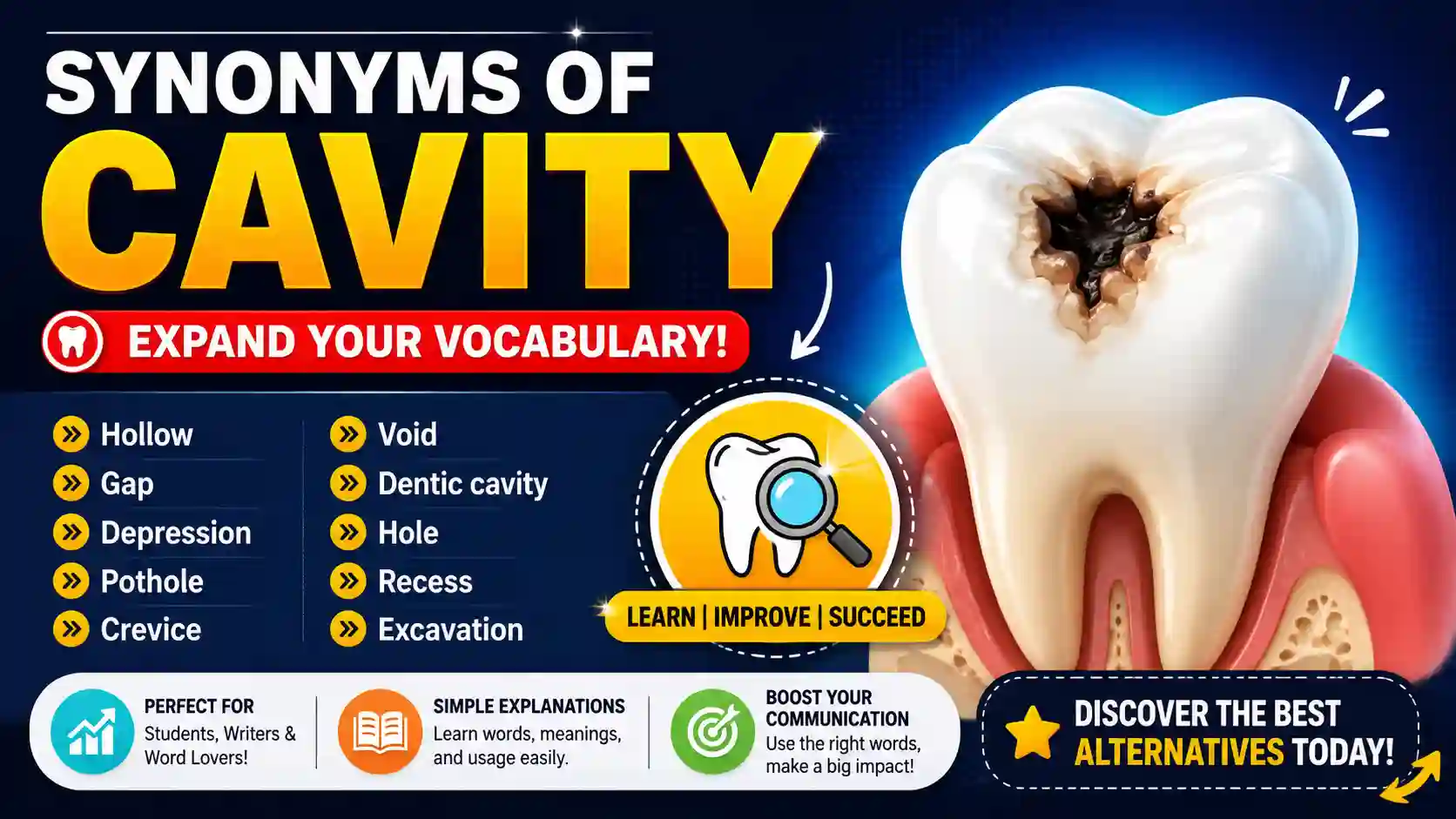
The most useful synonyms of cavity are hollow, hole, pit, recess, depression, indentation, concavity, and void. However, these words are not interchangeable in every sentence. Hole is the most common everyday alternative, while hollow often describes an empty space inside something. For dental contexts, tooth decay or caries may be more precise.
What Does Cavity Mean?
Cavity is a noun that generally means an empty, hollow, or sunken space inside something. It can describe a physical space in an object, a natural space in the body, or an area of decay in a tooth.
For example:
- The bird built its nest in a tree cavity.
- The surgeon examined the chest cavity.
- The dentist found a cavity in my tooth.
The best synonym changes with the meaning.
If you mean a simple opening, the hole may work.
If you mean an empty space inside something, hollow may be better.
If you mean a shallow dip on a surface, depression or indentation may be more accurate.
If you mean tooth decay, caries or tooth decay is more specific.
Pronunciation of Cavity
IPA: /ˈkæv.ə.ti/
Simple pronunciation: KAV-uh-tee
American English
/ˈkæv.ə.t̬i/
British English
/ˈkæv.ɪ.ti/
The spelling is the same in both varieties. The main pronunciation difference is the treatment of the middle consonant in many American accents.
Part of Speech
Cavity is primarily a countable noun.
Singular
- a cavity
Plural
- cavities
Example:
The dentist found three cavities.
The word does not normally function as a verb, adverb, or adjective.
A related technical adjective is cavitary, as in:
The scan showed a cavitary lesion.
This is specialist vocabulary and is not a normal everyday replacement for cavity.
Main Meanings of Cavity
Before choosing a synonym, identify which meaning you need.
| Meaning | Example | Best alternatives |
| Empty space inside something | cavity in a wall | hollow, void |
| Opening | cavity in the roof | hole, opening |
| Sunken surface | cavity in rock | depression, pit |
| Recessed area | cavity in a wall | recess |
| Body space | chest cavity | chamber, space |
| Dental decay | cavity in a tooth | caries, tooth decay |
| Scientific space | optical cavity | chamber, resonant cavity |
This sense-based approach is more useful than simply memorizing a list.
Quick Synonym Comparison
| Word | Best meaning | Register | Frequency |
| Hole | General opening or hollow | Neutral | Very common |
| Hollow | Empty space inside something | Neutral | Very common |
| Pit | Deep or noticeable depression | Neutral | Common |
| Depression | Sunken area | Formal/Neutral | Common |
| Indentation | Inward mark on a surface | Neutral/Formal | Common |
| Recess | Set-back space | Formal/Neutral | Common |
| Concavity | Inward-curving surface | Academic/Technical | Uncommon |
| Void | Empty internal space | Formal/Technical | Common in specialist writing |
| Chamber | Enclosed functional space | Technical/Formal | Common |
| Small contained area | Neutral | Common | |
| Gap | Space between things | Neutral | Very common |
| Opening | Access point or aperture | Neutral | Very common |
| Caries | Dental decay | Medical | Uncommon |
Important: Frequency describes general usefulness, not whether the word is an exact synonym.
1. Hole
Meaning: An opening or empty space in something.
Example:
There was a small hole in the roof.
Best used when: You want a simple, everyday word.
Register: Neutral, spoken English
Approximate learner level: A2–B1
Frequency: Very common
Nuance
The hole is broader and more ordinary than the cavity. It can describe an opening through something or an empty space in a solid object. Cambridge lists cavity as a synonym for this sense of hole.
Common collocations
- hole in the wall
- deep hole
- small hole
- drill a hole
- fill a hole
When not to use it
Avoid holes when a technical term is expected.
For example, a thoracic cavity is much more natural than a thoracic hole.
2. Hollow
Meaning: An empty or sunken space inside something.
Example:
The owl lived in a hollow in the old tree.
Best used when: Describing a natural or internal empty space.
Register: Neutral
Approximate learner level: B1
Frequency: Very common
Nuance
Hollow is one of the closest everyday alternatives to cavity. It often emphasizes that something is empty inside.
Dictionary.com defines hollow as an empty space within something and also as a hole, depression, or cavity.
Common collocations
- tree hollow
- hollow space
- hollow inside
- hollow log
When not to use it
Do not use it for a dental cavity unless you are deliberately using descriptive language.
3. Pit
Meaning: A hole or depression that is usually deep.
Example:
The truck got stuck in a muddy pit.
Best used when: The space has noticeable depth.
Register: Neutral
Approximate learner level: B1
Frequency: Common
Nuance
A pit often suggests a deeper depression than a normal cavity.
Common collocations
- deep pit
- fire pit
- mining pit
- pit in the ground
When not to use it
A small enclosed space in the body is not normally called a pit.
4. Depression
Meaning: A lower or sunken area on a surface.
Example:
Rainwater collected in a shallow depression.
Best used when: You want to emphasize that a surface dips inward.
Register: Neutral/Formal
Approximate learner level: B2
Frequency: Common
Nuance
This word is more precise than cavity when the feature is mainly a dip in a surface.
Common collocations
- shallow depression
- surface depression
- natural depression
When not to use it
Do not use depression when you mean an enclosed internal chamber.
5. Indentation
Meaning: A mark or area that has been pushed inward.
Example:
The metal panel had a deep indentation.
Best used when: Something has been pressed, struck, or shaped inward.
Register: Neutral/Formal
Approximate learner level: B2
Frequency: Common
Nuance
An indentation often results from pressure or impact.
Common collocations
- small indentation
- deep indentation
- surface indentation
When not to use it
A natural internal cavity is not necessarily an indentation.
6. Recess
Meaning: A space that is set back into a wall or surface.
Example:
The television was placed in a wall recess.
Best used when: Talking about architecture, furniture, or designed spaces.
Register: Formal/Neutral
Approximate learner level: B2
Frequency: Common
Nuance
A recess usually has a clear relationship with a surface. It is often intentional.
Common collocations
- wall recess
- recessed area
- shallow recess
When not to use it
Do not use recess as a general substitute for every medical or natural cavity.
7. Concavity
Meaning: A surface that curves inward.
Example:
The engineer measured the concavity of the lens.
Best used when: Writing about geometry, mathematics, engineering, or science.
Register: Academic/Technical
Approximate learner level: C1
Frequency: Uncommon
Nuance
This is a specialized word. It describes inward curvature, not simply an empty space.
Common collocations
- surface concavity
- degree of concavity
- concavity of a lens
When not to use it
Do not use it merely to sound sophisticated. In everyday writing, dip or hollow may be clearer.
8. Void
Meaning: An empty space, especially inside a material or structure.
Example:
Engineers discovered a void beneath the concrete floor.
Best used when: Writing about construction, engineering, geology, or technical subjects.
Register: Formal/Technical
Approximate learner level: C1
Frequency: Common in specialist writing
Nuance
Void sounds more technical than hole.
Common collocations
- internal void
- structural void
- empty void
- hidden void
When not to use it
In casual conversation, “There is a void in the wall” may sound overly technical.
9. Chamber
Meaning: An enclosed space, often designed for a particular purpose.
Example:
The machine contains a sealed chamber.
Best used when: The space has a function or defined boundaries.
Register: Formal/Technical
Approximate learner level: B2
Frequency: Common
Common collocations
- air chamber
- sealed chamber
- combustion chamber
- chamber pressure
When not to use it
A simple hole is not automatically a chamber.
10. Gap
Meaning: An open space between two things.
Example:
Cold air entered through a gap beneath the door.
Best used when: The empty space separates two objects or surfaces.
Register: Neutral
Approximate learner level: A2
Frequency: Very common
Key difference
Gap: usually between things.
Cavity: often inside something.
There is a gap between the boards.
There is a cavity inside the wall.
Collins includes a gap among the main alternatives for cavity but treats it as a separate sense involving a break or opening.
11. Opening
Meaning: A space that allows access, movement, light, or air.
Example:
The animal escaped through a narrow opening.
Best used when: The function of the space is more important than its depth.
Register: Neutral
Approximate learner level: A2
Frequency: Very common
Common collocations
- small opening
- narrow opening
- entrance opening
- opening in the wall
12. Pocket
Meaning: A small, contained area within something.
Example:
The rock contained a pocket of trapped air.
Best used when: The space is relatively small and localized.
Register: Neutral
Approximate learner level: B1
Frequency: Common
Nuance
Pockets can make a space sound small and contained.
13. Crater
Meaning: A large depression made by an impact, explosion, or volcanic activity.
Example:
The meteor left a huge crater.
Best used when: The hollow has a specific cause.
Register: Neutral
Approximate learner level: B2
Frequency: Common
When not to use it
A small cavity in a wall is not a crater.
Collins specifically treats crater as a context-specific sense of cavity, especially one produced by impact or explosion.
14. Cavern
Meaning: A large natural underground hollow.
Example:
The explorers entered a vast cavern.
Best used when: The space is large and cave-like.
Register: Neutral/Literary
Approximate learner level: B2
Frequency: Common
When not to use it
Do not call a tiny hollow in a tree a cavern.
15. Cave
Meaning: A natural hollow space in rock or underground.
Example:
The hikers found a small cave.
Best used when: You mean a natural underground space.
Register: Neutral
Approximate learner level: A2
Frequency: Very common
Key difference
A cave is a specific kind of natural hollow. Cavity is much broader.
16. Socket
Meaning: A hollow space designed to receive something.
Example:
The bulb fits securely into the socket.
Best used when: The hollow has a specific receiving function.
Register: Neutral/Technical
Approximate learner level: B2
Frequency: Common
It can also be anatomical, such as an eye socket or tooth socket.
When not to use it
A socket is not simply any cavity.
17. Dimple
Meaning: A small hollow or indentation.
Example:
A tiny dimple appeared in the soft metal.
Best used when: The depression is small and usually rounded.
Register: Neutral
Approximate learner level: B1
Frequency: Common
Nuance
Dimple is more specific and often suggests a small, shallow indentation.
18. Groove
Meaning: A long, narrow channel or indentation.
Example:
The cable fitted into a shallow groove.
Best used when: The cavity is long and narrow.
Register: Neutral
Approximate learner level: B1
Frequency: Common
19. Basin
Meaning: A broad, rounded depression that can hold liquid.
Example:
The rainwater collected in a natural basin.
Best used when: The hollow is broad and bowl-shaped.
Register: Neutral/Technical
Approximate learner level: B2
Frequency: Common
20. Excavation
Meaning: A hole or area created by removing earth or material.
Example:
The archaeological team examined the excavation.
Best used when: People have deliberately dug or removed material.
Register: Formal/Academic
Approximate learner level: C1
Frequency: Common in specialist writing
When not to use it
An excavation is normally created by digging or removal. It is not a synonym for a naturally occurring cavity.
21. Dental Caries
Meaning: The medical term for tooth decay.
Example:
The dentist treated early dental caries.
Best used when: Writing for medical, dental, or scientific audiences.
Register: Medical/Technical
Approximate learner level: C1
Frequency: Uncommon in everyday English
Important distinction
Cavity in everyday dental English usually refers to the damaged area or hole in a tooth.
Caries refers to the decay process/disease.
Therefore:
The dentist found a cavity.
is natural everyday English.
The patient has dental caries.
is more technical.
Merriam-Webster explicitly connects the dental sense of cavity with caries.
Best Synonyms by Context
This is the section most synonym lists are missing.
| Your sentence means… | Use this word |
| A normal hole | hole |
| An empty space inside something | hollow |
| A deep hollow | pit |
| A surface that dips | depression |
| A pressed-in mark | indentation |
| A designed inset | recess |
| An inward curve | concavity |
| An internal empty space | void |
| A functional enclosed space | chamber |
| Space between two things | gap |
| A passage or access point | opening |
| A small enclosed area | |
| A large impact depression | crater |
| A natural underground hollow | cave/cavern |
| A receiving space | socket |
| Tooth decay | caries/tooth decay |
Cavity vs. Hole vs. Hollow
This is one of the most important distinctions for English learners.
Cavity
More formal and often scientific.
The surgeon examined the abdominal cavity.
Hole
The common everyday word.
There is a hole in my shirt.
Hollow
Emphasizes emptiness inside something.
The tree has a hollow inside its trunk.
Dictionary.com specifically notes that hole is the common term, while cavity has more formal or scientific uses.
Cavity vs. Gap
These words are related but not identical.
Gap normally describes space between things.
There is a gap between the two bricks.
Cavity often describes space within something.
There is a cavity inside the wall.
Cavity vs. Dent
A dent is usually an indentation caused by pressure or impact.
The car has a dent in the door.
A cavity can be a natural or internal hollow.
The rock contains a cavity.
A dent is therefore a specific type of depression, not a universal replacement for cavity.
Cavity vs. Pit
A pit generally suggests a deeper depression.
The wheel dropped into a pit.
A cavity can be shallow, deep, internal, natural, or technical.
Cavity vs. Crater
A crater is a particular type of depression, often produced by an impact, explosion, or volcanic activity.
The meteor created a crater.
It would be incorrect to call every small cavity a crater.
Common Mistakes
Common Mistake Box
Mistake: “There is a gap inside the engine.”
Better: “There is a cavity inside the engine.”
Why: Gap usually suggests separation between things.
Mistake: “The dentist found a hole caused by caries, so caries and cavity are exactly the same.”
Better: “The dentist found a cavity caused by tooth decay.”
Why: Caries refers to dental decay, while cavity refers to the damaged hollow/area.
Mistake: “The scientist discovered a cave inside the machine.”
Better: “The scientist discovered a cavity inside the machine.”
Why: Cave normally refers to a natural underground hollow.
Mistake: “The wall has a crater.”
Better: “The wall has a cavity” or “The wall has a depression.”
Why: Crater usually implies a particular formation process.
How Native Speakers Choose the Word
Native speakers usually choose based on shape, location, cause, and purpose.
Shape
- shallow → depression
- deep → pit
- long and narrow → groove
- small and rounded → dimple
Location
- between objects → gap
- inside an object → cavity/hollow
- in a wall → recess
- underground → cave/cavern
Cause
- impact → crater
- pressure → dent
- digging → excavation
Purpose
- receives another object → socket
- functional enclosed space → chamber
This is a much better strategy than trying to memorize dozens of dictionary synonyms.
Common Collocations With Cavity
Native speakers frequently use cavity in combinations such as:
- chest cavity
- abdominal cavity
- nasal cavity
- oral cavity
- body cavity
- tooth cavity
- dental cavity
- tree cavity
- wall cavity
- cavity wall
- deep cavity
- internal cavity
- empty cavity
- fill a cavity
- cavity formation
Collins also lists combinations including chest cavity, deep cavity, dental cavity, internal cavity, nasal cavity, prevent cavities, fill a cavity, and stuff a cavity.
Word Origin and First Known Use
Cavity comes through Middle French cavité from Late Latin cavitās, ultimately related to Latin cavus, meaning “hollow.”
Merriam-Webster gives 1541 as the first known use in English for its first dictionary sense. Collins gives a sixteenth-century origin and traces the word to French and Late Latin.
The historical meaning fits the modern word well because the central idea has remained hollowness or an empty space.
American vs. British English
There is no major spelling difference:
- American English: cavity
- British English: cavity
The word is used in both varieties for body spaces and dental problems.
One useful difference is not the word itself but surrounding vocabulary. American and British speakers can sometimes prefer different everyday terms for related objects, but cavity itself is standard in both forms of English.
CEFR Learner Guide
These are approximate learning levels, not official CEFR assignments.
A1–A2
- hole
- gap
- cave
- opening
B1
- hollow
- pit
- dent
- groove
- dimple
B2
- recess
- depression
- indentation
- chamber
- cavern
- crater
- socket
C1 and specialist
- concavity
- void
- excavation
- caries
- dental caries
Remember: A more advanced word is not automatically a better word. Clear writing uses the simplest accurate word for the audience.
Practice: Choose the Best Word
1. The dentist found a ______ in my molar.
A. cavern
B. cavity
C. gap
D. crater
Answer: B. cavity
2. The meteor left a huge ______.
A. recess
B. pocket
C. crater
D. socket
Answer: C. crater
3. There was a small ______ between the two boards.
A. gap
B. chamber
C. cavern
D. cavity
Answer: A. gap
4. The bird lived in a ______ in the tree.
A. hollow
B. dent
C. crater
D. excavation
Answer: A. hollow
5. The machine contained an internal ______.
A. dimple
B. void
C. cave
D. dent
Answer: B. void
Rewrite Practice
Replace cavity with the most precise word.
Sentence 1
The rock contained a cavity.
Possible answer:
The rock contained a hollow.
Sentence 2
The meteor created a cavity in the surface.
Better:
The meteor created a crater.
Sentence 3
There was a cavity between the two boards.
Better:
There was a gap between the two boards.
Sentence 4
The wall had a cavity designed to hold the television.
Better:
The wall had a recess designed to hold the television.
FAQ
What is the most common synonym for cavity?
Hole is the most common everyday alternative when cavity means an opening or hollow space. Hollow is also very close when you want to emphasize an empty space inside something. Neither word replaces cavity in every technical or medical context.
What is another word for cavity in a tooth?
For everyday English, tooth decay and dental cavity are common expressions. Caries or dental caries is the more technical dental term. The exact choice depends on whether you mean the damaged area or the decay process.
Is hollow a synonym for cavity?
Yes, hollow can be a close synonym when cavity means an empty or sunken space. However, hollow has additional meanings and can function as a noun, adjective, and verb. Cavity is primarily a noun and often sounds more technical.
Is the hole the same as the cavity?
Not always. Hole is a broad everyday term for an opening or empty space. Cavity is often more specific and can describe an enclosed space inside something, including a body part or tooth. Technical writing often prefers cavities where holes would sound too general.
What is the formal word for cavity?
There is no single formal replacement for every use. Recess, void, concavity, and chamber can work in particular contexts. For example, void is useful in engineering, while concavity is suitable for geometry or technical descriptions.
What is the difference between cavity and depression?
A depression is specifically a lower or sunken area on a surface. A cavity can be a depression, but it can also be a deeper enclosed or internal space. Therefore, depression is narrower in meaning.
What is the difference between cavity and recess?
A recess is a space set back into a surface, especially a wall or architectural structure. A cavity is broader and can refer to natural, medical, dental, geological, or technical spaces.
Can I use cavity and void interchangeably?
Sometimes, especially in technical writing. Void emphasizes the absence of material, while cavity emphasizes the hollow space itself. Engineers may use void when discussing an empty area inside a structure, but everyday readers usually understand cavity more easily.
Final Takeaway
The best synonyms of cavity depend on what you actually mean.
Use a hole for a simple everyday opening. Use hollow for an empty space inside something. Choose pit for a deeper depression, recess for a set-back area, indentation for a pressed-in mark, and concavity for an inward curve. In technical writing, void and chamber may be better choices. For dental contexts, tooth decay and caries have more specific meanings.
The goal is not to replace cavity with the most complicated word. The goal is to choose the most accurate word for the situation.
References
- Merriam-Webster Dictionary: Cavity
- Merriam-Webster Thesaurus: Cavity
- Cambridge Dictionary: Cavity
- Collins Dictionary: Cavity
- Thesaurus.com: Cavity

Synonorm is a trusted English vocabulary resource created to help readers find the right words and understand the differences between similar terms. We provide clear explanations of synonyms, meanings, examples, usage, and alternatives. Our content makes vocabulary easier to learn and apply in everyday, academic, and professional English. Synonorm is designed for students, writers, ESL learners, professionals, and anyone who wants to improve their English vocabulary and communicate more clearly.