Quick Answer: What Are the Best Synonyms for Awareness?
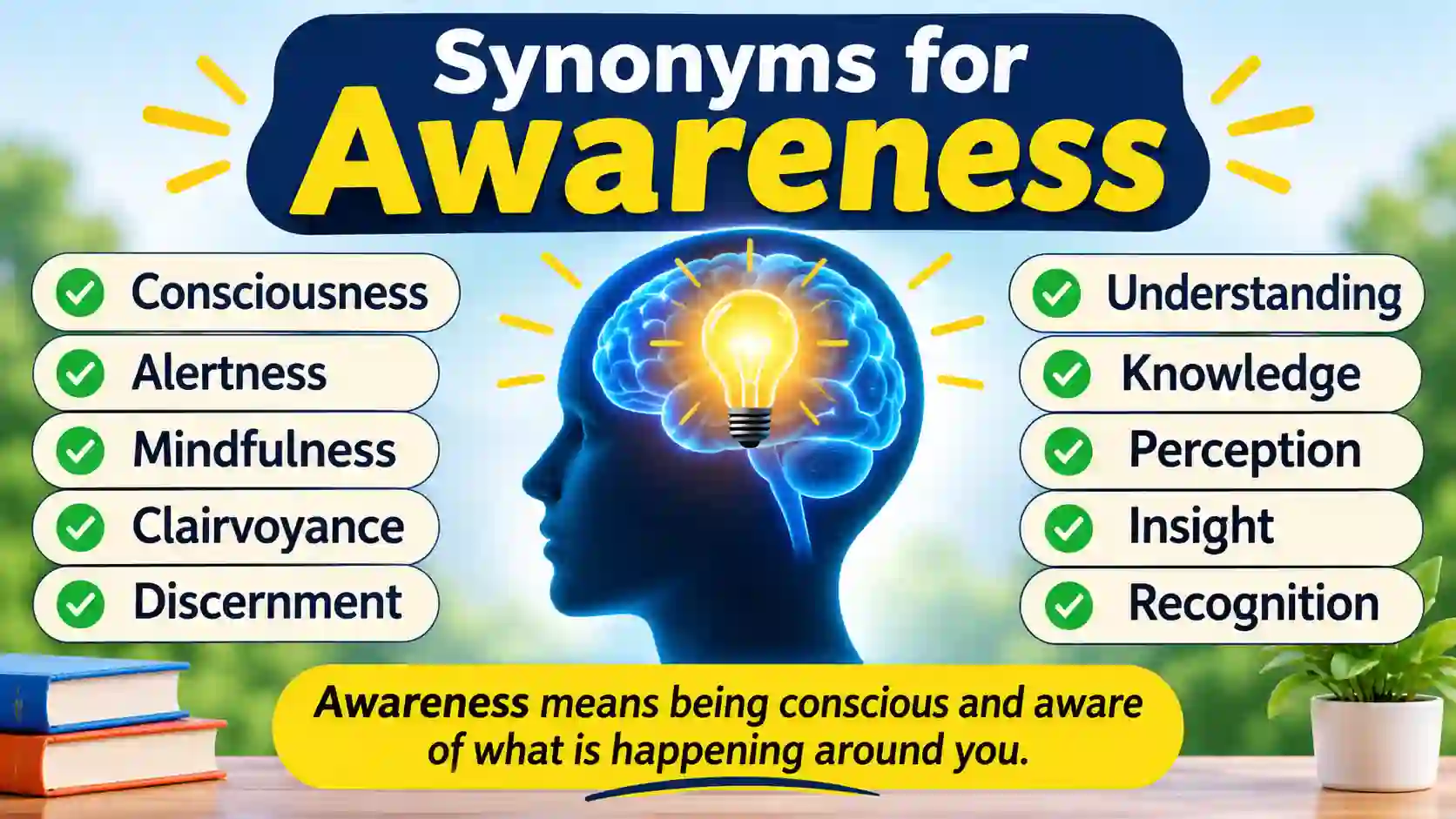
The best synonyms for awareness include knowledge, consciousness, understanding, recognition, realization, perception, familiarity, cognizance, mindfulness, and alertness. These words describe different ways of knowing, noticing, or understanding something. Some work in everyday English, while others suit academic, professional, or specific situations.
Do you use the word awareness too often in your writing? Finding a suitable alternative can help you explain your ideas without repeating the same word. However, not every similar word has exactly the same meaning.
For example, knowledge refers to information you have learned, while alertness means being ready to notice something. Mindfulness describes paying attention to the present moment, and recognition involves identifying or acknowledging something.
Learning the right synonyms for awareness can improve your essays, emails, blog posts, and everyday conversations. This guide explains 30 useful alternatives, their meanings, differences, pronunciation, and natural usage. You will also find practical examples, collocations, grammar tips, and exercises to help you choose the right word.
Pronunciation of Awareness
- American IPA: /əˈwer.nəs/
- British IPA: /əˈweə.nəs/
- American pronunciation: uh-WAIR-nuhs
- British pronunciation: uh-WAIR-uh-nuhs
- Part of speech: Noun
- Syllables: Three
- Word stress: Second syllable
What Does Awareness Mean?
Awareness is the state of knowing that something exists, understanding a situation, or noticing what is happening around you.
For example:
- She has awareness of the risks.
- Public awareness of air pollution is increasing.
- The driver showed awareness of nearby pedestrians.
Awareness is normally an uncountable noun. It can describe personal knowledge, public understanding, emotional insight, or attention to your surroundings.
Part of Speech and Word Family
Awareness is a noun. Its related forms include:
| Word | Part of Speech | Meaning |
| Aware | Adjective | Knowing about something |
| Awareness | Noun | The state of knowing |
| Unaware | Adjective | Not knowing something |
| Unawareness | Noun | A lack of awareness |
| Self-aware | Adjective | Conscious of your own thoughts and actions |
| Self-awareness | Noun | Understanding yourself |
There is no standard verb form of awareness. Use become aware, notice, or recognize when you need a verb.
Grammar: How to Use Awareness in a Sentence
These common sentence patterns will help you use the word correctly.
1. Awareness of + noun
- Children need awareness of road safety.
- The campaign increased awareness of online fraud.
2. Awareness that + clause
- There is growing awareness that pollution affects public health.
- She showed awareness that her decision could affect others.
3. Raise, increase, build, or develop awareness
- Schools should raise awareness about cyberbullying.
- The organization wants to build awareness of its services.
4. Awareness among people or group
- Awareness among employees has improved.
Common prepositions: of, about, and among.
Grammar reminder: Awareness is usually uncountable. Write “a lack of awareness” or “greater awareness,” not “many awarenesses.”
Quick Overview: 30 Synonyms and Related Alternatives
The table separates close alternatives from words that work only in particular situations.
| Word | Relationship | Formality |
| Knowledge | Close alternative | Neutral |
| Understanding | Close alternative | Neutral |
| Consciousness | Close alternative | Formal |
| Recognition | Close alternative | Neutral |
| Realization | Context-dependent | Neutral |
| Perception | Close alternative | Formal |
| Cognizance | Close alternative | Very formal |
| Familiarity | Context-dependent | Neutral |
| Comprehension | Context-dependent | Formal |
| Mindfulness | Context-dependent | Neutral |
| Alertness | Context-dependent | Neutral |
| Attention | Context-dependent | Neutral |
| Attentiveness | Context-dependent | Formal |
| Acquaintance | Context-dependent | Formal |
| Insight | Context-dependent | Neutral |
| Appreciation | Context-dependent | Neutral |
| Sensitivity | Context-dependent | Neutral |
| Discernment | Context-dependent | Formal |
| Vigilance | Context-dependent | Formal |
| Watchfulness | Context-dependent | Neutral |
| Acuteness | Related | Formal |
| Sensibility | Related | Literary |
| Perceptiveness | Related | Formal |
| Observation | Context-dependent | Neutral |
| Noticing | Context-dependent | Informal |
| Grasp | Context-dependent | Neutral |
| Information | Related, not an exact synonym | Neutral |
| Informedness | Related | Formal |
| Heed | Related | Formal |
| Sentience | Related, technical | Scientific |
30 Synonyms for Awareness With Meanings and Examples
1. Knowledge
Meaning: Knowledge is information or facts that someone has learned.
CEFR: A2–B1 (approximate learning guidance)
Frequency: Very common
Register: Neutral, academic, professional
Examples:
- Public knowledge of online safety has improved.
- The course increased students’ knowledge of environmental problems.
Best used when: You mean information or facts about a subject.
Collocations: General knowledge, practical knowledge, background knowledge.
Nuance: Knowledge focuses on what someone knows, while awareness can simply mean knowing that something exists.
When not to use it: Do not use it when you mean immediate attention to your surroundings.
2. Understanding
Meaning: Understanding is the ability to know what something means or how it works.
CEFR: B1
Frequency: Very common
Register: Neutral, academic, professional
Examples:
- The lesson improved our understanding of online privacy.
- She has a clear understanding of the company’s goals.
Best used when: You want to describe meaningful knowledge of an idea or situation.
Collocations: Deep understanding, basic understanding, mutual understanding.
Nuance: It suggests more than simply knowing that something exists.
When not to use it: Avoid it when you only mean noticing something.
3. Consciousness
Meaning: Consciousness is the state of being mentally aware or able to experience things.
CEFR: B2–C1
Frequency: Common
Register: Academic, scientific, formal
Examples:
- The discussion raised consciousness of social inequality.
- Scientists continue to study human consciousness.
Best used when: Discussing mental experience, social issues, or awareness of existence.
Collocations: Human consciousness, social consciousness, conscious awareness.
Nuance: It can refer to a broad mental state, not just knowledge of a particular topic.
When not to use it: Avoid it as a casual replacement for knowing a simple fact.
4. Recognition
Meaning: Recognition means identifying something or accepting that it exists or matters.
CEFR: B1–B2
Frequency: Very common
Register: Neutral, academic, professional
Examples:
- Recognition of the problem was the first step toward change.
- The campaign improved recognition of common online scams.
Best used when: Someone identifies or acknowledges an issue.
Collocations: Public recognition, recognition of risks, facial recognition.
Nuance: It focuses on identifying or accepting something.
When not to use it: Do not use it for general knowledge without an act of identification or acknowledgment.
5. Realization
Meaning: Realization is the moment when someone understands something clearly.
CEFR: B2
Frequency: Very common
Register: Neutral, academic
Examples:
- Her realization of the problem came too late.
- The experience led to a realization about the value of time.
Best used when: Describing a new understanding or discovery.
Collocations: Sudden realization, growing realization, realization that.
Nuance: It often suggests a change from not knowing to knowing.
When not to use it: Do not use it for knowledge someone has always had.
6. Perception
Meaning: Perception is the way someone notices or interprets something.
CEFR: B2
Frequency: Common
Register: Academic, professional, formal
Examples:
- Education can change public perception of environmental issues.
- Her perception of the situation was different from mine.
Best used when: Discussing viewpoints, interpretation, or sensory awareness.
Collocations: Public perception, visual perception, social perception.
Nuance: Perception concerns how someone sees or understands something, which may differ from the facts.
When not to use it: Avoid it when you simply mean factual knowledge.
7. Cognizance
Meaning: Cognizance means knowledge or recognition of something.
CEFR: C2 (approximate)
Frequency: Uncommon
Register: Legal, academic, highly formal
Examples:
- The company acted with full cognizance of the risks.
- Managers should maintain cognizance of changing regulations.
Best used when: Writing about formal knowledge of a situation or responsibility.
Collocations: Full cognizance, cognizance of risks, take cognizance.
Nuance: This word sounds more official than knowledge or understanding.
When not to use it: Avoid it in everyday conversation.
8. Familiarity
Meaning: Familiarity is knowledge gained through experience or previous contact.
CEFR: B2
Frequency: Common
Register: Neutral, academic, professional
Examples:
- Her familiarity with the software helped the team.
- Students need familiarity with basic grammar rules.
Best used when: Someone has previous experience with a subject or system.
Collocations: Basic familiarity, familiarity with technology, growing familiarity.
Nuance: It suggests previous exposure, not necessarily expert knowledge.
When not to use it: Do not use it when someone has only just noticed something.
9. Comprehension
Meaning: Comprehension is the ability to understand information or ideas.
CEFR: B2
Frequency: Common
Register: Academic, educational, formal
Examples:
- Reading improves children’s comprehension of difficult texts.
- The teacher tested the students’ comprehension of the lesson.
Best used when: Discussing the understanding of written or spoken information.
Collocations: Reading comprehension, listening comprehension, full comprehension.
Nuance: It emphasizes understanding meaning rather than simply noticing something.
When not to use it: Avoid it when you mean alertness or attention.
10. Mindfulness
Meaning: Mindfulness means paying careful attention to the present moment.
CEFR: B2
Frequency: Common
Register: Neutral, psychological, wellness
Examples:
- Mindfulness helped him focus on his daily activities.
- The teacher encouraged mindfulness during classroom discussions.
Best used when: Discussing present-moment attention and awareness of thoughts or feelings.
Collocations: Mindfulness practice, mindful awareness, mindfulness exercises.
Nuance: It suggests purposeful attention rather than general knowledge.
When not to use it: Do not use it to mean simply knowing a fact.
11. Alertness
Meaning: Alertness means being ready to notice things and respond quickly.
CEFR: B2
Frequency: Common
Register: Neutral, professional
Examples:
- Drivers need alertness when traveling at night.
- Her alertness helped prevent a serious mistake.
Best used when: Discussing safety, concentration, or quick reactions.
Collocations: Mental alertness, increased alertness, constant alertness.
Nuance: It suggests readiness and quick attention.
When not to use it: Avoid it for deep knowledge of an academic subject.
12. Attention
Meaning: Attention means focusing your mind or senses on something.
CEFR: A2
Frequency: Very common
Register: Neutral, spoken, academic
Examples:
- The safety announcement attracted everyone’s attention.
- Pay attention to the instructions before starting.
Best used when: You mean focus or concentration.
Collocations: Close attention, public attention, pay attention.
Nuance: Attention describes the act of focusing, while awareness describes a state of knowing.
When not to use it: Do not use it when you mean detailed knowledge.
13. Attentiveness
Meaning: Attentiveness means giving careful attention to someone or something.
CEFR: C1
Frequency: Common
Register: Formal, professional
Examples:
- The nurse showed attentiveness to every patient’s needs.
- His attentiveness during the meeting impressed his manager.
Best used when: Describing careful and thoughtful attention.
Collocations: Careful attentiveness, attentiveness to detail, personal attentiveness.
Nuance: It often describes a person’s behavior rather than information they know.
When not to use it: Avoid it as a replacement for general knowledge.
14. Acquaintance
Meaning: Acquaintance can mean some knowledge or experience of a subject.
CEFR: B2–C1
Frequency: Common
Register: Formal, neutral
Examples:
- She has a basic acquaintance with French literature.
- His acquaintance with the industry helped him find work.
Best used when: Describing limited experience or knowledge of something.
Collocations: Basic acquaintance, acquaintance with a subject, working acquaintance.
Nuance: It normally suggests limited knowledge, not deep expertise.
When not to use it: Do not confuse it with the more common meaning of a person you know but do not know well.
15. Insight
Meaning: Insight is a deep understanding of a person, problem, or situation.
CEFR: B2
Frequency: Very common
Register: Neutral, academic, professional
Examples:
- The interview gave us insight into customer behavior.
- Her experience provided valuable insight into the problem.
Best used when: Someone understands something in a thoughtful or revealing way.
Collocations: Valuable insight, fresh insight, insight into behavior.
Nuance: Insight suggests a deeper or more meaningful understanding.
When not to use it: Avoid it when you mean simple knowledge that something exists.
16. Appreciation
Meaning: Appreciation means understanding the value or importance of something.
CEFR: B2
Frequency: Very common
Register: Neutral, professional
Examples:
- The program developed an appreciation of local history.
- She has a strong appreciation for different cultures.
Best used when: Expressing awareness of value, beauty, quality, or importance.
Collocations: Appreciation of art, appreciation for nature, growing appreciation.
Nuance: It often carries a positive feeling of respect.
When not to use it: Do not use it when you only mean knowing that something exists.
17. Sensitivity
Meaning: Sensitivity is the ability to notice or respond to feelings, changes, or problems.
CEFR: B2
Frequency: Very common
Register: Neutral, professional, academic
Examples:
- Teachers need sensitivity to students’ emotional needs.
- The campaign increased sensitivity to cultural differences.
Best used when: Discussing emotional, social, or cultural awareness.
Collocations: Cultural sensitivity, emotional sensitivity, social sensitivity.
Nuance: It involves noticing and responding appropriately.
When not to use it: Avoid it when you mean ordinary factual knowledge.
18. Discernment
Meaning: Discernment is the ability to notice differences and make good judgments.
CEFR: C2
Frequency: Uncommon
Register: Formal, literary, academic
Examples:
- Good editors use discernment when selecting reliable sources.
- Her discernment helped the team avoid poor decisions.
Best used when: Describing thoughtful awareness that involves judgment.
Collocations: Good discernment, critical discernment, exercise discernment.
Nuance: It suggests careful judgment rather than simple observation.
When not to use it: Avoid it when you only mean knowing that something exists.
19. Vigilance
Meaning: Vigilance means carefully watching for danger or possible problems.
CEFR: C1
Frequency: Common
Register: Formal, professional
Examples:
- Online users need vigilance against fraudulent messages.
- Security teams maintained vigilance throughout the event.
Best used when: Discussing security, risks, safety, or possible threats.
Collocations: Constant vigilance, remain vigilant, vigilance against fraud.
Nuance: Vigilance implies continued attention because something could go wrong.
When not to use it: Do not use it for relaxed or general knowledge.
20. Watchfulness
Meaning: Watchfulness means carefully observing what happens around you.
CEFR: C1
Frequency: Uncommon
Register: Neutral, literary
Examples:
- The guard’s watchfulness helped keep the building secure.
- Parents need watchfulness when children play near busy roads.
Best used when: Describing careful observation over time.
Collocations: Constant watchfulness, careful watchfulness, parental watchfulness.
Nuance: It emphasizes watching rather than understanding.
When not to use it: Avoid it for abstract knowledge of history, science, or literature.
21. Acuteness
Meaning: Acuteness is the ability to notice or understand things sharply.
CEFR: C2
Frequency: Uncommon
Register: Formal, literary
Examples:
- Her mental acuteness helped her identify the hidden problem.
- The detective’s acuteness was clear during the investigation.
Best used when: Describing sharp mental perception or sensitivity.
Collocations: Mental acuteness, remarkable acuteness, visual acuteness.
Nuance: It describes the sharpness of someone’s ability to notice or understand.
When not to use it: Do not use it for ordinary knowledge.
22. Sensibility
Meaning: Sensibility is the ability to notice and respond to feelings, ideas, or experiences.
CEFR: C1–C2
Frequency: Uncommon
Register: Literary, formal
Examples:
- The writer showed sensibility toward social problems.
- Her artistic sensibility influenced the design.
Best used when: Discussing emotional, moral, or artistic awareness.
Collocations: Artistic sensibility, moral sensibility, emotional sensibility.
Nuance: It often carries an emotional or artistic meaning.
When not to use it: Avoid it when you simply mean factual knowledge.
23. Perceptiveness
Meaning: Perceptiveness is the ability to notice and understand things that others may miss.
CEFR: C1
Frequency: Uncommon
Register: Formal, professional
Examples:
- Her perceptiveness helped identify the customer’s real concerns.
- The manager praised his perceptiveness during the discussion.
Best used when: Describing someone who notices important details or hidden meanings.
Collocations: Emotional perceptiveness, social perceptiveness, remarkable perceptiveness.
Nuance: It combines careful observation with understanding.
When not to use it: Do not use it to describe simple information someone has learned.
24. Observation
Meaning: Observation is the act of watching something carefully to notice details or changes.
CEFR: B1
Frequency: Very common
Register: Academic, scientific, neutral
Examples:
- Careful observation helped researchers understand the behavior.
- The teacher encouraged observation of changes in nature.
Best used when: Discussing research, watching, or collecting information through the senses.
Collocations: Careful observation, direct observation, scientific observation.
Nuance: Observation is an activity that can lead to awareness, but the two words are not identical.
When not to use it: Avoid it when no act of watching or examining is involved.
25. Noticing
Meaning: Noticing is the act of becoming aware of something.
CEFR: A2–B1
Frequency: Very common
Register: Spoken, neutral, informal
Examples:
- Noticing small changes can help prevent bigger problems.
- She was good at noticing details in written work.
Best used when: Describing the moment someone sees, hears, or recognizes something.
Collocations: Noticing details, noticing changes, worth noticing.
Nuance: It focuses on the process of becoming aware.
When not to use it: Avoid it when discussing long-term knowledge or deep understanding.
26. Grasp
Meaning: Grasp means understanding an idea or situation clearly.
CEFR: B2
Frequency: Common
Register: Neutral, spoken, academic
Examples:
- The students developed a better grasp of online security.
- She quickly grasped the importance of the new rules.
Best used when: Describing someone’s understanding of a difficult idea.
Collocations: Firm grasp, basic grasp, grasp of a subject.
Nuance: It focuses on the result of understanding rather than simply noticing.
When not to use it: Do not use it for physical alertness.
27. Information
Meaning: Information is knowledge or facts provided about a subject.
CEFR: A2
Frequency: Very common
Register: Neutral, academic, professional
Examples:
- The website provides information about road safety.
- Employees received information about the new policy.
Best used when: You mean facts or details that help people become informed.
Collocations: Useful information, public information, provide information.
Nuance: Information can create awareness, but it is not the same as the state of being aware.
When not to use it: Do not replace awareness with information when discussing someone’s attention or consciousness.
28. Informedness
Meaning: Informedness is the state of having sufficient information about a subject.
CEFR: C1–C2
Frequency: Rare
Register: Academic, formal
Examples:
- The report examined the informedness of voters.
- Better access to reliable news can improve public informedness.
Best used when: Discussing how well a person or group has been informed.
Collocations: Public informedness, informedness of voters, level of informedness.
Nuance: It emphasizes having access to relevant information.
When not to use it: Avoid it in ordinary conversation; being informed is usually more natural.
29. Heed
Meaning: Heed means careful attention to advice, warnings, or instructions.
CEFR: C1
Frequency: Uncommon
Register: Formal, literary
Examples:
- Drivers should pay heed to road safety warnings.
- The team failed to heed the manager’s advice.
Best used when: Discussing whether someone listens to or acts on a warning.
Collocations: Pay heed, take heed, heed a warning.
Nuance: Heed is usually a noun or verb, not a direct replacement for awareness.
When not to use it: Do not use it when you simply mean general knowledge.
30. Sentience
Meaning: Sentience is the ability to experience feelings or sensations.
CEFR: C2
Frequency: Uncommon
Register: Scientific, philosophical, technical
Examples:
- Scientists continue to discuss animal sentience.
- The debate explored questions about machine sentience.
Best used when: Discussing the capacity to experience sensations or feelings.
Collocations: Animal sentience, human sentience, sentience debate.
Nuance: Sentience concerns the ability to experience, not simply knowing about a topic.
When not to use it: Do not use it as a normal replacement for awareness in everyday writing.
Strongest Synonyms, Strong Synonyms, and Related Words
For accurate writing, group these words according to their meaning.
Closest Alternatives
These words can replace awareness in many suitable sentences:
- Knowledge
- Understanding
- Consciousness
- Recognition
- Perception
- Cognizance
Context Dependent Alternatives
These work when the sentence expresses a specific type of knowing or noticing:
- Realization
- Familiarity
- Comprehension
- Mindfulness
- Alertness
- Attention
- Attentiveness
- Acquaintance
- Insight
- Appreciation
- Sensitivity
- Discernment
- Vigilance
- Watchfulness
- Acuteness
- Sensibility
- Perceptiveness
- Observation
- Noticing
- Grasp
Related Words, Not Exact Synonyms
These words connect to the idea of awareness but have different meanings:
- Information
- Informedness
- Heed
- Sentience
Remember: A related word is not automatically a suitable replacement. Always check the meaning of the full sentence.
Choose the Right Synonym: Side by Side Comparisons
The following examples show how a small change in vocabulary can change the meaning of a sentence.
| Word | Main Difference | Example |
| Awareness | Knowing that something exists | She has awareness of the risks. |
| Knowledge | Having facts or information | She has knowledge of the risks. |
| Understanding | Knowing what something means | She has an understanding of the risks. |
| Recognition | Identifying or accepting something | She showed recognition of the risks. |
| Perception | Interpreting something | Her perception of the risks changed. |
| Alertness | Being ready to notice | Her alertness helped her avoid danger. |
| Mindfulness | Paying attention to the present | Mindfulness helped her remain focused. |
| Familiarity | Knowing through experience | She has familiarity with the system. |
| Insight | Having a deeper understanding | The report offered insight into the risks. |
| Cognizance | Having formal knowledge | The company acted with cognizance of the risks. |
Which Synonym Should You Choose?
- Choose knowledge for facts and information.
- Choose understanding for clear comprehension.
- Choose consciousness for mental or social awareness.
- Choose recognition for identifying or acknowledging something.
- Choose perception for interpretation or viewpoints.
- Choose alertness for quick attention to surroundings.
- Choose mindfulness for present-moment attention.
- Choose familiarity for knowledge gained through experience.
- Choose insight for deep understanding.
- Choose vigilance for continued attention to possible danger.
Example: Changing One Sentence in Different Ways
Original: The campaign increased awareness of online fraud.
Possible alternatives:
- The campaign increased public knowledge of online fraud.
- The campaign improved recognition of common online scams.
- The campaign strengthened people’s understanding of online fraud.
- The campaign heightened public consciousness of digital risks.
Each sentence has a slightly different focus. The best alternative depends on what the campaign actually achieved.
Commonly Confused Words
| Words | Difference | Example |
| Awareness vs. Knowledge | Awareness means knowing something exists; knowledge involves information about it. | She has awareness of the issue and knowledge of its causes. |
| Awareness vs. Consciousness | Awareness can concern one topic; consciousness can describe mental experience. | He regained consciousness after the accident. |
| Awareness vs. Attention | Awareness is a state of knowing; attention is focused concentration. | Pay attention to the warning. |
| Awareness vs. Perception | Awareness means knowing; perception involves interpretation. | Her perception of the event was unusual. |
| Awareness vs. Mindfulness | Awareness is broad; mindfulness focuses on the present moment. | Mindfulness helped him notice his thoughts. |
Common Mistakes When Using Awareness Synonyms
Mistake 1: Treating Every Similar Word as an Exact Synonym
Mistake: His vigilance of history is excellent.
Correction: His knowledge of history is excellent.
Explanation: Vigilance means careful attention to possible danger or problems. Knowledge is the better choice for information about history.
Mistake 2: Confusing Awareness With Attention
Mistake: I have attention to the environmental problem.
Correction: I have awareness of the environmental problem.
Explanation: Use awareness when describing knowledge that an issue exists.
Mistake 3: Using Cognizance in Casual Conversation
Mistake: I have cognizance of your new phone.
Correction: I know about your new phone.
Explanation: Cognizance is highly formal and usually sounds unnatural in casual speech.
Mistake 4: Making Awareness Plural
Mistake: She has a lot of health.
Correction: She has a lot of knowledge about health.
Explanation: Awareness is normally uncountable when it describes general knowledge or understanding.
Mistake 5: Confusing Familiarity With Expertise
Mistake: I am an expert because I have familiarity with the software.
Correction: I have some familiarity with the software, but I still need more experience.
Explanation: Familiarity means previous knowledge or experience. It does not automatically mean expert ability.
American vs. British English: Spelling and Pronunciation
The noun awareness has the same spelling and basic meaning in American and British English.
| Feature | American English | British English |
| Spelling | Awareness | Awareness |
| IPA | /əˈwer.nəs/ | /əˈweə.nəs/ |
| Main meaning | Knowledge or understanding | Knowledge or understanding |
| Common phrase | Raise awareness | Raise awareness |
| Common expression | Public awareness | Public awareness |
The main difference is pronunciation, especially the vowel sound in the second syllable.
There is no standard American or British spelling variation for this word.
Word Origin and Etymology of Awareness
The word awareness comes from aware and the noun-forming suffix -ness.
The adjective aware comes from Old English gewær, which meant watchful or cautious. It is related to Germanic forms, including German gewahr.
Over time, the meaning developed from being watchful or alert to knowing that something exists or understanding a particular situation.
Word formation:
- Aware: Adjective
- -ness: Suffix that forms nouns
- Awareness: The state of being aware
Oxford records the Old English origin of awareness. A precise first-known-use date for the modern noun is not provided in that entry, so it is better not to present an unsupported historical date as certain.
CEFR Levels, Frequency, and Register
CEFR levels can help learners understand which vocabulary may be easier or more difficult. The following levels are approximate learning guidance, not official ratings for every word.
| Word | Approximate Level | Frequency | Best Context |
| Knowledge | A2 | Very common | Everyday and academic |
| Attention | A2 | Very common | Spoken and professional |
| Understanding | B1 | Very common | General and academic |
| Recognition | B1–B2 | Very common | General and academic |
| Observation | B1 | Very common | Research and education |
| Perception | B2 | Common | Academic and professional |
| Familiarity | B2 | Common | General and professional |
| Mindfulness | B2 | Common | Wellness and psychology |
| Insight | B2 | Very common | Business and academic |
| Cognizance | C2 | Uncommon | Legal and formal |
| Discernment | C2 | Uncommon | Academic and literary |
| Sentience | C2 | Uncommon | Scientific and philosophical |
Learner tip: Start with knowledge, understanding, recognition, attention, and familiarity. Learn advanced alternatives only when you understand their specific meanings.
Natural Collocations With Awareness
Collocations are words that commonly appear together. Learning them helps you write more naturally.
| Collocation | Example |
| Public awareness | Public awareness of the issue is growing. |
| Raise awareness | The charity wants to raise awareness of homelessness. |
| Increase awareness | The campaign increased awareness of road safety. |
| Growing awareness | There is growing awareness of online fraud. |
| Heightened awareness | The driver showed heightened awareness of the road. |
| Environmental awareness | Schools should promote environmental awareness. |
| Cultural awareness | Cultural awareness helps people work together. |
| Self-awareness | Self-awareness can improve personal development. |
| Social awareness | The project promotes social awareness. |
| Lack of awareness | A lack of awareness can lead to mistakes. |
| Brand awareness | Advertising can improve brand awareness. |
| Situational awareness | Pilots need strong situational awareness. |
These combinations are useful in academic writing, marketing, education, workplace communication, and everyday English.
When Should You Keep the Word Awareness?
Sometimes the original word is better than any replacement.
Keep awareness when:
- You mean general knowledge that something exists.
- You are discussing public understanding of a social issue.
- You are using established expressions such as brand awareness.
- You are discussing environmental, cultural, or health awareness.
- No alternative expresses the full meaning of your sentence.
For example, brand awareness is an established marketing term. Replacing it with brand vigilance would change the meaning.
Antonyms of Awareness
Antonyms describe the opposite of knowing, noticing, or understanding something.
| Antonym | Meaning |
| Ignorance | Lack of knowledge |
| Unawareness | Not knowing about something |
| Obliviousness | Failure to notice something |
| Inattention | Lack of focused attention |
| Unfamiliarity | Lack of knowledge or experience |
| Insensitivity | Lack of awareness or response to feelings |
| Unconsciousness | Lack of conscious awareness |
Related Vocabulary and Expressions
These phrases are useful when discussing different types of awareness.
- Raise public awareness
- Build brand awareness
- Develop self-awareness
- Promote environmental awareness
- Improve cultural awareness
- Increase health awareness
- Show social awareness
- Demonstrate situational awareness
- Heighten awareness of risks
- Spread information
- Become aware of something
- Be fully aware of a situation
How to Use Awareness Synonyms in Different Types of Writing
In Essays
Use knowledge, understanding, perception, and recognition when discussing ideas.
Example: Education increases students’ understanding of social issues.
In Emails
Choose clear and professional words.
Example: We would like to increase employee awareness of the updated safety policy.
In Blog Posts
Use suitable alternatives to avoid repeating the same word.
Example: Public knowledge of online privacy has improved. This growing understanding encourages safer browsing habits.
In Stories
Use realization, perception, and noticing to describe a character’s thoughts.
Example: Her sudden realization changed the way she viewed her friend.
In Social Media
Use familiar phrases such as raise awareness, spread information, and show support.
Example: Let’s raise awareness about protecting our environment.
In Professional Communication
Use cognizance, insight, recognition, and familiarity when their meanings fit the subject.
Writing tip: Never replace a word just to avoid repetition. The new word must preserve the meaning of the sentence.
Mini Vocabulary Practice
Test what you have learned with these three activities.
Exercise 1: Fill in the Blanks
Choose the best word from the word bank.
Word bank: Alertness, understanding, recognition, mindfulness, realization.
- Drivers need ______ when traveling on busy roads.
- The lesson improved our ______ of the subject.
- Public ______ of online scams has increased.
- Her sudden ______ helped her understand the mistake.
- ______ means paying attention to the present moment.
Exercise 2: Rewrite the Sentences
Replace the bold word with a suitable alternative without changing the main meaning.
- She has a strong awareness of environmental problems.
- The lesson improved our awareness of online safety.
- His awareness of the danger helped him act quickly.
Exercise 3: Match the Words
Match each word with the correct meaning.
| Word | Meaning |
| 1. Perception | A. Deep understanding |
| 2. Insight | B. Present-moment attention |
| 3. Mindfulness | C. Interpretation of something |
| 4. Familiarity | D. Knowledge through experience |
Answer Key
Exercise 1:
- Alertness
- Understanding
- Recognition
- Realization
- Mindfulness
2:
- She has a strong understanding of environmental problems.
- The lesson improved our knowledge of online safety.
- His alertness to the danger helped him act quickly.
3:
- C
- A
- B
- D
Frequently Asked Questions
1. What are the best synonyms for awareness?
The best synonyms include knowledge, understanding, consciousness, recognition, perception, familiarity, and cognizance. The correct choice depends on your sentence. Use knowledge for facts, understanding for clear comprehension, and recognition when someone identifies or accepts that something exists.
2. What is a more professional word for awareness?
Professional alternatives include understanding, recognition, perception, familiarity, and cognizance. For example, you can write “employee understanding of company policies” instead of “employee awareness of company policies.” Cognizance is particularly formal and suits specific official or legal contexts.
3. What is another way to say raising awareness?
You can say increasing understanding, promoting public knowledge, spreading information, building recognition, or educating people. The best phrase depends on your goal. For example, a charity may promote public understanding of an issue through educational campaigns and community events.
4. Is knowledge the same as awareness?
Knowledge and awareness are related but not identical. Awareness means knowing that something exists or noticing a situation. Knowledge usually involves having information or facts about it. Someone may be aware of climate change without understanding its causes or effects.
5. What is the opposite of awareness?
Common antonyms include ignorance, unawareness, obliviousness, inattention, and unfamiliarity. Each word describes a different type of lack. Ignorance means a lack of knowledge, while inattention means failing to focus. Obliviousness means not noticing something happening around you.
6. What is the difference between awareness and mindfulness?
Awareness is a broad term for knowing or noticing something. Mindfulness is a more specific form of attention that focuses on the present moment. For example, you can have awareness of traffic conditions, while mindfulness may involve noticing your thoughts and surroundings without distraction.
7. What is self-awareness?
Self-awareness means understanding your own thoughts, feelings, behavior, strengths, and weaknesses. It helps people recognize how their actions affect themselves and others. Someone with good self-awareness may notice when they become impatient and make an effort to respond calmly.
8. Which synonym for awareness is best for academic writing?
Understanding, perception, recognition, comprehension, and cognizance can work in academic writing. The best choice depends on the subject. Use comprehension when discussing learning, perception when discussing interpretation, and cognizance when referring to formal knowledge of a fact or situation.
Conclusion
Learning synonyms for awareness can improve your vocabulary, writing, and communication skills. Words such as knowledge, understanding, recognition, perception, and mindfulness help you express different meanings with greater accuracy.
Choose alternatives based on context rather than replacing words randomly. Practice using these expressions in essays, emails, blog posts, schoolwork, and conversations. Every new word you learn gives you another way to communicate clearly and confidently.
References
- Oxford Learner’s Dictionaries: Awareness definition, pronunciation, and collocations.
- Cambridge Dictionary: Awareness meaning and usage.
- Cambridge Thesaurus: Synonyms and antonyms of awareness.
- Merriam-Webster: English definitions and synonym guidance.
- Collins Dictionary: American English synonyms and definitions.

Synonorm is a trusted English vocabulary resource created to help readers find the right words and understand the differences between similar terms. We provide clear explanations of synonyms, meanings, examples, usage, and alternatives. Our content makes vocabulary easier to learn and apply in everyday, academic, and professional English. Synonorm is designed for students, writers, ESL learners, professionals, and anyone who wants to improve their English vocabulary and communicate more clearly.