
Quick Answer: What Are Synonyms of Consequences?
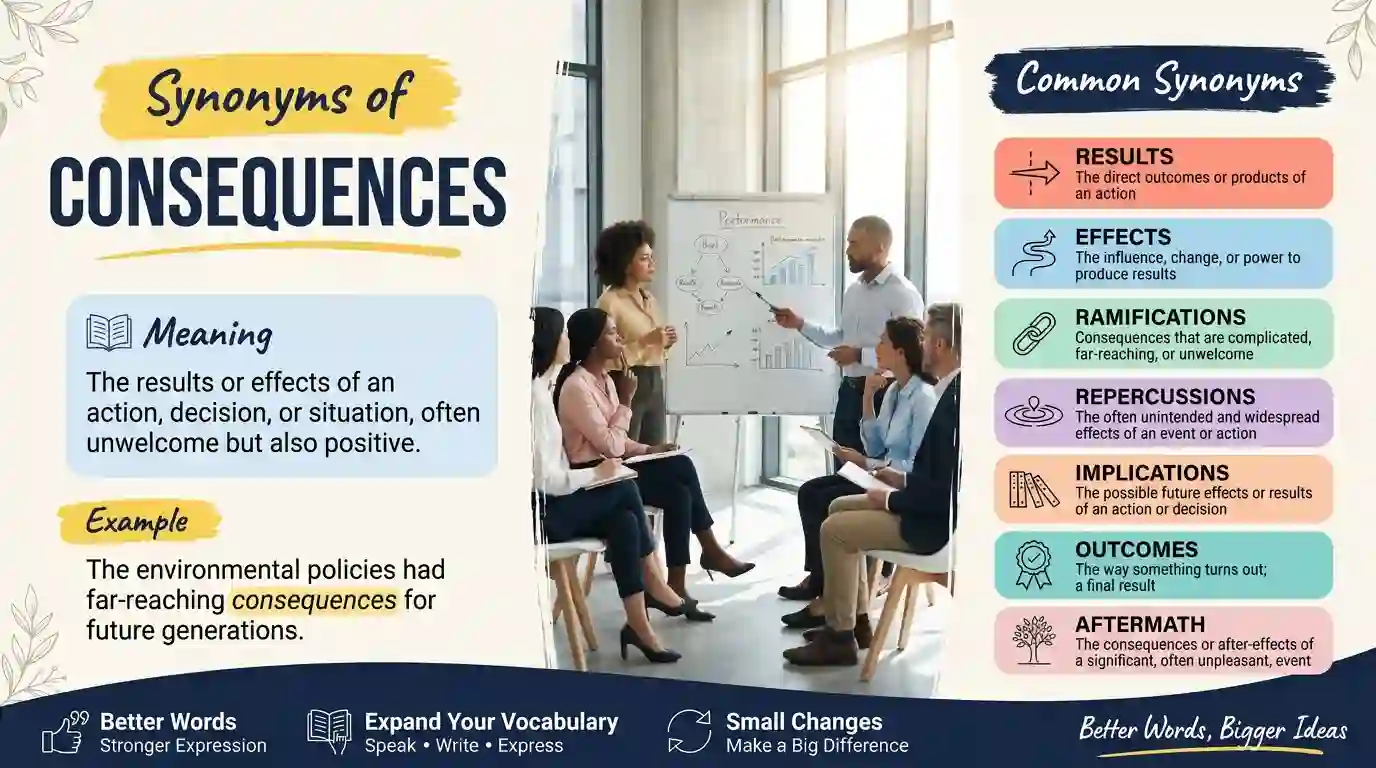
The best synonyms of consequences include results, effects, outcomes, repercussions, ramifications, aftermath, fallout, impact, upshot, and aftereffects. These words describe what happens because of an action, decision, or event. Some have neutral meanings, while others suggest harmful, unexpected, or long-lasting effects.
Have you ever written an essay and noticed that you keep using the word consequences? Finding another word can make your writing clearer, but not every synonym carries the same meaning.
Consequences are the results or effects that follow an action, decision, or event. For example, ignoring a warning can have serious consequences. These may include financial losses, safety problems, or damage to relationships.
Learning synonyms of consequences helps you explain these situations with greater accuracy. Students can improve their essays, teachers can explain vocabulary more clearly, and professionals can write better reports and emails.
This guide covers 30 alternatives, including their meanings, examples, pronunciation guidance, formality, collocations, and common usage mistakes.
Pronunciation of Consequences
IPA:
- American English: /ˈkɑːnsəkwensɪz/
- British English: /ˈkɒnsɪkwənsɪz/
Pronounced as: KON-suh-kwen-size.
The singular form is consequence, while consequences is the plural form.
Part of Speech
Consequences is a plural countable noun.
It describes multiple results that follow an action, decision, or event.
Examples:
- Every action has consequences.
- The consequences of the decision were unexpected.
Related word forms:
| Word | Part of Speech | Meaning |
| Consequence | Noun | A result |
| Consequences | Plural noun | Multiple results |
| Consequent | Adjective | Following as a result |
| Consequential | Adjective | Having important effects |
| Consequently | Adverb | As a result |
| Inconsequential | Adjective | Not important |
Word Origin and Etymology
The word consequence entered English through Middle English and Anglo-French. It comes from the Latin consequentia, which means something that follows.
Its Latin root is consequi, meaning to follow after or follow closely.
The word dates to the late Middle English period, around the 14th century. Its meaning developed around the idea of an event or condition that follows another event.
Interesting fact: The word also has a formal meaning related to importance. For example, “The matter is of no consequence” means that the matter is not important.
Grammar: How to Use Consequences
Here are five common sentence patterns.
1. Consequences of something
Use this pattern to explain the source of a result.
Example: The consequences of poor planning can be expensive.
2. Consequences for someone
Use this pattern to explain who experiences the effects.
Example: The policy had serious consequences for employees.
3. As a consequence of
Use this expression to mean because of something.
Example: As a consequence of the storm, several roads closed.
4. Face the consequences
Use this expression when someone must accept the results of their actions.
Example: He must face the consequences of his decision.
5. Consequences that follow
Use this pattern to describe results that happen after an event.
Example: We discussed the problems that could follow the changes.
Common Grammar Rule
Consequences is plural, so it usually takes a plural verb.
- Incorrect: The consequences were unexpected.
- Correct: The consequences were unexpected.
However, the singular form consequence takes a singular verb.
Example: The consequence was difficult to predict.
30 Synonyms of Consequences: Quick Comparison Table
The strength column describes how closely a word matches the meaning of consequences.
| Synonym | Strength | Formality |
| Results | Strongest | Neutral |
| Effects | Strongest | Neutral |
| Outcomes | Strongest | Neutral |
| Repercussions | Strongest | Formal |
| Ramifications | Strong | Formal |
| Aftermath | Strong | Neutral |
| Fallout | Strong | Informal |
| Impact | Strong | Neutral |
| Upshot | Strong | Informal |
| Aftereffects | Strong | Neutral |
| Implications | Strong | Formal |
| Side effects | Contextual | Neutral |
| End results | Strong | Neutral |
| Knock-on effects | Contextual | British |
| Ripple effects | Contextual | Neutral |
| Sequel | Contextual | Neutral |
| Outgrowth | Contextual | Formal |
| By-products | Contextual | Neutral |
| Corollary | Contextual | Academic |
| Fruit | Contextual | Literary |
| Product | Contextual | Neutral |
| Issue | Contextual | Neutral |
| Event | Related | Neutral |
| Payback | Contextual | Informal |
| Penalty | Contextual | Formal |
| Cost | Contextual | Neutral |
| Toll | Contextual | Neutral |
| Damage | Contextual | Neutral |
| Backlash | Contextual | Neutral |
| Sequelae | Specialized | Medical |
30 Synonyms of Consequences with Examples and Explanations
1. Results
Meaning: Results are things that happen because of an action or event.
Examples:
- Regular exercise produces positive results.
- The manager reviewed the results of the marketing campaign.
Best Used When: You need a simple word for the general outcome of an action.
Tone: Neutral, academic, professional.
CEFR: A2 | Frequency: Very common.
Collocations: Positive results, expected results, final results.
When Not to Use: Avoid it when you need to emphasize indirect or delayed harmful effects.
2. Effects
Meaning: Effects are changes caused by an action or situation.
Examples:
- Lack of sleep can have negative effects on memory.
- The new rules had positive effects on workplace safety.
Best Used When: Explaining how something changes a person, place, or situation.
Tone: Neutral, academic, scientific.
CEFR: B1 | Frequency: Very common.
Collocations: Long-term effects, harmful effects, beneficial effects.
When Not to Use: Do not use it when you specifically mean the final result of a process.
3. Outcomes
Meaning: Outcomes are the final results of an activity, decision, or process.
Examples:
- The team discussed several possible outcomes before voting.
- Better training can improve workplace outcomes.
Best Used When: Talking about the final state of a process or decision.
Tone: Neutral, academic, business.
CEFR: B2 | Frequency: Common.
Collocations: Possible outcomes, successful outcomes, desired outcomes.
When Not to Use: Avoid it when discussing a chain of indirect effects rather than a final result.
4. Repercussions
Meaning: Repercussions are usually indirect and negative results that follow an action.
Examples:
- The director faced serious repercussions after ignoring the safety rules.
- The announcement created political repercussions for the government.
Best Used When: Describing delayed or harmful results of an action.
Tone: Formal, professional, journalistic.
CEFR: C1 | Frequency: Common.
Collocations: Serious repercussions, political repercussions, lasting repercussions.
When Not to Use: Do not use it for ordinary positive results.
5. Ramifications
Meaning: Ramifications are the wider or more complex effects of an action or decision.
Examples:
- The lawyer explained the legal ramifications of the agreement.
- We considered the financial ramifications before investing.
Best Used When: Discussing complicated effects that may influence several areas.
Tone: Formal, academic, business.
CEFR: C1 | Frequency: Common.
Collocations: Legal ramifications, financial ramifications, wider ramifications.
When Not to Use: Avoid it for simple results that need no detailed explanation.
6. Aftermath
Meaning: The aftermath is the situation that follows a major or unpleasant event.
Examples:
- Volunteers helped families in the aftermath of the flood.
- The town faced many challenges in the aftermath of the fire.
Best Used When: Describing the conditions following a disaster, conflict, or serious event.
Tone: Neutral, formal, journalistic.
CEFR: B2 | Frequency: Common.
Collocations: Aftermath of war, aftermath of a disaster, immediate aftermath.
When Not to Use: Do not use it for every small result of an everyday action.
7. Fallout
Meaning: Fallout refers to unpleasant or damaging effects that follow an event.
Examples:
- The company struggled with the fallout from the public scandal.
- The policy created economic fallout across several industries.
Best Used When: Describing wider negative effects, especially in politics, business, and public life.
Tone: Informal, journalistic.
CEFR: C1 | Frequency: Common.
Collocations: Political fallout, economic fallout, public fallout.
When Not to Use: Avoid it when discussing ordinary positive outcomes.
8. Impact
Meaning: Impact is the strong effect that something has on a person or situation.
Examples:
- Technology has had a major impact on education.
- Rising prices have a serious impact on household budgets.
Best Used When: Highlighting the strength or importance of an effect.
Tone: Neutral, academic, professional.
CEFR: B2 | Frequency: Very common.
Collocations: Major impact, lasting impact, social impact.
When Not to Use: Do not use it as an automatic replacement for every individual result.
9. Upshot
Meaning: The upshot is the final or most important result of a situation.
Examples:
- The upshot of the meeting was a new agreement.
- We discussed several plans, but the upshot was that we needed more time.
Best Used When: Summarizing the main result of a discussion or event.
Tone: Informal, conversational.
CEFR: C1 | Frequency: Common.
Collocations: The upshot of, final upshot, practical upshot.
When Not to Use: Avoid it in highly formal academic writing when outcome is more suitable.
10. Aftereffects
Meaning: Aftereffects are changes or problems that remain after an event has ended.
Examples:
- The patient experienced aftereffects from the treatment.
- The emotional aftereffects of the accident lasted for months.
Best Used When: Discussing lasting physical, emotional, or social effects.
Tone: Neutral, medical, professional.
CEFR: B2 | Frequency: Common.
Collocations: Long-term aftereffects, physical aftereffects, emotional aftereffects.
When Not to Use: Avoid it for immediate results that do not continue.
11. Implications
Meaning: Implications are possible effects or important meanings that follow from a situation.
Examples:
- The research has important implications for education.
- We discussed the legal implications of the new agreement.
Best Used When: Explaining what an action or discovery may mean for the future.
Tone: Formal, academic, professional.
CEFR: C1 | Frequency: Common.
Collocations: Legal implications, wider implications, serious implications.
When Not to Use: Do not use it when you simply want to name an obvious, direct result.
12. Side Effects
Meaning: Side effects are additional effects that occur alongside the main result, often unwanted.
Examples:
- The medicine caused mild side effects.
- Working late every night can have side effects on family life.
Best Used When: Describing unintended or secondary effects.
Tone: Neutral, medical, everyday.
CEFR: B2 | Frequency: Very common.
Collocations: Common side effects, unwanted side effects, possible side effects.
When Not to Use: Avoid it when you mean the main intended result.
13. End Results
Meaning: End results are the final things produced by an action or process.
Examples:
- Careful planning improved the end results of the project.
- The end results were better than the team expected.
Best Used When: Emphasizing the final stage of a process.
Tone: Neutral, professional.
CEFR: B1 | Frequency: Common.
Collocations: Expected end results, overall end results, final results.
When Not to Use: Avoid it when describing several separate effects that happen along the way.
14. Knock-on Effects
Meaning: Knock-on effects are additional effects caused by an earlier event or action.
Examples:
- The factory closure had knock-on effects for nearby shops.
- Higher fuel prices created knock-on effects across the transport industry.
Best Used When: Describing a chain of effects that spreads to other areas.
Tone: Neutral, especially common in British English.
CEFR: C1 | Frequency: Common.
Collocations: Wider knock-on effects, economic knock-on effects, unexpected knock-on effects.
When Not to Use: Avoid it when discussing only one direct result.
15. Ripple Effects
Meaning: Ripple effects are further effects that spread from an initial action or event.
Examples:
- The school closure created ripple effects across the community.
- A small change in interest rates can have ripple effects on the housing market.
Best Used When: Explaining how one event influences several connected situations.
Tone: Neutral, academic, business.
CEFR: B2 | Frequency: Common.
Collocations: Wider ripple effects, economic ripple effects, lasting ripple effects.
When Not to Use: Do not use it when describing only one isolated result.
16. Sequel
Meaning: A sequel is something that follows an earlier event and develops or continues it.
Examples:
- The protests were a sequel to the earlier public demonstrations.
- The second investigation was a sequel to the first inquiry.
Best Used When: Describing a later event connected to an earlier one.
Tone: Neutral, literary, journalistic.
CEFR: C1 | Frequency: Common.
Collocations: Direct sequel, natural sequel, sequel to an event.
When Not to Use: Do not use it for a general result that does not continue an earlier event.
17. Outgrowth
Meaning: An outgrowth is something that develops naturally from an earlier situation or activity.
Examples:
- The new training program was an outgrowth of employee feedback.
- The disagreement was an outgrowth of poor communication.
Best Used When: Explaining how one situation develops from another.
Tone: Formal, academic.
CEFR: C1 | Frequency: Uncommon.
Collocations: Natural outgrowth, direct outgrowth, outgrowth of a movement.
When Not to Use: Avoid it for simple results that do not develop over time.
18. By products
Meaning: By-products are additional results produced while doing or creating something else.
Examples:
- Waste heat is a by-product of the manufacturing process.
- Greater confidence was an unexpected by-product of her training.
Best Used When: Describing secondary results that were not the main goal.
Tone: Neutral, scientific, professional.
CEFR: B2 | Frequency: Common.
Collocations: Industrial by-products, unwanted by-products, unexpected by-products.
When Not to Use: Do not use it for the main intended result.
19. Corollary
Meaning: A corollary is a natural result that follows logically from something else.
Examples:
- Increased demand is often a corollary of population growth.
- Greater responsibility is a corollary of leadership.
Best Used When: Discussing logical or closely connected results.
Tone: Formal, academic.
CEFR: C2 | Frequency: Uncommon.
Collocations: Natural corollary, logical corollary, direct corollary.
When Not to Use: Avoid it in simple conversations when the result or effect would be clearer.
20. Fruit
Meaning: Fruit can describe a positive result produced by effort or activity.
Examples:
- Years of hard work finally bore fruit.
- The research produced valuable fruit for the scientific community.
Best Used When: Describing benefits or achievements that come from effort.
Tone: Literary, formal.
CEFR: B2 | Frequency: Common in the expression “bear fruit.”
Collocations: Bear fruit, fruits of labor, fruits of success.
When Not to Use: Avoid it as a direct replacement for negative consequences.
21. Product
Meaning: A product can be something created as a result of an action or process.
Examples:
- The new design was a product of careful research.
- The disagreement was a product of poor communication.
Best Used When: Explaining what an activity or situation produces.
Tone: Neutral, academic, professional.
CEFR: B1 | Frequency: Very common.
Collocations: Product of experience, product of research, natural product.
When Not to Use: Do not use it when you mean a specific punishment or harmful effect.
22. Issue
Meaning: An issue can be a problem or matter that develops because of a situation.
Examples:
- The software update created several technical issues.
- Poor communication led to issues between the two departments.
Best Used When: Discussing problems that arise from an action or decision.
Tone: Neutral, professional.
CEFR: B1 | Frequency: Very common.
Collocations: Related issues, potential issues, ongoing issues.
When Not to Use: Do not treat every consequence as an issue. An issue usually refers to a problem or matter.
23. Event
Meaning: An event is something that happens, sometimes as part of a chain of events.
Examples:
- The announcement was followed by a series of unexpected events.
- The decision became an important event in the company’s history.
Best Used When: Describing something that happens after an earlier situation.
Tone: Neutral, everyday, journalistic.
CEFR: A2 | Frequency: Very common.
Collocations: Major event, unexpected event, chain of events.
When Not to Use: Avoid it when you need to explain the result rather than the occurrence itself.
24. Payback
Meaning: Payback can describe an unpleasant result or retaliation that follows someone’s actions.
Examples:
- He received payback for repeatedly mistreating his colleagues.
- The company faced public payback after ignoring customer complaints.
Best Used When: Describing retaliation or an informal form of punishment.
Tone: Informal, conversational.
CEFR: B2 | Frequency: Common.
Collocations: Get payback, exact payback, seek payback.
When Not to Use: Avoid it in formal academic writing or when describing neutral results.
25. Penalty
Meaning: A penalty is a punishment or disadvantage given for breaking a rule or law.
Examples:
- Late payments may result in a financial penalty.
- The player received a penalty for breaking the competition rules.
Best Used When: Discussing official punishment or financial consequences.
Tone: Formal, legal, professional.
CEFR: B2 | Frequency: Common.
Collocations: Financial penalty, legal penalty, severe penalty.
When Not to Use: Do not use it for every result of an action. A result does not always involve punishment.
26. Cost
Meaning: Cost can describe the money, effort, or loss caused by an action.
Examples:
- Poor planning increased the cost of the project.
- The decision came at a heavy personal cost.
Best Used When: Explaining financial or personal sacrifices.
Tone: Neutral, business, everyday.
CEFR: A2 | Frequency: Very common.
Collocations: Financial cost, hidden cost, social cost.
When Not to Use: Avoid it when the result has no connection to money, effort, or sacrifice.
27. Toll
Meaning: A toll is the amount of damage, suffering, or loss caused by something.
Examples:
- Years of stress took a toll on his health.
- The disaster took a heavy toll on local families.
Best Used When: Highlighting serious physical, emotional, or financial harm.
Tone: Neutral, emotional, journalistic.
CEFR: B2 | Frequency: Common.
Collocations: Heavy toll, emotional toll, financial toll.
When Not to Use: Avoid it when describing positive or harmless results.
28. Damage
Meaning: Damage is harm or loss caused to a person, object, organization, or situation.
Examples:
- The storm caused serious damage to nearby buildings.
- False information can cause lasting damage to someone’s reputation.
Best Used When: Focusing on harmful results.
Tone: Neutral, professional, everyday.
CEFR: A2 | Frequency: Very common.
Collocations: Serious damage, lasting damage, environmental damage.
When Not to Use: Do not use it for positive or neutral results.
29. Backlash
Meaning: A backlash is a strong negative reaction against an action or decision.
Examples:
- The advertisement caused a public backlash.
- The new workplace policy faced a backlash from employees.
Best Used When: Discussing criticism, protests, or public opposition.
Tone: Neutral, journalistic, professional.
CEFR: B2 | Frequency: Common.
Collocations: Public backlash, political backlash, strong backlash.
When Not to Use: Do not use it for ordinary consequences that involve no negative reaction.
30. Sequelae
Meaning: Sequelae are medical conditions or problems that remain after an illness or injury.
Examples:
- The patient experienced neurological sequelae after the infection.
- Some injuries can produce long-term sequelae.
Best Used When: Discussing lasting medical effects in healthcare or scientific writing.
Tone: Highly formal, medical, academic.
CEFR: C2 or specialized vocabulary | Frequency: Rare.
Collocations: Neurological sequelae, long-term sequelae, post-infection sequelae.
When Not to Use: Avoid this technical term in everyday conversations. Use aftereffects instead.
Strongest Synonyms of Consequences
These words are the most reliable alternatives in ordinary writing:
- Results
- Effects
- Outcomes
- Repercussions
Use them when you want to explain what follows an action or event without changing the central meaning.
Strong Synonyms of Consequences
These words work well in particular situations:
- Ramifications
- Aftermath
- Fallout
- Impact
- Upshot
- Aftereffects
- Implications
- End results
- Ripple effects
- Knock-on effects
Choose them according to the type of result you want to describe.
Related Words and Contextual Alternatives
These words describe specific kinds of results rather than serving as universal replacements:
- Side effects
- Sequel
- Outgrowth
- By-products
- Corollary
- Fruit
- Product
- Issue
- Event
- Payback
- Penalty
- Cost
- Toll
- Damage
- Backlash
- Sequelae
Choose the Right Synonym: Side by Side Comparisons
Understanding the difference between similar words helps you avoid mistakes.
| Word | Main Meaning | Example |
| Results | General things produced by an action | The results were positive. |
| Effects | Changes caused by something | The treatment had beneficial effects. |
| Outcomes | Final results of a process | The outcome was successful. |
| Repercussions | Usually indirect negative results | The decision had serious repercussions. |
| Ramifications | Wider or complex effects | We discussed the legal ramifications. |
| Aftermath | Situation following a major event | The aftermath of the storm was difficult. |
| Fallout | Unpleasant wider effects | The scandal created political fallout. |
| Impact | Strength or importance of an effect | The policy had a major impact. |
| Upshot | Main or final result | The upshot was a new agreement. |
| Implications | Possible meanings or future effects | The discovery has important implications. |
Which Word Should You Choose?
- For a general result, choose results.
- For a change caused by something, choose effects.
- For the final stage of a process, choose outcomes.
- For indirect negative effects, choose repercussions.
- For complex or far-reaching effects, choose ramifications.
- For the situation after a major event, choose the aftermath.
- For wider unpleasant effects, choose fallout.
- For a powerful influence, choose impact.
- For the main point or final result, choose upshot.
- For possible meanings or future effects, choose implications.
American vs. British English: Spelling and Pronunciation
The word consequences has the same spelling and general meaning in American and British English.
| Feature | American English | British English |
| Spelling | Consequences | Consequences |
| Singular pronunciation | /ˈkɑːnsəkwens/ | /ˈkɒnsɪkwəns/ |
| Plural pronunciation | /ˈkɑːnsəkwensɪz/ | /ˈkɒnsɪkwənsɪz/ |
| General meaning | Results or effects | Results or effects |
| Common expression | Face the consequences | Face the consequences |
One useful vocabulary difference involves related expressions.
British English commonly uses knock-on effects, while American English speakers may also use ripple effects or downstream effects to describe a chain of results.
There is no spelling change between the two varieties for this keyword.
Word Frequency, CEFR Levels, and Register
These CEFR labels are approximate learning guidance. They are not official ratings for every individual word.
| Word | Approx. Level | Frequency | Common Register |
| Results | A2 | Very common | Everyday, academic |
| Effects | B1 | Very common | Academic, everyday |
| Outcomes | B2 | Common | Business, academic |
| Repercussions | C1 | Common | Formal, journalistic |
| Ramifications | C1 | Common | Academic, business |
| Aftermath | B2 | Common | Journalistic, formal |
| Fallout | C1 | Common | Spoken, journalistic |
| Impact | B2 | Very common | Business, academic |
| Upshot | C1 | Common | Informal, spoken |
| Aftereffects | B2 | Common | Medical, everyday |
| Implications | C1 | Common | Academic, professional |
| Corollary | C2 | Uncommon | Academic |
| Sequelae | Specialized | Rare | Medical |
Learner Tip: Start with results, effects, and outcomes. Once you understand their differences, move on to more advanced alternatives such as ramifications and repercussions.
Common Mistakes When Using Synonyms of Consequences
Mistake 1: Using a negative synonym for a positive result
Incorrect: Exercise produces harmful repercussions for health.
Better: Exercise produces positive effects on health.
Explanation: Repercussions generally suggest indirect negative results. Effects work for positive and negative changes.
Mistake 2: Confusing outcomes with aftermath
Incorrect: The aftermath of the meeting was a successful agreement.
Better: The outcome of the meeting was a successful agreement.
Explanation: Aftermath usually describes the situation following a major or unpleasant event.
Mistake 3: Treating damage as a neutral synonym
Incorrect: The project produced several positive damages.
Better: The project produced several positive results.
Explanation: Damage describes harm, not a beneficial outcome.
Mistake 4: Using a singular verb with consequences
Incorrect: The consequences were serious.
Correct: The consequences were serious.
Explanation: Consequences is a plural noun.
Mistake 5: Confusing impact with impacts
Incorrect: The policy had many impacts.
Correct: The policy had many impacts.
Explanation: Impact can be countable when discussing separate effects. It is also commonly used as an uncountable noun when describing overall influence.
Writing Tips: How to Use Consequences Synonyms Naturally
Essays: Use effects, outcomes, implications, and ramifications when discussing academic topics.
Example: The study examines the long-term effects of environmental changes.
Emails: Use simple and direct words such as results and effects.
Example: We should review the possible results before approving the proposal.
Blog Posts: Use impact, results, and effects naturally.
Example: Poor website design can have a negative impact on user experience.
Stories: Use aftermath, fallout, and repercussions to create a stronger emotional effect.
Example: The village struggled in the aftermath of the fire.
Social Media: Use familiar expressions that readers understand quickly.
Example: Every choice has its own consequences.
Professional Communication: Use implications, ramifications, and outcomes when discussing business decisions.
Example: We must understand the financial implications before moving forward.
Daily Conversations: Choose simple vocabulary.
Example: What were the results of your interview?
Writing Tip: Never replace a word just to avoid repetition. Accuracy matters more than using advanced vocabulary.
Related Vocabulary
Antonyms and Opposite Concepts
There is no perfect one-word antonym for consequences in every context.
However, the following words describe the starting point or source of a result.
| Word | Meaning |
| Cause | Something that makes an event happen |
| Origin | The beginning of something |
| Source | Where something comes from |
| Root | The basic source of a problem |
| Beginning | The starting point |
| Inception | The start of a process |
| Initiation | The act of beginning |
Important: Cause is the closest conceptual contrast in a cause-and-effect relationship. These words are not all direct dictionary antonyms.
Related Expressions
- Face the consequences: Accept the results of your actions.
- Bear the consequences: Accept responsibility for the results.
- Suffer the consequences: Experience unpleasant results.
- As a consequence: As a result of something.
- In consequence of: Because of something.
- Unintended consequences: Results that were not planned.
- Far-reaching consequences: Effects that influence many areas.
- Serious consequences: Important or potentially harmful results.
- Consequences of one’s actions: Results caused by personal behavior.
Word Family
| Word | Part of Speech | Meaning |
| Consequence | Noun | A result |
| Consequences | Plural noun | Multiple results |
| Consequent | Adjective | Following as a result |
| Consequential | Adjective | Having important effects |
| Consequently | Adverb | As a result |
| Inconsequential | Adjective | Not important |
Frequently Asked Questions
1. What Are the 10 Best Synonyms of Consequences?
The 10 most useful synonyms are results, effects, outcomes, repercussions, ramifications, aftermath, fallout, impact, upshot, and aftereffects. Results and effects are general alternatives, while repercussions usually describe indirect negative results. Choose each word according to the meaning of your sentence.
2. What Is Another Word for Consequences in an Essay?
Good alternatives include effects, outcomes, implications, ramifications, and repercussions. Use effects when discussing changes, outcomes when discussing final results, and implications when explaining possible future effects. These words can make academic writing clearer and help you avoid unnecessary repetition.
3. What Is a More Formal Word for Consequences?
Ramifications, repercussions, and implications are useful formal alternatives. Ramifications describe wider or complex effects, repercussions usually describe indirect negative results, and implications explain possible meanings or future effects. These words are suitable for academic essays, professional reports, and business communication.
4. Are Consequences Always Negative?
No. Consequences can be positive, negative, or neutral. However, English speakers often use the word for unpleasant results. For positive situations, alternatives such as results, benefits, and outcomes may sound more natural, depending on the sentence.
5. What Is the Difference Between Consequences and Repercussions?
Consequences are results that follow an action or situation. Repercussions are usually indirect and negative results that may appear later. For example, missing a deadline has consequences, while the wider problems it creates for a business may be called repercussions.
6. What Is the Difference Between Consequences and Outcomes?
Consequences describe the effects that follow an action or event, while outcomes usually describe the final result of a process. Consequences often suggest negative effects, although they can be positive or neutral. Outcomes are generally more neutral and describe success or failure.
7. What Is the Opposite of Consequences?
Cause is the closest conceptual contrast to consequences in a cause-and-effect relationship. A cause starts something, while its consequences follow. Other words that describe starting points include origin, source, beginning, and inception. These are contextual contrasts rather than exact opposites.
8. How Can I Avoid Repeating the Word Consequences?
Choose alternatives that match your meaning. Use results for general effects, impact for a strong influence, outcomes for final results, and repercussions for indirect negative effects. You can also rewrite the sentence to improve its flow instead of replacing every occurrence with another word.
Vocabulary Quiz: Test Your Knowledge
Choose the correct answer for each question.
Question 1
Which word describes the final result of a process?
A. Aftermath
B. Outcome
C. Backlash
D. Penalty
Question 2
Which word usually describes indirect and negative results?
A. Result
B. Development
C. Repercussion
D. Response
Question 3
Choose the correct word:
“The decision had a major _____ on the local economy.”
A. Impact
B. Sequel
C. Origin
D. Beginning
Question 4
Which word describes the situation following a major disaster?
A. Corollary
B. Aftermath
C. Upshot
D. Price
Question 5
Which word describes a natural result that follows logically from something else?
A. Backlash
B. Damage
C. Corollary
D. Penalty
Fill in the Blanks
Complete each sentence using these words:
Results, repercussions, aftermath, impact, implications.
- The new law could have serious legal ______.
- The company studied the ______ of its advertising campaign.
- The town rebuilt its homes in the ______ of the flood.
- Social media has a major ______ on communication.
- Ignoring safety rules could have serious ______.
Sentence Rewriting Practice
Rewrite each sentence using the word in brackets.
- The decision had serious consequences. (Repercussions)
- The policy produced positive consequences. (Results)
- The event caused several consequences for the community. (Effects)
Matching Exercise
Match each word with its correct meaning.
| Word | Meaning |
| 1. Fallout | A. Final result |
| 2. Upshot | B. Wider negative effects |
| 3. Ramifications | C. Complex or far reaching effects |
| 4. Side effects | D. Additional or unintended effects |
Answer Key
Multiple Choice:
- B. Outcome
- C. Repercussion
- A. Impact
- B. Aftermath
- C. Corollary
Fill in the Blanks:
- Implications
- Results
- Aftermath
- Impact
- Repercussions
Sentence Rewriting:
- The decision had serious repercussions.
- The policy produced positive results.
- The event caused several effects for the community.
Matching:
- B
- A
- C
- D
Conclusion
Learning synonyms of consequences helps you express ideas with greater clarity and confidence. Words such as results, effects, outcomes, repercussions, and ramifications allow you to explain different types of effects without repeating the same expression.
Understand their differences and practice them in essays, emails, blog posts, and everyday conversations. Keep learning and let your vocabulary grow.
References
- Oxford Learner’s Dictionaries: Consequence
- Cambridge Dictionary: Consequence
- Cambridge Thesaurus: Synonyms of Consequence
- Collins Dictionary: Consequence
- Collins English Thesaurus: Synonyms of Consequence
- Etymonline: Consequence Word Origin

The Synonorm Editorial Team helps readers improve their English vocabulary with clear synonyms, antonyms, word meanings, and practical examples. Our goal is to make learning new words simple, useful, and enjoyable for students, writers, and English learners.