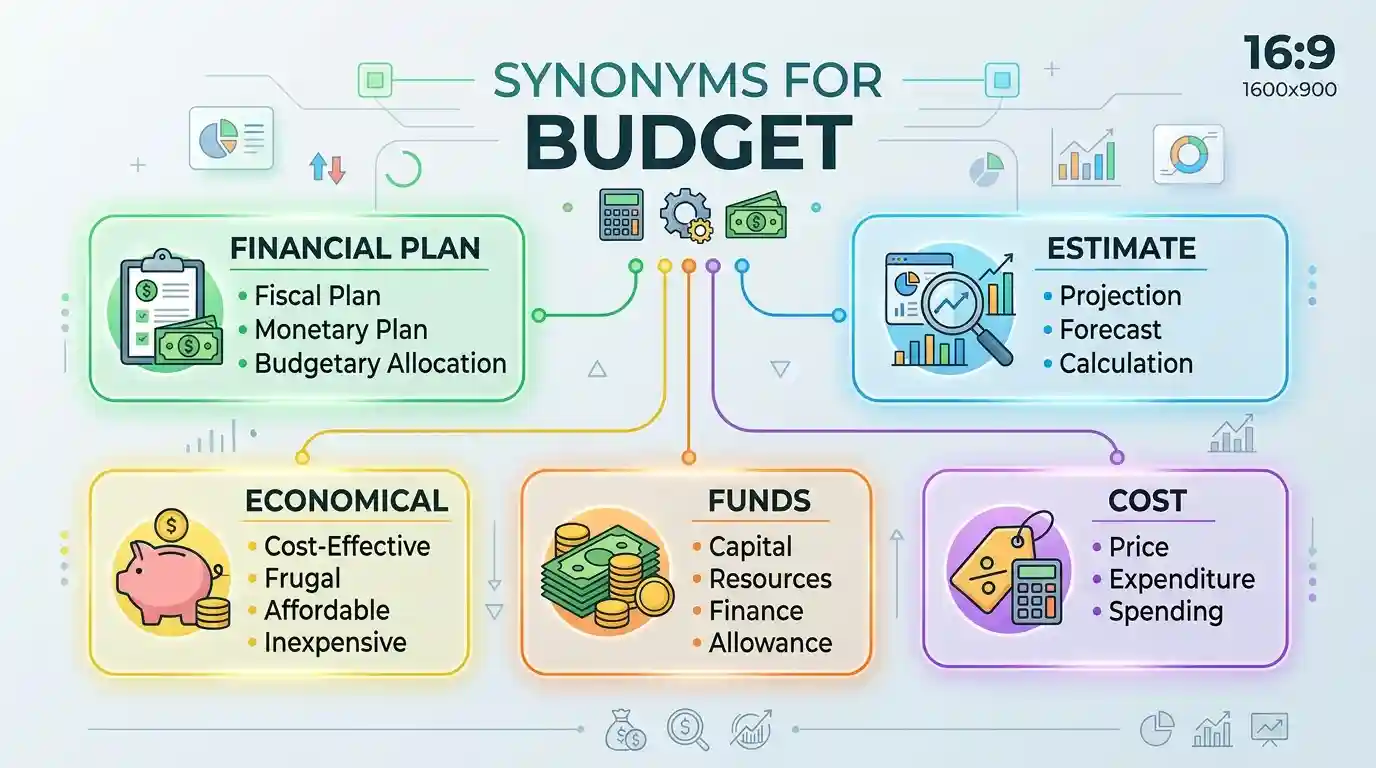
Have you ever wanted to use another word instead of budget, but were unsure which synonym would fit? You are not alone. The word budget has several meanings, so the best alternative changes with the sentence.
For example, a financial plan can replace a budget when you mean a plan for income and spending. Funds can work when you mean money available for a purpose. Allocation means money assigned to something, while estimate means an expected cost. When budget means inexpensive, words such as affordable, inexpensive, low-cost, and economical may fit.
This guide explains the most useful synonyms for budget with examples, CEFR levels, register, frequency, collocations, and usage warnings. That makes it easier to choose the right word instead of simply replacing one word with another.
Quick Answer: What Are the Best Synonyms for Budget?
The best synonyms for budget depend on meaning. Use a financial plan or spending plan for a plan about money. Use funds for available money, allocation for money assigned to a purpose, allowance for a fixed amount, and estimate for an expected cost. When budget means inexpensive, use affordable, inexpensive, low-cost, economical, or reasonable.
Budget Pronunciation
Budget
IPA: /ˈbʌdʒ.ɪt/
Pronunciation: BUJ-it
The spelling and pronunciation are essentially the same in American and British English. Cambridge gives /ˈbʌdʒ.ɪt/ for both varieties.
What Part of Speech Is Budget?
Budget can function as a noun, verb, and adjective.
Noun
A budget can mean a plan showing expected income and spending.
We prepared a budget for next year.
It can also mean the amount of money available for something.
The project has a limited budget.
Verb
Budget means to plan how money, time, or another limited resource will be used.
We need to budget for repairs.
Adjective
Before a noun, budget can mean inexpensive.
We stayed at a budget hotel.
Cambridge identifies these separate meanings, including the financial-plan sense, available-money sense, verb sense, and inexpensive adjective sense.
Synonyms for Budget at a Glance
| Word | Meaning closest to budget | Register | Frequency |
| Financial plan | Plan for income and spending | Neutral | Common |
| Spending plan | Plan for spending | Neutral | Common |
| Allowance | Fixed amount permitted or given | Neutral | Common |
| Allocation | Amount assigned to a purpose | Formal | Common |
| Allotment | Amount assigned | Formal | Uncommon |
| Funds | Money available | Neutral | Very common |
| Finances | Overall money situation | Neutral | Common |
| Resources | Available assets or means | Neutral | Very common |
| Spending limit | Maximum amount allowed | Neutral | Common |
| Estimate | Expected cost | Neutral | Very common |
| Funding | Money provided for a purpose | Business | Very common |
| Appropriation | Officially assigned money | Formal | Uncommon |
| Plan | General intended course of action | Neutral | Very common |
| Allocate | Assign money or resources | Formal | Common |
| Apportion | Divide into shares | Formal | Uncommon |
| Ration | Carefully limit a scarce supply | Neutral/Formal | Common |
| Affordable | Not too expensive | Neutral | Very common |
| Inexpensive | Low in price | Neutral | Common |
| Economical | Good value or low in operating cost | Neutral | Common |
| Low-cost | Having a low price or cost | Neutral/Business | Common |
| Reasonable | Fairly priced | Neutral | Very common |
| Bargain | Something bought at a good price | Informal | Common |
Important: These are not all perfect substitutes. The exact meaning of budget determines which word works.
1. Financial Plan
Meaning: A plan that shows expected income, spending, saving, or financial goals.
CEFR: B1–B2
Register: Neutral, business, academic
Frequency: Common
Examples:
- We created a financial plan for the coming year.
- Her financial plan includes money for emergencies.
Best used when: You mean the overall financial structure rather than just a spending limit.
Common collocations:
- personal financial plan
- long-term financial plan
- detailed financial plan
When not to use it: Do not use it when you simply mean money currently available.
2. Spending Plan
Meaning: A plan that explains how money will be spent.
CEFR: B1–B2
Register: Neutral
Frequency: Common
Examples:
- We made a spending plan before renovating the house.
- His spending plan leaves room for savings.
Nuance: It focuses more on outgoing money than a complete financial plan.
When not to use it: Avoid it when discussing total income and financial assets.
3. Allowance
Meaning: A fixed amount of money given or permitted for a particular purpose.
CEFR: B1
Register: Neutral
Frequency: Common
Examples:
- The employee receives a monthly travel allowance.
- My parents gave me a weekly allowance.
Collocations:
- travel allowance
- monthly allowance
- spending allowance
When not to use it: An allowance is normally a fixed amount, not a complete financial plan.
4. Allocation
Meaning: An amount of money or another resource assigned to a particular purpose.
CEFR: B2
Register: Business, academic, formal
Frequency: Common
Examples:
- The school increased its technology allocation.
- Each department received a separate allocation.
Nuance: Use allocation when the important idea is how money is divided or assigned.
When not to use it: It sounds too formal for many everyday conversations.
5. Allotment
Meaning: A particular amount officially given to someone or something.
CEFR: B2
Register: Formal
Frequency: Uncommon
Examples:
- Each department received a travel allotment.
- The project has a fixed equipment allotment.
When not to use it: In ordinary conversation, allocation or allowance will often sound more natural.
6. Funds
Meaning: Money that is available for a particular purpose.
CEFR: B1
Register: Neutral, business, formal
Frequency: Very common
Examples:
- We need more funds to complete the project.
- The charity used its funds carefully.
Nuance: Funds means the money itself. A budget can describe the plan for using that money.
Common collocations:
- available funds
- public funds
- additional funds
7. Finances
Meaning: The money and financial situation of a person or organization.
CEFR: B2
Register: Neutral, professional
Frequency: Common
Examples:
- She manages her finances carefully.
- The company is reviewing its finances.
When not to use it: Do not use finances when you need to name one specific spending limit.
8. Resources
Meaning: Money, materials, people, or other assets available for a purpose.
CEFR: B1–B2
Register: Neutral, business, academic
Frequency: Very common
Examples:
- The project needs more financial resources.
- The school has limited resources.
Nuance: This is a related word, not a perfect synonym. Resources can include people, equipment, time, and materials as well as money.
9. Spending Limit
Meaning: The maximum amount that may be spent.
CEFR: B1–B2
Register: Neutral
Frequency: Common
Examples:
- We set a spending limit of $500.
- The card has a monthly spending limit.
Best used when: You specifically mean a maximum amount.
When not to use it: A budget can include planned income and many categories of spending, so it is broader.
10. Estimate
Meaning: A calculation or judgment about what something will probably cost.
CEFR: B1
Register: Neutral, business
Frequency: Very common
Examples:
- The builder gave us an estimate for the repair.
- Our original cost estimate was too low.
Key difference:
Budget = what you plan or allow yourself to spend.
Estimate = what you expect something will cost.
This is one of the most important distinctions for English learners.
11. Funding
Meaning: Money provided for a particular project, activity, or organization.
CEFR: B2
Register: Business, academic, professional
Frequency: Very common
Examples:
- The project received additional funding.
- The university is seeking funding for research.
When not to use it: Funding describes money being provided. It does not automatically describe the complete spending plan.
12. Appropriation
Meaning: Money officially set aside for a particular purpose.
CEFR: C1
Register: Government, legal, formal
Frequency: Uncommon
Examples:
- The agency received an appropriation for new equipment.
- The legislature approved the appropriation.
When not to use it: Avoid this word in simple personal-finance conversations.
13. Plan
Meaning: An organized intention for what you will do.
CEFR: A2
Register: Neutral
Frequency: Very common
Examples:
- We need a plan for our monthly spending.
- The manager planned how to use the money.
Nuance: Plan is much broader than budget.
When not to use it: Do not replace budget with plan if the financial meaning is important and not already obvious.
14. Allocate
Meaning: To assign money or resources to a particular purpose.
CEFR: B2
Register: Business, academic, formal
Frequency: Common
Examples:
- We allocated $2,000 for advertising.
- The company allocated more money to research.
Grammar:
allocate + money/resources + to + purpose
The school allocated more funds to technology.
15. Apportion
Meaning: To divide something into shares.
CEFR: C1
Register: Formal
Frequency: Uncommon
Examples:
- The manager apportioned the funds among three teams.
- The costs were apportioned according to usage.
When not to use it: It can sound overly formal in everyday English.
16. Ration
Meaning: To carefully limit and distribute something that is scarce.
CEFR: B2
Register: Neutral/Formal
Frequency: Common
Examples:
- The team had to ration its limited supplies.
- The organization rationed its remaining funds.
Nuance: Ration suggests scarcity or restriction.
It is therefore not a general replacement for budget.
17. Affordable
Meaning: Cheap enough for someone to pay without serious difficulty.
CEFR: B1
Register: Neutral
Frequency: Very common
Examples:
- We need an affordable apartment.
- The company offers affordable software.
Best used when: Budget means relatively inexpensive.
Cambridge places affordable among words related to budget in the “costing less money than expected” sense.
When not to use it: Do not use affordable as a replacement for a financial plan.
18. Inexpensive
Meaning: Not costing much money.
CEFR: B1
Register: Neutral
Frequency: Common
Examples:
- They sell inexpensive furniture.
- We found an inexpensive restaurant nearby.
Nuance: It describes price, not financial planning.
19. Economical
Meaning: Using money efficiently or costing relatively little to operate.
CEFR: B2
Register: Neutral, professional
Frequency: Common
Examples:
- This car is economical to run.
- We chose an economical solution.
Nuance: Economical can suggest good value, low operating cost, or efficient use of resources.
It does not always mean the lowest purchase price.
20. Low-Cost
Meaning: Having a relatively low price or cost.
CEFR: B1–B2
Register: Neutral, business
Frequency: Common
Examples:
- The company offers low-cost training.
- We need a low-cost solution.
Common collocations:
- low-cost housing
- low-cost service
- low-cost solution
21. Reasonable
Meaning: Fair or not excessively expensive.
CEFR: B1
Register: Neutral
Frequency: Very common
Examples:
- The hotel charges reasonable rates.
- We found a reasonable price.
Nuance: Reasonable does not necessarily mean cheap. It means the price seems fair.
22. Bargain
Meaning: Something that is bought for a good or unusually low price.
CEFR: B1
Register: Informal, everyday
Frequency: Common
Examples:
- This laptop was a real bargain.
- She found a bargain at the market.
When not to use it: Do not use bargain to mean a financial plan or spending limit.
Collins lists bargain among alternatives related to the adjective sense of budget, not the core financial-plan noun sense.
The Best Synonym Depends on Your Meaning
| Original meaning | Best alternative | Why |
| A complete financial plan | Financial plan | Covers planned income and spending |
| A plan for spending | Spending plan | Focuses on outgoing money |
| Money available | Funds | Refers to available money |
| Money assigned to a department | Allocation | Shows an assigned share |
| A fixed permitted amount | Allowance | Shows an amount someone can use |
| Maximum amount | Spending limit | Shows the upper boundary |
| Expected cost | Estimate | Predicts the likely cost |
| Money provided | Funding | Focuses on financial support |
| Dividing resources | Allocate | Works as a verb |
| Inexpensive product/service | Affordable | Focuses on price |
| Low operating cost | Economical | Focuses on efficient spending |
| Good low-price deal | Bargain | Focuses on a favorable purchase |
Budget vs. Financial Plan
These terms overlap, but they are not identical.
A budget usually focuses on expected income and spending within a particular period or purpose.
A financial plan can be broader. It may include savings, investments, debt, insurance, and long-term goals.
Example:
I created a monthly budget.
I created a long-term financial plan.
The second sentence covers a wider financial picture.
Budget vs. Funds
Funds are money available for use.
A budget can explain how that money should be used.
The project has sufficient funds.
The project has a $50,000 budget.
The first focuses on available money. The second focuses on the planned or allowed amount.
Budget vs. Allocation
An allocation is an amount assigned to a specific person, department, project, or purpose.
The company has a large annual budget.
The marketing department received a $20,000 allocation.
The second sentence tells us about one assigned share of the larger financial structure.
Budget vs. Estimate
An estimate predicts a cost.
A budget sets a planned or permitted amount.
The contractor estimated that the work would cost $8,000.
We budgeted $10,000 for the work.
These words are often confused by learners.
Budget vs. Affordable
Budget can describe something inexpensive when used before a noun:
a budget hotel
Affordable describes something that people can reasonably pay for:
an affordable hotel
A budget hotel may be affordable, but the two words focus on slightly different ideas.
Common Mistakes With Budget Synonyms
Common Mistake Box
Mistake 1
Wrong: We need more budget to finish the project.
Better: We need more funding or funds to finish the project.
Why: If you mean additional money, funding or funds is usually more precise.
Mistake 2
Wrong: The contractor gave me a budget for the repair.
Better: The contractor gave me a cost estimate for the repair.
Why: An estimate predicts the expected cost.
Mistake 3
Wrong: The family has a small allocation for all its expenses.
Better: The family has a small budget for all its expenses.
Why: Allocation normally refers to an amount assigned to a particular purpose or group.
Mistake 4
Wrong: We have an affordable $1,000.
Better: We have a budget of $1,000.
Why: Affordable is an adjective. It cannot replace the noun budget in this structure.
Mistake 5
Wrong: This financial plan costs only $20.
Better: This product/service costs only $20.
Why: A financial plan is not normally the thing being described as inexpensive.
Natural Collocations With Budget
Learning collocations helps you sound more natural than simply memorizing synonyms.
Common noun phrases
- annual budget
- household budget
- project budget
- marketing budget
- operating budget
- travel budget
- tight budget
- limited budget
- fixed budget
- government budget
Common verbs
- create a budget
- prepare a budget
- set a budget
- manage a budget
- approve a budget
- balance a budget
- cut a budget
- exceed a budget
Common expressions
- on a budget
- within budget
- over budget
- under budget
- budget for something
Cambridge gives examples of within budget, over budget, and related financial uses, while Collins also groups budget with allowance, funds, allocation, and related financial terms.
Register Guide
Everyday English
Use:
- budget
- plan
- funds
- affordable
- inexpensive
- reasonable
Business English
Use:
- financial plan
- allocation
- funding
- estimate
- spending limit
- finances
Academic English
Use:
- allocation
- resources
- financial plan
- funding
- apportion
- appropriation
Government or legal English
Use:
- appropriation
- allocation
- funding
- expenditure
- fiscal plan
Informal English
Use:
- bargain
- cheap
- good deal
American vs. British English
The core word budget is spelled the same in American and British English and has the same basic pronunciation.
The main differences arise from vocabulary and context around it rather than from the spelling of budget itself.
British English commonly uses expressions such as budget hotel, budget airline, and budget price. American English uses these expressions too.
Collins provides separate British and American thesaurus groupings. Its British entry includes adjective alternatives such as economy, bargain, sale, reduced, keen, reasonable, low-priced, low-cost, cut-price, economical, and informal cheapo, while its American entry gives a somewhat shorter set.
CEFR Guide for Learners
| Word | Approx. learner level | Useful for |
| Budget | B1–B2 | Everyday and professional English |
| Plan | A2 | Basic communication |
| Funds | B1 | Money and business |
| Allowance | B1 | Fixed amounts |
| Affordable | B1 | Shopping and prices |
| Estimate | B1 | Costs |
| Inexpensive | B1 | Prices |
| Allocation | B2 | Business and academic writing |
| Funding | B2 | Projects and organizations |
| Finances | B2 | Personal/business money |
| Economical | B2 | Value and operating costs |
| Apportion | C1 | Formal writing |
| Appropriation | C1 | Government/legal contexts |
These levels are practical learner guidance, not universal official classifications. Different dictionaries and vocabulary systems can assign slightly different CEFR levels.
Frequency Guide
Very common: budget, plan, funds, affordable, estimate, reasonable
Common: financial plan, spending plan, allowance, allocation, finances, funding, inexpensive, economical, low-cost
Uncommon/formal: allotment, appropriation, apportion
The safest words for everyday learners are usually budget, plan, funds, affordable, inexpensive, estimate, and financial plan.
Word Origin of Budget
The English word budget has an unusual history.
It comes from Old French bougette, meaning a small leather bag or pouch. The word is connected with the idea of carrying money or financial documents in a bag.
The modern financial meaning developed later and became established in English in the 18th century.
This history explains why the word eventually became associated with the financial documents and plans presented by governments.
Related Vocabulary
Antonyms and Contrasts
The best opposite depends on the meaning.
For budget as a spending limit:
- overspending
- excess spending
- extravagance
For budget as inexpensive:
- expensive
- costly
- high-priced
- premium
Word Family
- budget — noun/verb
- budgeted — past tense/past participle
- budgeting — noun/present participle
- budgetary — adjective
Mini Practice
Fill in the Blanks
Choose the best word.
- We created a ______ for the coming year.
- The charity needs additional ______.
- The contractor provided a cost ______.
- The department received $10,000 ______.
- We are looking for an ______ hotel.
Answers:
- budget / financial plan
- funds / funding
- estimate
- allocation
- affordable / inexpensive
Rewrite the Sentences
Replace the underlined idea with a more precise word.
- We have a budget of $2,000 for advertising.
- The builder gave us a budget for the repairs.
- The company gave the department a budget of $20,000.
- They stayed in a budget hotel.
Possible Answers
- We have $2,000 allocated for advertising.
- The builder gave us a cost estimate for the repairs.
- The company gave the department a $20,000 allocation.
- They stayed in an inexpensive/affordable hotel.
FAQs About Synonyms for Budget
What is the closest synonym for budget?
The closest synonym depends on the meaning. A financial plan is one of the closest alternatives when a budget means a plan for income and spending. Funds are closer when the meaning is available money, while allocation is closer when money has been assigned to a purpose.
What is another word for budget in business?
Useful business alternatives include financial plan, allocation, funding, funds, spending limit, estimate, and financial statement. The correct choice depends on whether you are talking about planned spending, available money, assigned money, or expected costs.
What is a synonym for budget-friendly?
Common alternatives include affordable, inexpensive, economical, low-cost, and reasonably priced. Affordable focuses on what people can pay, while economics often suggests that something provides good value or uses money efficiently.
Is “funding” a synonym for budget?
Not exactly. Funding means money provided for a project, organization, or activity. A budget is a plan or amount that describes expected or permitted spending. Funding can therefore form part of a budget but does not have exactly the same meaning.
Is “financial plan” the same as “budget”?
They are closely related but not identical. A budget usually focuses on income and spending for a particular period or purpose. A financial plan can be broader and include savings, investments, debt, insurance, and long-term financial goals.
What is a synonym for budget in an essay?
For academic writing, useful choices include financial plan, spending plan, allocation, resources, funding, and appropriation, depending on context. Do not choose a difficult word simply to sound formal. The word should express the exact idea you need.
What is the synonym of budget as a verb?
As a verb, budget can mean plan, allocate, apportion, estimate, cost, or ration, depending on the sentence. For example, “We budgeted $5,000 for travel” can become “We allocated $5,000 for travel,” but the two verbs emphasize slightly different actions.
Does budget mean cheap?
Sometimes. When used before a noun, budget can mean relatively inexpensive, as in budget hotel or budget airline. In this meaning, affordable, inexpensive, low-cost, reasonable, and economical can sometimes be used instead.
Vocabulary Quiz
1. Which word best means money available for use?
A. Estimate
B. Funds
C. Plan
D. Bargain
2. Which word means money assigned to a specific purpose?
A. Allocation
B. Estimate
C. Bargain
D. Expense
3. Which word best describes an expected repair cost?
A. Funding
B. Estimate
C. Allowance
D. Resources
4. Which word best fits “a ______ hotel”?
A. Allocation
B. Financial
C. Budget
D. Appropriation
5. Which sentence is correct?
A. We allocated $5,000 to marketing.
B. We afford $5,000 to marketing.
C. We estimate $5,000 to marketing.
D. We funded $5,000 to marketing.
Answer Key
- B. Funds
- A. Allocation
- B. Estimate
- C. Budget
- A. We allocated $5,000 to marketing.
Final Takeaway
The best way to learn synonyms for budget is to learn them by meaning rather than memorizing a long list. Use a financial plan for a broad money plan, funds for available money, allocation for assigned money, estimate for expected cost, and affordable or inexpensive when budget means low-priced.
The right synonym makes your English more precise. Practice these words in essays, emails, professional writing, and everyday conversations, and you will gradually learn which one sounds most natural in each situation.
Trusted References
- Cambridge Dictionary and Cambridge English Thesaurus.
- Collins English Thesaurus.
- Thesaurus.com.
- Oxford Learner’s Dictionaries for learner-focused definitions and usage guidance.

Synonorm is a trusted English vocabulary resource created to help readers find the right words and understand the differences between similar terms. We provide clear explanations of synonyms, meanings, examples, usage, and alternatives. Our content makes vocabulary easier to learn and apply in everyday, academic, and professional English. Synonorm is designed for students, writers, ESL learners, professionals, and anyone who wants to improve their English vocabulary and communicate more clearly.