Quick Answer
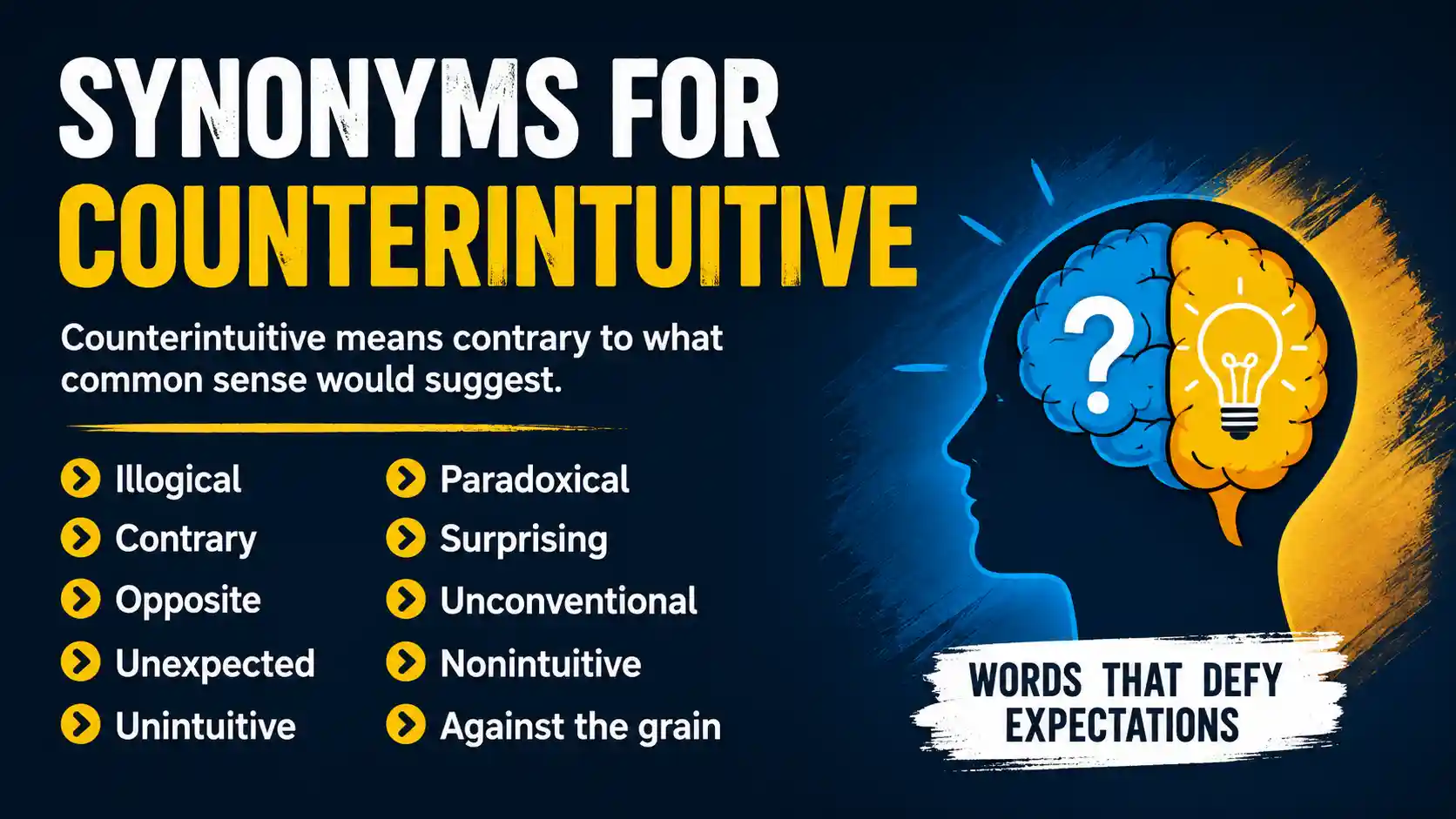
The closest synonyms for counterintuitive are unintuitive and nonintuitive. Depending on context, you can also use contrary to expectations, surprising, unexpected, paradoxical, or contrary to common sense. These words are not always interchangeable, so the best choice depends on whether you mean difficult to grasp, unexpected, contradictory, or against ordinary assumptions.
What Does Counterintuitive Mean?
Have you ever learned something that seemed wrong at first, but turned out to be true?
That is the basic idea behind counterintuitive.
Something is counterintuitive when it goes against what you naturally expect, assume, or feel should happen. It may seem strange at first, but that does not mean it is wrong or illogical.
For example:
It seems counterintuitive, but taking regular breaks can help you get more work done.
Most people may initially think that working longer without stopping will produce better results. The evidence, however, may show otherwise.
This word is useful in academic writing, science, business, technology, education, and everyday conversation. Learning the right alternatives can also help students, writers, bloggers, and professionals avoid repeating the same word.
Pronunciation
Counterintuitive
IPA: /ˌkaʊn.tər.ɪnˈtuː.ɪ.tɪv/
Pronunciation: kown-ter-in-TOO-uh-tiv
The main stress falls on TOO.
There is no major spelling difference between American and British English.
Part of Speech
Counterintuitive is an adjective.
Examples
- a counterintuitive result
- a counterintuitive idea
- a counterintuitive decision
- a counterintuitive approach
The related adverb is counterintuitive.
Counterintuitively, the smaller group performed better.
The noun intuition and adjective intuitive belong to the same word family.
Word Family
| Word | Part of Speech | Meaning |
| intuition | noun | Understanding something without conscious reasoning |
| intuitive | adjective | Easy to understand instinctively |
| intuitively | adverb | In an instinctive way |
| counterintuitive | adjective | Contrary to what instinct suggests |
| counterintuitively | adverb | In a way that goes against instinct |
Grammar and Sentence Patterns
The word commonly appears in a few useful structures.
Counterintuitive + noun
The researchers found a counterintuitive result.
She proposed a counterintuitive solution.
Seem/sound + counterintuitive
The idea may seem counterintuitive.
His explanation sounds counterintuitive at first.
It is counterintuitive to + verb
It is counterintuitive to spend more time planning before starting.
Counterintuitive that + clause
It may seem counterintuitive that less work can sometimes produce better results.
A useful phrase
It may seem counterintuitive, but…
This phrase is especially useful when you want to introduce an idea that challenges a common assumption.
Quick Synonym Guide
| Word or phrase | How close is it? | Main idea | Register |
| Unintuitive | Very close | Not easy to understand instinctively | Neutral |
| Nonintuitive | Very close | Not based on intuitive understanding | Academic/Technical |
| Contrary to expectations | Very close | Different from what was expected | Neutral/Formal |
| Contrary to common sense | Close | Opposes ordinary assumptions | Neutral |
| Paradoxical | Contextual | Seems contradictory | Formal |
| Unexpected | Related | Not predicted | Very common |
| Surprising | Related | Causes surprise | Very common |
| Unconventional | Related | Different from normal practice | Neutral/Formal |
| Unorthodox | Related | Outside accepted methods | Formal |
| Puzzling | Related | Difficult to understand | Neutral |
| Perplexing | Related | Very difficult to understand | Formal |
| Anomalous | Contextual | Different from a normal pattern | Academic |
| Illogical | Not a general synonym | Fails to follow sound reasoning | Neutral/Formal |
Remember: A related word is not automatically a true synonym. Choosing the word that matches the exact meaning is more important than finding the biggest list.
1. Unintuitive
Meaning: Something that is not easy to understand or use based on natural expectations.
Examples:
- The new software has an unintuitive navigation system.
- The mathematical solution seemed unintuitive at first.
Best used when: You are describing a design, process, idea, or solution that does not feel natural to understand.
Tone: Neutral to formal
Frequency: Common
Register: Technical, academic, professional, general
Common collocations:
- unintuitive interface
- unintuitive design
- unintuitive solution
Nuance
This is probably the closest everyday alternative to counterintuitive, especially when talking about systems, instructions, or ideas.
When not to use it
Do not use it when you simply mean “unexpected.”
The unexpected storm arrived early.
Here, unintuitive would sound unnatural.
2. Nonintuitive
Meaning: Not based on immediate or instinctive understanding.
Examples:
- The experiment produced a nonintuitive result.
- Some advanced mathematical concepts are nonintuitive.
Best used when: Writing about science, mathematics, technology, psychology, or other technical subjects.
Tone: Formal
Frequency: Common in specialist writing
Register: Academic and technical
Common collocations:
- nonintuitive result
- nonintuitive behavior
- nonintuitive relationship
Nuance
Nonintuitive and unintuitive are very close. Nonintuitive often sounds more technical.
When not to use it
For a casual conversation, unexpected or surprising may sound more natural.
3. Contrary to Expectations
Meaning: Different from what people expected to happen.
Examples:
- Contrary to expectations, the small company became highly successful.
- Contrary to expectations, the treatment produced better results.
Best used when: You want to clearly explain that reality differed from a prediction or assumption.
Tone: Neutral/Formal
Frequency: Very common
Register: Academic, business, journalism, general writing
Common collocations:
- contrary to expectations
- contrary to initial expectations
- contrary to popular expectations
Nuance
This phrase is often clearer than counterintuitive because it directly tells the reader what was unexpected.
When not to use it
Do not use it if there was no specific expectation being challenged.
4. Contrary to Common Sense
Meaning: Different from what ordinary reasoning seems to suggest.
Examples:
- Contrary to common sense, adding more features made the product harder to use.
- The simplest answer was contrary to common sense.
Best used when: You are discussing an ordinary assumption held by many people.
Tone: Neutral
Frequency: Common
Register: General and explanatory
Common collocations:
- contrary to common sense
- seemingly contrary to common sense
- apparently contrary to common sense
Nuance
This phrase is especially useful when explaining difficult ideas to a general audience.
5. Paradoxical
Meaning: Seemingly contradictory or containing an apparent contradiction.
Examples:
- The study produced a paradoxical result.
- It was paradoxical that more choices made customers less satisfied.
Best used when: Two ideas or results appear to conflict with each other.
Tone: Formal
Frequency: Common
Register: Academic, literary, professional
Common collocations:
- paradoxical result
- paradoxical effect
- paradoxical situation
Nuance
A paradoxical idea may be counterintuitive, but the two words are not identical.
Counterintuitive: It goes against what you naturally expect.
Paradoxical: It appears to contain a contradiction.
6. Unexpected
Meaning: Not expected or predicted.
Examples:
- The company experienced an unexpected increase in sales.
- We received an unexpected answer.
Best used when: Something happens differently from what you predicted.
Tone: Neutral
Frequency: Very common
Register: Everyday, academic, business
Common collocations:
- unexpected result
- unexpected outcome
- unexpected change
Nuance
This is one of the safest alternatives for everyday English.
However, unexpected is broader than counterintuitive.
7. Surprising
Meaning: Causing someone to feel surprise.
Examples:
- The final result was surprising.
- It was surprising to see the smaller team win.
Best used when: You want to emphasize a person’s reaction.
Tone: Neutral
Frequency: Very common
Register: Spoken and written English
Common collocations:
- surprising result
- surprising discovery
- surprising outcome
Nuance
Surprising focuses on the reaction. Counterintuitive focuses on the conflict between the result and an initial expectation.
8. Unconventional
Meaning: Different from the usual or accepted way of doing something.
Examples:
- The teacher used an unconventional method to explain the topic.
- The company took an unconventional approach to solving the problem.
Best used when: Someone chooses a method that differs from normal practice.
Tone: Neutral/Formal
Frequency: Common
Register: Business, academic, general
Common collocations:
- unconventional approach
- unconventional method
- unconventional strategy
Important distinction
Something can be unconventional without being counterintuitive.
9. Unorthodox
Meaning: Different from traditional or generally accepted methods.
Examples:
- The coach introduced an unorthodox training method.
- Her unorthodox approach attracted attention.
Best used when: A method or belief differs strongly from established practice.
Tone: Formal
Frequency: Common
Register: Professional, academic, journalistic
Common collocations:
- unorthodox approach
- unorthodox method
- unorthodox strategy
10. Puzzling
Meaning: Difficult to understand or explain.
Examples:
- The sudden drop in traffic was puzzling.
- Researchers found the pattern puzzling.
Best used when: Something creates confusion without necessarily contradicting logic.
Tone: Neutral
Frequency: Common
Register: General
Common collocations:
- puzzling result
- puzzling behavior
- puzzling question
11. Perplexing
Meaning: Very difficult to understand.
Examples:
- The sudden change in the data was perplexing.
- The situation remained perplexing for several weeks.
Best used when: You want a more formal alternative to puzzling.
Tone: Formal
Frequency: Common but less frequent than puzzling
Register: Formal, academic, literary
Common collocations:
- perplexing problem
- perplexing situation
- perplexing result
12. Confounding
Meaning: Difficult to explain because it does not fit what you expected.
Examples:
- The researchers discovered a confounding pattern in the results.
- The unexpected behavior was confusing to the team.
Best used when: Discussing difficult evidence, results, or observations.
Tone: Formal
Frequency: Uncommon
Register: Academic and technical
Important: In research, confounding can have a specific technical meaning. Do not use it as a simple replacement for counterintuitive in every sentence.
13. Baffling
Meaning: Extremely difficult to understand or explain.
Examples:
- The machine’s sudden failure was baffling.
- The disappearance remained baffling to investigators.
Best used when: Something is strongly confusing.
Tone: Neutral
Frequency: Common
Register: General and journalistic
Common collocations:
- baffling mystery
- baffling behavior
- baffling problem
14. Anomalous
Meaning: Different from what is normal or expected in a particular pattern or system.
Examples:
- The scientists noticed an anomalous reading.
- One anomalous result required further investigation.
Best used when: Discussing scientific data, statistics, measurements, or patterns.
Tone: Formal
Frequency: Uncommon
Register: Academic and scientific
Nuance
An anomalous result is unusual because it differs from a recognized pattern. It does not necessarily feel strange or counterintuitive.
15. Incongruous
Meaning: Not fitting naturally with the surrounding situation.
Examples:
- His cheerful response seemed incongruous during the serious discussion.
- The modern building looked incongruous beside the historic houses.
Best used when: Something does not seem to belong with other things around it.
Tone: Formal/Literary
Frequency: Uncommon
Register: Formal, literary
Common collocations:
- incongruous appearance
- incongruous behavior
- incongruous combination
16. Contrary
Meaning: Opposite to an idea, belief, or expectation.
Examples:
- The evidence was contrary to the original prediction.
- Contrary to popular belief, the process takes very little time.
Best used when: You need a concise way to show opposition.
Tone: Neutral/Formal
Frequency: Very common
Register: General, academic, business
Common collocations:
- contrary to expectations
- contrary to belief
- contrary to evidence
17. Unanticipated
Meaning: Not expected before an event happened.
Examples:
- The project faced several unanticipated difficulties.
- The decision created an unanticipated benefit.
Best used when: Writing formally about consequences, problems, or results that were not predicted.
Tone: Formal
Frequency: Common
Register: Business, academic, professional
Common collocations:
- unanticipated consequence
- unanticipated result
- unanticipated problem
18. Unusual
Meaning: Different from what is normal or common.
Examples:
- The researcher noticed an unusual pattern.
- It was unusual for the market to change so quickly.
Best used when: You simply need a general word for something outside the norm.
Tone: Neutral
Frequency: Very common
Register: Everyday English
Important distinction
Unusual is much broader than counterintuitive. Something can be unusual without challenging anyone’s expectations.
19. Difficult to Grasp
Meaning: Not easy to understand immediately.
Examples:
- The concept is difficult to grasp without an example.
- The relationship between the variables was difficult to grasp.
Best used when: Speaking to learners or general readers.
Tone: Neutral
Frequency: Common phrase
Register: General and educational
This phrase is often better than a sophisticated synonym when your goal is clarity.
20. Against Intuition
Meaning: Opposite to what instinct or immediate understanding suggests.
Examples:
- The result appears to be against intuition.
- The strategy seems to work against intuition at first.
Best used when: Explaining the concept directly rather than replacing the adjective.
Tone: Neutral
Frequency: Less common than counterintuitive
A more natural phrase in many contexts is:
It goes against our intuition.
Strongest Alternatives at a Glance
If you need the closest replacements, focus on these:
- Unintuitive
- Nonintuitive
- Contrary to expectations
- Contrary to common sense
- Paradoxical in contradiction-based contexts
Words such as unexpected, surprising, unusual, and unconventional are useful, but they should not be treated as exact replacements in every sentence.
Counterintuitive vs. Its Closest Alternatives
| Word | Main idea | Exact synonym? |
| Counterintuitive | Against natural expectation | Yes, original |
| Unintuitive | Not naturally understood | Very close |
| Nonintuitive | Not based on intuitive understanding | Very close |
| Unexpected | Not predicted | Related |
| Surprising | Causes surprise | Related |
| Paradoxical | Seems contradictory | Related |
| Illogical | Does not follow sound reasoning | No |
| Unusual | Not normal or common | Related |
| Unconventional | Not usual practice | Related |
| Unpredictable | Hard to predict | No |
The Most Important Difference
Consider these three sentences:
The result was counterintuitive.
The result went against what people naturally expected.
The result was unexpected.
The result was not predicted.
The argument was illogical.
The reasoning was faulty.
These sentences are not saying exactly the same thing.
Commonly Confused Words
Counterintuitive vs. Unexpected
Counterintuitive suggests a conflict with instinct or expectation.
Unexpected simply means that something was not expected.
The result was unexpected.
This tells us little about why it was surprising.
The result was counterintuitive.
This suggests that our natural assumption pointed in another direction.
Counterintuitive vs. Illogical
This is one of the most important distinctions for English learners.
Counterintuitive does not mean irrational.
An idea can be:
- counterintuitive and logical
- surprising and scientifically proven
- unusual but reasonable
But something that is illogical does not follow sound reasoning.
Counterintuitive vs. Paradoxical
A paradox appears to involve contradiction.
A counterintuitive idea simply goes against what people naturally expect.
They can overlap, but they are not interchangeable.
Counterintuitive vs. Unconventional
Unconventional describes a departure from normal practice.
Counterintuitive describes a conflict with natural expectation.
An unconventional method may make perfect intuitive sense.
Common Mistakes
Common Mistake Box
Mistake 1
The result was counterintuitive because it was incorrect.
Better
The result was counterintuitive because it differed from what we expected.
Why? Counterintuitive does not mean false.
Mistake 2
His answer was counterintuitive because his reasoning was bad.
If the reasoning was bad, illogical may be the better word.
His argument was illogical.
Mistake 3
Using counterintuitive whenever something is unusual.
The restaurant had a counterintuitive color scheme.
This sounds strange unless the colors violate an expectation about how the restaurant should look.
Better:
The restaurant had an unusual color scheme.
Mistake 4
Using unpredictable as a direct replacement.
The result was unpredictable.
This means you could not reliably predict it.
It does not necessarily mean the result went against intuition.
How to Use These Words in Different Types of Writing
Essays
For academic essays, counterintuitive, nonintuitive, paradoxical, and contrary to expectations can work well.
Contrary to expectations, the evidence suggests that the policy had the opposite effect.
This is clearer than repeating counterintuitively several times.
Blog Posts
Blog writing often benefits from simpler alternatives.
Use:
- surprising
- unexpected
- unusual
- counterintuitive
Example:
The surprising truth is that doing less can sometimes improve productivity.
Professional Communication
In business writing, clarity matters more than vocabulary complexity.
Instead of:
The counterintuitive outcome was somewhat perplexing.
You could write:
The unexpected result was difficult to explain.
That version is easier to understand.
Academic Writing
Academic writing may require more precise vocabulary.
The study produced a counterintuitive finding that challenged the original hypothesis.
Or:
The researchers observed an anomalous result that differed from the expected pattern.
Choose based on the evidence, not simply on which word sounds more advanced.
Everyday Conversation
Native speakers often use:
- surprising
- unexpected
- strange
- unusual
- hard to believe
Instead of:
That’s counterintuitive.
You might naturally hear:
That’s surprising.
or:
That’s not what I would have expected.
Word Origin and Etymology
Counterintuitive combines counter- with intuitive.
The prefix counter- can express opposition or contrast. Intuitive relates to intuition, the ability to understand or recognize something without conscious reasoning.
The word is relatively modern. Merriam-Webster gives 1955 as its first known use. Historical sources may give slightly different dates because the earliest surviving evidence depends on which records researchers locate.
The word therefore has a simple underlying idea:
counter + intuitive = against what intuition suggests
CEFR and Learner Guidance
Counterintuitive is best treated as an upper-intermediate to advanced vocabulary item, especially for learners who encounter it in academic, technical, business, and analytical texts.
A practical learning guide is:
| Level | Useful alternative |
| A1–A2 | strange, surprising |
| B1 | unexpected, unusual |
| B2 | unconventional, paradoxical |
| B2–C1 | counterintuitive, unintuitive |
| C1+ | nonintuitive, anomalous, confounding |
These are learning guidelines rather than official universal CEFR assignments. Different vocabulary lists may classify words differently.
American vs. British English
Counterintuitive is standard in both American and British English.
There is no important spelling difference.
The pronunciation can vary slightly because of differences in accent, especially in the pronunciation of the r sound.
The same is true for most of its major alternatives.
Words such as unexpected, surprising, unusual, unintuitive, and paradoxical are widely understood in both varieties.
Register and Frequency Guide
| Word | Frequency | Typical register |
| Counterintuitive | Common | Academic, professional, general |
| Unintuitive | Common | Technical, academic, general |
| Nonintuitive | Less common | Technical, academic |
| Unexpected | Very common | General |
| Surprising | Very common | Spoken and written |
| Unusual | Very common | General |
| Contrary | Very common | General/formal |
| Unconventional | Common | Professional/general |
| Unorthodox | Common | Formal |
| Paradoxical | Common | Academic/formal |
| Puzzling | Common | General |
| Perplexing | Less common | Formal |
| Anomalous | Less common | Scientific/academic |
| Incongruous | Less common | Formal/literary |
| Confounding | Less common | Academic/technical |
Common Collocations
Native English speakers often use counterintuitive with words such as:
- counterintuitive result
- counterintuitive finding
- counterintuitive idea
- counterintuitive conclusion
- counterintuitive approach
- counterintuitive effect
- counterintuitive relationship
- counterintuitive behavior
- counterintuitive pattern
- counterintuitive decision
- counterintuitive design
- counterintuitive solution
One particularly useful sentence pattern is:
It may seem counterintuitive, but…
For example:
It may seem counterintuitive, but simplifying a process can sometimes require more planning at the beginning.
This structure works well because it acknowledges the reader’s first reaction before explaining the surprising idea.
Antonyms of Counterintuitive
Depending on context, useful opposites include:
- intuitive
- logical
- predictable
- expected
- obvious
- straightforward
- understandable
- conventional
- reasonable
- natural
Example
The new system was counterintuitive.
Opposite:
The new system was intuitive and easy to use.
Related Vocabulary
If you want to expand your vocabulary around this concept, learn these expressions:
- go against intuition
- challenge an assumption
- contrary to expectations
- defy expectations
- challenge conventional thinking
- challenge common assumptions
- not what you would expect
- seem strange at first
- appear contradictory
- go against common sense
These expressions are often more natural than forcing a synonym into every sentence.
Mini Practice Exercises
Exercise 1: Fill in the Blank
Choose the best word.
Words: counterintuitive, unexpected, illogical, unconventional
- The result seemed ________, but later evidence supported it.
- The company adopted an ________ marketing strategy.
- The storm caused an ________ delay.
- His conclusion was ________ because the evidence did not support it.
Answers
- counterintuitive
- unconventional
- unexpected
- illogical
Exercise 2: Choose the Best Synonym
1. The interface was difficult to understand naturally.
A. Unintuitive
B. Unexpected
C. Unusual
D. Remarkable
Answer: A. Unintuitive
2. The result was different from the original prediction.
A. Logical
B. Unexpected
C. Conventional
D. Intuitive
Answer: B. Unexpected
3. The argument did not follow sound reasoning.
A. Counterintuitive
B. Surprising
C. Illogical
D. Unusual
Answer: C. Illogical
Sentence Rewriting Practice
Replace counterintuitive with the best alternative.
Sentence 1
The result was counterintuitive.
Possible rewrite:
The result was contrary to expectations.
Sentence 2
The software has a counterintuitive interface.
Better alternative:
The software has an unintuitive interface.
Sentence 3
The result seemed counterintuitive because it contradicted the normal pattern.
Possible alternative:
The result seemed anomalous because it differed from the normal pattern.
Notice that each replacement changes the emphasis slightly. That is why choosing synonyms by meaning is better than simply replacing words mechanically.
FAQ: Synonyms for Counterintuitive
What is the closest synonym for counterintuitive?
Unintuitive is one of the closest synonyms. Nonintuitive is also very close, particularly in technical or academic writing. However, contrary to expectations, we can sometimes express the meaning more clearly for a general audience.
What is an easy synonym for counterintuitive?
Unexpected and surprising are easy alternatives. They are common in everyday English and are simple for ESL learners. However, neither word always expresses the idea that something conflicts with natural intuition.
Is unintuitive the same as counterintuitive?
They are very similar, but not always identical. Unintuitive often describes something that is difficult to understand or use naturally. Counterintuitive more strongly suggests that something goes against what you would initially expect.
Is illogical a synonym for counterintuitive?
No, not in general. Illogical means that something does not follow sound reasoning. Counterintuitive means that something conflicts with an initial instinct or expectation. A counterintuitive idea can still be completely logical.
What is the opposite of counterintuitive?
Common opposites include intuitive, logical, expected, predictable, obvious, and straightforward. The best opposite depends on whether you are discussing instinct, reasoning, prediction, or ease of understanding.
What is the difference between counterintuitive and surprising?
Surprising focuses on the reaction something creates. Counterintuitive focuses on the fact that something goes against what you naturally expect. Something can be surprising without being counterintuitive.
What is the difference between counterintuitive and paradoxical?
A counterintuitive idea conflicts with an initial expectation. A paradoxical idea appears contradictory. These meanings can overlap, but they are not identical.
Is counterintuitive a formal word?
It is suitable for both general and formal English, but it appears frequently in academic, scientific, technical, business, and analytical writing. In casual conversation, surprising or unexpected may sound simpler and more natural.
Vocabulary Quiz
1. Which word is the closest synonym for counterintuitive?
A. Intuitive
B. Unintuitive
C. Predictable
D. Ordinary
2. Which word specifically describes faulty reasoning?
A. Unexpected
B. Illogical
C. Surprising
D. Unusual
3. Which word is best when an event simply was not predicted?
A. Unexpected
B. Unorthodox
C. Intuitive
D. Logical
4. Which word best describes a result that differs from a normal scientific pattern?
A. Anomalous
B. Conventional
C. Predictable
D. Familiar
5. Which sentence uses counterintuitive correctly?
A. The wooden table was counterintuitive.
B. The result was counterintuitive because it went against what researchers expected.
C. She is counterintuitive the answer.
D. The blue shirt was counterintuitive.
Answer Key
- B
- B
- A
- A
- B
Conclusion
The best synonyms for counterintuitive depend on the meaning you want to express. Use unintuitive when something does not feel natural to understand, unexpected when it was not predicted, paradoxical when it appears contradictory, and illogical only when the reasoning itself is faulty.
Good vocabulary is not about using the most complicated word. It is about choosing the word that says exactly what you mean. Practice these alternatives in essays, emails, articles, schoolwork, and conversations, and your English will become clearer, more precise, and more natural.
Trusted References
- Cambridge Dictionary
- Merriam-Webster
- Collins Dictionary
- Oxford English Dictionary
- Dictionary.com

Synonorm is a trusted English vocabulary resource created to help readers find the right words and understand the differences between similar terms. We provide clear explanations of synonyms, meanings, examples, usage, and alternatives. Our content makes vocabulary easier to learn and apply in everyday, academic, and professional English. Synonorm is designed for students, writers, ESL learners, professionals, and anyone who wants to improve their English vocabulary and communicate more clearly.