Quick Answer
The closest synonyms for tangent depend on what you mean. When tangent means moving away from the main topic, the best alternatives are digression, aside, and excursion. Words such as rambling, divagation, and parenthesis can work in certain contexts, but they have different shades of meaning. In mathematics, tangent has a completely different technical meaning.
What Does Tangent Mean?
Have you ever been talking about one thing and suddenly started discussing something completely different? You probably went off on a tangent.
For example:
We were talking about school, but James went off on a tangent about his new car.
Here, tangent means a departure from the subject being discussed. This is a common use in everyday English. Oxford describes go off on a tangent as a North American expression and go off at a tangent as the British form.
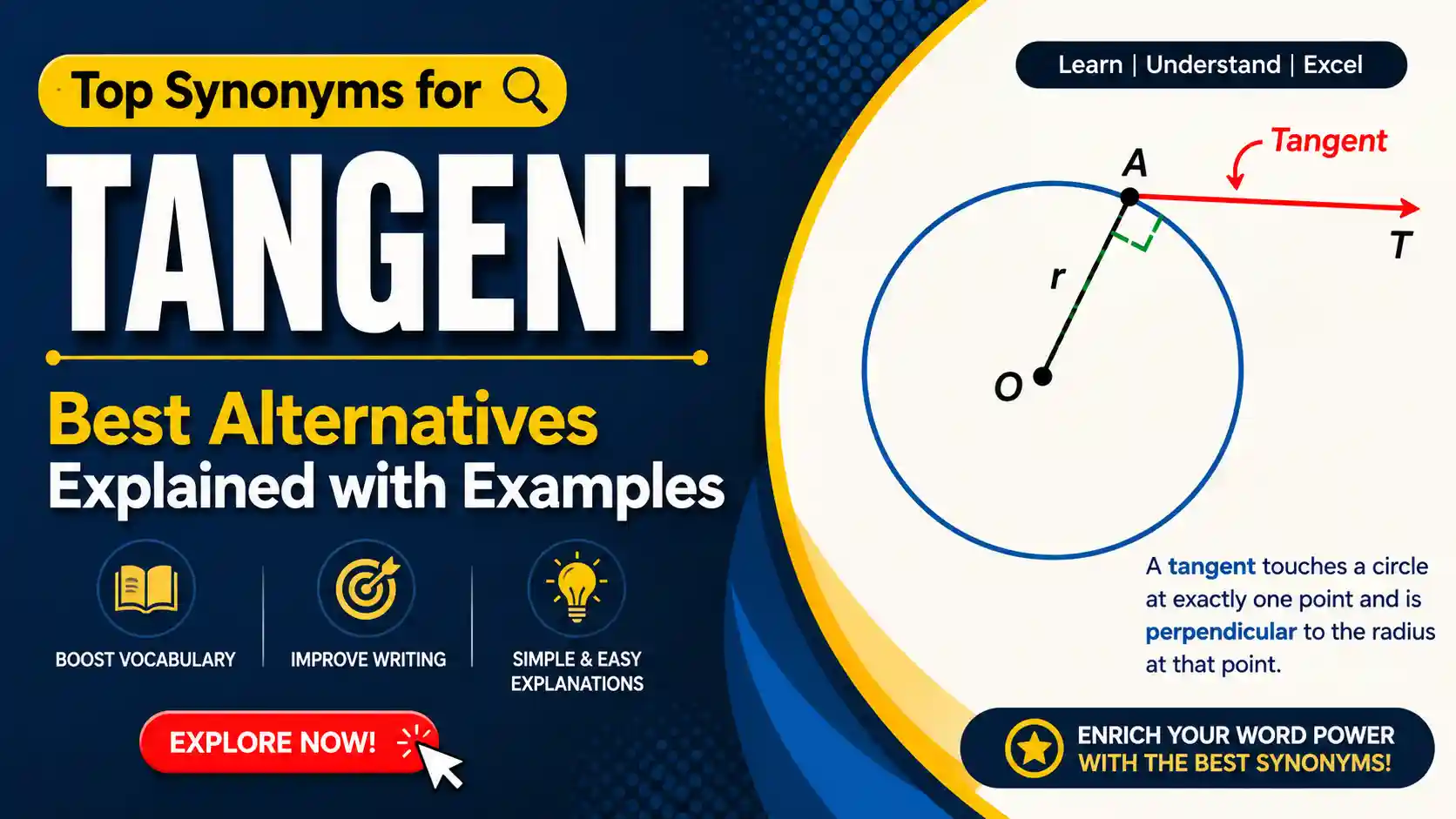
The word also has an important mathematical meaning. In geometry, a tangent is a line that touches a curve at a particular point. It is also the name of a trigonometric function.
So, before choosing a synonym, ask yourself:
Do I mean a change of subject, a side comment, or the mathematical term?
That small distinction will help you choose the right word.
Pronunciation
IPA: /ˈtændʒənt/
Pronounced: TAN-juhnt
The pronunciation is essentially the same in American and British English. Cambridge and Oxford both give a pronunciation beginning with /ˈtændʒ-/.
Part of Speech
Tangent as a Noun
This is the most common grammatical use.
The speaker went off on a tangent.
The tangent touches the circle at one point.
Tangent as an Adjective
Tangent can also be used as an adjective in mathematics.
The line is tangent to the circle.
The adjective means touching a curve or surface at a particular point.
Related Forms
The main related forms are:
- tangential: loosely connected or related
- tangentially: in a tangential way
- tangency: the state of being tangent
Tangent itself is not normally used as a verb or adverb.
Grammar and Common Usage
The most natural conversational pattern is:
go off on a tangent
I went off on a tangent during the presentation.
In British English, you may also hear:
go off at a tangent
The conversation went off at a tangent.
Oxford specifically identifies the first as North American English and the second as British English.
Other useful patterns include:
- go on a tangent
- go off on a tangent
- an interesting tangent
- a brief tangent
- a tangent to a curve
- a tangent line
- tangent to the circle
Remember: Tangent is usually a noun when it describes a side discussion. Tangential is the adjective.
The Best Synonyms for Tangent
There is no single synonym that works in every sentence. Merriam-Webster’s thesaurus lists aside, digression, excursion, excursus, parenthesis, divagation, and rambling among the noun synonyms or closely related choices for tangent.
The most useful choices for everyday learners are digression, aside, and excursion. Other words are better treated as related alternatives because their meanings are not identical.
1. Digression
Meaning: A digression is a move away from the main subject of a speech or piece of writing.
Example 1:
The professor made a short digression about the history of the university.
Example 2:
The book contains several interesting digressions.
Best used when: You are talking about formal speech, writing, lectures, or arguments.
Tone: Formal to neutral
CEFR: Around C1
Frequency: Common
Common collocations:
- brief digression
- lengthy digression
- interesting digression
- unnecessary digression
Nuance: This is one of the closest formal alternatives to the conversational sense of tangent. Merriam-Webster defines digression as leaving the main subject during an organized expression of thought.
When not to use it: Avoid it when you mean a mathematical tangent.
2. Aside
Meaning: An aside is a short comment that is separate from the main point.
Example 1:
As an aside, the manager mentioned that the office would close early.
Example 2:
She added a funny aside before continuing her story.
Best used when: You want to describe a brief additional thought.
Tone: Neutral
CEFR: Around B2
Frequency: Common
Common collocations:
- brief aside
- quick aside
- personal aside
- add an aside
Nuance: An aside is usually shorter and less disruptive than a tangent.
When not to use it: Do not use it when someone spends a long time discussing an unrelated subject.
3. Excursion
Meaning: An excursion can mean a temporary move into another subject or area.
Example 1:
The author makes a brief excursion into medieval history.
Example 2:
The lecture included an unexpected excursion into philosophy.
Best used when: Writing in a literary, academic, or polished style.
Tone: Formal/Literary
CEFR: Around C1
Frequency: Uncommon in this meaning
Common collocations:
- brief excursion
- literary excursion
- intellectual excursion
Nuance: This word can make a side discussion sound deliberate and interesting rather than careless.
When not to use it: It is not the most natural choice for everyday conversation.
4. Parenthesis
Meaning: In writing, a parenthesis can be an additional thought placed within the main discussion.
Example 1:
The author includes a short parenthesis about his childhood.
Example 2:
The historical detail feels like a parenthesis in the main argument.
Best used when: Discussing writing or a brief interruption in a line of thought.
Tone: Formal
CEFR: Around C1
Frequency: Common
Nuance: A parenthesis often feels more contained than a tangent.
When not to use it: Do not treat parenthesis as a universal replacement for tangent in conversation.
5. Rambling
Meaning: Rambling describes speech or writing that lacks a clear focus and continues for too long.
Example 1:
His answer became rambling after the first few minutes.
Example 2:
The essay feels rambling and needs a clearer structure.
Best used when: You want to criticize unfocused communication.
Tone: Informal/Neutral
CEFR: Around B2
Frequency: Common
Nuance: This is not an exact synonym. A person can go on a tangent without being generally rambling.
When not to use it: Do not use rambling for one short and useful side comment.
6. Divagation
Meaning: Divagation means wandering away from the main subject or line of thought.
Example 1:
The essay contains several intellectual divagations.
Example 2:
His speech was interrupted by frequent divagations.
Best used when: Reading or writing in a highly formal or literary context.
Tone: Formal/Literary
CEFR: C2
Frequency: Rare
Nuance: This is a genuine dictionary-related alternative, but it is not a practical everyday word for most English learners.
When not to use it: Avoid it in ordinary conversation. Digression is much more natural.
7. Excursus
Meaning: An excursus is a detailed section or discussion that moves away from the main subject.
Example 1:
The historian adds an excursus on ancient trade routes.
Example 2:
The book contains a long excursus on the author’s theory.
Best used when: Reading academic or scholarly writing.
Tone: Formal/Academic
CEFR: C2
Frequency: Rare
Nuance: This word is more specialized than tangent or digression.
When not to use it: Do not use it in everyday English unless you specifically need a scholarly term.
Related Words That Are Not Exact Synonyms
Some words are closely related to tangent, but calling them exact synonyms would mislead learners.
Sidetrack
Sidetrack means to distract someone from the main task or subject.
The unexpected question sidetracked the meeting.
It is useful in informal English, but it often focuses on distraction rather than simply moving onto another subject.
Detour
A detour is a temporary change from the normal route.
The conversation took a detour into childhood memories.
This is a useful metaphor, but it is not a direct dictionary replacement for every use of tangent.
Digressive
Digressive is an adjective meaning that something moves away from the main subject.
The final section of the essay is rather digressive.
It comes from the same semantic area as digression, but it cannot replace the noun tangent in every sentence.
Tangential
Tangential means only loosely connected with the main subject.
Her comment was tangential to the discussion.
This is especially useful in academic and professional writing.
Merriam-Webster lists tangential as a related adjective and gives examples showing its meaning of having a loose connection to a subject.
Quick Comparison: Which Word Should You Choose?
| Word | Meaning | Register | Best choice when… |
| Tangent | A departure from the topic | Neutral | You are speaking naturally |
| Digression | Departure from the main subject | Formal | You are writing or speaking formally |
| Aside | Short extra comment | Neutral | The comment is brief |
| Excursion | Temporary move into another subject | Literary/Formal | The writing is polished or academic |
| Parenthesis | Additional thought within a discussion | Formal | You are discussing written material |
| Rambling | Unfocused, lengthy communication | Informal | You want to highlight poor focus |
| Sidetrack | Being pulled away from the main task | Informal | Something causes distraction |
| Detour | Temporary change of direction | Neutral | You want a clear metaphor |
| Tangential | Loosely connected | Academic/Formal | You need an adjective |
Quick Tip: If you need one safe replacement for tangent in formal writing, choose digression. For everyday conversation, tangent and aside are usually more natural.
Tangent vs. Digression
These are the two words learners should understand first.
A tangent and a digression can both describe a move away from the main topic.
Compare:
The speaker went off on a tangent about travel.
The speaker made a digression about travel.
Both sentences work. The first sounds more conversational. The second sounds more formal.
Merriam-Webster also treats tangent as a synonym of digression, confirming that these words overlap in this sense.
Tangent vs. Aside
An aside is normally shorter.
As an aside, I should mention that the deadline has changed.
A tangent may take the speaker much further from the original subject.
We were discussing the deadline, but she went off on a tangent about office politics.
Think of an aside as a small side comment and a tangent as a bigger change of direction.
Tangent vs. Tangential
This is a common grammar mistake.
Tangent = noun
His story went off on a tangent.
Tangential = adjective
His story became tangential to the main issue.
Do not write:
His story was a tangent to the issue.
unless you are using tangent in a specialized or metaphorical construction.
The more natural adjective is tangential.
Tangent in Mathematics
The everyday meaning is only one part of the word.
In geometry, a tangent is a line that touches a curve at a particular point. Oxford gives the mathematical definition of a straight line that touches the outside of a curve without crossing it, while Merriam-Webster also gives the trigonometric sense.
For example:
The tangent line touches the circle at one point.
In trigonometry:
We used the tangent of the angle to solve the problem.
These mathematical meanings do not have synonyms such as digression or aside.
Important distinction
Conversation:
She went off on a tangent.
Mathematics:
The tangent touches the circle.
The surrounding context tells you which meaning is intended.
American vs. British English
The spelling tangent is the same in both American and British English.
The main difference appears in the common expression:
American English:
go off on a tangent
British English:
go off at a tangent
Oxford explicitly labels these forms by variety.
The pronunciation is also very similar in both varieties.
Register and Connotation
Different alternatives create different impressions.
| Word | Register | Usual feeling |
| Tangent | Neutral/Spoken | Natural, conversational |
| Digression | Formal | Controlled but off-topic |
| Aside | Neutral | Brief and usually mild |
| Excursion | Literary | Deliberate or interesting |
| Parenthesis | Formal | Brief additional thought |
| Rambling | Informal | Usually negative |
| Sidetrack | Informal | Distracted |
| Tangential | Academic | Loosely connected |
| Divagation | Literary | Highly unusual |
| Excursus | Academic | Scholarly and specialized |
This matters because a synonym should match the tone, not just the dictionary definition.
For example:
Sorry, I went off on a tangent.
sounds natural in conversation.
But:
The author makes a brief digression.
sounds better in an academic discussion.
Common Collocations
Native speakers commonly use tangent in patterns such as:
- go off on a tangent
- go off at a tangent
- go on a tangent
- an interesting tangent
- a brief tangent
- a sudden tangent
- a mathematical tangent
- tangent line
- tangent to a curve
- tangent function
These patterns are often more useful to learners than memorizing a long synonym list.
Common Mistakes
Common Mistake Box
Mistake 1
Wrong: She went on a tangent during the meeting.
Better: She went off on a tangent during the meeting.
Why: The conversational noun normally appears in the expression go off on a tangent.
Mistake 2
Wrong: His comment was a tangent to the subject.
Better: His comment was tangential to the subject.
Why: Tangential is the natural adjective for something loosely connected to a subject.
Mistake 3
Wrong: Tangent means an unrelated subject.
Better: A tangent is a departure from the subject being discussed.
Why: A tangent does not necessarily have to be completely unrelated. It can simply take the discussion away from its main line.
Mistake 4
Wrong: Aside comment
Better: An aside or a side comment
Why: Aside comment is understandable, but it is not the most natural expression.
Mistake 5
Wrong: Tangential line is always the correct mathematical term.
Better: Tangent line
Why: Tangent line is the standard mathematical expression.
When Not to Use Tangent
Do not use tangents whenever two subjects are simply different.
For example:
My favorite subject is English, but my brother likes mathematics.
This is not a tangent.
There is no discussion that moved away from the main topic.
But:
We were discussing English grammar, and then I went off on a tangent about my brother’s math class.
Now the tangent makes sense because the speaker moved away from the original subject.
Also avoid using tangent as a general synonym for difference, change, or disagreement. Those words have broader meanings.
Writing Tips
For Essays
Use digression or tangential when you need a formal tone.
The historical discussion becomes a brief digression from the central argument.
For Emails
Use simple language.
As an aside, please remember to attach the updated file.
For Blog Posts
Tangent can make your writing sound friendly and personal.
Before we continue, let me go off on a quick tangent about this unusual word.
Do not overuse it, though. Too many tangents can make an article difficult to follow.
For Stories
Use tangent, detour, or digression depending on your style.
Her story took an unexpected detour when she remembered her first job.
For Professional Communication
Choose a precise language.
That point is tangential to the main issue.
If someone is avoiding a question, deflection may be more accurate than tangent.
Word Origin and First Known Use
Tangent comes from Latin tangens, meaning “touching,” from tangere, meaning “to touch.” The mathematical sense developed from the idea of a line touching a curve.
Merriam-Webster records 1594 as the first known use of tangent.
Historical sources also discuss earlier mathematical use, including Thomas Fincke’s Geomietria Rotundi from 1583. The figurative idea of going off on a tangent appeared much later.
This history explains why the modern word has two very different-looking meanings: one mathematical and one conversational.
CEFR and Learner Guidance
CEFR levels for individual vocabulary items are approximate because different learning systems classify words differently.
A practical guide is:
| Word | Approximate level | Learner note |
| Tangent | B2-C1 | Learn both conversational and mathematical meanings |
| Aside | B2 | Useful in everyday and written English |
| Digression | C1 | Important for academic writing |
| Excursion | C1 | More literary in this meaning |
| Rambling | B2 | Useful for describing unfocused speech |
| Parenthesis | C1 | Useful for academic and writing contexts |
| Tangential | C1 | Important adjective for formal writing |
| Divagation | C2 | Rare and not essential for most learners |
| Excursus | C2 | Specialized academic vocabulary |
For most English learners, tangent, aside, digression, and tangential are the highest-value words to learn first.
Mini Practice
Fill in the Blanks
Choose the best answer.
- The professor made a brief ______ from the main topic.
A. digression
B. triangle - Sorry, I went off on a ______.
A. tangent
B. parenthetical - As an ______, the meeting starts at nine tomorrow.
A. aside
B. tangent - His answer became ______ and difficult to follow.
A. rambling
B. mathematical - The comment was ______ to the main issue.
A. tangential
B. tangent
Answers
- A. digression
- A. tangent
- A. aside
- A. rambling
- A. tangential
Sentence Rewriting Practice
Rewrite each sentence using the word in brackets.
1. The speaker moved away from the main subject.
Use: tangent
The speaker went off on a tangent.
2. The writer moved briefly away from the main argument.
Use: digression
The writer made a brief digression from the main argument.
3. She added a short extra thought.
Use: aside
She added an aside.
Quick Matching Exercise
Match each word to its best description.
| Word | Description |
| 1. Tangent | A. A short additional comment |
| 2. Digression | B. A departure from the main subject |
| 3. Rambling | C. Unfocused and lengthy communication |
| 4. Tangential | D. Loosely connected to the main subject |
Answers: 1-B, 2-B, 3-C, 4-D
FAQ
What is the closest synonym for tangent?
For the conversational meaning, digression is one of the closest formal synonyms. Aside and excursion can also work in certain contexts. The best choice depends on whether the speaker briefly adds another thought or moves farther away from the main subject.
What is another word for going off on a tangent?
You can say digress, get sidetracked, go off-topic, or take a detour. However, these are not identical. Digress is formal, get sidetracked suggests distraction, and detour is often used as a metaphor for a temporary change of direction.
Is digression a synonym for tangent?
Yes, when both words describe leaving the main subject. Digression is usually more formal, while tangent is very natural in everyday conversation. Merriam-Webster lists tangent and digression as synonyms in this sense.
What is the difference between tangent and tangential?
Tangent is normally a noun, while tangential is an adjective. You can say, “The speaker went off on a tangent,” but “The comment was tangential to the discussion.” The adjective means loosely or indirectly connected to the main subject.
Is tangent a formal word?
Tangent itself is neutral. The expression go off on a tangent is especially common in spoken and conversational English. In formal academic writing, digression may sound more appropriate when describing a departure from the main subject.
What is the opposite of a tangent?
There is no single perfect antonym. Depending on context, useful opposites include focus, directness, relevance, staying on topic, and sticking to the main point. The best choice depends on what aspect of tangent you want to contrast.
What does tangent mean in mathematics?
In mathematics, a tangent can be a line associated with a curve at a particular point. The word is also used for a trigonometric function. These technical meanings are completely different from the conversational meaning of moving away from a subject.
What is the British English version of “go off on a tangent”?
British English commonly uses go off at a tangent, while North American English commonly uses go off on a tangent. Both expressions describe suddenly moving away from the subject being discussed.
Final Takeaway
The best way to learn synonyms for tangents is not to memorize a huge list. Learn the small differences between the useful choices. Use tangent for natural conversation, digression for formal discussion or writing, aside for a short extra comment, and tangential when you need an adjective meaning loosely connected.
Once you understand these differences, your writing becomes more precise and your speaking sounds more natural. Try using the words in your essays, emails, conversations, and everyday writing. Good vocabulary is not about using the biggest word. It is about choosing the right word for the right situation.
Trusted References
- Merriam-Webster, Tangent and Merriam-Webster Thesaurus: Tangent.
- Oxford Learner’s Dictionaries, Tangent.
- Cambridge Dictionary, Tangent.
- Collins English Thesaurus, Aside.
- Dictionary.com / Thesaurus, Tangent and Go Off on a Tangent.

Synonorm is a trusted English vocabulary resource created to help readers find the right words and understand the differences between similar terms. We provide clear explanations of synonyms, meanings, examples, usage, and alternatives. Our content makes vocabulary easier to learn and apply in everyday, academic, and professional English. Synonorm is designed for students, writers, ESL learners, professionals, and anyone who wants to improve their English vocabulary and communicate more clearly.