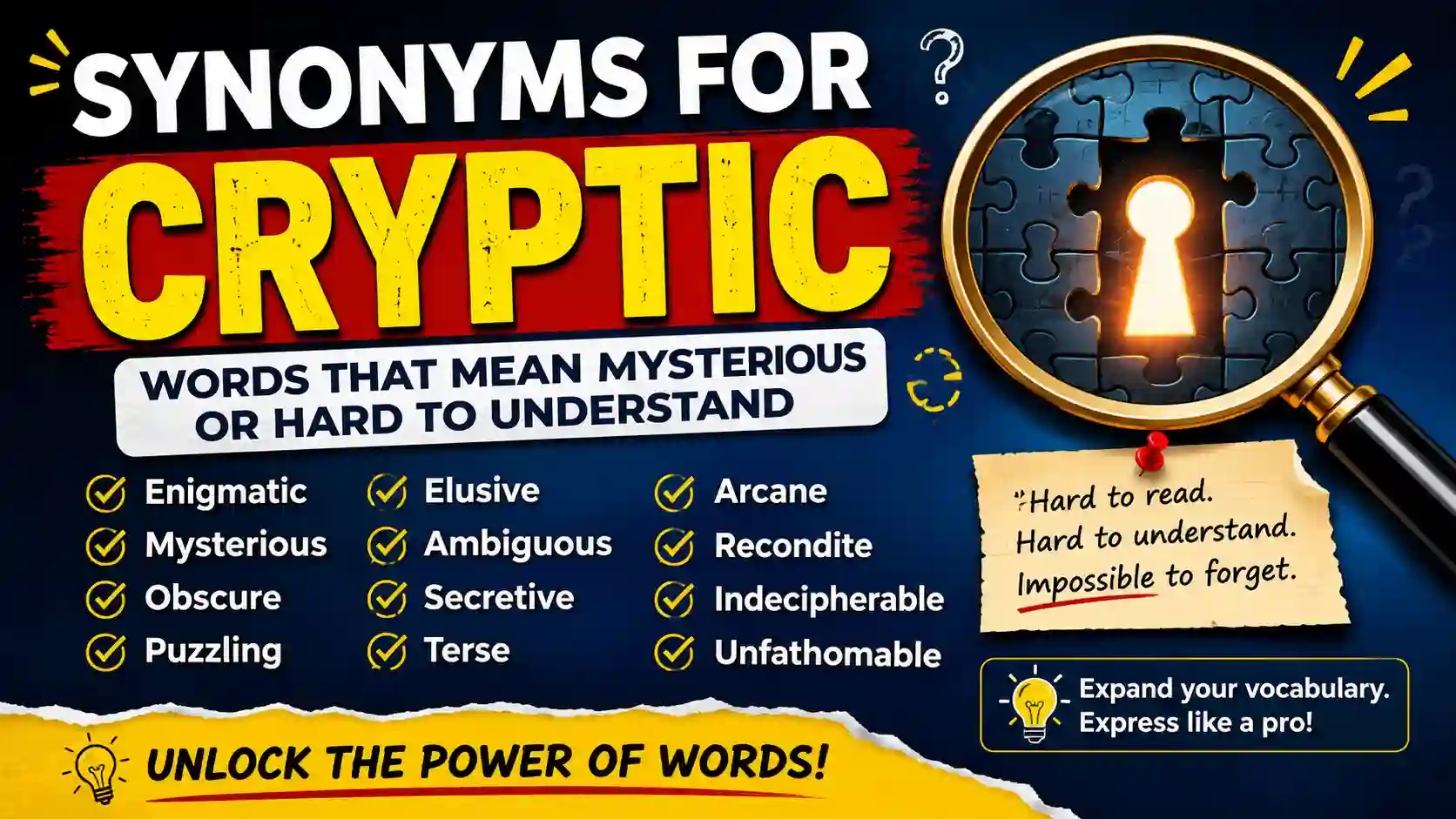
Have you ever read a message that seemed to hide its real meaning? If so, you might describe it as cryptic. The best synonyms for cryptic include mysterious, enigmatic, puzzling, obscure, ambiguous, perplexing, inscrutable, and baffling, but they are not all interchangeable.
Mysterious emphasizes something unknown, ambiguous suggests more than one possible meaning, while vague means that something lacks clear detail. This guide explains the closest synonyms for cryptic, their differences, examples, tone, frequency, and the situations where you should or should not use each word.
Quick Answer: What Are the Best Synonyms for Cryptic?
The closest everyday synonyms for cryptic are mysterious, enigmatic, puzzling, obscure, ambiguous, perplexing, and baffling. Use enigmatic for something mysterious and intriguing, ambiguous when it has multiple possible meanings, vague when it lacks detail, and coded when information is deliberately expressed through a code.
What Does Cryptic Mean?
Cryptic is an adjective used for something that has a hidden, mysterious, indirect, or difficult-to-understand meaning.
For example:
The manager gave a cryptic answer and left the team wondering what he meant.
The answer may not be completely meaningless. Instead, its meaning may be hidden or expressed in a way that makes the reader work to understand it.
Merriam-Webster defines cryptic in this sense as having or seeming to have a hidden or ambiguous meaning and also notes the idea of puzzling brevity.
The word can describe:
- a cryptic message
- a cryptic clue
- a cryptic remark
- a cryptic answer
- a cryptic warning
- a cryptic comment
- a cryptic expression
- a cryptic reference
Important distinction
Not everything that is difficult is cryptic.
A difficult physics problem may be complex.
An unclear instruction may be vague.
A sentence with two possible meanings may be ambiguous.
A mysterious clue with a hidden meaning may be cryptic.
That distinction is one of the most important things to understand when choosing a synonym.
Pronunciation of Cryptic
IPA: /ˈkrɪp.tɪk/
Pronunciation: KRIP-tik
The spelling is the same in American and British English.
Part of Speech
Cryptic is primarily an adjective.
Examples
- The message was cryptic.
- She gave a cryptic response.
- He smiled cryptically.
The common adverb is cryptically.
Common grammar patterns
cryptic + noun
- cryptic message
- cryptic clue
- cryptic statement
- cryptic remark
be + cryptic
- His answer was cryptic.
- Her explanation seemed cryptic.
verb + cryptically
- He replied cryptically.
- She smiled cryptically.
Quick Synonym Comparison
| Synonym | Main idea | Strength | Register | Frequency |
| Mysterious | Difficult to explain or know | Strong | Neutral | Very common |
| Enigmatic | Mysterious and intriguing | Strong | Formal/Literary | Common |
| Puzzling | Difficult to understand | Strong | Neutral | Common |
| Obscure | Hard to understand or not well known | Strong | Formal | Common |
| Ambiguous | More than one interpretation | Strong | Formal/Academic | Common |
| Perplexing | Causes confusion | Strong | Neutral/Formal | Common |
| Baffling | Extremely confusing | Strong | Neutral | Common |
| Vague | Lacks clear details | Related | Neutral | Very common |
| Inscrutable | Almost impossible to interpret | Very strong | Formal/Literary | Uncommon |
| Unclear | Not easy to understand | Related | Neutral | Very common |
| Opaque | Difficult to understand or interpret | Strong | Formal/Business | Common |
| Arcane | Known by very few people | Related | Formal | Uncommon |
| Esoteric | Understood by a specialized group | Related | Academic/Formal | Uncommon |
| Coded | Expressed through a code | Contextual | Technical | Common |
| Equivocal | Deliberately open to different interpretations | Strong | Formal | Uncommon |
The Best Synonyms for Cryptic
1. Mysterious
Meaning: Something mysterious is difficult to explain, understand, or know.
CEFR: B1–B2
Frequency: Very common
Register: Neutral
Connotation: Curious, unknown, sometimes suspenseful
Examples
- The detective received a mysterious letter.
- Her sudden decision remained mysterious.
Best used when: You want the simplest natural alternative to cryptic.
Common collocations:
- mysterious message
- mysterious behavior
- mysterious disappearance
When not to use it: Use cryptic instead when the mystery comes specifically from someone’s wording or hidden meaning.
2. Enigmatic
Meaning: Something enigmatic is mysterious, puzzling, and difficult to interpret.
CEFR: C1
Frequency: Common
Register: Formal, literary, academic
Connotation: Intriguing rather than merely confusing
Examples
- The author gave an enigmatic answer.
- She was known for her enigmatic smile.
Best used when: You want to describe something mysterious in a polished or sophisticated way.
Common collocations:
- enigmatic figure
- enigmatic smile
- enigmatic statement
When not to use it: Avoid it when the real problem is simply poor communication.
3. Puzzling
Meaning: Something puzzling is difficult to understand and makes you think.
CEFR: B2
Frequency: Common
Register: Neutral
Connotation: Curious, confusing, thought-provoking
Examples
- His reaction was puzzling.
- The scientist found the result puzzling.
Best used when: Something creates a question in your mind.
Common collocations:
- puzzling behavior
- puzzling question
- puzzling result
4. Obscure
Meaning: Something obscure is difficult to understand, identify, or know.
CEFR: C1
Frequency: Common
Register: Formal, academic
Connotation: Hidden, unfamiliar, or difficult to access
Examples
- The article contains several obscure references.
- The poem uses obscure language.
Best used when: The meaning is difficult because it is hidden, unfamiliar, or poorly expressed.
When not to use it: Do not use obscure when you specifically mean “has two meanings.” Use ambiguous instead.
5. Ambiguous
Meaning: Something ambiguous can have more than one possible interpretation.
CEFR: C1
Frequency: Common
Register: Formal, academic, business
Connotation: Uncertainty or lack of precision
Examples
- The contract contains ambiguous wording.
- His answer was ambiguous.
Best used when: A sentence or statement can reasonably be understood in different ways.
When not to use it: Do not call something ambiguous just because it is mysterious.
Merriam-Webster specifically distinguishes ambiguous from cryptic: ambiguity concerns language capable of more than one interpretation, while cryptic suggests deliberately concealed meaning.
6. Perplexing
Meaning: Something perplexing causes confusion because it is difficult to understand.
CEFR: C1
Frequency: Common
Register: Neutral/Formal
Connotation: Strong confusion
Examples
- The instructions were perplexing.
- His sudden change of attitude was perplexing.
Best used when: You want to emphasize the person’s confusion.
7. Baffling
Meaning: Something baffling is extremely difficult to understand or explain.
CEFR: B2
Frequency: Common
Register: Neutral
Connotation: Strong confusion or surprise
Examples
- The disappearance was baffling.
- Her decision was baffling to her coworkers.
Best used when: Something leaves you wondering how or why it happened.
8. Vague
Meaning: Something vague does not give enough clear or exact information.
CEFR: B2
Frequency: Very common
Register: Neutral
Connotation: Imprecise
Examples
- He gave a vague answer.
- The instructions were too vague.
Best used when: The problem is a lack of detail.
Cryptic vs. vague
Cryptic: The meaning seems hidden.
Vague: The details are not specific enough.
These words overlap, but they are not identical.
9. Inscrutable
Meaning: Something inscrutable is extremely difficult or impossible to understand.
CEFR: C2
Frequency: Uncommon
Register: Formal/Literary
Connotation: Deeply mysterious
Examples
- His expression was inscrutable.
- The meaning of the symbol remained inscrutable.
Best used when: You want a stronger and more sophisticated word for something almost impossible to interpret.
When not to use it: It is too formal for most everyday conversations.
10. Unclear
Meaning: Something unclear is not easy to understand.
CEFR: B1
Frequency: Very common
Register: Neutral
Examples
- The final instruction was unclear.
- The reason for the delay remains unclear.
Best used when: You need a simple, safe word.
Important: Unclear is broader and less expressive than cryptic.
11. Opaque
Meaning: In figurative English, opaque information is difficult to understand or interpret.
CEFR: C1
Frequency: Common
Register: Formal, business, academic
Examples
- The company’s decision-making process was opaque.
- The report gave an opaque explanation of the policy.
Best used when: Information is difficult to understand because the process or reasoning is hidden.
When not to use it: Avoid using opaque as a casual replacement for every unclear sentence.
12. Coded
Meaning: Something coded uses a code or special system to communicate information.
CEFR: B2
Frequency: Common
Register: Neutral/Technical
Examples
- The agents exchanged coded messages.
- The note contained a coded warning.
Best used when: An actual code, cipher, or systematic encoding is involved.
Important: A cryptic message is not necessarily a coded message.
13. Equivocal
Meaning: Something equivocal is deliberately unclear or open to different interpretations.
CEFR: C2
Frequency: Uncommon
Register: Formal/Academic
Examples
- The politician gave an equivocal response.
- His equivocal statement avoided a direct answer.
Best used when: Someone deliberately avoids committing to a clear position.
Nuance: This word can suggest evasion, not just mystery.
14. Arcane
Meaning: Something arcane is understood by very few people because it involves specialized knowledge.
CEFR: C2
Frequency: Uncommon
Register: Formal/Academic
Examples
- The book explains the arcane rules of medieval law.
- Only specialists understood the arcane terminology.
Best used when: The subject is obscure and specialized.
When not to use it: A mysterious text is not automatically arcane.
15. Esoteric
Meaning: Something esoteric is understood by a small group with specialized knowledge.
CEFR: C2
Frequency: Uncommon
Register: Academic/Formal
Examples
- The lecture focused on an esoteric branch of philosophy.
- The manuscript contains esoteric symbols.
Best used when: You are describing specialist knowledge.
Cryptic vs. esoteric: Cryptic is difficult because meaning is hidden or puzzling. Esoteric is difficult because only a small group knows or understands the subject.
16. Abstruse
Meaning: Something abstruse is difficult to understand because it is intellectually complex.
CEFR: C2
Frequency: Rare
Register: Academic/Formal
Examples
- The professor discussed an abstruse philosophical argument.
- The paper contains several abstruse ideas.
Best used when: Complexity is the main problem.
When not to use it: Do not use abstruse simply because something contains a secret.
17. Unfathomable
Meaning: Something unfathomable is extremely difficult or impossible to understand.
CEFR: C2
Frequency: Uncommon
Register: Literary/Formal
Examples
- The reason for his decision was unfathomable.
- The scale of the universe can seem unfathomable.
Best used when: You want to emphasize extreme depth or incomprehensibility.
18. Incomprehensible
Meaning: Something incomprehensible is impossible or extremely difficult to understand.
CEFR: C1
Frequency: Common
Register: Formal
Examples
- The technical report was incomprehensible to beginners.
- His explanation became incomprehensible.
Best used when: The reader or listener cannot understand something at all.
Important difference: This is generally stronger than cryptic.
19. Mystifying
Meaning: Something mystifying is extremely confusing or difficult to explain.
CEFR: C1
Frequency: Uncommon
Register: Neutral/Formal
Examples
- The machine’s failure was mystifying.
- Her reaction was completely mystifying.
Best used when: You want to stress that something has no obvious explanation.
20. Veiled
Meaning: Something veiled is expressed indirectly rather than openly.
CEFR: C1
Frequency: Common
Register: Formal/Literary
Examples
- He made a veiled threat.
- Her comment was a veiled criticism.
Best used when: Someone intentionally avoids saying something directly.
This is especially useful when writing about indirect criticism, threats, warnings, or references.
Synonyms by Meaning
Not every synonym works equally well. Choose the word according to the meaning you want.
If You Mean “Mysterious”
- mysterious
- enigmatic
- cryptic
- inscrutable
- mystifying
If You Mean “Difficult to Understand”
- puzzling
- perplexing
- baffling
- obscure
- unclear
If You Mean “More Than One Meaning”
- ambiguous
- equivocal
- unclear
If You Mean “Not Enough Detail”
- vague
- unclear
- imprecise
If You Mean “Specialized and Hard to Understand”
- arcane
- esoteric
- abstruse
- recondite
If You Mean “Indirect”
- veiled
- cryptic
- equivocal
If You Mean “Written in a Secret System”
- coded
- encoded
- ciphered
Cryptic vs. Mysterious vs. Enigmatic vs. Ambiguous
This is one of the most useful distinctions for English learners.
| Word | Core idea | Example |
| Cryptic | Meaning is hidden or puzzling | She gave a cryptic reply. |
| Mysterious | Something is unknown or difficult to explain | A mysterious visitor arrived. |
| Enigmatic | Something is mysteriously puzzling | He had an enigmatic smile. |
| Ambiguous | More than one interpretation is possible | The instructions were ambiguous. |
| Vague | Details are insufficient | His answer was vague. |
| Coded | A code is used | They sent a coded message. |
Easy memory trick
Cryptic = hidden meaning
Mysterious = unknown
Enigmatic = intriguing mystery
Ambiguous = multiple meanings
Vague = missing details
Coded = secret system
Common Collocations With Cryptic
Learning collocations helps you sound more natural.
Common combinations include:
- cryptic message
- cryptic clue
- cryptic remark
- cryptic answer
- cryptic statement
- cryptic response
- cryptic warning
- cryptic comment
- cryptic reference
- cryptic expression
- cryptic note
- cryptic post
Natural examples
- She posted a cryptic comment online.
- The detective discovered a cryptic clue.
- His cryptic response raised more questions.
- The journalist received a cryptic warning.
- The book contains several cryptic references.
When Should You Not Use “Cryptic”?
Avoid cryptic when you simply mean:
1. Difficult
Use difficult or complex.
The mathematics problem was complex.
Not:
The mathematics problem was cryptic.
2. Unclear because of missing details
Use vague.
The instructions were vague.
3. More than one interpretation
Use ambiguous.
The sentence was ambiguous.
4. Specialist knowledge
Use esoteric or arcane.
The discussion involved esoteric knowledge.
5. A secret code
Use coded or encoded.
The message was coded.
This distinction prevents the most common synonym mistakes.
Common Mistakes With Cryptic Synonyms
Common Mistake Box
Mistake: “The teacher gave an ambiguous answer” when you only mean the answer was difficult to understand.
Better: “The teacher gave a cryptic answer.”
Why: Ambiguous specifically suggests multiple possible interpretations.
Mistake: “The email was coded” when the writer simply expressed the idea indirectly.
Better: “The email was cryptic.”
Why: Coded suggests an actual code or encoding system.
Mistake: “The instructions were cryptic” when they simply lacked details.
Better: “The instructions were vague.”
Why: Vague focuses on insufficient detail.
Mistake: Using inscrutable in a simple everyday email.
Better: Use unclear or puzzling.
Why: Inscrutable is much more formal and literary.
How to Choose the Right Synonym
Ask yourself one question:
What exactly makes this thing difficult to understand?
If the answer has a hidden meaning, use cryptic.
If it is a mystery, use mysterious.
If it is an intriguing mystery, use enigmatic.
If it has multiple meanings, use ambiguous.
If it lacks specific information, use vague.
If it creates strong confusion, use baffling or perplexing.
If it involves specialist knowledge, use arcane or esoteric.
If it uses a secret code, use coded.
This approach is much more useful than memorizing a long thesaurus list.
Word Origin and Etymology
The word cryptic comes from roots connected with hiding and concealment.
Merriam-Webster traces it through Late Latin crypticus, from Late Greek kryptikós, related to Greek kryptós, meaning “hidden” or “secret.” The Greek root is associated with kryptō, meaning “to hide” or “conceal.” Merriam-Webster gives 1620 as the first known use of cryptic in the relevant sense.
The same historical root is connected with words such as:
- crypt
- cryptogram
- cryptography
- encryption
This history helps explain why cryptic developed its modern association with hidden meanings and secret communication.
American vs. British English
There is no important spelling difference:
American English: cryptic
British English: cryptic
The word is widely understood in both varieties.
Its pronunciation is also essentially the same:
/ˈkrɪp.tɪk/
The major difference is not regional usage but context. In both American and British English, cryptic commonly describes mysterious remarks, messages, clues, comments, and statements.
Register and Tone Guide
| Word | Register | Typical setting |
| Mysterious | Neutral | Everyday English |
| Puzzling | Neutral | Conversation, writing |
| Unclear | Neutral | Everyday and professional |
| Vague | Neutral | Everyday, business |
| Baffling | Neutral | News, conversation |
| Enigmatic | Formal/Literary | Essays, reviews |
| Obscure | Formal | Academic writing |
| Ambiguous | Formal | Business, law, academic writing |
| Opaque | Formal | Business, politics, academic writing |
| Perplexing | Formal/Neutral | Reports, essays |
| Inscrutable | Literary/Formal | Advanced writing |
| Arcane | Academic/Formal | Specialist subjects |
| Esoteric | Academic | Specialist knowledge |
| Abstruse | Academic | Philosophy, theory |
| Equivocal | Formal | Politics, law, professional writing |
Antonyms of Cryptic
The best opposite depends on the intended meaning.
If cryptic means difficult to understand:
- clear
- understandable
- intelligible
- straightforward
If cryptic means indirect:
- direct
- explicit
- frank
- open
If cryptic means ambiguous:
- unambiguous
- definite
- precise
- clear
Examples
Cryptic: He gave a cryptic answer.
Direct: He gave a direct answer.
Cryptic: The instructions were cryptic.
Clear: The instructions were clear.
Word Family and Related Vocabulary
Word family
- cryptic — adjective
- cryptically — adverb
Related words
- crypt
- cryptogram
- cryptography
- cryptographic
- encryption
- encrypt
- decrypt
These words are historically connected with the broader idea of hiding, secrecy, or coded information, although their modern meanings differ.
Practice: Choose the Best Word
Choose from:
cryptic, mysterious, ambiguous, vague, coded, esoteric
1.
The spy sent a ______ message that required a special key.
2.
The politician gave an ______ answer that could be interpreted in two different ways.
3.
The old house had a ______ history that nobody could explain.
4.
The manager gave a ______ response without explaining what would happen next.
5.
The professor discussed an ______ theory understood by only a few specialists.
6.
Her short message was so ______ that I had to read it several times.
Answers
- coded
- ambiguous
- mysterious
- vague
- esoteric
- cryptic
Rewrite Practice
Replace cryptic with the most precise synonym.
1. His message was cryptic because nobody knew what he meant.
Possible answer: His message was puzzling because nobody knew what he meant.
2. The contract contained cryptic wording that could have two meanings.
Best answer: The contract contained ambiguous wording that could have two meanings.
3. She gave a cryptic warning without saying what the danger was.
Possible answer: She gave a veiled warning without saying what the danger was.
4. The professor used cryptic terms known only to specialists.
Best answer: The professor used esoteric terms known only to specialists.
FAQ: Synonyms for Cryptic
What is the closest synonym for cryptic?
Enigmatic and mysterious are among the closest general synonyms for cryptic. Puzzling is also a strong choice when something is difficult to understand. The best synonym depends on the exact context because cryptic can suggest hidden meaning, mystery, indirect expression, or puzzling brevity.
What is a simple word for cryptic?
The simplest alternatives are mysterious, puzzling, unclear, and confusing. For everyday English, mystery is often the most natural choice. Use puzzling when something makes you wonder what it means or why it happened.
Is ambiguous the same as cryptic?
No. They overlap, but they are not identical. Ambiguous means that something can have two or more possible interpretations. Cryptic means that the meaning is hidden, mysterious, indirect, or difficult to interpret. A cryptic message can have one intended meaning without being technically ambiguous.
What is the difference between cryptic and vague?
Cryptic suggests hidden or puzzling meaning, while vague means that information is not precise or detailed enough. For example, “See you later” is vague because later is not specific. A strange statement that hints at something without explaining it can be cryptic.
What is a formal synonym for cryptic?
Useful formal synonyms include enigmatic, obscure, ambiguous, perplexing, opaque, inscrutable, and equivocal. However, they are not exact replacements in every sentence. Choose ambiguous for multiple interpretations and enigmatic for mysterious, puzzling qualities.
Is mysterious a synonym for cryptic?
Yes, in many contexts. Both words can describe something difficult to explain or understand. However, the mystery is broader. Cryptic more often describes language, messages, clues, remarks, or expressions whose meaning is hidden or difficult to interpret.
What is the opposite of cryptic?
Common opposites include clear, direct, explicit, straightforward, understandable, and unambiguous. The best opposite depends on the context. Direct is useful for indirect language, while clear is useful when the issue is difficulty of understanding.
Is coded a synonym for cryptic?
Only in some contexts. A coded message uses a code, cipher, or special system to communicate information. A cryptic message may simply be mysterious or indirect. Therefore, every coded message may appear cryptic, but not every cryptic message is coded.
Final Takeaway
The best synonym for cryptic depends on the exact shade of meaning you need. Use mysterious for something unknown, enigmatic for something intriguingly mysterious, puzzling for something that makes you think, ambiguous for multiple interpretations, vague for missing details, obscure for difficult or unfamiliar meaning, and coded when a real code is involved.
Good vocabulary is not about using the biggest word. It is about choosing the most accurate word. Once you understand these differences, your essays, emails, blog posts, stories, and conversations will sound clearer and more natural.
References
- Merriam-Webster, Cryptic, definition, synonym distinctions, etymology, and first known use.
- Merriam-Webster Thesaurus, Synonyms of Cryptic, synonym list and usage guidance.
- Collins English Thesaurus, Cryptic Synonyms, contextual synonym groups and examples.
- Cambridge English Thesaurus, Cryptic, related words and synonym groupings.

Synonorm is a trusted English vocabulary resource created to help readers find the right words and understand the differences between similar terms. We provide clear explanations of synonyms, meanings, examples, usage, and alternatives. Our content makes vocabulary easier to learn and apply in everyday, academic, and professional English. Synonorm is designed for students, writers, ESL learners, professionals, and anyone who wants to improve their English vocabulary and communicate more clearly.