Quick Answer: What Are Synonyms for Domestic?
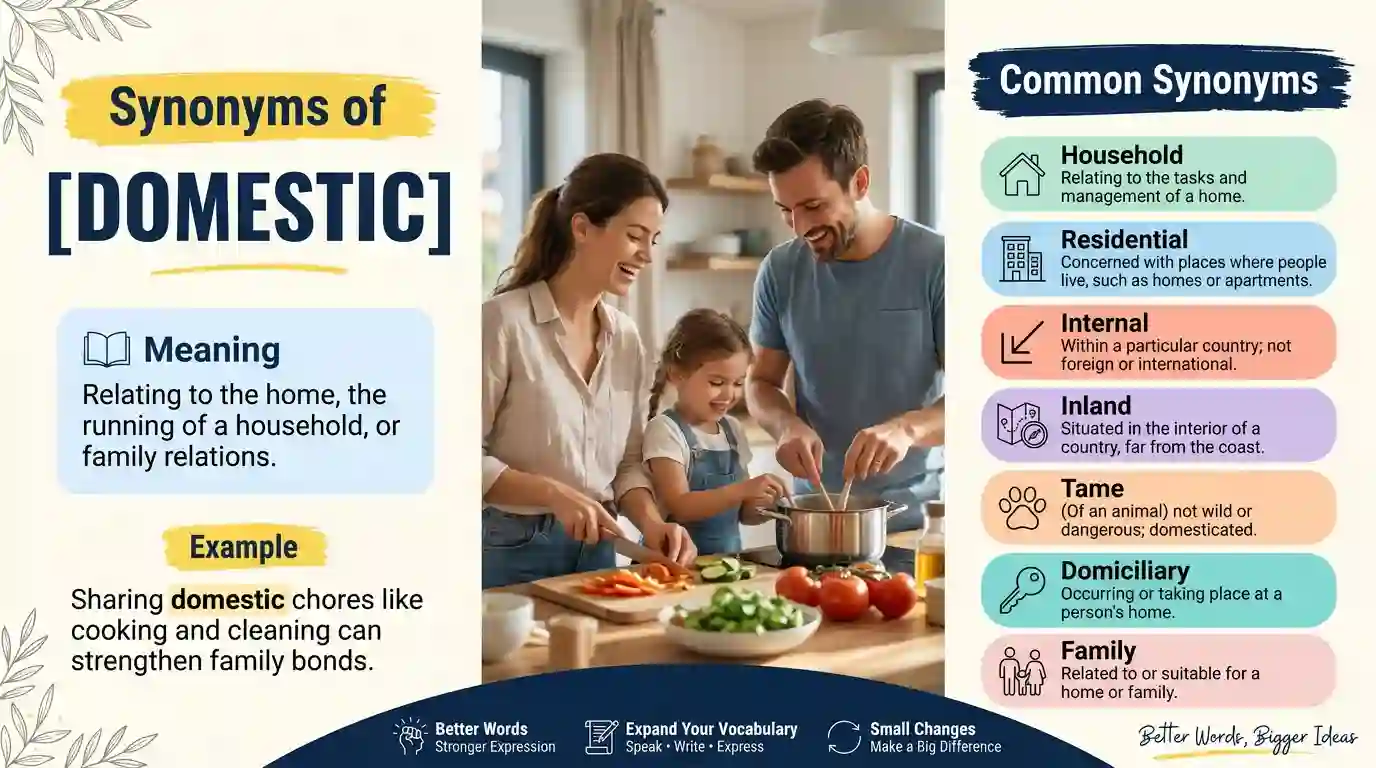
Synonyms for domestic include household, home, family, familial, residential, private, domesticated, tame, national, internal, native, and indigenous. The right alternative depends on the meaning. Domestic can describe home and family life, animals kept by humans, or activities and products within a particular country.
Have you ever used the word domestic in an essay or conversation and wondered whether another word would sound better? The answer depends on what you want to describe.
Domestic has several meanings in English. It can refer to household responsibilities, family relationships, animals kept by humans, or activities that take place within a country.
For example, domestic chores can also be called household chores. However, domestic flights usually means flights within one country, not flights connected with a home.
Understanding these differences helps you choose better words and avoid awkward sentences. This guide explains 30 synonyms for domestic, with simple definitions, original examples, pronunciation guidance, collocations, and practical usage notes.
Whether you are an English learner, student, teacher, blogger, or professional writer, you will find useful alternatives for everyday and formal communication.
Pronunciation of Domestic
- IPA: /dəˈmes.tɪk/
- Pronounced as: duh-MES-tik
- Syllables: Three
- Stress: Second syllable
- Part of speech: Adjective and noun
The standard British and American pronunciations are very similar.
What Does Domestic Mean?
Domestic has four main adjective meanings:
- Related to a home or family: Domestic chores, domestic responsibilities, and domestic life.
- Related to one country: Domestic flights, domestic markets, and domestic policies.
- Kept by humans: Domestic animals such as cats, dogs, and cattle.
- Enjoying home life: A person who enjoys cooking, cleaning, or spending time at home.
Domestic can also work as a noun. In this use, it can refer to a person employed to perform household work. This meaning is dated or less common in modern everyday English.
Part of Speech and Word Family
| Word | Part of Speech | Meaning |
|---|---|---|
| Domestic | Adjective | Related to home, country, or human-kept animals |
| Domestic | Noun | A household worker |
| Domestically | Adverb | In a home-related way or within a country |
| Domesticate | Verb | Adapt an animal or plant to human care |
| Domesticated | Adjective | Adapted to human care |
| Domestication | Noun | The process of adapting animals or plants |
| Domesticity | Noun | Home and family life |
Examples:
- Domestic workers provide household services.
- The company sells its products domestically.
- Humans domesticated several animal species thousands of years ago.
30 Synonyms for Domestic With Meanings and Examples
The following words and expressions are grouped by meaning. The CEFR levels are approximate learning guides, not official ratings for every synonym.
A. Synonyms Related to Home and Family
1. Household
Meaning: Connected with a home or the people who live there.
Examples:
- Household expenses increased after the family moved.
- Everyone should share household responsibilities.
Best used when: Discussing chores, family budgets, supplies, or everyday home activities.
- Register: Neutral, everyday
- CEFR: B1
- Frequency: Very common
- Collocations: Household chores, household expenses, household goods
- Nuance: Focuses on the practical running of a home.
Avoid when: Discussing national markets or domestic flights.
2. Home
Meaning: Connected with the place where someone lives.
Examples:
- The shop sells home cleaning products.
- She enjoys home cooking on weekends.
Best used when: Describing living spaces, family activities, or products used at home.
- Register: Neutral, spoken
- CEFR: A1
- Frequency: Very common
- Collocations: Home life, home cooking, home appliances
- Nuance: Friendly and familiar.
Avoid when: You need a precise term for national policies or international trade.
3. Family
Meaning: Connected with relatives or people who belong to the same family.
Examples:
- They made a family decision together.
- The hotel offers family entertainment.
Best used when: Discussing relationships, shared activities, and family responsibilities.
- Register: Neutral
- CEFR: A1
- Frequency: Very common
- Collocations: Family life, family matters, family responsibilities
- Nuance: Emphasizes relationships rather than household management.
Avoid when: Referring to domestic manufacturing or animals as a scientific category.
4. Familial
Meaning: Related to family relationships or family members.
Examples:
- The children share a strong familial bond.
- Familial support helped him during a difficult period.
Best used when: Writing about relationships, family history, or inherited characteristics.
- Register: Formal, academic
- CEFR: C1
- Frequency: Common
- Collocations: Familial bonds, familial relationships, familial responsibilities
- Nuance: More technical than the word family.
Avoid when: Describing everyday cleaning tasks or household products.
5. Residential
Meaning: Related to places where people live.
Examples:
- The city plans to develop more residential areas.
- The building contains residential apartments.
Best used when: Discussing housing, neighborhoods, buildings, and accommodation.
- Register: Formal, business, academic
- CEFR: B2
- Frequency: Common
- Collocations: Residential property, residential area, residential buildings
- Nuance: Focuses on places for living.
Avoid when: Describing family emotions or household relationships.
6. Private
Meaning: Personal or not open to the public.
Examples:
- The family discussed the issue in a private meeting.
- She prefers to keep her personal life private.
Best used when: Discussing personal affairs or matters that are not public.
- Register: Neutral, professional
- CEFR: B1
- Frequency: Very common
- Collocations: Private life, private affairs, private residence
- Nuance: Emphasizes privacy rather than home management.
Avoid when: You mean ordinary household work. Private and domestic do not have the same meaning.
7. Domiciliary
Meaning: Connected with a person’s home or place of residence.
Examples:
- The patient receives domiciliary care.
- The organization provides domiciliary support for older people.
Best used when: Discussing professional care and services delivered at someone’s home.
- Register: Formal, medical
- CEFR: C1–C2
- Frequency: Uncommon
- Collocations: Domiciliary care, domiciliary visits, domiciliary services
- Nuance: Technical and specific to home-based services.
Avoid when: Writing casual messages or discussing general family life.
8. Home-Loving
Meaning: Describes someone who enjoys spending time at home.
Examples:
- My home-loving grandfather rarely travels.
- She is a home-loving person who enjoys quiet evenings.
Best used when: Describing a person’s preference for home life.
- Register: Informal, descriptive
- CEFR: B2
- Frequency: Uncommon
- Collocations: Home-loving person, home-loving family, home-loving nature
- Nuance: Highlights personal preference.
Avoid when: Discussing household work or national affairs.
9. Homely
Meaning: Comfortable, simple, and welcoming like a home.
Examples:
- The cottage has a homely atmosphere.
- They decorated the room to make it feel homely.
Best used when: Describing comfortable homes and familiar surroundings.
- Register: Informal, descriptive
- CEFR: B2
- Frequency: Common
- Collocations: Homely atmosphere, homely environment, homely feeling
- Nuance: Commonly positive in British English.
Avoid when: Writing for an American audience if you mean cozy. Homely can mean unattractive in American English.
10. Stay-at-Home
Meaning: Describes someone who stays at home, often to care for family members.
Examples:
- She is a stay-at-home parent with two young children.
- He enjoys a stay-at-home lifestyle after retirement.
Best used when: Describing people and their home-centered lifestyles.
- Register: Neutral, everyday
- CEFR: B1
- Frequency: Very common
- Collocations: Stay-at-home parent, stay-at-home lifestyle, stay-at-home mother
- Nuance: Describes a lifestyle, not a building or household object.
Avoid when: Referring to national policies or domestic production.
B. Synonyms Related to Animals and Human Care
11. Domesticated
Meaning: Describes an animal or plant adapted to live or grow under human care.
Examples:
- Domesticated goats provide milk for farming communities.
- Dogs are domesticated animals that often live with people.
Best used when: Discussing animal and plant domestication.
- Register: Scientific, academic, neutral
- CEFR: B2
- Frequency: Very common
- Collocations: Domesticated animals, domesticated plants, domesticated species
- Nuance: Describes adaptation to human care over generations.
Avoid when: Describing household duties or national economic activities.
12. Tame
Meaning: Describes an animal that is accustomed to people or is not aggressive.
Examples:
- The tame rabbit allowed the children to feed it.
- A tame bird landed near the farmer.
Best used when: Describing an animal’s behavior.
- Register: Neutral, everyday
- CEFR: B1
- Frequency: Very common
- Collocations: Tame animal, tame bird, tame rabbit
- Nuance: Focuses on behavior, not the history of domestication.
Avoid when: You need to explain whether an entire species is domesticated. A wild animal can become tame without becoming domesticated.
13. Trained
Meaning: Taught to perform particular actions or follow instructions.
Examples:
- The trained dog follows simple commands.
- A trained horse responded calmly to its rider.
Best used when: Describing learned behavior or specific skills.
- Register: Neutral, everyday
- CEFR: A2
- Frequency: Very common
- Collocations: Trained dog, trained animal, trained horse
- Nuance: Emphasizes teaching and learning.
Avoid when: You mean an animal belongs to a domesticated species. Training and domestication are different processes.
14. House-Trained
Meaning: Describes a pet taught to behave properly inside a home, especially when using the toilet.
Examples:
- Their puppy is almost house-trained.
- The shelter recommends adopting a house-trained dog.
Best used when: Discussing pet behavior and toilet training.
- Register: Informal, everyday
- CEFR: B2
- Frequency: Common
- Collocations: House-trained puppy, house-trained dog, fully house-trained
- Nuance: Describes a specific learned behavior.
Avoid when: Describing farm animals or all domestic species.
C. Synonyms Related to Countries and National Affairs
15. National
Meaning: Connected with a particular country or its people.
Examples:
- The government introduced a national development plan.
- National businesses received additional support.
Best used when: Discussing countrywide policies, markets, and economic activities.
- Register: Neutral, formal
- CEFR: B1
- Frequency: Very common
- Collocations: National economy, national policy, national market
- Nuance: Emphasizes the country as a whole.
Avoid when: You mean something produced locally in a particular town.
16. Internal
Meaning: Happening or existing within a country, organization, or system.
Examples:
- The government reviewed its internal security policies.
- The company introduced new internal communication rules.
Best used when: Discussing internal affairs, systems, and organizational matters.
- Register: Formal, business, academic
- CEFR: B2
- Frequency: Very common
- Collocations: Internal affairs, internal security, internal policies
- Nuance: Emphasizes what happens inside a system.
Avoid when: Describing household chores or domestic animals.
17. Native
Meaning: Originally belonging to a particular place.
Examples:
- The garden contains several native plant species.
- Native businesses support the regional economy.
Best used when: Discussing languages, species, people, and geographical origins.
- Register: Neutral, academic
- CEFR: B1
- Frequency: Very common
- Collocations: Native species, native language, native plants
- Nuance: Focuses on original connection to a place.
Avoid when: You simply mean manufactured within a country. Native and domestic are not always interchangeable.
18. Indigenous
Meaning: Naturally belonging to a particular region or originating there.
Examples:
- The forest protects several indigenous plant species.
- Indigenous communities have preserved their cultural traditions.
Best used when: Discussing original populations, traditional cultures, and naturally occurring species.
- Register: Formal, academic
- CEFR: C1
- Frequency: Common
- Collocations: Indigenous people, indigenous culture, indigenous species
- Nuance: Often carries historical, cultural, or ecological importance.
Avoid when: Describing every product made within a country.
19. Local
Meaning: Connected with a particular area, town, or community.
Examples:
- The restaurant buys vegetables from local farmers.
- Local businesses created new jobs.
Best used when: Discussing nearby products, services, and businesses.
- Register: Neutral, everyday
- CEFR: A2
- Frequency: Very common
- Collocations: Local market, local products, local businesses
- Nuance: Refers to a specific area, not necessarily an entire country.
Avoid when: You need to distinguish a national market from an international one.
20. Homegrown
Meaning: Produced or developed locally or within one’s own country or organization.
Examples:
- The supermarket sells homegrown vegetables.
- The country is investing in homegrown technology companies.
Best used when: Discussing locally developed products, talent, and agricultural goods.
- Register: Neutral, business
- CEFR: B2
- Frequency: Common
- Collocations: Homegrown talent, homegrown produce, homegrown technology
- Nuance: Often suggests local pride and independence.
Avoid when: You need a precise legal or manufacturing description.
21. Homemade
Meaning: Made at home rather than bought ready-made.
Examples:
- We served homemade bread at dinner.
- She sells homemade candles online.
Best used when: Discussing food, crafts, and products made at home.
- Register: Informal, everyday
- CEFR: A2
- Frequency: Very common
- Collocations: Homemade food, homemade gifts, homemade decorations
- Nuance: Often suggests personal effort and care.
Avoid when: Describing all products manufactured within a country.
22. Locally Produced
Meaning: Made or grown within a particular area.
Examples:
- The restaurant uses locally produced dairy products.
- Locally produced furniture supports nearby manufacturers.
Best used when: Discussing food, materials, and manufactured goods.
- Register: Formal, business
- CEFR: B2
- Frequency: Common
- Collocations: Locally produced food, locally produced goods, locally produced materials
- Nuance: Emphasizes the place of production.
Avoid when: You mean goods produced across an entire country unless the local area is clearly defined.
23. Locally Made
Meaning: Created or manufactured in a nearby community or region.
Examples:
- The store sells locally made furniture.
- Tourists often purchase locally made souvenirs.
Best used when: Discussing crafts and products made by nearby businesses.
- Register: Neutral, business
- CEFR: B1
- Frequency: Common
- Collocations: Locally made products, locally made crafts, locally made goods
- Nuance: Highlights local production.
Avoid when: You need to state that a product was made anywhere within the country.
24. Home-Produced
Meaning: Produced within a home or by a household rather than by an outside producer.
Examples:
- The market sells home-produced preserves.
- Home-produced crafts were displayed at the village fair.
Best used when: Discussing goods made by individuals or families at home.
- Register: Neutral, descriptive
- CEFR: B2
- Frequency: Uncommon
- Collocations: Home-produced goods, home-produced food, home-produced crafts
- Nuance: Focuses on household production.
Avoid when: Discussing large-scale national manufacturing.
25. Country-Made
Meaning: Made within a particular country.
Examples:
- The buyer prefers country-made furniture.
- The shop promotes country-made products.
Best used when: Explaining the national origin of products in plain language.
- Register: Informal, descriptive
- CEFR: B1
- Frequency: Uncommon
- Collocations: Country-made goods, country-made products
- Nuance: Understandable but less established than domestically made.
Avoid when: Writing formal business or trade documents. Prefer domestically produced or made in [country].
26. Not Foreign
Meaning: Belonging to the country being discussed rather than another country.
Examples:
- The policy supports businesses that are not foreign-owned.
- The company focuses on products that are not foreign imports.
Best used when: Explaining a contrast between national and foreign products or activities.
- Register: Neutral
- CEFR: B1
- Frequency: Common as a phrase
- Collocations: Not foreign products, not foreign companies
- Nuance: A descriptive contrast, not a single-word synonym.
Avoid when: You need to distinguish domestic production from domestic ownership. A locally owned company may still import its products.
27. In Country
Meaning: Taking place within a particular country.
Examples:
- The organization provides in-country training.
- In-country travel costs vary by region.
Best used when: Discussing activities, services, travel, and operations within national borders.
- Register: Business, professional
- CEFR: B2
- Frequency: Common
- Collocations: In-country operations, in-country training, in-country travel
- Nuance: Emphasizes geographical boundaries.
Avoid when: Describing family life or domesticated animals.
28. Within Country
Meaning: Happening inside the borders of a particular country.
Examples:
- Within-country migration increased during the year.
- The report examines within-country transport networks.
Best used when: Discussing geography, movement, and national systems.
- Register: Academic, formal
- CEFR: B2–C1
- Frequency: Uncommon
- Collocations: Within-country movement, within-country travel, within-country differences
- Nuance: More explicit and technical than domestic.
Avoid when: Writing everyday sentences where domestic is more natural.
29. Non-Foreign
Meaning: Not belonging to or coming from another country.
Examples:
- The report separates foreign investment from non-foreign investment.
- The classification distinguishes foreign and non-foreign businesses.
Best used when: Creating a technical contrast between foreign and other categories.
- Register: Technical, formal
- CEFR: C1
- Frequency: Uncommon
- Collocations: Non-foreign investment, non-foreign ownership
- Nuance: A negative classification rather than a natural everyday synonym.
Avoid when: Writing ordinary sentences. Use domestic or national where appropriate.
30. Home Market
Meaning: Connected with the market in a company’s or country’s own country.
Examples:
- The brand is expanding its home-market sales.
- Competition in the home market has become stronger.
Best used when: Discussing business, trade, and a company’s own national market.
- Register: Business, formal
- CEFR: B2
- Frequency: Common in business writing
- Collocations: Home-market sales, home-market demand, home-market growth
- Nuance: Focuses on a company’s or country’s own market.
Avoid when: Discussing household responsibilities or home-based activities.
Synonyms Overview Table
| Synonym | Main Meaning | Formality |
|---|---|---|
| Household | Home responsibilities | Neutral |
| Home | Living place | Neutral |
| Family | Family relationships | Neutral |
| Familial | Family connections | Formal |
| Residential | Living spaces | Formal |
| Private | Personal matters | Neutral |
| Domiciliary | Home-based care | Formal |
| Home-loving | Enjoying home life | Informal |
| Homely | Comfortable and familiar | Informal |
| Stay-at-home | Home-centered lifestyle | Neutral |
| Domesticated | Adapted to human care | Neutral |
| Tame | Accustomed to people | Neutral |
| Trained | Taught behavior | Neutral |
| House-trained | Pet toilet training | Informal |
| National | Countrywide | Neutral |
| Internal | Within a system | Formal |
| Native | Original to a place | Neutral |
| Indigenous | Naturally belonging to a region | Formal |
| Local | Connected with an area | Neutral |
| Homegrown | Locally developed | Neutral |
| Homemade | Made at home | Informal |
| Locally produced | Made in an area | Formal |
| Locally made | Made nearby | Neutral |
| Home-produced | Made by a household | Neutral |
| Country-made | Made in a country | Informal |
| Not foreign | Not from abroad | Neutral |
| In-country | Within a country | Business |
| Within-country | Inside national borders | Academic |
| Non-foreign | Not foreign | Technical |
| Home-market | A company’s own market | Business |
Choose the Right Synonym: Side by Side Comparisons
The following comparisons show why context matters.
| Original phrase | Better alternative | Difference |
|---|---|---|
| Domestic chores | Household chores | Both describe work around the home. |
| Domestic life | Family life | Family life emphasizes relationships. |
| Domestic care | Domiciliary care | A technical expression for care delivered at home. |
| Domestic animals | Domesticated animals | Emphasizes adaptation to human care. |
| Domestic flights | Flights within the country | Explains the geographical meaning. |
| Domestic policy | Internal policy | Internal emphasizes matters inside a system or country. |
| Domestic market | Home market | Refers to the market in one’s own country. |
| Domestic products | Locally produced products | The latter may refer to a smaller area. |
| Domestic atmosphere | Homely atmosphere | Emphasizes comfort and familiarity. |
| Domestic worker | Household worker | Describes someone employed to perform home-related work. |
Strongest Synonyms by Context
- Home and family: Household, home, family, familial.
- Residential services: Residential, domiciliary.
- Animals: Domesticated, tame.
- National affairs: National, internal.
- Local products: Locally produced, homegrown.
- Business markets: Home market, domestic market.
Commonly Confused Words
| Word | Main Difference | Example |
|---|---|---|
| Domestic | Related to home, country, or human-kept animals | Domestic animals need care. |
| Foreign | Coming from another country | The shop imports foreign products. |
| Household | Related to a home or its members | Household expenses increased. |
| Residential | Connected with places where people live | The area has residential buildings. |
| Domesticated | Adapted to human care | Domesticated cattle live on farms. |
Common Mistakes When Using Domestic Synonyms
Mistake 1: Using household for national affairs
- Incorrect: The household economy improved this year.
- Correct: The domestic economy improved this year.
- Why: Household refers to a home or its members. Domestic can describe a country’s economy.
2: Treating tame and domesticated as identical
- Incorrect: Every tame animal is domesticated.
- Correct: A tame animal is not necessarily a domesticated species.
- Why: Tame describes behavior, while domesticated describes adaptation to human care.
3: Confusing local and domestic
- Incorrect: Every local product is a domestic product.
- Correct: Explain whether you mean a nearby area or the whole country.
- Why: Local can refer to a town or region, while domestic often refers to a country.
4: Using homely in American English to mean cozy
- Incorrect: The hotel has a homely atmosphere.
- Better: The hotel has a homey atmosphere.
- Why: Homely can mean unattractive in American English.
5: Using private for household activities
- Incorrect: Private chores are shared between family members.
- Correct: Household chores are shared between family members.
- Why: Private means personal or restricted, not necessarily related to home management.
American vs. British English
The spelling of domestic is identical in American and British English.
| Feature | American English | British English |
|---|---|---|
| Spelling | Domestic | Domestic |
| Pronunciation | /dəˈmes.tɪk/ | /dəˈmes.tɪk/ |
| Household meaning | Common | Common |
| National meaning | Common | Common |
| Animal meaning | Common | Common |
| Comfortable home | Homey | Homely or homelike |
Important differences:
- Homely and homey: British English commonly uses homely to describe a comfortable place. American English generally prefers homey.
- Domestic worker: Both varieties use this phrase, although domestic as a noun for a household servant is dated.
- Domestic flight: Both varieties use domestic flight for travel within one country.
Word Origin and Etymology
Domestic comes from the Latin adjective domesticus, meaning belonging to a household. Its root is domus, meaning house or home.
The word entered English through Old French domestique. It appeared in English in the early 15th century.
Over time, domestic developed several meanings:
- Early 15th century: Made or prepared in the home.
- 1540s: Connected with a person’s own country.
- 1610s: Connected with home and household affairs.
- 1610s: Used for animals living under human care.
- 1650s: Describing someone devoted to home life.
This history explains why domestic can describe both household activities and national matters.
Antonyms of Domestic
The opposite of domestic changes according to its meaning.
| Antonym | Meaning | Example |
|---|---|---|
| Foreign | From another country | Foreign products |
| International | Involving several countries | International flights |
| Imported | Brought in from abroad | Imported goods |
| Wild | Living naturally without domestication | Wild animals |
| Feral | A domesticated animal living in the wild | Feral cats |
| Outdoor | Taking place outside | Outdoor activities |
| Public | Open to the community | Public affairs |
Related Expressions
- Domestic life: Life connected with home and family.
- Domestic duties: Tasks performed around the home.
- Domestic market: A country’s own market.
- Domestic policy: Government policy about internal national matters.
- Domestic violence: Violence or abuse within a household or family relationship.
- Domestic animals: Animals kept by humans.
- Domestic production: Goods made within a country.
- Domestic travel: Travel within one’s own country.
Writing Tips: How to Use Domestic Synonyms Naturally
1. Essays: Use precise formal alternatives.
Example: Domestic production supports the national economy.
2. Emails: Choose simple words that communicate clearly.
Example: Please review the household expenses before Friday.
3. Blog posts: Use descriptive language that matches your topic.
Example: These home-based activities can make family life easier.
4. Stories: Select words that create a feeling.
Example: The old cottage had a homely atmosphere.
5. Social media: Prefer familiar and natural expressions.
Example: Enjoying a peaceful home life with my family.
6. Professional communication: Avoid decorative synonyms when precision matters.
Example: The company plans to expand its domestic operations.
7. Daily conversations: Use common alternatives such as home, family, household, and local.
Writing tip: Do not replace domestic every time it appears. Repetition is sometimes better than using an inaccurate synonym.
Frequently Asked Questions
1. What are the best synonyms for domestic?
The best synonyms include household, home, family, familial, residential, domesticated, national, and internal. The right choice depends on the context. Household works for home responsibilities, while national is more suitable for countrywide activities and policies.
2. What is another word for domestic in a sentence?
You can use household, family, or residential when discussing home-related matters. For example, domestic chores can become household chores. For national affairs, you might use national or internal, depending on the sentence.
3. What is the opposite of domestic?
Foreign and international are common opposites when domestic means belonging to one’s own country. Wild and feral can contrast with domesticated animals. The best antonym depends on whether you are discussing home life, national affairs, or animals.
4. Is household a synonym for domestic?
Household is a close synonym when domestic describes home activities, family responsibilities, or household products. For example, domestic chores and household chores have almost the same meaning. However, household cannot replace domestic in phrases such as domestic flights.
5. What is the difference between domestic and domesticated?
Domestic can describe home life, national affairs, or animals kept by humans. Domesticated specifically describes an animal or plant adapted to human care. Therefore, domesticated works in animal-related contexts but cannot replace domestic in expressions such as domestic policy.
6. What is a formal synonym for domestic?
Formal alternatives include familial, residential, domiciliary, internal, and indigenous. Their meanings differ. Domiciliary is suitable for professional home-care services, familial describes family relationships, and internal works for organizational or national matters.
7. What does domestic mean in business?
In business, domestic usually describes activities, products, sales, or markets within a particular country. For example, domestic sales refer to sales made within that country. Common expressions include domestic production, domestic competition, and domestic market.
8. Is domestic the same as local?
No. Domestic usually refers to something within a particular country, while local refers to a specific area or community. A product made in one city can be local to that city and domestic to the country. The two words overlap but are not identical.
Vocabulary Quiz: Test Your Knowledge
Question 1: Which word best replaces domestic in “domestic chores”?
A. International
B. Household
C. Foreign
D. Wild
Question 2: Which word describes an animal adapted to human care?
A. Residential
B. Internal
C. Domesticated
D. Private
Question 3: Which alternative is most suitable for domestic policy?
A. Internal policy
B. Household policy
C. Homey policy
D. Tame policy
Question 4: Which word describes a comfortable atmosphere in American English?
A. Inland
B. Homey
C. Indigenous
D. National
Question 5: What is a common antonym of domestic in “domestic products”?
A. Household
B. Residential
C. Foreign
D. Family
Answer Key
- B. Household
- C. Domesticated
- A. Internal
- B. Homey
- C. Foreign
Conclusion
Learning synonyms for domestic helps you express ideas more clearly in essays, emails, conversations, and professional writing. Words such as household, familial, residential, domesticated, and national each serve a different purpose.
Focus on their meanings and contexts instead of memorizing them as interchangeable words. Practice these alternatives in everyday sentences, and your vocabulary and communication skills will continue to improve.
References
- Cambridge Dictionary: https://dictionary.cambridge.org/us/thesaurus/domestic
- Collins English Thesaurus: https://www.collinsdictionary.com/dictionary/english-thesaurus/domestic
- Thesaurus.com: https://www.thesaurus.com/browse/domestic
- Oxford Learner’s Dictionaries: https://www.oxfordlearnersdictionaries.com/definition/english/domestic_1
- Online Etymology Dictionary: https://www.etymonline.com/word/domestic

Synonorm is a trusted English vocabulary resource created to help readers find the right words and understand the differences between similar terms. We provide clear explanations of synonyms, meanings, examples, usage, and alternatives. Our content makes vocabulary easier to learn and apply in everyday, academic, and professional English. Synonorm is designed for students, writers, ESL learners, professionals, and anyone who wants to improve their English vocabulary and communicate more clearly.