Quick Answer: What Are Synonyms for Proper?
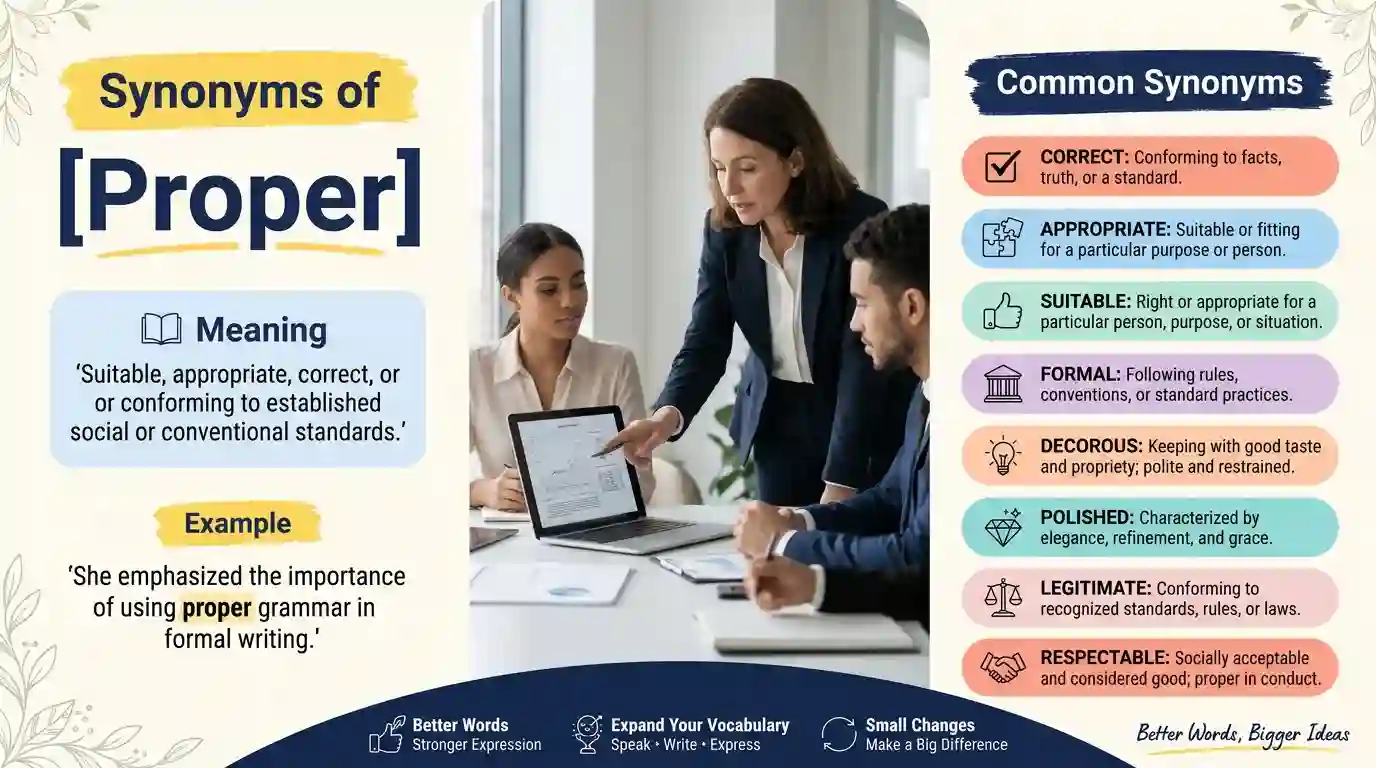
Common synonyms for proper include appropriate, suitable, correct, right, fitting, acceptable, decent, polite, accurate, and legitimate. The best alternative depends on the sentence. Use appropriate for something that suits a situation, correct for something free from mistakes, and genuine for something real rather than fake.
Do you often use the word proper in your writing? Although it is a useful English word, repeating it can make your sentences sound less varied.
The word proper has several meanings. It can describe something suitable, correct, socially acceptable, genuine, or particular to someone or something. For example, a student needs proper guidance, while a business needs accurate information and suitable equipment.
Learning synonyms properly helps you express these ideas more clearly. It also improves your vocabulary for essays, emails, professional documents, and everyday conversations.
However, choosing the wrong alternative can change your message. This guide explains 30 useful words, their meanings, examples, differences, and natural combinations. You will also learn which words work best in different situations and which ones you should avoid.
Pronunciation of Proper
- British IPA: /ˈprɒp.ə(r)/
- American IPA: /ˈprɑː.pɚ/
- Simple pronunciation: PROP-er
- Syllables: 2
- Word stress: First syllable
The spelling is the same in American and British English, but the vowel sounds differ.
Meaning and Parts of Speech
Proper is primarily an adjective. It describes something that meets an accepted standard, suits a situation, or belongs to a particular person or thing.
| Part of speech | Explanation | Example |
| Adjective | Correct or suitable | We need proper equipment. |
| Adverb | Nonstandard or informal regional use | He talks properly. |
| Noun | Appears in the expression proper noun | Paris is a proper noun. |
| Verb | No standard verb use | Use make suitable instead. |
Different meanings of proper
1. Suitable or appropriate: Something fits a situation or purpose.
Example: Wear proper shoes for hiking.
2. Correct: Something follows a rule or accepted standard.
Example: Follow the proper procedure.
3. Socially acceptable: Something follows good manners or social standards.
Example: Her behavior was proper.
4. Real or complete: Something is genuine, satisfactory, or complete.
Example: We finally enjoyed a proper dinner.
5. Particular or specific: Something belongs to a particular person, place, or defined area.
Example: The city proper is smaller than its metropolitan area.
Grammar Rules for Proper
The adjective proper normally comes before a noun.
Common patterns:
- Proper + noun: proper behavior, proper care, proper training.
- Be proper: His conduct was proper.
- Proper for + noun: This outfit is proper for the event.
- Proper to + noun: This characteristic is proper to the species.
- Properly + verb: Please complete the application properly.
Proper vs. Properly
These words have different grammatical jobs.
- Correct: She used the equipment properly.
- Correct: She used proper equipment.
- Incorrect: She used the equipment properly.
Remember: Use proper to describe a noun and properly to describe an action.
Quick Table: 30 Synonyms for Proper
The following words are grouped by meaning. Strength indicates how closely a word matches a particular sense of properness.
| Synonym | Strength | Formality |
| Appropriate | Strongest | Neutral |
| Suitable | Strongest | Neutral |
| Correct | Strongest | Neutral |
| Right | Strongest | Neutral |
| Fitting | Strong | Neutral |
| Apt | Strong | Formal |
| Acceptable | Strong | Neutral |
| Decent | Strong | Informal |
| Polite | Strong | Neutral |
| Respectable | Strong | Formal |
| Decorous | Strong | Formal |
| Seemly | Related | Literary |
| Accurate | Strong | Formal |
| Precise | Strong | Formal |
| Exact | Strong | Neutral |
| Legitimate | Strong | Formal |
| Valid | Strong | Formal |
| Established | Related | Formal |
| Conventional | Related | Formal |
| Applicable | Related | Formal |
| Relevant | Related | Neutral |
| Pertinent | Related | Formal |
| Real | Strong | Neutral |
| Genuine | Strong | Neutral |
| Authentic | Strong | Formal |
| Actual | Strong | Neutral |
| Particular | Contextual | Neutral |
| Specific | Contextual | Neutral |
| Individual | Contextual | Neutral |
| Own | Contextual | Neutral |
30 Best Synonyms for Proper with Examples and Explanations
1. Appropriate
Meaning: Something is appropriate when it suits a situation or purpose.
Examples:
- Formal clothing is appropriate for the interview.
- Teachers should use appropriate language in class.
Best used when: Discussing choices, behavior, clothing, or communication.
Tone: Neutral | Register: Business, academic, spoken.
CEFR: B1 | Frequency: Very common.
Collocations: Appropriate behavior, appropriate response, appropriate clothing.
Nuance: Focuses on suitability rather than factual accuracy.
When not to use: Do not use it when you specifically mean that information contains no mistakes.
2. Suitable
Meaning: Something is suitable when it meets a particular need.
Examples:
- This course is suitable for beginners.
- We need a suitable location for the meeting.
Best used when: Describing choices that match a purpose.
Tone: Neutral | Register: Everyday, academic, business.
CEFR: B1 | Frequency: Very common.
Collocations: Suitable candidate, suitable option, suitable location.
Nuance: Emphasizes fitness for a particular need.
When not to use: Avoid it when you mean legally valid.
3. Correct
Meaning: Something is correct when it has no mistakes or follows a rule.
Examples:
- Please write the correct answer.
- The student used the correct grammar.
Best used when: Discussing facts, rules, spelling, and answers.
Tone: Neutral | Register: Academic, professional, spoken.
CEFR: A2 | Frequency: Very common.
Collocations: Correct answer, correct spelling, correct method.
Nuance: Focuses on correctness, not general suitability.
When not to use: Do not replace proper manners with correct manners in every context.
4. Right
Meaning: Something is right when it is correct, suitable, or morally acceptable.
Examples:
- We need the right tools for this job.
- She made the right decision.
Best used when: Speaking naturally in everyday situations.
Tone: Neutral | Register: Spoken, informal, professional.
CEFR: A1 | Frequency: Very common.
Collocations: Right choice, right person, right way.
Nuance: More conversational and flexible than proper.
When not to use: Avoid it when a technical document requires a more precise term.
5. Fitting
Meaning: Something fitting is suitable for a particular situation.
Examples:
- The award was a fitting tribute to her work.
- His speech was a fitting end to the event.
Best used when: Describing something that feels especially suitable.
Tone: Neutral | Register: Literary, professional.
CEFR: B2 | Frequency: Common.
Collocations: Fitting tribute, fitting response, fitting conclusion.
Nuance: Often suggests that something is especially appropriate.
When not to use: Do not use it to describe factual accuracy.
6. Apt
Meaning: Something apt is well chosen or suitable.
Examples:
- That is an apt description of the problem.
- The teacher gave an apt example.
Best used when: Describing comments, examples, comparisons, or expressions.
Tone: Formal | Register: Academic, literary.
CEFR: B2 | Frequency: Common.
Collocations: Apt description, apt comparison, apt remark.
Nuance: Often suggests a particularly accurate or clever choice.
When not to use: Avoid it as a general replacement for proper equipment.
7. Acceptable
Meaning: Something acceptable is good enough or allowed.
Examples:
- Your explanation is acceptable for this assignment.
- The company introduced acceptable working conditions.
Best used when: Discussing standards, rules, and requirements.
Tone: Neutral | Register: Academic, business.
CEFR: B1 | Frequency: Very common.
Collocations: Acceptable standard, acceptable behavior, acceptable result.
Nuance: Something can be acceptable without being excellent.
When not to use: Do not use it when you mean the best possible option.
8. Decent
Meaning: Something decent meets a reasonable standard or shows good behavior.
Examples:
- Every employee deserves a decent salary.
- He showed decent manners at dinner.
Best used when: Discussing reasonable quality, fairness, or behavior.
Tone: Informal to neutral | Register: Spoken, everyday.
CEFR: B1 | Frequency: Very common.
Collocations: Decent job, decent meal, decent behavior.
Nuance: Suggests an acceptable or respectable standard.
When not to use: Avoid it in technical descriptions that require exact standards.
9. Polite
Meaning: A polite person uses good manners and treats others with respect.
Examples:
- Please remain polite during the discussion.
- The receptionist gave us a polite reply.
Best used when: Describing manners, speech, and social behavior.
Tone: Neutral | Register: Spoken, business.
CEFR: A2 | Frequency: Very common.
Collocations: Polite request, polite response, polite conversation.
Nuance: Focuses on manners rather than correctness.
When not to use: Do not describe accurate information as polite.
10. Respectable
Meaning: Someone or something respectable deserves respect.
Examples:
- She built a respectable career through hard work.
- The organization has a respectable reputation.
Best used when: Describing achievements, people, careers, and reputations.
Tone: Positive, formal | Register: Professional.
CEFR: B2 | Frequency: Common.
Collocations: Respectable career, respectable reputation, respectable amount.
Nuance: Suggests social approval or a good standard.
When not to use: Do not confuse it with respectful, which means showing respect.
11. Decorous
Meaning: Something decorous follows accepted standards of good behavior.
Examples:
- The guests maintained decorous behavior.
- Her decorous speech impressed the audience.
Best used when: Describing formal and respectful conduct.
Tone: Formal | Register: Literary, academic.
CEFR: C1 | Frequency: Uncommon.
Collocations: Decorous conduct, decorous behavior, decorous language.
Nuance: More formal and refined than polite.
When not to use: Avoid it in casual conversations.
12. Seemly
Meaning: Something seemingly is socially suitable or acceptable.
Examples:
- The guests behaved in a seemingly manner.
- Such comments are not apparent during a formal event.
Best used when: Discussing traditional standards of good behavior.
Tone: Literary | Register: Formal writing.
CEFR: C2 | Frequency: Rare.
Collocations: Seemly conduct, seemly behavior, seemly appearance.
Nuance: Has an old-fashioned tone.
When not to use: Avoid it in modern everyday conversation.
13. Accurate
Meaning: Something accurate is free from mistakes and matches the facts.
Examples:
- The report contains accurate information.
- Please provide an accurate description of the incident.
Best used when: Discussing reports, facts, measurements, and research.
Tone: Neutral, professional | Register: Academic, technical.
CEFR: B2 | Frequency: Very common.
Collocations: Accurate information, accurate results, accurate description.
Nuance: Focuses on factual correctness.
When not to use: Do not use it to describe polite behavior.
14. Precise
Meaning: Something precise is exact and carefully defined.
Examples:
- The scientist recorded precise measurements.
- Give me precise instructions for the task.
Best used when: Discussing measurements, instructions, and details.
Tone: Formal | Register: Academic, technical, business.
CEFR: B2 | Frequency: Common.
Collocations: Precise measurements, precise language, precise instructions.
Nuance: Emphasizes detail and exactness.
When not to use: Do not use it to mean socially acceptable.
15. Exact
Meaning: Something exact matches a particular detail or measurement.
Examples:
- Tell me the exact time of the appointment.
- The two documents contain the exact same wording.
Best used when: Referring to specific quantities, details, or information.
Tone: Neutral | Register: Everyday, academic, professional.
CEFR: B1 | Frequency: Very common.
Collocations: Exact amount, exact location, exact time.
Nuance: Emphasizes complete precision.
When not to use: Avoid it when discussing general suitability.
16. Legitimate
Meaning: Something legitimate is lawful, valid, or genuine.
Examples:
- The customer had a legitimate reason for requesting a refund.
- Always use legitimate sources for your research.
Best used when: Discussing legal rights, authority, claims, and genuine reasons.
Tone: Formal | Register: Legal, academic, business.
CEFR: B2 | Frequency: Common.
Collocations: Legitimate concern, legitimate business, legitimate claim.
Nuance: Often carries a legal or official meaning.
When not to use: Do not use it simply to mean suitable.
17. Valid
Meaning: Something valid meets the required legal or logical conditions.
Examples:
- Your passport is valid for another year.
- She presented a valid argument during the debate.
Best used when: Discussing arguments, documents, reasons, and permissions.
Tone: Formal | Register: Legal, academic, business.
CEFR: B2 | Frequency: Very common.
Collocations: Valid reason, valid argument, valid document.
Nuance: Focuses on whether something meets accepted conditions.
When not to use: Do not use it to mean polite.
18. Established
Meaning: Something established is recognized or accepted over time.
Examples:
- The company follows established procedures.
- Researchers used an established method.
Best used when: Discussing accepted rules, systems, and practices.
Tone: Formal | Register: Academic, business.
CEFR: B2 | Frequency: Very common.
Collocations: Established practice, established rules, established method.
Nuance: Describes something recognized or already accepted, not necessarily the only correct option.
When not to use: Avoid it when you mean a choice that simply suits an occasion.
19. Conventional
Meaning: Something conventional follows common customs or accepted practices.
Examples:
- The company follows conventional business practices.
- They chose a conventional wedding ceremony.
Best used when: Describing common methods, customs, and accepted standards.
Tone: Neutral to formal | Register: Academic, business.
CEFR: B2 | Frequency: Common.
Collocations: Conventional method, conventional approach, conventional wisdom.
Nuance: Focuses on what is generally accepted or usual.
When not to use: Do not assume conventional means are correct in every situation.
20. Applicable
Meaning: Something applicable relates to a particular situation or case.
Examples:
- These rules are applicable to all employees.
- Check whether the discount is applicable to your order.
Best used when: Discussing laws, rules, conditions, and requirements.
Tone: Formal | Register: Legal, academic, business.
CEFR: C1 | Frequency: Common.
Collocations: Applicable rules, applicable law, applicable conditions.
Nuance: Means relevant to a specific case, not necessarily suitable in a broader sense.
When not to use: Avoid it when discussing manners or general quality.
21. Relevant
Meaning: Something relevant is connected to the subject being discussed.
Examples:
- Include relevant information in your application.
- The teacher shared relevant examples during the lesson.
Best used when: Discussing information related to a topic.
Tone: Neutral | Register: Academic, professional.
CEFR: B1 | Frequency: Very common.
Collocations: Relevant information, relevant details, relevant experience.
Nuance: Connected does not always mean correct.
When not to use: Do not use it as a replacement for appropriate clothing.
22. Pertinent
Meaning: Something pertinent is directly connected to a subject or issue.
Examples:
- The lawyer asked several pertinent questions.
- Please provide pertinent details about the complaint.
Best used when: Discussing important information that directly relates to a matter.
Tone: Formal | Register: Academic, legal.
CEFR: C1 | Frequency: Uncommon.
Collocations: Pertinent information, pertinent question, pertinent details.
Nuance: More formal than relevant.
When not to use: Avoid it when a simpler word makes your message clearer.
23. Real
Meaning: Something real exists and is not imaginary or false.
Examples:
- We need real evidence before making a decision.
- She wanted a real opportunity to improve her skills.
Best used when: Contrasting something genuine with something false or imaginary.
Tone: Neutral | Register: Everyday, spoken.
CEFR: A1 | Frequency: Very common.
Collocations: Real experience, real problem, real opportunity.
Nuance: Can replace proper when it means genuine or complete in certain contexts.
When not to use: Do not replace proper procedure with real procedure.
24. Genuine
Meaning: Something genuine is real and not fake.
Examples:
- The shop sells genuine leather products.
- She showed genuine interest in the project.
Best used when: Describing products, feelings, and intentions.
Tone: Neutral | Register: Everyday, business.
CEFR: B2 | Frequency: Very common.
Collocations: Genuine concern, genuine product, genuine interest.
Nuance: Focuses on authenticity rather than suitability.
When not to use: Do not use it when something must follow a specific rule.
25. Authentic
Meaning: Something authentic is real, original, or true to its source.
Examples:
- The museum displayed an authentic historical document.
- Visitors enjoyed authentic local food.
Best used when: Discussing culture, history, products, and original experiences.
Tone: Neutral to formal | Register: Academic, cultural, business.
CEFR: B2 | Frequency: Very common.
Collocations: Authentic experience, authentic document, authentic cuisine.
Nuance: Often emphasizes originality or faithfulness to a source.
When not to use: Avoid it when you mean socially acceptable.
26. Actual
Meaning: Something actually exists in reality or is truly the case.
Examples:
- We need to know the actual cost of the project.
- The actual results were different from our expectations.
Best used when: Distinguishing facts from assumptions or estimates.
Tone: Neutral | Register: Academic, business, spoken.
CEFR: B1 | Frequency: Very common.
Collocations: Actual cost, actual result, actual situation.
Nuance: Can replace proper in certain contexts where it means real or genuine, but it is not a general substitute.
When not to use: Do not use it to describe good manners.
27. Particular
Meaning: Something particular refers to one specific person, thing, or situation.
Examples:
- She has a particular method for organizing her notes.
- The rules apply to a particular group of employees.
Best used when: Identifying one item or situation among several.
Tone: Neutral | Register: Academic, professional.
CEFR: B1 | Frequency: Very common.
Collocations: Particular reason, particular situation, particular interest.
Nuance: Related to the specific or individual sense of proper.
When not to use: Do not use it as a replacement for proper behavior.
28. Specific
Meaning: Something specific refers to one clearly identified person, thing, or detail.
Examples:
- The manager gave specific instructions.
- This course teaches skills for a specific career.
Best used when: Talking about clearly defined details or requirements.
Tone: Neutral | Register: Academic, business.
CEFR: B1 | Frequency: Very common.
Collocations: Specific reason, specific details, specific requirement.
Nuance: Focuses on clearly defined information.
When not to use: Do not use it to mean polite or socially acceptable.
29. Individual
Meaning: Something an individual belongs to or concerns one person or thing separately.
Examples:
- Each student received an individual assignment.
- The manager reviewed the individual reports.
Best used when: Describing separate people, objects, or responsibilities.
Tone: Neutral | Register: Academic, professional.
CEFR: B1 | Frequency: Very common.
Collocations: Individual needs, individual choice, individual responsibility.
Nuance: Can relate to the sense of proper meaning one’s own or particular.
When not to use: Do not use it as a synonym for correct or suitable.
30. Own
Meaning: Own describes something that belongs to a particular person or thing.
Examples:
- Everyone should have their own workspace.
- She used her own money to start the business.
Best used when: Describing possession or something belonging to someone.
Tone: Neutral | Register: Everyday, professional.
CEFR: A1 | Frequency: Very common.
Collocations: Own decision, own property, own responsibility.
Nuance: This word connects to the original historical sense of proper, meaning one’s own or particular.
When not to use: Do not use it to mean correct or suitable.
Strongest, Strong, and Contextual Synonyms
Strongest synonyms
These are generally the safest replacements in common situations:
- Appropriate
- Suitable
- Correct
- Right
- Fitting
Strong synonyms
These work well when the sentence has a more specific meaning:
- Acceptable
- Decent
- Polite
- Respectable
- Decorous
- Accurate
- Precise
- Exact
- Legitimate
- Valid
- Real
- Genuine
- Authentic
- Actual
Contextual alternatives
These are connected to particular senses of proper but are not universal replacements:
- Apt
- Seemly
- Established
- Conventional
- Applicable
- Relevant
- Pertinent
- Particular
- Specific
- Individual
- Own
Choose the Right Synonym: Side by Side Comparisons
| Word | Main meaning | Example |
| Proper | Correct, suitable, or acceptable | Follow proper procedures. |
| Appropriate | Suitable for a situation | Use appropriate language. |
| Suitable | Meets a need or purpose | Choose suitable equipment. |
| Correct | Free from mistakes | Give the correct answer. |
| Decent | Meets an acceptable standard | Earn a decent salary. |
| Polite | Shows good manners | Give a polite reply. |
| Accurate | Matches the facts | Provide accurate details. |
| Genuine | Real, not fake | Buy genuine products. |
| Legitimate | Lawful or valid | Make a legitimate claim. |
| Specific | Clearly identified | Give specific instructions. |
Which word should you choose?
If you mean suitable: Choose appropriate, suitable, fitting, or apt.
If you mean correct: Choose correct, accurate, precise, or exact.
If you mean good behavior: Choose polite, decent, respectable, or decorous.
If you mean genuine: Choose real, genuine, authentic, or actual.
If you mean particular: Choose specific, particular, individual, or own, depending on the sentence.
Word Origin and Etymology
The word proper entered English through Old French propre, which came from Latin proprius. The Latin word meant one’s own, particular, or special.
Historical records place the English adjective around 1300. Its early meanings included belonging to oneself, being particular to something, and being suitable for a purpose.
Over time, the word developed additional meanings involving correctness, acceptable behavior, and suitability.
Its related forms include:
- Properly: In a correct or suitable way.
- Properness: The quality of being proper.
- Improper: Not correct or socially acceptable.
- Propriety: Conformity to accepted standards of behavior.
CEFR Levels for English Learners
These are approximate learning guides rather than official CEFR classifications for every meaning.
| Level | Useful vocabulary |
| A1 | Right, real, own |
| A2 | Correct, polite |
| B1 | Appropriate, suitable, acceptable, relevant, actual |
| B2 | Accurate, precise, legitimate, genuine, authentic |
| C1 | Applicable, pertinent, decorous |
| C2 | Seemly |
Learning tip: Beginners should master right, correct, suitable, and appropriate before learning less common alternatives.
American vs. British English
The spelling of proper does not change between American and British English. However, pronunciation and some informal uses differ.
| Feature | American English | British English |
| Spelling | Proper | Proper |
| IPA | /ˈprɑː.pɚ/ | /ˈprɒp.ə(r)/ |
| Standard adverb | Properly | Properly |
| Informal meaning | Correct or suitable | Can also mean complete or very |
| Example | A proper meal | A proper mess |
American example: We need proper tools for the job.
British example: We need proper tools for the job.
British informal example: That was a proper disaster!
Standard example: Please complete the form properly.
There is no separate American or British spelling for proper. The regional differences mainly concern pronunciation and informal usage.
Register, Connotation, and Frequency
Choosing a synonym is not only about meaning. The situation and tone also matter.
| Word | Register | Connotation | Frequency |
| Appropriate | Professional | Suitable | Very common |
| Suitable | Neutral | Practical | Very common |
| Correct | Academic | Accurate | Very common |
| Right | Spoken | Natural | Very common |
| Decent | Informal | Reasonable | Very common |
| Polite | Social | Respectful | Very common |
| Apt | Literary | Well chosen | Common |
| Decorous | Formal | Refined | Uncommon |
| Seemly | Literary | Traditional | Rare |
| Pertinent | Academic | Directly relevant | Uncommon |
| Genuine | Neutral | Authentic | Very common |
| Legitimate | Formal | Lawful or valid | Common |
Frequency labels are broad learner guidance, not measured corpus rankings.
Commonly Confused Words
| Words | Difference | Example |
| Proper vs. appropriate | Proper has several meanings; appropriate focuses on suitability. | Appropriate clothing for the occasion. |
| Proper vs. correct | Correct focuses on freedom from errors. | The correct answer is B. |
| Proper vs. suitable | Suitable focuses on meeting a need. | A suitable candidate for the job. |
| Proper vs. respectable | Respectability suggests social approval. | A respectable career. |
| Proper vs. genuine | Genuine means real rather than fake. | A genuine leather bag. |
Common Mistakes When Using Proper
Mistake 1
Incorrect: She speaks proper Englishly.
Correct: She speaks proper English.
Alternative: She speaks English properly.
Explanation: Proper describes English, while properly describes the action of speaking.
Mistake 2
Incorrect: He is a proper person.
Correct: He is a proper person.
Explanation: Use the adjective before a noun.
Mistake 3
Incorrect: The information is polite.
Correct: The information is accurate.
Explanation: Polite describes manners, not factual information.
Mistake 4
Incorrect: This answer is suitable.
Correct: This answer is suitable.
Explanation: Suitable is an adjective. Do not add an adverb ending when the sentence needs an adjective.
Mistake 5
Incorrect: A traditional method is always a proper method.
Better: A traditional method may be suitable, depending on the situation.
Explanation: Traditional means based on established customs. It does not automatically mean correct.
When Not to Use a Synonym for Proper
Avoid changing properly when the alternative changes the meaning.
- Do not replace proper equipment with polite equipment.
- Do not replace proper behavior with accurate behavior.
- Do not replace proper documentation with decent documentation.
- Do not replace proper names with suitable names when discussing grammatical terminology.
- Do not replace the city proper with the appropriate city.
The original word may be the clearest option.
Writing Tips: How to Use Synonyms Naturally
In essays
Use appropriate, accurate, and relevant when explaining academic ideas.
In emails
Choose suitable, correct, and appropriate to keep professional messages clear.
In blog posts
Use specific, genuine, or relevant when these words express your meaning more accurately.
In stories
Use decent, polite, fitting, and respectable to describe characters and their behavior.
In social media
Choose simple words such as right, real, and suitable.
In professional communication
Use legitimate, valid, applicable, and accurate when the context supports them.
In daily conversations
Prefer common words over rare alternatives. A simple word used correctly is better than a difficult word used incorrectly.
Writing tip: Never replace a word just to avoid repetition. Clear writing matters more than using as many synonyms as possible.
Antonyms of Proper
| Antonym | Meaning |
| Improper | Not socially or morally acceptable |
| Inappropriate | Not suitable for a situation |
| Incorrect | Not correct |
| Wrong | Not right or accurate |
| Unsuitable | Not suitable for a purpose |
| Inaccurate | Containing mistakes |
| Indecent | Not acceptable by social standards |
| Unacceptable | Not allowed or not good enough |
| Inauthentic | Not genuine |
| Unseemly | Not socially appropriate |
Related Expressions and Word Family
Common expressions
- Proper care
- Proper education
- Proper behavior
- Proper procedure
- Proper attention
- Proper guidance
- In proper order
- Prim and proper
- Right and proper
- Proper use
Word family
| Word | Part of speech | Meaning |
| Proper | Adjective | Correct or suitable |
| Properly | Adverb | In the correct way |
| Properness | Noun | Quality of being proper |
| Improper | Adjective | Not correct or acceptable |
| Improperly | Adverb | In an incorrect way |
| Propriety | Noun | Accepted standards of behavior |
Frequently Asked Questions
1. What are the 10 best synonyms for proper?
The 10 useful synonyms for proper are appropriate, suitable, correct, right, fitting, acceptable, decent, polite, accurate, and legitimate. Each word has a different emphasis. Choose based on whether you mean suitability, correctness, behavior, or legal acceptance.
2. What is another word for proper in formal writing?
Appropriate, suitable, accurate, legitimate, valid, and applicable are useful alternatives in formal writing. For example, you could write “appropriate procedures” instead of “proper procedures.” However, the best word depends on what you want to communicate.
3. What is the easiest synonym for proper?
The easiest alternatives are right, correct, suitable, and appropriate. These words are common in everyday English and easy for beginners to understand. For example, “Choose the proper answer” can become “Choose the correct answer.”
4. What is a synonym for proper behavior?
Polite, decent, respectable, decorous, and well-mannered can describe proper behavior. Polite is the most common everyday choice. Decorous is more formal and usually describes behavior at ceremonies or other formal events.
5. What is the difference between proper and appropriate?
Proper can mean correct, suitable, genuine, or socially acceptable. Appropriate mainly means suitable for a particular situation or purpose. For example, proper grammar follows accepted rules, while appropriate clothing matches an event.
6. Is there another word suitable for this?
Yes. Suitable is a close synonym when proper describes something that meets a need or purpose. For example, “We need proper equipment” can become “We need suitable equipment.” However, suitable does not always mean factually correct.
7. What is the opposite of proper?
Common antonyms include improper, inappropriate, incorrect, unsuitable, indecent, and unacceptable. The best opposite depends on the sentence. Use incorrect for a wrong answer and inappropriate for behavior that does not suit a situation.
8. Is it proper formal or informal English?
Proper works in both formal and informal English. It appears in professional phrases such as “proper documentation” and everyday expressions such as “a proper meal.” British speakers also use it informally to mean complete or very, as in “a proper mess.”
Vocabulary Quiz: Test Your Knowledge
Choose the best answer for each question.
Question 1: Which word is the closest synonym for proper in “Wear proper clothing for the interview”?
A. Relevant
B. Appropriate
C. Accurate
D. Genuine
Question 2: Which word describes information that contains no mistakes?
A. Polite
B. Decent
C. Accurate
D. Traditional
Question 3: Which word describes someone who uses good manners?
A. Polite
B. Specific
C. Legitimate
D. Precise
Question 4: Choose the best word:
“The company needs a ______ candidate for the position.”
A. Authentic
B. Suitable
C. Exact
D. Customary
Question 5: Which word means real and not fake?
A. Seemly
B. Applicable
C. Conventional
D. Genuine
Answer Key
- B. Appropriate
- C. Accurate
- A. Polite
- B. Suitable
- D. Genuine
Mini Practice Exercises
Exercise A: Fill in the blanks
Use appropriate, correct, polite, and genuine.
- Please give me the ______ answer.
- We need ______ clothing for the event.
- The customer received a ______ response.
- This shop sells ______ products.
Exercise B: Rewrite the sentences
Replace proper with a more suitable synonym.
- The student gave a proper answer.
- We need proper information.
- He showed proper manners.
Exercise C: Match the words
| Word | Meaning |
| 1. Accurate | A. Good manners |
| 2. Polite | B. Free from mistakes |
| 3. Genuine | C. Real, not fake |
Practice answers:
Exercise A: 1. correct, 2. appropriate, 3. polite, 4. genuine.
B: Possible answers are correct answers, accurate information, and polite manners.
C: 1-B, 2-A, 3-C.
Conclusion
Learning synonyms properly helps you express ideas more clearly and naturally. Words such as appropriate, suitable, correct, fitting, and decent give you more choices in everyday English.
Remember that every synonym has its own meaning and tone. Practice these words in essays, emails, schoolwork, and conversations. With regular practice, you can build stronger vocabulary and communicate with confidence.
References
- Cambridge Dictionary: https://dictionary.cambridge.org/dictionary/english/proper
- Cambridge Thesaurus: https://dictionary.cambridge.org/thesaurus/proper
- Merriam-Webster: https://www.merriam-webster.com/dictionary/proper
- Collins Dictionary: https://www.collinsdictionary.com/dictionary/english-thesaurus/proper
- Online Etymology Dictionary: https://www.etymonline.com/word/proper

Synonorm is a trusted English vocabulary resource created to help readers find the right words and understand the differences between similar terms. We provide clear explanations of synonyms, meanings, examples, usage, and alternatives. Our content makes vocabulary easier to learn and apply in everyday, academic, and professional English. Synonorm is designed for students, writers, ESL learners, professionals, and anyone who wants to improve their English vocabulary and communicate more clearly.