Quick Answer: What Are Synonyms for Somber?
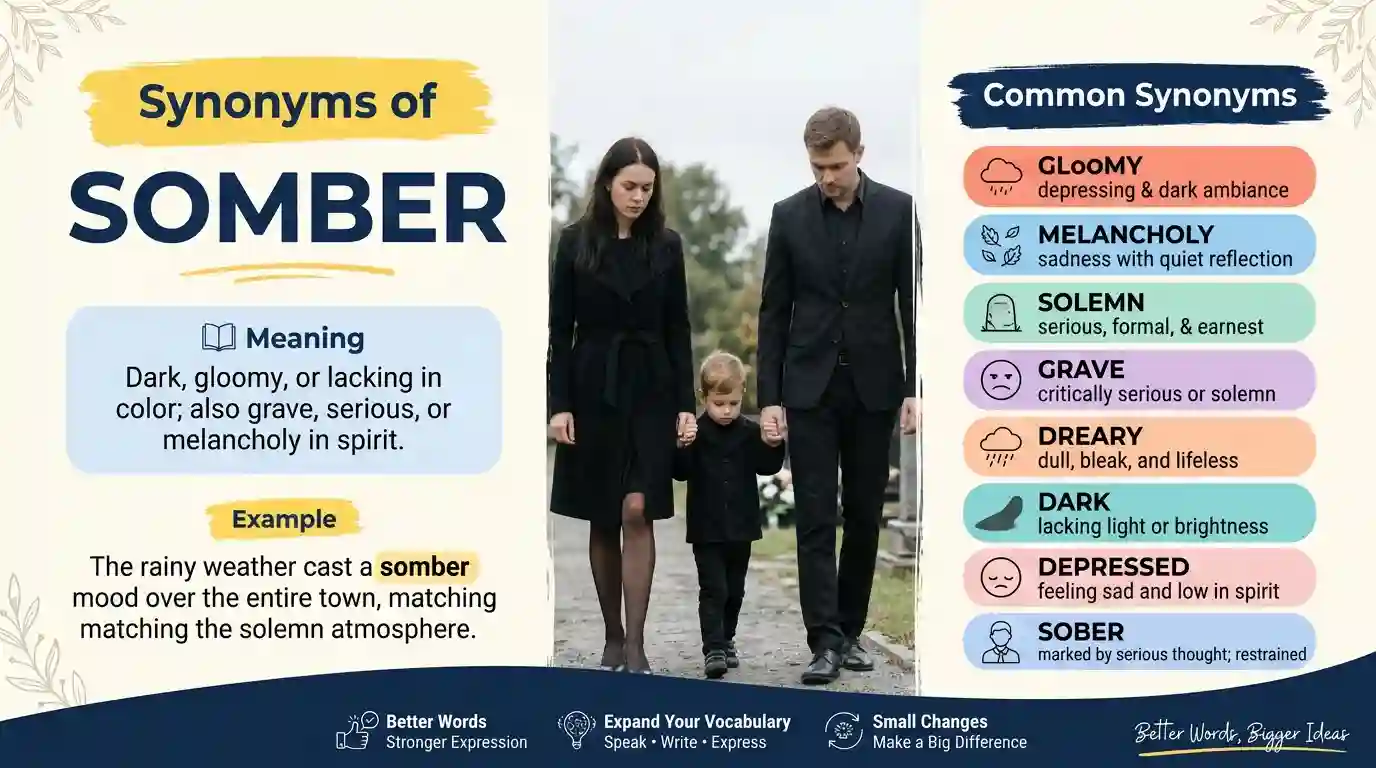
Common synonyms for somber include gloomy, solemn, mournful, grim, grave, melancholy, dismal, bleak, dreary, and sober. These words describe sadness, serious feelings, or dark appearances. The best choice depends on the context. For example, use solemn for a respectful event, gloomy for a sad atmosphere, and drab for dull colors.
Have you ever used the word somber several times in the same paragraph? Finding the right alternative can make your writing clearer and more interesting.
Somber describes something serious, sad, gloomy, or dark. You might describe a person’s expression as somber after receiving bad news, or call a funeral a somber occasion. The word can also describe dark, plain colors.
However, its alternatives do not all mean the same thing. Mournful suggests grief, solemn suggests respect, and bleak suggests little hope. Choosing the wrong word can change the message of your sentence.
This guide explains 30 synonyms for somber, with meanings, original examples, pronunciation, common phrases, and usage advice. It is designed for students, ESL learners, teachers, bloggers, and anyone who wants to communicate more accurately in English.
Pronunciation of Somber
- American IPA: /ˈsɑːm.bɚ/
- British IPA: /ˈsɒm.bə/
- Simple pronunciation: SOM-ber
- Syllables: 2
- Word stress: First syllable
The first part sounds like “som,” and the second sounds like “ber.”
Part of Speech
Somber is an adjective. It describes a noun by showing that something feels serious, sad, gloomy, or dark.
Examples:
- The room had a somber atmosphere.
- She gave him a somber look.
- The speaker used a somber tone.
- He wore a somber gray jacket.
Related Word Forms
| Word | Part of Speech | Meaning |
| Somber | Adjective | Serious, sad, or dark |
| Somberly | Adverb | In a serious or gloomy way |
| Somberness | Noun | The quality of being somber |
| Sombre | Adjective | British-preferred spelling |
Example: The manager somberly announced the unexpected news.
Grammar: How to Use Somber Correctly
Use somber before a noun or after a linking verb.
Common sentence patterns:
- Somber + noun: The family shared a somber moment.
- Be somber: Everyone was somber after the announcement.
- Look + somber: He looked somber during the interview.
- Seem + somber: The town seemed somber that evening.
Common expressions:
- Somber mood
- Somber atmosphere
- Somber expression
- Somber tone
- Somber occasion
- Somber colors
- Somber news
- Somber reflection
You can also say someone is somber about or over something, although the sentence should make the reason clear.
Example: The community remained somber over the tragic accident.
Grammar reminder: Somber is an adjective, not a noun. Use somberness when you need the noun form.
30 Synonyms for Somber With Meanings and Examples
The following words are grouped according to their main meaning. Some are close synonyms, while others work only in particular contexts.
1. Gloomy
Meaning: Gloomy describes something that feels dark, unhappy, or without hope.
Examples:
- The gloomy weather kept us inside all afternoon.
- His gloomy expression showed that something was wrong.
Best Used When: Describing unhappy feelings, dark weather, or a depressing atmosphere.
Tone: Neutral | CEFR: B1 | Frequency: Very common
Register: Spoken, academic, general writing.
Connotation: Suggests sadness or a lack of hope.
Common Collocations: Gloomy mood, gloomy outlook, gloomy weather.
When Not to Use: Avoid it when you only mean respectful seriousness.
2. Solemn
Meaning: Solemn describes something serious, respectful, and free from joking.
Examples:
- The guests remained solemn during the memorial.
- She made a solemn promise to her family.
Best Used When: Describing ceremonies, important promises, or respectful behavior.
Tone: Formal | CEFR: B2 | Frequency: Common
Register: Formal, academic, literary.
Connotation: Suggests dignity and respect rather than ordinary sadness.
Common Collocations: Solemn promise, solemn occasion, solemn expression.
When Not to Use: Do not use it for simple disappointment or dull colors.
3. Mournful
Meaning: Mournful describes deep sadness, especially after a loss.
Examples:
- A mournful melody filled the quiet hall.
- He gave a mournful look at the empty chair.
Best Used When: Describing grief, loss, or sorrow.
Tone: Literary | CEFR: C1 | Frequency: Common
Register: Literary, formal, descriptive writing.
Connotation: Strongly associated with mourning and emotional pain.
Common Collocations: Mournful voice, mournful expression, mournful song.
When Not to Use: Avoid it for ordinary serious discussions.
4. Grim
Meaning: Grim describes something serious, unpleasant, or worrying.
Examples:
- The report revealed a grim picture of the situation.
- She gave us a grim warning about the storm.
Best Used When: Describing difficult news, dangerous conditions, or serious expressions.
Tone: Neutral | CEFR: B2 | Frequency: Very common
Register: Spoken, news, professional writing.
Connotation: Suggests trouble, danger, or unpleasant reality.
Common Collocations: Grim reality, grim news, grim expression.
When Not to Use: Avoid it when the situation is simply sad but not threatening.
5. Grave
Meaning: Grave describes something extremely serious or important.
Examples:
- The doctor explained the grave risks of the operation.
- His expression became grave after reading the letter.
Best Used When: Discussing serious risks, decisions, and important matters.
Tone: Formal | CEFR: B2 | Frequency: Common
Register: Academic, business, formal.
Connotation: Emphasizes importance and seriousness.
Common Collocations: Grave concern, grave danger, grave consequences.
When Not to Use: Do not use it as a simple replacement for sadness.
6. Melancholy
Meaning: Melancholy describes a quiet, thoughtful feeling of sadness.
Examples:
- The old photograph brought a sense of melancholy.
- A melancholy melody played through the empty room.
Best Used When: Describing reflective sadness, memories, art, and music.
Tone: Literary | CEFR: C1 | Frequency: Common
Register: Literary, academic, descriptive writing.
Connotation: Suggests gentle or lingering sadness.
Common Collocations: Deep melancholy, melancholy mood, melancholy music.
When Not to Use: Avoid it for an urgent warning or a dangerous situation.
7. Dismal
Meaning: Dismal describes something very unpleasant, gloomy, or disappointing.
Examples:
- The dismal weather ruined our picnic.
- The company reported dismal sales figures.
Best Used When: Describing poor results, gloomy conditions, or disappointing situations.
Tone: Neutral | CEFR: B2 | Frequency: Common
Register: Spoken, academic, business.
Connotation: Suggests disappointment and unhappiness.
Common Collocations: Dismal results, dismal outlook, dismal weather.
When Not to Use: Avoid it for a respectful ceremony.
8. Bleak
Meaning: Bleak describes something that seems hopeless or offers little comfort.
Examples:
- The family faced a bleak future after losing their home.
- The empty fields looked bleak in winter.
Best Used When: Describing difficult futures, harsh conditions, or empty landscapes.
Tone: Neutral | CEFR: B2–C1 | Frequency: Common
Register: News, academic, literary.
Connotation: Strongly suggests little hope.
Common Collocations: Bleak future, bleak outlook, bleak landscape.
When Not to Use: Avoid it for an ordinary serious meeting with no sense of hopelessness.
9. Dreary
Meaning: Dreary describes something dull, boring, or unpleasantly gloomy.
Examples:
- The dreary afternoon made the journey feel longer.
- She was tired of the same dreary routine.
Best Used When: Describing dull weather, repetitive routines, and lifeless surroundings.
Tone: Neutral | CEFR: B2 | Frequency: Common
Register: Spoken, general writing.
Connotation: Suggests boredom and a lack of brightness.
Common Collocations: Dreary day, dreary weather, dreary routine.
When Not to Use: Do not use it for deep grief.
10. Sober
Meaning: Sober describes a serious, thoughtful, and controlled attitude.
Examples:
- The team took a sober look at its recent mistakes.
- Her sober assessment helped everyone understand the problem.
Best Used When: Describing careful thinking, realistic judgment, and serious discussions.
Tone: Formal | CEFR: B2 | Frequency: Very common
Register: Business, academic, professional.
Connotation: Suggests self-control and practical thinking.
Common Collocations: Sober assessment, sober judgment, sober reflection.
When Not to Use: Avoid it when you specifically mean grief or emotional sadness.
11. Serious
Meaning: Serious describes something important, significant, or lacking humor.
Examples:
- We need to discuss a serious problem.
- The teacher had a serious expression.
Best Used When: Describing important matters or a person’s focused attitude.
Tone: Neutral | CEFR: A2 | Frequency: Very common
Register: Spoken, academic, business.
Connotation: Focuses on importance, not necessarily sadness.
Common Collocations: Serious issue, serious discussion, serious expression.
When Not to Use: Avoid it when describing only dark colors.
12. Sad
Meaning: Sad describes an unhappy feeling.
Examples:
- She felt sad when her best friend moved away.
- The sad ending made the audience quiet.
Best Used When: You want a simple, direct word for unhappiness.
Tone: Neutral | CEFR: A1 | Frequency: Very common
Register: Spoken, general writing.
Connotation: Directly expresses unhappiness.
Common Collocations: Sad news, sad story, sad expression.
When Not to Use: Avoid it when you mean respectful seriousness without emotional sadness.
13. Cheerless
Meaning: Cheerless describes something that lacks happiness, warmth, or enjoyment.
Examples:
- The cheerless room needed brighter decorations.
- A cheerless atmosphere filled the empty building.
Best Used When: Describing an unhappy place, situation, or environment.
Tone: Neutral | CEFR: B2–C1 | Frequency: Uncommon
Register: Descriptive, literary, general writing.
Connotation: Suggests an absence of happiness.
Common Collocations: Cheerless room, cheerless atmosphere, cheerless existence.
When Not to Use: Avoid it for a serious but hopeful situation.
14. Depressing
Meaning: Depressing describes something that makes people feel sad or discouraged.
Examples:
- The depressing news changed everyone’s mood.
- Living in the empty building became depressing.
Best Used When: Describing something that causes unhappiness.
Tone: Neutral | CEFR: B1 | Frequency: Very common
Register: Spoken, general writing.
Connotation: Focuses on the effect something has on people.
Common Collocations: Depressing news, depressing situation, depressing atmosphere.
When Not to Use: Do not use it for something serious that does not make people unhappy.
15. Funereal
Meaning: Funereal describes something that resembles a funeral or mourning.
Examples:
- Funeral music played during the ceremony.
- A funereal silence settled over the room.
Best Used When: Creating a strong description of mourning, death, or funeral-like surroundings.
Tone: Literary | CEFR: C2 | Frequency: Rare
Register: Literary, formal.
Connotation: Strongly connected to death and mourning.
Common Collocations: Funereal silence, funereal music, funereal atmosphere.
When Not to Use: Avoid it for everyday sadness.
16. Downcast
Meaning: Downcast describes someone who looks sad or disappointed.
Examples:
- The student walked away with downcast eyes.
- His downcast expression showed his disappointment.
Best Used When: Describing facial expressions, eyes, or body language.
Tone: Neutral | CEFR: B2 | Frequency: Common
Register: Spoken, descriptive writing.
Connotation: Suggests visible sadness or disappointment.
Common Collocations: Downcast eyes, downcast expression, downcast face.
When Not to Use: Avoid it for a dark room or an entire event.
17. Morose
Meaning: Morose describes someone who seems unhappy, withdrawn, or unfriendly.
Examples:
- He became morose after the disagreement.
- Her morose manner made the conversation uncomfortable.
Best Used When: Describing a gloomy person’s behavior or attitude.
Tone: Formal | CEFR: C1 | Frequency: Uncommon
Register: Literary, formal, descriptive.
Connotation: Can suggest persistent sadness and an unfriendly attitude.
Common Collocations: Morose expression, morose mood, morose person.
When Not to Use: Avoid it for someone who is simply quiet or tired.
18. Dour
Meaning: Dour describes someone who looks stern, serious, or unfriendly.
Examples:
- The dour receptionist rarely smiled.
- His dour expression made the visitors uncomfortable.
Best Used When: Describing a stern personality or facial expression.
Tone: Formal | CEFR: C1 | Frequency: Uncommon
Register: Literary, formal.
Connotation: Suggests a humorless or stern character.
Common Collocations: Dour expression, dour personality, dour manner.
When Not to Use: Avoid it when you mean deep sadness or grief.
19. Doleful
Meaning: Doleful describes someone or something that shows sadness or sorrow.
Examples:
- The child gave a doleful look when the game ended.
- A doleful melody played in the background.
Best Used When: Describing visible sadness, sorrowful expressions, or sad music.
Tone: Literary | CEFR: C1 | Frequency: Uncommon
Register: Literary, descriptive writing.
Connotation: Suggests sorrow, often in a noticeable or expressive way.
Common Collocations: Doleful expression, doleful voice, doleful song.
When Not to Use: Avoid it in ordinary professional communication.
20. Joyless
Meaning: Joyless describes something that has no happiness or pleasure.
Examples:
- The joyless routine made him want a change.
- They spent a joyless afternoon waiting for the results.
Best Used When: Describing experiences or situations without happiness.
Tone: Neutral | CEFR: B2 | Frequency: Common
Register: General writing, descriptive.
Connotation: Suggests a lack of pleasure or satisfaction.
Common Collocations: Joyless existence, joyless life, joyless atmosphere.
When Not to Use: Avoid it for a brief serious moment.
21. Lugubrious
Meaning: Lugubrious describes something excessively sad or gloomy.
Examples:
- His lugubrious speech made the gathering even quieter.
- The actor used a lugubrious voice in the scene.
Best Used When: You need a rare literary word for exaggerated sadness.
Tone: Literary | CEFR: C2 | Frequency: Rare
Register: Literary, formal.
Connotation: Can suggest theatrical or excessive sadness.
Common Collocations: Lugubrious expression, lugubrious tone, lugubrious manner.
When Not to Use: Avoid it in everyday conversations or simple student essays.
22. Subdued
Meaning: Subdued describes something quiet, restrained, or lacking energy.
Examples:
- The celebration had a subdued atmosphere after the announcement.
- She spoke in a subdued voice during the meeting.
Best Used When: Describing quiet emotions, restrained behavior, or muted colors.
Tone: Neutral | CEFR: C1 | Frequency: Common
Register: Business, descriptive, academic.
Connotation: Suggests controlled or reduced emotion rather than deep sadness.
Common Collocations: Subdued mood, subdued voice, subdued colors.
When Not to Use: Avoid it when you specifically mean grief or hopelessness.
23. Weighty
Meaning: Weighty describes something important, serious, or deserving careful thought.
Examples:
- The committee discussed several weighty matters.
- His speech addressed a weighty social issue.
Best Used When: Describing important topics or serious discussions.
Tone: Formal | CEFR: C1 | Frequency: Common
Register: Academic, business, formal.
Connotation: Suggests importance and significance.
Common Collocations: Weighty matter, weighty issue, weighty decision.
When Not to Use: It is not a direct substitute for sad or gloomy.
24. Austere
Meaning: Austere describes something plain, strict, or without decoration or comfort.
Examples:
- The room had an austere design with simple furniture.
- The building’s austere appearance made it look imposing.
Best Used When: Describing plain surroundings, strict styles, or serious appearances.
Tone: Formal | CEFR: C1 | Frequency: Common
Register: Academic, architectural, formal.
Connotation: Suggests simplicity, restraint, or severity.
Common Collocations: Austere design, austere lifestyle, austere appearance.
When Not to Use: Avoid it when you mean someone is emotionally sad.
25. Dim
Meaning: Dim describes something that has little light or brightness.
Examples:
- The dim hallway looked empty at night.
- A dim light came through the curtains.
Best Used When: Describing low light or a weak visual appearance.
Tone: Neutral | CEFR: A2 | Frequency: Very common
Register: Spoken, descriptive.
Connotation: Suggests limited light or brightness.
Common Collocations: Dim light, dim room, dim hallway.
When Not to Use: Avoid it for sadness unless the context clearly uses darkness symbolically.
26. Dusky
Meaning: Dusky describes something slightly dark, especially in color or light.
Examples:
- Dusky clouds covered the evening sky.
- The artist used dusky shades in the painting.
Best Used When: Describing dark shades, evening light, or muted colors.
Tone: Literary | CEFR: C1 | Frequency: Uncommon
Register: Literary, descriptive.
Connotation: Suggests soft or muted darkness.
Common Collocations: Dusky sky, dusky light, dusky colors.
When Not to Use: Avoid it for a person’s serious or sad mood.
27. Drab
Meaning: Drab describes something dull, plain, or lacking bright colors.
Examples:
- The office walls looked drab and lifeless.
- He wore a drab gray jacket to the meeting.
Best Used When: Describing dull clothing, colors, and surroundings.
Tone: Neutral | CEFR: B2 | Frequency: Common
Register: General writing, descriptive.
Connotation: Suggests a lack of color, interest, or excitement.
Common Collocations: Drab colors, drab clothing, drab surroundings.
When Not to Use: Avoid it when you mean grief or serious behavior.
28. Dark
Meaning: Dark describes something with little light or a gloomy quality.
Examples:
- Dark clouds covered the evening sky.
- The novel explores dark and serious themes.
Best Used When: Describing low light, colors, or unpleasant subjects.
Tone: Neutral | CEFR: A1 | Frequency: Very common
Register: Spoken, academic, descriptive.
Connotation: Can suggest physical darkness or emotional seriousness.
Common Collocations: Dark atmosphere, dark colors, dark mood.
When Not to Use: Avoid it when you need a specific emotional word such as mournful.
29. Sepulchral
Meaning: Sepulchral describes something that resembles a tomb or has a deep, hollow, gloomy quality.
Examples:
- A sepulchral silence filled the old building.
- His sepulchral voice echoed through the empty hall.
Best Used When: Creating a dramatic description of silence, voices, or tomb-like places.
Tone: Literary | CEFR: C2 | Frequency: Rare
Register: Literary, formal.
Connotation: Suggests death, tombs, and an eerie atmosphere.
Common Collocations: Sepulchral silence, sepulchral voice, sepulchral atmosphere.
When Not to Use: Avoid it for ordinary sadness or routine professional writing.
30. Murky
Meaning: Murky describes something dark, unclear, or difficult to see through.
Examples:
- The murky water hid the rocks below.
- The abandoned building had a murky atmosphere.
Best Used When: Describing unclear water, poor visibility, or confusing situations.
Tone: Neutral | CEFR: C1 | Frequency: Common
Register: General writing, descriptive, informal.
Connotation: Suggests darkness or a lack of clarity.
Common Collocations: Murky water, murky atmosphere, murky situation.
When Not to Use: Avoid it as a direct replacement for emotional sadness.
Synonym Categories: Which Words Are Closest to Somber?
The most useful way to organize these alternatives is by the meaning you want to express.
Strongest Synonyms
These words are close alternatives when describing a serious, sad, or gloomy mood:
- Gloomy
- Solemn
- Mournful
- Grim
- Grave
- Melancholy
- Dismal
- Bleak
- Dreary
- Sober
Strong Synonyms in Specific Contexts
These words work well in certain emotional situations:
- Cheerless
- Depressing
- Funereal
- Downcast
- Morose
- Doleful
- Joyless
- Lugubrious
- Subdued
Related and Context Dependent Words
These words overlap with one meaning of somber but should not replace it in every sentence:
- Serious
- Sad
- Dour
- Weighty
- Austere
- Dim
- Dusky
- Drab
- Dark
- Sepulchral
- Murky
Choose the Right Synonym: Side by Side Comparisons
Use this table to understand the differences between commonly confused alternatives.
| Word | Main Meaning | Best Example |
| Gloomy | Sad or lacking hope | A gloomy outlook |
| Solemn | Serious with respect | A solemn ceremony |
| Mournful | Showing grief | A mournful song |
| Grim | Unpleasant or threatening | Grim news |
| Grave | Extremely serious | Grave concern |
| Melancholy | Quiet, thoughtful sadness | Melancholy memories |
| Dreary | Dull and boring | A dreary afternoon |
| Bleak | Without much hope | A bleak future |
| Sober | Serious and realistic | A sober assessment |
| Drab | Dull in appearance | Drab clothing |
Five Important Differences
1. Somber vs. Gloomy
Somber can describe serious behavior or dark colors. Gloomy usually suggests sadness, darkness, or a lack of hope.
2. Somber vs. Solemn
Somber can describe sadness and seriousness. Solemn places more emphasis on dignity, respect, and formal seriousness.
3. Somber vs. Mournful
Somber can describe a general serious mood. Mournful specifically suggests grief or sorrow.
4. Somber vs. Grim
Somber often describes a subdued mood. Grim suggests something unpleasant, severe, or threatening.
5. Somber vs. Melancholy
Somber can be serious and restrained. Melancholy suggests reflective or lingering sadness.
Word Origin (Etymology) of Somber
The English word somber comes from French sombre, meaning dark or gloomy.
Its deeper history is linked to the Late Latin form subumbrare, meaning to shade or cast into shadow. This is connected with the Latin elements sub (under) and umbra (shadow).
The word first described darkness and dull appearances. Over time, it also developed the emotional meanings of sadness, gloom, and seriousness.
Historical dictionaries date its English use to around 1750–1760.
Related forms:
- Somberly
- Somberness
- Sombre
American vs. British English: Somber or Sombre?
Both spellings are correct. The main difference is regional preference.
| Feature | American English | British English |
| Spelling | Somber | Sombre |
| Meaning | Serious, sad, or dark | Serious, sad, or dark |
| Pronunciation | /ˈsɑːm.bɚ/ | /ˈsɒm.bə/ |
| Example | A somber mood | A sombre mood |
| Preferred usage | United States | United Kingdom |
The meaning does not change between the two spellings.
Example:
- American: The town was in a somber mood.
- British: The town was in a sombre mood.
For a US-focused website, use somber consistently. For a UK-focused website, use sombre.
CEFR Levels for Somber Synonyms
CEFR stands for the Common European Framework of Reference for Languages. It describes language skills from beginner to advanced.
The following levels are approximate vocabulary-learning guidance, not official classifications for every word.
| Level | Suggested Vocabulary |
| A1 | Sad, dark |
| A2 | Serious, dim |
| B1 | Gloomy, depressing |
| B2 | Solemn, grim, grave, dreary |
| C1 | Melancholy, morose, bleak, austere |
| C2 | Lugubrious, funereal, sepulchral |
Beginners should first learn common words such as sad, serious, and dark. Advanced learners can explore literary alternatives.
Commonly Confused Words
| Word | Difference | Example |
| Somber vs. Serious | Somber often adds sadness or darkness. Serious focuses on importance. | The meeting was serious, but the mood was somber. |
| Gloomy vs. Dreary | Gloomy suggests sadness; dreary suggests dullness. | The gloomy news ended a dreary day. |
| Solemn vs. Sober | Solemn suggests dignity; sober suggests thoughtful judgment. | She made a solemn promise after a sober discussion. |
| Melancholy vs. Mournful | Melancholy can be reflective; mournful often suggests grief. | The melody was melancholy, but her voice was mournful. |
| Grim vs. Grave | Grim suggests an unpleasant reality; grave emphasizes seriousness. | The doctor gave a grave warning about the grim situation. |
Common Mistakes When Using Somber Synonyms
Mistake 1: Using Solemn for Ordinary Disappointment
Mistake: I felt solemn when my favorite team lost.
Correction: I felt sad when my favorite team lost.
Explanation: Solemn usually describes respectful or formal seriousness. Sadness is more natural for ordinary disappointment.
Mistake 2: Confusing Drab With Mournful
Mistake: She looked drab after hearing the bad news.
Correction: She looked mournful after hearing the bad news.
Explanation: Drab mainly describes dull colors or appearances. Mournful describes visible sadness.
Mistake 3: Using Melancholy as an Adverb
Mistake: He spoke melancholy during the meeting.
Correction: He spoke in a melancholy tone.
Explanation: Melancholy is commonly an adjective and a noun. Its adverb form is melancholic, although it is uncommon.
Mistake 4: Treating Serious and Somber as Identical
Mistake: Every serious person is somber.
Correction: A person can be serious without being sad or gloomy.
Explanation: Serious focuses on importance or a lack of humor. Somber adds a darker or more subdued quality.
Mistake 5: Mixing Regional Spelling
Mistake: The American report described a sombre atmosphere.
Correction: The American report described a somber atmosphere.
Explanation: Both forms are correct, but American publications generally prefer somber.
Writing Tips: How to Use Somber Synonyms Naturally
Different situations call for different words. Here is how to choose them.
Essays: Use serious, grave, or solemn when discussing important events and social issues.
Example: The country faced a grave economic challenge.
Emails: Use serious or sober when discussing workplace concerns.
Example: We need to take a sober look at the recent results.
Blog Posts: Use gloomy, dreary, or bleak when describing weather, places, or difficult situations.
Example: The gloomy weather changed the mood of the town.
Stories: Use melancholy, mournful, or funereal to create emotional depth.
Example: A melancholy melody played softly in the background.
Social Media: Use sad, gloomy, or downcast to express feelings in simple language.
Example: A gloomy day calls for a little extra kindness.
Professional Communication: Use grave, serious, and sober for reports and discussions.
Example: The company must address these serious concerns.
Daily Conversations: Choose familiar words instead of rare literary alternatives.
Example: You seem a little downcast today. Is everything okay?
Writing Tip: Do not replace a repeated word with a random thesaurus suggestion. Check its meaning, emotional tone, and sentence compatibility first.
Related Vocabulary
Antonyms of Somber
Antonyms describe the opposite meaning.
| Antonym | Meaning |
| Cheerful | Happy and positive |
| Bright | Full of light or color |
| Joyful | Feeling great happiness |
| Lively | Full of energy |
| Hopeful | Expecting good things |
| Sunny | Bright or positive |
| Playful | Full of fun |
| Optimistic | Expecting a good outcome |
| Upbeat | Positive and energetic |
| Lighthearted | Free from serious worry |
Related Expressions
These phrases help describe serious or unhappy situations:
- In a serious mood
- With a heavy heart
- A cloud of sadness
- A gloomy outlook
- A solemn occasion
- A dark atmosphere
- A feeling of sorrow
- In low spirits
- A serious turn of events
- A moment of reflection
Word Family
| Word | Part of Speech | Meaning |
| Somber | Adjective | Dark, serious, or sad |
| Somberly | Adverb | In a serious or gloomy way |
| Somberness | Noun | The state of being somber |
| Sombre | Adjective | British-preferred spelling |
Practice Exercises: Test Your Vocabulary
Use these exercises to learn the differences between the alternatives.
Exercise 1: Fill in the Blanks
Choose the best word for each sentence.
- Everyone remained ______ during the memorial service.
- The company reported ______ financial results.
- She gave me a ______ look after hearing the news.
- The family faced a ______ future.
- The room looked ______ because it had no bright colors.
Options: solemn, dismal, mournful, bleak, drab.
Exercise 2: Rewrite the Sentences
Replace the highlighted word with a more suitable alternative.
- The room had a sad atmosphere after the announcement.
- The teacher gave a serious warning about the danger.
- The song had a sad and thoughtful feeling.
- The building had a dark and gloomy appearance.
- He looked sad and disappointed after the result.
Exercise 3: Match the Words With Their Meanings
| Word | Meaning |
| 1. Solemn | A. Dull and plain |
| 2. Melancholy | B. Respectful and serious |
| 3. Drab | C. Quiet, thoughtful sadness |
| 4. Grim | D. Threatening or unpleasant |
| 5. Downcast | E. Looking sad or disappointed |
Answer Key
Exercise 1:
- Solemn
- Dismal
- Mournful
- Bleak
- Drab
Exercise 2:
- Gloomy
- Grave
- Melancholy
- Somber or gloomy
- Downcast
Other answers may work if the context remains natural.
Exercise 3:
- B
- C
- A
- D
- E
Frequently Asked Questions About Synonyms for Somber
1. What are the best synonyms for somber?
The best synonyms include gloomy, solemn, mournful, grim, grave, melancholy, dismal, and bleak. Each word expresses a different shade of meaning. Use gloomy for an unhappy atmosphere, solemn for respectful seriousness, and mournful for deep grief.
2. What is another word for a somber mood?
Gloomy, melancholy, subdued, and downcast can describe a somber mood. Gloomy suggests unhappiness, melancholy suggests thoughtful sadness, and subdued suggests restrained emotions. Choose the word that best describes how someone feels.
3. Is gloomy a synonym for somber?
Yes. Gloomy is a close synonym when somber describes sadness, darkness, or an unhappy atmosphere. However, it does not always replace somber. For example, a solemn ceremony is more naturally described as solemn than gloomy because it emphasizes respect.
4. What is the difference between somber and solemn?
Somber describes a serious, sad, or dark mood. Solemn emphasizes seriousness, dignity, and respect. A funeral can be both somber and solemn, but a respectful promise is more naturally described as solemn.
5. What is the opposite of somber?
Common antonyms include cheerful, joyful, bright, hopeful, lively, and upbeat. The best opposite depends on the context. Cheerful works for an unhappy mood, while bright works for dark colors or a lack of light.
6. Is somber formal or informal?
Somber is a standard adjective that works in formal writing, news reports, professional communication, and everyday conversations. It sounds natural when describing serious events, sad expressions, muted colors, and gloomy atmospheres.
7. What is the difference between somber and sombre?
Both spellings have the same meaning. Somber is the preferred American English spelling, while sombre is preferred in British English. The pronunciation also differs slightly between the two accents.
8. What is a more advanced word for somber?
Advanced alternatives include melancholy, morose, funereal, lugubrious, and sepulchral. These words have more specific meanings. For example, melancholy suggests reflective sadness, morose describes a gloomy attitude, and funereal suggests a connection with mourning.
Conclusion
Learning synonyms for somber helps you express sadness, seriousness, and dark appearances more accurately. Words such as gloomy, solemn, mournful, grim, and melancholy each add a different meaning to your sentences.
Choose alternatives based on context instead of replacing words randomly. Practice them in essays, emails, schoolwork, and daily conversations. With regular practice, you can build a stronger vocabulary and communicate with greater confidence.
References
- Cambridge Dictionary: https://dictionary.cambridge.org/dictionary/english/somber
- Cambridge Thesaurus: https://dictionary.cambridge.org/thesaurus/somber
- Merriam-Webster: https://www.merriam-webster.com/dictionary/somber
- Collins Dictionary: https://www.collinsdictionary.com/dictionary/english/somber
- Thesaurus.com: https://www.thesaurus.com/browse/somber

The Synonorm Editorial Team helps readers improve their English vocabulary with clear synonyms, antonyms, word meanings, and practical examples. Our goal is to make learning new words simple, useful, and enjoyable for students, writers, and English learners.