Primary Keyword: Synonyms for extra
SEO Title: 30 Synonyms for Extra: Meaning, Examples & Usage (2026)
Search Intent: Informational
Target Audience: English learners, students, teachers, writers, and professionals.
What Are Synonyms for Extra?
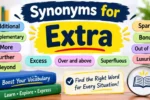
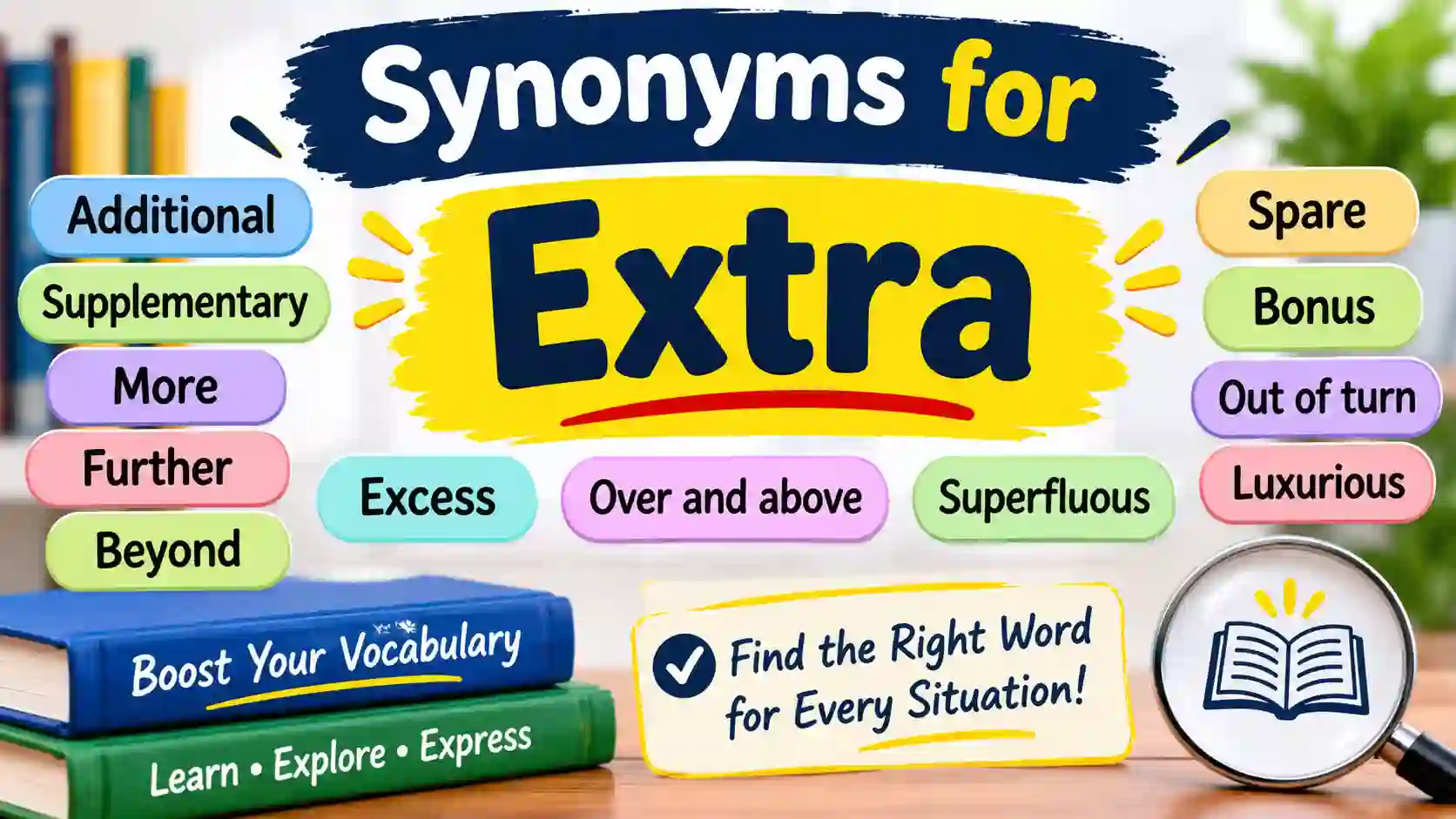
Synonyms for extra include additional, added, further, more, spare, supplementary, surplus, and accessory. These words describe something beyond the usual amount, something added to an existing item, or something available as an additional benefit. However, the best synonym depends on the sentence and the meaning you want to express.
Do you often use the word extra in your conversations, essays, or emails? It is a simple and useful English word, but repeating it can make your writing less interesting.
Learning synonyms for extra gives you more ways to express the same idea. For example, you can use additional time, spare equipment, supplementary information, or a bonus feature.
Although these expressions are related, they do not always mean the same thing. Additional describes something added, spare refers to something kept for later, and surplus means more than what is needed.
This guide explains 30 synonyms for extra, their meanings, pronunciation, examples, collocations, and differences. It also helps you understand which words sound natural in academic writing, business communication, and everyday English.
Pronunciation of Extra
- American IPA: /ˈek.strə/
- British IPA: /ˈek.strə/
- Pronunciation: EK-struh
- Syllables: Two
- Stress: First syllable
The standard pronunciation is almost identical in American and British English.
Part of Speech
Extra has three main grammatical uses.
| Part of speech | Meaning | Example |
| Adjective | More than usual or expected | We need extra chairs. |
| Adverb | To a greater degree or in addition | She worked extra hard. |
| Noun | Something added or an optional feature | The package includes several extras. |
Extra is also used as a noun for a background performer in a film. For example, the production company hired 20 extras.
It is not normally used as a verb.
Grammar: How to Use Extra
1. Extra Before a Noun
Use extra before a noun to describe an additional amount or item.
- We need extra information.
- The school purchased extra computers.
- Please bring an extra chair.
2. Extra After a Verb
Extra can follow a verb when it describes an additional amount or charge.
- Customers must pay extra.
- The hotel charges extra for parking.
- She earns extra by working on weekends.
3. Extra Before an Adjective or Adverb
Extra can emphasize an adjective or adverb.
- Please be extra careful.
- He worked extra hard.
- The room was extra quiet.
Common Grammar Mistake
Incorrect: We need more extra chairs.
Better: We need more chairs.
Also correct: We need extra chairs.
Use more extra only when you genuinely mean an increase in an already additional amount, and the context makes that meaning clear.
30 Synonyms for Extra: Quick Overview
The following alternatives are grouped by their grammatical meaning. Some are direct substitutes, while others work only in specific contexts.
| No. | Synonym | Main Use | Register |
| 1 | Additional | Something added | Neutral |
| 2 | Added | Included with something | Neutral |
| 3 | Further | More information or help | Formal |
| 4 | More | Greater quantity | Everyday |
| 5 | Spare | Kept for future use | Neutral |
| 6 | Supplementary | Supporting material | Academic |
| 7 | Supplemental | Additional support | Formal |
| 8 | Surplus | More than required | Business |
| 9 | Excess | Beyond a suitable amount | Formal |
| 10 | Superfluous | Unnecessary addition | Literary |
| 11 | Redundant | Repeated or unnecessary | Professional |
| 12 | Unnecessary | Not required | Neutral |
| 13 | Auxiliary | Supporting a main system | Technical |
| 14 | Ancillary | Secondary support | Formal |
| 15 | Accessory | Additional product or item | Retail |
| 16 | Backup | Kept as protection | Informal |
| 17 | Reserve | Saved for later | Neutral |
| 18 | Another | One more item | Everyday |
| 19 | Other | Additional or different items | Neutral |
| 20 | Fresh | Newly available | Everyday |
| 21 | New | Recently introduced | Neutral |
| 22 | Addition | Something added | Neutral |
| 23 | Add-on | An extra feature | Business |
| 24 | Attachment | An additional connected item | Technical |
| 25 | Supplement | Something that completes or adds to another thing | Formal |
| 26 | Extension | An added part or period | Neutral |
| 27 | Additionally | In addition to something | Formal |
| 28 | Exceptionally | To an unusual degree | Neutral |
| 29 | Especially | To a greater or particular degree | Neutral |
| 30 | Particularly | More than usual or others | Neutral |
Important: Words 1–21 mainly relate to extra as an adjective. Words 22–26 are useful noun alternatives. Words 27–30 apply to particular adverbial uses, not to every sentence containing extra.
Detailed Synonyms for Extra
1. Additional
Meaning: Additional means something added to what already exists.
Examples:
- The students received additional study materials.
- We need additional workers during the busy season.
Best Used When: You need a clear and professional alternative to extra.
Tone: Neutral | Register: Academic, business, everyday | CEFR: B1 | Frequency: Very common
Common collocations: Additional information, additional support, additional costs.
When Not to Use: Do not use it when describing an item kept for emergencies. Spare is better in that situation.
2. Added
Meaning: Added describes something included with an existing thing.
Examples:
- The new plan includes added security.
- The company introduced added benefits for employees.
Best Used When: You want to emphasize that something has been included.
Tone: Neutral | Register: Business, everyday | CEFR: A2–B1 | Frequency: Very common
Common collocations: Added value, added benefit, added protection.
When Not to Use: Avoid it when you mean something stored for later use.
3. Further
Meaning: Further means additional or more than what already exists.
Examples:
- Please contact us for further information.
- The manager requested further details about the project.
Best Used When: You need another piece of information, help, research, or progress.
Tone: Neutral | Register: Formal, academic, business | CEFR: B1 | Frequency: Very common
Common collocations: Further information, further assistance, further research.
When Not to Use: Avoid further when describing a spare physical object.
4. More
Meaning: More means a greater number or amount.
Examples:
- We need more chairs for the meeting.
- She requested more time to complete the assignment.
Best Used When: You want a simple and natural alternative to extra.
Tone: Neutral | Register: Spoken, everyday | CEFR: A1 | Frequency: Very common
Common collocations: More time, more money, more information.
When Not to Use: More does not always mean an additional feature or a spare item.
5. Spare
Meaning: Spare describes something available for use when needed.
Examples:
- I keep a spare charger in my desk.
- The hotel has a spare room for visitors.
Best Used When: You are talking about an unused item kept as a backup.
Tone: Neutral | Register: Everyday, spoken | CEFR: B1 | Frequency: Very common
Common collocations: Spare key, spare room, spare parts.
When Not to Use: Do not use spare for additional information or extra fees.
6. Supplementary
Meaning: Supplementary describes something that supports or improves something else.
Examples:
- The teacher provided supplementary reading materials.
- The course includes supplementary lessons for beginners.
Best Used When: You are discussing additional educational or supporting resources.
Tone: Neutral | Register: Academic, formal | CEFR: B2 | Frequency: Common
Common collocations: Supplementary material, supplementary education, supplementary information.
When Not to Use: Avoid it for ordinary additional objects such as chairs or cups.
7. Supplemental
Meaning: Supplemental means provided in addition to something else.
Examples:
- The school offers supplemental classes.
- Employees can receive supplemental benefits.
Best Used When: You describe extra resources, services, or financial support.
Tone: Neutral | Register: Business, academic | CEFR: B2 | Frequency: Common
Common collocations: Supplemental income, supplemental insurance, supplemental material.
When Not to Use: Avoid it when a simpler word such as more or additional is more natural.
8. Surplus
Meaning: Surplus describes something remaining after needs have been met.
Examples:
- The store sold its surplus inventory.
- The charity distributed surplus food to families.
Best Used When: You discuss more products, supplies, or money than necessary.
Tone: Neutral | Register: Business, financial | CEFR: B2 | Frequency: Common
Common collocations: Surplus stock, surplus funds, surplus supplies.
When Not to Use: Do not use it for a planned additional service that people still need.
9. Excess
Meaning: Excess refers to an amount beyond what is normal or necessary.
Examples:
- Remove the excess water from the container.
- The company wants to reduce excess spending.
Best Used When: You describe an additional quantity that goes beyond an acceptable level.
Tone: Neutral to negative | Register: Formal, academic | CEFR: B2 | Frequency: Common
Common collocations: Excess weight, excess baggage, excess water.
When Not to Use: Avoid it for a positive extra benefit.
10. Superfluous
Meaning: Superfluous describes something unnecessary because there is already enough.
Examples:
- The editor removed superfluous words from the article.
- The design contained several superfluous details.
Best Used When: You want to describe an unnecessary addition.
Tone: Negative | Register: Literary, academic, formal | CEFR: C1 | Frequency: Uncommon
Common collocations: Superfluous details, superfluous information, superfluous words.
When Not to Use: Do not use it for useful additional resources.
11. Redundant
Meaning: Redundant describes something repeated or no longer needed.
Examples:
- The writer removed redundant sentences.
- The new software made the old system redundant.
Best Used When: An additional item repeats something or serves no further purpose.
Tone: Negative | Register: Business, technical, academic | CEFR: B2 | Frequency: Common
Common collocations: Redundant information, redundant words, redundant equipment.
When Not to Use: Avoid it for an additional feature that provides a genuine benefit.
12. Unnecessary
Meaning: Unnecessary means something is not needed or required.
Examples:
- The manager removed unnecessary steps.
- Avoid unnecessary expenses when planning your budget.
Best Used When: You want to explain that something additional is not required.
Tone: Neutral to negative | Register: Everyday, professional | CEFR: B1 | Frequency: Very common
Common collocations: Unnecessary costs, unnecessary delay, unnecessary details.
When Not to Use: Do not use it for something useful that a person wants.
13. Auxiliary
Meaning: Auxiliary describes something that provides extra support to a main system or activity.
Examples:
- The building has an auxiliary power system.
- Auxiliary staff helped organize the event.
Best Used When: You describe supporting equipment, workers, or systems.
Tone: Neutral | Register: Technical, formal | CEFR: C1 | Frequency: Uncommon
Common collocations: Auxiliary power, auxiliary staff, auxiliary equipment.
When Not to Use: Avoid it as a general replacement for extra money or extra time.
14. Ancillary
Meaning: Ancillary describes something secondary that supports a main service or activity.
Examples:
- The hospital provides ancillary services.
- The project requires ancillary support.
Best Used When: You discuss secondary services or supporting activities.
Tone: Neutral | Register: Business, academic, formal | CEFR: C1 | Frequency: Uncommon
Common collocations: Ancillary services, ancillary staff, ancillary equipment.
When Not to Use: Avoid it in casual conversation when additional is clearer.
15. Accessory
Meaning: An accessory is an additional item that accompanies or improves another product.
Examples:
- The phone comes with several useful accessories.
- She purchased a camera accessory for her new device.
Best Used When: You discuss additional products or items.
Tone: Neutral | Register: Retail, fashion, everyday | CEFR: B2 | Frequency: Common
Common collocations: Phone accessory, fashion accessory, car accessories.
When Not to Use: Do not use accessories for extra time, effort, or information.
16. Backup
Meaning: Backup describes something kept ready in case the main thing fails.
Examples:
- Always keep a backup copy of your documents.
- The hospital installed backup generators.
Best Used When: You describe something that provides protection against failure or loss.
Tone: Neutral | Register: Technical, business, informal | CEFR: B1 | Frequency: Very common
Common collocations: Backup plan, backup system, backup equipment.
When Not to Use: Avoid it when describing an additional reward or optional product feature.
17. Reserve
Meaning: A reserve is something saved and kept available for future use.
Examples:
- The company maintains a reserve supply of fuel.
- We keep reserve funds for emergencies.
Best Used When: You discuss resources saved for future needs.
Tone: Neutral | Register: Business, everyday | CEFR: B1–B2 | Frequency: Common
Common collocations: Reserve funds, reserve stock, reserve supply.
When Not to Use: Do not use it for something already included in a package.
18. Another
Meaning: Another means one more person or thing of the same general kind.
Examples:
- Could you bring another glass of water?
- We need another computer for the office.
Best Used When: You want to identify one more countable item.
Tone: Neutral | Register: Everyday, spoken | CEFR: A1 | Frequency: Very common
Common collocations: Another chance, another example, another opportunity.
When Not to Use: Avoid it for uncountable quantities such as extra information.
19. Other
Meaning: Other describes additional or different people or things.
Examples:
- The company offers other services.
- We need other materials for the project.
Best Used When: You refer to additional items within a group.
Tone: Neutral | Register: Everyday, business | CEFR: A1 | Frequency: Very common
Common collocations: Other options, other services, other resources.
When Not to Use: Do not use it when you specifically mean one more item. Another is often better.
20. Fresh
Meaning: Fresh describes something newly prepared, available, or introduced.
Examples:
- The team brought fresh ideas to the meeting.
- We ordered fresh supplies for the workshop.
Best Used When: You want to emphasize newness rather than quantity.
Tone: Positive | Register: Everyday, business | CEFR: A2 | Frequency: Very common
Common collocations: Fresh ideas, fresh supplies, fresh resources.
When Not to Use: Fresh does not automatically mean additional.
21. New
Meaning: New describes something recently created, introduced, or obtained.
Examples:
- The company introduced new safety features.
- The school received new equipment.
Best Used When: Something additional is also recently introduced or obtained.
Tone: Neutral | Register: Everyday, professional | CEFR: A1 | Frequency: Very common
Common collocations: New features, new resources, new information.
When Not to Use: Do not use new simply to replace extra. Something can be new without being additional.
22. Addition
Meaning: An addition is something included with an existing thing.
Examples:
- The new library is a useful addition to the school.
- The website has an addition to its original collection.
Best Used When: You mean a new item, feature, or part that has been included.
Tone: Neutral | Register: Academic, business | CEFR: B1 | Frequency: Very common
Common collocations: Useful addition, welcome addition, valuable addition.
When Not to Use: Do not use it where the adjective additional is required.
23. Add on
Meaning: An add-on is an extra feature or item attached to an existing product or service.
Examples:
- The software offers several useful add-ons.
- Customers can purchase an add-on for extended protection.
Best Used When: You describe an additional product feature or optional service.
Tone: Neutral | Register: Technology, business | CEFR: B2 | Frequency: Common
Common collocations: Software add-on, optional add-on, paid add-on.
When Not to Use: Avoid it for additional effort, time, or people.
24. Attachment
Meaning: An attachment is an additional item connected to or supplied with something.
Examples:
- The machine comes with three attachments.
- Please check the attachment included with the equipment.
Best Used When: You discuss an extra component or a file sent with an email.
Tone: Neutral | Register: Technical, business | CEFR: B1–B2 | Frequency: Common
Common collocations: Email attachment, machine attachment, file attachment.
When Not to Use: It is not a general substitute for extra money or extra time.
25. Supplement
Meaning: A supplement is something added to improve or complete another thing.
Examples:
- The report includes a supplement with further details.
- The school provided a supplement to the main textbook.
Best Used When: You describe additional material that supports an existing resource.
Tone: Neutral | Register: Academic, formal | CEFR: B2 | Frequency: Common
Common collocations: Dietary supplement, report supplement, textbook supplement.
When Not to Use: Do not use it for a simple additional object such as another chair.
26. Extension
Meaning: An extension is an additional part, length, or period added to something.
Examples:
- The teacher gave the students an extension.
- The company built an extension to its main office.
Best Used When: You mean additional time, space, or a connected part.
Tone: Neutral | Register: Academic, business | CEFR: B1 | Frequency: Common
Common collocations: Time extension, building extension, contract extension.
When Not to Use: Avoid it when you simply mean a greater quantity.
27. Additionally
Meaning: Additionally means in addition to something already mentioned.
Examples:
- The package includes installation. Additionally, it provides free support.
- The school offers online lessons and additional study materials.
Best Used When: You want to introduce another point in formal or organized writing.
Tone: Neutral | Register: Academic, professional | CEFR: B2 | Frequency: Common
Common collocations: Additionally required, additionally available, additionally provided.
When Not to Use: It cannot replace extra directly before a noun.
28. Exceptionally
Meaning: Exceptionally means to an unusual or remarkable degree.
Examples:
- The hotel was exceptionally comfortable.
- She performed exceptionally well in the competition.
Best Used When: Extra means unusually or to an especially high degree.
Tone: Positive or neutral | Register: Formal, everyday | CEFR: B2 | Frequency: Common
Common collocations: Exceptionally good, exceptionally talented, exceptionally well.
When Not to Use: Do not use it when extra simply means additional.
29. Especially
Meaning: Especially means particularly or more than others in a specific situation.
Examples:
- The new lessons are especially useful for beginners.
- We need to be careful, especially during winter.
Best Used When: You want to emphasize a particular person, thing, or situation.
Tone: Neutral | Register: Everyday, academic | CEFR: B1 | Frequency: Very common
Common collocations: Especially important, especially useful, especially helpful.
When Not to Use: It is not a direct substitute for extra chairs or extra money.
30. Particularly
Meaning: Particularly means especially or to a greater degree than others.
Examples:
- This lesson is particularly helpful for new students.
- The manager was particularly pleased with the results.
Best Used When: You want to emphasize a specific quality or situation.
Tone: Neutral | Register: Formal, academic, spoken | CEFR: B2 | Frequency: Common
Common collocations: Particularly useful, particularly important, particularly difficult.
When Not to Use: Do not use it to describe an additional quantity.
Strongest Synonyms, Strong Synonyms, and Related Words
Strongest Synonyms
These words most closely match the common meaning of extra as something additional:
- Additional
- Added
- Further
- More
- Another
- Spare
Strong Synonyms
These work well in particular situations:
- Supplementary
- Supplemental
- Surplus
- Auxiliary
- Backup
- Reserve
- Addition
- Add-on
- Supplement
- Extension
Related Words
These words have narrower or different meanings:
- Excess
- Superfluous
- Redundant
- Unnecessary
- Accessory
- Ancillary
- Attachment
- Other
- Fresh
- New
- Additionally
- Exceptionally
- Especially
- Particularly
Choose the Right Synonym: Side by Side Comparisons
| Word | Main Difference | Example |
| Additional | Something added to an existing amount | We need additional staff. |
| Spare | Something kept ready for later | I have a spare charger. |
| Surplus | More than what is needed | The factory sold surplus stock. |
| Further | More information or assistance | Please request further details. |
| Supplementary | Material that supports another resource | Supplementary lessons are available. |
| Excess | An amount beyond a suitable level | Remove excess water. |
| Bonus | An additional reward or benefit | Employees received a bonus. |
| Superfluous | An unnecessary addition | Remove superfluous details. |
Which Word Should You Choose?
- Extra time → Additional time or more time.
- Extra money kept for emergencies → Reserve funds.
- Extra key → Spare key.
- Extra learning material → Supplementary material.
- Extra products beyond demand → Surplus products.
- Extra fee → Additional charge.
- Extra reward → Bonus.
- Extra information that repeats existing details → Redundant information.
Commonly Confused Words
| Words | Difference | Example |
| Extra vs. Additional | Both mean added, but additional is often more formal. | Additional support is available. |
| Spare vs. Surplus | Spare is kept for use; surplus is more than required. | Keep a spare key. |
| Excess vs. Excessive | Excess is a noun or adjective; excessive is an adjective. | Excessive spending is harmful. |
| Supplementary vs. Supplemental | Both describe supporting additions. | Supplemental lessons are available. |
| Extra vs. Extraordinary | Extra means additional; extraordinary means remarkable or unusual. | It was an extraordinary performance. |
Common Mistakes English Learners Make
Mistake 1: Treating all synonyms as interchangeable
Incorrect: I need surplus information about the exam.
Better: I need additional information about the exam.
Explanation: Surplus usually describes an amount beyond what is needed.
Mistake 2: Using excessive for a positive addition
Incorrect: The school provided excessive learning materials.
Better: The school provided supplementary learning materials.
Explanation: Excessive suggests too much, not simply more.
Mistake 3: Using bonus for a compulsory payment
Incorrect: The customer must pay a bonus charge.
Better: The customer must pay an additional charge.
Explanation: Bonus normally describes a reward or advantage.
Mistake 4: Confusing extra with extraordinary
Incorrect: We need extraordinary chairs for the guests.
Better: We need extra chairs for the guests.
Explanation: Extraordinary means unusual or remarkable.
Writing Tips: Use Synonyms Naturally
Essays: Use additional, further, supplementary, and excessive when they fit the subject.
Emails: Use further assistance and additional information for professional communication.
Blog posts: Use more, bonus, and added to make explanations easy to read.
Stories: Use another, spare, fresh, and leftover when describing people or objects.
Social media: Use bonus, plus, and more in short messages.
Business writing: Use additional, surplus, auxiliary, and ancillary in suitable professional contexts.
Daily conversations: Use more, another, spare, and extra.
Writing Tip: Do not replace every use of extra with a different word. Repetition is acceptable when it makes the meaning clearer. Accuracy matters more than variety.
Word Origin and Etymology
Extra comes from Latin extrā, meaning outside or beyond. The English adjective appeared in the mid-17th century and probably developed as a shortened form of extraordinary, influenced by similar forms in French and German.
The word gradually developed its modern meanings, including additional, beyond the usual amount, and something available for an additional payment.
The prefix extra- also appears in words such as extracurricular and extraterrestrial.
CEFR Vocabulary Guide
These are approximate learning suggestions, not official CEFR classifications for every word.
| Level | Useful Words |
| A1 | More, another, new, other |
| A2 | Added, fresh |
| B1 | Additional, further, spare, unnecessary, backup, addition |
| B2 | Supplementary, supplemental, surplus, excessive, redundant, accessory |
| C1 | Auxiliary, ancillary, superfluous |
Start with the A1 and B1 words before learning advanced alternatives.
American vs. British English
Extra has the same spelling and basic meaning in both American and British English.
| Feature | American English | British English |
| Spelling | Extra | Extra |
| Pronunciation | /ˈek.strə/ | /ˈek.strə/ |
| Additional | Common | Common |
| Supplemental | Common | Used |
| Supplementary | Used | Common |
| Optional extra | Understood | Common expression |
| Spare room | Common | Common |
There is no major spelling difference for extra itself.
Supplemental and supplementary are both correct in both varieties. Their relative preferences can depend on context and publication style.
Antonyms of Extra
| Antonym | Meaning | Example |
| Necessary | Needed | Food is necessary. |
| Essential | Extremely important | Water is essential. |
| Required | Needed by a rule | ID is required. |
| Basic | Fundamental or standard | This is a basic package. |
| Minimum | The smallest amount | Pay the minimum fee. |
| Limited | Restricted in amount | We have limited supplies. |
These are contextual opposites, not universal opposites for every meaning of extra.
Expressions Related to Extra
- Go the extra mile: Make more effort than expected.
- At no extra cost: Without an additional payment.
- Extra pair of hands: Another person who can help.
- Over and above: In addition to what is expected.
- More than enough: A greater amount than necessary.
- Optional extra: Something available by choice, often for an added price.
Frequently Asked Questions
1. What is the best synonym for extra?
Additional is one of the best general synonyms for extra. It works in academic writing, professional emails, and everyday English. However, spare is better for backup items, supplementary is better for supporting material, and surplus describes an amount greater than what is needed.
2. What is another word for extra in formal writing?
Additional, further, supplementary, supplemental, ancillary, and auxiliary can work in formal writing. Additional is the most flexible choice. Ancillary and auxiliary are more specialized, so use them when describing secondary services, supporting staff, or equipment.
3. What is a simple word for extra?
More is the simplest alternative in many sentences. For example, you can say “I need more time” instead of “I need extra time.” Another is useful when you mean one more countable item, while spare describes something kept for later use.
4. Is additional the same as extra?
Additional and extra often have the same meaning when describing something added to an existing amount. Additional usually sounds more formal, while extra is common in everyday conversation. However, additional cannot replace every meaning of extra, especially its slang and adverbial uses.
5. What is the difference between extra, surplus, and excess?
Extra means additional or beyond the usual amount. Surplus refers to an amount remaining after needs have been met. Excess describes an amount beyond what is suitable or necessary. These words differ in tone and context, so they should not always replace one another.
6. What is the opposite of extra?
Common contextual opposites include necessary, essential, required, basic, and minimum. For example, extra features may contrast with basic features, while unnecessary items contrast with essential items. The correct opposite depends on the intended meaning of extra.
7. What is a synonym for extra effort?
Additional effort, greater effort, increased effort, and further effort are useful alternatives. The expression go the extra mile also means making more effort than expected. For example, “She went the extra mile to help her students.”
8. What does extra mean in slang?
In slang, extra describes someone who behaves in an overly dramatic or exaggerated way. For example, “You’re being extra about a small problem.” Similar expressions include over-the-top, dramatic, and exaggerated. This informal meaning is different from the ordinary meaning of additional.
Vocabulary Quiz
1. Which word describes something kept for future use?
A. Excess
B. Spare
C. Superfluous
D. Further
2. Which word means more than what is needed?
A. Surplus
B. Another
C. Fresh
D. Additional
3. Which word is suitable for supporting educational material?
A. Redundant
B. Excessive
C. Supplementary
D. Unnecessary
4. What does bonus usually mean?
A. A repeated detail
B. An additional reward
C. An unnecessary expense
D. A backup system
5. Which word describes information that repeats something already stated?
A. Added
B. Spare
C. Redundant
D. Further
Answer Key: 1-B, 2-A, 3-C, 4-B, 5-C.
Conclusion
Learning synonyms for extra improves your vocabulary and helps you communicate more clearly. Words such as additional, further, spare, supplementary, and surplus each express a different idea.
Choose the right word based on its meaning and context. Practice these alternatives in emails, essays, schoolwork, and everyday conversations. With regular practice, your English will become more natural and confident.
References
- Oxford Learner’s Dictionaries: Extra – https://www.oxfordlearnersdictionaries.com/definition/english/extra_1
- Cambridge Dictionary: Extra – https://dictionary.cambridge.org/dictionary/english/extra
- Cambridge Thesaurus: Extra Synonyms – https://dictionary.cambridge.org/us/thesaurus/extra
- Collins Dictionary: Extra – https://www.collinsdictionary.com/dictionary/english/extra
- Merriam-Webster: Extra – https://www.merriam-webster.com/dictionary/extra

Synonorm is a trusted English vocabulary resource created to help readers find the right words and understand the differences between similar terms. We provide clear explanations of synonyms, meanings, examples, usage, and alternatives. Our content makes vocabulary easier to learn and apply in everyday, academic, and professional English. Synonorm is designed for students, writers, ESL learners, professionals, and anyone who wants to improve their English vocabulary and communicate more clearly.