What Are the Synonyms of Introspective?
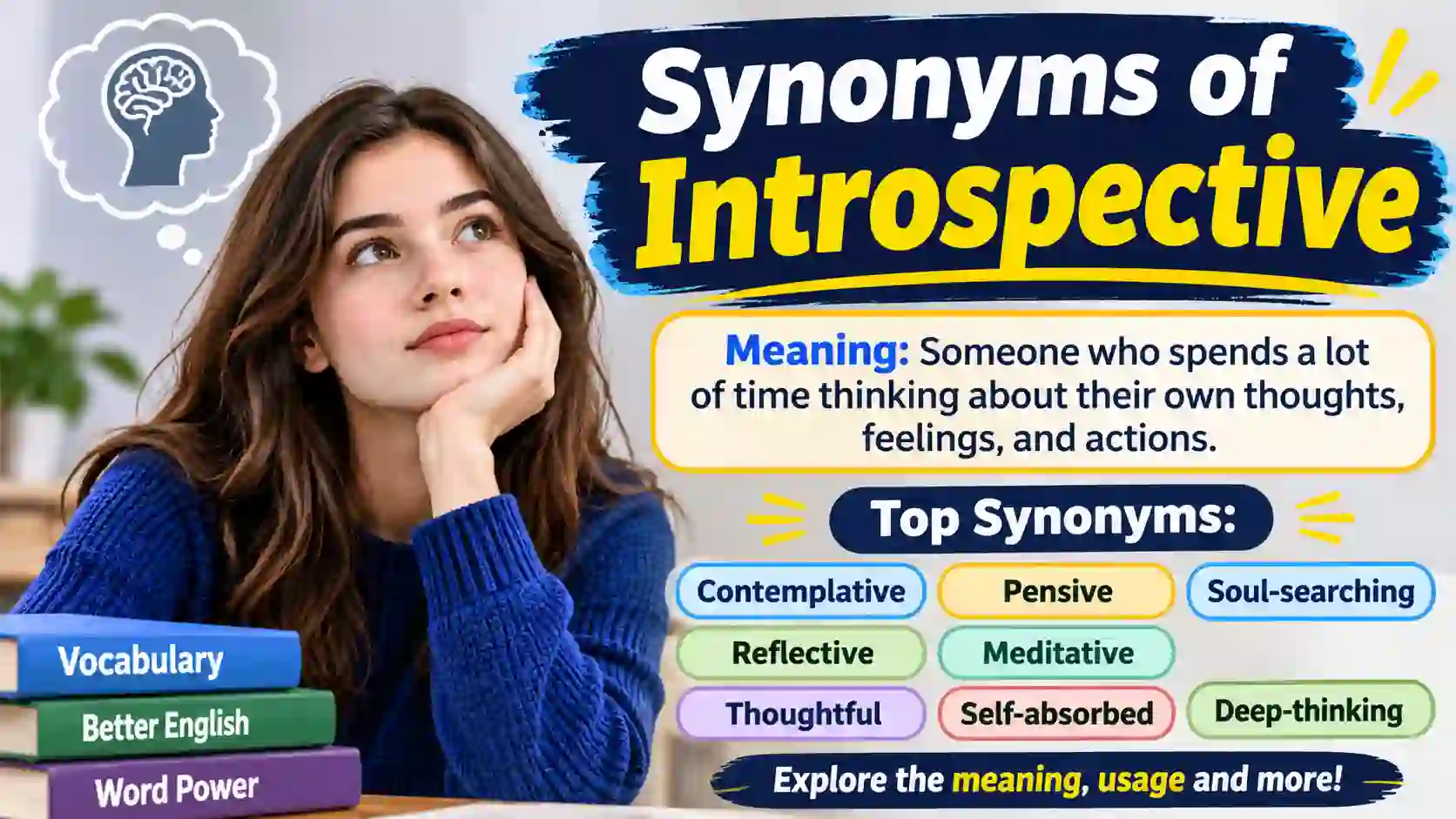
The best synonyms of introspective include reflective, contemplative, inward-looking, self-examining, self-reflective, meditative, and pensive. These words describe people or thoughts connected to examining the mind, feelings, and personal experiences. Some focus on deep thinking, while others describe self-awareness or emotional reflection. The right synonym depends on your sentence and intended meaning.
Do you sometimes stop and think about your feelings, decisions, or past experiences? You may be an introspective person. Someone who is introspective spends time looking inside their own mind to understand what they think and feel.
For example, a student who thinks about why they failed a test and how they can improve is showing introspective behavior.
Learning synonyms of introspective can help you describe this quality in different ways. Students can use these alternatives in essays, writers can improve their descriptions, and professionals can communicate ideas more clearly.
However, not every word that means thoughtful is a perfect replacement. This guide explains 30 alternatives, their meanings, examples, differences, and natural uses.
Pronunciation of Introspective
- IPA (American): /ˌɪn.trəˈspek.tɪv/
- IPA (British): /ˌɪn.trəˈspek.tɪv/
- Simple pronunciation: in-truh-SPEK-tiv
- Stress: SPEK
Both American and British English use the same standard spelling and broadly the same pronunciation.
Part of Speech
Introspective is an adjective. It describes a person, mood, activity, or piece of writing that examines inner thoughts and feelings.
Examples:
- She has an introspective personality.
- His diary contains introspective writing.
- The experience made him more introspective.
Related Word Forms
| Word | Part of Speech | Meaning |
| Introspective | Adjective | Examining inner thoughts |
| Introspection | Noun | Examination of your own mind |
| Introspect | Verb | Examine your own thoughts |
| Introspectively | Adverb | In an introspective way |
| Introspectiveness | Noun | The quality of being introspective |
Grammar and Usage
Use introspective before a noun or after linking verbs such as be, seem, and become.
Common sentence patterns:
- Introspective + noun: She wrote an introspective poem.
- Be introspective: He tends to be introspective.
- Become + introspective: The experience made her introspective.
- Introspective about + subject: He became introspective about his choices.
Natural collocations:
- Introspective personality
- Introspective mood
- Introspective writing
- Introspective thoughts
- Introspective nature
- Introspective journey
Remember that introspective does not mean shy or antisocial. An outgoing person can also examine their own thoughts and feelings.
Quick Overview: 30 Synonyms of Introspective
| Synonym | Strength | Register |
| Reflective | Very close | Neutral |
| Self-reflective | Very close | Academic |
| Inward-looking | Very close | Neutral |
| Self-examining | Very close | Formal |
| Self-scrutinizing | Very close | Formal |
| Self-questioning | Very close | Neutral |
| Self-analytical | Very close | Academic |
| Contemplative | Close | Formal |
| Meditative | Close | Literary |
| Pensive | Close | Literary |
| Thoughtful | Close | Neutral |
| Ruminative | Contextual | Academic |
| Musing | Contextual | Literary |
| Brooding | Contextual | Literary |
| Soul-searching | Contextual | Literary |
| Self-observant | Contextual | Formal |
| Self-aware | Related | Professional |
| Mindful | Related | Neutral |
| Philosophical | Related | Academic |
| Deliberative | Related | Formal |
| Cogitative | Related | Literary |
| Deep-thinking | Related | Informal |
| Introspective-minded | Avoid | Unnatural |
| Wistful | Related | Literary |
| Serious-minded | Related | Neutral |
| Absorbed | Related | Neutral |
| Pondering | Related | Neutral |
| Meditating | Related | Neutral |
| Speculative | Related | Academic |
| Thoughtful-looking | Contextual | Informal |
The final two descriptive expressions are not standard direct synonyms. Use established alternatives such as reflective or pensive in formal writing.
30 Synonyms of Introspective with Examples
1. Reflective
Meaning: Thinking carefully about your own experiences, actions, or feelings.
Examples:
- She became reflective after reviewing her past decisions.
- His reflective nature helps him learn from mistakes.
Best used when: Someone considers experiences to understand what they learned.
Tone: Neutral, academic, professional.
CEFR: B2 | Frequency: Very common.
Collocations: Reflective thinking, reflective writing, reflective practice.
Nuance: One of the closest and most useful alternatives. It can describe personal reflection or broader thinking.
When not to use it: Do not use it if you specifically mean a person is examining their private emotions and no broader reflection is involved.
2. Self reflective
Meaning: Carefully examining your own thoughts, behavior, and experiences.
Examples:
- The teacher encouraged self-reflective learning.
- His self-reflective approach helped him improve his communication.
Best used when: Discussing personal development or learning.
Tone: Academic, professional.
CEFR: C1 | Frequency: Common.
Collocations: Self-reflective practice, self-reflective learning, self-reflective process.
Nuance: More specifically focused on the self than reflective.
When not to use it: Avoid it when a simple word such as thoughtful would sound more natural.
3. Inward looking
Meaning: Focused on a person’s inner thoughts and feelings.
Examples:
- Her inward-looking personality made her interested in psychology.
- The novel presents an inward-looking account of personal change.
Best used when: Describing someone who focuses on their inner world.
Tone: Neutral, literary.
CEFR: B2 | Frequency: Common.
Collocations: Inward-looking personality, inward-looking approach, inward-looking perspective.
Nuance: Very close to introspective, although it can also describe organizations or policies that focus internally.
When not to use it: Do not confuse it with shy or socially withdrawn.
4. Self examining
Meaning: Carefully checking your own behavior, thoughts, or beliefs.
Examples:
- The self-examining writer questioned his earlier opinions.
- She adopted a self-examining approach to personal growth.
Best used when: Someone honestly evaluates their actions.
Tone: Formal, academic.
CEFR: C1 | Frequency: Uncommon.
Collocations: Self-examining process, self-examining attitude, self-examining questions.
Nuance: Emphasizes deliberate personal examination.
When not to use it: Avoid it when someone is simply thinking quietly without evaluating themselves.
5. Self scrutinizing
Meaning: Carefully examining your own behavior, decisions, or beliefs.
Examples:
- His self-scrutinizing approach helped him recognize his mistakes.
- The writer used a self-scrutinizing tone throughout the essay.
Best used when: Describing close and sometimes critical personal examination.
Tone: Formal, academic.
CEFR: C1–C2 | Frequency: Uncommon.
Collocations: Self-scrutinizing process, self-scrutinizing attitude, careful self-scrutiny.
Nuance: Stronger and more critical than ordinary introspection.
When not to use it: Avoid it when you want to describe peaceful or casual reflection.
6. Self questioning
Meaning: Asking yourself whether your thoughts, actions, or beliefs are correct.
Examples:
- His self-questioning nature helped him challenge old assumptions.
- The experience encouraged self-questioning and personal growth.
Best used when: Someone doubts or reviews their own decisions.
Tone: Neutral, academic.
CEFR: B2–C1 | Frequency: Uncommon.
Collocations: Self-questioning process, self-questioning attitude, personal self-questioning.
Nuance: Focuses on asking yourself difficult questions.
When not to use it: Do not use it for someone who simply enjoys quiet time.
7. Self analytical
Meaning: Examining your own behavior and feelings in a logical way.
Examples:
- She takes a self-analytical approach to personal development.
- His self-analytical nature helps him identify his weaknesses.
Best used when: Discussing logical examination of personal behavior.
Tone: Formal, professional, academic.
CEFR: C1 | Frequency: Uncommon.
Collocations: Self-analytical approach, self-analysis, analytical thinking.
Nuance: More systematic and logical than introspective.
When not to use it: Avoid it when you mean emotional reflection without logical analysis.
8. Contemplative
Meaning: Spending time thinking deeply about something.
Examples:
- He sat by the window in a contemplative mood.
- Her contemplative nature helped her explore difficult questions.
Best used when: Someone engages in calm, deep thought.
Tone: Formal, literary.
CEFR: C1 | Frequency: Common.
Collocations: Contemplative mood, contemplative nature, contemplative silence.
Nuance: Focuses on deep thought, which may or may not involve examining yourself.
When not to use it: Do not use it when you specifically mean someone is analyzing personal behavior.
9. Meditative
Meaning: Involving calm, focused, or deep thought.
Examples:
- The quiet garden created a meditative atmosphere.
- She entered a meditative state while considering her future.
Best used when: Describing peaceful reflection or mental focus.
Tone: Literary, formal, spiritual.
CEFR: C1 | Frequency: Common.
Collocations: Meditative state, meditative practice, meditative mood.
Nuance: Often connected with meditation, calmness, and inner peace.
When not to use it: Avoid it for anxious or troubled overthinking.
10. Pensive
Meaning: Thinking deeply, often with a serious or slightly sad expression.
Examples:
- He wore a pensive expression during the meeting.
- She became pensive while reading her old letters.
Best used when: Describing a thoughtful mood or appearance.
Tone: Literary, neutral.
CEFR: C1 | Frequency: Common.
Collocations: Pensive expression, pensive mood, pensive silence.
Nuance: Often describes a temporary mood rather than a permanent personality.
When not to use it: Do not use it when you specifically mean someone regularly examines their character.
11. Thoughtful
Meaning: Thinking carefully before making a decision or giving an answer.
Examples:
- He gave a thoughtful answer during the discussion.
- She took a thoughtful look at her recent decisions.
Best used when: Someone considers an idea or situation carefully.
Tone: Neutral, informal, professional.
CEFR: B1 | Frequency: Very common.
Collocations: Thoughtful response, thoughtful person, thoughtful reflection.
Nuance: Can also mean kind or considerate, so it is broader than introspective.
When not to use it: Avoid assuming that every thoughtful person examines their inner feelings.
12. Ruminative
Meaning: Thinking about something repeatedly for a long time.
Examples:
- His ruminative thoughts kept him awake.
- She entered a ruminative mood after the difficult conversation.
Best used when: Describing prolonged or repeated thinking.
Tone: Formal, psychological, literary.
CEFR: C2 | Frequency: Uncommon.
Collocations: Ruminative thinking, ruminative mood, ruminative thoughts.
Nuance: Can suggest repetitive or negative thinking rather than healthy self-reflection.
When not to use it: Avoid it for one brief moment of thoughtful consideration.
13. Musing
Meaning: Quietly thinking about an idea or experience.
Examples:
- She spent the afternoon musing about her future.
- His private musings inspired a new story.
Best used when: Describing relaxed or imaginative thought.
Tone: Literary, informal.
CEFR: C1 | Frequency: Uncommon.
Collocations: Private musings, quiet musing, musing thoughts.
Nuance: Often suggests unstructured or imaginative thinking.
When not to use it: Avoid it for formal descriptions of systematic self-examination.
14. Brooding
Meaning: Thinking deeply and repeatedly about something troubling.
Examples:
- He spent the evening brooding over his failure.
- Her brooding expression suggested that something was wrong.
Best used when: Describing troubled or unhappy thinking.
Tone: Literary, emotional.
CEFR: C1 | Frequency: Common.
Collocations: Brooding silence, brooding mood, brooding thoughts.
Nuance: More negative than introspective because it often suggests worry or sadness.
When not to use it: Avoid it for positive self-reflection.
15. Soul searching
Meaning: Deeply examining your beliefs, values, and life choices.
Examples:
- After leaving his job, he spent months soul-searching.
- The difficult decision led her into a period of soul-searching.
Best used when: Someone is searching for personal meaning or direction.
Tone: Literary, emotional.
CEFR: B2 | Frequency: Common.
Collocations: Deep soul-searching, period of soul-searching, personal soul-searching.
Nuance: More serious and emotional than everyday reflection.
When not to use it: Avoid it for small daily decisions.
16. Self observant
Meaning: Paying close attention to your own behavior and reactions.
Examples:
- He became more self-observant after starting a journal.
- A self-observant learner notices personal study habits.
Best used when: Discussing observation of your own actions.
Tone: Formal, academic.
CEFR: C1–C2 | Frequency: Rare.
Collocations: Self-observation, self-observant attitude, self-observation practice.
Nuance: More focused on observing yourself than interpreting your feelings.
When not to use it: Prefer self-aware or self-reflective in everyday writing.
17. Self aware
Meaning: Understanding your own feelings, strengths, and weaknesses.
Examples:
- She is self-aware enough to recognize her mistakes.
- A self-aware leader understands how their words affect others.
Best used when: Describing personal understanding and emotional awareness.
Tone: Neutral, professional.
CEFR: B2 | Frequency: Very common.
Collocations: Self-aware person, self-aware leader, emotionally self-aware.
Nuance: Self-awareness is often the result of introspection, not the same process.
When not to use it: Avoid it when someone thinks deeply but has not developed self-understanding.
18. Mindful
Meaning: Paying attention to your present thoughts, feelings, and experiences.
Examples:
- He became more mindful of his reactions.
- She takes a mindful approach to handling stress.
Best used when: Discussing present awareness and personal reactions.
Tone: Neutral, wellness-related.
CEFR: B2 | Frequency: Very common.
Collocations: Mindful awareness, mindful approach, mindful decision-making.
Nuance: Mindfulness emphasizes present awareness, while introspection often examines inner experiences.
When not to use it: Avoid it when discussing detailed analysis of past events.
19. Philosophical
Meaning: Thinking deeply about life, truth, values, or existence.
Examples:
- Their philosophical discussion continued late into the evening.
- He became philosophical about success after retiring.
Best used when: Discussing major questions about life and human nature.
Tone: Academic, literary.
CEFR: C1 | Frequency: Common.
Collocations: Philosophical questions, philosophical discussion, philosophical outlook.
Nuance: Focuses on big ideas rather than personal feelings alone.
When not to use it: Avoid it as an exact replacement when describing private emotional examination.
20. Deliberative
Meaning: Carefully considering choices before making a decision.
Examples:
- Her deliberative nature prevents rushed decisions.
- The manager used a deliberative approach to solve the problem.
Best used when: Describing careful decision-making.
Tone: Formal, academic, business.
CEFR: C1 | Frequency: Uncommon.
Collocations: Deliberative process, deliberative approach, deliberative decision-making.
Nuance: Focuses on weighing options rather than examining emotions.
When not to use it: Avoid it when you mean emotional self-reflection.
21. Cogitative
Meaning: Involving deep or careful thinking.
Examples:
- His cogitative nature made him interested in complex ideas.
- The quiet room supported cognitive work.
Best used when: A literary or specialized description of deep thought is needed.
Tone: Literary, formal.
CEFR: C2 | Frequency: Rare.
Collocations: Cogitative process, cogitative thinking, cogitative nature.
Nuance: Emphasizes thinking rather than personal self-examination.
When not to use it: Prefer thoughtful or contemplative in everyday English.
22. Deep thinking
Meaning: Considering ideas carefully and looking beyond simple answers.
Examples:
- The deep-thinking student asked questions about human behavior.
- His deep-thinking nature helped him solve difficult problems.
Best used when: Using simple language to describe someone who thinks deeply.
Tone: Informal, neutral.
CEFR: B1–B2 | Frequency: Uncommon.
Collocations: Deep-thinking person, deep-thinking approach, deep thinker.
Nuance: Focuses on the depth of thought rather than self-examination.
When not to use it: Prefer analytical or reflective in formal academic writing.
23. Wistful
Meaning: Feeling gentle sadness while remembering something or wishing for something.
Examples:
- She gave a wistful smile while remembering her school days.
- He looked wistful when discussing his childhood home.
Best used when: Describing thoughtful sadness or longing.
Tone: Literary, emotional.
CEFR: C1 | Frequency: Common.
Collocations: Wistful smile, wistful expression, wistful memories.
Nuance: Describes an emotion rather than a process of examining yourself.
When not to use it: Avoid it when there is no sadness or longing.
24. Serious minded
Meaning: Thinking carefully about important matters and treating them seriously.
Examples:
- She is a serious-minded student who values education.
- His serious-minded attitude helped the team stay focused.
Best used when: Describing someone’s mature approach to important issues.
Tone: Neutral, professional.
CEFR: B2 | Frequency: Common.
Collocations: Serious-minded person, serious-minded approach, serious-minded discussion.
Nuance: Focuses on attitude rather than inward reflection.
When not to use it: Do not use it to suggest someone regularly examines their emotions.
25. Absorbed
Meaning: Giving complete attention to something.
Examples:
- He was absorbed in thoughts about his future.
- She sat absorbed in her memories.
Best used when: Describing someone deeply occupied by thoughts or an activity.
Tone: Neutral.
CEFR: B2 | Frequency: Very common.
Collocations: Absorbed in thought, deeply absorbed, completely absorbed.
Nuance: Describes concentration, not necessarily self-examination.
When not to use it: Avoid it when the focus is understanding your own emotions.
26. Pondering
Meaning: Thinking carefully about something before reaching a conclusion.
Examples:
- She was pondering the choices available to her.
- He spent the afternoon pondering his next move.
Best used when: Someone is considering a question or decision.
Tone: Neutral, literary.
CEFR: B2 | Frequency: Common.
Collocations: Pondering a question, pondering the future, deeply pondering.
Nuance: Focuses on considering an issue rather than necessarily looking inward.
When not to use it: Avoid it as a direct synonym when personal emotions are the main focus.
27. Meditating
Meaning: Practicing mental focus or thinking deeply about something.
Examples:
- She was meditating on the choices before her.
- He spent the morning meditating on the meaning of forgiveness.
Best used when: Describing meditation or deliberate reflection.
Tone: Neutral, spiritual.
CEFR: B1 | Frequency: Very common.
Collocations: Meditating on a question, meditating quietly, meditating on life.
Nuance: This is a verb form, not an adjective replacement for introspective.
When not to use it: Do not write “a meditating personality” when you mean an introspective personality.
28. Speculative
Meaning: Considering possibilities that may or may not be true.
Examples:
- His speculative thoughts explored several possible futures.
- The discussion became speculative as they considered different outcomes.
Best used when: Discussing theories, possibilities, or uncertain ideas.
Tone: Academic, formal.
CEFR: C1 | Frequency: Common.
Collocations: Speculative thinking, speculative ideas, speculative discussion.
Nuance: Focuses on possibilities rather than personal feelings.
When not to use it: Avoid it as an exact replacement for introspective.
29. Introspective in nature
Meaning: Describes someone or something that naturally focuses on inner thoughts and feelings.
Examples:
- Her writing is introspective in nature.
- He has always been introspective in nature.
Best used when: You want to describe a lasting personal quality without repeating the adjective.
Tone: Neutral, formal.
CEFR: B2 | Frequency: Common expression.
Collocations: Introspective in nature, introspective by nature, naturally introspective.
Nuance: This is an expression containing the original keyword, not a separate synonym.
When not to use it: Avoid it when a simple adjective would make your sentence clearer.
30. Deep in thought
Meaning: Thinking so carefully that you pay little attention to what is happening around you.
Examples:
- He sat by the window, deep in thought about his future.
- She was deep in thought after the conversation.
Best used when: Describing a temporary state of concentration or reflection.
Tone: Neutral, everyday English.
CEFR: B1 | Frequency: Very common.
Collocations: Deep in thought, lost in thought, sit deep in thought.
Nuance: A natural expression for someone who is thinking deeply, but it does not necessarily mean they are examining themselves.
When not to use it: Avoid it when you want to describe a permanent personality trait.
Strongest Synonyms of Introspective
These alternatives most clearly express inward examination:
- Reflective
- Self-reflective
- Inward-looking
- Self-examining
- Self-scrutinizing
- Self-questioning
- Self-analytical
Use these words when discussing personal growth, emotions, behavior, and self-understanding.
Strong Synonyms of Introspective
These words describe related types of deep thought:
- Contemplative
- Meditative
- Pensive
- Thoughtful
- Ruminative
- Musing
- Brooding
- Soul-searching
They work when the sentence focuses on thought, mood, or personal reflection.
Related Words and Expressions
These words have connections with introspection but should not be treated as exact synonyms:
- Self-aware
- Mindful
- Philosophical
- Deliberative
- Cogitative
- Deep-thinking
- Wistful
- Serious-minded
- Absorbed
- Pondering
- Meditating
- Speculative
Choose the Right Synonym: Side by Side Comparison
| Word | Main focus | Best context |
| Introspective | Examining yourself | Inner thoughts |
| Reflective | Considering experiences | Essays and learning |
| Self-aware | Understanding yourself | Personal development |
| Contemplative | Deep thinking | Literature |
| Pensive | Serious, thoughtful mood | Emotional descriptions |
| Meditative | Calm mental focus | Peaceful reflection |
| Ruminative | Repeated thinking | Psychological writing |
| Brooding | Troubled thinking | Emotional stories |
| Introverted | Social preferences | Personality |
| Mindful | Present awareness | Daily habits |
How to Select the Best Word
- Use reflective when someone thinks about past experiences.
- Use self-awareness when someone understands their feelings.
- Use contemplative for calm, deep thinking.
- Use pensive for a serious or slightly sad mood.
- Use self-examining for someone who evaluates their actions.
- Use brooding for troubled or negative thinking.
- Use mindfulness for present awareness.
- Use introvertedness for social preferences, not self-examination.
Commonly Confused Words
| Word | Difference | Example |
| Introverted | Prefers quieter social settings | He is introverted but enjoys meaningful conversations. |
| Reflective | Thinks carefully about experiences | She wrote a reflective essay. |
| Self-aware | Understands personal behavior | He is self-aware of his weaknesses. |
| Pensive | Appears deeply thoughtful | She looked pensive after the news. |
| Subjective | Based on personal opinions | The review contains subjective opinions. |
Important: Introverted and introspective are not interchangeable. A person can be outgoing and introspective at the same time.
Common Mistakes
Mistake 1
Incorrect: He is very introspective.
Correction: He is very introspective.
Explanation: Introspection is a noun. Introspective is an adjective.
Mistake 2
Incorrect: She is introspective, so she must be shy.
Correction: She is introspective, but she enjoys social activities.
Explanation: Introspection does not automatically mean shyness.
Mistake 3
Incorrect: Subjective is always a synonym of introspective.
Correction: Subjective means based on personal opinions or feelings.
Explanation: The two words may overlap in certain discussions, but their meanings are different.
Mistake 4
Incorrect: He is introverted because he examines his feelings.
Correction: He is introspective because he examines his feelings.
Explanation: Introversion concerns social preferences, while introspection concerns inner examination.
Writing Tips: How to Use These Words Naturally
Essays
Use reflective, self-reflective, or contemplative when discussing personal experiences.
Example: Reflective thinking helps students learn from their mistakes.
Emails
Use thoughtfulness when describing a careful response.
Example: Thank you for your thoughtful response to my proposal.
Blog Posts
Use self-aware or inward-looking when discussing personal growth.
Example: Becoming more self-aware can help you understand your habits.
Stories
Use pensive, wistful, or brooding to describe a character’s mood.
Example: She stood near the old house with a wistful expression.
Social Media
Use reflective or mindfulness in short captions.
Example: Taking time to reflect, learn, and grow.
Professional Communication
Use self-reflective or analytical when discussing performance reviews and improvement.
Example: Our team adopted a more reflective approach to project reviews.
Writing tip: Do not replace every occurrence of introspective with a different word. Choose alternatives according to meaning, tone, and context.
Word Origin and Etymology of Introspective
The word introspective comes from Latin roots.
- Intro-: Inward or within.
- Specere: To look at or observe.
- -ive: A suffix used to form adjectives.
The related Latin verb introspicere means to look within or examine.
Historical word records date the adjective introspective to around 1820, with an early citation associated with Robert Southey.
The noun introspection appeared earlier, in the 1670s, although its meaning of examining one’s own feelings and thoughts developed around 1807.
These dates refer to recorded English usage, not necessarily the first time the idea or word was used.
American vs. British English
There is no standard spelling difference between American and British English.
| Feature | American English | British English |
| Spelling | Introspective | Introspective |
| Standard IPA | /ˌɪn.trəˈspek.tɪv/ | /ˌɪn.trəˈspek.tɪv/ |
| Meaning | Looking inward | Looking inward |
| Reflective | Common | Common |
| Contemplative | Common | Common |
| Pensive | Common | Common |
Both varieties use the same main vocabulary alternatives. Individual speakers may differ slightly in vowel quality and accent.
CEFR Levels for Learners
CEFR means Common European Framework of Reference for Languages. It measures language proficiency from A1 to C2.
The following are practical learning estimates, not official CEFR classifications.
| Word | Suggested Level |
| Thoughtful | B1 |
| Pondering | B2 |
| Reflective | B2 |
| Inward-looking | B2 |
| Self-aware | B2 |
| Soul-searching | B2 |
| Contemplative | C1 |
| Meditative | C1 |
| Pensive | C1 |
| Self-reflective | C1 |
| Ruminative | C2 |
| Cogitative | C2 |
Learning tip: Start with thoughtful, reflective, and self-awareness. Learn less common words after you understand their differences.
Frequency and Register Guide
These labels describe practical usage, not measured corpus rankings.
| Word | Frequency estimate | Register |
| Thoughtful | Very common | Neutral |
| Reflective | Very common | Neutral |
| Self-aware | Very common | Professional |
| Contemplative | Common | Formal |
| Pensive | Common | Literary |
| Mindful | Very common | Neutral |
| Brooding | Common | Literary |
| Ruminative | Uncommon | Academic |
| Self-examining | Uncommon | Formal |
| Cogitative | Rare | Literary |
Antonyms of Introspective
Antonyms describe contrasting qualities. Some useful contextual opposites include:
| Antonym | Meaning |
| Unreflective | Not thinking carefully |
| Thoughtless | Not considering actions or consequences |
| Impulsive | Acting without careful thought |
| Superficial | Concerned mainly with surface details |
| Carefree | Free from worry |
| Outward-focused | Paying attention to external matters |
| Unobservant | Not noticing things carefully |
These are contextual opposites rather than perfect antonyms in every sentence.
Related Expressions
- Looking within
- Examining yourself
- Thinking deeply
- Searching your soul
- Reflecting on the past
- Understanding your emotions
- Learning from personal experiences
- Taking a closer look at yourself
Word Family
| Word | Part of Speech | Example |
| Introspect | Verb | He likes to introspect. |
| Introspection | Noun | Introspection can support personal growth. |
| Introspective | Adjective | She has an introspective personality. |
| Introspectively | Adverb | He thought introspectively. |
| Introspectiveness | Noun | Her introspectiveness shaped her writing. |
Frequently Asked Questions
1. What are the best synonyms of introspective?
The best synonyms of introspective include reflective, self-reflective, contemplative, inward-looking, self-examining, and meditative. These words describe different forms of inner thought. Reflective is the most flexible everyday alternative, while self-reflective is especially useful for personal development and academic writing.
2. What is another word for an introspective person?
An introspective person can be described as reflective, contemplative, self-aware, or inward-looking. These words describe someone who spends time understanding personal thoughts and feelings. Choose reflective for general thinking and self-aware when the person understands their strengths, weaknesses, and emotions.
3. Is reflective the same as introspective?
Reflective and introspective have similar meanings, but they are not always identical. Reflective describes careful thought about experiences, ideas, or actions. Introspective specifically focuses on examining your own thoughts and feelings. A reflective person may think about the world, while an introspective person looks inward.
4. What is the opposite of introspective?
Common contextual opposites include unreflective, thoughtless, impulsive, and outward-focused. These words describe people or actions that do not involve much inward examination. However, the best opposite depends on the sentence because introspective does not have one perfect antonym.
5. Is introspective a positive or negative word?
Introspective is generally a neutral or positive word. It often describes someone who understands personal feelings and learns from experiences. However, excessive inward thinking can sometimes become rumination or overthinking. The surrounding sentence determines whether the word has a positive or negative tone.
6. What is the difference between introspective and introverted?
Introspective means examining your own thoughts and feelings. Introverted describes someone who generally prefers quieter social settings or smaller groups. A person can be both introspective and introverted, but these qualities are different. An outgoing person can also be highly introspective.
7. How do you use introspective sentences?
Use introspective as an adjective to describe a person, personality, mood, or piece of writing. For example, “After the experience, she became more introspective.” You can also write, “His introspective writing explores personal emotions and difficult life choices.”
8. What is the noun form of introspective?
The main noun form is introspection, which means examining your own thoughts, feelings, and behavior. For example, “After several weeks of introspection, he understood why he had made that decision.” Other related nouns include introspectiveness, although it is less common.
Vocabulary Quiz
Test your understanding with these five questions.
1. Which word most closely describes examining your own thoughts?
A. Careless
B. Self-reflective
C. Impulsive
D. Cheerful
2. Which word describes someone who thinks deeply and calmly?
A. Contemplative
B. Withdrawn
C. Thoughtless
D. Carefree
3. Which word often suggests repeated, troubled thinking?
A. Mindful
B. Thoughtful
C. Brooding
D. Self-aware
4. What is the noun form of introspective?
A. Introspectively
B. Introspection
C. Introverted
D. Reflective
5. Which word describes a person who prefers quieter social settings?
A. Pensive
B. Ruminative
C. Introverted
D. Deliberative
Answer Key
- B. Self-reflective
- A. Contemplative
- C. Brooding
- B. Introspection
- C. Introverted
Additional Practice Exercises
Fill in the Blanks
Choose the correct word.
- After the experience, he became more ______ about his decisions. (reflective / impulsive)
- She had a ______ expression while reading the old letter. (pensive / careless)
- A ______ person understands their own emotions. (self-aware / thoughtless)
Answers: 1. Reflective, 2. Pensive, 3. Self-aware.
Rewrite the Sentences
Replace introspective with a suitable alternative.
- He is an introspective person who often examines his feelings.
- She entered an introspective mood after the discussion.
- The writer used an introspective approach to explore personal experiences.
Possible answers: Reflective, contemplative, and self-reflective.
Matching Exercise
Match each word with its meaning.
- Pensive
- Self-aware
- Contemplative
- Brooding
A. Understanding yourself
B. Deep, calm thinking
C. Serious, thoughtful expression
D. Troubled, repeated thinking
Answers: 1-C, 2-A, 3-B, 4-D.
Conclusion
Learning synonyms of introspective helps you describe thoughts, emotions, and personal experiences with greater accuracy. Words such as reflective, contemplative, self-aware, and self-examining add variety to your writing and speaking.
The key is to choose words that fit your intended meaning rather than simply using difficult vocabulary. Practice these alternatives in essays, emails, schoolwork, and conversations. A stronger vocabulary begins with learning one useful word at a time.
References
- Cambridge Dictionary: Introspective and its synonyms.
- Thesaurus.com: Introspective Synonyms and Antonyms.
- Collins Dictionary: Introspective Thesaurus.
- Etymonline: Historical Origin of Introspective.
- Dictionary.com: Introspective Definition and Word Forms.

Synonorm is a trusted English vocabulary resource created to help readers find the right words and understand the differences between similar terms. We provide clear explanations of synonyms, meanings, examples, usage, and alternatives. Our content makes vocabulary easier to learn and apply in everyday, academic, and professional English. Synonorm is designed for students, writers, ESL learners, professionals, and anyone who wants to improve their English vocabulary and communicate more clearly.