Quick Answer: What Are the Synonyms of Explain?
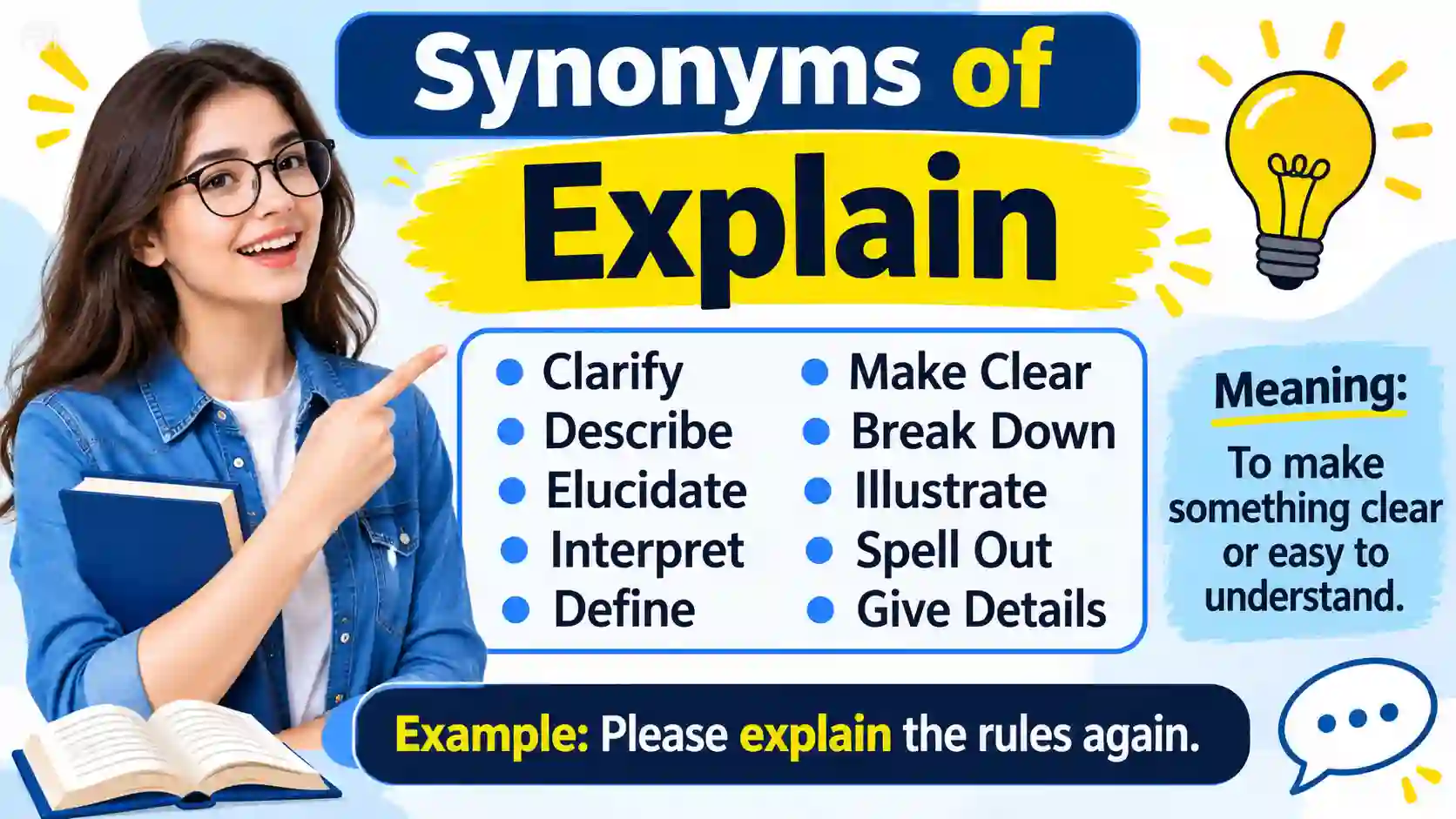
The best synonyms of explain include clarify, describe, illustrate, demonstrate, define, interpret, elaborate, elucidate, explicate, and spell out. These words help communicate information, make difficult ideas understandable, or give reasons for something. The right alternative depends on whether you want to provide details, remove confusion, show evidence, or defend a decision.
Have you ever noticed how often you use the word explain in your essays, emails, or daily conversations? It is a useful verb, but repeating it too often can make your writing sound less natural.
The word explain means to make something clear by giving information, examples, details, or reasons. For example, a teacher explains a difficult lesson, while a manager explains why a project needs more time.
Learning synonyms of explanation gives you more ways to share your thoughts. However, similar words do not always have identical meanings. Clarify removes confusion, illustrates uses examples, and justifies reasons to defend an action.
This guide explores 30 alternatives with meanings, original examples, pronunciation, grammar patterns, common collocations, and practical writing advice.
Pronunciation of Explain
- IPA: /ɪkˈspleɪn/
- Simple pronunciation: ik-SPLAYN
- Syllables: 2
- Word stress: Second syllable
- Part of speech: Verb
- American and British English: Same spelling and broadly similar pronunciation.
Meaning and Word Forms of Explain
Explain is a verb that describes making information understandable or giving reasons for something.
| Word | Part of speech | Example |
| Explain | Verb | Please explain the rules. |
| Explains | Verb | She explains the lesson. |
| Explained | Past-tense verb | He explained his decision. |
| Explaining | Present participle | I am explaining the process. |
| Explanation | Noun | His explanation was clear. |
| Explainable | Adjective | The error is explainable. |
| Explanatory | Adjective | Read the explanatory notes. |
| Unexplained | Adjective | The cause remains unexplained. |
There is no commonly used adverb formed directly from explain. Use phrases such as in an explanatory way when needed.
Grammar: How to Use Explain in a Sentence
The verb explain commonly follows these patterns:
| Sentence pattern | Example |
| Explain + something | Explain the answer. |
| Explain + something + to someone | Explain the rules to me. |
| Explain why | Explain why you left. |
| Explain how | Explain how this works. |
| Explain that | She explained that she was busy. |
| Explain + something + by + method | He explained the idea by using a diagram. |
Important grammar rules:
- Before the person receiving the explanation: “She explained the process to us.”
- Do not normally use “explain” with a direct object.
- Use explain why and explain how for questions about reasons and methods.
- Use explain when introducing a statement.
Word choice matters: The sentence “Explain me the answer” is incorrect in standard English. Write “Explain the answer to me.”
Word Origin and Etymology
The English word explain comes from Latin explanare, meaning to make a level, smooth out, or make clear. It entered English through Middle English explanen.
Its recorded English use dates to approximately 1375–1425, although historical dating can vary between dictionaries.
The original meaning connects to the modern idea of making something plain or understandable.
Collins English Dictionary+1
30 Synonyms of Explain With Examples and Explanations
The following alternatives are organized according to their actual meanings. CEFR levels are approximate study guidance, not official classifications for every word.
1. Clarify
Meaning: To make something clear or remove confusion.
- The teacher clarified the instructions before the test.
- Please clarify your final point in the report.
Best used when: Someone does not understand a statement or situation.
- Register: Neutral, academic, business
- CEFR: B2 (approximate)
- Frequency: Very common
- Collocations: Clarify a point, clarify expectations, clarify the situation.
- Nuance: Focuses on removing confusion.
- Avoid when: You need to give a complete description rather than clear up an existing misunderstanding.
2. Describe
Meaning: To tell someone what something is like.
- The witness described the car to the police.
- Can you describe the new learning system?
Best used when: You want to provide details about a person, place, object, or event.
- Register: Neutral, academic, spoken
- CEFR: A2
- Frequency: Very common
- Collocations: Describe an event, describe a process, describe a situation.
- Nuance: Focuses on details and characteristics.
- Avoid when: The question asks for a cause or reason rather than a description.
3. Illustrate
Meaning: To make an idea clearer by using examples or pictures.
- The teacher illustrated the concept with a simple diagram.
- These figures illustrate the company’s growth.
Best used when: Examples or visual information can help readers understand an idea.
- Register: Academic, business, neutral
- CEFR: B2
- Frequency: Common
- Collocations: Illustrate a point, illustrate an idea, illustrate a concept.
- Nuance: Supports an explanation with examples or evidence.
- Avoid when: You need to give a precise definition without examples.
4. Demonstrate
Meaning: To show how something works or how to do something.
- The instructor demonstrated how to operate the machine.
- The experiment demonstrates the effects of heat.
Best used when: You can explain something through practical action or evidence.
- Register: Academic, professional, neutral
- CEFR: B1
- Frequency: Very common
- Collocations: Demonstrate a method, demonstrate a skill, demonstrate how.
- Nuance: Emphasizes showing rather than only telling.
- Avoid when: You are giving a simple verbal explanation without a demonstration.
5. Define
Meaning: To state the exact meaning of a word, idea, or concept.
- The dictionary defines the word clearly.
- The team needs to define its main objectives.
Best used when: Someone needs a precise meaning or description of a term.
- Register: Academic, business, neutral
- CEFR: B1
- Frequency: Very common
- Collocations: Define a term, define a concept, define the limits.
- Nuance: Focuses on exact meaning.
- Avoid when: You need to describe a process or explain why something happened.
6. Interpret
Meaning: To explain the meaning of information, words, or events.
- The researcher interpreted the results carefully.
- Readers may interpret the poem differently.
Best used when: Information needs analysis or a particular meaning must be understood.
- Register: Academic, literary, professional
- CEFR: B2
- Frequency: Common
- Collocations: Interpret results, interpret a message, interpret a law.
- Nuance: Often involves judgment or specialist understanding.
- Avoid when: You are simply repeating an established fact.
7. Elaborate
Meaning: To give more information about something.
- Could you elaborate on your research findings?
- The manager elaborated on the new workplace policy.
Best used when: Someone wants additional details about an existing point.
- Register: Academic, business, neutral
- CEFR: B2
- Frequency: Common
- Collocations: Elaborate on an idea, elaborate on a point, elaborate on a proposal.
- Nuance: Adds depth rather than simply introducing a new subject.
- Avoid when: You need a brief answer.
8. Elucidate
Meaning: To make a difficult idea easier to understand.
- The professor elucidated the complex theory.
- The report elucidates the reasons behind the decision.
Best used when: You need to explain a complicated or unclear subject carefully.
- Register: Formal, academic
- CEFR: C1–C2 (approximate)
- Frequency: Uncommon
- Collocations: Elucidate a theory, elucidate a concept, elucidate a point.
- Nuance: Suggests bringing clarity to something obscure.
- Avoid when: A simpler word such as clarify sounds more natural.
9. Explicate
Meaning: To explain an idea or text through detailed analysis.
- The professor explained the poem’s central argument.
- The article explicates the principles behind the method.
Best used when: You analyze a complex text, theory, or concept.
- Register: Academic, formal
- CEFR: C2 (approximate)
- Frequency: Uncommon
- Collocations: Explicate a text, explicate a theory, explicate an argument.
- Nuance: Suggests careful and detailed analysis.
- Avoid when: You are writing for beginners or having an everyday conversation.
10. Expound
Meaning: To explain an idea in a detailed and organized way.
- The professor expounded his theory during the lecture.
- The author expounds the principles of good leadership.
Best used when: A speaker or writer presents a detailed explanation of a complex subject.
- Register: Formal, academic, literary
- CEFR: C1 (approximate)
- Frequency: Uncommon
- Collocations: Expound a theory, expound a principle, expound an argument.
- Nuance: Often suggests an extended, systematic explanation.
- Avoid when: You need a short and simple explanation.
11. Simplify
Meaning: To make something easier to understand or use.
- The teacher simplified the difficult lesson.
- We simplified the instructions for new employees.
Best used when: Information is too complicated for the intended audience.
- Register: Neutral, educational, business
- CEFR: B1
- Frequency: Very common
- Collocations: Simplify a process, simplify instructions, simplify an explanation.
- Nuance: Reduces complexity.
- Avoid when: Important technical details must remain complete and precise.
12. Spell Out
Meaning: To explain something clearly and in detail.
- The contract spells out the payment conditions.
- Please spell out what you expect from the team.
Best used when: You want to make requirements or expectations completely clear.
- Register: Informal, spoken, business
- CEFR: B2 (approximate)
- Frequency: Common
- Collocations: Spell out the rules, spell out the details, spell out the requirements.
- Nuance: Suggests leaving little room for misunderstanding.
- Avoid when: A formal academic expression such as specify is more suitable.
13. Detail
Meaning: To give specific information about something.
- The report details the causes of the delay.
- She detailed every step of the application process.
Best used when: You need to communicate specific facts or individual points.
- Register: Academic, business, neutral
- CEFR: B2
- Frequency: Common
- Collocations: Detail the findings, detail the process, detail the requirements.
- Nuance: Emphasizes individual facts and details.
- Avoid when: You only need to give a short definition.
14. Specify
Meaning: To state something clearly and exactly.
- Please specify the date of your appointment.
- The instructions specify the required file format.
Best used when: Exact details, conditions, or requirements matter.
- Register: Formal, technical, business
- CEFR: B2
- Frequency: Common
- Collocations: Specify a reason, specify requirements, specify the details.
- Nuance: Focuses on precision.
- Avoid when: The reader needs a full explanation rather than exact information.
15. Outline
Meaning: To give the main points without discussing every detail.
- The speaker outlined the project’s main goals.
- She outlined the steps needed to finish the task.
Best used when: You want to provide an overview before discussing details.
- Register: Academic, business, neutral
- CEFR: B2
- Frequency: Common
- Collocations: Outline a plan, outline the reasons, outline a procedure.
- Nuance: Gives a framework or summary.
- Avoid when: You need to explain every step in depth.
16. Account For
Meaning: To explain the reason for something or show why it happened.
- Poor planning accounts for much of the delay.
- Can you account for the missing money?
Best used when: You need to explain a cause, difference, result, or action.
- Register: Formal, academic, business
- CEFR: B2
- Frequency: Very common
- Collocations: Account for a change, account for a difference, account for an expense.
- Nuance: Focuses on reasons or responsibility.
- Avoid when: You simply want to describe how an object looks.
17. Justify
Meaning: To provide reasons or evidence that support an action or decision.
- The student justified her answer with evidence.
- The company must justify its decision.
Best used when: Someone needs to defend a choice or show that an action is reasonable.
- Register: Formal, academic, professional
- CEFR: B2
- Frequency: Common
- Collocations: Justify a decision, justify an action, justify an expense.
- Nuance: Goes beyond explanation by adding a defense.
- Avoid when: You only need to describe how something works.
18. Rationalize
Meaning: To create or present reasons that make an action seem reasonable.
- He tried to rationalize his careless behavior.
- The manager rationalized the decision to reduce expenses.
Best used when: Discussing how someone attempts to make a decision or action appear logical.
- Register: Academic, business, formal
- CEFR: C1
- Frequency: Common
- Collocations: Rationalize behavior, rationalize a decision, rationalize an expense.
- Nuance: Can suggest self-justification rather than an objective explanation.
- Avoid when: You need a neutral word for presenting verified facts.
19. Make Clear
Meaning: To express something so people can understand it.
- The teacher made the difference clear.
- Please make your expectations clear to everyone.
Best used when: You want to communicate an idea directly.
- Register: Neutral, academic, professional
- CEFR: A2–B1
- Frequency: Very common
- Collocations: Make a point clear, make the purpose clear, make expectations clear.
- Nuance: Directly emphasizes understanding.
- Avoid when: A more precise verb such as define or demonstrate is needed.
20. Clear Up
Meaning: To remove confusion or resolve a misunderstanding.
- The manager cleared up the misunderstanding.
- This meeting should clear up any questions about the new policy.
Best used when: Confusion or uncertainty already exists.
- Register: Spoken, informal, neutral
- CEFR: B1
- Frequency: Very common
- Collocations: Clear up confusion, clear up a misunderstanding, clear up doubts.
- Nuance: Emphasizes resolving uncertainty.
- Avoid when: You are introducing a completely new subject.
21. Break Down
Meaning: To divide complicated information into smaller parts.
- The tutor broke down the math problem into simple steps.
- Let me break down the main points of the report.
Best used when: A complicated process needs to become easier to follow.
- Register: Informal, educational, business
- CEFR: B1
- Frequency: Very common
- Collocations: Break down a problem, break down information, break down a process.
- Nuance: Makes complexity manageable.
- Avoid when: You need a highly formal alternative in an academic paper.
22. Show
Meaning: To help someone understand through an example, demonstration, or evidence.
- Let me show you how this application works.
- The chart shows why sales increased.
Best used when: You can communicate an idea directly or visually.
- Register: Spoken, everyday, neutral
- CEFR: A1
- Frequency: Very common
- Collocations: Show how, show the difference, show the reason.
- Nuance: Simple and direct, but less specific than explained.
- Avoid when: A detailed verbal account is required.
23. Paraphrase
Meaning: To express the same idea using different words.
- The student paraphrased the passage in simple English.
- Please paraphrase the instructions for younger readers.
Best used when: You want to restate information without changing its original meaning.
- Register: Academic, educational
- CEFR: C1 (approximate)
- Frequency: Common
- Collocations: Paraphrase a passage, paraphrase a statement, paraphrase an argument.
- Nuance: Changes the wording, not the central meaning.
- Avoid when: You need to add new evidence or explain the causes of something.
24. Teach
Meaning: To help someone learn through instruction.
- My brother taught me how to repair a bicycle.
- The trainer teaches new employees how to use the software.
Best used when: Explaining information is part of a learning process.
- Register: Educational, everyday, neutral
- CEFR: A1
- Frequency: Very common
- Collocations: Teach a lesson, teach a skill, teach someone how.
- Nuance: Focuses on helping someone learn over time.
- Avoid when: You only need to answer one simple question.
25. Translate
Meaning: To express information in another language or form.
- She translated the instructions into Urdu.
- The teacher translated technical language into everyday English.
Best used when: Information must be converted into another language or an understandable form.
- Register: Academic, professional, everyday
- CEFR: A2
- Frequency: Very common
- Collocations: Translate a sentence, translate a document, translate technical language.
- Nuance: In a figurative sense, it can make an unfamiliar idea accessible.
- Avoid when: You are explaining an idea without changing its language or form.
26. Decode
Meaning: To discover the meaning of something coded or difficult to understand.
- The analyst decoded the hidden message.
- This guide helps beginners decode technical language.
Best used when: Information is hidden, coded, or difficult to understand.
- Register: Technical, educational, informal
- CEFR: B2 (approximate)
- Frequency: Common
- Collocations: Decode a message, decode a signal, decode information.
- Nuance: Suggests uncovering meaning.
- Avoid when: The information is already clear and straightforward.
27. Decipher
Meaning: To work out the meaning of something difficult to read or understand.
- I struggled to decipher the handwritten note.
- The researcher deciphered the ancient inscription.
Best used when: You need to understand unclear writing, symbols, or complicated information.
- Register: Academic, literary, formal
- CEFR: C1
- Frequency: Common
- Collocations: Decipher handwriting, decipher a code, decipher a message.
- Nuance: Suggests effort in discovering meaning.
- Avoid when: Someone has already presented the information clearly.
28. Illuminate
Meaning: To help people understand something by providing useful insight.
- The research illuminates the causes of the problem.
- Her examples illuminated the central idea of the book.
Best used when: Evidence or insight helps readers understand a complex subject.
- Register: Academic, literary, formal
- CEFR: C1
- Frequency: Uncommon
- Collocations: Illuminate an issue, illuminate a concept, illuminate a problem.
- Nuance: Suggests bringing new understanding.
- Avoid when: You need a simple everyday instruction.
29. Unravel
Meaning: To solve or make sense of something complicated.
- The scientist unraveled the mystery behind the results.
- The documentary unravels the history of the ancient city.
Best used when: You discuss a mystery, complex problem, or difficult series of events.
- Register: Literary, academic, neutral
- CEFR: C1
- Frequency: Common
- Collocations: Unravel a mystery, unravel a problem, unravel a complex situation.
- Nuance: Suggests gradually discovering how something fits together.
- Avoid when: You need a simple definition or straightforward explanation.
30. Put Into Words
Meaning: To express a thought or feeling using language.
- She struggled to put her feelings into words.
- He put his concerns into words during the meeting.
Best used when: Someone wants to communicate a thought that is difficult to express.
- Register: Neutral, spoken, literary
- CEFR: B1
- Frequency: Common
- Collocations: Put feelings into words, put thoughts into words, put an idea into words.
- Nuance: Focuses on expressing thoughts rather than explaining technical information.
- Avoid when: You need to give detailed instructions or explain a process.
Synonym Categories: Which Words Are Closest to Explain?
Not all 30 alternatives are interchangeable. These groups help you select a word according to its actual meaning.
Strongest Direct Alternatives
These words are closest to the main meaning of making something understandable:
- Clarify
- Describe
- Illustrate
- Demonstrate
- Define
- Elucidate
- Explicate
- Expound
- Simplify
- Spell out
- Make clear
Context Specific Alternatives
These words work when the explanation has a particular purpose:
- Interpret
- Elaborate
- Detail
- Specify
- Outline
- Account for
- Paraphrase
- Break down
- Clear up
- Put into words
Related Alternatives
These words have a narrower meaning and cannot always replace explain:
- Justify
- Rationalize
- Show
- Teach
- Translate
- Decode
- Decipher
- Illuminate
- Unravel
Choose the Right Synonym: Side by Side Comparisons
The easiest way to learn synonyms is to understand what changes when you replace one word with another.
| Word | Main purpose | Example |
| Explain | Make something understandable | Explain the process. |
| Clarify | Remove confusion | Clarify the instructions. |
| Describe | Give details | Describe the process. |
| Illustrate | Give examples | Illustrate the concept. |
| Demonstrate | Show how something works | Demonstrate the method. |
| Define | Give an exact meaning | Define the term. |
| Elaborate | Add more information | Elaborate on the idea. |
| Justify | Defend with reasons | Justify the decision. |
| Interpret | Explain a meaning | Interpret the results. |
| Simplify | Reduce complexity | Simplify the process. |
Three Important Differences
Explain vs. Clarify
Explain gives information that helps someone understand a subject. Clarification makes an unclear statement or situation easier to understand.
Explain vs. Illustrate
Explain communicates information. Illustrate supports that information with examples, pictures, or evidence.
Explain vs. Justify
Explain tells someone how or why something happened. Justify gives reasons intended to show that an action or decision was reasonable.
CEFR Levels and Word Frequency
These approximate levels can help English learners plan their vocabulary practice.
| Level | Words to study |
| A1–A2 | Show, teach, describe, define, translate |
| B1 | Demonstrate, simplify, break down, make clear |
| B2 | Clarify, illustrate, interpret, elaborate, specify |
| C1 | Expound, rationalize, decipher, illuminate, unravel |
| C2 | Elucidate, explicate |
Frequency guide
- Very common: Explain, show, describe, teach, clarify, demonstrate.
- Common: Illustrate, define, interpret, elaborate, specify, paraphrase.
- Uncommon: Elucidate, explicate, expound, illuminate.
These labels are editorial guidance rather than measured frequency statistics. A word’s frequency can change considerably between everyday conversation, academic writing, and specialist subjects.
American vs. British English: Spelling and Usage
Most synonyms of explain have the same spelling and meaning in American and British English.
One useful spelling difference appears in the word rationalize.
| Word | American English | British English |
| Explain | Explain | Explain |
| Clarify | Clarify | Clarify |
| Demonstrate | Demonstrate | Demonstrate |
| Elucidate | Elucidate | Elucidate |
| Paraphrase | Paraphrase | Paraphrase |
| Rationalize | Rationalize | Rationalise |
Pronunciation note: Explain is pronounced /ɪkˈspleɪn/ in both varieties, with some variation in individual accents. Most of the other words also have broadly similar pronunciations, although regional vowel sounds can differ.
Usage note: British and American speakers use expressions such as spell out, clear up, and break down. Their meanings are generally shared, although individual contexts and preferences may vary.
Common Mistakes When Using Synonyms of Explain
Mistake 1: Confusing describe with clarify
Incorrect:
Please clarify the appearance of the new building.
Correct:
Please describe the appearance of the new building.
Reason: Describe provides details about appearance. Clarification removes confusion.
Mistake 2: Using justify instead of explain
Incorrect:
Can you justify how this machine works?
Correct:
Can you explain how this machine works?
Reason: Explain describes a process. Justify defends an action or decision.
Mistake 3: Forgetting the preposition after elaborate
Incorrect:
Please elaborate your answer.
Correct:
Please elaborate on your answer.
Reason: Elaborate on is the usual construction when introducing the subject.
Mistake 4: Using the wrong object order
Incorrect:
She explained the lesson.
Correct:
She explained the lesson to me.
Reason: Use it to explain something to someone.
Mistake 5: Using account for as a general synonym
Incorrect:
Please account for the instructions to beginners.
Correct:
Please explain the instructions to beginners.
Reason: Account for is suitable for explaining reasons, causes, differences, or responsibility, not for every kind of information.
Writing Tips: How to Use Explain Synonyms Naturally
Different writing situations require different vocabulary.
| Writing situation | Useful alternatives | Example |
| Essays | Interpret, illustrate, clarify | The findings illustrate the main argument. |
| Emails | Clarify, specify, outline | Please clarify the deadline. |
| Blog posts | Break down, simplify, describe | This guide breaks down the process. |
| Stories | Depict, unravel, describe | The story depicts village life. |
| Social media | Show, spell out, clear up | Let me spell out the difference. |
| Business reports | Demonstrate, account for, detail | The report accounts for the increase. |
| Daily conversations | Show, explain, clear up | Can you show me how it works? |
Writing Tip
Do not replace every occurrence of explanation with an advanced word. Use simple language when it communicates your meaning best. A correct, natural sentence is more valuable than an unnecessarily complicated one.
Related Vocabulary
Antonyms of Explain
Antonyms describe actions that make information unclear or difficult to understand.
| Antonym | Meaning |
| Confuse | Make someone uncertain. |
| Obscure | Make something difficult to understand. |
| Mislead | Give someone an incorrect idea. |
| Complicate | Make something more difficult. |
| Mystify | Make something puzzling. |
| Obfuscate | Deliberately make something unclear. |
| Conceal | Keep information hidden. |
| Misrepresent | Present something inaccurately. |
Related Expressions
These phrases can make your everyday English more natural:
- Shed light on: Provide useful information about something.
- Get the point across: Communicate an idea successfully.
- Put into words: Express a thought or feeling.
- Make sense of: Understand something confusing.
- Give an account of: Describe what happened.
- Walk someone through: Explain something step by step.
- Put in plain English: Express something in simple language.
- Clear the air: Resolve confusion or tension.
Word Family of Explain
| Word | Part of speech | Meaning |
| Explain | Verb | Make something understandable. |
| Explanation | Noun | Information that makes something clear. |
| Explanatory | Adjective | Intended to explain something. |
| Explainable | Adjective | Capable of being explained. |
| Explainer | Noun | A person or resource that explains. |
| Unexplained | Adjective | Not yet explained. |
Frequently Asked Questions About Synonyms of Explain
1. What are the 10 best synonyms to explain?
Ten useful alternatives are clarify, describe, illustrate, demonstrate, define, interpret, elaborate, simplify, elucidate, and explicate. They serve different purposes. Clarify removes confusion, illustrates, provides examples, and demonstrates how something works. Choose the word that best matches your intended meaning.
2. What is a professional word to explain?
Professional alternatives include clarify, elaborate, demonstrate, specify, outline, and elucidate. Use clarify when discussing unclear information, elaborate when adding details, and specify when giving exact requirements. In professional communication, explaining is also a perfectly acceptable and effective choice.
3. What is another word to explain in simple English?
Simple alternatives include show, describe, teach, tell, and make clear. These expressions work well in everyday conversations, schoolwork, and beginner-level writing. For example, instead of saying “Explain how this works,” you can say “Show me how this works.”
4. What is a formal synonym to explain?
Formal alternatives include elucidate, explicate, expound, interpret, and clarify. Academic writers often use explicate when analyzing a text and elucidate when making a complex idea clearer. However, these words should only be used when their meanings fit the sentence.
5. What is the difference between explain and clarify?
Explain means to make something understandable through information, details, or reasons. Clarify means to remove confusion or make an existing point clearer. A teacher explains an entire lesson but may clarify one difficult part when a student has a question.
6. What is the difference between explain and elaborate?
Explain introduces information or makes a subject understandable. Elaborate adds more details to an idea that someone has already mentioned. For example, a student explains an answer and then elaborates by providing extra facts, examples, and supporting information.
7. What is a good synonym to explain in an essay?
Useful alternatives include illustrate, demonstrate, interpret, clarify, and elaborate. Use illustrate when providing examples, demonstrate when presenting evidence, and interpret when discussing meaning. Avoid replacing every use of explanation with a complicated word simply to make an essay sound more academic.
8. What is the opposite of explaining?
Common antonyms include confuse, obscure, mislead, complicate, mystify, and obfuscate. These words describe making information difficult to understand or presenting it unclearly. Their meanings differ, so choose the opposite that best fits the sentence and situation.
Vocabulary Quiz: Test Your Knowledge
Test your understanding of these alternatives with five multiple-choice questions.
Synonym Knowledge Test
0/5 answered
1. Which word means to remove confusion?
A. Depict
B. Clarify
C. Justify
D. Translate
2. Which synonym means to show how something works?
A. Demonstrate
B. Rationalize
C. Paraphrase
D. Conceal
3. Which word means to provide additional details?
A. Decode
B. Elaborate
C. Define
D. Depict
4. Which word means to defend a decision with reasons?
A. Describe
B. Simplify
C. Justify
D. Illustrate
5. Which expression means to divide complicated information into smaller parts?
A. Clear up
B. Spell out
C. Break down
D. Account for
Check My Answers
Additional Practice Exercises
Exercise 1: Fill in the blanks
Choose from: clarify, demonstrate, elaborate, specify.
- Could you _______ your answer with another example?
- The trainer will _______ how to operate the machine.
- Please _______ what you meant in your email.
- The application asks you to _______ your preferred date.
Exercise 2: Rewrite the sentences
Replace explain with a suitable alternative.
- The teacher explained the concept using pictures.
- Please explain the exact requirements.
- The researcher explained the meaning of the results.
Exercise 3: Match the words with their meanings
| Word | Meaning |
| 1. Simplify | A. Give an exact meaning |
| 2. Define | B. Make something easier |
| 3. Justify | C. Defend something with reasons |
| 4. Paraphrase | D. Express using different words |
Practice Answer Key
- Exercise 1: 1. Elaborate, 2. Demonstrate, 3. Clarify, 4. Specify.
- Exercise 2: 1. Illustrated, 2. Specify, 3. Interpreted.
- Exercise 3: 1-B, 2-A, 3-C, 4-D.
Conclusion
Learning synonyms of explanation helps you become a better writer, speaker, and communicator. Words such as clarify, illustrate, demonstrate, and elaborate give you more ways to express your ideas.
Choose each word according to its meaning and context. Practice these alternatives in essays, emails, schoolwork, and everyday conversations. Keep learning, keep writing, and let your English vocabulary grow!
References and Sources
Use these trusted resources to verify definitions, pronunciation, word origins, and synonym differences.
- Cambridge Dictionary: Explain Synonyms
- Thesaurus.com: Explain Synonyms and Antonyms
- Collins English Thesaurus: Explain
- Collins English Dictionary: Explain Definition and Word Origin
- Cambridge Dictionary: Explain Definition

Synonorm is a trusted English vocabulary resource created to help readers find the right words and understand the differences between similar terms. We provide clear explanations of synonyms, meanings, examples, usage, and alternatives. Our content makes vocabulary easier to learn and apply in everyday, academic, and professional English. Synonorm is designed for students, writers, ESL learners, professionals, and anyone who wants to improve their English vocabulary and communicate more clearly.