Quick Answer: What Are Synonyms for Simultaneously?
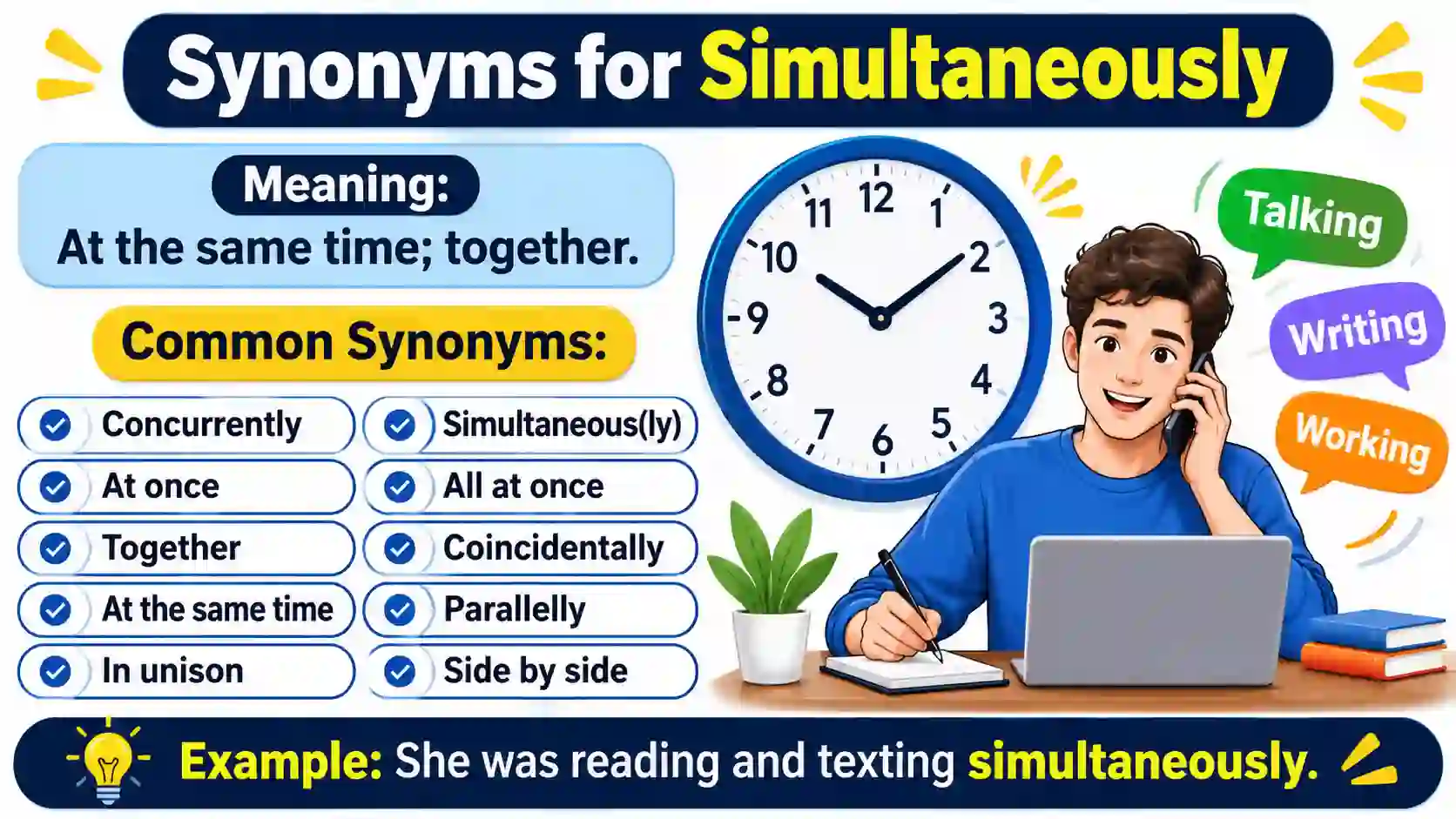
The best synonyms for simultaneously include at the same time, concurrently, at the same moment, together, and in parallel. These expressions describe events or activities that happen during an overlapping period. Some alternatives suggest exact timing, while others describe coordination, teamwork, or shared activity.
Do you often use the word simultaneously in essays, emails, or everyday conversations? Although it is a useful word, repeating it too often can make your writing sound dull.
Learning synonyms for simultaneously gives you more ways to describe actions that happen at the same time. For example, instead of writing, “The two computers started simultaneously,” you could say, “The two computers started at the same time.”
However, not every similar expression has the same meaning. Words such as concurrently and at the same moment describe overlapping or exact timing, while jointly focusing on shared effort.
This guide explores 30 alternatives with simple definitions, original examples, pronunciation guidance, grammatical notes, and practical usage tips. It will help you choose natural English for schoolwork, business communication, and daily conversations.
Pronunciation of Simultaneously
- IPA (American): /ˌsaɪ.məlˈteɪ.ni.əs.li/
- IPA (British): /ˌsɪm.əlˈteɪ.ni.əs.li/
- Easy pronunciation: sigh-muhl-TAY-nee-uhs-lee (US), sim-uhl-TAY-nee-uhs-lee (UK).
- Syllables: Usually counted as six.
- Word stress: TAY.
The spelling is the same in American and British English. The opening vowel sound differs.
Part of Speech
Simultaneously is an adverb. It describes when or how an action happens.
| Word | Part of speech | Meaning |
| Simultaneous | Adjective | Happening at the same time |
| Simultaneously | Adverb | Happening at the same time |
| Simultaneity | Noun | The state of happening at the same time |
| Simultaneousness | Noun | The quality of being simultaneous |
Examples:
- Both trains arrived simultaneously.
- The two events were simultaneous.
- The simultaneity of the signals surprised the engineers.
There is no commonly used standard English verb formed directly from simultaneously.
Word Origin and Etymology
The word simultaneously comes from simultaneous combined with the adverb-forming suffix -ly.
The adjective simultaneously entered English around the mid-17th century. Its origin is connected to Latin simul, meaning “at the same time” or “together.” Historical dictionaries trace the adjective to the 1650s.
The related noun simultaneity also dates to the 17th century. The historical date for the adjective should not automatically be treated as the first recorded date of the adverb.
Grammar: How to Use Simultaneously
You can use simultaneously in several sentence positions.
1. At the end of a sentence
The two phones rang simultaneously.
2. Before the main verb
Both companies simultaneously released their products.
3. After the subject
The students simultaneously raised their hands.
4. With while
She listened to a podcast while simultaneously preparing dinner.
5. With with
The announcement was made simultaneously with the product launch.
Important grammar tip: Use simultaneously when activities overlap in time. Use sequentially or one after another when activities follow an order.
Quick Synonym Comparison Table
| Synonym | Strength | Register |
| At the same time | Exact, natural equivalent | Neutral |
| Concurrently | Very close equivalent | Formal |
| At the same moment | Exact timing | Neutral |
| At the same instant | Exact timing | Formal |
| At once | Context-dependent | Neutral |
| All at once | Several things together | Informal |
| Together | Shared or simultaneous action | Neutral |
| In parallel | Overlapping processes | Business, technical |
| Synchronously | Coordinated timing | Technical |
| In unison | Coordinated group action | Neutral |
| In sync | Matching timing | Informal |
| Concurrently with | Overlapping events | Formal |
| During the same period | Shared time frame | Neutral |
| In tandem | Connected activities | Business |
| Contemporaneously | Same historical period | Academic |
| Coincident in time | Shared timing | Technical |
| At the same time as | Direct time relationship | Neutral |
| Side by side | Parallel activity | Neutral |
| Meanwhile | Another activity during that period | Neutral |
| In the meantime | During an intervening period | Neutral |
| Jointly | Shared responsibility | Business |
| Collectively | Group participation | Formal |
| In concert | Coordinated cooperation | Formal |
| As one | United group action | Literary |
| In coordination | Organized cooperation | Business |
| Concertedly | Coordinated effort | Formal |
| Conjointly | Together or jointly | Formal |
| In cooperation | Shared effort | Formal |
| As a group | Group action | Neutral |
| In chorus | Voices acting together | Literary |
The strength labels describe how closely an expression matches the meaning of simultaneously. They do not measure the emotional strength of a word.
30 Synonyms for Simultaneously With Examples and Explanations
The first group contains the most useful replacements. The remaining expressions are contextual alternatives. Check their meanings before using them in place of the original word.
1. At the Same Time
Meaning: Two or more actions happen during one shared period.
Examples:
- The children started laughing at the same time.
- I cannot study and watch a movie at the same time.
Best used when: You need a simple and natural replacement in almost any everyday situation.
Tone: Neutral.
Register: Spoken and general writing.
CEFR: A2 | Frequency: Very common.
Collocations: Happen at the same time, arrive at the same time, work at the same time.
When not to use: Avoid it if you need a highly technical description of synchronized timing.
2. Concurrently
Meaning: Two or more activities take place during overlapping periods.
Examples:
- The company manages four projects concurrently.
- Both training programs run concurrently this summer.
Best used when: Discussing projects, processes, research, or professional activities.
Tone: Formal.
Register: Academic and business.
CEFR: C1 | Frequency: Common.
Collocations: Operate concurrently, work concurrently, run concurrently.
When not to use: Avoid it in simple conversations when at the same time sounds more natural.
3. At the Same Moment
Meaning: Two or more events occur at one particular point in time.
Examples:
- Both players kicked the ball at the same moment.
- The lights went out at the same moment.
Best used when: You want to emphasize that events happened at nearly or exactly the same point.
Tone: Neutral.
Register: General and spoken English.
CEFR: B1 | Frequency: Common.
Collocations: Arrive at the same moment, react at the same moment, happen at the same moment.
When not to use: Avoid it when you are describing activities that overlap for several hours rather than a particular instant.
4. At the Same Instant
Meaning: Events happen at precisely the same point in time.
Examples:
- Both sensors detected movement at the same instant.
- The two cameras recorded the flash at the same instant.
Best used when: Exact timing is important.
Tone: Formal.
Register: Technical and academic.
CEFR: B2 | Frequency: Uncommon.
Collocations: Occur at the same instant, arrive at the same instant, detect at the same instant.
When not to use: Avoid it for general activities that simply overlap.
5. At Once
Meaning: Several things happen together, or something happens immediately.
Examples:
- All the students answered at once.
- The warning lights turned on at once.
Best used when: Several people react or several events occur together.
Tone: Neutral.
Register: Spoken and general writing.
CEFR: A2 | Frequency: Very common.
Collocations: Speak at once, respond at once, happen at once.
When not to use: Do not use it if the reader might confuse its meaning with “immediately.”
6. All at Once
Meaning: Many things happen together, often suddenly.
Examples:
- Five customers entered the store all at once.
- Several questions came to my mind all at once.
Best used when: You want to emphasize a sudden group of events.
Tone: Informal.
Register: Spoken English and storytelling.
CEFR: A2 | Frequency: Very common.
Collocations: Arrive all at once, happen all at once, appear all at once.
When not to use: Avoid it when describing slow and steady overlapping processes.
7. Together
Meaning: People or things act as a group or at the same time.
Examples:
- The two bells rang together.
- The children sang together during the school event.
Best used when: People or objects share an action or timing.
Tone: Neutral.
Register: Everyday and spoken English.
CEFR: A1 | Frequency: Very common.
Collocations: Work together, sing together, arrive together.
When not to use: Avoid it when the only connection is timing and there is no cooperation.
8. In Parallel
Meaning: Separate activities happen or develop during overlapping periods.
Examples:
- The developers tested both systems in parallel.
- Our research and marketing teams worked in parallel.
Best used when: Describing independent processes that progress during the same period.
Tone: Formal.
Register: Business, academic, and technical.
CEFR: C1 | Frequency: Common.
Collocations: Work in parallel, develop in parallel, run in parallel.
When not to use: Avoid it when you need to emphasize that two events began at exactly the same instant.
9. Synchronously
Meaning: Actions happen at the same time with coordinated timing.
Examples:
- The two clocks operated synchronously.
- The dancers moved synchronously across the stage.
Best used when: Coordination or matching timing matters.
Tone: Formal.
Register: Technical and academic.
CEFR: C1 | Frequency: Uncommon.
Collocations: Operate synchronously, communicate synchronously, move synchronously.
When not to use: Avoid it for unrelated activities that merely overlap.
10. In Unison
Meaning: Several people act, speak, or move together at the same time.
Examples:
- The audience shouted in unison.
- The team raised its hands in unison.
Best used when: Describing coordinated group movements or responses.
Tone: Neutral to literary.
Register: Spoken and literary.
CEFR: B2 | Frequency: Common.
Collocations: Speak in unison, move in unison, respond in unison.
When not to use: Avoid it when describing independent activities with no coordination.
11. In Sync
Meaning: People or things act with matching timing or rhythm.
Examples:
- The dancers stayed in sync throughout the show.
- The two devices are finally in sync.
Best used when: Describing matching timing, rhythm, or coordination.
Tone: Informal.
Register: Spoken English.
CEFR: B1 | Frequency: Common.
Collocations: Stay in sync, keep in sync, move in sync.
When not to use: Avoid it in formal writing when synchronously is more appropriate.
12. Concurrently With
Meaning: Something happens during the same period as another activity.
Examples:
- The investigation continued concurrently with the review.
- The training started concurrently with the new project.
Best used when: Connecting two overlapping processes.
Tone: Formal.
Register: Academic and business.
CEFR: C1 | Frequency: Common.
Collocations: Begin concurrently with, proceed concurrently with, operate concurrently with.
When not to use: Avoid it when the simple word gives a clearer sentence.
13. During the Same Period
Meaning: Two or more activities happen within an overlapping time frame.
Examples:
- Both students attended college during the same period.
- The two companies expanded during the same period.
Best used when: Describing events that share a longer time frame.
Tone: Neutral.
Register: General and academic.
CEFR: B1 | Frequency: Common.
Collocations: Work during the same period, operate during the same period, study during the same period.
When not to use: Avoid it when exact timing is important.
14. In Tandem
Meaning: Two or more things work together in a connected or coordinated way.
Examples:
- The marketing and sales teams worked in tandem.
- Good planning and communication work in tandem.
Best used when: Describing activities that support each other.
Tone: Neutral to formal.
Register: Business and general writing.
CEFR: C1 | Frequency: Common.
Collocations: Work in tandem, operate in tandem, develop in tandem.
When not to use: Avoid it when two unrelated events simply happen at the same time.
15. Contemporaneously
Meaning: Something happens or exists during the same historical or general period as something else.
Examples:
- The two historical documents were written contemporaneously.
- Several important discoveries emerged contemporaneously.
Best used when: Discussing historical records, research, or developments.
Tone: Very formal.
Register: Academic and historical writing.
CEFR: C2 | Frequency: Uncommon.
Collocations: Exist contemporaneously, occur contemporaneously, written contemporaneously.
When not to use: Avoid it in everyday conversations because it may sound unnecessarily complex.
16. Coincident in Time
Meaning: Two events happen during the same period or at the same point in time.
Examples:
- The two changes were coincident in time.
- The events were coincident in time but had different causes.
Best used when: Comparing the timing of events in research or formal analysis.
Tone: Formal.
Register: Technical and academic.
CEFR: C2 | Frequency: Rare.
Collocations: Changes coincident in time, events coincident in time, periods coincident in time.
When not to use: Avoid it in ordinary conversations.
17. At the Same Time As
Meaning: One event happens during the time of another event.
Examples:
- The new store opened at the same time as the shopping center.
- The alarm sounded at the same time as the warning signal.
Best used when: Connecting two events in a sentence.
Tone: Neutral.
Register: General English.
CEFR: A2 | Frequency: Very common.
Collocations: Happen at the same time as, begin at the same time as, arrive at the same time as.
When not to use: Avoid it when the events have no shared time relationship.
18. Side by Side
Meaning: Two people or things work, stand, or exist alongside each other.
Examples:
- The two teams worked side by side.
- Traditional and modern methods developed side by side.
Best used when: Highlighting parallel activity or close cooperation.
Tone: Neutral.
Register: General and descriptive writing.
CEFR: A2 | Frequency: Very common.
Collocations: Work side by side, stand side by side, live side by side.
When not to use: Avoid it when precise timing is the main point.
19. Meanwhile
Meaning: Another activity happens during the period in which something else is taking place.
Examples:
- I prepared the meal. Meanwhile, my brother cleaned the kitchen.
- The manager answered calls. Meanwhile, the staff prepared the documents.
Best used when: Connecting two activities that happen during overlapping periods.
Tone: Neutral.
Register: Spoken and written English.
CEFR: B1 | Frequency: Very common.
Collocations: Meanwhile, elsewhere; meanwhile, at home; meanwhile, back at the office.
When not to use: Avoid it when exact simultaneous timing is essential.
20. In the Meantime
Meaning: During the period before something else happens or while waiting for it.
Examples:
- The repair will take an hour. In the meantime, you can wait outside.
- The manager is away. In the meantime, her assistant will answer questions.
Best used when: Describing an intervening period.
Tone: Neutral.
Register: Spoken and written English.
CEFR: B1 | Frequency: Very common.
Collocations: In the meantime, wait; in the meantime, continue; in the meantime, prepare.
When not to use: Avoid it when two actions must happen at precisely the same moment.
21. Jointly
Meaning: Two or more people do something together or share responsibility for it.
Examples:
- The companies jointly developed a new product.
- Both teachers jointly prepared the lesson.
Best used when: Emphasizing shared responsibility or cooperation.
Tone: Formal.
Register: Business and academic writing.
CEFR: B2 | Frequency: Common.
Collocations: Jointly manage, jointly produce, jointly announce.
When not to use: Avoid it when you only mean that independent events happened at the same time.
22. Collectively
Meaning: Several people or things are considered or act as a group.
Examples:
- The employees collectively completed the project.
- The organizations collectively supported the campaign.
Best used when: Emphasizing group effort or shared results.
Tone: Formal.
Register: Academic and business.
CEFR: B2 | Frequency: Common.
Collocations: Act collectively, decide collectively, work collectively.
When not to use: Avoid it when exact timing is more important than group participation.
23. In Concert
Meaning: People or groups act together toward a shared goal.
Examples:
- Several organizations worked in concert to support local families.
- The departments acted in concert during the emergency.
Best used when: Describing coordinated cooperation.
Tone: Formal.
Register: Literary, business, and formal writing.
CEFR: C1 | Frequency: Common.
Collocations: Act in concert, work in concert, move in concert.
When not to use: Avoid it when the activities have no shared purpose.
24. As One
Meaning: A group acts together as if it were a single unit.
Examples:
- The crowd cheered as one.
- The players moved as one toward the goal.
Best used when: Describing a united group response.
Tone: Literary.
Register: Storytelling and descriptive writing.
CEFR: B2 | Frequency: Common.
Collocations: Move as one, respond as one, rise as one.
When not to use: Avoid it for separate and unrelated activities.
25. In Coordination
Meaning: Activities are organized to work together.
Examples:
- The teams worked in coordination during the event.
- The department acted in coordination with local officials.
Best used when: Describing planned teamwork and organized activity.
Tone: Formal.
Register: Business and technical writing.
CEFR: B2 | Frequency: Common.
Collocations: Work in coordination, act in coordination, operate in coordination.
When not to use: Avoid it if the activities are independent and have no planned connection.
26. Concertedly
Meaning: People make a coordinated or united effort toward a shared purpose.
Examples:
- The organizations worked concertedly to improve local services.
- The team acted concertedly to solve the problem.
Best used when: Highlighting deliberate group effort.
Tone: Formal.
Register: Academic and business.
CEFR: C2 | Frequency: Uncommon.
Collocations: Work concertedly, act concertedly, respond concertedly.
When not to use: Avoid it when you only want to describe shared timing.
27. Conjointly
Meaning: Two or more people or things act jointly or in combination.
Examples:
- The researchers examined the two factors conjointly.
- The partners conjointly managed the project.
Best used when: Describing combined work or shared consideration.
Tone: Formal.
Register: Academic and technical.
CEFR: C2 | Frequency: Rare.
Collocations: Work conjointly, consider conjointly, act conjointly.
When not to use: Avoid it in everyday writing when together or jointly sounds clearer.
28. In Cooperation
Meaning: People or groups work together to achieve something.
Examples:
- The school organized the event in cooperation with local businesses.
- The two departments completed the project in cooperation.
Best used when: Describing shared effort and assistance.
Tone: Neutral to formal.
Register: Business and general writing.
CEFR: B1 | Frequency: Common.
Collocations: Work in cooperation, act in cooperation, operate in cooperation.
When not to use: Avoid it when the only connection between events is their timing.
29. As a Group
Meaning: Several people act or do something together as one group.
Examples:
- The students entered the hall as a group.
- The employees discussed the changes as a group.
Best used when: Emphasizing group participation rather than exact timing.
Tone: Neutral.
Register: Spoken and general writing.
CEFR: A2 | Frequency: Very common.
Collocations: Work as a group, act as a group, decide as a group.
When not to use: Avoid it when the people or events are not acting as a group.
30. In Chorus
Meaning: Several people speak, sing, or shout together at the same time.
Examples:
- The children shouted the answer in chorus.
- The audience sang in chorus during the final song.
Best used when: Describing several voices expressing something together.
Tone: Literary.
Register: Storytelling and descriptive writing.
CEFR: B2 | Frequency: Uncommon.
Collocations: Speak in chorus, sing in chorus, shout in chorus.
When not to use: Avoid it for unrelated actions that do not involve voices or group expression.
Strongest, Strong, and Related Synonyms
For accurate writing, divide the alternatives into three groups.
Strongest Synonyms
These are the closest and most practical replacements:
- At the same time
- Concurrently
- At the same moment
- At the same instant
- At the same time as
- During the same period
Strong Synonyms
These work well when the context involves matching timing or coordinated action:
- At once
- All at once
- Synchronously
- In unison
- In sync
- In parallel
- Concurrently with
- Contemporaneously
- In tandem
- Coincident in time
Related Words and Expressions
These describe group activity, cooperation, or overlapping periods rather than exact timing:
- Together
- Side by side
- Meanwhile
- In the meantime
- Jointly
- Collectively
- In concert
- As one
- In coordination
- Concertedly
- Conjointly
- In cooperation
- As a group
- In chorus
Commonly Confused Words
| Word | Difference | Example |
| Simultaneously | Events happen at the same time. | Both alarms rang simultaneously. |
| Subsequently | Something happens afterward. | She graduated and subsequently found work. |
| Consecutively | Events happen one after another without interruption. | He won three consecutive games. |
| Sequentially | Events follow a particular order. | Complete the steps sequentially. |
| Periodically | Something happens at regular intervals. | The system checks the files periodically. |
Remember: Simultaneously means the same time. Subsequently means afterward. Consecutively means one after another.
American vs. British English
The word has the same spelling and meaning in both varieties. Its opening vowel sound differs.
| Feature | American English | British English |
| Spelling | Simultaneously | Simultaneously |
| IPA | /ˌsaɪ.məlˈteɪ.ni.əs.li/ | /ˌsɪm.əlˈteɪ.ni.əs.li/ |
| Opening sound | Often “sigh” | Often “sim” |
| Common alternative | At the same time | At the same time |
| Formal alternative | Concurrently | Concurrently |
There is no major difference in spelling or everyday usage.
CEFR Levels for Vocabulary Learners
The following levels are approximate study guidance, not official CEFR classifications for every expression.
| Learning level | Suggested vocabulary |
| A1–A2 | Together, at once, at the same time |
| B1 | Meanwhile, in the meantime, side by side |
| B2 | In unison, jointly, collectively, as one |
| C1 | Concurrently, in parallel, synchronously, in tandem |
| C2 | Contemporaneously, conjointly, concertedly |
Cambridge classifies simultaneously as B2 vocabulary.
Common Mistakes When Using Simultaneously
Mistake 1: Confusing simultaneously with subsequently
- Mistake: She finished her homework and subsequently watched television simultaneously.
- Correction: She finished her homework and subsequently watched television.
- Explanation: Subsequently means afterward.
Mistake 2: Using together for independent activities
- Mistake: The two independent machines worked together.
- Correction: The two machines operated simultaneously.
- Explanation: Together may suggest cooperation, while simultaneously describing timing.
Mistake 3: Confusing at once with immediately
- Mistake: The two speakers answered at once, meaning they answered immediately.
- Correction: The two speakers answered simultaneously.
- Explanation: At once has two meanings. Context determines which one is intended.
Mistake 4: Using simultaneous instead of simultaneously
- Mistake: The machines operated simultaneously.
- Correction: The machines operated simultaneously.
- Explanation: Simultaneous is an adjective. Simultaneously is an adverb.
Mistake 5: Using meanwhile to describe exact timing
- Mistake: Both doors opened meanwhile.
- Correction: Both doors opened at the same moment.
- Explanation: Meanwhile connects activities during an overlapping period but does not guarantee exact timing.
Writing Tips: How to Use Synonyms Naturally
Different writing situations require different vocabulary.
| Writing type | Suitable alternatives | Example |
| Essays | Concurrently, during the same period | Both factors operated concurrently. |
| Emails | At the same time, together | We can review both documents at the same time. |
| Blog posts | Meanwhile, at once | Meanwhile, the second team prepared its report. |
| Stories | In unison, as one | Everyone turned toward the door in unison. |
| Social media | All at once, at the same time | Three exciting things happened all at once! |
| Business writing | Concurrently, in parallel | Both departments worked in parallel. |
| Conversations | Together, at the same time | Can we do both tasks at the same time? |
Writing tip: Do not replace every occurrence simultaneously with a complicated word. Clear and natural English is more important than using advanced vocabulary.
Related Vocabulary
Antonyms of Simultaneously
| Antonym | Meaning | Example |
| Separately | Not together | They completed the tasks separately. |
| Individually | One person or thing at a time | Each student answered individually. |
| Independently | Without depending on another | Both teams worked independently. |
| Sequentially | In a particular order | The files were processed sequentially. |
| One by one | Separately and in order | The guests entered one by one. |
| Asynchronously | Without synchronized timing | The team communicated asynchronously. |
Related Expressions
- One after another: Events happen in sequence.
- At different times: Events do not happen together.
- In the interim: During the period between two events.
- At the same instant: At precisely one point in time.
- All together: As a group.
- In the same breath: Within the same statement or moment.
Word Family
| Word | Part of speech | Meaning |
| Simultaneous | Adjective | Happening at the same time |
| Simultaneously | Adverb | At the same time |
| Simultaneity | Noun | The state of happening at the same time |
| Simultaneousness | Noun | The quality of being simultaneous |
| Synchronous | Adjective | Happening with coordinated timing |
| Asynchronous | Adjective | Not happening with synchronized timing |
Frequently Asked Questions
1. What are the best synonyms for simultaneously?
The best synonyms are at the same time, concurrently, at the same moment, at once, and in parallel. Use at the same time in everyday English. Choose concurrently for formal writing and in parallel for separate activities that progress during the same period.
2. What is a more formal word for simultaneously?
Concurrently is one of the most useful formal alternatives. It describes activities that happen during overlapping periods. For example, “The two departments operated concurrently” is suitable for business reports, research papers, and professional communication.
3. What is another way to say at the same time?
You can use it simultaneously, concurrently, at the same moment, or at once. The best choice depends on the situation. Use at the same moment for a specific point in time and concurrently for activities that overlap.
4. Is concurrently the same as simultaneously?
The words have very similar meanings, but their emphasis can differ. Simultaneously often highlights actions happening at the same time, while concurrently commonly describes activities that continue during overlapping periods. Both are suitable for formal writing.
5. What is the opposite of simultaneously?
Common opposites include separately, individually, one by one, and asynchronously. The best choice depends on context. For example, “The students answered individually” means they did not answer together, while “The files were processed sequentially” means they followed an order.
6. Can I use it simultaneously in academic writing?
Yes. Simultaneously is suitable for research papers, essays, academic reports, and technical explanations. It helps describe events, processes, and changes that occur at the same time. However, use alternatives when they express the intended meaning more clearly.
7. What is the difference between simultaneously and synchronously?
Simultaneously means happening at the same time. Synchronously usually adds the idea of coordinated timing. Two independent alarms can ring simultaneously, while synchronized clocks operate synchronously because their timing follows a shared reference.
8. What is a simple word for simultaneously?
Together and at the same time are simple alternatives. They work well in daily conversations and basic writing. However, together can suggest cooperation, so at the same time is often the clearer option when timing is the main point.
Vocabulary Quiz
Test what you have learned with these five questions.
1. Which word is the simplest replacement for simultaneously?
A. Subsequently
B. At the same time
C. Separately
D. Periodically
2. Which word describes activities that overlap during the same period?
A. Concurrently
B. Individually
C. Sequentially
D. Independently
3. Which expression describes coordinated group movement?
A. Meanwhile
B. Subsequently
C. In unison
D. One by one
4. Which word means that something happens afterward?
A. Synchronously
B. Concurrently
C. Together
D. Subsequently
5. Which word is most suitable for describing activities that happen with coordinated timing?
A. Synchronously
B. Separately
C. Periodically
D. Individually
Answer Key
- B. At the same time
- A. Concurrently
- C. In unison
- D. Subsequently
- A. Synchronously
Conclusion
Learning synonyms simultaneously helps you describe time, actions, and shared activities more clearly. Expressions such as at the same time, concurrently, and in parallel give you useful options for different situations.
Understanding their small differences is just as important as learning their meanings. Practice these alternatives in your emails, essays, schoolwork, and daily conversations. With regular practice, you can build stronger vocabulary and communicate more naturally.
References
- Cambridge Dictionary: Simultaneously
- Cambridge Thesaurus: Synonyms of Simultaneously
- Oxford Learner’s Dictionaries: Simultaneously
- Collins English Thesaurus: Simultaneously
- Etymonline: Origin of Simultaneous

Synonorm is a trusted English vocabulary resource created to help readers find the right words and understand the differences between similar terms. We provide clear explanations of synonyms, meanings, examples, usage, and alternatives. Our content makes vocabulary easier to learn and apply in everyday, academic, and professional English. Synonorm is designed for students, writers, ESL learners, professionals, and anyone who wants to improve their English vocabulary and communicate more clearly.