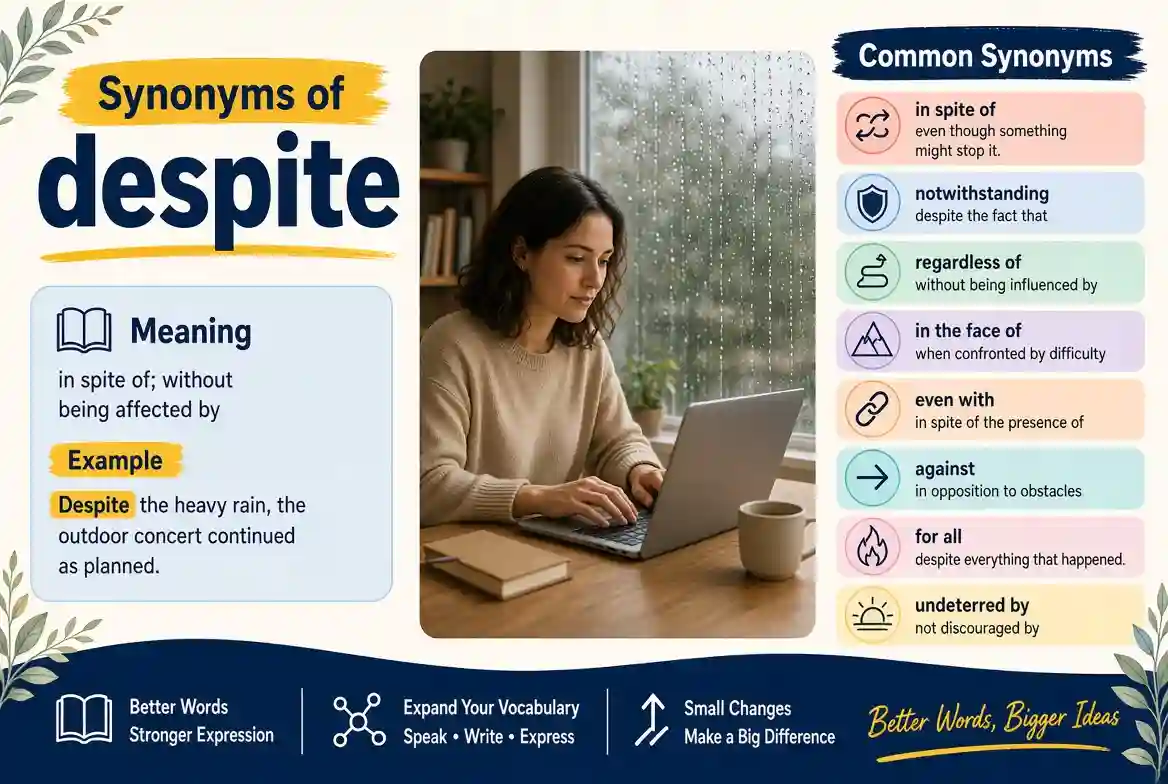
Quick Answer: What Are the Synonyms of Despite?
The closest synonyms of despite are in spite of, notwithstanding, regardless of, and even with. Other expressions, such as although, even though, and though, communicate a similar contrast but require different grammar. These alternatives help you express unexpected results, difficulties, and situations that do not stop an action.
Have you ever wanted to replace the word despite in an essay, email, or conversation? Using the same word repeatedly can make your writing sound less varied. However, choosing the wrong replacement can also change your meaning.
Despite means that something happens even though another fact or difficulty might have prevented it. For example, “Despite the heavy rain, the children played outside.” The rain did not stop them from playing.
There are several synonyms of despite, but each has its own purpose. Some work directly before nouns, while others need a complete sentence. Some fit formal writing, while others sound more natural in everyday speech.
This guide explains 30 useful alternatives with meanings, original examples, grammar patterns, pronunciation, word origins, and practical writing tips. You will also learn which expressions are closest in meaning and which ones only express a related idea.
Pronunciation of Despite
- IPA: /dɪˈspaɪt/
- Pronunciation: dih-SPYTE
- Syllables: 2
- Word stress: Second syllable
- American English: /dɪˈspaɪt/
- British English: /dɪˈspaɪt/
The spelling and standard pronunciation are the same in American and British English.
Part of Speech and Meaning
In modern everyday English, despite is mainly a preposition.
It introduces a fact or condition that does not prevent something else from happening.
Examples:
- Despite the cost, we bought the tickets.
- She continued working despite feeling tired.
Historically, despite also appeared as a noun meaning contempt or scorn. That meaning is now uncommon.
It does not normally function as a modern everyday verb, adjective, or adverb.
Grammar Rules: How to Use Despite
There are four useful sentence patterns.
1. Despite + noun or noun phrase
Despite the noise, the baby slept.
2. Despite + pronoun
Despite this, the workers continued.
3. Despite + verb-ing
Despite working late, she finished the report.
4. Despite the fact that + subject + verb
Despite the fact that it was raining, we went outside.
Remember this rule
- Despite the problem, we continued.
- In spite of the problem, we continued.
- Although there was a problem, we continued.
Do not write “despite of” or put an ordinary complete clause directly after despite.
Synonyms of Despite: Quick Comparison Table
| Synonym | Meaning / Use | Register |
| In spite of | Direct replacement | Neutral |
| Notwithstanding | Despite a fact | Formal |
| Regardless of | Independent of a condition | Neutral |
| Even with | Despite having something | Neutral |
| In the face of | Facing a challenge | Formal |
| In defiance of | Deliberately opposing | Formal |
| Against | In opposition to or despite | Contextual |
| In the teeth of | Facing strong opposition | Literary |
| Although | Introduces a contrast clause | Neutral |
| Even though | Stronger contrast | Neutral |
| Though | Shorter contrast expression | Conversational |
| While | Introduces contrast | Neutral |
| Much as | Concession involving feelings | Literary |
| Albeit | Introduces a qualification | Formal |
| For all | Despite a quality or fact | Literary |
| Nevertheless | Connects contrasting statements | Formal |
| Nonetheless | Connects contrasting statements | Formal |
| Even so | Despite that fact | Neutral |
| However | Introduces a contrasting statement | Neutral |
| Still | Shows continuation | Conversational |
| Yet | Shows unexpected contrast | Neutral |
| All the same | Despite the situation | Informal |
| Despite this | Refers to a previous fact | Neutral |
| In spite of this | Refers to a previous fact | Neutral |
| Undeterred by | Not discouraged by | Formal |
| Against the odds | Despite low chances | Neutral |
| Come what may | Whatever happens | Literary |
| No matter what | Regardless of circumstances | Neutral |
| In spite of everything | Despite all difficulties | Neutral |
| For all that | Despite what has happened | Literary |
These are 30 useful alternatives and related expressions, not 30 interchangeable prepositions.
30 Synonyms of Despite With Examples and Explanations
Closest Direct Replacements
These expressions are the most useful when you want to preserve the main meaning of despite.
1. In Spite Of
Meaning: Something happens even when another situation makes it difficult.
Examples:
- In spite of the cold weather, the workers completed their outdoor project.
- She passed the examination in spite of her limited preparation.
- Tone: Neutral
- Register: Spoken, academic, general
- Frequency: Very common
- CEFR guidance: B1
- Collocations: In spite of difficulties, in spite of everything, in spite of the weather.
Nuance: This is the closest everyday replacement for despite.
When not to use: Do not leave out. The correct phrase is in spite of, not in spite of the problem.
2. Notwithstanding
Meaning: Despite a particular fact or situation.
Examples:
- Notwithstanding the delay, the company delivered the order.
- The school remained open, notwithstanding the severe weather.
- Tone: Formal
- Register: Legal, academic, official
- Frequency: Uncommon
- CEFR guidance: C1–C2
- Collocations: Notwithstanding the evidence, notwithstanding objections, notwithstanding the circumstances.
Nuance: It sounds more official and formal than despite.
When not to use: Avoid it in casual conversations when a simpler phrase works.
3. Regardless Of
Meaning: Without allowing a condition to influence something.
Examples:
- The competition welcomes participants regardless of their experience.
- Everyone deserves respect regardless of their background.
- Tone: Neutral
- Register: Business, professional, academic
- Frequency: Very common
- CEFR guidance: B2
- Collocations: Regardless of age, regardless of cost, regardless of circumstances.
Nuance: It emphasizes independence from a condition rather than an unexpected result.
When not to use: Do not assume it always expresses the same contrast as despite.
4. Even With
Meaning: Something happens despite having a particular problem or disadvantage.
Examples:
- Even with limited resources, the students created an impressive project.
- He completed the journey even with an injured ankle.
- Tone: Neutral
- Register: Spoken, professional
- Frequency: Common
- CEFR guidance: B1–B2
- Collocations: Even with limited time, even with support, even with experience.
Nuance: It highlights a condition that might normally make an action difficult.
When not to use: It may not work when you need to refer to a complete contrasting clause.
5. In The Face Of
Meaning: Continuing despite a serious problem, threat, or challenge.
Examples:
- The residents remained hopeful in the face of adversity.
- The business continued operating in the face of strong competition.
- Tone: Formal
- Register: Journalism, business, storytelling
- Frequency: Common
- CEFR guidance: B2–C1
- Collocations: In the face of danger, adversity, criticism.
Nuance: This expression often suggests courage or determination.
When not to use: Avoid it for small everyday inconveniences.
6. In Defiance Of
Meaning: Doing something despite a rule, warning, authority, or opposition.
Examples:
- The protesters continued their march in defiance of the restrictions.
- He opened the business in defiance of strong opposition.
- Tone: Formal
- Register: Legal, political, journalism
- Frequency: Uncommon
- CEFR guidance: C1
- Collocations: In defiance of authority, in defiance of orders, in defiance of expectations.
Nuance: Unlike ordinary spite, this expression often suggests deliberate resistance.
When not to use: Do not use it for an obstacle that someone is simply experiencing.
7. Against
Meaning: In opposition to something or despite an opposing condition.
Examples:
- Against all expectations, the youngest player won the tournament.
- The team succeeded against considerable pressure.
- Tone: Neutral
- Register: Spoken, journalism, storytelling
- Frequency: Very common
- CEFR guidance: B1
- Collocations: Against expectations, against the odds, against strong opposition.
Nuance: The exact meaning depends on the expression that follows it.
When not to use: Do not replace every occurrence of despite with against. It can also mean opposition, direction, or contact.
8. In The Teeth Of
Meaning: Facing strong opposition, difficulty, or danger.
Examples:
- The rescue team continued in the teeth of the storm.
- The project moved forward in the teeth of fierce criticism.
- Tone: Literary
- Register: Journalism, storytelling
- Frequency: Rare
- CEFR guidance: C1–C2
- Collocations: In the teeth of opposition, a storm, criticism.
Nuance: This is a vivid expression for serious resistance.
When not to use: Avoid it in simple everyday writing.
Clause Based Alternatives
These expressions have a similar meaning but need different sentence structures.
9. Although
Meaning: Even though something is true, another thing happens.
Examples:
- Although the road was narrow, the driver passed safely.
- Although she had little experience, she performed confidently.
- Tone: Neutral
- Register: Academic, spoken, professional
- Frequency: Very common
- CEFR guidance: B1
- Collocations: Although difficult, although necessary, although important.
Nuance: A standard, flexible way to introduce a contrasting clause.
When not to use: Do not place a bare noun directly after although.
10. Even Though
Meaning: Although something is true, the opposite or unexpected result happens.
Examples:
- Even though the shop was closing, the manager helped us.
- He attended the interview even though he felt nervous.
- Tone: Neutral
- Register: Spoken, general writing
- Frequency: Very common
- CEFR guidance: B1
- Collocations: Even though it happened, even though I tried, even though they knew.
Nuance: It often gives stronger emphasis than although.
When not to use: Do not use it directly before a noun phrase.
11. Though
Meaning: Although something is true.
Examples:
- Though the journey was tiring, everyone enjoyed it.
- The restaurant was expensive. The food was excellent, though.
- Tone: Conversational
- Register: Spoken, informal writing
- Frequency: Very common
- CEFR guidance: B1
- Collocations: Even though, though difficult, strange though it sounds.
Nuance: It can introduce a clause or appear at the end of a sentence.
When not to use: Avoid casual sentence-final though in highly formal writing.
12. While
Meaning: Although something is true, another contrasting fact also applies.
Examples:
- While the apartment was small, it offered plenty of natural light.
- While I respect his opinion, I disagree with his conclusion.
- Tone: Neutral
- Register: Academic, professional, spoken
- Frequency: Very common
- CEFR guidance: B1–B2
- Collocations: While acknowledging, while understanding, while useful.
Nuance: It can express contrast or time, depending on the sentence.
When not to use: Make sure the reader understands the contrast rather than a time relationship.
13. Much As
Meaning: Although someone wants, likes, or accepts something, another fact remains true.
Examples:
- Much as I admire her work, I cannot accept the proposal.
- Much as he wanted to travel, he had to finish his studies.
- Tone: Formal, literary
- Register: Literary, professional
- Frequency: Uncommon
- CEFR guidance: C1
- Collocations: Much as I admire, much as I appreciate, much as we want.
Nuance: It often expresses a contrast involving feelings or opinions.
When not to use: Avoid it when a straightforward despite construction is clearer.
14. Albeit
Meaning: Although something is true, it needs a qualification.
Examples:
- The plan was successful, albeit expensive.
- She gave an impressive, albeit brief, speech.
- Tone: Formal
- Register: Academic, professional, literary
- Frequency: Uncommon
- CEFR guidance: C1
- Collocations: Albeit difficult, albeit limited, albeit expensive.
Nuance: It is useful for adding a short qualification.
When not to use: Do not use it like before an ordinary complete clause.
15. For All
Meaning: Despite a particular quality or fact.
Examples:
- For all his experience, he struggled with the new system.
- For all its beauty, the old building needed repairs.
- Tone: Literary
- Register: Literary, formal
- Frequency: Uncommon
- CEFR guidance: C1
- Collocations: For all his efforts, for all its advantages, for all their experience.
Nuance: It often contrasts an expected advantage with an unexpected weakness.
When not to use: Avoid it if the meaning of the phrase is unclear.
Sentence Connectors and Related Expressions
These expressions connect ideas or show that an earlier difficulty did not change the final result.
16. Nevertheless
Meaning: Despite what has just been mentioned.
Examples:
- The deadline was difficult. Nevertheless, the team finished on time.
- The evidence was limited; nevertheless, the investigation continued.
- Tone: Formal
- Register: Academic, professional
- Frequency: Common
- CEFR guidance: B2–C1
- Collocations: Nevertheless continued, nevertheless important, nevertheless successful.
Nuance: A sentence connector rather than a direct preposition.
When not to use: Do not write “nevertheless the rain” as a replacement for “despite the rain.”
17. Nonetheless
Meaning: Even so, or despite what was previously said.
Examples:
- The task required extra effort. Nonetheless, she accepted it.
- The results were disappointing. Nonetheless, the research was valuable.
- Tone: Formal
- Register: Academic, business
- Frequency: Common
- CEFR guidance: C1
- Collocations: Nonetheless valuable, nonetheless successful, nonetheless continued.
Nuance: Similar to nevertheless.
When not to use: Do not use it directly before a noun phrase.
18. Even So
Meaning: Despite the situation just mentioned.
Examples:
- The hotel was far from the city center. Even so, we enjoyed our stay.
- He had little time to prepare. Even so, his presentation was excellent.
- Tone: Neutral
- Register: Spoken, general writing
- Frequency: Common
- CEFR guidance: B2
- Collocations: Even so, continued; even so, accepted; even so, remained.
Nuance: A natural way to connect two contrasting statements.
When not to use: Avoid using it directly before a noun.
19. However
Meaning: Used to introduce a contrasting statement.
Examples:
- The course was challenging. However, I learned many useful skills.
- The product was expensive; however, its quality was excellent.
- Tone: Neutral
- Register: Academic, business, spoken
- Frequency: Very common
- CEFR guidance: B1
- Collocations: However difficult, however useful, however expensive.
Nuance: It introduces a contrast rather than directly replacing despite.
When not to use: Do not use it as a preposition before a noun.
20. Still
Meaning: Something continues or remains true despite a situation.
Examples:
- The road was blocked, but we still reached the village.
- She was tired, yet she still completed her work.
- Tone: Neutral
- Register: Spoken, everyday
- Frequency: Very common
- CEFR guidance: A2–B1
- Collocations: Still trying, still working, still possible.
Nuance: Emphasizes continuation.
When not to use: Do not use still alone before a noun as a substitute for despite.
21. Yet
Meaning: But something happens despite an earlier fact.
Examples:
- The task was difficult, yet everyone completed it.
- He was inexperienced, yet he handled the situation well.
- Tone: Neutral
- Register: Spoken, academic, literary
- Frequency: Very common
- CEFR guidance: B1
- Collocations: Small yet powerful, difficult yet rewarding, simple yet effective.
Nuance: Expresses a clear contrast in a short structure.
When not to use: Do not confuse it with its other meaning of “up to now.”
22. All The Same
Meaning: Despite the situation, something remains true.
Examples:
- The restaurant was crowded, but we enjoyed our dinner all the same.
- The journey was long. I would make the same trip all the same.
- Tone: Informal
- Register: Spoken, conversational
- Frequency: Common
- CEFR guidance: B2
- Collocations: Enjoyed it all the same, continued all the same.
Nuance: A friendly expression used in everyday English.
When not to use: Avoid it in highly formal reports.
23. Despite This
Meaning: Even after considering the fact just mentioned.
Examples:
- The company faced financial difficulties. Despite this, it hired new workers.
- The instructions were confusing. Despite this, the students completed the task.
- Tone: Neutral
- Register: Academic, professional
- Frequency: Common
- CEFR guidance: B2
- Collocations: Despite this problem, despite this challenge, despite this fact.
Nuance: Refers back to a previously mentioned situation.
When not to use: Do not use this if the reader cannot identify what it refers to.
24. In Spite Of This
Meaning: Something happens even after a problem or difficulty has been mentioned.
Examples:
- The first attempt failed. In spite of this, the team tried again.
- Sales declined during the winter. In spite of this, the business remained profitable.
- Tone: Neutral
- Register: General, academic
- Frequency: Common
- CEFR guidance: B2
- Collocations: In spite of this delay, in spite of this setback.
Nuance: Similar to despite this, but slightly longer.
When not to use: Avoid repeating it too often in the same paragraph.
25. Undeterred By
Meaning: Not discouraged or stopped by something.
Examples:
- Undeterred by the criticism, the writer published another article.
- The hikers continued, undeterred by the difficult weather.
- Tone: Formal
- Register: Journalism, storytelling, professional
- Frequency: Uncommon
- CEFR guidance: C1
- Collocations: Undeterred by criticism, failure, obstacles.
Nuance: Highlights determination.
When not to use: Do not use it if the subject is not showing persistence.
Contextual and Idiomatic Alternatives
These expressions work in specific situations and should not be replaced automatically.
26. Against The Odds
Meaning: Achieving something even when success seems unlikely.
Examples:
- Against the odds, the small company became profitable.
- She won the competition against the odds.
- Tone: Neutral
- Register: Journalism, storytelling
- Frequency: Common
- CEFR guidance: B2
- Collocations: Succeed against the odds, win against the odds.
Nuance: Highlights an unlikely achievement.
When not to use: Avoid it for ordinary situations with no real challenge.
27. Come What May
Meaning: Whatever happens, a decision or commitment remains unchanged.
Examples:
- She promised to complete her education, come what may.
- We will support each other, come what may.
- Tone: Literary
- Register: Storytelling, expressive speech
- Frequency: Uncommon
- CEFR guidance: C1
- Collocations: Whatever happens, come what may; stay together, come what may.
Nuance: Expresses determination and commitment.
When not to use: Avoid it in simple factual reports.
28. No Matter What
Meaning: Regardless of what happens.
Examples:
- I will continue learning no matter what happens.
- She plans to reach her goal no matter what.
- Tone: Neutral
- Register: Spoken, everyday writing
- Frequency: Very common
- CEFR guidance: B1
- Collocations: No matter what happens, no matter what anyone says.
Nuance: Emphasizes an unchanged decision or result.
When not to use: Do not use it as an exact replacement before every noun phrase.
29. In Spite Of Everything
Meaning: Continuing or succeeding despite many problems.
Examples:
- In spite of everything, the family remained hopeful.
- She kept working toward her dream in spite of everything.
- Tone: Neutral
- Register: Spoken, storytelling
- Frequency: Common
- CEFR guidance: B2
- Collocations: In spite of everything, continued; remained hopeful; stayed together.
Nuance: Suggests that several difficulties have occurred.
When not to use: Avoid it when you need to identify one specific obstacle.
30. For All That
Meaning: Despite what has happened or been said.
Examples:
- The journey was exhausting. For all that, it was worth taking.
- He made several mistakes. For all that, his work was valuable.
- Tone: Literary
- Register: Literary, formal
- Frequency: Uncommon
- CEFR guidance: C1
- Collocations: For all that, worthwhile; for all that, successful.
Nuance: An expressive way to acknowledge a difficulty while maintaining a positive or contrasting conclusion.
When not to use: Avoid it in everyday writing if a clearer connector works better.
4. Strongest Synonyms, Strong Synonyms, and Related Expressions
To make your vocabulary easier to learn, use these three groups.
Strongest Synonyms
These are the closest replacements in suitable grammatical contexts.
- In spite of
- Notwithstanding
- Regardless of
- Even with
Strong Synonyms
These express a similar relationship but need changes in sentence structure or emphasis.
- Although
- Even though
- Though
- In the face of
- In defiance of
- Against
- In the teeth of
- Albeit
- Much as
Related Expressions
These communicate contrast, continuation, or determination.
- Nevertheless
- Nonetheless
- Even so
- However
- Still
- Yet
- All the same
- Despite this
- In spite of this
- Undeterred by
- Against the odds
- Come what may
- No matter what
- In spite of everything
- For all that
5. Choose the Right Synonym: Side by Side Comparisons
The best synonym depends on your intended meaning.
| Original sentence | Alternative | What changes? |
| Despite the rain, we played. | In spite of the rain, we played. | Almost no change |
| Despite the rain, we played. | Although it was raining, we played. | Clause structure changes |
| Despite his experience, he failed. | Regardless of his experience, he failed. | Emphasis shifts to independence from experience |
| Despite the criticism, she continued. | Undeterred by criticism, she continued. | Adds determination |
| Despite the delay, we arrived. | The delay happened. Nevertheless, we arrived. | Two statements become connected |
| Despite the danger, they continued. | In the face of danger, they continued. | Emphasizes a serious challenge |
Quick decision guide
- Need a direct replacement? Use in spite of.
- Need a formal expression? Use notwithstanding.
- Need a complete clause? Use though.
- Want stronger emphasis? Use even though.
- Want to show determination? Use undeterred by.
- Want to connect two sentences? Use nevertheless or even so.
6. Word Origin and Etymology
The word despite has roots in Old French and Latin.
It developed from Middle English despit, which came from Old French despit. Its Latin source is despectus, associated with looking down on someone, scorn, or contempt.
The historical development is interesting:
| Period | Development |
| Latin | Despectus, meaning scorn or contempt |
| Old French | Despit |
| Middle English | Despit |
| Around 1300 | Noun meaning contempt or defiance |
| Early 15th century | Prepositional meaning similar to notwithstanding |
| Modern English | Despite, meaning in spite of |
Merriam-Webster records 1602 as the first known use of the prepositional sense in its dictionary record. Etymonline traces the prepositional development to the early 15th century. These dates differ because historical dictionaries use different surviving records and dating methods.
Merriam-Webster+2
7. CEFR Levels and Learner Guidance
The following levels are practical learning recommendations. They are not official CEFR ratings assigned to every individual expression.
| Level | Words to Practice |
| A1–A2 | Still, but, yet |
| B1 | Despite, although, though, even though, in spite of |
| B2 | Regardless of, however, nevertheless, in the face of |
| C1 | Notwithstanding, undeterred by, much as, albeit |
| C2 | More complex literary and legal expressions |
My advice: Learn despite, although, and in spite of first. Then practice more formal alternatives.
8. American vs. British English
There is no standard spelling difference between American and British English.
| Feature | American | British |
| Spelling | Despite | Despite |
| IPA | /dɪˈspaɪt/ | /dɪˈspaɪt/ |
| Part of speech | Preposition | Preposition |
| Main meaning | In spite of | In spite of |
| Common alternative | In spite of | In spite of |
| Formal alternative | Notwithstanding | Notwithstanding |
Both varieties use the same standard spelling and pronunciation. Some alternatives may differ in popularity by context, but there is no major regional grammar difference for despite.
Oxford Learner’s Dictionaries+2
9. Commonly Confused Words
| Word | Main Difference | Example |
| Despite | Introduces a contrasting circumstance | Despite the cold, we went out. |
| Although | Introduces a complete clause | Although it was cold, we went out. |
| Because | Introduces a reason | We stayed inside because it was cold. |
| However | Connects contrasting statements | It was cold. However, we went out. |
| Unless | Introduces a condition | We will go unless it gets too cold. |
10. Common Mistakes to Avoid
Mistake 1: Adding of after despite
Wrong: Despite the rain, we played.
Right: Despite the rain, we played.
Why: Despite does not need to.
Mistake 2: Using a full clause after despite
Wrong: Despite being tired, he worked.
Right: Although he was tired, he worked.
Why: Although takes a complete clause.
Mistake 3: Confusing regardless of with despite
Unclear: She passed regardless of studying hard.
Better: She passed despite studying hard.
Why: Regardless of normal means without considering something. It does not automatically express an unexpected result.
Mistake 4: Using nevertheless before a noun
Wrong: Nevertheless the difficulties, we continued.
Right: Despite the difficulties, we continued.
Why: Nevertheless connects contrasting statements.
11. Writing Tips for Students and Professionals
Essays: Use although, despite, and nevertheless to connect ideas without changing their meaning.
Emails: Use regardless of and in spite of for clear professional communication.
Blog posts: Use even though and still to keep your writing natural.
Stories: Use against the odds and in the face of adversity to describe difficult situations.
Social media: Use still, even so, and all the same for conversational language.
Business communication: Use notwithstanding only when its formal tone suits the document.
Daily conversation: Prefer simple expressions. Clear language is usually better than complicated vocabulary.
12. Related Vocabulary and Antonyms
There is no perfect single-word antonym for the common prepositional meaning of despite. However, these expressions can communicate a different relationship.
| Expression | Meaning |
| Because of | For the reason of |
| Due to | Caused by |
| Owing to | As a result of |
| On account of | Because of |
| Thanks to | As a result of something helpful |
Compare:
- Despite the rain, the match continued.
- Because of the rain, the match was cancelled.
The first sentence shows contrast. The second gives a reason.
Word Family
| Word | Part of Speech | Meaning |
| Despite | Preposition | In spite of |
| Spite | Noun | A desire to hurt or annoy |
| Spiteful | Adjective | Showing spite |
| Spitefully | Adverb | In a spiteful way |
| Despise | Verb | Strongly dislike |
| Despicable | Adjective | Morally unpleasant |
13. Mini Practice Exercises
Try these exercises to check your understanding.
Exercise A: Fill in the blanks
Choose the correct word: despite, although, or nevertheless.
- ______ the heavy traffic, we arrived early.
- ______ she was nervous, she gave a good speech.
- The task was difficult. ______, he completed it.
Exercise B: Rewrite the sentences
Change each sentence without changing its main meaning.
- Despite the cold weather, we went hiking. (Use in spite of.)
- Although he was tired, he continued working. (Use despite.)
- The product was expensive. Nevertheless, I purchased it. (Use despite.)
Exercise C: Match the expressions
| Expression | Meaning |
| A. Undeterred by | 1. Whatever happens |
| B. Come what may | 2. Not discouraged |
| C. Because of | 3. For the reason of |
Answers: A–2, B–1, C–3.
14. Frequently Asked Questions
1. What are the closest synonyms of despite?
The closest synonyms are in spite of, notwithstanding, and even with. Regardless of is also a useful alternative when you want to show that a condition does not affect a decision. The correct choice depends on the intended meaning and sentence structure.
2. What is another word for despite in formal writing?
Notwithstanding, it is one of the most formal alternatives. It appears in legal documents, academic writing, and official statements. For example, “Notwithstanding the objections, the proposal was approved.” In less formal writing, despite or in spite of usually sounds more natural.
3. Can although replace despite?
Yes, but you must change the sentence structure. Despite takes a noun phrase or an -ing form, while although introduces a complete clause. For example, “Despite the rain, we played” becomes “Although it was raining, we played.”
4. What is the difference between despite and in spite of?
Both expressions have almost the same meaning. However, their grammar differs slightly. Despite is followed by a noun, pronoun, or -ing form, while in spite of includes the preposition of. For example, “Despite the delay” and “In spite of the delay” are both correct.
5. Is regardless of the same as despite?
They are similar but not always interchangeable. Despite highlights a contrast between an expected result and what actually happens. Regardless emphasizes that a condition does not influence a decision or outcome. Their meanings overlap in some sentences.
6. Is it formal or informal?
Despite is a neutral preposition. You can use it in everyday conversation, school essays, professional emails, reports, and academic writing. It does not sound unusually formal or informal, making it a useful word for different communication settings.
7. What is the opposite of despite?
There is no exact one-word opposite of despite. However, expressions such as because of, due to, owing to, and on account of introduce reasons rather than contrasting circumstances. For example, “Despite the rain, we played” contrasts with “Because of the rain, we stayed inside.”
8. Can despite beginning a sentence?
Yes. Despite can begin a sentence when it introduces a noun phrase, pronoun, or -ing form. For example, “Despite the difficulties, the team completed the project.” You can also place it later in the sentence: “The team completed the project despite the difficulties.”
15. Vocabulary Quiz: Test Your Knowledge
English vocabulary test
0/5 answered
1. Which expression is the closest direct replacement for despite?
A. Because of
B. In spite of
C. Unless
D. Therefore
2. Which word introduces a complete clause?
A. Despite
B. Notwithstanding
C. Although
D. Regardless of
3. Which expression emphasizes determination?
A. Undeterred by
B. Because of
C. Whereas
D. Due to
4. Which sentence is grammatically correct?
A. Despite the rain, we played.
B. Despite it being raining, we played.
C. Despite the rain, we played.
D. Despite the rain, we played.
5. Which connector is suitable between two contrasting statements?
A. Nevertheless
B. Despite of
C. Because
D. Unless
Check Answers
Conclusion
Learning synonyms of despite helps you express contrast, describe challenges, and communicate ideas more clearly. Start with in spite of, although, and regardless of before exploring more formal expressions such as notwithstanding and albeit.
Always check grammar and meaning before replacing a word. Practice these alternatives in essays, emails, schoolwork, and everyday conversations. With regular practice, you can build stronger vocabulary and more natural English communication skills.
References
- Oxford Learner’s Dictionaries: Despite.
- Collins English Thesaurus: Despite Synonyms.
- British Council: Contrasting Ideas and Grammar.
- Merriam-Webster: Despite Word History.
- Online Etymology Dictionary: Despite.

Synonorm is a trusted English vocabulary resource created to help readers find the right words and understand the differences between similar terms. We provide clear explanations of synonyms, meanings, examples, usage, and alternatives. Our content makes vocabulary easier to learn and apply in everyday, academic, and professional English. Synonorm is designed for students, writers, ESL learners, professionals, and anyone who wants to improve their English vocabulary and communicate more clearly.