Quick Answer
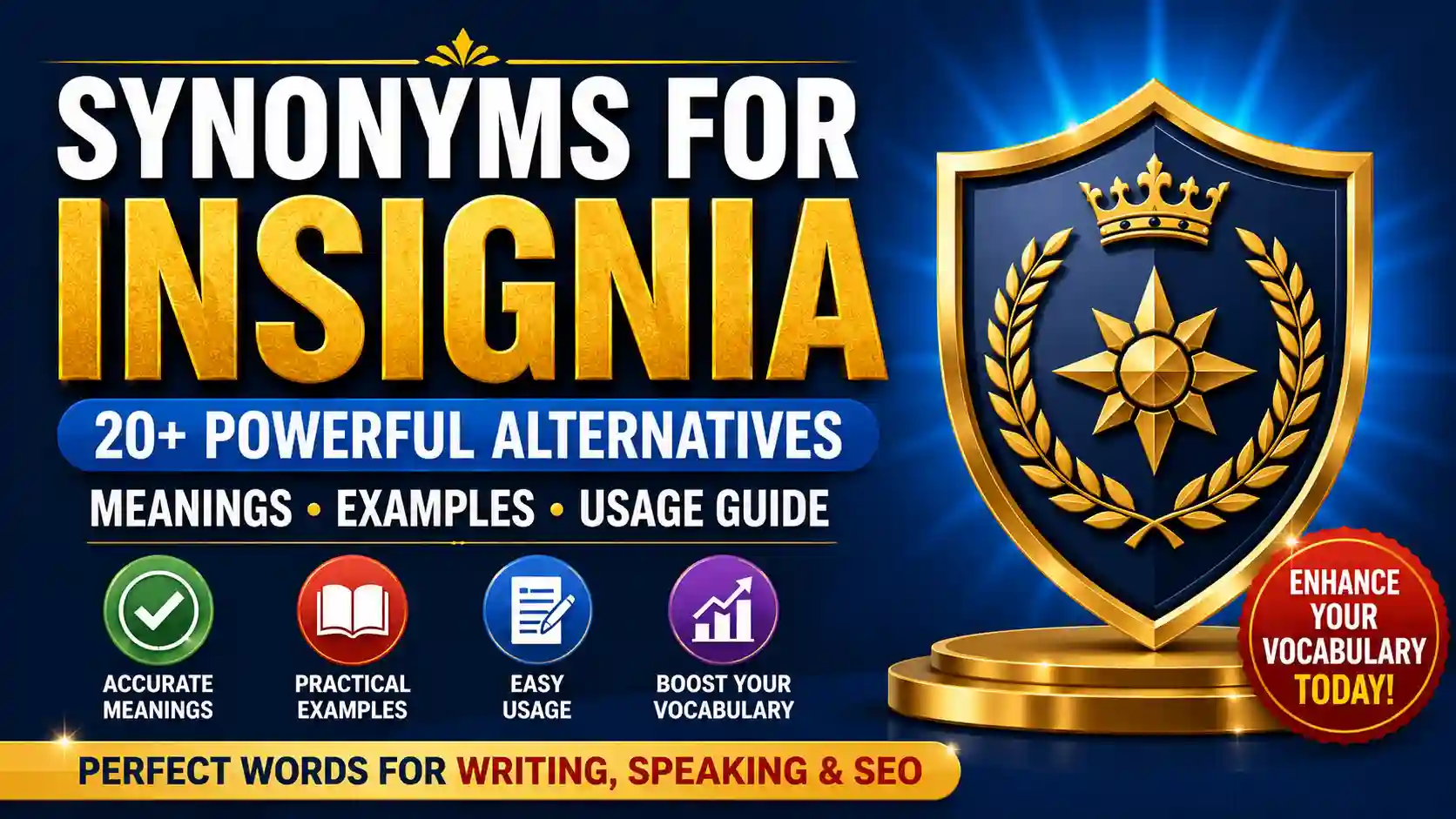
The closest synonyms for insignia are badge, emblem, symbol, mark, crest, sign, decoration, device, and coat of arms. The best choice depends on context. Use badge for rank or membership, emblem for an organization, symbol for a broader idea, and crest for traditional or heraldic identity.
What Does Insignia Mean?
Have you ever seen a badge on a military uniform or a symbol on a school jacket and wondered what to call it?
The word insignia describes a badge, symbol, or other identifying mark that shows a person’s rank, membership, office, or connection with an organization. It is especially common in military, official, historical, and institutional contexts.
For example:
The captain wore the insignia of his rank.
You could replace insignia with badge in this sentence, but not every possible synonym would sound natural.
That is the key to learning synonyms for insignia. The words may be similar, but they do not always mean exactly the same thing. This guide shows you which alternative works best in different situations, from essays and professional writing to everyday English.
Pronunciation of Insignia
IPA: /ɪnˈsɪɡ.ni.ə/
Easy pronunciation: in-SIG-nee-uh
Cambridge gives essentially the same pronunciation for British and American English.
Part of Speech
Insignia is a noun.
Examples:
- The officer wore military insignia.
- The royal insignia was displayed during the ceremony.
- The uniform carried the insignia of the regiment.
It is not normally used as a verb, adjective, or adverb.
Is Insignia Singular or Plural?
This is one of the most interesting points about the word.
Historically, insignia comes from Latin and was originally a plural form. Modern English, however, uses insignia in both singular and plural ways. Insignias is also a standard plural form. Oxford lists “insignia or insignias,” while Collins explains that modern American English allows singular insignia with insignias as its plural.
Examples:
- The insignia is clearly visible.
- The insignia are displayed in the museum.
- Several insignias are visible on the uniforms.
For everyday modern writing, the exact choice can depend on whether you are treating insignia as one identifying item, a collective term, or a plural set.
Quick Comparison of the Best Alternatives
| Word | Best meaning | Register | Frequency |
| Badge | Rank, membership, authority | Neutral | Very common |
| Emblem | Group or organizational identity | Neutral/Formal | Common |
| Symbol | Represents an idea or identity | Neutral | Very common |
| Mark | Identifying feature | Neutral | Very common |
| Crest | Traditional or heraldic design | Formal | Common |
| Sign | General identifying indication | Neutral | Very common |
| Decoration | Honor, distinction, or award | Formal/Neutral | Common |
| Device | Formal or heraldic design | Formal | Uncommon |
| Seal | Official institutional mark | Formal | Common |
| Coat of arms | Heraldic identity | Formal | Common |
| Ensign | Identifying flag | Formal | Uncommon |
| Identification mark | Technical identifying feature | Formal | Common phrase |
| Distinguishing mark | Feature that sets something apart | Formal | Common phrase |
| Earmark | Characteristic or identifying feature | Neutral/Formal | Common |
| Regalia | Ceremonial dress or symbols of office | Formal | Uncommon |
Important: These words are not perfect substitutes in every sentence. The closest everyday replacement is often badge, but the right word changes with the context.
1. Badge
Meaning: A badge is an object or mark worn or displayed to show identity, membership, rank, or authority.
Examples:
- The police officer showed his badge.
- Her uniform carried a small identification badge.
Best used when: You are talking about a physical sign of rank, membership, or official position.
Tone: Neutral
Register: Everyday, professional, official
Frequency: Very common
Approximate CEFR: B1
Common collocations:
- police badge
- rank badge
- identification badge
- membership badge
When not to use it: Do not use a badge when you are describing a broad symbolic idea rather than a physical identifying object.
Nuance: This is usually the closest simple synonym for insignia.
2. Emblem
Meaning: An emblem is a design or object that represents a group, organization, country, or idea.
Examples:
- The eagle became the emblem of the organization.
- The school placed its emblem on the new uniforms.
Best used when: The main purpose is representation rather than showing a person’s rank.
Tone: Neutral to formal
Register: General, academic, professional
Frequency: Common
Approximate CEFR: B2
Common collocations:
- national emblem
- school emblem
- official emblem
When not to use it: A small rank badge is more naturally called a badge than an emblem.
Nuance: Emblem focuses on representation and identity.
3. Symbol
Meaning: A symbol is something that represents an idea, quality, group, or meaning.
Examples:
- The dove is a symbol of peace.
- The star became a symbol of the team’s success.
Best used when: The identifying mark carries a broader meaning.
Tone: Neutral
Register: Spoken, academic, professional
Frequency: Very common
Approximate CEFR: B1
Common collocations:
- national symbol
- religious symbol
- cultural symbol
When not to use it: Do not choose symbols when the context specifically concerns official rank insignia.
Nuance: Symbol is broader than insignia.
4. Mark
Meaning: A mark is a visible feature that identifies or distinguishes something.
Examples:
- The small mark identified the official documents.
- The artist added a personal mark to the design.
Best used when: You need a broad word for something that distinguishes one thing from another.
Tone: Neutral
Register: Everyday, professional
Frequency: Very common
Approximate CEFR: A2-B1
Common collocations:
- identifying mark
- distinctive mark
- official mark
When not to use it: Mark can be too general when you need to emphasize official rank or membership.
Nuance: It describes the identifying function without telling the reader exactly what the object looks like.
5. Crest
Meaning: A crest is a distinctive design connected with a family, school, club, institution, or heraldic tradition.
Examples:
- The university crest appeared on the certificate.
- The club stitched its crest onto the players’ jackets.
Best used when: The design has a traditional, institutional, or heraldic character.
Tone: Formal
Register: Historical, academic, institutional
Frequency: Common
Approximate CEFR: B2
Common collocations:
- family crest
- school crest
- club crest
- royal crest
When not to use it: A modern business logo is not automatically a crest.
Nuance: Crest often suggests tradition and heritage.
6. Sign
Meaning: A sign is something that communicates information or indicates something.
Examples:
- The mark was a sign of membership.
- The uniform displayed a sign of official status.
Best used when: You need a broad, simple word.
Tone: Neutral
Register: Spoken and general English
Frequency: Very common
Approximate CEFR: A1-A2
Common collocations:
- sign of authority
- sign of membership
- identifying sign
When not to use it: Sign is usually too broad for precise professional writing about official insignia.
7. Decoration
Meaning: A decoration can be an award or honor given for service, achievement, or distinction.
Examples:
- The officer received a military decoration.
- His decorations represented years of service.
Best used when: The identifying object represents an honor or achievement.
Tone: Neutral/Formal
Register: Military, official, historical
Frequency: Common
Approximate CEFR: B2
Common collocations:
- military decoration
- national decoration
- official decoration
When not to use it: A basic organizational emblem is not necessarily a decoration.
Nuance: This word emphasizes honor or achievement, not simply identification.
8. Device
Meaning: In formal or heraldic language, a device can mean a distinctive design or figure used as a symbol.
Examples:
- The family used a lion as its heraldic device.
- The royal device appeared on the document.
Best used when: Writing about heraldry, history, or formal symbolism.
Tone: Formal
Register: Historical, heraldic, academic
Frequency: Uncommon in this sense
Approximate CEFR: C1
When not to use it: In modern everyday English, device usually means a machine or piece of technology, so this meaning can confuse learners.
9. Seal
Meaning: A seal is an official design used by an organization, institution, government, or authority.
Examples:
- The university seal appeared on the diploma.
- The official document carried the government seal.
Best used when: The mark represents institutional authority or authentication.
Tone: Formal
Register: Official, academic, legal, institutional
Frequency: Common
Approximate CEFR: B2
Common collocations:
- official seal
- government seal
- university seal
When not to use it: Do not call an ordinary company logo a seal unless it functions as an official seal.
10. Coat of Arms
Meaning: A coat of arms is a formal heraldic design associated with a person, family, city, institution, or state.
Examples:
- The castle displayed the family’s coat of arms.
- The city’s coat of arms appeared above the entrance.
Best used when: You are discussing formal heraldry.
Tone: Formal
Register: Historical, academic, ceremonial
Frequency: Common
Approximate CEFR: C1
When not to use it: A simple school logo is not necessarily a coat of arms.
Nuance: This phrase has a much narrower meaning than insignia.
11. Ensign
Meaning: An ensign is a flag used to identify a country, organization, or military unit, especially a naval one.
Examples:
- The naval ensign flew above the ship.
- The vessel carried its national ensign.
Best used when: The identifying object is specifically a flag.
Tone: Formal
Register: Military, nautical, historical
Frequency: Uncommon
Approximate CEFR: C1
When not to use it: A shoulder badge is not an ensign.
12. Earmark
Meaning: An earmark can be a distinctive sign or characteristic that identifies something.
Examples:
- The unusual pattern became an earmark of the designer’s work.
- The silver border was an earmark of the old uniforms.
Best used when: You mean a characteristic feature rather than a physical badge.
Tone: Neutral/Formal
Register: General, academic
Frequency: Common
Approximate CEFR: C1
When not to use it: Do not use it as a direct replacement for military insignia.
13. Regalia
Meaning: Regalia refers to special clothes, objects, or symbols associated with royalty, office, ceremony, or authority.
Examples:
- The king appeared in traditional ceremonial regalia.
- The museum displayed royal regalia.
Best used when: You are describing a collection of ceremonial symbols or objects of authority.
Tone: Formal/Literary
Register: Historical, ceremonial
Frequency: Uncommon
Approximate CEFR: C1-C2
When not to use it: A single ordinary badge is not normally called regalia.
14. Identification Mark
Meaning: An identification mark is a visible feature used to identify a person, object, or organization.
Examples:
- The aircraft carried an identification mark on its tail.
- The equipment had an identification mark for easy recognition.
Best used when: Precision is more important than style.
Tone: Formal
Register: Technical, professional
Frequency: Common phrase
Approximate CEFR: B2-C1
When not to use it: It can sound unnecessarily technical in casual conversation.
15. Distinguishing Mark
Meaning: A distinguishing mark is a feature that makes something recognizable or different from other things.
Examples:
- The crest became a distinguishing mark of the family.
- The unusual border was a distinguishing mark of the old design.
Best used when: You want to emphasize what makes something identifiable.
Tone: Formal
Register: Academic, professional, descriptive
Frequency: Common phrase
Approximate CEFR: B2-C1
When not to use it: In casual English, a badge or symbol may sound more natural.
The Closest Synonyms for Different Contexts
There is no single “best synonym” for every sentence. Think about what the insignia does.
| Context | Best choice | Example |
| Military rank | Badge | His badge showed his rank. |
| Organization identity | Emblem | The emblem represented the organization. |
| General meaning | Symbol | The symbol represented peace. |
| School or club tradition | Crest | The school crest was embroidered on the jacket. |
| Official institution | Seal | The university seal appeared on the document. |
| Heraldry | Coat of arms | The family coat of arms was displayed. |
| Identifying feature | Mark | The mark distinguished the official papers. |
| Military flag | Ensign | The naval ensign flew from the mast. |
| Honor or award | Decoration | He received a military decoration. |
| Technical identification | Identification mark | The aircraft had a visible identification mark. |
Writing Tip: When replacing a word with a synonym, do not ask only, “Does this word have a similar meaning?” Ask, “Would a native speaker use this word in this exact situation?”
Words That Are Related but Not Exact Synonyms
Some words often appear in synonym lists for insignia, but they should be treated carefully.
Logo
A logo identifies a brand, company, product, or organization.
The company’s logo appears on the website.
It can overlap with insignia when an organization uses the logo as an identifying mark, but logo is not a universal substitute.
Medal
A medal is an award or commemorative object.
She received a medal for bravery.
A medal may serve as an insignia, but a medal has a more specific meaning.
Ribbon
A ribbon can represent an award, especially in military contexts.
His uniform displayed several service ribbons.
It is a particular type of recognition, not a general synonym.
Pin
A pin is a small object worn on clothing.
She wore a membership pin.
A pin can carry insignia, but the physical object and the identifying design are not necessarily the same thing.
Motif
A motif is a repeated design or idea, especially in art, literature, and decoration.
The artist used a floral motif throughout the building.
It does not normally mean an official identifying badge.
Commonly Confused Words
| Word | Main idea | Example |
| Insignia | Official identifying mark | The uniform displayed military insignia. |
| Badge | Physical identifying object | The officer showed his badge. |
| Emblem | Representative design | The eagle is the organization’s emblem. |
| Logo | Brand identity | The company changed its logo. |
| Symbol | Represents an idea or meaning | The dove is a symbol of peace. |
Easy rule to remember
Badge = who you are or what rank you hold
Emblem = what group you represent
Logo = what brand or organization you identify
Symbol = what idea or meaning you represent
Insignia = an identifying mark, especially one connected with rank, office, membership, or authority
Common Grammar Mistakes
Common Mistake
Mistake: He wore an insignia on his uniform.
Correction: He wore an insignia on his uniform.
Why: An is singular, so use insignia, not insignias.
Mistake: He wore two insignia.
Correction: He wore two insignia.
Also possible: He wore two insignias.
Why: Both plural patterns are found in standard modern English. Oxford lists insignia or insignias, while Collins also recognizes both patterns.
Mistake: The company insignia was a logo.
Better: The company’s logo served as its identifying emblem.
Why: This makes the relationship between the logo and the broader idea of identification clearer.
Insignia in American and British English
The spelling insignia is the same in both American and British English.
The pronunciation is also broadly the same:
/ɪnˈsɪɡ.ni.ə/
The more interesting difference concerns grammatical treatment.
Cambridge presents insignia as a plural noun in its main British and American dictionary entries, while its American intermediate entry treats it as countable. Oxford also lists insignia or insignias as plural forms.
So learners should not assume that one form is automatically “wrong.”
Word Origin and Etymology
Insignia entered English in the mid-17th century.
Oxford traces it to Latin insignia, the plural of insigne, meaning “sign” or “badge of office.” The Latin word is related to insignis, meaning distinguished or marked, and ultimately to signum, meaning “sign” or “mark.”
Collins gives a similar Latin origin and dates the word to the 17th century.
This history makes the modern meaning easy to understand: an insignia is essentially a distinctive mark that identifies or distinguishes.
How Common Is Insignia?
Insignia is a useful but relatively formal vocabulary word.
You are more likely to encounter it in:
- military writing
- historical writing
- official documents
- discussions of heraldry
- descriptions of uniforms
- institutional contexts
- news reports
- academic writing
In casual conversation, speakers often choose badge, symbol, logo, or mark instead.
That does not make insignia difficult or unnatural. It simply means the word has a more specialized feel.
Register and Tone Guide
| Word | Register | Typical setting |
| Badge | Neutral | Everyday, military, police |
| Emblem | Neutral/Formal | Organizations, institutions |
| Symbol | Neutral | Everyday, academic |
| Mark | Neutral | General English |
| Crest | Formal | Schools, families, heraldry |
| Seal | Formal | Universities, government |
| Device | Formal | Heraldry, history |
| Ensign | Formal | Military, naval |
| Regalia | Formal/Literary | Royal, ceremonial |
| Coat of arms | Formal | Heraldry, history |
How to Use These Words in Writing
Essays
For academic writing, insignia, emblem, symbol, and mark can all work, but choose according to meaning.
The royal insignia reflected the political authority of the monarchy.
Business Writing
Use logo, emblem, or official seal when appropriate.
The company’s logo appears on all official materials.
Professional Communication
Use badge when discussing identification or access.
Employees must display their identification badges.
Stories
Your choice can change the mood.
Badge sounds modern and direct.
Crest sounds traditional.
Insignia sounds official.
Signet sounds historical.
Everyday Conversation
Simple words usually sound more natural.
Instead of:
What is that insignia on your shirt?
You might say:
What is that badge on your shirt?
But if the context is military or historical, insignia may be the better word.
Related Vocabulary
Words Connected With Identity
- badge
- emblem
- symbol
- logo
- mark
- crest
- seal
- identification
Words Connected With Rank
- badge
- insignia
- rank
- decoration
- medal
- ribbon
- chevron
Words Connected With Heraldry
- crest
- coat of arms
- heraldry
- shield
- device
- emblem
- seal
Does Insignia Have an Antonym?
There is no single exact opposite of insignia.
The word describes an identifying mark, so the closest contrasting ideas depend on context:
- anonymity
- lack of identification
- concealment
- unmarked status
- obscurity
For example:
The uniforms had no identifying marks.
Here, no identifying marks expresses the opposite idea more naturally than searching for one direct antonym.
Mini Practice
Fill in the Blanks
Choose badge, emblem, crest, seal, or logo.
- The police officer showed his ______.
- The university ______ appeared on the diploma.
- The family displayed its traditional ______.
- The company redesigned its ______.
- The organization adopted an eagle as its ______.
Answers
- badge
- seal
- crest
- logo
- emblem
Rewrite the Sentences
Replace insignia with the most natural alternative.
- The officer’s insignia was visible on his sleeve.
- The university’s insignia appeared on the certificate.
- The company’s insignia appeared on its website.
- The family insignia was carved above the entrance.
Suggested Answers
- The officer’s badge was visible on his sleeve.
- The university’s seal appeared on the certificate.
- The company’s logo appeared on its website.
- The family crest was carved above the entrance.
Notice that the answer changes because the context changes.
Vocabulary Quiz
1. Which word is usually best for a police officer’s identifying object?
A. Motif
B. Badge
C. Regalia
D. Device
2. Which word is most appropriate for a company’s graphic identity?
A. Logo
B. Ensign
C. Crest
D. Decoration
3. Which word is strongly associated with traditional family identity?
A. Badge
B. Label
C. Crest
D. Ribbon
4. Which word is broader and often represents an idea?
A. Symbol
B. Badge
C. Seal
D. Patch
5. Which word is most closely associated with official institutional authentication?
A. Motif
B. Seal
C. Pin
D. Ribbon
Answers
- B. Badge
- A. Logo
- C. Crest
- A. Symbol
- B. Seal
Frequently Asked Questions
What is the closest synonym for insignia?
Badge is often the closest everyday synonym, especially when insignia refers to rank, membership, or authority. However, emblem, symbol, crest, and mark may be better depending on the context. There is no single substitute that works naturally in every sentence.
What are five synonyms for insignia?
Five useful alternatives are badge, emblem, symbol, mark, and crest. Each has a slightly different focus. A badge often identifies rank or membership, an emblem represents an organization, a symbol conveys meaning, a mark identifies something, and a crest often has traditional or heraldic associations.
Is badge the same as insignia?
Not exactly. A badge is a specific type of identifying object or mark, while insignia is a broader term. A badge can be insignia, but insignia can also take the form of an emblem, symbol, crest, or other distinguishing mark.
Is emblem a synonym for insignia?
Yes, emblem can be used as a synonym in contexts where both words refer to a design that represents an organization, group, or identity. However, emblem does not necessarily suggest rank or official status, so it is not interchangeable with insignia in every situation.
What is the difference between insignia and logo?
A logo is primarily a graphic used to identify a company, brand, product, or organization. Insignia usually refers to an identifying mark connected with membership, rank, office, authority, or distinction. A logo can function as an identifying insignia, but the two words have different typical uses.
What is the plural of insignia?
Modern English allows insignia and insignias as plural forms. The word originally came from Latin as a plural form, but English later developed singular use as well. Oxford lists “insignia or insignias,” and Collins recognizes both modern patterns.
Is insignia a formal word?
Yes. Insignia has a more formal and specialized feel than words such as badge or sign. It is particularly common in military, historical, institutional, official, and heraldic contexts.
What is the difference between insignia and symbol?
A symbol can represent an idea, quality, group, or concept, while insignia usually identifies a person, group, rank, office, or organization. A dove can be a symbol of peace, while a military badge can be insignia showing someone’s rank.
Final Takeaway
The best way to learn synonyms for insignia is to learn the difference between them, not simply memorize a long list. Choose badge for rank or membership, emblem for organizational identity, symbol for broader meaning, crest for traditional identity, and seal for official authority. Once you understand these small differences, your writing becomes more precise and your vocabulary sounds much more natural.
Trusted References
- Oxford Advanced Learner’s Dictionary: insignia
- Cambridge Dictionary: insignia
- Merriam-Webster: insignia
- Collins Dictionary: insignia

Synonorm is a trusted English vocabulary resource created to help readers find the right words and understand the differences between similar terms. We provide clear explanations of synonyms, meanings, examples, usage, and alternatives. Our content makes vocabulary easier to learn and apply in everyday, academic, and professional English. Synonorm is designed for students, writers, ESL learners, professionals, and anyone who wants to improve their English vocabulary and communicate more clearly.