Quick Answer
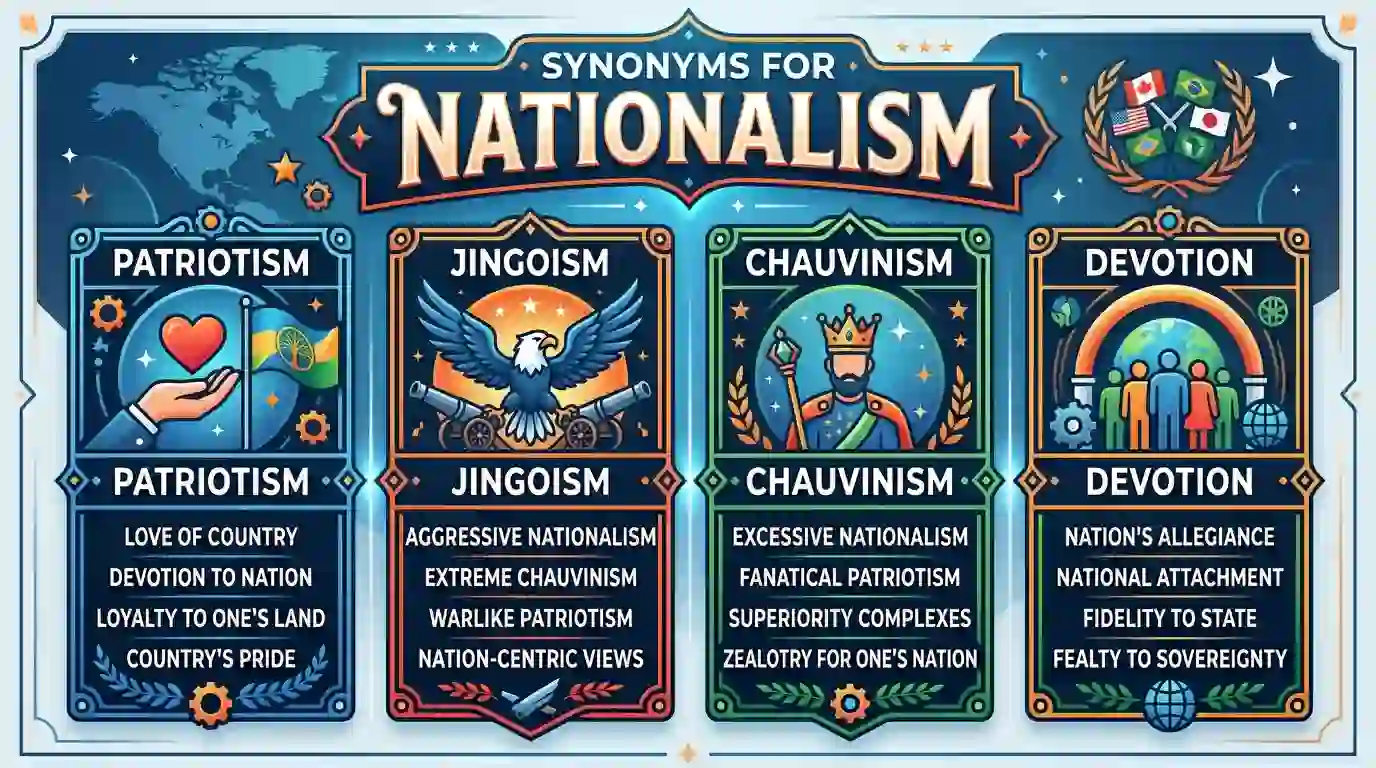
The closest everyday synonym for nationalism is often patriotism, but the two words are not always identical. National pride, patriotic sentiment, national loyalty, and love of country can describe positive national feelings. Jingoism, chauvinism, and ultranationalism describe more extreme forms. Words such as self-determination, autonomy, sovereignty, and separatism are related political concepts, not exact synonyms.
What Does Nationalism Mean?
Have you ever used the word nationalism several times in an essay and wanted a better alternative? The answer is not as simple as opening a thesaurus and choosing the first word you see.
Nationalism has more than one sense. It can describe strong loyalty or devotion to a nation. It can also describe a political belief or movement that gives importance to a nation’s interests, identity, or political independence. Collins, for example, includes both the desire for political independence and strong love for one’s nation among its meanings.
This means the best synonym depends on your sentence.
If you mean love and pride in your country, use patriotism or national pride. If you mean political freedom, words such as self-determination or political independence may be more precise. If you mean an extreme or aggressive form of national feeling, jingoism, chauvinism, or ultranationalism may fit better.
This guide separates true alternatives from related political terms so you can choose the right word without changing your meaning.
Pronunciation
Nationalism
IPA: /ˈnæʃənəlɪzəm/
Simple pronunciation: NASH-uh-nuh-li-zum
The spelling is the same in American and British English. Cambridge lists UK and US pronunciations with only small differences in the unstressed sounds.
Part of Speech and Word Forms
Nationalism is a noun.
Related forms include:
- national — adjective
- nationally — adverb
- nationalist — noun/adjective
- nationalistic — adjective
- nationalistically — adverb
Examples
- Nationalism influenced the movement.
- She described herself as a nationalist.
- The speech used nationalistic language.
- The issue was discussed nationally.
Usually, nationalism is used as an uncountable noun when we mean the general idea.
Grammar and Usage
Common patterns with nationalism
Native English commonly uses expressions such as:
- the rise of nationalism
- the growth of nationalism
- a resurgence of nationalism
- nationalist movements
- nationalistic rhetoric
- strong nationalism
- extreme nationalism
- civic nationalism
- cultural nationalism
- economic nationalism
Useful sentence patterns
The rise of nationalism
The rise of nationalism changed the political debate.
Nationalism + adjective
Cultural nationalism influenced the movement.
Nationalism + among + group
Nationalism grew among some members of the community.
Nationalism + in + place
Nationalism became an important issue in the region.
Grammar Tip
Do not automatically replace every occurrence of nationalism with a different word. A synonym is useful only when it preserves the original meaning.
Quick Synonym Guide
| Word or phrase | How close is it? | Main idea | Register |
| Patriotism | Very close in some contexts | Love of country | Neutral |
| National pride | Close | Pride in one’s nation | Neutral |
| National loyalty | Close in some contexts | Loyalty to a nation | Neutral/Formal |
| Patriotic sentiment | Close | Feelings of national devotion | Formal |
| Love of country | Close | Affection for one’s country | Neutral |
| National spirit | Related | Shared national feeling | Neutral/Literary |
| Chauvinism | Extreme related term | Belief in superiority | Formal |
| Jingoism | Extreme related term | Aggressive national feeling | Formal |
| Ultranationalism | Extreme related term | Extreme nationalism | Academic |
| Self-determination | Political concept | Right to determine political future | Formal |
| Autonomy | Political concept | Self-government within a larger system | Formal |
| Sovereignty | Political concept | Supreme state authority | Formal |
| Separatism | Political concept | Support for separation | Formal |
Important: The table deliberately separates close alternatives from related political concepts. Large thesaurus sites often mix these categories. WordHippo, for example, gives many different terms under several senses of nationalism, including independence-related vocabulary and extreme political ideologies.
The Best Synonyms for Nationalism
1. Patriotism
Meaning: Love, loyalty, and pride in one’s country.
CEFR: B2
Frequency: Very common
Register: Neutral, academic, formal, spoken
Connotation: Usually positive or neutral
Examples:
- Her patriotism was evident in her years of public service.
- The national celebration created a strong feeling of patriotism.
Best used when: You want to emphasize affection and pride rather than a political ideology.
Common collocations:
- strong patriotism
- sense of patriotism
- patriotic duty
When not to use it: Do not use it when the sentence specifically means a movement for political independence.
Nuance: Patriotism is probably the most useful everyday alternative, but it is not a perfect substitute in every political or historical context.
2. National Pride
Meaning: Pride in your country’s people, culture, history, or achievements.
CEFR: B1-B2
Frequency: Very common
Register: Neutral
Connotation: Usually positive
Examples:
- The team’s victory created a sense of national pride.
- The museum celebrates national pride through art and history.
Best used when: The focus is emotional pride rather than political ideology.
Common collocations:
- national pride
- sense of national pride
- source of national pride
When not to use it: Avoid it when you specifically mean an organized political movement.
3. National Loyalty
Meaning: Strong loyalty or commitment to one’s nation.
CEFR: B2
Frequency: Common
Register: Neutral/Formal
Connotation: Neutral
Examples:
- The debate raised questions about national loyalty.
- The ceremony was designed to express national loyalty.
Best used when: The sentence emphasizes loyalty rather than ideology.
When not to use it: Do not use it for political independence unless loyalty is actually the main idea.
4. Patriotic Sentiment
Meaning: Feelings of love, loyalty, or pride toward one’s country.
CEFR: B2-C1
Frequency: Common
Register: Formal/Academic
Connotation: Usually positive or neutral
Examples:
- The speech appealed to patriotic sentiment.
- The event produced strong patriotic sentiment among the audience.
Best used when: Writing essays, reports, journalism, or academic analysis.
Common collocations:
- strong patriotic sentiment
- public patriotic sentiment
- patriotic sentiment grew
5. Love of Country
Meaning: Strong affection for one’s country.
CEFR: B1
Frequency: Common
Register: Neutral
Connotation: Positive
Examples:
- His actions showed a deep love of country.
- The poem expresses love of country without attacking other nations.
Best used when: You want a clear and simple phrase.
When not to use it: It is less precise when discussing nationalism as a political doctrine.
6. National Spirit
Meaning: A shared feeling of identity, unity, or pride within a nation.
CEFR: B2
Frequency: Common
Register: Neutral/Literary
Connotation: Usually positive
Examples:
- The festival helped strengthen the national spirit.
- The writer believed education could build national spirit.
Best used when: Discussing unity, culture, celebrations, or shared identity.
Stronger or More Negative Terms
These are not neutral replacements for nationalism. They describe particular forms of intense national feeling.
7. Chauvinism
Meaning: Excessive belief in the superiority of one’s own group or country.
CEFR: C1
Frequency: Common
Register: Formal/Academic
Connotation: Negative
Examples:
- The historian criticized the speech for its chauvinism.
- National pride can become chauvinism when it treats other nations as inferior.
Best used when: The idea of superiority is important.
When not to use it: Do not call ordinary patriotism chauvinism.
Nuance: In modern English, chauvinism can also refer to excessive belief in the superiority of other groups, not only nations. Context matters.
8. Jingoism
Meaning: Extreme national feeling, often involving enthusiastic support for war against another country.
CEFR: C1
Frequency: Uncommon
Register: Formal/Political/Journalistic
Connotation: Strongly negative
Examples:
- The article warned against political jingoism.
- Critics said the speech encouraged jingoism.
Best used when: National feeling becomes aggressive or strongly connected with military action.
Cambridge labels jingoism as a political and disapproving term and defines it as an extreme belief that one’s country is always best, often shown through support for war.
When not to use it: Do not use jingoism simply to mean patriotism.
9. Ultranationalism
Meaning: An extreme form of nationalism.
CEFR: C1
Frequency: Uncommon
Register: Academic/Political
Connotation: Usually negative
Examples:
- The historian studied the rise of ultranationalism.
- The movement rejected the ultranationalism associated with earlier political groups.
Best used when: You are discussing an unusually extreme form of nationalism.
When not to use it: It is too strong for ordinary national pride.
10. Superpatriotism
Meaning: Excessively strong patriotism.
CEFR: C1
Frequency: Rare
Register: Formal/Uncommon
Connotation: Usually critical
Example:
The essay questioned the dangers of superpatriotism.
Best used when: You specifically want to stress excessive patriotism.
Because this is uncommon, ESL learners usually do not need it in everyday writing.
11. Flag-Waving
Meaning: A visible or highly enthusiastic display of patriotism.
CEFR: C1
Frequency: Common
Register: Informal/Journalistic
Connotation: Often critical or humorous
Examples:
- The campaign relied heavily on flag-waving imagery.
- The article criticized the event as little more than flag-waving.
When not to use it: It does not mean nationalism itself. It describes a style of patriotic display.
Related Political Terms That Are NOT Exact Synonyms
This distinction is one of the most important improvements over basic thesaurus lists.
12. Self-Determination
Meaning: The right or ability of a people to decide their own political future.
CEFR: C1
Frequency: Common
Register: Academic/Political
Connotation: Usually neutral
Example:
The movement demanded greater self-determination.
Use it when: Nationalism is specifically connected with political choice or independence.
Do not use it when: You simply mean love of country.
13. Autonomy
Meaning: The power to make decisions or govern independently within a larger political structure.
CEFR: C1
Frequency: Common
Register: Formal/Academic
Example:
The region received greater political autonomy.
Key difference: Autonomy can mean limited self-government. It does not necessarily mean complete independence.
14. Sovereignty
Meaning: The authority of a state to govern itself and control its territory.
CEFR: C1
Frequency: Common
Register: Formal/Political
Example:
The agreement recognized the state’s sovereignty.
Key difference: Sovereignty is about political authority, not emotional attachment to a country.
15. Separatism
Meaning: Support for separating a region or group from a larger political state.
CEFR: C1
Frequency: Common
Register: Academic/Political
Example:
The region experienced a period of strong separatism.
Key difference: Nationalism does not always seek separation. Separatism specifically involves separation.
16. Secessionism
Meaning: Support for formally leaving a country or political union.
CEFR: C1-C2
Frequency: Uncommon
Register: Academic/Political
Example:
Secessionism became an important issue in the region.
Key difference: It is narrower than nationalism because it specifically concerns leaving a political state or union.
Which Synonym Should You Choose?
Use this quick decision guide:
If you mean love of country:
Patriotism
Her patriotism was clear.
If you mean pride in national achievements:
National pride
The victory became a source of national pride.
If you mean loyalty:
National loyalty
The debate questioned his national loyalty.
If you mean shared belonging:
National identity
Language can shape national identity.
If you mean political choice:
Self-determination
The group demanded self-determination.
If you mean limited self-government:
Autonomy
The region requested greater autonomy.
If you mean state authority:
Sovereignty
The dispute concerned national sovereignty.
If you mean aggressive national feeling:
Jingoism
Critics warned against jingoism.
If you mean belief in superiority:
Chauvinism
The writer rejected national chauvinism.
If you mean extreme nationalism:
Ultranationalism
The study examined the rise of ultranationalism.
Nationalism vs. Patriotism
This is probably the most important distinction for English learners.
| Nationalism | Patriotism |
| Can refer to a political ideology or movement | Mainly refers to love and pride in one’s country |
| Can involve national independence or national interests | Usually emphasizes devotion to country |
| Can be neutral or critical depending on context | Usually positive or neutral |
| Can become extreme | Can also be excessive, but the word itself is not normally negative |
| Common in history and political writing | Common in everyday English |
Collins lists patriotism, loyalty to your country, chauvinism, and jingoism among related alternatives, while also distinguishing different senses of nationalism.
Nationalism vs. National Identity
These terms are closely related but not identical.
National identity means a person’s or group’s sense of belonging to a particular nation.
Nationalism can build on that identity and turn it into a stronger cultural, social, or political position.
Example
Language helped shape their national identity.
This does not necessarily mean:
Language created nationalism.
The second sentence suggests a broader ideological or political development.
Nationalism vs. Nationality
These words are also easy to confuse.
Nationality usually refers to a person’s national status, citizenship, or national affiliation.
Nationalism refers to an ideology, movement, or strong national feeling.
Correct examples
Her nationality is Pakistani.
Nationalism became an important political force.
Do not use these words interchangeably.
Common Mistakes
Common Mistake Box
Mistake 1
Wrong: Patriotism and nationalism always mean exactly the same thing.
Better: Patriotism and nationalism overlap, but nationalism can have political and ideological meanings that patriotism does not.
Mistake 2
Wrong: Jingoism is a neutral synonym for nationalism.
Better: Jingoism describes an extreme and often aggressive form of national feeling.
Cambridge specifically marks jingoism as disapproving.
Mistake 3
Wrong: Autonomy means complete independence.
Better: Autonomy usually means a degree of self-government within a larger political system.
Mistake 4
Wrong: Nationality means nationalism.
Better: Nationality normally refers to national status or affiliation.
Mistake 5
Wrong: Every word listed by a thesaurus can replace nationalism.
Better: Check the meaning and context first.
This is especially important because large synonym databases can contain very broad semantic associations. WordHippo’s nationalism page includes terms connected with several distinct senses, including patriotism, political independence, and authoritarian systems.
Word Origin and Etymology
The word nationalism is formed from nationalist plus the suffix -ism.
Etymological sources place the emergence of the modern English word in the 19th century. Different references give slightly different dates, so it is safer to describe the first recorded use as approximate rather than claim one exact date without qualification.
The related word national has much older roots connected with ideas of birth, people, and nation.
Why the history matters
The meaning of nationalism developed alongside major political and cultural changes in Europe and elsewhere. As a result, modern writers use the word in several related ways, including national identity, political independence, and strong devotion to a nation.
American vs. British English
There is no important spelling difference:
- American English: nationalism
- British English: nationalism
The pronunciation is also broadly similar.
The same is true for patriotism, jingoism, chauvinism, and autonomy. Differences are mainly related to accent and stress rather than spelling.
British and American writing tip
You do not need to change nationalism when switching between US and UK English.
Register and Tone Guide
| Word | Register | Typical tone |
| Patriotism | Neutral | Positive/neutral |
| National pride | Neutral | Positive |
| National loyalty | Formal/neutral | Neutral |
| Patriotic sentiment | Formal | Neutral |
| Love of country | Neutral | Positive |
| National spirit | Neutral/literary | Positive |
| Chauvinism | Formal | Negative |
| Jingoism | Formal/political | Negative |
| Ultranationalism | Academic/political | Usually negative |
| Flag-waving | Informal/journalistic | Often critical |
| Self-determination | Academic/political | Neutral |
| Autonomy | Formal | Neutral |
| Sovereignty | Formal | Neutral |
| Separatism | Academic/political | Context-dependent |
Natural Collocations
Learning collocations is often more useful than memorizing isolated synonyms.
Common combinations include:
- rise of nationalism
- growth of nationalism
- resurgence of nationalism
- civic nationalism
- cultural nationalism
- economic nationalism
- extreme nationalism
- nationalist movement
- nationalist politics
- nationalist sentiment
- national pride
- strong patriotism
- patriotic sentiment
- political independence
- national identity
Cambridge’s dictionary material includes established combinations such as civic nationalism, cultural nationalism, and extreme nationalism.
How to Use These Words in Different Types of Writing
Academic Essays
Prefer precise terms:
- nationalism
- national identity
- self-determination
- sovereignty
- separatism
- patriotic sentiment
Avoid using rare words just to sound advanced.
Blog Posts
Use familiar words:
- patriotism
- national pride
- love of country
- national identity
Explain specialized political terms when you introduce them.
Professional Writing
Choose the exact concept.
For example, use sovereignty when discussing state authority, not patriotism.
Creative Writing
Words such as national spirit, national pride, and patriotic sentiment can create emotional or cultural context.
Everyday Conversation
The most natural choices are usually:
- patriotism
- national pride
- love of country
Antonyms and Contrasting Vocabulary
There is no single perfect antonym for nationalism because the word has several meanings.
Depending on context, related contrasting ideas may include:
- internationalism
- cosmopolitanism
- global cooperation
- international cooperation
- transnationalism
These should not automatically be treated as exact opposites.
For example, a person can have strong patriotism and still support international cooperation.
Word Family
| Word | Part of speech | Meaning |
| nation | Noun | A country or people with a shared national identity |
| national | Adjective | Related to a nation |
| nationally | Adverb | At a national level |
| nationalist | Noun/Adjective | A person or position supporting nationalism |
| nationalism | Noun | National ideology, identity, or strong national feeling |
| nationalistic | Adjective | Showing strong national feeling |
| nationalize | Verb | Bring under national/state ownership |
| nationalization | Noun | The act of bringing something under state ownership |
Mini Practice Exercises
Fill in the Blanks
Choose the best answer.
1. The movement demanded greater political ________.
A. patriotism
B. self-determination
C. national pride
D. jingoism
2. Her strong ________ was evident during the national celebration.
A. sovereignty
B. separatism
C. patriotism
D. autonomy
3. Critics accused the speaker of promoting ________.
A. jingoism
B. nationality
C. citizenship
D. autonomy
4. The agreement gave the region greater political ________.
A. patriotism
B. autonomy
C. jingoism
D. national pride
5. The team’s victory became a source of national ________.
A. pride
B. sovereignty
C. separatism
D. self-rule
Answers
- B. self-determination
- C. patriotism
- A. jingoism
- B. autonomy
- A. pride
Sentence Rewriting Practice
Replace nationalism with the most precise alternative.
Sentence 1
The celebration showed strong nationalism.
Possible improvement:
The celebration showed strong national pride.
Use this version when the focus is positive pride.
Sentence 2
The movement demanded nationalism from the ruling government.
Better:
The movement demanded greater self-determination.
Use this when the intended meaning is political control over the group’s future.
Sentence 3
The article criticized extreme nationalism.
Possible improvement:
The article criticized ultranationalism.
Use this when the writer specifically means an extreme form of nationalism.
Final Quick Reference
If you need a replacement for nationalism, ask yourself what you really mean:
Love of country? → patriotism
Pride in your nation? → national pride
Loyalty? → national loyalty
Shared belonging? → national identity
Political choice? → self-determination
Limited self-government? → autonomy
State authority? → sovereignty
Separation? → separatism
Extreme national feeling? → ultranationalism
Aggressive national feeling? → jingoism
Belief in national superiority? → chauvinism
This approach is more accurate than simply replacing nationalism with any word that appears in a large thesaurus list.
Frequently Asked Questions
What is the best synonym for nationalism?
Patriotism is often the closest everyday alternative when nationalism means love or pride in one’s country. However, nationalism can also describe a political ideology or movement, so self-determination, national identity, or another context-specific term may be more accurate.
Is patriotism the same as nationalism?
No. The words overlap, but they are not always interchangeable. Patriotism mainly emphasizes love and pride in one’s country. Nationalism can also refer to political independence, national interests, or a broader political ideology.
What is a stronger word for nationalism?
For extreme national feeling, ultranationalism, jingoism, or chauvinism may be appropriate. They are not neutral synonyms. Jingoism can imply aggressive support for one’s country, especially in relation to war.
What is a positive synonym for nationalism?
Depending on the context, patriotism, national pride, national spirit, and love of country can express positive national feeling. These choices are especially useful when you want to emphasize affection rather than political ideology.
Is jingoism a synonym for nationalism?
Jingoism is better treated as a specific extreme form of national feeling, rather than a neutral synonym. It often involves the belief that one’s country is superior and can include enthusiastic support for military action.
What is the difference between nationalism and national identity?
National identity is a person’s or group’s sense of belonging to a nation. Nationalism can include national identity but may also involve political goals, national interests, or an ideology centered on the nation.
What is a synonym for nationalism in an essay?
Choose according to your meaning. Use patriotism for love of country, national pride for pride, national identity for belonging, self-determination for political choice, and sovereignty for state authority.
What is the opposite of nationalism?
There is no single exact opposite. Depending on context, internationalism, cosmopolitanism, or international cooperation may express ideas that place less emphasis on national boundaries or national interests. The correct contrast depends on the sentence.
Conclusion
The best synonym for nationalism depends on the meaning you want to express. Patriotism works well for love of country, while national pride focuses on pride and national identity focuses on belonging. For political contexts, self determination, autonomy, and sovereignty can be more precise, but they are not exact synonyms.
For extreme national feeling, jingoism, chauvinism, and ultranationalism carry stronger meanings. Learning these differences will help you write clearer essays, articles, emails, and everyday English.
Trusted References
- Cambridge Dictionary, Nationalism and related vocabulary.
- Collins English Dictionary, Nationalism.
- WordHippo, Nationalism Synonyms.
- Thesaurus.com, Nationalism Synonyms & Antonyms.
- Cambridge Dictionary, Jingoism.

Synonorm is a trusted English vocabulary resource created to help readers find the right words and understand the differences between similar terms. We provide clear explanations of synonyms, meanings, examples, usage, and alternatives. Our content makes vocabulary easier to learn and apply in everyday, academic, and professional English. Synonorm is designed for students, writers, ESL learners, professionals, and anyone who wants to improve their English vocabulary and communicate more clearly.