Quick Answer: What Are Synonyms for Numerous?
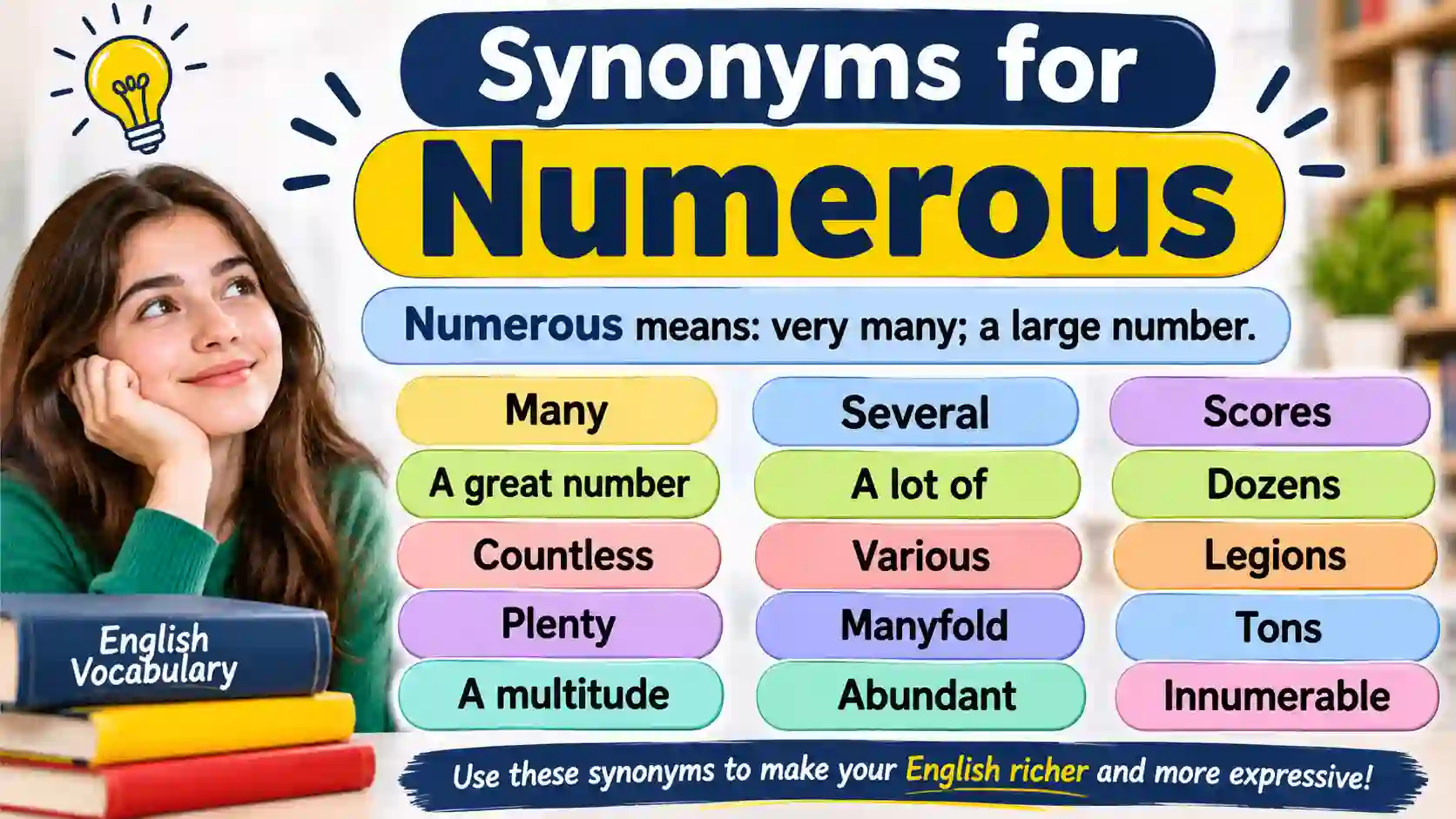
The best synonyms for numerous include many, countless, innumerable, a great many, a multitude of, and a large number of. These words describe people or things that exist in large numbers. Other alternatives, such as various, multiple, abundant, and plentiful, work in specific contexts. The right choice depends on quantity, meaning, grammar, and writing style.
Do you often use the word numerous in your essays, emails, or articles? Although it is a useful English word, repeating it can make your writing sound less natural.
Numerous means that something exists in large numbers. For example, “Numerous students joined the competition” means that many students took part.
Learning synonyms for numerous gives you more ways to express quantity. You can use simple words in conversations, formal alternatives in reports, and descriptive expressions in stories.
However, choosing the right word matters. Several does not suggest the same quantity as countless, and various focuses on different types rather than numbers alone.
This guide explains 30 alternatives, their meanings, natural examples, collocations, formality, and common mistakes. It also helps you select the right word for academic, professional, and everyday English.
Pronunciation of Numerous
- American IPA: /ˈnuː.mə.rəs/
- British IPA: /ˈnjuː.mə.rəs/
- American pronunciation: NOO-muh-ruhs
- British pronunciation: NYOO-muh-ruhs
- Syllables: 3
- Stress: First syllable
Both pronunciations are correct. The main difference is the initial sound. Many American speakers use the “noo” sound, while many British speakers use the “nyoo” sound.
English meaning – Cambridge Dictionary+1
Part of Speech and Meaning
Numerous is an adjective. It describes a large number of people or things.
Examples:
- Numerous customers visited the store.
- The researcher discovered numerous problems.
- Numerous opportunities exist for new graduates.
It does not have a standard verb or adverb form that learners commonly need.
| Word | Part of Speech | Meaning |
| Numerous | Adjective | Existing in large numbers |
| Number | Noun / Verb | A count or the act of counting |
| Numerical | Adjective | Related to numbers |
| Numerically | Adverb | In terms of numbers |
| Numerosity | Noun | The quality of being numerous |
Learner note: Numerous and numerous exist, but both are uncommon. Most writers should use numerous and more familiar related words.
Grammar: How to Use Numerous in a Sentence
Numerous normally comes before a plural countable noun.
Basic sentence patterns:
- Numerous + plural noun: Numerous visitors arrived early.
- There are + numerous + plural nouns: There are numerous reasons to exercise.
- Subject + verb + numerous + plural noun: The report identifies numerous challenges.
- Too numerous to + verb: The examples are too numerous to list.
Countable and uncountable nouns
| Correct | Incorrect |
| Numerous books | Numerous book |
| Numerous people | Numerous person |
| Numerous questions | Numerous question |
| Numerous information | Numerous information (incorrect usage) |
| A large amount of information | Numerous information |
Use numerous with countable plural nouns. Use a great deal of or a large amount of with uncountable nouns.
Quick Overview: 30 Synonyms for Numerous
The table separates close alternatives from words that only work in certain situations.
| Synonym | Strength | Register |
| Many | Strongest | Neutral |
| A great many | Strongest | Neutral |
| Countless | Strongest | Neutral |
| Innumerable | Strongest | Formal |
| Myriad | Strong | Literary / Neutral |
| A multitude of | Strong | Formal |
| A large number of | Strong | Neutral |
| Legion | Strong | Literary |
| Numberless | Strong | Literary |
| Multitudinous | Strong | Literary |
| Plentiful | Contextual | Neutral |
| Abundant | Contextual | Formal / Neutral |
| Copious | Contextual | Formal |
| Profuse | Contextual | Formal |
| Various | Related | Neutral |
| Multiple | Related | Neutral |
| Several | Related | Neutral |
| A host of | Strong | Neutral |
| A plethora of | Strong | Formal |
| A wealth of | Contextual | Neutral |
| Extensive | Related | Formal |
| Considerable | Related | Formal |
| Ample | Related | Neutral |
| Generous | Related | Neutral |
| Diverse | Related | Formal |
| Manifold | Related | Literary |
| Sundry | Related | Formal |
| A good many | Strong | Neutral |
| Loads of | Related | Informal |
| Heaps of | Related | Informal |
Strength indicates how closely a word can express a large quantity, not a scientifically measured ranking.
30 Synonyms for Numerous With Examples and Explanations
1. Many
Meaning: Many means a large number of people or things.
Examples:
- Many students use online dictionaries to learn English.
- Many customers prefer shopping from home.
Best used when: You need a simple, direct replacement for numerous.
Tone: Neutral | CEFR: A1 | Frequency: Very common
Collocations: many people, many reasons, many opportunities.
Nuance: This is the closest everyday alternative.
When not to use: Do not use many before an uncountable noun.
2. A Great Many
Meaning: A great many means a very large number.
Examples:
- A great many visitors attended the festival.
- A great many families moved to the new housing area.
Best used when: You want to emphasize a large group.
Tone: Neutral | CEFR: B1 | Frequency: Common
Collocations: a great many people, a great many reasons, a great many occasions.
Nuance: Stronger emphasis than the simple word many.
When not to use: Avoid it before uncountable nouns.
3. Countless
Meaning: Countless means too many to count easily.
Examples:
- Countless stars appeared above the mountains.
- The teacher has helped countless learners improve their writing.
Best used when: You want to express an extremely large or seemingly endless number.
Tone: Neutral | CEFR: B2 | Frequency: Common
Collocations: countless opportunities, countless times, countless people.
Nuance: More expressive than numerous.
When not to use: Avoid it when you need an exact number.
4. Innumerable
Meaning: Innumerable means so many that they cannot be counted.
Examples:
- Innumerable insects live in tropical forests.
- The project created innumerable opportunities for young artists.
Best used when: You need a formal alternative that emphasizes an extremely large number.
Tone: Formal | CEFR: C1 | Frequency: Common
Collocations: innumerable examples, innumerable possibilities, innumerable occasions.
Nuance: Stronger and more emphatic than numerous.
When not to use: Avoid it for a small, easily counted group.
5. Myriad
Meaning: Myriad means a very large number of things.
Examples:
- The internet provides a myriad of learning resources.
- A myriad of choices makes the decision more difficult.
Best used when: You want a concise alternative in descriptive or formal writing.
Tone: Literary / Neutral | CEFR: C1 | Frequency: Common
Collocations: myriad opportunities, myriad possibilities, myriad reasons.
Nuance: Often suggests both abundance and variety.
When not to use: Do not use it simply to make an ordinary sentence sound complicated.
6. A Multitude Of
Meaning: A multitude of means a very large number of people or things.
Examples:
- A multitude of visitors entered the museum.
- The website offers a multitude of educational resources.
Best used when: You want to describe a large collection.
Tone: Formal | CEFR: C1 | Frequency: Common
Collocations: a multitude of choices, a multitude of problems, a multitude of opportunities.
Nuance: Often emphasizes a large group or collection.
When not to use: Avoid it in very simple sentences where many sounds better.
7. A Large Number Of
Meaning: A large number means many individual people or things.
Examples:
- A large number of students applied for the course.
- A large number of customers attended the opening event.
Best used when: You want a clear expression in reports and academic writing.
Tone: Neutral | CEFR: B1 | Frequency: Very common
Collocations: a large number of people, cases, applications.
Nuance: More explicit and factual than numerous.
When not to use: Do not use it before an uncountable noun.
8. Legion
Meaning: Legion means very numerous or existing in great numbers.
Examples:
- Her supporters are legion.
- The difficulties facing the new business are legion.
Best used when: You want to emphasize a large number in a strong expression.
Tone: Literary / Formal | CEFR: C1 | Frequency: Uncommon
Collocations: supporters are legion, problems are legion, reasons are legion.
Nuance: Often appears after a linking verb, especially in the expression “are legion.”
When not to use: Avoid it in ordinary beginner-level conversation.
9. Numberless
Meaning: Numberless means too numerous to count.
Examples:
- Numberless stars covered the clear night sky.
- Numberless stories have been told about the ancient city.
Best used when: You need a poetic or literary expression.
Tone: Literary | CEFR: C2 | Frequency: Rare
Collocations: numberless stars, numberless ages, numberless possibilities.
Nuance: More poetic than the everyday word countless.
When not to use: Avoid it in professional reports and casual messages.
10. Multitudinous
Meaning: Multitudinous means existing in very large numbers.
Examples:
- The city contains multitudinous cultural attractions.
- The report explores the multitudinous challenges of modern education.
Best used when: You need a rare descriptive word in literary writing.
Tone: Literary | CEFR: C2 | Frequency: Rare
Collocations: multitudinous forms, multitudinous possibilities, multitudinous details.
Nuance: Sounds elaborate and emphasizes great quantity or variety.
When not to use: Avoid it in everyday English because it may sound unnatural.
11. Plentiful
Meaning: Plentiful means available in large amounts or numbers.
Examples:
- Fresh vegetables are plentiful in the local market.
- Job opportunities are plentiful in some growing industries.
Best used when: You want to describe an available supply.
Tone: Neutral | CEFR: B2 | Frequency: Common
Collocations: plentiful resources, plentiful food, plentiful opportunities.
Nuance: Suggests that something is available in sufficient or generous amounts.
When not to use: Avoid it when you only want to count individual objects.
12. Abundant
Meaning: Abundant means existing or available in large quantities.
Examples:
- The region has abundant natural resources.
- Wildflowers are abundant during the spring season.
Best used when: You want to describe a large supply.
Tone: Formal / Neutral | CEFR: B2 | Frequency: Common
Collocations: abundant evidence, abundant resources, abundant opportunities.
Nuance: Often describes a positive or plentiful supply.
When not to use: Do not use it as an exact substitute for numerous in every sentence.
13. Copious
Meaning: Copious means produced or available in large amounts.
Examples:
- The student took copious notes during the lecture.
- The report provides copious details about the research.
Best used when: You describe a large amount of information, writing, or material.
Tone: Formal | CEFR: C1 | Frequency: Common
Collocations: copious notes, copious details, copious amounts.
Nuance: Focuses more on quantity than on the number of individual objects.
When not to use: Avoid it for ordinary groups of people.
14. Profuse
Meaning: Profuse means produced or expressed in large amounts.
Examples:
- The guest offered profuse thanks to the hosts.
- The plant produces profuse flowers in summer.
Best used when: You want to describe an excessive or generous amount.
Tone: Formal | CEFR: C1 | Frequency: Common
Collocations: profuse apologies, profuse thanks, profuse sweating.
Nuance: Often suggests something abundant or overflowing.
When not to use: Do not use it as a general substitute for numerous with every plural noun.
15. Various
Meaning: Various means several different types or kinds.
Examples:
- The store sells various types of clothing.
- Various students shared their ideas during the discussion.
Best used when: You want to emphasize differences among things.
Tone: Neutral | CEFR: B1 | Frequency: Very common
Collocations: various reasons, various methods, various options.
Nuance: Focuses on variety rather than a large number.
When not to use: Avoid it when you only want to emphasize quantity.
16. Multiple
Meaning: Multiple means more than one or involving several separate items.
Examples:
- The company operates multiple offices across the country.
- The student submitted multiple assignments.
Best used when: You want to highlight separate items, parts, or occurrences.
Tone: Neutral | CEFR: B2 | Frequency: Very common
Collocations: multiple choices, multiple reasons, multiple locations.
Nuance: Does not necessarily mean a large number.
When not to use: Do not use it when you specifically want to emphasize an extremely large quantity.
17. Several
Meaning: Several means more than two but not a very large number.
Examples:
- Several students stayed after the lesson.
- I visited the library several times last month.
Best used when: You are describing a moderate number.
Tone: Neutral | CEFR: A2 | Frequency: Very common
Collocations: several days, several people, several reasons.
Nuance: Usually suggests fewer items than numerous.
When not to use: Avoid it when you mean an extremely large number.
18. A Host Of
Meaning: A host of means a large number of people or things.
Examples:
- A host of new businesses opened in the city.
- The application includes a host of useful features.
Best used when: You want a natural expression for a large collection.
Tone: Neutral | CEFR: B2 | Frequency: Common
Collocations: a host of benefits, a host of problems, a host of options.
Nuance: Often emphasizes a wide collection.
When not to use: Avoid it when you need an exact count.
19. A Plethora Of
Meaning: A plethora of means a very large number or amount of something.
Examples:
- The platform offers a plethora of online courses.
- The report presents a plethora of possible solutions.
Best used when: You want an expressive alternative in formal or descriptive writing.
Tone: Formal | CEFR: C1 | Frequency: Common
Collocations: a plethora of options, a plethora of choices, a plethora of information.
Nuance: Can suggest an overwhelming amount, not just a large quantity.
When not to use: Avoid it when a simpler expression communicates your point better.
20. A Wealth Of
Meaning: A wealth of means a large amount of something useful or valuable.
Examples:
- The website provides a wealth of educational resources.
- The experienced teacher shared a wealth of knowledge.
Best used when: You want to describe a large and valuable supply.
Tone: Neutral | CEFR: B2 | Frequency: Common
Collocations: a wealth of information, a wealth of experience, a wealth of resources.
Nuance: Usually carries a positive meaning.
When not to use: Avoid it when describing an unwanted or harmful quantity.
21. Extensive
Meaning: Extensive means covering a large area, range, or amount.
Examples:
- The researcher conducted extensive studies on climate change.
- The company has an extensive network of suppliers.
Best used when: You want to emphasize broad coverage or range.
Tone: Formal | CEFR: B2 | Frequency: Common
Collocations: extensive research, extensive experience, extensive knowledge.
Nuance: Focuses on breadth rather than simply the number of items.
When not to use: Avoid it when you only mean many individual objects.
22. Considerable
Meaning: Considerable means large or important enough to notice.
Examples:
- The project required considerable effort.
- The city has a considerable number of public parks.
Best used when: You want to describe a significant amount or number.
Tone: Formal | CEFR: B2 | Frequency: Common
Collocations: considerable effort, considerable time, considerable number.
Nuance: Emphasizes significance or size.
When not to use: Avoid it for a small or insignificant quantity.
23. Ample
Meaning: Ample means enough or more than enough.
Examples:
- The hall provides ample space for the guests.
- We have ample time to complete the project.
Best used when: You want to emphasize that something is sufficient.
Tone: Neutral | CEFR: B2 | Frequency: Common
Collocations: ample space, ample time, ample evidence.
Nuance: Focuses on sufficiency rather than a large number.
When not to use: Do not use it as an exact replacement for numerous.
24. Generous
Meaning: Generous can describe an amount that is larger than usual or expected.
Examples:
- The recipe requires a generous amount of fresh herbs.
- The company offered a generous supply of materials.
Best used when: You want to emphasize a large or more-than-sufficient amount.
Tone: Neutral | CEFR: B1 | Frequency: Very common
Collocations: generous amount, generous supply, generous portion.
Nuance: Often suggests a positive or more-than-expected amount.
When not to use: Do not use it as a direct synonym for numerous when describing a simple count.
25. Diverse
Meaning: Diverse means made up of different types or kinds.
Examples:
- The university welcomes students from diverse backgrounds.
- The region supports diverse forms of wildlife.
Best used when: You want to emphasize differences in type, background, or character.
Tone: Formal | CEFR: B2 | Frequency: Common
Collocations: diverse communities, diverse opinions, diverse backgrounds.
Nuance: Focuses on variety rather than quantity.
When not to use: Do not use it when you simply mean a large number of similar objects.
26. Manifold
Meaning: Manifold means many and varied.
Examples:
- The new system offers manifold benefits.
- The causes of the problem are manifold.
Best used when: You need a formal or literary word to describe many aspects.
Tone: Literary / Formal | CEFR: C2 | Frequency: Uncommon
Collocations: manifold benefits, manifold reasons, manifold possibilities.
Nuance: Often suggests several different aspects or forms.
When not to use: Avoid it in simple everyday conversation.
27. Sundry
Meaning: Sundry means various or several different kinds of things.
Examples:
- The box contained sundry household items.
- The report covered sundry administrative matters.
Best used when: You want a formal or slightly old-fashioned way to describe different items.
Tone: Formal | CEFR: C1 | Frequency: Uncommon
Collocations: sundry items, sundry expenses, sundry reasons.
Nuance: Emphasizes different or miscellaneous things.
When not to use: Avoid it when you simply mean a large number.
28. A Good Many
Meaning: A good many means quite a large number.
Examples:
- A good many people attended the local event.
- A good many students chose the science course.
Best used when: You want a conversational but emphatic expression.
Tone: Neutral | CEFR: B2 | Frequency: Common
Collocations: a good many people, a good many times, a good many reasons.
Nuance: Suggests more than just a few.
When not to use: Avoid it in highly formal technical writing.
29. Loads Of
Meaning: Loads of means a large number or amount.
Examples:
- There are loads of interesting books in the library.
- We have loads of time before the meeting.
Best used when: You are speaking casually with friends or family.
Tone: Informal | CEFR: B1 | Frequency: Very common
Collocations: loads of people, loads of time, loads of work.
Nuance: Friendly, conversational, and emphatic.
When not to use: Avoid it in academic essays and formal business reports.
30. Heaps Of
Meaning: Heaps of means a large number or amount of something.
Examples:
- We have heaps of homework to complete.
- She received heaps of compliments after her presentation.
Best used when: You want a relaxed expression in informal English.
Tone: Informal | CEFR: B1 | Frequency: Common
Collocations: heaps of fun, heaps of work, heaps of people.
Nuance: Casual and often associated with conversational English, particularly British and Australian usage.
When not to use: Avoid it in formal academic and professional writing.
Choose the Right Synonym for Numerous
Knowing a synonym is not enough. You also need to understand when it fits naturally.
Here are side-by-side comparisons using similar sentences.
| Word | Example | What It Emphasizes |
| Numerous | Numerous students joined the program. | A large number |
| Many | Many students joined the program. | General quantity |
| Several | Several students joined the program. | A moderate number |
| Multiple | Multiple students joined the program. | More than one |
| Countless | Countless students joined the program. | An extremely large number |
| Various | Various students joined the program. | Different types or kinds |
| Abundant | Resources were abundant. | A plentiful supply |
| Plentiful | Resources were plentiful. | A good available supply |
| Innumerable | Innumerable stars filled the sky. | Too many to count |
| Myriad | A myriad of options was available. | A very large variety or number |
Five Practical Sentence Rewrites
Original: The company received numerous applications.
- Simple: The company received many applications.
- Formal: The company received a large number of applications.
- Emphatic: The company received countless applications.
- Conversational: The company received loads of applications.
- Academic: The company received numerous applications from qualified candidates.
Original: The report identifies numerous problems.
- Simple: The report identifies many problems.
- Formal: The report identifies a multitude of problems.
- Stronger emphasis: The report identifies countless problems.
- Natural professional style: The report identifies several major problems.
Notice that the last example changes the emphasis and may suggest a smaller number. This is why you should not replace words without checking the meaning.
Which Synonym Should You Use in Different Situations?
| Situation | Best word choices |
| School essays | Numerous, many, considerable |
| Academic research | Numerous, a large number of, manifold |
| Business reports | Numerous, multiple, considerable |
| Everyday conversations | Many, loads of, several |
| Creative writing | Countless, myriad, numberless |
| Describing resources | Abundant, plentiful, a wealth of |
| Describing different types | Various, diverse, sundry |
| Describing a large amount of information | Copious, a wealth of |
Synonym Categories
Strongest Synonyms
These alternatives most directly express a large number:
- Many
- A great many
- Countless
- Innumerable
- Myriad
- A multitude of
- A large number of
- Legion
- Numberless
- Multitudinous
- A host of
- A plethora of
- A good many
Strong Synonyms
These words express a large supply or quantity in the right context:
- Abundant
- Plentiful
- Copious
- Profuse
- A wealth of
- Loads of
- Heaps of
Related Words
These words have overlapping meanings but should not always replace numerous:
- Various
- Multiple
- Several
- Extensive
- Considerable
- Ample
- Generous
- Diverse
- Manifold
- Sundry
Word Origin and Etymology of Numerous
The word numerous has Latin roots.
It comes from the Latin adjective numerosus, meaning “numerous” or “consisting of many.” This word comes from numerus, which means “number.”
English was adopted numerous times during the late Middle English period. The word belongs to the same historical family as number and numerical.
Word history:
| Stage | Word | Meaning |
| Latin | Numerus | Number |
| Latin | Numerosus | Consisting of many |
| Middle English | Numerous | Existing in large numbers |
| Modern English | Numerous | Many or large in number |
First known use: Oxford identifies numerous as a late Middle English word. Its historical entry gives the Latin origin but does not provide one precise year in the accessible entry. It is therefore better not to assign an unsupported exact date.
Oxford Learner’s Dictionaries+1
American vs. British English: Spelling and Usage
The spelling of numerous is identical in American and British English.
| Feature | American English | British English |
| Spelling | Numerous | Numerous |
| IPA | /ˈnuː.mə.rəs/ | /ˈnjuː.mə.rəs/ |
| Common pronunciation | NOO-muh-ruhs | NYOO-muh-ruhs |
| Meaning | Many | Many |
| Grammar | Adjective | Adjective |
| Formality | Formal | Formal |
There is no important difference in the word’s grammatical use or meaning.
A few pronunciation details:
- American pronunciation commonly drops the initial /j/ sound.
- Many British speakers retain the /j/ sound.
- Both pronunciations are accepted.
- Regional accents can produce further variations.
Examples in both varieties:
- American: Numerous organizations support the project.
- British: Numerous organisations support the project.
The spelling difference in these examples is organizations/organisations, not numerous.
Frequency and CEFR Guide
CEFR levels help learners understand the approximate difficulty of vocabulary. They are not universal classifications for every synonym.
Oxford labels numerous B1 in its Oxford 3000 word list, while Cambridge labels it C1 in its dictionary entry. This shows why dictionary-specific classifications should not be treated as universal.
Oxford Learner’s Dictionaries+1
The following table gives practical learner guidance rather than official CEFR assignments.
| Word | Suggested Level | Frequency |
| Many | A1 | Very common |
| Several | A2 | Very common |
| Numerous | B1–C1* | Common |
| A great many | B1 | Common |
| A large number of | B1 | Very common |
| Loads of | B1 | Very common |
| Heaps of | B1 | Common |
| Various | B1 | Very common |
| A good many | B2 | Common |
| Multiple | B2 | Very common |
| Plentiful | B2 | Common |
| Abundant | B2 | Common |
| Extensive | B2 | Common |
| Ample | B2 | Common |
| Considerable | B2 | Common |
| Countless | B2 | Common |
| Diverse | B2 | Common |
| A host of | B2 | Common |
| A wealth of | B2 | Common |
| Myriad | C1 | Common |
| Innumerable | C1 | Common |
| A plethora of | C1 | Common |
| Copious | C1 | Common |
| Profuse | C1 | Common |
| Sundry | C1 | Uncommon |
| Manifold | C2 | Uncommon |
| Legion | C1 | Uncommon |
| Numberless | C2 | Rare |
| Multitudinous | C2 | Rare |
Numerous have different classifications across dictionaries. Its exact level depends on the reference system.
Natural Collocations: How Native Speakers Use Numerous
A collocation is a group of words that commonly appear together. Learning these combinations helps you sound more natural.
The following are natural, corpus-style usage patterns. They are illustrative examples, not claimed quotations from a particular corpus.
| Common Collocation | Natural Example |
| Numerous occasions | We have discussed this on numerous occasions. |
| Numerous studies | Numerous studies examine this issue. |
| Numerous opportunities | The program offers numerous opportunities. |
| Numerous reasons | There are numerous reasons for the change. |
| Numerous attempts | She made numerous attempts to contact the office. |
| Numerous challenges | The business faces numerous challenges. |
| Numerous benefits | Regular exercise offers numerous benefits. |
| Numerous examples | The textbook provides numerous examples. |
| Numerous complaints | The company received numerous complaints. |
| Numerous questions | The teacher answered numerous questions. |
| Numerous awards | The writer has received numerous awards. |
| Numerous resources | The website contains numerous learning resources. |
Five Especially Useful Expressions
- On numerous occasions: many times.
- Too numerous to mention: so many that listing them would be impractical.
- Too numerous to count: an extremely large number.
- Numerous attempts: many efforts to do something.
- Numerous studies have shown: a common academic writing pattern.
These combinations are particularly useful for essays, research papers, and professional reports.
Oxford Learner’s Dictionaries+2
Commonly Confused Words
| Word | Main Difference | Example |
| Numerous | A large number | Numerous visitors arrived. |
| Various | Different types | Various visitors shared their views. |
| Multiple | More than one | Multiple visitors registered. |
| Several | A moderate number | Several visitors arrived early. |
| Abundant | A large supply | Food was abundant at the event. |
Remember:
- Numerous = quantity.
- Various = variety.
- Multiple = more than one.
- Several = a moderate number.
- Abundant = plentiful supply.
Common Mistakes When Using Numerous
Mistake 1: Forgetting the plural noun
Incorrect: Numerous students joined the competition.
Correct: Numerous students joined the competition.
Explanation: Numerous normally describes plural countable nouns.
Mistake 2: Using numerous with uncountable nouns
Incorrect: Numerous advice was provided.
Correct: A great deal of advice was provided.
Explanation: Advice is uncountable in standard English.
Mistake 3: Confusing numerous with various
Incorrect for different types: Numerous types of fruit were available.
Better: Various types of fruit were available.
Explanation: Various emphasizes different kinds. Numerous emphasizes the number of items.
Mistake 4: Using numerous for a small quantity
Awkward: Numerous two students attended.
Correct: Two students attended.
Explanation: Use an exact number when you know the quantity.
Mistake 5: Using unnecessarily complicated vocabulary
Awkward: Multitudinous people visited our shop.
Better: Many people visited our shop.
Explanation: A rare synonym does not automatically improve a sentence.
Writing Tips: Use Synonyms Naturally
- Essays: Use numerous, many, and considerable when discussing evidence, studies, or challenges.
- Emails: Prefer several, many, and a large number of for clear communication.
- Blog posts: Use a wealth of, a host of, and countless when the meaning supports them.
- Stories: Use myriad and countless for descriptive writing.
- Social media: Use loads of and heaps of for an informal tone.
- Professional communication: Use numerous, multiple, and a large number of.
- Daily conversations: Use many, several, and a lot of.
A useful writing rule
Do not replace every occurrence of numerous with a different synonym. Repetition is sometimes better than an inaccurate alternative.
Less natural: The report identifies countless issues, various issues, and multiple issues.
Better: The report identifies numerous issues, including delays, high costs, and communication problems.
Related Vocabulary
Antonyms of Numerous
| Antonym | Meaning | Example |
| Few | A small number | Few people attended. |
| Scarcely any | Almost none | Scarcely any seats remained. |
| Limited | Restricted in quantity | We have limited resources. |
| Sparse | Spread out or present in small numbers | Trees are sparse in this area. |
| Rare | Not common | Such opportunities are rare. |
| Scarce | Available in insufficient quantities | Fresh water is scarce here. |
Related Expressions
- A large number of
- In large numbers
- A great many
- Too many to count
- In abundance
- A good number of
- A wide range of
- A large collection of
Related Word Family
| Word | Part of Speech | Meaning |
| Number | Noun / Verb | A count or counting |
| Numerical | Adjective | Related to numbers |
| Numerically | Adverb | In terms of numbers |
| Numerosity | Noun | The state of being numerous |
| Numerous | Adjective | Existing in large numbers |
Frequently Asked Questions (FAQs)
1. What are the 10 best synonyms for numerous?
The 10 useful alternatives are many, countless, innumerable, a great many, a multitude of, myriad, a large number of, abundant, plentiful, and a host of. Many are best for everyday English, while innumerable and myriad work well in more formal or descriptive writing.
2. What is another word for numerous in academic writing?
Good academic alternatives include numerous, a large number of, considerable, multiple, and innumerable. The best choice depends on the sentence. For example, “Numerous studies support this conclusion” is natural academic English. You can also write “A large number of studies support this conclusion.”
3. What is the difference between numerous and many?
Numerous and many both describe a large number of people or things. However, numerous usually sounds more formal, while many is more common in everyday speech. For example, “Numerous students attended the lecture” and “Many students attended the lecture” communicate almost the same idea.
4. Is numerous a positive or negative word?
Numerous is neutral. It does not express a positive or negative opinion by itself. For example, numerous opportunities can sound positive, while numerous problems can sound negative. The noun that follows numerous gives the sentence its emotional meaning.
5. What is a stronger word than numerous?
Countless and innumerable are strong alternatives when you want to emphasize an extremely large number. Myriad and numberless can also express great quantities. However, these words can sound more dramatic than numerous, so use them when the context supports that emphasis.
6. Can numerous be used with uncountable nouns?
No. Numerous normally takes plural countable nouns, such as books, people, questions, and opportunities. For uncountable nouns, use expressions such as “a large amount of,” “a great deal of,” or “plenty of.” For example, write “a great deal of information,” not “numerous information.”
7. What is the opposite of numerous?
The common opposites of numerous include few, scarce, limited, sparse, and scarcely any. Few describes a small number of items, while scarce describes something that is difficult to find. Sparse describes things that are spread out or present in small numbers.
8. Is numerous formal or informal?
Numerous is generally considered formal or neutral-formal English. It is common in academic papers, business reports, professional documents, and news writing. In casual conversation, speakers often choose many, a lot of, loads of, or heaps of instead.
Vocabulary Practice: Test Your Knowledge
Choose the correct answer for each question.
Five-question vocabulary test
5 questions
1. Which word is the closest simple synonym for numerous?
A. Few
B. Many
C. Rare
D. Limited
2. Which word emphasizes an extremely large number that is difficult to count?
A. Several
B. Countless
C. Multiple
D. Various
3. Which word emphasizes different types rather than quantity?
A. Numerous
B. Countless
C. Various
D. Legion
4. Which sentence is grammatically correct?
A. Numerous students attended.
B. Numerous information was shared.
C. Numerous students attended.
D. Numerous water was needed.
5. Which expression is best for informal conversation?
A. Multitudinous
B. Innumerable
C. Loads of
D. Numberless
Check My Answers
Additional Mini Exercises
Exercise 1: Fill in the blanks
Choose from: numerous, several, abundant, various.
- The library contains ________ books.
- The company offers ________ payment methods.
- Fresh water is ________ in this region.
- ________ students stayed after class.
Exercise 2: Rewrite the sentences
Replace numerous with a suitable alternative.
- Numerous people attended the event.
- The website provides numerous educational resources.
- Numerous stars appeared in the sky.
Exercise 3: Match the words
| Word | Meaning |
| 1. Countless | A. Different kinds |
| 2. Various | B. Too many to count |
| 3. Several | C. A moderate number |
| 4. Abundant | D. Available in large quantities |
Answer Key
- Exercise 1: 1. Numerous, 2. Various, 3. Abundant, 4. Several.
- Exercise 2: Possible answers: Many people; a wealth of educational resources; countless stars.
- Exercise 3: 1-B, 2-A, 3-C, 4-D.
Conclusion
Learning synonyms for numerous helps you improve your vocabulary, writing, and speaking skills. Words such as many, countless, innumerable, and plentiful give you different ways to describe quantity.
However, the best word always depends on context. Practice these alternatives in essays, emails, schoolwork, and daily conversations. Start with simple words and gradually add more advanced vocabulary to your English.
References and Further Reading
These established dictionary resources support the definitions, pronunciation, etymology, and synonym choices discussed in this article.
- Oxford Learner’s Dictionaries: Numerous
- Cambridge Dictionary: Numerous
- Cambridge Thesaurus: Numerous Synonyms
- Thesaurus.com: Numerous Synonyms and Antonyms
- Merriam-Webster: Numerous

Synonorm is a trusted English vocabulary resource created to help readers find the right words and understand the differences between similar terms. We provide clear explanations of synonyms, meanings, examples, usage, and alternatives. Our content makes vocabulary easier to learn and apply in everyday, academic, and professional English. Synonorm is designed for students, writers, ESL learners, professionals, and anyone who wants to improve their English vocabulary and communicate more clearly.