Quick Answer
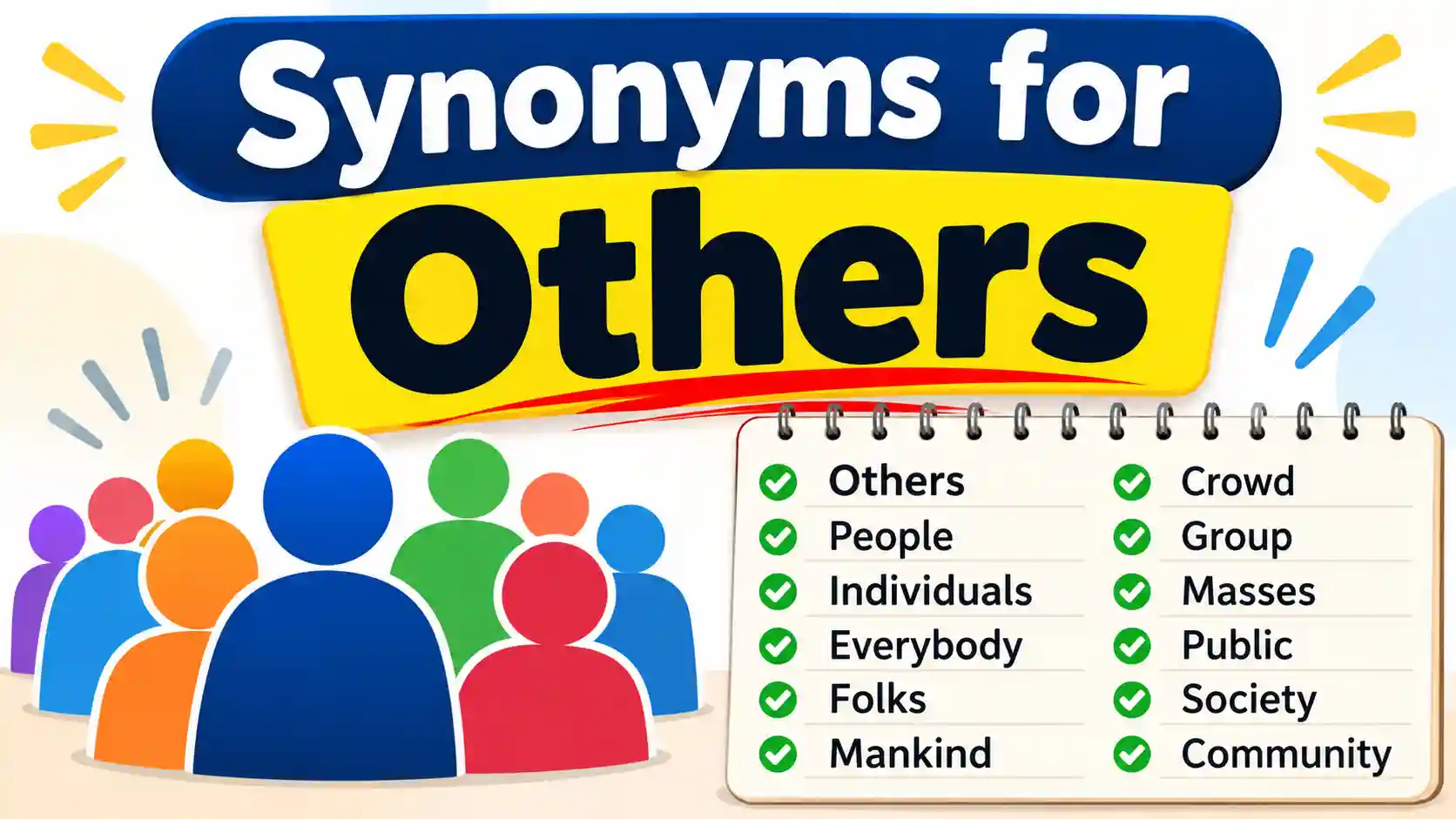
The best synonyms for others include other people, other individuals, the rest, everyone else, the remaining members, different people, and fellow human beings. Use other people for general references, the rest for remaining members, and everyone else when you mean all the other people in a group.
Some people enjoy working alone, while others prefer working in a team. Have you noticed how often the word others appears in everyday English?
The word helps us talk about different people, things, or members of a group without naming each one. However, repeating it too often can make writing sound dull.
Learning the right synonyms for others can improve your essays, emails, blog posts, and conversations. A word like colleagues works for coworkers, while peers describes people at a similar level. These words have different meanings, so choosing carefully matters.
This guide explains 30 alternatives, with original examples, pronunciation, grammar advice, usage labels, and practical exercises.
Pronunciation of Others
| Feature | Details |
| Word | Others |
| American IPA | /ˈʌð.ɚz/ |
| British IPA | /ˈʌð.əz/ |
| Simple pronunciation | UTH-erz |
| Syllables | Two |
| Stress | First syllable |
The voiced TH sound is the same sound you hear in this, that, and they.
Part of Speech and Meaning
Others is a plural pronoun. It refers to people or things that are different from, or additional to, those already mentioned.
Examples:
- Some people like summer; others prefer winter.
- These books are mine, but the others belong to my sister.
It can also be described as the plural noun use of others in traditional dictionary classifications.
| Word | Grammatical role | Example |
| Other | Determiner | Other students arrived. |
| Others | Pronoun | Others arrived. |
| Another | Determiner/pronoun | Another student arrived. |
| The others | Definite plural pronoun | The others arrived. |
Grammar Rules and Sentence Patterns
1. Some … others
Some people prefer tea, while others prefer coffee.
2. Others + plural verb
Others believe the decision was unfair.
3. Help others
Volunteers help others in their community.
4. Others’ + noun
Others’ opinions can teach us something new.
5. Each other
The two classmates help each other.
6. One another
The team members respect one another.
Remember that each other and one another describe mutual relationships. They are not direct substitutes for the ordinary plural pronoun others.
Word Origin and Etymology
Others come from Old English ōþer, which meant the second of two, different, or additional. The plural others developed from the noun-like use of other.
The word has Germanic roots and is related to Old High German andar, German ander, and Gothic anþar.
- First recorded use of another: Before 900 CE.
- Historical meaning: A different person or thing, or the remaining one.
- Development: From Old English into Middle English and modern English.
The first known use of others is not necessarily the first known use of every modern meaning of others.
Etymology, Origin & Meaning+2
Synonyms for Others: Quick Comparison Table
| Synonym | Strength | Formality |
| Other people | Strongest | Neutral |
| Other individuals | Strongest | Formal |
| The rest | Strongest | Neutral |
| The remainder | Strong | Formal |
| Everyone else | Strong | Neutral |
| Everybody else | Strong | Neutral |
| Different people | Strong | Neutral |
| Other members | Strong | Neutral |
| Remaining members | Strong | Formal |
| Other persons | Strong | Formal |
| Someone else | Context-dependent | Neutral |
| Somebody else | Context-dependent | Neutral |
| Additional people | Context-dependent | Formal |
| More people | Context-dependent | Neutral |
| Fellow human beings | Related | Literary |
| Peers | Related | Academic |
| Colleagues | Related | Business |
| Associates | Related | Business |
| Companions | Related | Neutral |
| Counterparts | Related | Formal |
| Participants | Related | Academic |
| Individuals | Related | Formal |
| Folks | Related | Informal |
| Outsiders | Related | Neutral |
| Third parties | Related | Legal |
| The remaining ones | Context-dependent | Neutral |
| The rest of them | Context-dependent | Spoken |
| Other groups | Context-dependent | Neutral |
| Other parties | Context-dependent | Formal |
| Other human beings | Related | Neutral |
30 Best Synonyms for Others With Examples and Explanations
The following alternatives are organized by meaning. CEFR and frequency labels are approximate learner guidance, not official dictionary or corpus measurements.
1. Other People
Meaning: People who are different from those already mentioned.
Examples:
- We should respect other people and their opinions.
- Other people may have better solutions to this problem.
- Best used when: Talking about different people generally.
- Tone: Neutral
- CEFR: A2
- Frequency: Very common
- Register: Spoken, general, academic
- Collocations: Other people’s views, other people around, respect other people.
- Nuance: One of the closest alternatives to others when referring to people.
- When not to use: When you mean the remaining objects in a collection.
2. Other Individuals
Meaning: Different people considered separately.
Examples:
- Other individuals may qualify for financial support.
- The researchers interviewed other individuals from the community.
- Best used when: Writing reports and research papers.
- Tone: Formal
- CEFR: B2
- Frequency: Common
- Register: Academic, professional
- Collocations: Other individuals involved, affected individuals, individual differences.
- Nuance: More formal and precise than other people.
- When not to use: In friendly everyday conversations where simpler wording sounds better.
3. The Rest
Meaning: The people or things that remain.
Examples:
- Three students finished early, but the rest needed more time.
- I used two notebooks and saved the rest for next week.
- Best used when: Referring to remaining members of a known group.
- Tone: Neutral
- CEFR: A2
- Frequency: Very common
- Register: Spoken, general, written
- Collocations: The rest of the team, the rest of the day, the rest of the group.
- Nuance: Focuses on what remains.
- When not to use: When talking about an unrelated group.
4. The Remainder
Meaning: The part or members left after some have been taken away or used.
Examples:
- The remainder of the class completed the examination.
- She donated the remainder of her collection.
- Best used when: Discussing remaining amounts, items, or group members.
- Tone: Formal
- CEFR: B2
- Frequency: Common
- Register: Academic, business
- Collocations: Remainder of the group, remaining balance, remainder of the amount.
- Nuance: More formal than the rest.
- When not to use: In casual conversations where the rest is more natural.
5. Everyone Else
Meaning: All people except the person or group already mentioned.
Examples:
- Everyone else agreed with the teacher’s suggestion.
- I arrived early, but everyone else was late.
- Best used when: Referring to all remaining people.
- Tone: Neutral
- CEFR: A2
- Frequency: Very common
- Register: Spoken, general
- Collocations: Everyone else involved, everyone else agrees, everyone else present.
- Nuance: Means all other people, not just a few.
- When not to use: When you mean only some additional people.
6. Everybody Else
Meaning: All the people apart from a particular person or group.
Examples:
- Everybody else enjoyed the school trip.
- She completed her work before everybody else.
- Best used when: Talking about an entire remaining group.
- Tone: Neutral
- CEFR: A2
- Frequency: Very common
- Register: Spoken, informal
- Collocations: Everybody else knows, everybody else agrees, everybody else involved.
- Nuance: Has almost the same meaning as everyone else.
- When not to use: When only a small number of additional people are meant.
7. Different People
Meaning: People who are not the same as those already mentioned.
Examples:
- Different people have different ways of learning.
- We invited different people to share their experiences.
- Best used when: Emphasizing differences between individuals or groups.
- Tone: Neutral
- CEFR: A2
- Frequency: Very common
- Register: General, spoken
- Collocations: Different people think, different people prefer, different people involved.
- Nuance: Highlights differences rather than remaining members.
- When not to use: When referring to all the remaining members of a known group.
8. Other Members
Meaning: Additional people belonging to the same group or organization.
Examples:
- Other members supported the committee’s decision.
- She discussed the proposal with other members of the club.
- Best used when: Discussing teams, clubs, and organizations.
- Tone: Neutral
- CEFR: B1
- Frequency: Common
- Register: Professional, academic
- Collocations: Other team members, other members present, other members involved.
- Nuance: Makes group membership clear.
- When not to use: For unrelated people outside the group.
9. Remaining Members
Meaning: People who are still part of a group after some have left or been removed.
Examples:
- The remaining members continued the meeting.
- All remaining members received an email from the manager.
- Best used when: Describing people who stay in a group.
- Tone: Neutral / Formal
- CEFR: B2
- Frequency: Common
- Register: Business, academic
- Collocations: Remaining members of the team, remaining members present, remaining members involved.
- Nuance: More precise than others when referring to a specific group.
- When not to use: When discussing different groups rather than remaining members.
10. Other Persons
Meaning: Additional or different human beings.
Examples:
- The rules protect other persons from unfair treatment.
- The organization collected information about other persons involved.
- Best used when: Formal or legal writing requires an explicit reference to people.
- Tone: Formal
- CEFR: B2
- Frequency: Common in formal documents
- Register: Legal, administrative
- Collocations: Other persons involved, other persons affected, other persons present.
- Nuance: Sounds more official than other people.
- When not to use: In natural everyday conversation.
11. Someone Else
Meaning: A different or additional person.
Examples:
- Someone else may know how to solve this problem.
- Please ask someone else to review the document.
- Best used when: Referring to one unspecified person.
- Tone: Neutral
- CEFR: A2
- Frequency: Very common
- Register: Spoken, general
- Collocations: Someone else available, someone else’s opinion, someone else responsible.
- Nuance: Singular, not a direct plural replacement for others.
- When not to use: When you mean several people.
12. Somebody Else
Meaning: Another person whose identity is not known or specified.
Examples:
- Somebody else left a message on my desk.
- I thought somebody else had booked the room.
- Best used when: Referring to an unspecified person.
- Tone: Neutral / Spoken
- CEFR: A2
- Frequency: Very common
- Register: Informal, spoken
- Collocations: Somebody else involved, somebody else’s responsibility, somebody else available.
- Nuance: Very close in meaning to someone else.
- When not to use: When referring to a group of people.
13. Additional People
Meaning: Extra people added to an existing number or group.
Examples:
- We need additional people to manage the event.
- Additional people joined the training session.
- Best used when: Discussing extra workers, guests, or participants.
- Tone: Formal
- CEFR: B1
- Frequency: Common
- Register: Business, administrative
- Collocations: Additional people required, additional people involved, additional people needed.
- Nuance: Emphasizes an increase in number.
- When not to use: When you simply mean different people.
14. More People
Meaning: A greater number of people.
Examples:
- More people are using online learning tools.
- We invited more people to the second meeting.
- Best used when: Talking about an increase in the number of people.
- Tone: Neutral
- CEFR: A1
- Frequency: Very common
- Register: Spoken, general
- Collocations: More people needed, more people interested, more people involved.
- Nuance: Focuses on quantity rather than difference.
- When not to use: When you mean a specific remaining group.
15. Fellow Human Beings
Meaning: Other people who share the human experience.
Examples:
- We should show kindness to our fellow human beings.
- Helping fellow human beings can make communities stronger.
- Best used when: Discussing humanity, kindness, and social responsibility.
- Tone: Warm / Literary
- CEFR: B1
- Frequency: Common
- Register: Literary, formal, spoken
- Collocations: Fellow human beings, fellow citizens, fellow members.
- Nuance: Highlights shared humanity.
- When not to use: As a routine replacement for others in ordinary sentences.
16. Peers
Meaning: People who have a similar age, status, experience, or position.
Examples:
- Students often learn valuable skills from their peers.
- She received positive feedback from her professional peers.
- Best used when: Talking about people at a similar level.
- Tone: Neutral / Formal
- CEFR: B2
- Frequency: Common
- Register: Academic, professional
- Collocations: Peer group, peer pressure, professional peers.
- Nuance: Suggests similarity in status or experience.
- When not to use: When referring to people with no shared level or position.
17. Colleagues
Meaning: People who work with you in the same organization or profession.
Examples:
- My colleagues helped me prepare the presentation.
- She discussed the new policy with her colleagues.
- Best used when: Discussing professional relationships.
- Tone: Neutral / Formal
- CEFR: B1
- Frequency: Very common
- Register: Business, professional
- Collocations: Close colleagues, work colleagues, professional colleagues.
- Nuance: Refers specifically to people connected through work.
- When not to use: For unrelated people or ordinary classmates.
18. Associates
Meaning: People connected through business, work, or an activity.
Examples:
- He invited his business associates to the conference.
- The director discussed the project with several associates.
- Best used when: Describing professional or business connections.
- Tone: Formal
- CEFR: B2
- Frequency: Common
- Register: Business, professional
- Collocations: Business associates, professional associates, close associates.
- Nuance: Suggests a connection without necessarily implying friendship.
- When not to use: For ordinary friends or family.
19. Companions
Meaning: People who spend time with or accompany someone.
Examples:
- The travelers met several companions during their journey.
- She enjoyed spending time with her companions.
- Best used when: Describing shared experiences or friendship.
- Tone: Neutral / Literary
- CEFR: B1
- Frequency: Common
- Register: Spoken, literary
- Collocations: Travel companions, loyal companions, close companions.
- Nuance: Suggests togetherness.
- When not to use: When you simply mean unrelated people.
20. Counterparts
Meaning: People with similar roles or positions in different organizations or groups.
Examples:
- The managers met their counterparts from another company.
- British teachers shared ideas with their American counterparts.
- Best used when: Comparing people with similar responsibilities.
- Tone: Formal
- CEFR: C1
- Frequency: Common
- Register: Business, academic
- Collocations: International counterparts, foreign counterparts, professional counterparts.
- Nuance: Emphasizes matching roles.
- When not to use: For people who do not have comparable positions.
21. Participants
Meaning: People who take part in an event, activity, or study.
Examples:
- Other participants asked questions during the workshop.
- The researchers interviewed participants from different cities.
- Best used when: Discussing events, surveys, competitions, or research.
- Tone: Formal
- CEFR: B2
- Frequency: Common
- Register: Academic, professional
- Collocations: Study participants, event participants, other participants.
- Nuance: Identifies people through their involvement.
- When not to use: For people who are not taking part in the activity.
22. Individuals
Meaning: Separate people considered as distinct persons.
Examples:
- Individuals have different learning needs.
- The program provides support to individuals in need.
- Best used when: Emphasizing separate people rather than a group.
- Tone: Formal
- CEFR: B2
- Frequency: Common
- Register: Academic, professional
- Collocations: Private individuals, affected individuals, individual rights.
- Nuance: More formal than people.
- When not to use: When a simple everyday phrase would be clearer.
23. Folks
Meaning: An informal word for people.
Examples:
- Some folks prefer studying early in the morning.
- The local folks welcomed the visitors.
- Best used when: Talking casually about people or a community.
- Tone: Friendly / Informal
- CEFR: B1
- Frequency: Common
- Register: Spoken, informal
- Collocations: Local folks, young folks, folks around here.
- Nuance: Has a warm and conversational feeling, especially in American English.
- When not to use: In formal research papers or legal documents.
24. Outsiders
Meaning: People who do not belong to a particular group.
Examples:
- Outsiders were not allowed into the private meeting.
- The club welcomed outsiders who wanted to learn.
- Best used when: Describing people outside an organization or community.
- Tone: Neutral / Context-dependent
- CEFR: B2
- Frequency: Common
- Register: General, social, political
- Collocations: Political outsiders, complete outsiders, social outsiders.
- Nuance: Can suggest exclusion or separation.
- When not to use: When you mean different members of the same group.
25. Third Parties
Meaning: People or organizations that are not the two main sides in a situation.
Examples:
- Third parties may review the agreement.
- The company shared the information with no outside third parties.
- Best used when: Discussing contracts, legal matters, and business arrangements.
- Tone: Formal
- CEFR: C1
- Frequency: Common
- Register: Legal, business
- Collocations: Third-party services, third-party involvement, third-party access.
- Nuance: Identifies an additional party outside the main relationship.
- When not to use: For ordinary people in a casual group.
26. The Remaining Ones
Meaning: The people or things left after some have been selected or removed.
Examples:
- We checked the remaining ones before closing the store.
- Two chairs were broken, but the remaining ones were safe.
- Best used when: Referring to items or members left from a known group.
- Tone: Neutral
- CEFR: B1
- Frequency: Common
- Register: General, spoken
- Collocations: Remaining ones available, remaining ones selected, remaining ones unchanged.
- Nuance: Can refer to both people and things.
- When not to use: When discussing a completely separate group.
27. The Rest of Them
Meaning: All the remaining people or things in a known group.
Examples:
- Two guests arrived early, but the rest of them came later.
- I completed three assignments and will finish the rest of them tomorrow.
- Best used when: Referring back to a previously mentioned group.
- Tone: Neutral
- CEFR: B1
- Frequency: Very common
- Register: Spoken, general
- Collocations: The rest of them arrived, the rest of them agreed, the rest of them stayed.
- Nuance: Conversational and specific.
- When not to use: When the group has not been identified.
28. Other Groups
Meaning: Groups that are different from the group already mentioned.
Examples:
- Other groups also participated in the competition.
- The research included other groups from nearby communities.
- Best used when: Comparing separate teams or communities.
- Tone: Neutral
- CEFR: B1
- Frequency: Common
- Register: Academic, general
- Collocations: Other groups involved, other groups affected, other groups participating.
- Nuance: Refers to whole groups, not individual people.
- When not to use: When you mean individual members.
29. Other Parties
Meaning: Other people or organizations involved in a situation or agreement.
Examples:
- Other parties must approve the proposed agreement.
- The lawyer contacted the other parties involved in the case.
- Best used when: Discussing agreements, negotiations, and legal matters.
- Tone: Formal
- CEFR: C1
- Frequency: Common in specialist writing
- Register: Legal, business
- Collocations: Interested parties, involved parties, affected parties.
- Nuance: Can refer to individuals, businesses, or organizations.
- When not to use: In everyday conversations about friends or classmates.
30. Other Human Beings
Meaning: People other than the person or people already mentioned.
Examples:
- We should consider how our decisions affect other human beings.
- Good communication helps us understand other human beings.
- Best used when: Discussing human behavior, society, and relationships.
- Tone: Neutral / Literary
- CEFR: B1
- Frequency: Common
- Register: Literary, academic, general
- Collocations: Other human beings, respect human beings, treatment of human beings.
- Nuance: Emphasizes that the people being discussed are human.
- When not to use: When a shorter expression such as other people is clearer.
Strongest Synonyms, Strong Synonyms, and Related Words
Not every alternative has the same meaning. This classification helps you select the right expression.
Strongest Synonyms
These are the closest alternatives when referring to different people or remaining group members.
- Other people
- Other individuals
- The rest
- Everyone else
- Everybody else
- Different people
- Other members
- Remaining members
Strong Synonyms
These work well in particular contexts.
- The remainder
- Other persons
- Additional people
- More people
- The remaining ones
- The rest of them
- Other groups
Related Words
These are useful alternatives in specific situations, but they are not direct replacements in every sentence.
- Peers
- Colleagues
- Associates
- Companions
- Counterparts
- Participants
- Individuals
- Folks
- Outsiders
- Third parties
- Other parties
- Fellow human beings
- Other human beings
Choose the Right Synonym: Side by Side Comparisons
Consider this sentence:
“Some employees supported the proposal, while others opposed it.”
Here are several ways to rewrite it.
| Alternative | Rewritten sentence | Meaning |
| Other employees | Other employees opposed it. | Different employees |
| The rest | The rest opposed it. | Remaining employees |
| Everyone else | Everyone else opposed it. | All remaining employees |
| The remaining members | The remaining members opposed it. | Members left in the group |
| Other individuals | Other individuals opposed it. | Different people |
| Colleagues | Colleagues opposed it. | Coworkers, if established by context |
Five Important Context Differences
1. Other people vs. the rest
- Other people may have different ideas.
- The rest may have different ideas.
The first refers to different people. The second refers to those remaining in an identified group.
2. Others vs. everyone else
- Others supported the decision.
- Everyone else supported the decision.
The first does not necessarily include all remaining people. The second does.
3. Peers vs. colleagues
- My peers reviewed my work.
- My colleagues reviewed my work.
Peers share a similar level or status. Colleagues share a professional or work connection.
4. Additional people vs. different people
- We need additional people.
- We need different people.
Additional means more people. Different means people who are not the same as those already mentioned.
5. Someone else vs. others
- Someone else can help.
- Others can help.
The first refers to one unspecified person. The second refers to multiple people.
Commonly Confused Words
| Word | Main difference | Example |
| Other | Different or additional; usually before a noun | Other students arrived. |
| Others | Different or additional people/things | Others arrived. |
| Another | One more or a different one | Another student arrived. |
| The others | All remaining members of a known group | The others arrived. |
| Each other | A mutual relationship | They helped each other. |
A Simple Grammar Formula
- Other + plural noun: other students
- Another + singular countable noun: another student
- Others: others arrived
- The others: the others arrived
- Each other: they respect each other
Common Mistakes to Avoid
Mistake 1: Using others before a noun
Incorrect:
Other students attended the class.
Correct:
Other students attended the class.
Why? Use other before a plural noun. Others normally stand alone.
Mistake 2: Using another with a plural noun
Incorrect:
Other people joined the event.
Correct:
Other people joined the event.
Why? Another normally takes a singular countable noun.
Mistake 3: Confusing others and the others
Incorrect for a specific remaining group:
Others are the only students left.
Better:
The others are the only students left.
Why? The definite article identifies the particular remaining group.
Mistake 4: Using a singular verb
Incorrect:
Others are waiting outside.
Correct:
Others are waiting outside.
Why? Others are plural and normally take a plural verb.
Mistake 5: Treating each other as a synonym
Incorrect:
We should respect each other’s people.
Correct:
We should respect other people.
Why? Each other describes a mutual relationship, not a group of additional people.
American vs. British English
The spelling of others is identical in American and British English. Its core meaning and grammar are also the same.
| Feature | American English | British English |
| Spelling | Others | Others |
| IPA | /ˈʌð.ɚz/ | /ˈʌð.əz/ |
| Other people | Common | Common |
| The rest | Common | Common |
| Colleagues | Common | Common |
| Folks | Especially common in casual speech | Understood and used |
| Additional people | Common | Common |
Pronunciation Tip
American English often uses a stronger rhotic sound in the final syllable. British English usually does not pronounce the final r in this position.
There is no need to memorize different spellings for this word.
Frequency and Register Guide
The following labels are practical guidance rather than measured frequency rankings.
| Expression | Frequency | Register |
| Other people | Very common | Neutral |
| The rest | Very common | Neutral |
| Everyone else | Very common | Spoken |
| Someone else | Very common | Spoken |
| More people | Very common | General |
| Colleagues | Common | Business |
| Peers | Common | Academic |
| Associates | Common | Professional |
| Participants | Common | Academic |
| Counterparts | Common | Formal |
| Outsiders | Common | Social |
| Third parties | Common | Legal |
| Other persons | Common in formal writing | Legal |
| Fellow human beings | Common | Literary |
Writing Tips: How to Use Synonyms Naturally
Essays
Use individuals, peers, and other people when discussing education, society, and human behavior.
Example:
“Some students prefer independent study, while others learn better in groups.”
Emails
Use colleagues, other team members, and additional people in professional communication.
Example:
“Please share the updated report with the other team members.”
Blog Posts
Use people, the rest, and everyone else to keep your content easy to read.
Example:
“Some readers enjoy detailed guides, while others prefer short articles.”
Stories
Use companions, strangers, and other characters when describing people.
Example:
“The traveler met several companions along the road.”
Social Media
Use folks and other people in friendly posts.
Example:
“Some folks love early mornings, while others enjoy staying up late.”
Professional Communication
Use associates, counterparts, and other parties when describing business relationships.
Example:
“Our managers will contact their international counterparts next week.”
Daily Conversations
Choose simple expressions such as someone else, the rest, and other people.
Example:
“Some people like coffee, while others prefer tea.”
Related Vocabulary
Antonyms and Contrasting Expressions
There is no single universal antonym for others. Its opposite depends on what you mean.
| Expression | Contrast |
| The same people | People already identified |
| The same ones | Identical people or things |
| Oneself | One’s own person |
| No one else | Nobody additional |
| Nobody | Not any person |
These are contextual contrasts, not exact antonyms in every sentence.
Related Expressions
- Among others: Including additional people or things.
- One another: A mutual relationship.
- Each other: A mutual action or feeling.
- Someone different: A different individual.
- Everyone else: All other people.
- Other than: Except for or different from.
- And others: Additional people or things not individually named.
Word Family
| Word | Part of speech | Meaning |
| Other | Determiner / pronoun | Different or additional |
| Others | Pronoun | Different or additional people/things |
| Another | Determiner / pronoun | One more or different |
| Otherwise | Adverb | In another way or if not |
| Otherness | Noun | The quality of being different |
Frequently Asked Questions (FAQs)
1. What are the 10 best synonyms for others?
The 10 useful alternatives are other people, other individuals, the rest, everyone else, everybody else, different people, remaining members, other members, the remainder, and other persons. Choose based on whether you mean different people or the remaining members of a group.
2. What is another word for others in formal writing?
Formal alternatives include other individuals, other persons, the remainder, remaining members, and participants. In academic writing, participants work when referring to people involved in research. In professional documents, other individuals are often a clear and natural choice.
3. What is a better word for others in an essay?
Other people, individuals, peers, and the remaining members can improve an essay when they match the intended meaning. For example, use peers when discussing students at a similar level. Avoid changing words simply to make your vocabulary sound more complicated.
4. What is the difference between others and other people?
Others is a plural pronoun that stands alone, while other people contains an adjective and a noun. Both can refer to different people. For example, “Others disagree” and “Other people disagree” are correct, although their sentence structures differ.
5. Is the rest a synonym for others?
Yes, the rest can replace others when referring to the remaining members of a known group. For example, “Some employees left early, while the rest stayed.” However, the rest emphasizes the remaining group rather than simply referring to different people.
6. Is others singular or plural?
Others are plural and normally take a plural verb. For example, “Others are waiting outside” is correct. Its singular alternatives depend on the context. You can use another for one additional person or thing and someone else for one different person.
7. What is the difference between others and the others?
Others refer to different or additional people or things without necessarily identifying a complete remaining group. The others refers to all the remaining members of a specific group. For example, “Others joined the meeting” and “The others joined the meeting” have different meanings.
8. What is a professional way to say something to others?
Professional alternatives include colleagues, associates, counterparts, other individuals, and other parties. Use colleagues for coworkers, counterparts for people with similar roles, and other parties for people or organizations involved in an agreement.
Vocabulary Practice: Test Your Knowledge
Try these five questions to check how well you understand the word others and its alternatives.
English vocabulary quiz
0/5 completed
1. Which expression refers to all remaining people?
A. Someone else
B. Everyone else
C. Another person
D. A colleague
2. Which word describes people working in the same organization?
A. Outsiders
B. Companions
C. Colleagues
D. Remainder
3. Which word is singular?
A. Others
B. Another
C. Individuals
D. Peers
4. Which word is most suitable for people at a similar professional level?
A. Outsiders
B. Peers
C. Folks
D. Remainder
5. Choose the grammatically correct sentence.
A. Other students arrived.
B. Another student arrived.
C. Other students arrived.
D. The other students arrived.
Check my answers
Conclusion
Learning synonyms for others helps you write better essays, create clearer emails, and communicate naturally. Words such as other people, the rest, individuals, and everyone else offer useful alternatives for different situations.
Focus on meaning, grammar, and tone instead of memorizing long lists. Practice these expressions in everyday conversations and professional writing to build stronger English skills.
Trusted References
- Cambridge Dictionary: Other: meaning, grammar and usage.
- Merriam-Webster: Other: definitions and grammatical forms.
- Collins Dictionary: Other: definitions and examples.
- Online Etymology Dictionary: History and origin of others.
- Dictionary.com: Other: meaning and etymology.

Synonorm is a trusted English vocabulary resource created to help readers find the right words and understand the differences between similar terms. We provide clear explanations of synonyms, meanings, examples, usage, and alternatives. Our content makes vocabulary easier to learn and apply in everyday, academic, and professional English. Synonorm is designed for students, writers, ESL learners, professionals, and anyone who wants to improve their English vocabulary and communicate more clearly.