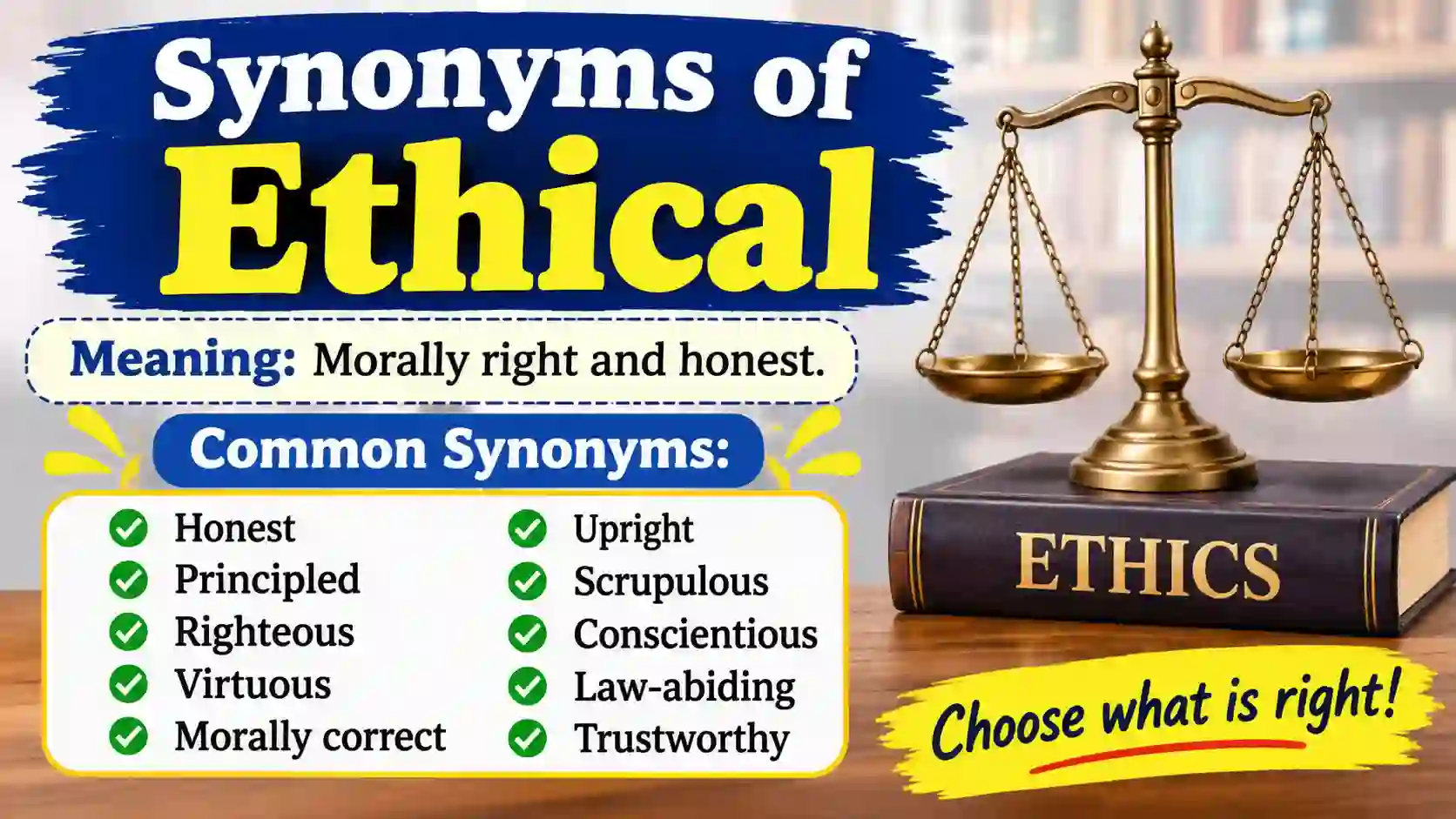
What Are the Synonyms of Ethical?
The best synonyms of ethical include moral, principled, honest, fair, just, virtuous, upright, honorable, conscientious, and scrupulous. These words describe people, actions, and decisions that follow standards of right and wrong. However, each word has a slightly different meaning. Some focus on honesty, while others emphasize fairness, personal values, or professional responsibility.
Have you ever needed to describe someone who always tries to do the right thing? You might call that person ethical. But using the same word repeatedly can make your writing sound dull.
Learning synonyms of ethics gives you more ways to express ideas about honesty, fairness, and good behavior. For example, you can describe an honest employee as principled, a fair decision as just, or a person with strong moral values as virtuous.
These alternatives are useful in school essays, business reports, professional emails, academic research, and everyday conversations.
In this guide, you will learn 30 synonyms of ethics, their meanings, examples, pronunciation guidance, and differences. You will also discover which words fit professional situations and which ones work better in casual English.
Pronunciation of Ethical
- IPA: /ˈeθɪkəl/
- Pronunciation: ETH-i-kuhl
- Syllables: 3
- Stress: First syllable
- Part of speech: Adjective
The pronunciation is essentially the same in American and British English.
Meaning of Ethical
Ethical describes something that follows accepted principles of right and wrong. It can refer to a person’s behavior, a company’s decisions, professional standards, or actions that respect other people.
For example:
- An ethical teacher treats students fairly.
- An ethical company respects its employees.
- Ethical research protects participants.
- An ethical decision considers possible harm to others.
The word has two closely connected uses:
- Relating to beliefs and principles about right and wrong.
- Morally correct or acceptable.
Word Origin and Etymology
The word ethical comes from the Greek word ethos, which relates to character, custom, and habits. It entered English through the word ethic, with the adjective-forming suffix -al.
Historical dictionary records place its first recorded English use around 1600–1610. This date refers to recorded evidence, not necessarily the first time someone used the word.
Today, ethics appear in discussions about medicine, education, research, business, technology, and personal behavior.
Part of Speech and Word Family
Ethical is an adjective. It describes a noun rather than naming an action.
Examples:
- Ethical behavior
- Ethical standards
- Ethical decisions
- Ethical business practices
Related Word Forms
| Word | Part of speech | Meaning |
| Ethic | Noun | A guiding moral principle |
| Ethics | Noun | Principles of right and wrong |
| Ethical | Adjective | Morally acceptable |
| Ethically | Adverb | In a morally acceptable way |
| Unethical | Adjective | Not morally acceptable |
| Ethicist | Noun | A person who studies ethics |
Grammar Rules for Ethical
Use these common sentence patterns:
| Pattern | Example |
| Ethical + noun | Ethical leadership builds trust. |
| Be ethical | Every business should be ethical. |
| Ethical to + verb | Is it ethical to share private information? |
| Ethical standards | The hospital follows ethical standards. |
| Ethically + verb | The company operates ethically. |
| On ethical grounds | The proposal was rejected on ethical grounds. |
Common grammar mistake:
Incorrect: The company behaves ethically.
Correct: The company behaves ethically.
Use ethical as an adjective and ethically as an adverb.
Synonyms of Ethical: Quick Comparison Table
| Synonym | Strength | Formality |
| Moral | Strongest | Neutral |
| Principled | Strongest | Formal |
| Honest | Strongest | Neutral |
| Fair | Strongest | Neutral |
| Just | Strong | Formal |
| Virtuous | Strong | Literary |
| Upright | Strong | Formal |
| Honorable | Strong | Formal |
| Conscientious | Strong | Formal |
| Scrupulous | Strong | Formal |
| Decent | Strong | Informal |
| Righteous | Strong | Literary |
| Responsible | Strong | Neutral |
| Impartial | Contextual | Formal |
| Unbiased | Contextual | Neutral |
| Equitable | Contextual | Academic |
| Trustworthy | Contextual | Neutral |
| Respectable | Contextual | Neutral |
| Right | Contextual | Neutral |
| Good | Contextual | Informal |
| Humane | Contextual | Formal |
| Noble | Contextual | Literary |
| Reputable | Related | Formal |
| Reproachable | Not a synonym | Formal |
| Aboveboard | Contextual | Informal |
The table contains a mixture of close and context-dependent alternatives. The detailed sections below explain their differences.
30 Best Synonyms of Ethical With Meanings and Examples
1. Moral
Meaning: Moral describes something that follows ideas about right and wrong.
Examples:
- The teacher encouraged moral behavior among her students.
- He made a moral choice despite strong pressure.
Best used when: Discussing general values and principles.
- Tone: Neutral
- CEFR: B1
- Frequency: Very common
- Register: Academic, spoken, general
- Collocations: Moral values, moral principles, moral responsibility
- Nuance: The closest general alternative to ethics.
- When not to use: Avoid it when you specifically mean professional rules or standards.
2. Principled
Meaning: A principled person follows strong beliefs about what is right.
Examples:
- Our manager made a principled decision during the dispute.
- She remained principled when others offered her money.
Best used when: Describing people who refuse to abandon their values.
- Tone: Formal
- CEFR: C1
- Frequency: Common
- Register: Professional, academic
- Collocations: Principled decision, principled leader, principled approach
- Nuance: Emphasizes commitment and consistency.
- When not to use: Do not use it simply to mean truthful.
3. Honest
Meaning: Honest means telling the truth and avoiding cheating or deception.
Examples:
- An honest employee reports every mistake.
- She gave an honest answer about the project’s results.
Best used when: Discussing truthfulness and trust.
- Tone: Neutral
- CEFR: A2
- Frequency: Very common
- Register: Spoken, business, general
- Collocations: Honest person, honest answer, honest business
- Nuance: Focuses on truth rather than every aspect of morality.
- When not to use: Avoid it when fairness is the main issue.
4. Fair
Meaning: Fair means treating people reasonably without favoritism.
Examples:
- The company promised a fair hiring process.
- A fair teacher listens to every student’s opinion.
Best used when: Discussing equal treatment and unbiased decisions.
- Tone: Neutral
- CEFR: A2
- Frequency: Very common
- Register: Spoken, professional
- Collocations: Fair treatment, fair decision, fair competition
- Nuance: Emphasizes reasonable and equal treatment.
- When not to use: Fairness alone does not cover every moral responsibility.
5. Just
Meaning: Just means fair and morally right.
Examples:
- The judge reached a just decision.
- Everyone deserves a just opportunity to succeed.
Best used when: Discussing justice, rights, and fair treatment.
- Tone: Formal
- CEFR: B2
- Frequency: Common
- Register: Legal, academic, formal
- Collocations: Just decision, just society, just cause
- Nuance: Focuses on fairness and justice.
- When not to use: Avoid it when you simply mean truthful.
6. Virtuous
Meaning: Virtuous describes someone with very good moral qualities.
Examples:
- Her virtuous actions inspired the entire community.
- He earned respect through his virtuous behavior.
Best used when: Praising someone with excellent moral character.
- Tone: Literary
- CEFR: C1
- Frequency: Common
- Register: Literary, formal
- Collocations: Virtuous person, virtuous life, virtuous behavior
- Nuance: Stronger and more praising than ethical.
- When not to use: Avoid it in ordinary business descriptions.
7. Upright
Meaning: Upright describes someone who behaves honestly and follows good moral standards.
Examples:
- Everyone trusted the upright community leader.
- She was known as an upright citizen.
Best used when: Describing a person’s strong moral character.
- Tone: Formal
- CEFR: C1
- Frequency: Common
- Register: Formal, literary
- Collocations: Upright citizen, upright character, morally upright
- Nuance: Suggests integrity and honesty.
- When not to use: Do not confuse it with the physical meaning of standing straight.
8. Honorable (Honourable)
Meaning: Honorable describes behavior that deserves respect.
Examples:
- The officer made an honorable choice.
- She kept her promise when it became difficult.
Best used when: Discussing dignity, integrity, and respect.
- Tone: Formal
- CEFR: B2
- Frequency: Common
- Register: Professional, literary
- Collocations: Honorable conduct, honorable decision, honorable person
- Nuance: Emphasizes dignity and respect.
- When not to use: It is not always suitable for technical ethical standards.
American English uses honorable, while British English generally uses honourable.
9. Conscientious
Meaning: Conscientious means taking care to do your duties properly and responsibly.
Examples:
- A conscientious researcher checks every source.
- She is a conscientious employee who respects company rules.
Best used when: Describing careful and responsible professional behavior.
- Tone: Formal
- CEFR: C1
- Frequency: Common
- Register: Academic, business
- Collocations: Conscientious employee, conscientious effort, conscientious decision
- Nuance: Combines care, duty, and responsibility.
- When not to use: Do not use it simply to describe someone who tells the truth.
10. Scrupulous
Meaning: Scrupulous means being very careful to follow moral or professional standards.
Examples:
- The accountant was scrupulous about reporting expenses.
- The scientist followed scrupulous research practices.
Best used when: Describing careful attention to moral details.
- Tone: Formal
- CEFR: C1
- Frequency: Uncommon
- Register: Academic, legal, professional
- Collocations: Scrupulous honesty, scrupulous attention, scrupulous care
- Nuance: Suggests exceptional care about avoiding wrongdoing.
- When not to use: Avoid it for ordinary tasks without a moral dimension.
11. Decent
Meaning: Decent means behaving in a good and acceptable way.
Examples:
- A decent employer respects workers’ rights.
- He made a decent effort to treat everyone fairly.
Best used when: Describing everyday acceptable behavior.
- Tone: Neutral
- CEFR: B1
- Frequency: Very common
- Register: Spoken, informal
- Collocations: Decent person, decent behavior, decent treatment
- Nuance: Less formal and usually less powerful than ethical.
- When not to use: Avoid it when discussing strict professional standards.
12. Righteous
Meaning: Righteous means morally right and strongly committed to good behavior.
Examples:
- The community supported her righteous efforts.
- He stood up for what he believed was right.
Best used when: Discussing strong moral or religious beliefs.
- Tone: Literary
- CEFR: C1
- Frequency: Common
- Register: Literary, religious, formal
- Collocations: Righteous cause, righteous anger, righteous behavior
- Nuance: Carries a strong moral feeling.
- When not to use: Avoid it when an objective, neutral tone is needed.
13. Responsible
Meaning: Responsible means doing your duties and accepting the results of your actions.
Examples:
- The business follows responsible advertising practices.
- Responsible leaders consider how their choices affect others.
Best used when: Discussing duties and accountability.
- Tone: Neutral
- CEFR: B1
- Frequency: Very common
- Register: Business, spoken, academic
- Collocations: Responsible behavior, responsible leadership, responsible business
- Nuance: Focuses on duty and consequences.
- When not to use: Responsibility alone does not prove that an action is morally right.
14. Impartial
Meaning: Impartial means treating everyone fairly without supporting one side.
Examples:
- The committee selected an impartial judge.
- An impartial review considered every application.
Best used when: Discussing decisions without favoritism.
- Tone: Formal
- CEFR: C1
- Frequency: Common
- Register: Legal, academic, professional
- Collocations: Impartial judgment, impartial observer, impartial investigation
- Nuance: Focuses on neutrality.
- When not to use: Avoid it when discussing personal honesty alone.
15. Unbiased
Meaning: Unbiased means having no unfair preference for one person or side.
Examples:
- The journalist provided an unbiased report.
- We need unbiased feedback before changing the policy.
Best used when: Discussing research, reviews, and reporting.
- Tone: Neutral
- CEFR: B2
- Frequency: Common
- Register: Academic, media, business
- Collocations: Unbiased opinion, unbiased review, unbiased information
- Nuance: Emphasizes freedom from prejudice.
- When not to use: An unbiased decision can still be morally wrong.
16. Equitable
Meaning: Equitable means fair and reasonable for everyone involved.
Examples:
- The company introduced an equitable payment system.
- Students deserve equitable access to learning resources.
Best used when: Discussing policies, rights, and resource distribution.
- Tone: Formal
- CEFR: C1
- Frequency: Common
- Register: Academic, legal, business
- Collocations: Equitable access, equitable treatment, equitable distribution
- Nuance: Often considers different needs rather than simply giving everyone the same thing.
- When not to use: Do not assume equitable always means exactly equal.
17. Trustworthy
Meaning: Trustworthy describes someone or something that can be trusted.
Examples:
- We need a trustworthy partner for this project.
- The organization has built a trustworthy reputation.
Best used when: Describing reliable people, organizations, and information sources.
- Tone: Neutral
- CEFR: B2
- Frequency: Common
- Register: Professional, spoken
- Collocations: Trustworthy source, trustworthy person, trustworthy organization
- Nuance: Focuses on reliability and trust.
- When not to use: A trustworthy person is not automatically ethical in every action.
18. Respectable
Meaning: Respectable describes behavior or a reputation that people consider worthy of respect.
Examples:
- The company has a respectable record of employee treatment.
- He built a respectable business through honest work.
Best used when: Discussing reputation and accepted social standards.
- Tone: Neutral
- CEFR: B2
- Frequency: Common
- Register: General, professional
- Collocations: Respectable reputation, respectable conduct, respectable business
- Nuance: Focuses on public respect.
- When not to use: Social approval does not always prove moral goodness.
19. Good
Meaning: Good describes something that meets positive moral or social standards.
Examples:
- She made a good choice by protecting the customer’s privacy.
- A good manager treats employees with respect.
Best used when: Using simple everyday English to discuss positive behavior.
- Tone: Neutral
- CEFR: A1
- Frequency: Very common
- Register: Spoken, informal
- Collocations: Good behavior, good intentions, good character
- Nuance: Broad and less precise than ethical.
- When not to use: Avoid it in academic writing when a more exact word is available.
20. Right
Meaning: Right can describe an action that is morally correct.
Examples:
- Returning the lost money was the right thing to do.
- She believed that protecting the workers was right.
Best used when: Discussing simple moral choices.
- Tone: Neutral
- CEFR: A1
- Frequency: Very common
- Register: Spoken, general
- Collocations: Right decision, right thing, morally right
- Nuance: Simple and direct.
- When not to use: Avoid it when discussing a detailed professional code of ethics.
21. Humane
Meaning: Humane means showing kindness and concern for people or animals.
Examples:
- The shelter follows humane animal-care practices.
- Doctors should support humane treatment for every patient.
Best used when: Discussing dignity, compassion, and the prevention of suffering.
- Tone: Formal
- CEFR: C1
- Frequency: Common
- Register: Academic, professional
- Collocations: Humane treatment, humane conditions, humane approach
- Nuance: Focuses on kindness and compassion.
- When not to use: It is not a general replacement for every ethical decision.
22. Noble
Meaning: Noble means showing high moral qualities or a desire to do good.
Examples:
- Helping poor families was a noble goal.
- She made a noble effort to protect the community.
Best used when: Praising generous or admirable actions.
- Tone: Literary
- CEFR: B2
- Frequency: Common
- Register: Literary, formal
- Collocations: Noble cause, noble intention, noble effort
- Nuance: Expresses admiration and respect.
- When not to use: Avoid it for ordinary technical rules.
23. Upstanding
Meaning: Upstanding describes a person who behaves honestly and respects moral standards.
Examples:
- The town respected him as an upstanding citizen.
- She built a career as an upstanding professional.
Best used when: Praising someone’s character and reputation.
- Tone: Neutral
- CEFR: C1
- Frequency: Common
- Register: General, formal
- Collocations: Upstanding citizen, upstanding member, upstanding individual
- Nuance: Describes a person’s good reputation and character.
- When not to use: It is less natural for describing a specific policy or procedure.
24. Reputable
Meaning: Reputable means having a good reputation and being respected.
Examples:
- The school hired a reputable research organization.
- Customers prefer reputable companies with clear policies.
Best used when: Discussing the public reputation of an organization or person.
- Tone: Formal
- CEFR: B2
- Frequency: Common
- Register: Business, professional
- Collocations: Reputable company, reputable source, reputable organization
- Nuance: Focuses on public trust and reputation.
- When not to use: A good reputation does not guarantee ethical behavior.
25. Aboveboard
Meaning: Aboveboard means honest, open, and free from hidden dishonest activity.
Examples:
- All financial dealings must remain aboveboard.
- The agreement was completely aboveboard.
Best used when: Describing honest transactions and business dealings.
- Tone: Informal
- CEFR: C1
- Frequency: Uncommon
- Register: Spoken, informal, business
- Collocations: Completely aboveboard, keep something aboveboard, aboveboard dealings
- Nuance: Suggests that nothing dishonest is hidden.
- When not to use: Avoid it in highly formal academic definitions.
26. High-minded
Meaning: High-minded describes someone who follows strong moral or idealistic beliefs.
Examples:
- The high-minded leader refused to misuse public funds.
- Her high-minded goals focused on improving education.
Best used when: Describing idealistic people and their moral goals.
- Tone: Literary
- CEFR: C1
- Frequency: Uncommon
- Register: Literary, formal
- Collocations: High-minded ideals, high-minded principles, high-minded person
- Nuance: Suggests noble intentions and elevated standards.
- When not to use: It can sound overly praising or unrealistic in ordinary conversation.
27. Incorruptible
Meaning: Incorruptible describes someone who cannot be persuaded to act dishonestly for personal gain.
Examples:
- The community regarded the judge as incorruptible.
- She remained incorruptible despite repeated attempts to influence her.
Best used when: Discussing resistance to bribery, corruption, and misuse of power.
- Tone: Formal
- CEFR: C1
- Frequency: Uncommon
- Register: Legal, political, literary
- Collocations: Incorruptible judge, incorruptible leader, incorruptible character
- Nuance: Stronger than ethical because it emphasizes resistance to corruption.
- When not to use: Do not use it as a general alternative for every morally acceptable action.
28. Fitting
Meaning: Fitting means suitable or appropriate for a particular situation.
Examples:
- The committee chose a fitting response to the complaint.
- Her decision was fitting for the circumstances.
Best used when: Describing actions that are suitable or appropriate.
- Tone: Neutral
- CEFR: B2
- Frequency: Common
- Register: General, formal
- Collocations: Fitting response, fitting choice, fitting conclusion
- Nuance: Focuses on suitability rather than moral goodness.
- When not to use: Do not replace ethical with fitting when morality is the main issue.
29. Right minded
Meaning: Right-minded describes someone with sensible and morally acceptable beliefs.
Examples:
- Right-minded citizens supported fair treatment for workers.
- The proposal attracted support from right-minded community members.
Best used when: Describing people who support reasonable moral standards.
- Tone: Literary
- CEFR: C1
- Frequency: Uncommon
- Register: Literary, spoken
- Collocations: Right-minded person, right-minded people, right-minded approach
- Nuance: Expresses approval of someone’s beliefs.
- When not to use: Avoid it when an objective or neutral tone is important.
30. Even handed
Meaning: Even-handed means treating all people or sides fairly.
Examples:
- The editor gave an even-handed account of the disagreement.
- The manager took an even-handed approach to employee complaints.
Best used when: Discussing fair treatment and balanced decisions.
- Tone: Neutral
- CEFR: C1
- Frequency: Common
- Register: Professional, academic, spoken
- Collocations: Even-handed approach, even-handed treatment, even-handed judgment
- Nuance: Emphasizes fairness between different people or groups.
- When not to use: It does not describe all aspects of moral behavior.
Strongest, Strong, and Contextual Synonyms of Ethical
Not all alternatives are equally close to the original word.
Strongest Synonyms
These words work as close alternatives in many situations:
- Moral
- Principled
- Just
- Honest
- Fair
- Upright
- Virtuous
- Honorable
Strong Synonyms
These describe specific aspects of ethical behavior:
- Conscientious
- Scrupulous
- Decent
- Righteous
- Responsible
- Upstanding
- Incorruptible
- Trustworthy
Contextual Synonyms
These work when the sentence emphasizes a particular quality:
- Impartial
- Unbiased
- Equitable
- Respectable
- Humane
- Noble
- Reputable
- Aboveboard
- High-minded
- Even-handed
Important: Words such as fitting, reputable, and right-minded are related alternatives, not universal replacements. Always check whether the sentence keeps its original meaning.
Choose the Right Synonym: Side by Side Comparisons
Ethical vs. Moral
Both words relate to right and wrong.
- Ethical: Often describes professional and social standards.
- Moral: Often describes personal beliefs and general principles.
Example:
- The hospital follows ethical medical standards.
- Her moral values guide her personal choices.
Ethical vs. Principled
- Ethical: Follows accepted moral standards.
- Principled: Remains committed to strong beliefs.
Example:
- The company introduced ethical policies.
- The director remained principled under pressure.
Ethical vs. Honest
- Ethical: Covers wider moral responsibilities.
- Honest: Focuses on truthfulness.
Example:
- The company follows ethical business practices.
- The employee gave an honest explanation.
Ethical vs. Fair
- Ethical: Considers wider moral duties.
- Fair: Focuses on reasonable and equal treatment.
Example:
- The organization follows ethical policies.
- The organization introduced a fair payment system.
Ethical vs. Legal
- Ethical: Morally acceptable.
- Legal: Permitted by law.
Example:
- The company followed legal requirements.
- The company also considered its ethical responsibilities.
Words Related to Ethical but Not Exact Synonyms
Some words appear frequently in discussions about morality but should not be used as automatic replacements.
| Word | Meaning | Why it is different |
| Legal | Permitted by law | Law and morality are not identical. |
| Legitimate | Lawful, valid, or accepted | Validity does not guarantee moral goodness. |
| Transparent | Open and clear | Openness is only one part of ethical conduct. |
| Accountable | Responsible for actions | Responsibility does not prove good conduct. |
| Sincere | Genuine in feelings | A sincere person can make an unethical choice. |
| Sustainable | Able to continue over time | Long-term sustainability is not the same as morality. |
| Proper | Suitable or appropriate | Something appropriate is not always ethical. |
| Correct | Right according to facts or rules | Accuracy and morality are different ideas. |
Commonly Confused Words
| Word | Difference | Example |
| Ethical | Follows moral principles | The company follows ethical standards. |
| Unethical | Breaks accepted moral standards | The company used unethical marketing tactics. |
| Immoral | Goes against moral principles | He considered the action immoral. |
| Amoral | Does not consider moral questions | The fictional character was described as amoral. |
| Legal | Permitted by law | The business operates legally. |
Ethical vs. Unethical vs. Immoral vs. Amoral
- Ethical means morally acceptable.
- Unethical means not following accepted moral standards.
- Immoral means going against moral principles.
- Amoral means not being concerned with moral distinctions.
For example, a researcher who protects participants acts ethically. One who ignores accepted research responsibilities may act unethically.
American vs. British English
Ethical has the same spelling and meaning in American and British English.
| American English | British English |
| Ethical | Ethical |
| Honor | Honour |
| Honorable | Honourable |
| Behavior | Behaviour |
| Ethically | Ethically |
| Ethics | Ethics |
The pronunciation of ethical is essentially the same in both varieties.
The main difference appears in related words such as honor and behaviour.
CEFR Levels for Learning Synonyms of Ethical
These levels are approximate vocabulary-learning guides, not official CEFR classifications for every individual word.
| Level | Suggested words |
| A1–A2 | Good, right, honest, fair |
| B1 | Moral, decent, responsible |
| B2 | Just, honorable, reputable, humane |
| C1 | Principled, virtuous, conscientious, impartial, scrupulous |
| Advanced | Incorruptible, high-minded, right-minded, even-handed |
Beginners should first learn to be honest, fair, and moral. Advanced learners can practice more precise alternatives such as conscientious, scrupulous, and equitable.
Common Mistakes When Using Synonyms of Ethical
Mistake 1: Treating legal and ethical as identical
Mistake: Every legal business decision is ethical.
Correction: A legal business decision is not necessarily ethical.
Explanation: Law and morality are connected, but they are not the same.
Mistake 2: Using honest as a complete replacement
Mistake: The company follows honest standards.
Correction: The company follows ethical standards.
Explanation: Honest focuses on truthfulness, while ethics covers wider moral responsibilities.
Mistake 3: Confusing ethical and ethically
Mistake: The company behaves ethically.
Correction: The company behaves ethically.
Explanation: Ethical is an adjective. Ethically is an adverb.
Mistake 4: Using impartial to mean morally good
Mistake: Her impartial behavior made her a virtuous person.
Correction: Her virtuous behavior made her a respected person.
Explanation: Impartial means free from favoritism. It does not automatically mean morally good.
Mistake 5: Confusing ethics with etiquette
Mistake: Ethical means following table manners.
Correction: Ethical means following moral principles.
Explanation: Etiquette concerns social manners, while ethics concerns right and wrong.
How to Use Synonyms of Ethical in Different Types of Writing
Essays and Academic Writing
Use moral, principled, equitable, and impartial.
Example:
Original: Universities should maintain ethical research standards.
Alternative: Universities should maintain principled research practices.
Professional Emails
Use responsible, transparent, honest, and accountable.
Example:
Original: We are committed to ethical business practices.
Alternative: We are committed to responsible business practices.
Blog Posts
Use honest, fair, decent, and trustworthy.
Example:
Original: Customers prefer ethical companies.
Alternative: Customers prefer honest and responsible companies.
Stories and Creative Writing
Use virtuous, noble, upright, and righteous.
Example:
Original: The ethical king protected his people.
Alternative: The virtuous king protected his people.
Social Media
Use honest, fair, decent, and principled.
Example:
Original: Always make ethical choices.
Alternative: Stay honest, treat people fairly, and stand by your values.
Daily Conversations
Use good, fair, honest, and right.
Example:
Original: Do you think that was an ethical decision?
Alternative: Do you think that was the right thing to do?
Writing Tip: Do not replace every occurrence of ethics with another word. Sometimes repeating the original word is better than using an inaccurate synonym.
Related Vocabulary
Antonyms of Ethical
| Antonym | Meaning |
| Unethical | Not morally acceptable |
| Immoral | Against moral standards |
| Dishonest | Not truthful |
| Corrupt | Dishonest, especially through misuse of power |
| Unfair | Not treating people reasonably |
| Unscrupulous | Ignoring moral standards |
| Unjust | Not fair or right |
| Deceitful | Intending to mislead |
| Dishonorable | Not deserving respect |
| Underhanded | Secretly dishonest |
Related Expressions
Moral compass: A person’s sense of right and wrong.
Code of conduct: Rules that guide acceptable behavior.
Conflict of interest: A situation where personal interests may affect professional decisions.
Professional integrity: Following honest and responsible professional standards.
Ethical dilemma: A situation involving a difficult moral choice.
Social responsibility: A duty to consider the effects of actions on society.
Corporate responsibility: A company’s responsibility toward people and society.
Good faith: Acting honestly and sincerely.
Mini Practice Exercises
Test your understanding with these short activities.
Exercise 1: Fill in the Blanks
Choose the best word from the list.
Words: honest, impartial, humane, principled, equitable.
- The judge must remain ______ during the investigation.
- A ______ person does not lie to customers.
- The shelter follows ______ animal-care practices.
- The manager introduced an ______ payment system.
- She remained ______ despite pressure from her colleagues.
Exercise 2: Rewrite the Sentences
Replace the highlighted word with a suitable alternative without changing the main meaning.
- The company follows ethical business practices.
- The journalist gave an ethical report without favoritism.
- The manager made an ethical decision based on strong values.
- The doctor supported ethical treatment for every patient.
Exercise 3: Match the Words
Match each word with its correct meaning.
| Word | Meaning |
| 1. Scrupulous | A. Kind and compassionate |
| 2. Equitable | B. Very careful about moral standards |
| 3. Humane | C. Fair and reasonable |
| 4. Honest | D. Truthful |
| 5. Accountable | E. Responsible for actions |
Answer Key
Exercise 1:
- Impartial
- Honest
- Humane
- Equitable
- Principled
2:
- The company follows principled business practices.
- The journalist gave an impartial report without favoritism.
- The manager made a principled decision based on strong values.
- The doctor supported humane treatment for every patient.
3:
1-B, 2-C, 3-A, 4-D, 5-E.
Frequently Asked Questions About Synonyms of Ethical
1. What are the 10 best synonyms of ethics?
The 10 best synonyms of ethical are moral, principled, honest, fair, just, virtuous, upright, honorable, conscientious, and scrupulous. These alternatives describe different aspects of good moral behavior. Choose one based on whether you want to emphasize honesty, fairness, personal values, or professional responsibility.
2. What is another word for ethical in professional writing?
In professional writing, you can use principled, responsible, conscientious, impartial, or honest. The best choice depends on your sentence. For example, principled leadership highlights strong values, while conscientious behavior emphasizes care and responsibility when performing professional duties.
3. What is the difference between ethical and moral?
Ethical and moral both relate to right and wrong. However, ethics often describes standards followed in professions and organizations, while moral frequently describes personal beliefs and values. For example, ethical research follows professional standards, while moral beliefs guide personal choices.
4. What is the opposite of ethical?
The most common opposites of ethics are unethical and immoral. Other antonyms include dishonest, corrupt, unfair, unjust, deceitful, and unscrupulous. These words describe behavior that breaks moral standards, involves dishonesty, or treats people unfairly.
5. Is honest a synonym for ethical?
Honest is a close synonym, but the two words have different meanings. Honest mainly describes truthfulness and a lack of deception. Ethical has a wider meaning that includes fairness, responsibility, respect, and moral behavior. An ethical person should generally act honestly.
6. What is a simple word for ethical?
Morality is one of the simplest direct alternatives to ethics. Other easy words include honest, fair, good, and decent. For example, instead of saying “She made an ethical decision,” you can say “She made a fair decision” when fairness is the main point.
7. What does ethically mean?
Ethically is the adverb form of ethical. It describes an action performed according to moral principles. For example, “The company operates ethically” means the company follows acceptable moral standards. Use ethical before a noun and ethically to describe how someone performs an action.
8. Can something be legal but unethical?
Yes. Something can follow the law but still raise moral concerns. For example, a company might legally collect certain customer information but fail to respect customer expectations. Legal standards explain what the law permits, while ethical standards also consider fairness, honesty, and possible harm.
Conclusion
Learning synonyms of ethics helps you express ideas about honesty, fairness, morality, and responsibility with greater confidence. Words like moral, principled, fair, and just make your writing more precise and your communication more natural.
Practice these alternatives in essays, emails, schoolwork, and everyday conversations. Remember, the best vocabulary choice is always the one that communicates your exact meaning.
References and Further Reading
- Oxford Learner’s Dictionaries: https://www.oxfordlearnersdictionaries.com/definition/english/ethical
- Cambridge Dictionary: https://dictionary.cambridge.org/dictionary/english/ethical
- Cambridge Thesaurus: https://dictionary.cambridge.org/thesaurus/ethical
- Collins Dictionary: https://www.collinsdictionary.com/dictionary/english-thesaurus/ethical
- Power Thesaurus: https://www.powerthesaurus.org/ethical

Synonorm is a trusted English vocabulary resource created to help readers find the right words and understand the differences between similar terms. We provide clear explanations of synonyms, meanings, examples, usage, and alternatives. Our content makes vocabulary easier to learn and apply in everyday, academic, and professional English. Synonorm is designed for students, writers, ESL learners, professionals, and anyone who wants to improve their English vocabulary and communicate more clearly.