What Are Synonyms for Versatile?
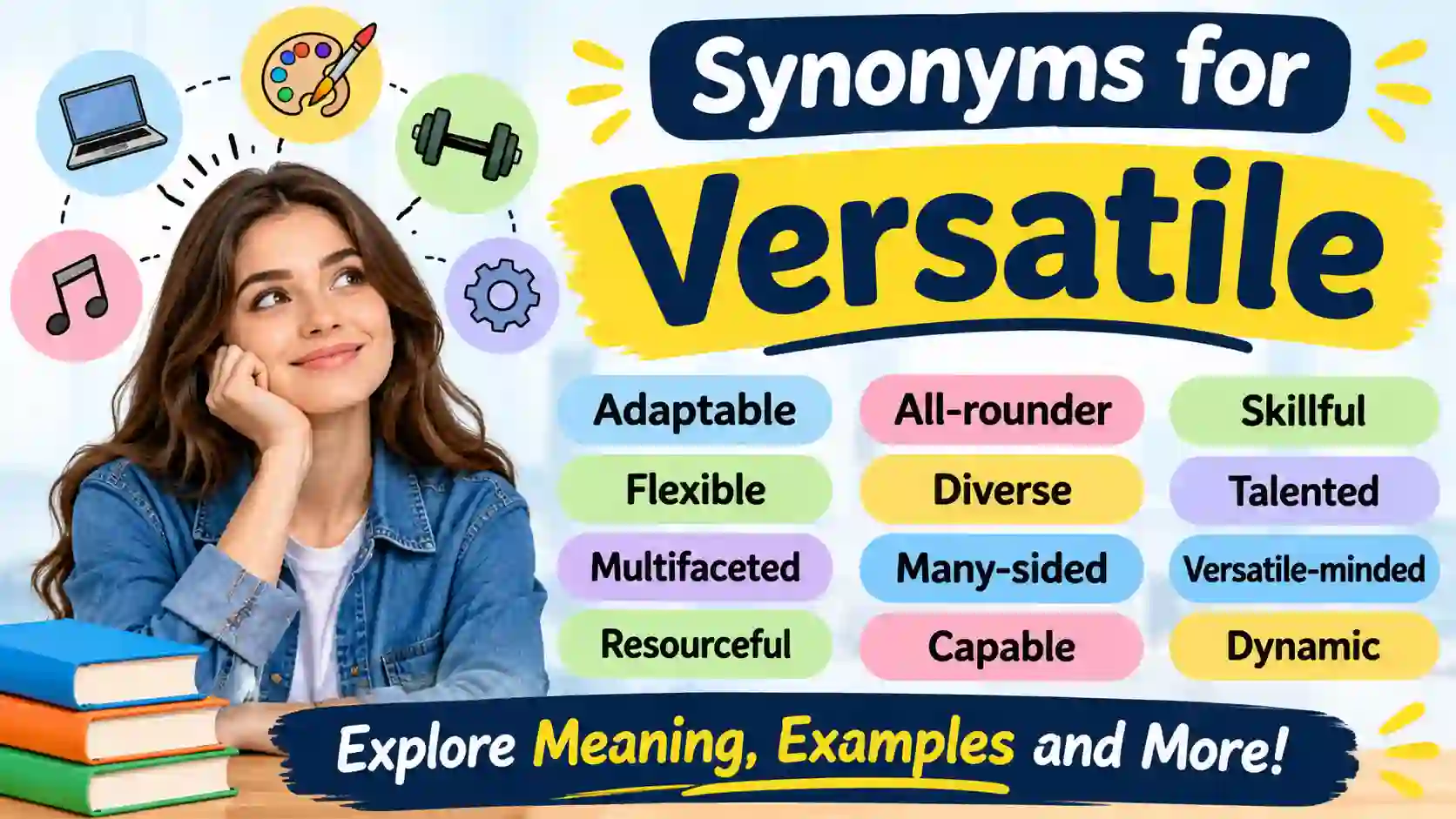
The best synonyms for versatile include adaptable, flexible, resourceful, multifaceted, all-round, multi-skilled, and multipurpose. These words describe people who can handle different tasks or things that serve several purposes. However, each word has a slightly different meaning, so the right choice depends on the person, object, skill, or situation you are describing.
Imagine hiring someone who can write articles, manage social media, solve problems, and work with customers. You might call that person versatile because they can handle different responsibilities.
The same word can describe a useful kitchen tool, a piece of clothing that suits many occasions, or an actor who performs well in different roles.
But repeating the word versatile can make your writing less interesting. Learning synonyms for versatile gives you more ways to describe skills, flexibility, usefulness, and different abilities.
This guide explains 30 alternatives with simple definitions, original examples, pronunciation, word origins, common combinations, and practical writing advice. Whether you are an English learner, student, teacher, blogger, or professional, you will learn how to choose words that fit your meaning.
Pronunciation of Versatile
- American IPA: /ˈvɝː.sə.t̬əl/
- British IPA: /ˈvɜː.sə.taɪl/
- American pronunciation: VUR-suh-tuhl
- British pronunciation: VUR-suh-tile
Both pronunciations are correct. The spelling does not change between American and British English.
Meaning and Part of Speech
Versatile is an adjective. It describes someone who can do many different things or something that has many uses.
Examples:
- A versatile employee can manage different responsibilities.
- A versatile jacket works for several occasions.
- A versatile musician can perform different styles of music.
The word generally carries a positive meaning because it praises usefulness, skill, or the ability to adjust.
Word Forms
| Word | Part of Speech | Meaning |
| Versatile | Adjective | Having many skills or uses |
| Versatility | Noun | The quality of being versatile |
| Versatilely | Adverb | In a versatile way; uncommon |
| Versatileness | Noun | The quality of being versatile; uncommon |
Example: Her versatility makes her a valuable member of the team.
Grammar: How to Use Versatile
Use these common sentence patterns:
- Be versatile: The designer is versatile.
- Versatile + noun: She has a versatile skill set.
- Versatile enough to + verb: The tool is versatile enough to handle several jobs.
- Versatile in + field: He is versatile in music and entertainment.
- Versatility in + noun: Her versatility in the workplace is impressive.
Common collocations include:
- Highly versatile
- Extremely versatile
- Versatile professional
- Versatile performer
- Versatile tool
- Versatile approach
- Versatile material
Remember that versatile is an adjective, while versatility is a noun.
Correct: The company values her versatility.
Incorrect: The company values her versatility.
30 Synonyms for Versatile With Examples and Explanations
The following words are organized by how closely they match the meaning of versatile. Some describe people, while others work better for objects, products, and situations.
1. Adaptable
Meaning: Able to adjust easily to new situations or conditions.
Examples:
- An adaptable employee learns new systems quickly.
- Our adaptable team handled the sudden schedule change.
Best used when: Describing someone who responds well to change.
Tone: Neutral, professional
CEFR: B2 (approximate)
Frequency: Very common
Register: Business, spoken English, academic
Collocations: Adaptable person, adaptable approach, highly adaptable.
Nuance: Adaptable focuses on adjusting to new conditions, not necessarily having many unrelated skills.
When not to use: Do not use it when you specifically mean that a product has several functions.
2. Flexible
Meaning: Able to change plans, methods, or behavior when needed.
Examples:
- Our manager has a flexible working style.
- This flexible design suits different room layouts.
Best used when: Talking about schedules, methods, attitudes, and materials.
Tone: Neutral
CEFR: B1
Frequency: Very common
Register: Spoken English, business, everyday writing
Collocations: Flexible schedule, flexible approach, flexible material.
Nuance: Flexible emphasizes the ability or willingness to change.
When not to use: Avoid it when you want to emphasize professional expertise in several fields.
3. Multifaceted
Meaning: Having many different parts, qualities, or aspects.
Examples:
- She has a multifaceted career in business and art.
- The project requires a multifaceted approach.
Best used when: Describing complex subjects, careers, personalities, and projects.
Tone: Formal, academic
CEFR: C1 (approximate)
Frequency: Common
Register: Academic, professional, literary
Collocations: Multifaceted personality, multifaceted career, multifaceted issue.
Nuance: It highlights different aspects rather than simply the ability to perform tasks.
When not to use: Do not use it as the first choice for a simple household product with several functions.
4. Resourceful
Meaning: Good at finding practical ways to solve problems.
Examples:
- The resourceful student repaired the model with recycled materials.
- A resourceful manager can find solutions during difficult situations.
Best used when: Praising creativity and practical problem-solving.
Tone: Positive, neutral
CEFR: B2 (approximate)
Frequency: Common
Register: Business, spoken English, professional
Collocations: Resourceful employee, resourceful leader, resourceful solution.
Nuance: A resourceful person uses available tools and ideas effectively.
When not to use: Do not use it merely to describe someone who has several qualifications.
5. All Round (British) / All Around (American)
Meaning: Good at several different activities or skills.
Examples:
- She is an all-round performer with strong musical and acting skills.
- He is an all-around athlete who plays several sports.
Best used when: Describing people with broad abilities.
Tone: Neutral, informal
CEFR: B2 (approximate)
Frequency: Common
Register: Spoken English, sports, general writing
Collocations: All-round ability, all-round performer, all-around athlete.
Nuance: All-round is especially common in British English, while all-around is widely used in American English.
When not to use: Avoid it when describing an object designed for several technical functions.
6. Multi Skilled
Meaning: Having several different practical or professional skills.
Examples:
- The multi-skilled technician repairs computers and office equipment.
- Our multi-skilled staff can handle different customer requests.
Best used when: Describing employees, workers, and professionals.
Tone: Neutral, professional
CEFR: B2 (approximate)
Frequency: Common
Register: Business, employment, professional
Collocations: Multi-skilled worker, multi-skilled team, multi-skilled employee.
Nuance: This word clearly highlights the number and range of someone’s skills.
When not to use: Do not use it to describe a machine with several functions.
7. Well Rounded
Meaning: Having a good balance of different skills, qualities, or interests.
Examples:
- The school encourages well-rounded development.
- She is a well-rounded professional with technical and communication skills.
Best used when: Describing balanced personal or professional development.
Tone: Positive, neutral
CEFR: B2 (approximate)
Frequency: Common
Register: Education, business, everyday English
Collocations: Well-rounded individual, well-rounded education, well-rounded personality.
Nuance: It suggests balance, not just a large number of abilities.
When not to use: Avoid it when describing a product with multiple uses.
8. Many Sided
Meaning: Having several different qualities, interests, or aspects.
Examples:
- The many-sided artist works in painting, music, and photography.
- Her many-sided personality makes her an interesting speaker.
Best used when: Describing people, subjects, and characters with different aspects.
Tone: Neutral, literary
CEFR: C1 (approximate)
Frequency: Uncommon
Register: Literary, descriptive writing
Collocations: Many-sided personality, many-sided character, many-sided career.
Nuance: It emphasizes variety in qualities or aspects.
When not to use: Use multifaceted in most formal academic writing if it sounds more natural.
9. Many Skilled
Meaning: Having abilities in several different areas.
Examples:
- The many-skilled artist works in several creative fields.
- A many-skilled professional can support different departments.
Best used when: Describing people with several abilities.
Tone: Neutral
CEFR: C1 (approximate)
Frequency: Uncommon
Register: Descriptive, professional
Collocations: Many-skilled professional, many-skilled worker.
Nuance: It is a direct descriptive expression, although multi-skilled is more common in everyday professional English.
When not to use: Prefer multi-skilled when you want a more natural modern expression.
10. Protean
Meaning: Able to change into many different forms, styles, or types.
Examples:
- The actor has a protean talent for playing different characters.
- The protean nature of the industry makes planning difficult.
Best used when: Describing remarkable variety or an unusual ability to change.
Tone: Literary, academic
CEFR: C2 (approximate)
Frequency: Rare
Register: Literary, academic
Collocations: Protean talent, protean nature, protean character.
Nuance: It suggests remarkable changeability and variety.
When not to use: Avoid it in everyday writing when adaptable or versatile communicates the idea more clearly.
11. Skilled
Meaning: Having the ability to do something well.
Examples:
- The skilled designer created a clear website layout.
- We hired a skilled technician for the project.
Best used when: Emphasizing ability and experience.
Tone: Neutral
CEFR: B1
Frequency: Very common
Register: Business, education, spoken English
Collocations: Skilled worker, highly skilled, skilled professional.
Nuance: Skilled describes competence, but it does not automatically mean someone has many different abilities.
When not to use: Avoid it as a complete replacement when range and adaptability matter.
12. Talented
Meaning: Naturally good at doing something.
Examples:
- The talented musician plays several instruments.
- She is a talented writer with a strong creative voice.
Best used when: Highlighting natural ability or exceptional performance.
Tone: Positive, neutral
CEFR: B1
Frequency: Very common
Register: General, professional, spoken English
Collocations: Talented artist, talented individual, highly talented.
Nuance: It emphasizes talent rather than flexibility.
When not to use: Do not use it simply because someone can adjust to changing conditions.
13. Proficient
Meaning: Able to do something well because of knowledge and practice.
Examples:
- She is proficient in English and Spanish.
- The employee is proficient in several design applications.
Best used when: Describing measurable knowledge and professional ability.
Tone: Formal
CEFR: B2
Frequency: Common
Register: Academic, business, professional
Collocations: Proficient in English, technically proficient, highly proficient.
Nuance: Proficient highlights a strong level of competence in a particular activity.
When not to use: Avoid it when you mean someone can adjust easily to new situations.
14. Capable
Meaning: Having the ability to complete a task successfully.
Examples:
- She is capable of managing several projects.
- The capable assistant handled the difficult assignment.
Best used when: Showing that someone can perform responsibilities.
Tone: Neutral
CEFR: B1
Frequency: Very common
Register: General, business, professional
Collocations: Capable person, capable employee, capable of handling.
Nuance: Capable suggests ability, but not necessarily a wide range of talents.
When not to use: Avoid it when you want to praise exceptional expertise.
15. Accomplished
Meaning: Highly skilled and successful in a particular field.
Examples:
- She is an accomplished artist and public speaker.
- The accomplished chef developed a creative menu.
Best used when: Describing people with proven achievements.
Tone: Formal, positive
CEFR: C1 (approximate)
Frequency: Common
Register: Professional, academic, literary
Collocations: Accomplished writer, accomplished musician, accomplished professional.
Nuance: It emphasizes achievement and experience rather than adaptability alone.
When not to use: Do not use it simply because someone is willing to try different tasks.
16. Competent
Meaning: Having enough knowledge and skill to do something properly.
Examples:
- A competent employee can manage everyday responsibilities.
- The new technician proved competent in several tasks.
Best used when: Describing reliable performance.
Tone: Neutral, formal
CEFR: B2
Frequency: Common
Register: Business, academic, professional
Collocations: Competent worker, competent professional, technically competent.
Nuance: Competent means sufficiently skilled. It does not necessarily suggest exceptional talent.
When not to use: Avoid it when you want to express broad creativity or outstanding ability.
17. Handy
Meaning: Useful, practical, or good at doing certain tasks.
Examples:
- My brother is handy with household repairs.
- This handy device makes cooking easier.
Best used when: Discussing practical skills or useful objects.
Tone: Informal, friendly
CEFR: B1
Frequency: Very common
Register: Spoken English, everyday writing
Collocations: Handy person, handy tool, handy to have.
Nuance: Handy often suggests practical usefulness.
When not to use: Avoid it in formal professional descriptions where proficient or capable is more appropriate.
18. Adept
Meaning: Very skilled at doing a particular activity.
Examples:
- He is adept at solving technical problems.
- The designer is adept at creating simple websites.
Best used when: Highlighting strong ability in a specific area.
Tone: Formal, positive
CEFR: C1 (approximate)
Frequency: Common
Register: Business, academic, professional
Collocations: Adept at problem-solving, adept learner, technically adept.
Nuance: Adept usually describes skill in a particular activity rather than a broad range of skills.
When not to use: Do not use it as a replacement for versatile when you mean many different abilities.
19. Adroit
Meaning: Clever and skillful at handling situations or tasks.
Examples:
- The adroit negotiator resolved the disagreement.
- She gave an adroit response to a difficult question.
Best used when: Describing clever handling of a situation.
Tone: Formal, literary
CEFR: C2 (approximate)
Frequency: Uncommon
Register: Literary, formal writing
Collocations: Adroit handling, adroit negotiator, adroit response.
Nuance: Adroit emphasizes cleverness and skill rather than the number of abilities.
When not to use: Avoid it in basic communication when skilled or capable is clearer.
20. Ingenious
Meaning: Showing cleverness when creating ideas or solutions.
Examples:
- The engineer designed an ingenious storage system.
- Her ingenious solution saved the team several hours.
Best used when: Praising creativity and clever problem-solving.
Tone: Positive, formal
CEFR: C1 (approximate)
Frequency: Common
Register: Academic, professional, literary
Collocations: Ingenious solution, ingenious design, ingenious idea.
Nuance: Ingenious focuses on creativity, not general flexibility.
When not to use: Do not use it simply to describe someone who can perform several routine tasks.
21. All Purpose
Meaning: Designed to serve several different needs or functions.
Examples:
- This all-purpose cleaner works on several surfaces.
- We bought an all-purpose bag for work and travel.
Best used when: Describing products, materials, and equipment.
Tone: Neutral
CEFR: B1 (approximate)
Frequency: Very common
Register: Commercial, everyday English
Collocations: All-purpose cleaner, all-purpose flour, all-purpose tool.
Nuance: It focuses on practical uses rather than personal skills.
When not to use: Avoid it for describing someone’s personality or professional talents.
22. Multipurpose
Meaning: Suitable for several different uses.
Examples:
- The multipurpose room hosts meetings and training sessions.
- This multipurpose bag works for school and travel.
Best used when: Describing something designed for more than one purpose.
Tone: Neutral
CEFR: B1 (approximate)
Frequency: Very common
Register: Everyday, technical, commercial
Collocations: Multipurpose room, multipurpose tool, multipurpose equipment.
Nuance: Multipurpose highlights the number of uses an object can serve.
When not to use: Do not use it to describe a person’s ability to adjust to change.
23. Multifunctional
Meaning: Having several different functions or features.
Examples:
- The multifunctional desk includes storage and charging features.
- We installed a multifunctional device in the office.
Best used when: Discussing technology, equipment, furniture, and machines.
Tone: Technical, professional
CEFR: B2 (approximate)
Frequency: Common
Register: Technical, business
Collocations: Multifunctional device, multifunctional furniture, multifunctional space.
Nuance: It usually describes built-in functions rather than a person’s talents.
When not to use: Avoid it when describing an employee or creative professional.
24. Functional
Meaning: Designed to work properly or serve a practical purpose.
Examples:
- The functional workspace has room for several activities.
- We selected functional furniture for the small apartment.
Best used when: Emphasizing usefulness and practical design.
Tone: Neutral, technical
CEFR: B2
Frequency: Common
Register: Design, technical, professional
Collocations: Functional design, functional clothing, functional space.
Nuance: Something functional works well, but it may not have several uses.
When not to use: Do not treat it as an exact replacement for versatile.
25. Adjustable
Meaning: Able to be changed to fit different needs or conditions.
Examples:
- The adjustable chair suits people of different heights.
- We selected an adjustable desk for the office.
Best used when: Describing objects or settings that can be changed.
Tone: Neutral, technical
CEFR: B1
Frequency: Very common
Register: Technical, commercial, everyday English
Collocations: Adjustable chair, adjustable settings, adjustable height.
Nuance: Adjustable describes the ability to change a setting or position.
When not to use: It does not normally describe a person’s range of talents.
26. Varied
Meaning: Including different types, styles, or forms.
Examples:
- The teacher uses varied methods to keep students interested.
- Her varied experience includes writing and marketing.
Best used when: Describing a mixture of experiences, interests, or activities.
Tone: Neutral
CEFR: B1
Frequency: Very common
Register: Academic, general writing
Collocations: Varied experience, varied activities, varied interests.
Nuance: Varied describes diversity in a collection, not someone’s ability to perform every task.
When not to use: Avoid it when you mean that someone is skilled in many areas.
27. Diverse
Meaning: Including different types, backgrounds, or qualities.
Examples:
- The company has a diverse team of professionals.
- The course covers diverse subjects and practical skills.
Best used when: Describing variety within a group or collection.
Tone: Neutral, formal
CEFR: B2
Frequency: Very common
Register: Academic, business, professional
Collocations: Diverse skills, diverse interests, diverse backgrounds.
Nuance: Diverse focuses on variety, not necessarily ability.
When not to use: Do not assume that a diverse group is automatically versatile.
28. Wide Ranging
Meaning: Covering many different subjects, areas, or activities.
Examples:
- The professor has wide-ranging knowledge of history.
- Her wide-ranging experience helped the company grow.
Best used when: Describing knowledge, experience, interests, or discussions.
Tone: Formal
CEFR: C1 (approximate)
Frequency: Common
Register: Academic, business, professional
Collocations: Wide-ranging experience, wide-ranging knowledge, wide-ranging discussion.
Nuance: It highlights breadth rather than the ability to change between tasks.
When not to use: Avoid it when you specifically mean someone can adjust quickly.
29. Open Minded
Meaning: Willing to consider different ideas and opinions.
Examples:
- An open-minded teacher listens to different opinions.
- The open-minded manager welcomed suggestions from the team.
Best used when: Describing someone who accepts different viewpoints.
Tone: Positive, neutral
CEFR: B2 (approximate)
Frequency: Very common
Register: Spoken English, education, professional
Collocations: Open-minded person, open-minded attitude, open-minded approach.
Nuance: Open-mindedness is about thinking, not necessarily having many skills.
When not to use: It is not a direct replacement for versatile when discussing professional ability.
30. Generalist
Meaning: A person who has broad knowledge or experience across several areas rather than deep specialization in one.
Examples:
- The generalist supports several departments.
- Our generalist consultant understands different parts of the business.
Best used when: Describing professionals with broad knowledge across fields.
Tone: Neutral, professional
CEFR: C1 (approximate)
Frequency: Common in professional contexts
Register: Business, academic, professional
Collocations: Business generalist, HR generalist, generalist approach.
Nuance: A generalist has breadth across fields, while a versatile person can apply different skills and adjust to different tasks.
When not to use: Do not use it when you mean someone has expert-level skills in many separate fields.
Synonyms for Versatile by Context
The right synonym depends on what you want to describe.
| Context | Best Alternatives |
| A person with many skills | Multi skilled, all round, adaptable |
| An employee | Resourceful, capable, adaptable |
| A professional | Accomplished, proficient, multi-skilled |
| A student | Well-rounded, adaptable, capable |
| A performer | All-round, multifaceted, talented |
| A machine | Multifunctional, multipurpose |
| A tool | All-purpose, multifunctional |
| Clothing | Flexible, adaptable, multipurpose |
| Knowledge | Wide-ranging, varied, broad |
| A creative person | Multifaceted, resourceful, talented |
Strongest Synonyms, Strong Synonyms, and Related Words
Strongest Synonyms
These alternatives most closely match versatile in common contexts:
- Adaptable
- Flexible
- Resourceful
- Multifaceted
- All-round
- Multi-skilled
- Many-sided
- All-purpose
- Multipurpose
- Multifunctional
Strong Synonyms
These describe a person’s abilities or useful qualities, but do not always express the full meaning:
- Well-rounded
- Skilled
- Talented
- Proficient
- Capable
- Accomplished
- Competent
- Adept
- Many-skilled
- Generalist
Related Words
These share one or more qualities with versatile but are not exact synonyms:
- Ingenious
- Adroit
- Protean
- Functional
- Adjustable
- Varied
- Diverse
- Wide-ranging
- Open-minded
- Handy
Choose the Right Synonym: Side by Side Comparisons
Several alternatives appear similar, but their meanings are not identical.
| Word Pair | Main Difference | Example |
| Versatile vs. Adaptable | Range of skills vs. ability to adjust | An adaptable worker learns new systems. |
| Versatile vs. Flexible | Many abilities or uses vs. willingness to change | A flexible schedule allows different hours. |
| Versatile vs. Multifaceted | Range of uses or skills vs. several aspects | A multifaceted career includes several fields. |
| Versatile vs. Resourceful | Broad ability vs. creative problem-solving | A resourceful employee finds practical solutions. |
| Versatile vs. Multipurpose | General range vs. several intended uses | A multipurpose room serves several functions. |
| Versatile vs. Well-rounded | Broad ability vs. balanced development | A well-rounded student develops different qualities. |
| Versatile vs. Skilled | Range of abilities vs. competence | A skilled designer creates professional layouts. |
| Versatile vs. Generalist | Ability across situations vs. broad professional knowledge | A generalist understands several business areas. |
Quick tip: Use adaptable for changing conditions, multi-skilled for employees with several abilities, and multipurpose for products with several uses.
Word Origin and History of Versatile
The word versatile comes from the Latin versatilis, meaning turning, revolving, or capable of moving in different directions.
It is connected to the Latin verb versare, meaning to turn repeatedly, and the older verb vertere, meaning to turn.
The word entered English around the late 16th or early 17th century. Historical dictionaries record its early use around 1595–1605.
Over time, the word developed its familiar modern meanings:
- A person who can move between different activities or subjects.
- Someone who has several abilities.
- An object or material that can serve different purposes.
Its history explains the central idea of moving between different uses or activities.
American vs. British English
The spelling of versatile is identical in both varieties of English. The main difference is pronunciation.
| Feature | American English | British English |
| Spelling | Versatile | Versatile |
| IPA | /ˈvɝː.sə.t̬əl/ | /ˈvɜː.sə.taɪl/ |
| Common pronunciation | VUR-suh-tuhl | VUR-suh-tile |
| Related expression | All-around | All round |
Examples:
American: He is an all-around athlete.
British: He is an all-round athlete.
Both expressions are correct. The choice usually depends on regional preference.
CEFR Vocabulary Guide
The Common European Framework of Reference (CEFR) helps learners understand their language development.
The following levels are approximate learning guidance, not official CEFR classifications for every word.
| Learning Level | Useful Words |
| A1 | Learn basic descriptions such as useful and good at |
| A2 | Flexible, useful |
| B1 | Skilled, capable, handy, varied |
| B2 | Adaptable, resourceful, proficient, multipurpose |
| C1 | Multifaceted, accomplished, wide-ranging, ingenious |
| C2 | Protean, adroit |
Start with common words before learning rare literary alternatives.
Commonly Confused Words
| Word | Difference | Example |
| Versatile | Having many abilities or uses | This is a versatile camera. |
| Variable | Able to change or differ | The weather is variable. |
| Diverse | Including different types | We have a diverse team. |
| Adaptable | Able to adjust to change | She is adaptable at work. |
| Multifaceted | Having many different aspects | It is a multifaceted problem. |
Common Mistakes When Using Synonyms for Versatile
Mistake 1: Using Multipurpose for a Person
Incorrect: She is a multipurpose employee.
Correct: She is a multi-skilled employee.
Why: Multipurpose usually describes objects or places designed for several uses.
Mistake 2: Treating Skilled as an Exact Synonym
Incorrect: Every skilled person is versatile.
Correct: A skilled person is good at a particular activity, while a versatile person can handle different activities or uses.
Why: The words describe different qualities.
Mistake 3: Confusing Versatile With Adaptable
Incorrect: Versatile and adaptable always mean exactly the same thing.
Correct: A versatile worker has a range of skills. An adaptable worker adjusts to changing conditions.
Why: They overlap, but they emphasize different abilities.
Mistake 4: Using Talented for Objects
Incorrect: This talented kitchen appliance makes cooking easier.
Correct: This versatile kitchen appliance makes cooking easier.
Why: Talented normally describes people with natural abilities.
Mistake 5: Confusing the Adjective and Noun
Incorrect: Her versatility is impressive.
Correct: Her versatility is impressive.
Why: Versatile describes something, while versatility names the quality.
How to Use Versatile Synonyms in Writing
Essays
Use multifaceted, adaptable, or wide-ranging when explaining complex subjects, professional skills, and personal development.
Emails
Use capable, proficient, and resourceful when describing workplace abilities.
Blog Posts
Use multipurpose, multifunctional, and flexible when explaining products or practical solutions.
Stories
Use multifaceted, talented, and adaptable when describing characters.
Social Media
Use all-around, multi-skilled, or talented for short, friendly descriptions.
Professional Communication
Use adaptable, accomplished, and resourceful when discussing employees, leadership, and teamwork.
Daily Conversations
Use flexible, skilled, and handy because they sound natural and are easy to understand.
Writing tip: Never replace a word just to avoid repetition. Choose a synonym only when it keeps the original meaning clear.
Antonyms of Versatile
Antonyms describe the opposite meaning.
| Antonym | Meaning |
| Inflexible | Unable or unwilling to change |
| Limited | Having few abilities or uses |
| Rigid | Not willing to change |
| Restricted | Limited by rules or conditions |
| Specialized | Focused on a particular area |
| One-sided | Having only one main aspect |
| Fixed | Not easily changed |
| Unadaptable | Unable to adjust easily |
Note that specialized is not always a negative word. A specialist can be highly skilled in one area without being versatile.
Related Expressions and Word Family
Related Expressions
- Jack of all trades: Someone who can perform many different jobs.
- All-rounder: A person who performs well in several activities.
- Multi-talented: Someone with several talents.
- Quick learner: Someone who learns new skills quickly.
- Swiss Army knife: A figurative expression for a person or thing that serves many purposes.
- Broad skill set: A collection of abilities across different areas.
- Generalist: A person with broad knowledge rather than narrow specialization.
Word Family
| Word | Part of Speech | Meaning |
| Versatile | Adjective | Having many skills or uses |
| Versatility | Noun | The quality of being versatile |
| Versatilely | Adverb | In a versatile manner |
| Versatileness | Noun | The state of being versatile; uncommon |
Frequently Asked Questions
1. What is the best synonym for versatile?
Adaptable is one of the closest alternatives when describing people who handle different situations. Flexible, resourceful, and multifaceted also work in suitable contexts. For products, multipurpose and multifunctional may be more accurate. Always choose the word that matches your sentence.
2. What is another word for versatile in a professional setting?
Useful professional alternatives include adaptable, resourceful, multi-skilled, proficient, and capable. Use adaptable for employees who handle change, multi-skilled for workers with several abilities, and resourceful for people who solve problems using available resources.
3. What is a simple word for versatile?
Flexibility is a simple and common alternative. It describes someone or something that can adjust to different needs. You can also use capable for a person with useful abilities or multipurpose for an object that serves several functions.
4. What is the opposite of versatile?
Common antonyms include inflexible, limited, rigid, restricted, and one-sided. The best opposite depends on the sentence. For example, an inflexible person struggles with change, while a limited tool has fewer possible uses than a versatile one.
5. How do you describe a person who is versatile?
You can describe a versatile person as adaptable, multi-skilled, resourceful, talented, or well-rounded. Such a person can handle different tasks, learn new abilities, and work across different areas. Each alternative highlights a slightly different quality.
6. Is versatile a positive or negative word?
Versatile is generally positive in modern everyday English. It praises a person’s range of abilities or an object’s usefulness. For example, describing an employee as versatile suggests that they can handle different responsibilities effectively.
7. What is the difference between versatile and adaptable?
Versatile describes someone or something with several abilities or uses. Adaptable describes the ability to adjust to new conditions. A versatile employee may perform several jobs, while an adaptable employee learns to work in a changing environment.
8. What is the noun form of versatile?
The noun form is versatility. It describes the quality of being able to perform different tasks or serve different purposes. For example, “Her versatility makes her a valuable team member.” Versatile is the adjective, while versatility is the noun.
Vocabulary Quiz: Test Your Knowledge
Choose the correct answer for each question.
1. Which word best describes someone who adjusts easily to new situations?
A. Talented
B. Adaptable
C. Accomplished
D. Ambidextrous
2. Which word is best for a product with several functions?
A. Multipurpose
B. Resourceful
C. Well-rounded
D. Adept
3. Which word describes someone who can use both hands equally well?
A. Dynamic
B. Flexible
C. Ambidextrous
D. Multifaceted
4. Choose the correct word: She is highly ______ in graphic design.
A. Varied
B. Proficient
C. Multipurpose
D. Adjustable
5. What is the noun form of versatile?
A. Versatility
B. Versatilely
C. Versatileness
D. Versatilement
Answer Key
- B. Adaptable
- A. Multipurpose
- C. Ambidextrous
- B. Proficient
- A. Versatility
Additional Vocabulary Practice
Exercise 1: Fill in the Blanks
Choose from adaptable, resourceful, and multipurpose.
- A ______ employee can learn new systems quickly.
- A ______ manager finds practical solutions to problems.
- This ______ room is used for meetings and training.
Exercise 2: Rewrite the Sentences
Replace versatile with a more suitable alternative.
- She is a versatile employee who can perform several jobs.
- This versatile machine performs several functions.
- He is versatile and adjusts well to new situations.
Exercise 3: Match the Words
| Word | Meaning |
| 1. Adept | A. Having different functions |
| 2. Multifaceted | B. Highly skilled at something |
| 3. Multifunctional | C. Having many aspects |
Practice answers:
Exercise 1: 1. Adaptable, 2. Resourceful, 3. Multipurpose.
Exercise 2: 1. Multi-skilled, 2. Multifunctional, 3. Adaptable.
Exercise 3: 1-B, 2-C, 3-A.
Conclusion
Learning synonyms for versatile helps you describe skills, people, products, and situations with greater accuracy. Words such as adaptable, flexible, resourceful, and multifaceted make your writing clearer and more interesting.
Remember that each alternative has its own meaning and tone. Practice these words in essays, emails, blog posts, and everyday conversations. Start with simple vocabulary and build your confidence one word at a time.
References and Further Reading
- Cambridge Dictionary: Versatile and its synonyms.
- Collins English Dictionary: Versatile definition and word origin.
- Thesaurus.com: Versatile synonyms and antonyms.
- Oxford Learner’s Dictionaries: Versatile.
- Merriam-Webster Dictionary: Versatile.

Synonorm is a trusted English vocabulary resource created to help readers find the right words and understand the differences between similar terms. We provide clear explanations of synonyms, meanings, examples, usage, and alternatives. Our content makes vocabulary easier to learn and apply in everyday, academic, and professional English. Synonorm is designed for students, writers, ESL learners, professionals, and anyone who wants to improve their English vocabulary and communicate more clearly.