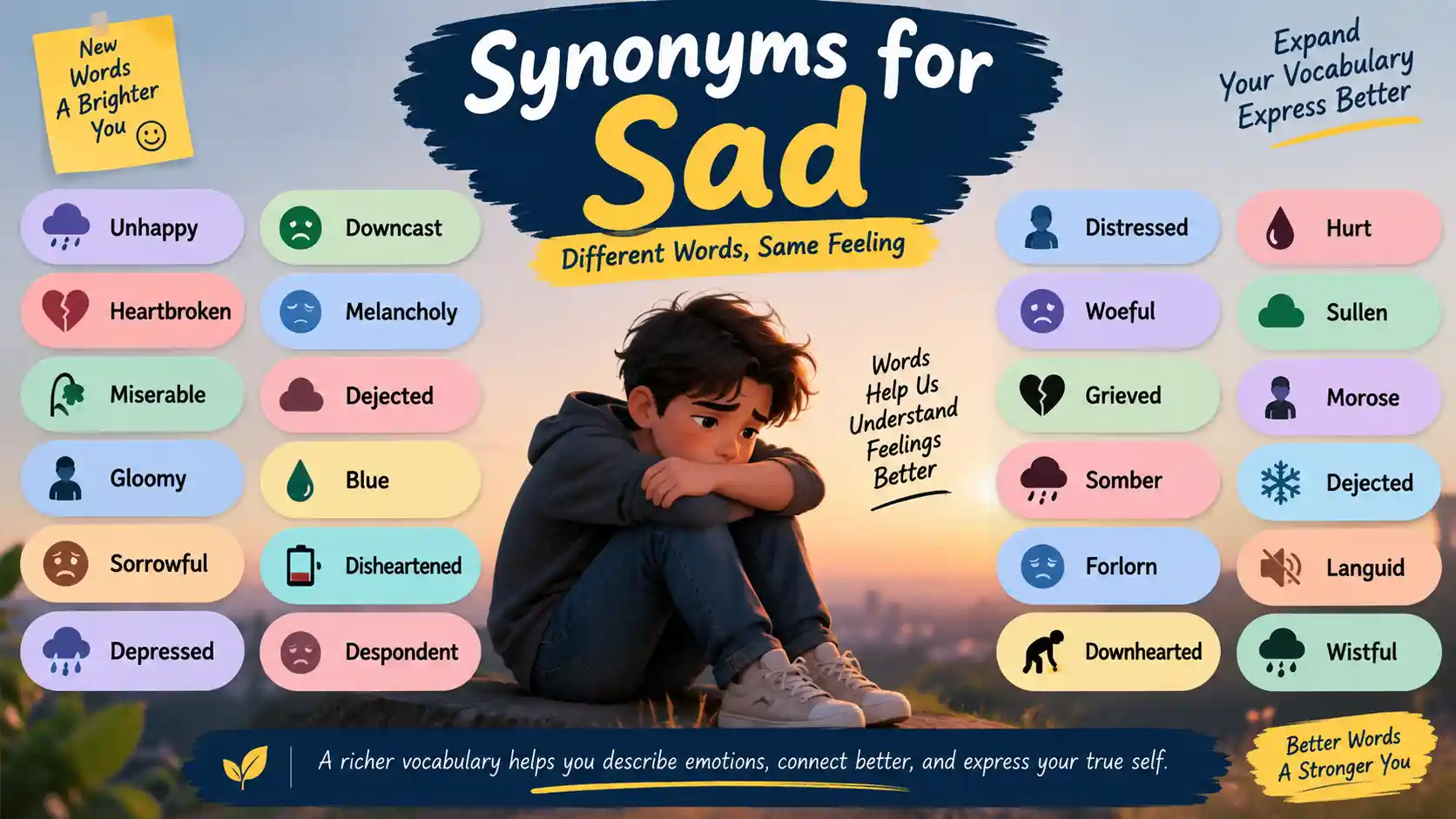
Feeling unhappy is something everyone experiences, but the word sad does not always tell the whole story. Sometimes you are only a little down. At other times, you may feel deeply disappointed, lonely, heartbroken, or overwhelmed.
That is why choosing the right word matters.
This guide explores useful synonyms for sad, but it does more than give you a long list. It explains the difference between similar words, shows natural examples, identifies formal and informal choices, and tells you when a word is too strong or simply does not fit.
Whether you are an English learner, student, teacher, writer, blogger, or professional, you can use this guide to make your English more precise and natural.
Quick Answer: What Are Some Synonyms for Sad?
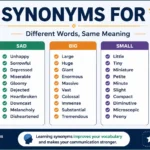
Common alternatives to sad include unhappy, upset, miserable, down, low, dejected, downcast, gloomy, glum, melancholy, sorrowful, mournful, dispirited, despondent, distressed, heartbroken, distraught, crestfallen, forlorn, and heavyhearted. These words are related, but each expresses a slightly different kind of unhappiness.
What Does “Sad” Mean?
Sad is a very common adjective meaning unhappy or sorry. Cambridge classifies the basic emotional meaning as A1, making it an important beginner word.
For example:
- I feel sad today.
- She was sad after the argument.
- We received some sad news.
The word can describe a person’s feelings, appearance, an event, a story, or something that causes unhappiness.
It can also have other meanings. For example, the sad truth means an unpleasant or regrettable truth. In informal British English, sad can also describe something considered boring or unfashionable.
Pronunciation
IPA: /sæd/
American English: /sæd/
British English: /sæd/
The spelling and standard pronunciation are essentially the same in American and British English.
Part of Speech
Sad is primarily an adjective.
- She looks sad.
Its related forms include:
- sadness: noun
- sadly: adverb
- sadden: verb
- saddened: adjective/past participle
Example:
The news saddened the family, and their sadness was clear.
Cambridge lists sadness as the noun form.
Sad: Grammar and Common Sentence Patterns
English learners commonly use sad in these structures:
Feel + sad
- I feel sad today.
- She felt sad after the conversation.
Be + sad + about
- He was sad about the decision.
- They were sad about leaving.
Be + sad + that
- I am sad that you cannot come.
- She was sad that the event was canceled.
Be + sad + to-infinitive
- I was sad to hear the news.
- He was sad to leave his friends.
Cambridge specifically records these patterns, including sad about, sad that, and sad to + verb.
Common Grammar Mistake
Incorrect: I am sad.
Correct: I am sad.
Why?
Sad is an adjective, while sadness is a noun.
Quick Comparison of Useful Alternatives
| Word | Main idea | Strength | Register |
| Unhappy | General lack of happiness | Mild–medium | Neutral |
| Upset | Emotional reaction | Medium | Neutral |
| Down | Temporary low mood | Mild | Informal |
| Low | Low emotional state | Mild–medium | Neutral/Informal |
| Miserable | Very unhappy | Strong | Neutral |
| Dejected | Sad because of disappointment | Strong | Neutral/Formal |
| Downcast | Sad-looking or discouraged | Medium–strong | Neutral |
| Gloomy | Sad or lacking hope | Medium | Neutral |
| Glum | Quietly unhappy | Medium | Informal |
| Dispirited | Loss of confidence or enthusiasm | Strong | Formal |
| Despondent | Sad and without hope | Strong | Formal |
| Melancholy | Quiet, reflective sadness | Medium | Literary |
| Sorrowful | Deep sadness | Strong | Formal/Literary |
| Mournful | Sadness connected with loss | Strong | Formal/Literary |
| Heartbroken | Extreme personal sadness | Very strong | Neutral |
| Distraught | Overwhelmed by distress | Very strong | Formal/Neutral |
| Crestfallen | Sad after disappointment | Medium–strong | Neutral |
| Forlorn | Sad and lonely or abandoned | Strong | Literary |
| Heavyhearted | Deep sadness or worry | Strong | Literary |
Important: These are not all perfect substitutes. A good synonym matches both the meaning and the situation.
1. Unhappy
Meaning: Not happy or satisfied.
Example sentences:
- She felt unhappy about the changes at work.
- The child seemed unhappy after moving to a new school.
Best used when: You want the closest simple alternative to sad in many everyday situations.
Tone: Neutral
Frequency: Very common
Learner level: Beginner to intermediate
Common collocations:
- unhappy about
- deeply unhappy
- unhappy with
When not to use it: Avoid it when you specifically mean grief, extreme emotional pain, or loneliness.
Nuance: Unhappy is broader than sad. A person can be unhappy because they dislike a situation, not simply because they feel sorrow.
2. Upset
Meaning: Emotionally troubled, unhappy, or worried because something happened.
Example sentences:
- Mia was upset after the argument.
- He became upset when he heard the decision.
Best used when: Something has triggered an emotional reaction.
Tone: Neutral
Frequency: Very common
Learner level: A2–B1
Common collocations:
- upset about
- upset with someone
- deeply upset
When not to use it: Do not use upset when you specifically want to express quiet sadness. It can also suggest anger, worry, or frustration.
3. Down
Meaning: A little sad or less cheerful than usual.
Example sentences:
- I have been feeling a little down lately.
- She seemed down after her friend left.
Best used when: Talking casually about a temporary low mood.
Tone: Informal
Frequency: Very common
Learner level: B1
Common collocations:
- feel down
- a little down
- really down
When not to use it: Avoid it in very formal writing unless the context supports conversational language.
Cambridge includes down among words related to feeling sad.
4. Low
Meaning: Feeling unhappy or emotionally weak.
Example sentences:
- He felt low after losing his job.
- I have been feeling quite low this week.
Best used when: Describing a period of reduced emotional energy.
Tone: Informal/Neutral
Frequency: Common
Common collocations:
- feel low
- really low
- emotionally low
When not to use it: Do not automatically replace sad with low. It often describes a general emotional state rather than one moment of sadness.
5. Miserable
Meaning: Extremely unhappy or uncomfortable.
Example sentences:
- She felt miserable after the breakup.
- I was miserable during the long wait.
Best used when: The unhappiness is noticeably stronger than ordinary sadness.
Tone: Neutral
Frequency: Common
Learner level: B1
Common collocations:
- feel miserable
- absolutely miserable
- miserable day
When not to use it: It is too strong for a small disappointment.
6. Dejected
Meaning: Sad and disappointed because something did not go as hoped.
Example sentences:
- He looked dejected after missing the final goal.
- The students were dejected when the competition ended.
Best used when: Disappointment is the main reason for sadness.
Tone: Neutral/Formal
Frequency: Uncommon
Learner level: B2
Common collocations:
- look dejected
- feel dejected
- dejected expression
When not to use it: Do not use it for ordinary sadness with no connection to disappointment.
7. Downcast
Meaning: Looking sad or discouraged.
Example sentences:
- She had a downcast expression.
- He looked downcast after the meeting.
Best used when: You are describing someone’s face, appearance, or mood.
Tone: Neutral/Formal
Frequency: Uncommon
Common collocations:
- downcast face
- downcast expression
- look downcast
Nuance: This word often focuses on how sadness appears outwardly.
8. Downhearted
Meaning: Sad and discouraged.
Example sentences:
- She felt downhearted after failing the interview.
- The team became downhearted after several losses.
Best used when: Sadness is mixed with reduced confidence or hope.
Tone: Neutral
Frequency: Uncommon
Common collocations:
- feel downhearted
- become downhearted
- rather downhearted
When not to use it: It sounds less natural than sad or down in casual conversation.
9. Dispirited
Meaning: Having lost confidence, energy, or enthusiasm.
Example sentences:
- The workers became dispirited after months of delays.
- He felt dispirited when nobody supported his idea.
Best used when: You want to show that sadness has reduced someone’s motivation.
Tone: Formal
Frequency: Uncommon
Learner level: C1
Common collocations:
- become dispirited
- feel dispirited
- dispirited team
When not to use it: It is not simply a formal version of sad. The idea of lost enthusiasm matters.
10. Despondent
Meaning: Very unhappy and without hope.
Example sentences:
- She became despondent after several failed attempts.
- He sounded despondent about his future.
Best used when: Someone feels deeply discouraged and has little hope.
Tone: Formal
Frequency: Uncommon
Learner level: C1
Common collocations:
- deeply despondent
- feel despondent
- become despondent
When not to use it: Avoid it for everyday minor sadness because it sounds unusually strong and formal.
11. Gloomy
Meaning: Sad, dark, or lacking hope.
Example sentences:
- He was in a gloomy mood.
- The empty house had a gloomy atmosphere.
Best used when: Describing a person’s mood, an atmosphere, or a negative outlook.
Tone: Neutral
Frequency: Common
Learner level: B1
Common collocations:
- gloomy mood
- gloomy atmosphere
- gloomy outlook
Nuance: Unlike sad, gloomy can describe places, weather, moods, and expectations.
12. Glum
Meaning: Quietly unhappy and without much enthusiasm.
Example sentences:
- The students looked glum after the test.
- He sat there with a glum expression.
Best used when: Someone looks visibly unhappy but is not overwhelmed by emotion.
Tone: Informal/Neutral
Frequency: Common
Common collocations:
- glum expression
- look glum
- glum face
When not to use it: It does not normally suggest deep grief.
13. Melancholy
Meaning: A quiet, thoughtful feeling of sadness.
Example sentences:
- The old song gave him a feeling of melancholy.
- A sense of melancholy filled the room.
Best used when: Sadness has a reflective, gentle, or poetic quality.
Tone: Literary
Frequency: Common in writing, less common in casual speech
Learner level: C1
Common collocations:
- deep melancholy
- sense of melancholy
- melancholy mood
When not to use it: Avoid it when you simply mean “I am unhappy” in everyday conversation.
14. Sorrowful
Meaning: Feeling or showing deep sadness.
Example sentences:
- She gave him a sorrowful smile.
- His voice became sorrowful as he remembered the past.
Best used when: Writing about serious emotional pain.
Tone: Formal/Literary
Frequency: Uncommon
Common collocations:
- sorrowful expression
- sorrowful voice
- sorrowful heart
When not to use it: It may sound too dramatic in ordinary conversation.
15. Mournful
Meaning: Showing sadness caused by loss, especially death.
Example sentences:
- A mournful song played during the ceremony.
- Her voice sounded mournful.
Best used when: The context involves mourning, death, or serious loss.
Tone: Formal/Literary
Frequency: Uncommon
Common collocations:
- mournful song
- mournful voice
- mournful expression
When not to use it: Do not use it for simple everyday disappointment.
16. Heartbroken
Meaning: Extremely sad because of serious personal loss.
Example sentences:
- She was heartbroken after the relationship ended.
- He was heartbroken when his beloved dog died.
Best used when: The emotional pain is very deep.
Tone: Neutral/Emotional
Frequency: Common
Learner level: B2
Common collocations:
- completely heartbroken
- absolutely heartbroken
- heartbroken after
When not to use it: It is too strong for ordinary problems such as missing a bus or getting a low quiz score.
Cambridge lists heartbroken among the stronger words related to sadness.
17. Distraught
Meaning: Extremely upset and unable to remain calm.
Example sentences:
- The distraught mother called the police.
- He was distraught after receiving the news.
Best used when: Someone is overwhelmed by intense emotional distress.
Tone: Formal/Neutral
Frequency: Uncommon
Learner level: C1
Common collocations:
- deeply distraught
- visibly distraught
- distraught family
When not to use it: It is much stronger than sad.
18. Distressed
Meaning: Very worried, upset, or emotionally troubled.
Example sentences:
- The distressed passenger asked for help.
- She sounded distressed during the call.
Best used when: Sadness is mixed with worry, fear, or emotional strain.
Tone: Neutral/Formal
Frequency: Common
Common collocations:
- visibly distressed
- emotionally distressed
- distressed person
When not to use it: If you only mean mild sadness, distressed may exaggerate the situation.
19. Crestfallen
Meaning: Very disappointed and sad because something went wrong.
Example sentences:
- He looked crestfallen after missing the opportunity.
- The children were crestfallen when the trip was canceled.
Best used when: Disappointment is more important than grief.
Tone: Neutral
Frequency: Uncommon
Learner level: C1
Common collocations:
- look crestfallen
- seem crestfallen
- crestfallen expression
20. Forlorn
Meaning: Sad and lonely, often because someone feels abandoned.
Example sentences:
- The forlorn child waited quietly by the door.
- He looked forlorn after his friends left.
Best used when: Loneliness and sadness appear together.
Tone: Literary
Frequency: Uncommon
Learner level: C1
Common collocations:
- forlorn figure
- forlorn expression
- forlorn look
When not to use it: It is not a natural everyday replacement for sad.
21. Heavyhearted
Meaning: Feeling deeply sad or worried.
Example sentences:
- She left the village heavyhearted.
- He returned home heavyhearted after saying goodbye.
Best used when: You want an emotional or literary description.
Tone: Literary
Frequency: Uncommon
Common collocation:
- heavyhearted farewell
- heavyhearted traveler
- heavy heart
22. Disconsolate
Meaning: Extremely sad and difficult to comfort.
Example sentences:
- She was disconsolate after losing her home.
- The disconsolate child sat quietly in the corner.
Best used when: The sadness is unusually deep.
Tone: Formal/Literary
Frequency: Rare
Learner level: C2
When not to use it: It is too formal for most everyday conversations.
23. Doleful
Meaning: Showing obvious sadness.
Example sentences:
- The dog gave him a doleful look.
- She spoke in a doleful voice.
Best used when: Describing an expression, sound, or appearance.
Tone: Literary
Frequency: Rare
Common collocations:
- doleful expression
- doleful eyes
- doleful voice
24. Woeful
Meaning: Extremely sad, painful, or unfortunate.
Example sentences:
- The novel tells a woeful story of loss.
- They faced a woeful situation.
Best used when: You want dramatic or literary language.
Tone: Literary/Formal
Frequency: Uncommon
When not to use it: It is rarely the best choice for ordinary conversation.
25. Blue
Meaning: Sad or unhappy.
Example sentences:
- I was feeling a little blue after my friend left.
- She gets blue when she spends too much time alone.
Best used when: You are writing or speaking informally.
Tone: Informal
Frequency: Common enough to recognize, but less universal than sad or unhappy
When not to use it: Avoid it in formal academic or professional writing unless the style is intentionally conversational.
Cambridge specifically labels blue as an informal word for sad.
The Most Useful Choices by Situation
Instead of memorizing all 25 words, learn them by situation.
For everyday sadness
Use:
- sad
- unhappy
- upset
- down
- low
For disappointment
Use:
- dejected
- crestfallen
- downcast
- disappointed
For deep emotional pain
Use:
- heartbroken
- miserable
- sorrowful
- distraught
For hopelessness
Use:
- despondent
- dispirited
- downhearted
For grief and loss
Use:
- mournful
- sorrowful
- heartbroken
For literary writing
Use:
- melancholy
- forlorn
- heavyhearted
- doleful
- disconsolate
- woeful
Choose the Right Word: Side-by-Side Comparisons
| Situation | Natural choice | Why |
| Your friend canceled lunch | Upset | Natural emotional reaction |
| You feel slightly unhappy today | Down | Casual and mild |
| You failed an important competition | Dejected | Sad because of disappointment |
| You lost someone you love | Heartbroken | Very deep personal grief |
| You have no hope about the situation | Despondent | Emphasizes hopelessness |
| You are grieving | Mournful | Connected with mourning |
| You feel sad and lonely | Forlorn | Emphasizes loneliness |
| A song creates quiet sadness | Melancholy | Reflective emotional quality |
| You cannot stay calm because of terrible news | Distraught | Extreme emotional distress |
| You are generally unhappy with your situation | Unhappy | Broad and natural |
Teacher’s Tip: The best synonym is not the fanciest word. It is the word that communicates your exact meaning naturally.
Words That Are Often Confused With Sad
Sad vs Upset
Sad focuses on unhappiness.
Upset focuses on an emotional reaction and may include anger or worry.
- I was sad when my friend moved away.
- I was upset when my friend canceled our plans without telling me.
Sad vs Depressed
These words overlap, but they should not be treated as identical.
Sad can describe a normal temporary emotion.
Depressed can describe a deeper or longer-lasting low mood and can also refer to a mental health condition.
Merriam-Webster and Cambridge both recognize depressed among words associated with sadness, but context matters.
Sad vs Miserable
Miserable is much stronger.
- I felt sad after the movie.
- I felt miserable after months of serious problems.
Sad vs Heartbroken
Heartbroken suggests severe emotional pain, usually after a major personal loss.
- She was sad about missing the event.
- She was heartbroken after losing her partner.
Sad vs Gloomy
Sad normally describes emotion.
Gloomy can describe emotion, atmosphere, weather, or an outlook.
- He looked sad.
- The room felt gloomy.
American vs British English
The basic word sad has the same spelling and pronunciation in American and British English.
However, there is an additional informal British use. In British English, sad can sometimes describe a person or activity as boring, unfashionable, or socially uncool. Cambridge records this meaning as informal.
For example:
He spends every weekend organizing his train collection. That’s a bit sad.
This meaning is different from emotional sadness.
For international English learners, the safest meaning to learn first is:
sad = unhappy
Word Origin and Etymology
The history of sad is more interesting than it first appears.
Merriam-Webster traces the adjective to Middle English and Old English sæd, which originally meant sated or full. It is related to Old High German sat and Latin satis, meaning “enough.” Merriam-Webster gives the first known use of the modern adjective in the 13th century.
Over time, the word developed meanings connected with seriousness, weariness, and eventually the emotional senseof unhappinessfamiliar today.
This is a useful reminder that word meanings can change greatly over centuries.
CEFR and Learner Guidance
Not every synonym has a universally assigned CEFR level, and dictionary labels can vary. For learners, a practical progression is more useful than pretending every word has an exact level.
Beginner
Learn these first:
- sad
- unhappy
- upset
- down
Intermediate
Add:
- miserable
- gloomy
- glum
- low
- dejected
- downcast
Upper-intermediate
Learn:
- heartbroken
- melancholy
- dispirited
- crestfallen
- distressed
Advanced
Explore:
- despondent
- distraught
- forlorn
- heavyhearted
- disconsolate
- doleful
The basic word sad itself is classified as A1 by Cambridge.
Common Mistakes Learners Make
Common Mistake Box
Mistake 1
I am sadness.
Correct
I am sad.
Sad is an adjective. Sadness is a noun.
Mistake 2
I was heartbroken because I lost five points on my quiz.
Better
I was disappointed because I lost five points on my quiz.
Heartbroken is normally much too strong for a minor setback.
Mistake 3
I am depressed because my favorite team lost yesterday.
Better
I am disappointed because my favorite team lost yesterday.
A temporary reaction to a single event does not automatically justify depressed.
Mistake 4
The funeral was down.
Better
The funeral was mournful.
Down normally describes a person’s mood, not the formal emotional character of an event.
Mistake 5
The sad person was very melancholy about his exam.
Better
He felt disappointed about his exam.
Melancholy often suggests a quiet or reflective sadness and may sound unnatural for a simple exam result.
Natural Collocations
Learning words in combinations makes them easier to use.
Sad
- sad news
- sad story
- sad expression
- sad ending
Unhappy
- deeply unhappy
- unhappy about
- unhappy with
Upset
- upset about
- upset with
- deeply upset
Miserable
- feel miserable
- miserable day
- absolutely miserable
Heartbroken
- completely heartbroken
- heartbroken after
- heartbroken over
Dejected
- look dejected
- feel dejected
- dejected expression
Gloomy
- gloomy mood
- gloomy atmosphere
- gloomy outlook
Melancholy
- deep melancholy
- sense of melancholy
- melancholy mood
Distraught
- visibly distraught
- deeply distraught
- distraught family
These combinations are more useful for learners than simply memorizing isolated words.
How to Use Better Vocabulary in Writing
Essays
Avoid repeating sad in every paragraph.
Instead of:
The character was sad. She was sad because her father left. Her sad face showed that she was sad.
Try:
The character was deeply upset when her father left. Her downcast expression showed how much the separation affected her.
The second version gives the reader more information.
Professional Emails
Choose calm, respectful words.
Good choices include:
- saddened
- disappointed
- concerned
- sorry
Avoid dramatic words such as heartbroken or distraught unless the situation truly requires them.
Stories
Literary words can create atmosphere:
- melancholy
- forlorn
- mournful
- heavyhearted
But use them sparingly. Too many unusual words can make a story sound unnatural.
Everyday Conversation
Simple words are usually best:
- sad
- upset
- down
- unhappy
- disappointed
Natural English is not about using the biggest word available.
Related Vocabulary
Antonyms
The most direct opposite of sad is happy.
Other useful opposites include:
- cheerful
- joyful
- glad
- delighted
- pleased
- optimistic
- lighthearted
- content
Cambridge lists several of these as antonyms or contrasting words for sad.
Word Family
| Word | Part of Speech | Example |
| sad | Adjective | She looks sad. |
| sadness | Noun | His sadness was obvious. |
| sadly | Adverb | Sadly, the plan failed. |
| sadden | Verb | The news saddened everyone. |
| saddened | Past participle/adjective | We were saddened by the loss. |
Mini Practice: Fill in the Blanks
Choose from:
upset, heartbroken, dejected, down, mournful
- I have been feeling a little ______ this week.
- She was ______ after losing her partner.
- He looked ______ after failing the final interview.
- The family was ______ after the death of their grandfather.
- She was ______ about the argument with her sister.
Answers
- down
- heartbroken
- dejected
- mournful
- upset
Sentence Rewriting Practice
Replace sad with a more precise word.
1.
He was sad after losing the competition.
Possible answer:
He was dejected after losing the competition.
2.
She was sad after her relationship ended.
Possible answer:
She was heartbroken after her relationship ended.
3.
I feel sad today.
Possible answer:
I feel a little down today.
4.
The song created a sad atmosphere.
Possible answer:
The song created a melancholy atmosphere.
There can be more than one correct answer. The goal is to choose a word that fits the intended nuance.
FAQ
What is the best synonym for sad?
Unhappy is one of the closest everyday alternatives. However, the best word depends on context. Upset suggests an emotional reaction, down suggests a mild low mood, and heartbroken expresses much stronger personal pain.
What are five common words for sad?
Five practical choices are unhappy, upset, down, low, and miserable. These are more useful for everyday English than many rare literary alternatives.
What is a stronger word than sad?
Miserable, heartbroken, distraught, and despondent can express stronger feelings. They are not interchangeable, though. Heartbroken suggests personal loss, while despondent emphasizes hopelessness.
Is “upset” the same as “sad”?
Not exactly. Upset can mean sad, but it can also involve anger, worry, frustration, or emotional disturbance. For example, someone may be upset because a friend lied to them, even if anger is stronger than sadness.
Is “depressed” a synonym for sad?
It can overlap with sadness, but it should not be treated as a simple replacement. Depressed may describe a deeper or prolonged low mood and can also refer to a mental health condition. Use it carefully and according to context.
What is a casual word for sad?
Down is a very natural informal choice. You can say, “I am feeling a little down today.” Blue is another informal expression, although it may sound more idiomatic or stylistic depending on the speaker and context.
What is a literary synonym for sad?
Words such as melancholy, forlorn, mournful, heavyhearted, doleful, and disconsolate can have a literary tone. They are useful in stories and descriptive writing but may sound unnatural in ordinary conversation.
What is the opposite of sad?
The most direct opposite is happy. Depending on context, you can also use cheerful, joyful, glad, delighted, pleased, optimistic, or lighthearted.
Vocabulary Quiz
1. Which word best describes sadness caused by a major personal loss?
A. Glum
B. Heartbroken
C. Down
D. Cheerful
2. Which word is most natural for a mild temporary low mood?
A. Disconsolate
B. Down
C. Distraught
D. Mournful
3. Which word emphasizes hopelessness?
A. Despondent
B. Glum
C. Happy
D. Cheerful
4. Which word is especially associated with mourning?
A. Mournful
B. Down
C. Upset
D. Glum
5. Which word focuses on disappointment?
A. Dejected
B. Joyful
C. Cheerful
D. Delighted
Answer Key
- B. Heartbroken
- B. Down
- A. Despondent
- A. Mournful
- A. Dejected
Conclusion
Good vocabulary is not about replacing every simple word with a complicated one. It is about choosing the right word. Use unhappy for general dissatisfaction, upset for an emotional reaction, down for a mild low mood, dejected for disappointment, melancholy for reflective sadness, and heartbroken for severe personal pain.
Practice these distinctions in conversations, essays, emails, stories, and everyday writing. Once you understand the nuance behind each word, you will communicate emotions more clearly and naturally.
References
- Cambridge Dictionary, “sad”: definition, pronunciation, grammar, CEFR information, and usage.
- Cambridge English Thesaurus, “sad”: related words, synonyms, antonyms, and contextual examples.
- Merriam-Webster, “sad”: definition, synonyms, etymology, and first-known-use information.
- Merriam-Webster Thesaurus, “sad”: broader synonym and related-word distinctions.

Synonorm is a trusted English vocabulary resource created to help readers find the right words and understand the differences between similar terms. We provide clear explanations of synonyms, meanings, examples, usage, and alternatives. Our content makes vocabulary easier to learn and apply in everyday, academic, and professional English. Synonorm is designed for students, writers, ESL learners, professionals, and anyone who wants to improve their English vocabulary and communicate more clearly.