Have you ever seen someone play a funny trick, act foolishly, or get involved in suspicious activities? You might describe these actions as shenanigans. But what other words can you use to express the same idea?
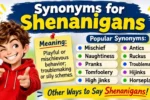
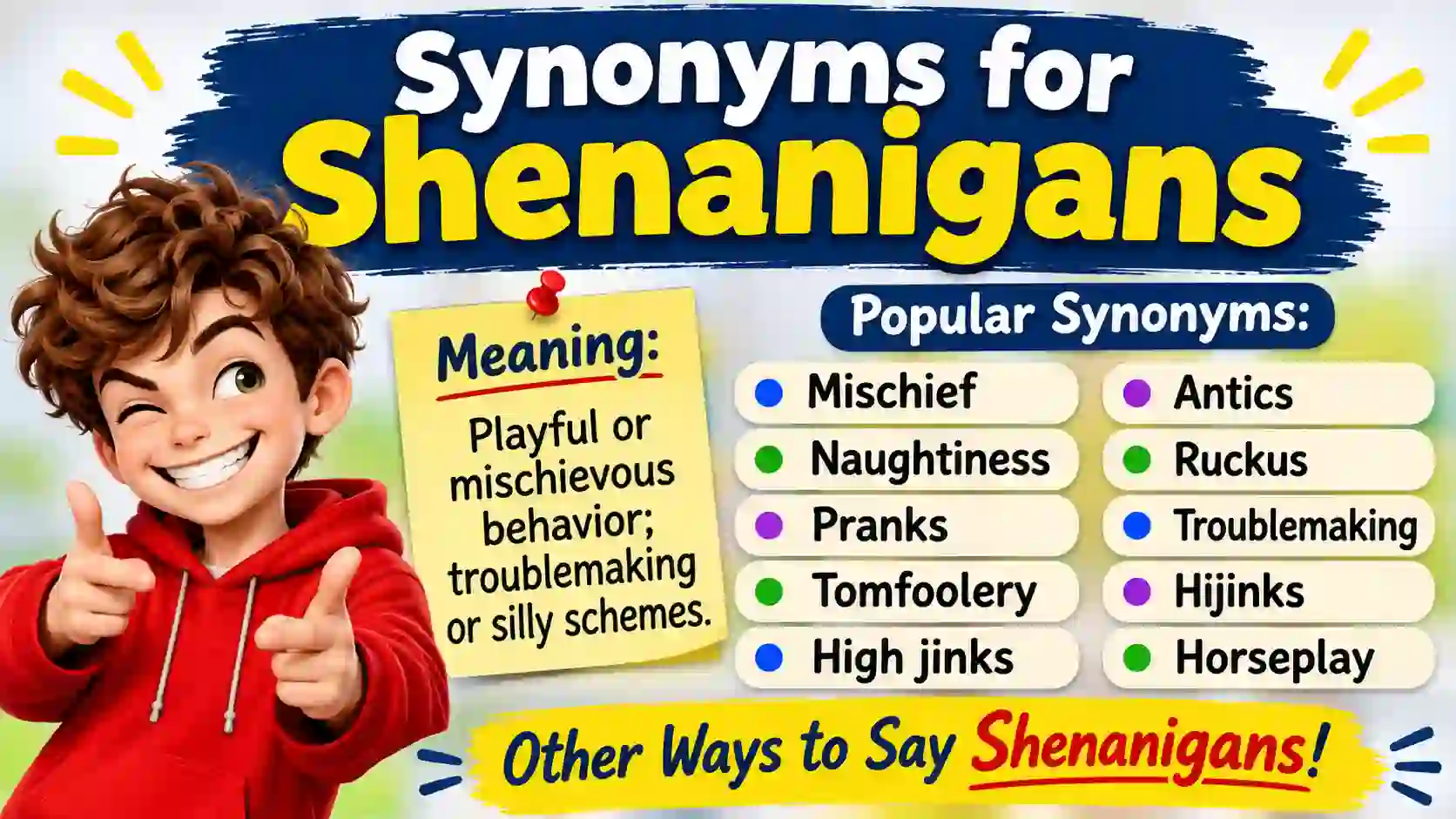
The best synonyms for shenanigans include mischief, antics, hijinks, pranks, horseplay, tomfoolery, capers, trickery, skulduggery, and monkey business. However, these words do not all have the same meaning. Some describe harmless fun, while others suggest dishonesty or wrongdoing.
This guide explores 30 useful alternatives with simple definitions, original examples, pronunciation, word history, and practical usage advice. Whether you are an English learner, student, teacher, blogger, or professional writer, you will learn how to choose the right word for every situation.
Quick Answer: What Are Synonyms for Shenanigans?
Synonyms for shenanigans include mischief, antics, hijinks, pranks, horseplay, tomfoolery, capers, trickery, and skulduggery. These words describe playful trouble, silly actions, practical jokes, or dishonest activities. Choose mischief for harmless trouble and trickery or skulduggery for deceptive behavior.
Pronunciation of Shenanigans
- IPA: /ʃəˈnæn.ɪ.ɡənz/
- Simple pronunciation: shuh-NAN-ih-gunz
- Syllables: Four
- Word stress: Second syllable
The word sounds similar in American and British English, although some dictionaries record slightly different regional vowel sounds.
What Does Shenanigans Mean?
Shenanigans is an informal noun that describes silly, playful, or dishonest activities.
It has two main meanings:
- Playful behavior: Funny tricks, jokes, or harmless trouble.
- Dishonest behavior: Secret tricks, questionable actions, or complicated schemes.
For example:
- The children got into shenanigans during their school trip.
- The investigation exposed financial shenanigans at the company.
The first sentence describes playful trouble. The second suggests dishonest business activity.
Understanding these two meanings is important when choosing a synonym.
Part of Speech and Grammar
Shenanigans is a plural noun. Its singular form is shenanigan, although speakers commonly use the plural.
| Word form | Part of speech | Example |
|---|---|---|
| Shenanigan | Singular noun | One shenanigan caused confusion. |
| Shenanigans | Plural noun | Their shenanigans were amusing. |
There is no standard verb, adjective, or adverb form.
Common Sentence Patterns
- Get up to shenanigans.
- Stop the shenanigans.
- Political shenanigans.
- Financial shenanigans.
- No more shenanigans.
Grammar reminder: Use a plural verb with shenanigans.
Correct: Their shenanigans were entertaining.
Incorrect: Their shenanigans was entertaining.
30 Best Synonyms for Shenanigans With Examples and Explanations
The following alternatives are grouped by their actual meanings. Some are close synonyms, while others work only in specific situations.
CEFR levels are approximate learner guides, and frequency labels are qualitative rather than measured corpus rankings.
1. Mischief
Meaning: Mischief is playful behavior that causes minor trouble.
Examples:
- The puppy got into mischief while the family was away.
- His mischievous behavior made everyone laugh.
Best used when: Describing harmless trouble or naughty behavior.
Register: Neutral, everyday English
CEFR: B1 | Frequency: Very common
Collocations: playful mischief, cause mischief, get into mischief.
Nuance: Usually suggests minor trouble without serious harm.
2. Antics
Meaning: Antics are funny or unusual actions that attract attention.
Examples:
- The comedian’s antics entertained the entire audience.
- Everyone laughed at the dog’s unusual antics.
Best used when: Describing amusing or entertaining behavior.
Register: Neutral to informal
CEFR: B2 | Frequency: Common
Collocations: funny antics, silly antics, childish antics.
Nuance: Focuses on noticeable actions rather than dishonest intentions.
3. Hijinks
Meaning: Hijinks are lively, playful, and sometimes troublesome activities.
Examples:
- The students remembered their college hijinks.
- Their weekend hijinks disturbed the neighbors.
Best used when: Talking about energetic fun or group mischief.
Register: Informal
CEFR: C1 | Frequency: Uncommon
Collocations: college hijinks, youthful hijinks, late-night hijinks.
Nuance: Often suggests amusing, lively trouble.
4. Pranks
Meaning: Pranks are tricks played on someone for amusement.
Examples:
- My brother played a harmless prank on me.
- The employees planned a surprise prank for their colleague.
Best used when: Describing practical jokes.
Register: Neutral
CEFR: A2 | Frequency: Very common
Collocations: harmless prank, practical joke, pull a prank.
Nuance: Usually describes a particular joke rather than general behavior.
5. Horseplay
Meaning: Horseplay is rough or noisy physical play.
Examples:
- The teacher warned the students against horseplay.
- Their horseplay nearly knocked over a chair.
Best used when: Describing physical joking or rough play.
Register: Informal
CEFR: B2 | Frequency: Common
Collocations: rough horseplay, stop horseplay, dangerous horseplay.
Nuance: Focuses on physical activity.
6. Tomfoolery
Meaning: Tomfoolery means silly or foolish behavior.
Examples:
- The manager asked everyone to stop the tomfoolery.
- Their tomfoolery interrupted the important meeting.
Best used when: Describing foolish actions that disturb others.
Register: Informal
CEFR: C1 | Frequency: Uncommon
Collocations: childish tomfoolery, stop the tomfoolery, silly tomfoolery.
Nuance: Emphasizes foolishness rather than dishonesty.
7. Capers
Meaning: Capers are playful or adventurous activities.
Examples:
- The friends shared stories about their childhood capers.
- Their weekend capers became family legends.
Best used when: Describing amusing adventures or mischievous episodes.
Register: Informal, literary
CEFR: C1 | Frequency: Uncommon
Collocations: comic capers, childhood capers, adventurous capers.
Nuance: Often gives playful behavior an adventurous feeling.
8. Monkey Business
Meaning: Monkey business means foolish or suspicious behavior.
Examples:
- The teacher warned the students against monkey business.
- The accountant noticed some monkey business in the records.
Best used when: Describing silly actions or questionable activities.
Register: Informal
CEFR: B2 | Frequency: Common
Collocations: no monkey business, stop monkey business, financial monkey business.
Nuance: Can suggest either playful trouble or dishonesty.
9. Trickery
Meaning: Trickery means using tricks to deceive someone.
Examples:
- The salesman used trickery to mislead customers.
- The magician’s performance involved clever trickery.
Best used when: Describing deceptive methods.
Register: Neutral to formal
CEFR: B2 | Frequency: Common
Collocations: clever trickery, political trickery, deliberate trickery.
Nuance: Can describe dishonest actions or harmless illusions.
10. Skulduggery
Meaning: Skulduggery means secret and dishonest behavior.
Examples:
- The investigation uncovered political skulduggery.
- The company faced accusations of financial skulduggery.
Best used when: Discussing secretive or dishonest dealings.
Register: Informal, journalistic
CEFR: C2 | Frequency: Uncommon
Collocations: political skulduggery, financial skulduggery, expose skulduggery.
Nuance: More serious than ordinary mischief.
11. Foolery
Meaning: Foolery means foolish or silly behavior.
Examples:
- The audience grew tired of his constant foolery.
- Their foolery delayed the entire event.
Best used when: Describing pointless or immature actions.
Register: Informal
CEFR: C1 | Frequency: Uncommon
Collocations: childish foolery, silly foolery, stop the foolery.
Nuance: Focuses on foolishness rather than deception.
12. Nonsense
Meaning: Nonsense means foolish or unreasonable behavior.
Examples:
- The manager refused to tolerate such nonsense.
- The children laughed at the nonsense in the story.
Best used when: Describing unreasonable ideas or silly behavior.
Register: Neutral
CEFR: A2 | Frequency: Very common
Collocations: absolute nonsense, stop this nonsense, talk nonsense.
Nuance: Can describe speech, ideas, or actions.
13. Silliness
Meaning: Silliness means behavior that is funny, foolish, or not serious.
Examples:
- Their silliness made the journey enjoyable.
- The children filled the room with harmless silliness.
Best used when: Describing lighthearted behavior.
Register: Neutral
CEFR: B1 | Frequency: Common
Collocations: harmless silliness, childish silliness, moment of silliness.
Nuance: Usually has a softer meaning than mischief.
14. High Jinks
Meaning: High jinks are lively and playful activities.
Examples:
- The students enjoyed high jinks after their final exams.
- Their high jinks continued late into the evening.
Best used when: Describing energetic group fun.
Register: Informal
CEFR: C1 | Frequency: Uncommon
Collocations: youthful high jinks, college high jinks, late-night high jinks.
Nuance: Similar to hijinks. The spelling is also commonly written as one word, hijinks.
15. Buffoonery
Meaning: Buffoonery means ridiculous or foolish behavior.
Examples:
- The actor’s exaggerated buffoonery made the audience laugh.
- The meeting turned into an afternoon of buffoonery.
Best used when: Describing exaggerated foolishness.
Register: Literary
CEFR: C1 | Frequency: Uncommon
Collocations: comic buffoonery, public buffoonery, childish buffoonery.
Nuance: Often sounds critical or mocking.
16. Clowning Around
Meaning: Clowning around means behaving in a silly or amusing way.
Examples:
- The boys were clowning around before the match.
- Stop clowning around and finish your homework.
Best used when: Talking about people who joke instead of taking something seriously.
Register: Informal, spoken English
CEFR: B1 | Frequency: Common
Collocations: stop clowning around, constantly clowning around, clown around at work.
Nuance: Describes behavior rather than a specific trick.
17. Fooling Around
Meaning: Fooling around means behaving playfully or wasting time without seriousness.
Examples:
- The students were fooling around in the hallway.
- We spent the afternoon fooling around in the garden.
Best used when: Describing casual play or unproductive behavior.
Register: Informal
CEFR: B1 | Frequency: Very common
Collocations: fool around at work, stop fooling around, fool around with friends.
Nuance: In some contexts, it can also refer to casual sexual or romantic involvement, so context matters.
18. Funny Business
Meaning: Funny business means suspicious or dishonest behavior.
Examples:
- The accountant noticed funny business in the financial records.
- The owner promised there would be no funny business during the sale.
Best used when: Casually describing suspicious activities.
Register: Informal
CEFR: B2 | Frequency: Common
Collocations: no funny business, financial funny business, suspicious dealings.
Nuance: Often suggests that something is not quite right.
19. Deception
Meaning: Deception means making someone believe something false.
Examples:
- The investigation revealed deliberate deception.
- The company faced complaints about deception in its advertising.
Best used when: Describing intentional misleading behavior.
Register: Formal
CEFR: B2 | Frequency: Common
Collocations: deliberate deception, public deception, deception tactics.
Nuance: More serious than ordinary jokes or playful tricks.
20. Dishonesty
Meaning: Dishonesty means behaving without truth or fairness.
Examples:
- His dishonesty damaged the team’s trust.
- The company dismissed an employee for repeated dishonesty.
Best used when: Discussing lying or unethical behavior.
Register: Neutral to formal
CEFR: B1 | Frequency: Common
Collocations: financial dishonesty, workplace dishonesty, admit dishonesty.
Nuance: Describes a lack of honesty rather than a particular trick.
21. Cheating
Meaning: Cheating means breaking rules to gain an unfair advantage.
Examples:
- The referee caught the player cheating.
- The school introduced new rules to prevent cheating.
Best used when: Describing unfair behavior in games, exams, or other activities.
Register: Neutral
CEFR: A2 | Frequency: Very common
Collocations: exam cheating, cheating scandal, catch someone cheating.
Nuance: Involves breaking agreed rules or gaining an unfair advantage.
22. Fraud
Meaning: Fraud means intentional deception for financial or personal gain.
Examples:
- The authorities investigated the insurance fraud.
- The company faced serious fraud allegations.
Best used when: Describing serious deceptive or unlawful conduct.
Register: Formal, legal, business
CEFR: B2 | Frequency: Common
Collocations: financial fraud, commit fraud, fraud investigation.
Nuance: A serious term, not a replacement for an ordinary prank.
23. Chicanery
Meaning: Chicanery means using clever but dishonest methods to achieve something.
Examples:
- The report exposed political chicanery.
- The investigation revealed corporate chicanery.
Best used when: Describing complicated dishonest schemes.
Register: Formal, literary
CEFR: C2 | Frequency: Rare
Collocations: political chicanery, corporate chicanery, legal chicanery.
Nuance: Suggests cunning manipulation or dishonest tactics.
24. Underhandedness
Meaning: Underhandedness means using secret and unfair methods.
Examples:
- The investigation exposed underhandedness in the bidding process.
- Employees complained about underhandedness in management decisions.
Best used when: Discussing secretive and unfair actions.
Register: Formal
CEFR: C1 | Frequency: Uncommon
Collocations: political underhandedness, deliberate underhandedness, business underhandedness.
Nuance: Focuses on hidden intentions and unfair methods.
25. Wrongdoing
Meaning: Wrongdoing means an action that is morally wrong, dishonest, or illegal.
Examples:
- The audit revealed serious financial wrongdoing.
- The organization promised to investigate employee wrongdoing.
Best used when: Referring to unethical or illegal actions.
Register: Formal
CEFR: B2 | Frequency: Common
Collocations: corporate wrongdoing, admit wrongdoing, investigate wrongdoing.
Nuance: A broad term that covers many kinds of misconduct.
26. Misbehavior
Meaning: Misbehavior means acting in an unacceptable or improper way.
Examples:
- The teacher addressed the students’ classroom misbehavior.
- Repeated misbehavior resulted in disciplinary action.
Best used when: Discussing rule-breaking or disruptive conduct.
Register: Neutral
CEFR: B1 | Frequency: Common
Collocations: classroom misbehavior, disruptive misbehavior, repeated misbehavior.
Nuance: More direct and less playful than shenanigans.
27. Rowdiness
Meaning: Rowdiness means loud, noisy, and uncontrolled behavior.
Examples:
- The restaurant received complaints about the guests’ rowdiness.
- The teacher struggled to control the classroom rowdiness.
Best used when: Describing noisy or disruptive group behavior.
Register: Informal
CEFR: B2 | Frequency: Common
Collocations: drunken rowdiness, classroom rowdiness, noisy behavior.
Nuance: Focuses on noise and disorder.
28. Double Dealing
Meaning: Double-dealing means acting dishonestly, especially by deceiving people or breaking trust.
Examples:
- The investigation exposed double-dealing between the partners.
- Customers complained about the company’s double-dealing.
Best used when: Describing dishonest dealings between people or organizations.
Register: Formal to neutral
CEFR: C1 | Frequency: Uncommon
Collocations: political double-dealing, business double-dealing, expose double-dealing.
Nuance: Suggests betrayal and dishonesty, not innocent fun.
29. Swindling
Meaning: Swindling means cheating someone out of money or property.
Examples:
- The criminal was arrested for swindling older people customers.
- The investigation uncovered an online swindling scheme.
Best used when: Discussing scams or dishonest financial activity.
Register: Neutral to formal
CEFR: C1 | Frequency: Uncommon
Collocations: swindling customers, financial swindling, swindling scheme.
Nuance: More specific than general trickery because it involves cheating someone for gain.
30. Malfeasance
Meaning: Malfeasance means wrongdoing, especially by someone in a position of responsibility or authority.
Examples:
- The investigation examined allegations of official malfeasance.
- The report identified serious financial malfeasance.
Best used when: Discussing serious professional, public, or organizational wrongdoing.
Register: Formal, legal, academic
CEFR: C2 | Frequency: Rare
Collocations: official malfeasance, financial malfeasance, allegations of malfeasance.
Nuance: Much more formal and serious than shenanigans.
Choose the Right Synonym: Side by Side Comparisons
Use this table to select a word that matches your intended meaning.
| If you mean… | Best word | Example |
|---|---|---|
| Harmless trouble | Mischief | The puppy caused mischief. |
| Funny actions | Antics | His antics entertained us. |
| Practical jokes | Pranks | They played harmless pranks. |
| Energetic fun | Hijinks | Their weekend hijinks were memorable. |
| Rough physical play | Horseplay | The coach stopped the horseplay. |
| Foolish behavior | Tomfoolery | Stop the tomfoolery. |
| Suspicious activity | Funny business | There was funny business in the accounts. |
| Secret dishonest behavior | Skulduggery | The inquiry exposed skulduggery. |
| Intentional deception | Trickery | The deal involved trickery. |
| Serious financial crime | Fraud | Police investigated fraud. |
The easiest rule: Use playful words for harmless fun and precise words for dishonest conduct.
Strongest Synonyms, Strong Synonyms, and Related Words
Strongest Contextual Synonyms
These are useful alternatives in the right situations:
- Mischief
- Antics
- Hijinks
- Pranks
- Horseplay
- Tomfoolery
- Capers
- Monkey business
- Trickery
- Skulduggery
Strong Alternatives for Dishonest Behavior
- Deception
- Dishonesty
- Fraud
- Chicanery
- Underhandedness
- Double-dealing
- Swindling
- Malfeasance
Related Words
- Nonsense
- Silliness
- Buffoonery
- Clowning around
- Fooling around
- Funny business
- Wrongdoing
- Misbehavior
- Rowdiness
These groups are based on meaning and context, not a universal ranking of synonym strength.
Commonly Confused Words
| Word | Main difference | Example |
|---|---|---|
| Shenanigans | Playful or dishonest activities | Their shenanigans caused trouble. |
| Mischief | Usually minor playful trouble | The puppy caused mischief. |
| Antics | Funny or unusual actions | His antics made everyone laugh. |
| Prank | A specific practical joke | She played a prank on her brother. |
| Trickery | Methods used to deceive | The deal involved trickery. |
A prank is usually one specific joke. Shenanigans can describe several actions or a general pattern of behavior.
Word Origin and Etymology
The word shenanigan first appeared in American English around 1854.
Its earliest known printed evidence comes from California newspapers. One early use appeared in the phrase “come the shenanigan.”
The exact origin remains uncertain. Linguists have suggested possible connections with Spanish and German words, as well as an Irish connection, but no theory has been firmly established.
Historical details:
- First known use: 1854.
- Origin: American English slang.
- Original sense: Nonsense, trickery, or deceit.
- Modern sense: Playful trouble, suspicious behavior, or dishonest activities.
The safest explanation is that shenanigan is a nineteenth-century American slang word of uncertain origin.
American vs. British English
The spelling is the same in American and British English.
| Feature | American English | British English |
|---|---|---|
| Spelling | Shenanigans | Shenanigans |
| Part of speech | Plural noun | Usually plural noun |
| Main meanings | Mischief and trickery | Mischief and deception |
| Pronunciation | Regional vowel variation | Regional vowel variation |
| General register | Informal | Informal |
Both varieties use the word naturally. Some British dictionaries give a slightly different vowel transcription from American dictionaries.
There is no important spelling difference to memorize.
Common Grammar Mistakes
Mistake 1: Using a singular verb
Incorrect: The shenanigans was funny.
Correct: The shenanigans were funny.
Mistake 2: Using fraud for innocent jokes
Incorrect: The children enjoyed fraud at school.
Correct: The children enjoyed playing pranks at school.
Mistake 3: Using horseplay for financial misconduct
Incorrect: The audit uncovered financial horseplay.
Correct: The audit uncovered financial misconduct.
Mistake 4: Using antics for every dishonest action
Incorrect: The company was accused of fraudulent antics.
Better: The company was accused of fraudulent practices.
How to Use Shenanigans Synonyms in Writing
Essays and Academic Writing
Use precise alternatives such as misconduct, deception, or wrongdoing when discussing serious issues.
Example: The investigation revealed several instances of financial misconduct.
Emails
Choose polite and clear language.
Example: Please ensure that everyone follows the meeting guidelines and avoids unnecessary disruptions.
Blog Posts
Use lively vocabulary to make descriptions more engaging.
Example: The playful antics of these puppies will brighten your day.
Stories
Use words such as mischief, capers, and hijinks to make characters interesting.
Example: The young prince became famous for his mischievous adventures.
Social Media
Casual expressions work well for funny posts.
Examples:
- Weekend hijinks with my favorite people!
- Just another day of friendship and mischief.
- A little silliness makes life better.
Professional Communication
Use specific terms such as irregularities, misconduct, or deceptive practices.
Example: The audit identified possible irregularities in the company’s financial records.
Related Vocabulary: Antonyms and Expressions
Antonyms of Shenanigans
| Antonym | Meaning |
|---|---|
| Seriousness | Being thoughtful and responsible |
| Discipline | Following rules |
| Honesty | Telling the truth |
| Integrity | Following strong moral principles |
| Orderliness | Keeping things organized |
| Responsibility | Being accountable |
| Decorum | Appropriate behavior |
| Sincerity | Being genuine |
Related Expressions
Up to no good: Doing something wrong or suspicious.
Playing tricks: Trying to fool someone.
Fooling around: Behaving without seriousness.
Getting into trouble: Doing something that causes problems.
Pulling someone’s leg: Joking with someone.
Monkeying around: Playing or acting foolishly.
Calling shenanigans: Informally expressing doubt about something that seems unfair or untrue.
Frequently Asked Questions
1. What are the best synonyms for shenanigans?
The best alternatives include mischief, antics, hijinks, pranks, horseplay, tomfoolery, capers, trickery, and monkey business. Choose mischief for playful trouble, pranks for practical jokes, and trickery for dishonest actions. The right word depends on the situation and the intended meaning.
2. What does shenanigans mean in simple English?
Shenanigans means silly, playful, or dishonest activities. It often describes people playing tricks, making jokes, or causing minor trouble. For example, children making jokes during class might be engaging in shenanigans. The word can also describe suspicious business or political activities.
3. Is shenanigans positive or negative?
Shenanigans can have both positive and negative meanings. In a friendly situation, it describes harmless fun and playful behavior. In a serious situation, it can suggest dishonest activities or suspicious tricks. The surrounding words and context help readers understand its meaning.
4. What is a professional synonym for shenanigans?
Professional alternatives include misconduct, irregularities, deceptive practices, wrongdoing, and fraud. For example, instead of writing financial shenanigans in a formal report, you could write financial misconduct. Choose the term that accurately describes the behavior rather than using a vague expression.
5. Is mischief the same as shenanigans?
Mischief and shenanigans have similar meanings when describing playful trouble. However, mischief usually describes minor naughty behavior, while shenanigans can also suggest dishonest activities. A child might cause mischief, while a company might face accusations of financial shenanigans.
6. What is the difference between antics and shenanigans?
Antics are unusual, funny, or entertaining actions. Shenanigans can describe similar playful activities but may also suggest suspicious or dishonest behavior. A comedian’s funny actions are antics, while a politician’s questionable activities might be described as political shenanigans.
7. Is shenanigans singular or plural?
Shenanigans is normally a plural noun, so it usually takes a plural verb. For example, “Their shenanigans were entertaining” is correct. The singular form shenanigan also exists, but speakers commonly prefer the plural form in everyday English.
8. What is another word for harmless shenanigans?
Mischief, antics, pranks, hijinks, and silliness can describe harmless shenanigans. Mischief works well for playful trouble, while pranks describes practical jokes. Hijinks is useful for energetic group fun. These alternatives make casual conversations and creative writing more expressive.
Vocabulary Practice: Test Your Knowledge
Exercise 1: Fill in the Blanks
Choose the correct word.
- The children were making playful ______ during the school trip.
- The company was accused of financial ______.
- My brother played a harmless ______ on me.
- The coach stopped the players’ rough ______.
- The investigation uncovered political ______.
Options: Mischief, fraud, prank, horseplay, skulduggery.
Exercise 2: Multiple-Choice Questions
1. Which word describes a practical joke?
A. Fraud
B. Prank
C. Dishonesty
D. Wrongdoing
2. Which word describes secret dishonest activities?
A. Frolics
B. Silliness
C. Skulduggery
D. Clowning
3. Which word describes rough physical play?
A. Horseplay
B. Deception
C. Chicanery
D. Fraud
4. Which word describes foolish behavior?
A. Integrity
B. Tomfoolery
C. Responsibility
D. Honesty
5. Which word is best for serious financial deception?
A. Frolics
B. Antics
C. Fraud
D. Hijinks
Exercise 3: Rewrite the Sentences
Replace the bold word with a suitable alternative.
- The children enjoyed their shenanigans in the garden.
- The investigation exposed financial shenanigans.
- His funny shenanigans entertained everyone.
- The students stopped their shenanigans when the teacher arrived.
- The salesman used shenanigans to mislead customers.
Answer Key
Exercise 1
- Mischief
- Fraud
- Prank
- Horseplay
- Skulduggery
2
- B. Prank
- C. Skulduggery
- A. Horseplay
- B. Tomfoolery
- C. Fraud
3: Suggested Answers
- The children enjoyed their playful antics in the garden.
- The investigation exposed financial misconduct.
- His funny antics entertained everyone.
- The students stopped their mischief when the teacher arrived.
- The salesman used deception to mislead customers.
Conclusion
Learning synonyms for shenanigans helps you describe playful behavior, funny actions, and dishonest activities more accurately. Words such as mischief, antics, pranks, and trickery make your writing and conversations more natural.
Always consider meaning and context before choosing an alternative. Practice these words in essays, emails, schoolwork, and everyday conversations. Keep learning, and your English vocabulary will grow stronger every day!
References
- Oxford Learner’s Dictionaries: https://www.oxfordlearnersdictionaries.com/
- Cambridge Dictionary: https://dictionary.cambridge.org/dictionary/english/shenanigans
- Merriam-Webster: https://www.merriam-webster.com/dictionary/shenanigan
- Collins Dictionary: https://www.collinsdictionary.com/dictionary/english/shenanigan
- Online Etymology Dictionary: https://www.etymonline.com/word/shenanigan
- Thesaurus.com: https://www.thesaurus.com/browse/shenanigans

Synonorm is a trusted English vocabulary resource created to help readers find the right words and understand the differences between similar terms. We provide clear explanations of synonyms, meanings, examples, usage, and alternatives. Our content makes vocabulary easier to learn and apply in everyday, academic, and professional English. Synonorm is designed for students, writers, ESL learners, professionals, and anyone who wants to improve their English vocabulary and communicate more clearly.