
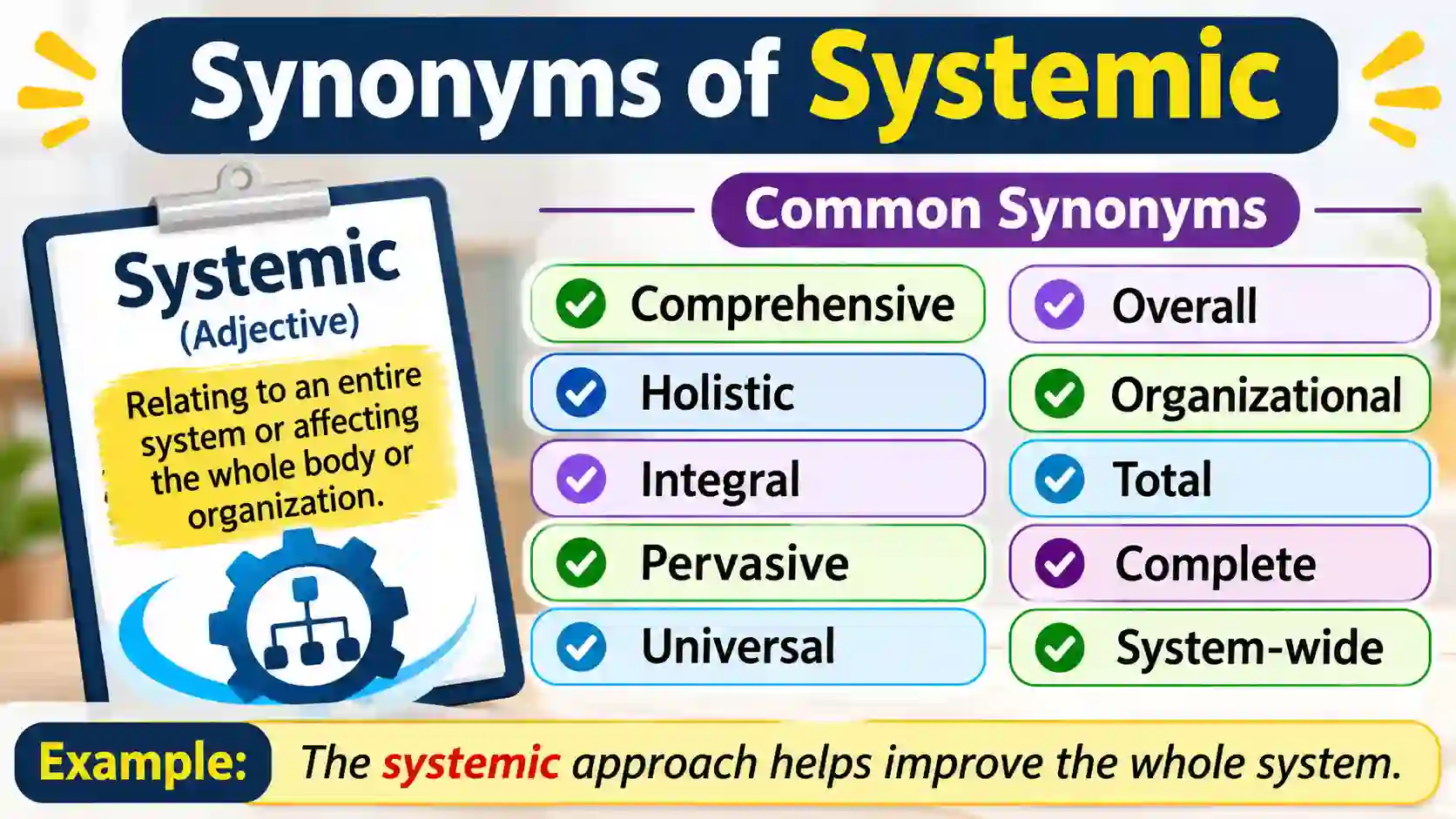
Quick Answer: What Are the Synonyms of Systemic?
The best synonyms of systemic include system-wide, structural, organization-wide, institutional, pervasive, and widespread. They describe something connected with or affecting a complete system rather than one isolated part. Other alternatives, such as deep-rooted, embedded, and fundamental, work when the sentence focuses on the causes or nature of a problem.
Imagine a company where employees in several departments struggle with the same management problems. Would you call this an individual issue or a problem affecting the whole organization?
The word systemic helps explain situations like this. It describes something that relates to or affects an entire system, organization, or structure.
However, finding the right alternative can be difficult. For example, structural highlights the framework of a system, while widespread focuses on how many people or places experience something.
Learning synonyms of systemic can improve your vocabulary, essays, reports, emails, and professional communication. This guide explores 30 useful alternatives, with meanings, examples, pronunciation, collocations, and practical advice about when to use each word.
Pronunciation of Systemic
- IPA: /sɪˈstem.ɪk/
- American pronunciation: sis-TEM-ik
- British pronunciation: sis-TEM-ik
- Syllables: 3
- Word stress: Second syllable
The pronunciation is broadly the same in standard American and British English.
English meaning – Cambridge Dictionary+1
Meaning of Systemic
Systemic is an adjective that describes something connected with or affecting a complete system.
It often refers to problems, conditions, changes, or risks that extend beyond one isolated part.
Examples:
- The investigation revealed systemic problems in the banking industry.
- The school introduced systemic changes to improve education.
- Doctors investigated a systemic infection.
Two Main Meanings
| Context | Meaning | Example |
| General and organizational | Connected with or affecting an entire system | Systemic management problems |
| Medical and biological | Affecting the body or an entire body system | Systemic infection |
This distinction matters because a word that works in business writing may not work in medical writing.
English meaning – Cambridge Dictionary+2
Part of Speech and Word Forms
Systemic is primarily an adjective.
| Word | Part of speech | Meaning |
| System | Noun | Connected parts working together |
| Systemic | Adjective | Relating to or affecting a system |
| Systemically | Adverb | In a way that affects or relates to a system |
| Systematic | Adjective | Following an organized method |
| Systematically | Adverb | In an organized manner |
| Systematize | Verb | Arrange something into an organized system |
Examples:
- The organization faces systemic challenges.
- The problems affect the company systemically.
- The researcher used a systematic process.
- The manager wants to systematize the records.
Grammar: How to Use Systemic in a Sentence
Systemic usually appears before a noun or after a linking verb.
Pattern 1: Systemic + noun
- Systemic problems
- Systemic failure
- Systemic risk
- Systemic change
- Systemic inequality
Example: The investigation identified systemic failures in the organization.
Pattern 2: Be + systemic
Example: The problems are systemic rather than individual.
Pattern 3: Systemically + verb or adjective
Example: The organization is systemically affected by poor management.
Common Prepositions
- Systemic problems within an organization.
- Systemic changes across an industry.
- Systemic issues in education.
- Systemic effects on society.
Grammar reminder: Do not use systematic when you mean that a problem affects an entire organization. The two words have different standard meanings.
Quick Overview: 30 Synonyms of Systemic
The following table separates close alternatives from words that only work in certain situations.
| No. | Synonym | Strength | Register |
| 1 | System wide | Very close | Neutral |
| 2 | Structural | Very close | Formal |
| 3 | Organization-wide | Very close | Business |
| 4 | Institutional | Close | Academic |
| 5 | Pervasive | Close | Formal |
| 6 | Widespread | Contextual | Neutral |
| 7 | Deep-rooted | Contextual | Neutral |
| 8 | Embedded | Contextual | Formal |
| 9 | Ingrained | Contextual | Neutral |
| 10 | Fundamental | Contextual | Formal |
| 11 | Endemic | Contextual | Academic |
| 12 | Generalized | Contextual | Technical |
| 13 | Extensive | Contextual | Neutral |
| 14 | Far-reaching | Contextual | Formal |
| 15 | Interconnected | Contextual | Academic |
| 16 | Intrinsic | Related | Academic |
| 17 | Inherent | Related | Formal |
| 18 | Integral | Related | Formal |
| 19 | Comprehensive | Related | Business |
| 20 | Holistic | Related | Academic |
| 21 | All-encompassing | Related | Literary |
| 22 | Universal | Related | Formal |
| 23 | General | Related | Neutral |
| 24 | Essential | Related | Neutral |
| 25 | Underlying | Related | Formal |
| 26 | Rooted | Contextual | Neutral |
| 27 | Multisystem | Technical | Medical |
| 28 | Whole-body | Medical | Neutral |
| 29 | Systemwide | Variant spelling | Technical |
| 30 | System related | Descriptive phrase | Neutral |
The strength labels are editorial guidance. They are not official thesaurus rankings. Several entries are contextual alternatives rather than exact synonyms.
30 Synonyms of Systemic With Examples and Explanations
1. System wide
Meaning: Affecting every part of a complete system.
Examples:
- The bank introduced system-wide security improvements.
- System-wide failures affected several financial services.
Best Used When: You want to describe something that reaches the entire system.
Tone: Neutral, business, technical.
CEFR: B2 | Frequency: Common
Nuance: One of the closest alternatives to systemic when the focus is the entire system.
Collocations: System-wide changes, system-wide review, system-wide failure.
When Not to Use: Avoid it when only one small section is affected.
2. Structural
Meaning: Connected with the basic framework of something.
Examples:
- The company needs structural changes to improve its operations.
- Structural weaknesses affected the education system.
Best Used When: Discussing basic problems within an organization or social structure.
Tone: Formal, academic, business.
CEFR: C1 | Frequency: Common
Nuance: Focuses on the design or framework rather than simply how widely something spreads.
Collocations: Structural problems, structural reform, structural inequality.
When Not to Use: Do not use it when describing a problem that is widespread but not built into the framework.
3. Organization wide
Meaning: Affecting an entire organization.
Examples:
- The director announced organization-wide training.
- Organization-wide communication failures delayed the project.
Best Used When: Writing about businesses, schools, hospitals, or other organizations.
Tone: Business, professional.
CEFR: B2 | Frequency: Common
Nuance: More specific than systemic because it identifies an organization as the affected system.
Collocations: Organization-wide policy, organization-wide review, organization-wide changes.
When Not to Use: Avoid it for problems affecting an entire country or biological system.
4. Institutional
Meaning: Connected with an established organization or institution.
Examples:
- Institutional barriers prevented equal access to education.
- The report identified institutional failures in public services.
Best Used When: Discussing governments, schools, hospitals, or established organizations.
Tone: Formal, academic.
CEFR: C1 | Frequency: Common
Nuance: Highlights rules, policies, and practices within institutions.
Collocations: Institutional reform, institutional bias, institutional failure.
When Not to Use: Avoid it when the issue is not connected to an institution.
5. Pervasive
Meaning: Spreading through many parts of a place or system.
Examples:
- Pervasive corruption damages public confidence.
- The investigation revealed pervasive discrimination.
Best Used When: Describing an influence or problem that appears throughout an environment.
Tone: Formal, academic.
CEFR: C1 | Frequency: Common
Nuance: Often carries a negative meaning and suggests something difficult to escape.
Collocations: Pervasive influence, pervasive problem, pervasive corruption.
When Not to Use: Avoid it for an isolated or minor issue.
6. Widespread
Meaning: Existing in many places or affecting many people.
Examples:
- Widespread unemployment affected local communities.
- The report highlighted widespread errors in financial records.
Best Used When: Emphasizing the reach of a problem.
Tone: Neutral, spoken, academic.
CEFR: B2 | Frequency: Very common
Nuance: Describes distribution, not necessarily the underlying cause.
Collocations: Widespread concern, widespread damage, widespread inequality.
When Not to Use: Avoid it when you specifically need to describe a problem built into a system.
7. Deep rooted
Meaning: Existing for a long time and difficult to change.
Examples:
- Deep-rooted inequality affected access to education.
- The organization struggled with deep-rooted management problems.
Best Used When: Discussing long-standing social or organizational issues.
Tone: Neutral, formal.
CEFR: B2 | Frequency: Common
Nuance: Emphasizes history and persistence.
Collocations: Deep-rooted beliefs, deep-rooted problems, deep-rooted inequality.
When Not to Use: Avoid it for a new or temporary problem.
8. Embedded
Meaning: Firmly included within a larger structure or system.
Examples:
- Bias was embedded in the hiring process.
- The company discovered embedded weaknesses in its reporting system.
Best Used When: Explaining how a problem has become part of an existing process.
Tone: Formal, technical.
CEFR: B2–C1 | Frequency: Common
Nuance: Highlights something built into the system.
Collocations: Embedded bias, embedded practices, embedded systems.
When Not to Use: Avoid it when something is simply found in many unrelated places.
9. Ingrained
Meaning: Deeply established as a habit, belief, or behavior.
Examples:
- Ingrained attitudes made workplace reform difficult.
- The company struggled to change its ingrained practices.
Best Used When: Describing beliefs or behaviors that are difficult to change.
Tone: Neutral, conversational, formal.
CEFR: C1 | Frequency: Common
Nuance: More suitable for habits and attitudes than for entire technical systems.
Collocations: Ingrained habits, ingrained beliefs, ingrained attitudes.
When Not to Use: Avoid it for a temporary or newly introduced problem.
10. Fundamental
Meaning: Forming a basic or essential part of something.
Examples:
- The company needs fundamental changes to its management structure.
- Trust is fundamental to a successful working relationship.
Best Used When: Discussing basic causes, principles, or important changes.
Tone: Formal, academic.
CEFR: B2 | Frequency: Very common
Nuance: Highlights the basic nature of something rather than its reach.
Collocations: Fundamental change, fundamental problem, fundamental reform.
When Not to Use: Avoid it when you only mean that something affects many locations.
11. Endemic
Meaning: Regularly found within a particular place, group, or environment.
Examples:
- Corruption became endemic within the department.
- The region continues to struggle with endemic poverty.
Best Used When: Describing persistent conditions within a particular environment.
Tone: Academic, medical, formal.
CEFR: C1 | Frequency: Common
Nuance: Often describes a problem that has become a regular feature of a particular environment.
Collocations: Endemic disease, endemic poverty, endemic corruption.
When Not to Use: Avoid it for a one-time event or a problem that has no particular geographical or social setting.
12. Generalized
Meaning: Affecting many areas rather than one specific part.
Examples:
- The patient experienced generalized pain.
- Generalized weaknesses affected several departments.
Best Used When: Discussing broad effects in medical or technical writing.
Tone: Formal, technical.
CEFR: C1 | Frequency: Common
Nuance: Focuses on broad distribution, not necessarily structural causes.
Collocations: Generalized symptoms, generalized weakness, generalized condition.
When Not to Use: Avoid it when you specifically mean an institutional problem.
13. Extensive
Meaning: Large in size, amount, or range.
Examples:
- The investigation revealed extensive damage.
- The organization needs extensive operational changes.
Best Used When: Describing the size or scope of an issue.
Tone: Neutral, professional.
CEFR: B2 | Frequency: Very common
Nuance: Emphasizes scale rather than the structure of a system.
Collocations: Extensive research, extensive damage, extensive changes.
When Not to Use: Avoid it when describing a problem that is built into a system.
14. Far reaching
Meaning: Having a wide or significant effect.
Examples:
- The new policy introduced far-reaching changes.
- The decision had far-reaching consequences for employees.
Best Used When: Discussing decisions or reforms with broad effects.
Tone: Formal, professional.
CEFR: B2 | Frequency: Common
Nuance: Focuses on consequences rather than the structure of a problem.
Collocations: Far-reaching impact, far-reaching consequences, far-reaching reforms.
When Not to Use: Avoid it as a direct replacement for systemic in medical descriptions.
15. Interconnected
Meaning: Linked in a way that allows different parts to affect each other.
Examples:
- The economy faces several interconnected challenges.
- Interconnected problems made the project difficult to manage.
Best Used When: Explaining relationships between different parts of a system.
Tone: Neutral, academic.
CEFR: C1 | Frequency: Common
Nuance: Highlights connections between parts rather than the fact that the whole system is affected.
Collocations: Interconnected systems, interconnected issues, interconnected problems.
When Not to Use: Avoid it when the parts are not actually connected.
16. Intrinsic
Meaning: Belonging naturally to the basic nature of something.
Examples:
- The researchers examined intrinsic weaknesses in the model.
- Trust has intrinsic value in professional relationships.
Best Used When: Discussing basic qualities or characteristics.
Tone: Academic, formal.
CEFR: C1 | Frequency: Common
Nuance: Focuses on internal nature rather than broad effects.
Collocations: Intrinsic value, intrinsic quality, intrinsic nature.
When Not to Use: Avoid it when you simply mean something affects an entire organization.
17. Inherent
Meaning: Existing naturally as part of something.
Examples:
- Every business decision carries inherent risks.
- The system has inherent weaknesses.
Best Used When: Describing qualities that belong naturally to something.
Tone: Formal, academic.
CEFR: C1 | Frequency: Common
Nuance: Suggests that a quality comes from the nature of something.
Collocations: Inherent risk, inherent weakness, inherent quality.
When Not to Use: Avoid it for problems caused entirely by outside factors.
18. Integral
Meaning: Forming an important part of a whole.
Examples:
- Communication is integral to successful management.
- Education is an integral part of social development.
Best Used When: Explaining how an important element fits into a larger whole.
Tone: Formal, academic, business.
CEFR: C1 | Frequency: Common
Nuance: Highlights importance and connection, not widespread effects.
Collocations: Integral part, integral role, integral component.
When Not to Use: Avoid it when describing widespread failures.
19. Comprehensive
Meaning: Covering all or nearly all important parts of a subject.
Examples:
- The school introduced a comprehensive improvement plan.
- The company completed a comprehensive review of its policies.
Best Used When: Describing complete plans, reviews, or solutions.
Tone: Formal, business, academic.
CEFR: B2 | Frequency: Common
Nuance: Focuses on coverage and completeness.
Collocations: Comprehensive review, comprehensive plan, comprehensive approach.
When Not to Use: Avoid it when describing a deeply established problem.
20. Holistic
Meaning: Considering the whole of something rather than looking at separate parts.
Examples:
- The school adopted a holistic approach to student development.
- Doctors considered the patient’s holistic needs.
Best Used When: Discussing approaches that consider connected parts together.
Tone: Academic, professional.
CEFR: C1 | Frequency: Common
Nuance: Describes an approach or way of thinking, not necessarily a problem affecting an entire system.
Collocations: Holistic approach, holistic care, holistic development.
When Not to Use: Avoid it as a direct substitute for systemic failure.
21. All encompassing
Meaning: Including every part of a subject or situation.
Examples:
- The organization needs an all-encompassing strategy.
- The review covered an all-encompassing range of operational concerns.
Best Used When: Describing broad strategies or approaches.
Tone: Formal, literary.
CEFR: C1 | Frequency: Uncommon
Nuance: Emphasizes complete coverage.
Collocations: All-encompassing strategy, all-encompassing approach, all-encompassing framework.
When Not to Use: Avoid it for a problem that affects only selected parts.
22. Universal
Meaning: Applying to everyone or everything within a defined group.
Examples:
- The company introduced universal safety standards.
- Researchers searched for universal patterns in human behavior.
Best Used When: Describing rules, principles, or conditions that apply broadly.
Tone: Formal, academic.
CEFR: B2 | Frequency: Very common
Nuance: Suggests that something applies to all members or cases.
Collocations: Universal access, universal standards, universal principles.
When Not to Use: Avoid it when a problem affects only some parts of a system.
23. General
Meaning: Relating to a broad subject rather than a specific detail.
Examples:
- The report raised general concerns about management.
- General weaknesses affected the process.
Best Used When: Making broad statements without identifying a particular structure.
Tone: Neutral, everyday English.
CEFR: A2 | Frequency: Very common
Nuance: Less precise than systemic.
Collocations: General concern, general problem, general condition.
When Not to Use: Avoid it when discussing an issue that specifically affects an entire system.
24. Essential
Meaning: Extremely important or necessary.
Examples:
- Reliable information is essential for good decisions.
- Strong leadership is essential to organizational success.
Best Used When: Emphasizing importance or necessity.
Tone: Neutral, formal.
CEFR: B1 | Frequency: Very common
Nuance: Describes importance, not the reach or structure of an issue.
Collocations: Essential services, essential skills, essential requirements.
When Not to Use: Do not use it as a direct replacement for systemic.
25. Underlying
Meaning: Existing beneath the surface and helping explain a situation.
Examples:
- The investigation revealed underlying management problems.
- The team examined the underlying causes of repeated failures.
Best Used When: Discussing hidden or basic causes.
Tone: Neutral, formal.
CEFR: B2 | Frequency: Very common
Nuance: Focuses on what causes or supports a situation.
Collocations: Underlying cause, underlying issue, underlying problem.
When Not to Use: Avoid it when you only want to describe the visible reach of a problem.
26. Rooted
Meaning: Firmly established in a particular belief, condition, or situation.
Examples:
- The conflict was rooted in historical inequality.
- The company’s difficulties were rooted in poor planning.
Best Used When: Explaining the origin or foundation of an issue.
Tone: Neutral, literary, academic.
CEFR: B2 | Frequency: Common
Nuance: Focuses on where a problem comes from.
Collocations: Rooted in tradition, rooted in history, deeply rooted.
When Not to Use: Avoid it when the problem has no clear historical or underlying cause.
27. Multisystem
Meaning: Involving several different systems, especially in medicine.
Examples:
- The patient was diagnosed with a multisystem disorder.
- Researchers studied multisystem interactions in the body.
Best Used When: Discussing multiple biological or technical systems.
Tone: Medical, technical.
CEFR: C2 | Frequency: Uncommon
Nuance: Refers to several systems, not necessarily every part of one system.
Collocations: Multisystem disorder, multisystem disease, multisystem involvement.
When Not to Use: Avoid it when describing a company-wide or society-wide problem.
28. Whole body
Meaning: Involving or affecting the entire human body.
Examples:
- The doctor investigated whole-body symptoms.
- The treatment produced a whole-body response.
Best Used When: Discussing medical conditions or treatments.
Tone: Medical, neutral.
CEFR: B1–B2 | Frequency: Common
Nuance: A useful plain-English expression, but not a universal replacement for systemic.
Collocations: Whole-body treatment, whole-body symptoms, whole-body examination.
When Not to Use: Avoid it in business, social, or financial writing.
29. Systemwide
Meaning: Extending across an entire system.
Examples:
- The government announced systemwide reforms.
- The systemwide review identified several weaknesses.
Best Used When: Writing technical or organizational material.
Tone: Technical, business.
CEFR: C1 | Frequency: Common
Nuance: This is a closed compound spelling system-wide. Both forms are used. Follow the preferred spelling of your publication or style guide.
Collocations: Systemwide reform, systemwide failure, systemwide review.
When Not to Use: Avoid changing spelling inconsistently within the same article.
30. System related
Meaning: Connected with a particular system or its operation.
Examples:
- The report identified several system-related concerns.
- System-related errors affected the software.
Best Used When: You want a broad descriptive phrase without claiming that every part of the system is affected.
Tone: Neutral, technical.
CEFR: B2 | Frequency: Common
Nuance: Much broader and weaker than systemic. It only indicates a connection with a system.
Collocations: System-related problems, system-related errors, system-related information.
When Not to Use: Avoid it when you specifically mean a deep or widespread failure.
Strongest Synonyms of Systemic
These are the best options when you want to preserve the main idea of affecting or relating to an entire system.
- System-wide
- Structural
- Organization-wide
- Institutional
- Pervasive
Example:
Original: The company experienced systemic failures.
Possible rewrites:
- The company experienced system-wide failures.
- The company experienced structural failures.
- The company experienced organization-wide failures.
Each version emphasizes a slightly different aspect of the problem.
Strong Contextual Synonyms
These alternatives are useful when the sentence emphasizes how widespread, persistent, or deeply established something is.
- Widespread
- Deep-rooted
- Embedded
- Ingrained
- Fundamental
- Endemic
- Generalized
- Extensive
- Far-reaching
- Interconnected
- Rooted
Related Words, Not Exact Synonyms
These words share certain ideas with systemic but should not automatically replace it.
- Intrinsic
- Inherent
- Integral
- Comprehensive
- Holistic
- All-encompassing
- Universal
- General
- Essential
- Underlying
- Multisystem
- Whole-body
- Systematic
- System-related
This distinction is particularly important for students writing academic assignments.
Choose the Right Synonym: Side by Side Comparisons
| Word | What it emphasizes | Best example |
| Systemic | The whole system | Systemic failures affected the bank. |
| System-wide | Every part of a system | System wide changes improved operations. |
| Structural | The basic framework | Structural weaknesses affected management. |
| Institutional | Established organizations | Institutional barriers limited access. |
| Pervasive | Spread throughout | Pervasive corruption damages trust. |
| Widespread | Large distribution | Widespread unemployment affected families. |
| Deep-rooted | Long history | Deep-rooted inequality remained a problem. |
| Embedded | Built into a structure | Bias was embedded in hiring practices. |
| Fundamental | Basic nature or foundation | Fundamental reform became necessary. |
| Comprehensive | Complete coverage | A comprehensive review identified problems. |
Which Synonym Should You Use?
If you are writing about a company
Choose organization-wide, structural, or system-wide.
If you are writing about society
Choose institutional, pervasive, widespread, or deep-rooted.
If you are writing about finance
Choose system-wide, structural, or interconnected, depending on the financial risk.
If you are writing about medicine
Choose systemic when the condition affects the body or a body system. Use whole-body for simpler explanations where appropriate.
If you are writing about research
Choose structural, fundamental, or underlying when explaining causes and frameworks.
Systemic in Different Contexts
Understanding context is one of the most important parts of synonym learning.
1. Systemic Problems in Business
A systemic business problem affects how an organization operates beyond one employee or department.
Examples:
- Systemic management failures
- Structural weaknesses
- Organization-wide communication problems
- Institutional barriers
2. Systemic Problems in Society
Social issues can become systemic when established practices, policies, or structures contribute to unequal outcomes.
Examples:
- Systemic inequality
- Institutional discrimination
- Pervasive corruption
- Deep-rooted social problems
3. Systemic Risk in Finance
Systemic risk refers to the possibility that trouble in one financial institution, market, or connected part of the financial system could spread and threaten the stability of the wider financial system.
Useful related expressions include:
- Financial system-wide risk
- Interconnected financial risk
- Structural financial weakness
These expressions are not all exact substitutes for the technical term systemic risk.
4. Systemic Conditions in Medicine
In medical writing, systemic often describes an illness, drug, or condition that affects the body more broadly rather than remaining in one local area.
Examples:
- Systemic infection
- Systemic inflammation
- Systemic treatment
- Systemic disease
Important: Systemic and whole-body are not always identical in clinical writing. A particular body system can be involved without every part of the body being affected.
English meaning – Cambridge Dictionary+2
Word Origin and Etymology of Systemic
The word systemic comes from system combined with the adjective-forming suffix -ic.
The word system ultimately traces back to the Greek systēma, which refers to an organized whole or connected arrangement.
According to Collins and Dictionary.com, systemic was first recorded around 1795–1805. This is a historical range, not an exact date for the first surviving written use.
Collins English Dictionary+1
Word Family
| Word | Meaning |
| System | A group of connected parts |
| Systemic | Relating to or affecting a system |
| Systemically | In a way connected with a whole system |
| Systematic | Following an organized method |
| Systematically | In a planned and organized way |
| Systematize | Organize something into a system |
| Systematization | The process of creating an organized system |
American vs. British English
The word systemic is generally spelled the same in American and British English.
| Feature | American English | British English |
| Spelling | Systemic | Systemic |
| Standard pronunciation | /sɪˈstem.ɪk/ | /sɪˈstem.ɪk/ |
| Main stress | Second syllable | Second syllable |
| Organizational meaning | Whole-system effect | Whole-system effect |
| Medical meaning | Body or body-system effect | Body or body-system effect |
One dictionary-specific point deserves attention: Collins records an additional British sense of systemic as an alternative to systematic, while Cambridge clearly distinguishes the two in its standard learner definitions. For clear international writing, use systemic for whole-system effects and systematic for an organized method.
English meaning – Cambridge Dictionary+2
CEFR Vocabulary Guide
CEFR levels help learners decide which words to study first. The following levels are approximate teaching recommendations, not official classifications of each word.
| Level | Recommended words |
| A1–A2 | General |
| B1 | Essential, whole body |
| B2 | Structural, widespread, fundamental, extensive, comprehensive, rooted |
| C1 | Pervasive, institutional, embedded, ingrained, inherent, integral, underlying |
| C2 / Specialized | Multisystem and advanced technical usage |
My recommendation: Learn structural, widespread, system-wide, fundamental, and deep-rooted first. They are especially useful for everyday professional and academic writing.
Register and Frequency Guide
Register tells you where a word sounds natural. Frequency tells you how often readers are likely to encounter it.
| Word | Register | Approximate frequency |
| Systemic | Academic, business, medical | Common |
| System-wide | Business, technical | Common |
| Structural | Academic, business | Common |
| Widespread | Everyday, academic | Very common |
| Pervasive | Formal, academic | Common |
| Institutional | Academic, professional | Common |
| Deep-rooted | General, literary | Common |
| Embedded | Technical, general | Common |
| Ingrained | Spoken, general | Common |
| Multisystem | Medical, technical | Uncommon |
| All-encompassing | Literary, formal | Uncommon |
These are qualitative learner-friendly estimates, not measured corpus rankings.
Common Collocations With Systemic
Collocations are word combinations that native speakers regularly use together.
| Collocation | Natural example |
| Systemic problem | The investigation revealed a systemic problem. |
| Systemic failure | The report identified systemic failure in management. |
| Systemic change | The country needs systemic change. |
| Systemic risk | The crisis increased systemic risk. |
| Systemic inequality | Researchers examined systemic inequality. |
| Systemic disease | The doctor investigated a systemic disease. |
| Systemic infection | The patient received treatment for a systemic infection. |
| Systemic reform | The government discussed systemic reform. |
| Systemic weakness | The audit exposed a systemic weakness. |
| Systemic corruption | The investigation uncovered systemic corruption. |
| Systemic treatment | The doctor considered systemic treatment. |
| Systemic effects | Researchers examined the systemic effects of the drug. |
Unique learner insight: Pay attention to the noun following systemic. The combination often tells you which meaning is intended. For example, systemic risk belongs to finance, while systemic infection belongs to medicine.
Commonly Confused Words
| Word | Main meaning | Example |
| Systemic | Relating to or affecting a system | Systemic failures affected the company. |
| Systematic | Following an organized method | The researcher used a systematic process. |
| Systematicity | The quality of being systematic | The paper discussed the systematicity of the method. |
| Systematized | Arranged into an organized system | The records were systematized. |
| Structural | Relating to the basic framework | Structural changes improved operations. |
Systemic vs. Systematic: The Most Important Difference
Systemic: The problem affects the system.
Systematic: The action follows an organized method.
Compare:
- The hospital has systemic problems.
- The hospital conducted a systematic review.
The first sentence describes a problem within the organization. The second describes how the review was conducted.
Cambridge and Collins both provide separate explanations for these standard uses.
English meaning – Cambridge Dictionary+2
Common Mistakes When Using Systemic
Mistake 1: Confusing systemic with systematic
Incorrect: We followed a systemic approach to research.
Correct: We followed a systematic approach to research.
Why: The sentence describes an organized method.
Mistake 2: Using systemic for an isolated problem
Incorrect: One employee’s late arrival was a systemic issue.
Better: One employee had an individual attendance problem.
Why: One isolated event does not automatically affect an entire system.
Mistake 3: Treating widespread and systemic as identical
Incorrect: Every widespread problem is systemic.
Correct: A widespread problem may be systemic if it is connected to the way the system operates.
Why: Widespread describes reach, while systemic describes the relationship with the system.
Mistake 4: Using essential as a direct replacement
Incorrect: The company has essential problems.
Better: The company has structural problems.
Why: Essential means necessary or extremely important, not system-wide.
Writing Tips: How to Use Systemic Synonyms
Essays: Use structural, institutional, and fundamental when discussing society, education, or public policy.
Example: Structural barriers can limit access to education.
Emails: Use organization-wide or system-wide for company policies and changes.
Example: We recommend an organization-wide review of the reporting process.
Blog Posts: Use widespread, deep-rooted, and underlying to explain complex issues in simple English.
Example: Deep-rooted problems often require long-term solutions.
Stories: Use ingrained, pervasive, or far-reaching to describe beliefs, behavior, and consequences.
Example: His ingrained habits made change difficult.
Social Media: Use familiar alternatives such as widespread and deep-rooted rather than technical terms.
Example: Real progress starts when we address deep-rooted problems.
Professional Reports: Use structural, institutional, and system-wide when the evidence supports these descriptions.
Example: The audit identified system-wide weaknesses in the reporting process.
Daily Conversations: Say “a problem throughout the company” when a simpler expression sounds more natural.
Writing Tip
A good synonym does not simply make a sentence sound more advanced. It makes the meaning more exact. Choose accuracy over variety.
Antonyms of Systemic
There is no single opposite of systemic that works in every context. The following words provide useful contrasts.
| Antonym | Meaning | Example |
| Local | Limited to one area | The damage was local. |
| Isolated | Separate from other events | It was an isolated incident. |
| Individual | Related to one person | It was an individual problem. |
| Limited | Restricted in scope | The effect was limited. |
| Specific | Relating to one particular thing | The report identified a specific error. |
| Partial | Involving only part of something | The repair was partial. |
| External | Coming from outside | External factors caused the problem. |
| Piecemeal | Done in separate small stages | The company made piecemeal changes. |
Example comparison:
- Systemic failure affected the entire department.
- An isolated failure affected one employee’s workstation.
Related Vocabulary and Expressions
These expressions are useful when discussing organizations, systems, and major problems.
- Root cause: The main reason something happens.
- System failure: A situation in which a system does not work correctly.
- Structural reform: Changes to the basic framework.
- Institutional reform: Changes intended to improve an established institution.
- Organizational weakness: A problem affecting how an organization operates.
- Systemic inequality: Inequality connected with how a system operates.
- System-wide reform: Changes affecting an entire system.
- Underlying issue: A basic problem that may not be immediately visible.
- Organizational culture: Shared values and practices within an organization.
- Interconnected challenges: Problems that influence one another.
Frequently Asked Questions About Synonyms of Systemic
1. What are the 5 best synonyms of systemic?
The five most useful alternatives are system-wide, structural, organization-wide, institutional, and pervasive. System-wide is especially close when something affects an entire system. Structural works better when discussing weaknesses in the basic design or framework of an organization.
2. What is another word for systemic problems?
Other expressions for systemic problems include structural problems, organization-wide issues, institutional failures, and pervasive difficulties. You can also use deep-rooted problems when discussing issues that have existed for a long time. The correct choice depends on the cause and reach of the problem.
3. Is systemic the same as systematic?
No. Systemic means relating to or affecting a whole system. Systematic means following an organized method or plan. For example, systemic problems affect an organization, while a systematic investigation follows a planned process. These words should not be used interchangeably in standard English.
4. What is the opposite of systemic?
Common contextual opposites include local, isolated, individual, limited, and specific. These words describe situations that affect a smaller area or a particular person rather than an entire system. However, the best opposite depends on the meaning of systemic in your sentence.
5. What does systemic mean in simple English?
Systemic means connected with or affecting an entire system rather than just one small part. For example, if poor communication affects every department in a company, it may be a systemic problem. The word is also used in medicine for conditions that affect the body or a body system.
6. What are formal alternatives to systemic?
Formal alternatives include structural, institutional, pervasive, fundamental, and organization-wide. These words are useful in academic papers, research reports, business documents, and professional communication. However, they have different meanings, so choose the alternative that accurately describes the issue.
7. Can systemic have a positive meaning?
Yes. Systemic can describe positive changes, improvements, and reforms that affect an entire system. For example, systemic improvements in education can improve learning opportunities across schools. The word itself is neutral, although it frequently appears in discussions of serious problems.
8. What is the difference between systemic and widespread?
Systemic describes something connected with or affecting a whole system, while widespread describes something that exists in many places or affects many people. A problem can be widespread without being systemic. Systemic often highlights how the structure or operation of a system contributes to an issue.
9. What is a synonym for systemic change?
Useful alternatives include system-wide change, structural change, fundamental reform, and organization-wide change. Structural change is best when the basic framework needs improvement. System-wide change works when the change affects all parts of a particular system.
Vocabulary Practice: Test Your Knowledge
Choose the correct answer for each question.
Vocabulary knowledge test
0/5 answered
1. Which word describes something affecting an entire system?
A. Isolated
B. System-wide
C. Individual
D. Temporary
2. Which word describes an organized method?
A. Systemic
B. Pervasive
C. Systematic
D. Widespread
3. Which word describes something deeply established over time?
A. Deep-rooted
B. External
C. Partial
D. Limited
4. Which word is best for a problem built into an organization’s basic framework?
A. General
B. Structural
C. Essential
D. Universal
5. Which word describes something that spreads throughout an environment?
A. Specific
B. Integral
C. Pervasive
D. Individual
Submit answers
Additional Practice Exercises
Exercise 1: Fill in the blanks
Use these words: systematic, widespread, structural, pervasive.
- The company needs ______ reform.
- The researcher followed a ______ process.
- ______ unemployment affected several communities.
- ______ corruption damaged public trust.
Exercise 2: Rewrite the sentences
Replace systemic with a more suitable alternative.
- The company experienced systemic failures.
- The country needs systemic reform.
- Systemic problems have existed for many years.
Exercise 3: Match the words with their meanings
| Word | Meaning |
| 1. Institutional | A. Spread throughout |
| 2. Pervasive | B. Connected with an established organization |
| 3. Fundamental | C. Basic or essential |
| 4. Embedded | D. Firmly included within a structure |
Practice answer key
Exercise 1
- Structural
- Systematic
- Widespread
- Pervasive
2: Possible answers:
- The company experienced system-wide failures.
- The country needs structural reform.
- Deep-rooted problems have existed for many years.
3: 1-B, 2-A, 3-C, 4-D.
Conclusion
Learning synonyms of systemic helps you explain complex ideas with greater accuracy. Words such as structural, system-wide, pervasive, and institutional give you different ways to describe problems and changes.
Understanding their differences also prevents common vocabulary mistakes. Practice these alternatives in essays, emails, reports, and everyday conversations. A stronger vocabulary will help you communicate with more confidence and clarity.
References and Trusted Sources
The following dictionaries were used to check definitions, pronunciation, spelling, word history, and usage.
- Cambridge Dictionary: Systemic
- Thesaurus.com: Systemic Synonyms and Antonyms
- Collins English Dictionary: Systemic
- Cambridge Dictionary: Systematic
- Dictionary.com: Systemic

Synonorm is a trusted English vocabulary resource created to help readers find the right words and understand the differences between similar terms. We provide clear explanations of synonyms, meanings, examples, usage, and alternatives. Our content makes vocabulary easier to learn and apply in everyday, academic, and professional English. Synonorm is designed for students, writers, ESL learners, professionals, and anyone who wants to improve their English vocabulary and communicate more clearly.