What Are Synonyms of Insight?
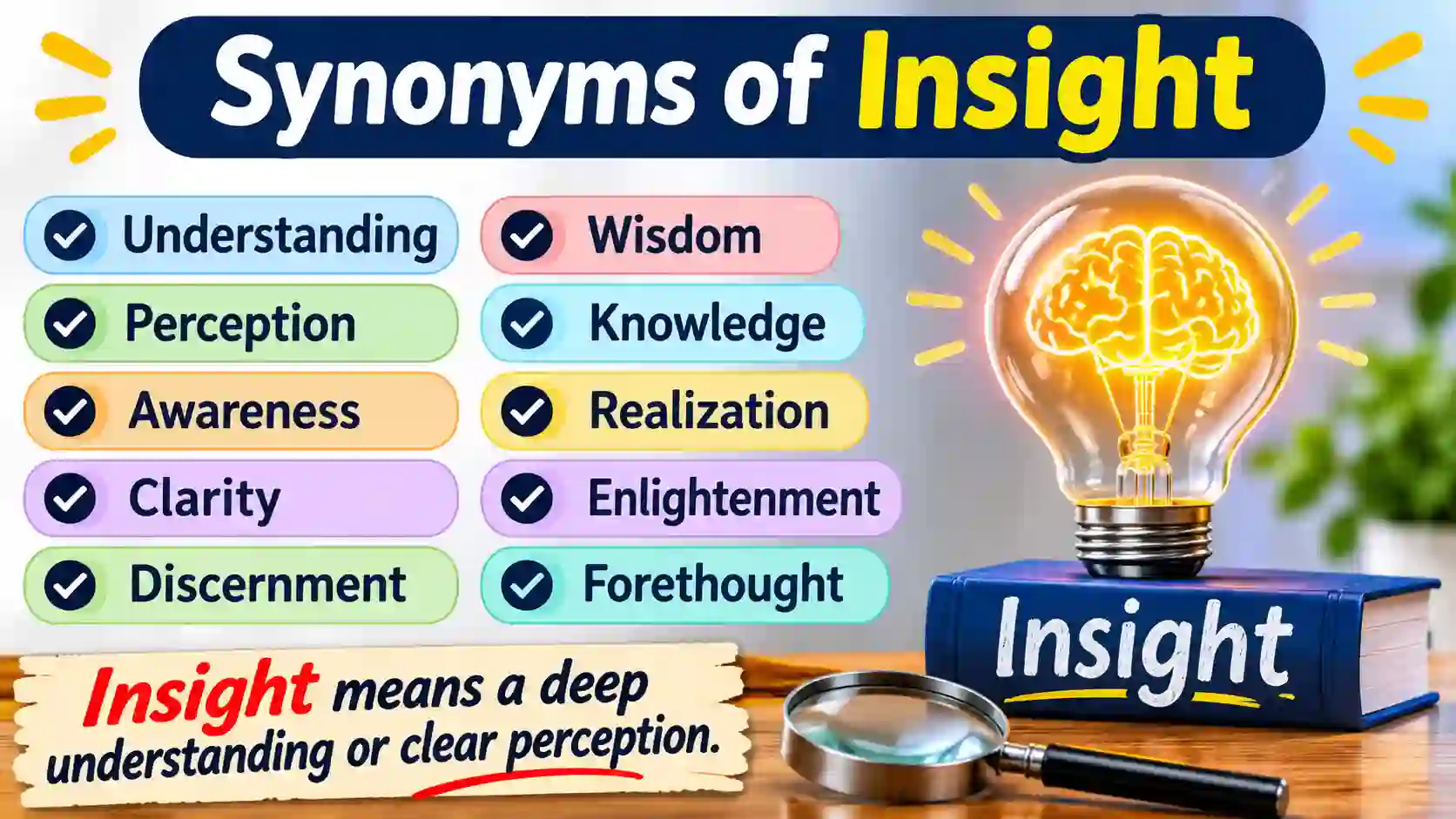
The best synonyms of insight include understanding, perception, discernment, intuition, comprehension, acumen, wisdom, and perspicacity. These words describe the ability to understand something deeply, recognize important details, or see the real meaning behind a situation. However, each alternative has a slightly different meaning and works best in certain contexts.
Have you ever understood the real reason behind a problem when others could not see it? Perhaps you noticed a hidden pattern, understood someone’s feelings, or discovered why a business was losing customers. This ability is called insight.
Learning synonyms of insight can make your English more accurate and expressive. For example, understanding describes knowing how something works, while intuition describes an instinctive feeling. Acumen refers to sharp practical judgment, especially in business.
Students, teachers, bloggers, and professionals can all benefit from learning these alternatives. This guide explains 30 useful words, their meanings, examples, pronunciation, grammatical patterns, and differences. It also helps you choose the right alternative instead of replacing words without checking their meaning.
Pronunciation of Insight
- IPA: /ˈɪn.saɪt/
- Simple pronunciation: IN-site
- Syllables: 2
- Word stress: First syllable
- American English: /ˈɪn.saɪt/
- British English: /ˈɪn.saɪt/
The standard pronunciation and spelling are the same in American and British English.
Meaning and Part of Speech
Insight is a noun. It describes a clear, deep understanding of a person, situation, subject, or problem.
It can refer to:
- The ability to understand complicated situations.
- A particular discovery that reveals something important.
- A deeper understanding of your own thoughts and behavior.
Examples:
- Her insight helped us understand the real problem.
- The research provides valuable insight into human behavior.
- I gained a new insight from the discussion.
Word Forms
| Word | Part of speech | Meaning |
| Insight | Noun | Deep understanding |
| Insightful | Adjective | Showing deep understanding |
| Insightfully | Adverb | In a perceptive way |
| Insightfulness | Noun | The quality of being insightful |
There is no commonly used standard verb to insight. Use understand, recognize, realize, or discover instead.
Grammar: How to Use Insight Correctly
Insight can be both countable and uncountable.
Uncountable use: When discussing the general ability to understand something.
- She has considerable insight into human behavior.
- His insight helped the team.
Countable use: When referring to a particular discovery or useful piece of understanding.
- The interview gave us an interesting insight.
- The report offers several useful insights.
Common Grammar Patterns
| Pattern | Example |
| Insight into something | Insight into customer behavior |
| Gain insight into | We gained insight into the issue. |
| Provide insight into | The study provides insight into learning. |
| Offer an insight | The article offers an insight into history. |
| Valuable insight | Her advice provided valuable insight. |
| Insight from experience | He gained insight from experience. |
Important: Use insight when explaining the subject someone understands.
Incorrect: The report gives insight of the problem.
Correct: The report gives insight into the problem.
30 Synonyms of Insight With Examples and Explanations
The following alternatives are grouped by meaning. Some are close synonyms, while others express a particular type of understanding.
Closest Synonyms
1. Understanding
Meaning: The ability to know what something means or how it works.
Examples:
- Her understanding of human behavior impressed the teacher.
- The training improved our understanding of the problem.
Best used when: You mean general or deep knowledge of a subject.
- Tone: Neutral
- CEFR: B1 (approximate)
- Frequency: Very common
- Collocations: Deep understanding, clear understanding, mutual understanding.
- Connotation: Clear knowledge without necessarily implying a sudden discovery.
- Avoid when: You specifically mean instinctive judgment.
2. Perception
Meaning: The way someone notices and understands something.
Examples:
- His perception of the situation changed after the meeting.
- The designer has a strong perception of customer needs.
Best used when: Discussing how someone interprets events or people.
- Tone: Formal
- CEFR: B2 (approximate)
- Frequency: Common
- Collocations: Public perception, visual perception, keen perception.
- Connotation: Personal observation and interpretation.
- Avoid when: You mean proven knowledge rather than someone’s viewpoint.
3. Discernment
Meaning: The ability to recognize important differences and make good judgments.
Examples:
- Her discernment helped her identify the reliable source.
- Good editors use discernment when selecting information.
Best used when: Someone can judge quality, truth, or value carefully.
- Tone: Formal
- CEFR: C1 (approximate)
- Frequency: Uncommon
- Collocations: Sound discernment, critical discernment, exercise discernment.
- Connotation: Careful and intelligent judgment.
- Avoid when: A simple word like judgment would be clearer.
4. Intuition
Meaning: The ability to understand something without consciously analyzing every detail.
Examples:
- My intuition told me that something was wrong.
- The artist used intuition when choosing the final design.
Best used when: Describing instinctive understanding.
- Tone: Neutral
- CEFR: B2 (approximate)
- Frequency: Common
- Collocations: Strong intuition, natural intuition, trust your intuition.
- Connotation: Instinct rather than deliberate analysis.
- Avoid when: You need to describe a conclusion based on detailed evidence.
5. Comprehension
Meaning: The ability to understand information or ideas.
Examples:
- Regular reading improves language comprehension.
- Her comprehension of the instructions was excellent.
Best used when: Discussing education, reading, listening, or learning.
- Tone: Academic / Formal
- CEFR: B2 (approximate)
- Frequency: Common
- Collocations: Reading comprehension, listening comprehension, full comprehension.
- Connotation: Understanding information correctly.
- Avoid when: You mean wise decisions or instinctive understanding.
6. Acumen
Meaning: The ability to understand situations quickly and make clever decisions.
Examples:
- Her business acumen helped the company grow.
- The consultant showed excellent financial acumen.
Best used when: Describing practical intelligence in business or professional life.
- Tone: Formal / Business
- CEFR: C1 (approximate)
- Frequency: Uncommon
- Collocations: Business acumen, financial acumen, commercial acumen.
- Connotation: Sharp practical judgment.
- Avoid when: You mean ordinary knowledge or simple awareness.
7. Perspicacity
Meaning: The ability to understand complicated things quickly and clearly.
Examples:
- Her perspicacity helped her identify the weak argument.
- The author’s perspicacity made the analysis valuable.
Best used when: Describing exceptional intellectual understanding.
- Tone: Formal / Literary
- CEFR: C2 (approximate)
- Frequency: Rare
- Collocations: Keen perspicacity, remarkable perspicacity, intellectual perspicacity.
- Connotation: Exceptional mental sharpness.
- Avoid when: Writing for beginners who may not know this word.
8. Perceptiveness
Meaning: The ability to notice and understand important details.
Examples:
- Her perceptiveness helped her recognize the customer’s concerns.
- The teacher showed great perceptiveness when dealing with students.
Best used when: Someone notices details that others may overlook.
- Tone: Neutral / Formal
- CEFR: C1 (approximate)
- Frequency: Common
- Collocations: Remarkable perceptiveness, emotional perceptiveness, keen perceptiveness.
- Connotation: Careful observation and awareness.
- Avoid when: You mean specialist knowledge rather than the ability to notice things.
9. Perceptivity
Meaning: The quality of being able to notice and understand things.
Examples:
- Her perceptivity helped her understand the difficult discussion.
- The writer’s perceptivity added depth to the story.
Best used when: Discussing someone’s ability to notice and interpret details.
- Tone: Formal
- CEFR: C2 (approximate)
- Frequency: Rare
- Collocations: Intellectual perceptivity, emotional perceptivity, keen perceptivity.
- Connotation: Strong awareness and observation.
- Avoid when: A more familiar word such as perceptiveness is suitable.
10. Judgment
Meaning: The ability to make sensible decisions after considering information.
Examples:
- Her judgment helped the team avoid a costly mistake.
- Good judgment is important when evaluating online sources.
Best used when: Discussing decisions and evaluations.
- Tone: Neutral
- CEFR: B1 (approximate)
- Frequency: Very common
- Collocations: Sound judgment, good judgment, personal judgment.
- Connotation: Practical decision-making ability.
- Avoid when: You only mean noticing something without evaluating it.
Strong Contextual Synonyms
11. Wisdom
Meaning: The ability to make good choices using knowledge and experience.
Examples:
- Her wisdom helped the family through a difficult period.
- Years of teaching gave him wisdom about human behavior.
- Tone: Neutral
- CEFR: B1 (approximate)
- Frequency: Very common
- Collocations: Practical wisdom, great wisdom, words of wisdom.
- Best used for: Experience-based understanding.
- Avoid when: You mean a small discovery or technical finding.
12. Awareness
Meaning: Knowing that something exists or is happening.
Examples:
- The campaign increased awareness of online safety.
- Her awareness of the warning signs prevented a problem.
- Tone: Neutral
- CEFR: B1 (approximate)
- Frequency: Very common
- Collocations: Public awareness, growing awareness, environmental awareness.
- Best used for: Recognition of an issue or situation.
- Avoid when: You mean deep analysis rather than simply knowing something exists.
13. Grasp
Meaning: A clear understanding of an idea or subject.
Examples:
- She has a strong grasp of English grammar.
- The student quickly gained a grasp of the topic.
- Tone: Neutral / Spoken
- CEFR: B2 (approximate)
- Frequency: Very common
- Collocations: Firm grasp, basic grasp, grasp of the subject.
- Best used for: Practical understanding.
- Avoid when: You need a more formal academic term.
14. Observation
Meaning: The act or ability of noticing details about something.
Examples:
- Her observation revealed a pattern in the results.
- Careful observation helped the scientist understand the process.
- Tone: Neutral / Academic
- CEFR: B1–B2 (approximate)
- Frequency: Very common
- Collocations: Careful observation, direct observation, scientific observation.
- Best used for: Understanding gained by noticing details.
- Avoid when: You mean a conclusion without an observational process.
15. Penetration
Meaning: Deep understanding of the hidden meaning or nature of something.
Examples:
- The critic showed unusual penetration in analyzing the novel.
- Her intellectual penetration helped reveal the weakness in the theory.
- Tone: Formal / Literary
- CEFR: C2 (approximate)
- Frequency: Rare in this sense
- Collocations: Intellectual penetration, analytical penetration, penetrating insight.
- Best used for: Deep analytical understanding.
- Avoid when: Writing casually, because the word has several other common meanings.
16. Shrewdness
Meaning: The ability to understand situations and make clever practical decisions.
Examples:
- Her shrewdness helped her negotiate a better deal.
- The investor showed shrewdness when selecting the opportunity.
- Tone: Neutral
- CEFR: C1 (approximate)
- Frequency: Common
- Collocations: Business shrewdness, political shrewdness, financial shrewdness.
- Best used for: Clever practical judgment.
- Avoid when: You want to describe kindness or purely academic understanding.
17. Astuteness
Meaning: The ability to notice important details and make clever decisions.
Examples:
- His astuteness helped him recognize the business opportunity.
- The editor showed astuteness when reviewing the article.
- Tone: Formal
- CEFR: C1 (approximate)
- Frequency: Uncommon
- Collocations: Political astuteness, business astuteness, remarkable astuteness.
- Best used for: Sharp practical awareness.
- Avoid when: You mean simple knowledge without judgment.
18. Sagacity
Meaning: The ability to make wise decisions using experience and good judgment.
Examples:
- The leader’s sagacity helped the community.
- Her sagacity was clear in the advice she offered.
- Tone: Literary / Formal
- CEFR: C2 (approximate)
- Frequency: Rare
- Collocations: Great sagacity, political sagacity, practical sagacity.
- Best used for: Mature and thoughtful judgment.
- Avoid when: Writing simple everyday English.
19. Acuity
Meaning: Sharpness of thought, understanding, or perception.
Examples:
- Her analytical acuity helped solve the difficult problem.
- The lawyer’s mental acuity impressed the audience.
- Tone: Formal
- CEFR: C1 (approximate)
- Frequency: Uncommon
- Collocations: Mental acuity, intellectual acuity, analytical acuity.
- Best used for: Sharp mental ability.
- Avoid when: You mean general information or experience.
20. Keenness
Meaning: Strong interest, awareness, or ability to notice things.
Examples:
- His keenness for detail improved the final report.
- She showed a keen understanding of the issue.
- Tone: Neutral
- CEFR: C1 (approximate)
- Frequency: Common
- Collocations: Keen interest, keen eye, keenness to learn.
- Best used for: Strong interest or sharp attention.
- Avoid when: You need a precise synonym for a particular discovery.
Related and Specialized Alternatives
21. Sense
Meaning: The ability to understand or recognize something.
Examples:
- She has a good sense of what customers need.
- His sense of timing helped the presentation.
- Tone: Neutral
- CEFR: A2–B1 (approximate)
- Frequency: Very common
- Collocations: Common sense, business sense, sense of direction.
- Best used for: Everyday practical understanding.
- Avoid when: You need to describe a complex research finding.
22. Vision
Meaning: The ability to imagine possibilities and understand a future direction.
Examples:
- Her vision helped the organization develop a new strategy.
- The founder had a clear vision for the future.
- Tone: Neutral / Business
- CEFR: B2 (approximate)
- Frequency: Very common
- Collocations: Clear vision, strategic vision, creative vision.
- Best used for: Leadership and long-term thinking.
- Avoid when: You mean simple awareness or factual knowledge.
23. Appreciation
Meaning: A full understanding of the value or importance of something.
Examples:
- The course gave students an appreciation of local history.
- Her appreciation of the problem grew after the discussion.
- Tone: Neutral / Formal
- CEFR: B2 (approximate)
- Frequency: Very common
- Collocations: Deep appreciation, full appreciation, appreciation of the importance.
- Best used for: Understanding value or significance.
- Avoid when: You mean instinctive judgment.
24. Recognition
Meaning: The ability to identify or notice something important.
Examples:
- Her recognition of the warning signs prevented damage.
- The research led to recognition of a hidden pattern.
- Tone: Neutral
- CEFR: B1 (approximate)
- Frequency: Very common
- Collocations: Pattern recognition, facial recognition, recognition of a problem.
- Best used for: Identifying something meaningful.
- Avoid when: You mean a complete explanation of why something happens.
25. Interpretation
Meaning: The way someone explains or understands the meaning of information.
Examples:
- Her interpretation of the results revealed an interesting pattern.
- The teacher offered a different interpretation of the poem.
- Tone: Formal / Academic
- CEFR: B2 (approximate)
- Frequency: Common
- Collocations: Personal interpretation, accurate interpretation, alternative interpretation.
- Best used for: Explaining the meaning of evidence or events.
- Avoid when: You mean knowledge itself rather than someone’s explanation.
26. Knowledge
Meaning: Information and understanding gained through learning or experience.
Examples:
- His knowledge of history impressed the class.
- The project gave us new knowledge about customer behavior.
- Tone: Neutral
- CEFR: A2 (approximate)
- Frequency: Very common
- Collocations: General knowledge, practical knowledge, expert knowledge.
- Best used for: Facts and learned information.
- Avoid when: You specifically mean an ability to identify hidden meaning.
27. Intelligence
Meaning: The ability to learn, reason, and solve problems.
Examples:
- Her intelligence helped her solve the complex puzzle.
- Emotional intelligence improves communication between coworkers.
- Tone: Neutral / Academic
- CEFR: B1 (approximate)
- Frequency: Very common
- Collocations: Emotional intelligence, human intelligence, artificial intelligence.
- Best used for: General mental ability.
- Avoid when: You mean one particular discovery or observation.
28. Realization
Meaning: The moment when someone suddenly understands something.
Examples:
- He had a realization that changed his career plans.
- Her realization came after reviewing the evidence.
- Tone: Neutral
- CEFR: B2 (approximate)
- Frequency: Very common
- Collocations: Sudden realization, painful realization, growing realization.
- Best used for: A new or sudden understanding.
- Avoid when: You mean long-term professional knowledge.
29. Enlightenment
Meaning: A deeper understanding that changes how someone thinks.
Examples:
- The discussion brought intellectual enlightenment.
- Her travels gave her a new perspective on life.
- Tone: Literary / Formal
- CEFR: C1 (approximate)
- Frequency: Common
- Collocations: Spiritual enlightenment, intellectual enlightenment, age of enlightenment.
- Best used for: Major changes in understanding.
- Avoid when: You mean a small piece of information.
30. Introspection
Meaning: The process of examining your own thoughts and feelings.
Examples:
- Introspection helped him understand his reaction to criticism.
- The journal encouraged personal introspection.
- Tone: Formal / Literary
- CEFR: C1 (approximate)
- Frequency: Uncommon
- Collocations: Deep introspection, personal introspection, self-reflection.
- Best used for: Understanding your own thoughts and behavior.
- Avoid when: You mean insight into an external problem or another person.
Quick Synonym Comparison Table
| Word | Main meaning | Best context |
| Understanding | Knowing how something works | Everyday English |
| Perception | Interpreting something | Analysis |
| Discernment | Recognizing differences | Judgment |
| Intuition | Instinctive understanding | Personal decisions |
| Comprehension | Understanding information | Education |
| Acumen | Sharp practical judgment | Business |
| Perspicacity | Exceptional understanding | Literary writing |
| Wisdom | Experience-based judgment | Life advice |
| Awareness | Knowing something exists | Social issues |
| Realization | Sudden understanding | Personal discovery |
Strongest Synonyms, Strong Synonyms, and Related Words
Strongest Synonyms
These are the closest alternatives when the meaning is deep understanding or the ability to recognize the true nature of something:
- Understanding
- Perception
- Discernment
- Comprehension
- Intuition
- Acumen
- Perspicacity
- Perceptiveness
Strong Contextual Synonyms
These words work when the sentence focuses on a particular aspect of understanding:
- Wisdom
- Judgment
- Awareness
- Grasp
- Observation
- Shrewdness
- Astuteness
- Sagacity
- Acuity
- Keenness
Related Words
These words connect to insight but should not automatically replace it:
- Sense
- Vision
- Appreciation
- Recognition
- Interpretation
- Knowledge
- Intelligence
- Realization
- Enlightenment
- Introspection
Choose the Right Synonym: Side by Side Comparisons
The easiest way to choose a synonym is to identify what kind of understanding you want to describe.
| If you mean… | Choose… | Example |
| Knowing how something works | Understanding | Her understanding of the system improved. |
| Seeing a hidden meaning | Perception | His perception revealed the problem. |
| Making a wise decision | Judgment | Her judgment saved time. |
| Understanding without analysis | Intuition | My intuition warned me. |
| Professional business thinking | Acumen | His business acumen impressed us. |
| A sudden discovery | Realization | I had a sudden realization. |
| Understanding through experience | Wisdom | Her wisdom guided the team. |
| Noticing small details | Discernment | His discernment helped him choose. |
One Situation, Different Words
Imagine a company is losing customers.
- Awareness: The manager knows that customers are leaving.
- Knowledge: The manager has customer survey information.
- Observation: The manager notices that complaints are increasing.
- Insight: The manager understands that poor customer support is causing customers to leave.
- Acumen: The manager uses that understanding to make a smart business decision.
This distinction is especially useful for students, writers, and business professionals.
Word Origin and Etymology of Insight
Insight comes from Middle English insight or insight. The word combines the idea of looking inward with sight, which explains its connection to deep understanding.
Its historical background is also linked to related Scandinavian and Germanic words, including Swedish insikt, Danish indsigt, Dutch inzicht, and German Einsicht.
First known use: Major dictionary references place the word’s early use around 1150–1200. Its modern meaning of understanding the inner nature of something developed over time.
The exact date of a word’s first use can change as historical texts are discovered.
American vs. British English
There is no major spelling difference between American and British English.
| Feature | American English | British English |
| Spelling | Insight | Insight |
| Pronunciation | /ˈɪn.saɪt/ | /ˈɪn.saɪt/ |
| Plural | Insights | Insights |
| Main expression | Insight into | Insight into |
| Business usage | Common | Common |
| Academic usage | Common | Common |
Some accents may pronounce individual sounds differently, but the standard dictionary pronunciation is essentially the same.
Other words in this article may have regional variations. For example, judgment is standard in American English, while judgement is also widely used in British English.
Commonly Confused Words
| Word | Difference | Example |
| Information | Facts or details, not necessarily deep understanding | The report contains useful information. |
| Opinion | A personal belief or view | Her opinion differs from mine. |
| Knowledge | Learned facts and information | He has knowledge of economics. |
| Intelligence | General mental ability | Intelligence helps people solve problems. |
| Intuition | Instinctive understanding | Her intuition told her to wait. |
Remember: You can have information without insight. Insight often develops when you study information, notice patterns, and understand their meaning.
Common Mistakes When Using Insight
Mistake 1: Using the wrong preposition
Incorrect: The report gives insight into customer behavior.
Correct: The report gives insight into customer behavior.
Explanation: The usual grammatical expression is insight into.
Mistake 2: Confusing knowledge with insight
Incorrect: Memorizing facts always creates insight.
Correct: Memorizing facts builds knowledge, while analyzing them can develop insight.
Explanation: Knowledge involves information. Insight involves deeper understanding.
Mistake 3: Using intuition for research findings
Incorrect: The research proved my intuition.
Better: The research supported my initial understanding.
Explanation: Intuition is usually instinctive. Research-based conclusions rely on evidence.
Mistake 4: Treating all synonyms as interchangeable
Incorrect: His expertise helped him understand the problem.
This is not always wrong, but expertise describes advanced knowledge or skill, not necessarily the ability to recognize a hidden cause.
Better: His analytical insight helped him understand the problem.
Writing Tips: How to Use Insight Synonyms Naturally
Essays
Use comprehension, perception, discernment, and interpretation when discussing research and arguments.
Example: The study provides a deeper understanding of student behavior.
Emails
Use understanding and awareness for clear professional messages.
Example: Thank you for sharing your understanding of the project requirements.
Blog Posts
Use knowledge, perspective, and awareness when explaining topics to readers.
Example: This guide provides valuable knowledge about online marketing.
Stories
Use realization, intuition, and wisdom to describe a character’s thoughts.
Example: A sudden realization helped her understand the truth.
Social Media
Use simple words such as clarity, awareness, and understanding.
Example: A little awareness can make a big difference.
Professional Communication
Use acumen, discernment, and judgment when discussing business decisions.
Example: Her financial acumen helped the company improve its strategy.
Writing Tip: Do not replace every occurrence of insight with another word. Repeating the original word is better than using an inaccurate alternative.
Natural Collocations With Insight
Native English speakers often use insight with particular adjectives and verbs.
| Collocation | Original example |
| Valuable insight | The interview provided valuable insight into the industry. |
| Deep insight | The book offers deep insight into human emotions. |
| Fresh insight | The research provides fresh insight into the problem. |
| New insight | The discovery offers new insight into the process. |
| Keen insight | Her keen insight helped identify the weakness. |
| Business insight | The report offers useful business insight. |
| Gain insight | Students gain insight through practical experience. |
| Provide insight | The survey provides insight into customer needs. |
| Offer insight | The article offers insight into modern education. |
| Insight into behavior | The research explores insight into human behavior. |
Other natural expressions include valuable insights, fascinating insights, useful insights, and considerable insight.
Antonyms of Insight
Antonyms describe the opposite of deep understanding or good judgment.
| Antonym | Meaning |
| Ignorance | Lack of knowledge |
| Confusion | Lack of clarity |
| Misunderstanding | Incorrect understanding |
| Unawareness | Lack of awareness |
| Incomprehension | Failure to understand |
| Obtuseness | Slowness in understanding |
| Blindness | Failure to recognize something important |
Related Expressions and Word Family
Useful Expressions
- A flash of insight: A sudden moment of understanding.
- Gain insight into: Develop deeper understanding.
- Provide insight: Offer useful understanding.
- Fresh perspective: A new way of looking at something.
- Deep understanding: Strong knowledge of a subject.
- Moment of realization: A time when something becomes clear.
- Keen observation: The ability to notice important details.
Word Family
| Word | Part of speech | Meaning |
| Insight | Noun | Deep understanding |
| Insightful | Adjective | Showing deep understanding |
| Insightfully | Adverb | In a perceptive way |
| Insightfulness | Noun | The quality of being insightful |
Examples:
- She made an insightful comment.
- He wrote insightfully about human behavior.
- Her insightfulness impressed the audience.
Frequently Asked Questions
1. What are the best synonyms of insight?
The best synonyms include understanding, perception, discernment, intuition, comprehension, acumen, and wisdom. Understanding is the most flexible everyday alternative. Acumen works particularly well in business, while discernment describes the ability to recognize important differences and make sensible judgments.
2. What is another word for deep insight?
Other expressions for deep insight include profound understanding, keen perception, deep comprehension, and exceptional discernment. These phrases describe the ability to understand complicated ideas or recognize hidden meanings. Profound understanding is particularly useful in formal and academic writing.
3. What is a simple word for insight?
Understanding is a simple and useful alternative to insight. Other accessible words include awareness, knowledge, and realization. Use understanding when you mean knowing how something works. Use realization when someone suddenly discovers or understands something important.
4. Is insight the same as knowledge?
No. Knowledge refers to facts and information gained through learning or experience. Insight goes further by helping someone understand the deeper meaning of information. Knowing customer statistics is knowledge, while understanding why customers behave in a certain way demonstrates insight.
5. What is the difference between insight and intuition?
Insight is a deep understanding of a situation, person, or problem. Intuition is the ability to sense or understand something without consciously analyzing every detail. Insight can develop through research and experience, while intuition often comes from instinct or subconscious thinking.
6. What is the opposite of insight?
Common opposites include ignorance, confusion, misunderstanding, unawareness, and incomprehension. The correct antonym depends on the sentence. Ignorance describes a lack of knowledge, while confusion describes uncertainty or a lack of clarity.
7. How do you use insight in a sentence?
Use insight as a noun to describe deep understanding or an important discovery. For example, “Her research provided valuable insight into student behavior.” Another example is, “He gained new insight from his professional experience.” The expression insight into is especially common.
8. Is insight a noun or an adjective?
Insight is a noun. It refers to deep understanding or the ability to recognize important details. Its adjective form is insightful. For example, “She shared an insightful opinion during the discussion.” Insightfully is the related adverb.
Vocabulary Quiz: Test Your Knowledge
Choose the correct answer for each question.
1. Which word describes understanding gained through experience and good judgment?
A. Confusion
B. Wisdom
C. Ignorance
D. Information
2. Which synonym describes a sudden moment of understanding?
A. Realization
B. Expertise
C. Awareness
D. Consciousness
3. Which word is especially suitable for sharp business judgment?
A. Sensibility
B. Introspection
C. Acumen
D. Cognition
4. Which word describes understanding something through instinct?
A. Comprehension
B. Intuition
C. Knowledge
D. Recognition
5. Which expression is grammatically correct?
A. Insight of the problem
B. Insight at the problem
C. Insight into the problem
D. Insight by the problem
Answer Key
- B. Wisdom
- A. Realization
- C. Acumen
- B. Intuition
- C. Insight into the problem
Mini Practice Exercises
Exercise 1: Fill in the Blanks
Choose from: intuition, awareness, acumen, realization, comprehension.
- Her business ______ helped her make a smart investment.
- The campaign increased public ______ of online safety.
- I had a sudden ______ that I had made a mistake.
- Good reading habits improve reading ______.
- My ______ told me something was wrong.
Exercise 2: Rewrite the Sentences
Replace insight with a suitable alternative.
- Her insight helped the company solve its problem.
- The book offers insight into human behavior.
- His insight into business impressed the manager.
Exercise 3: Match the Words
- Wisdom
- Intuition
- Awareness
- Realization
A. Instinctive understanding
B. Experience-based judgment
C. Knowing something exists
D. Sudden understanding
Practice Answer Key
Exercise 1: 1. Acumen, 2. Awareness, 3. Realization, 4. Comprehension, 5. Intuition.
Exercise 2: Possible alternatives include judgment, understanding, and perception. The best answer depends on the intended meaning.
Exercise 3: 1-B, 2-A, 3-C, 4-D.
Conclusion
Learning synonyms of insight helps you express ideas with greater clarity and confidence. Words such as understanding, perception, wisdom, and discernment make your writing more precise when used correctly.
Practice these alternatives in essays, emails, blog posts, and everyday conversations. Remember, choosing the right word matters more than using difficult vocabulary. Keep learning and make every new word count!
References
- Oxford Learner’s Dictionaries: https://www.oxfordlearnersdictionaries.com/
- Cambridge Dictionary: https://dictionary.cambridge.org/dictionary/english/insight
- Merriam-Webster: https://www.merriam-webster.com/dictionary/insight
- Collins Dictionary: https://www.collinsdictionary.com/dictionary/english/insight
- Thesaurus.com: https://www.thesaurus.com/browse/insight

Synonorm is a trusted English vocabulary resource created to help readers find the right words and understand the differences between similar terms. We provide clear explanations of synonyms, meanings, examples, usage, and alternatives. Our content makes vocabulary easier to learn and apply in everyday, academic, and professional English. Synonorm is designed for students, writers, ESL learners, professionals, and anyone who wants to improve their English vocabulary and communicate more clearly.