Have you ever needed a better word than “accomplishments” for an essay, résumé, school assignment, or professional email? Choosing the right alternative can make your writing clearer and more interesting.
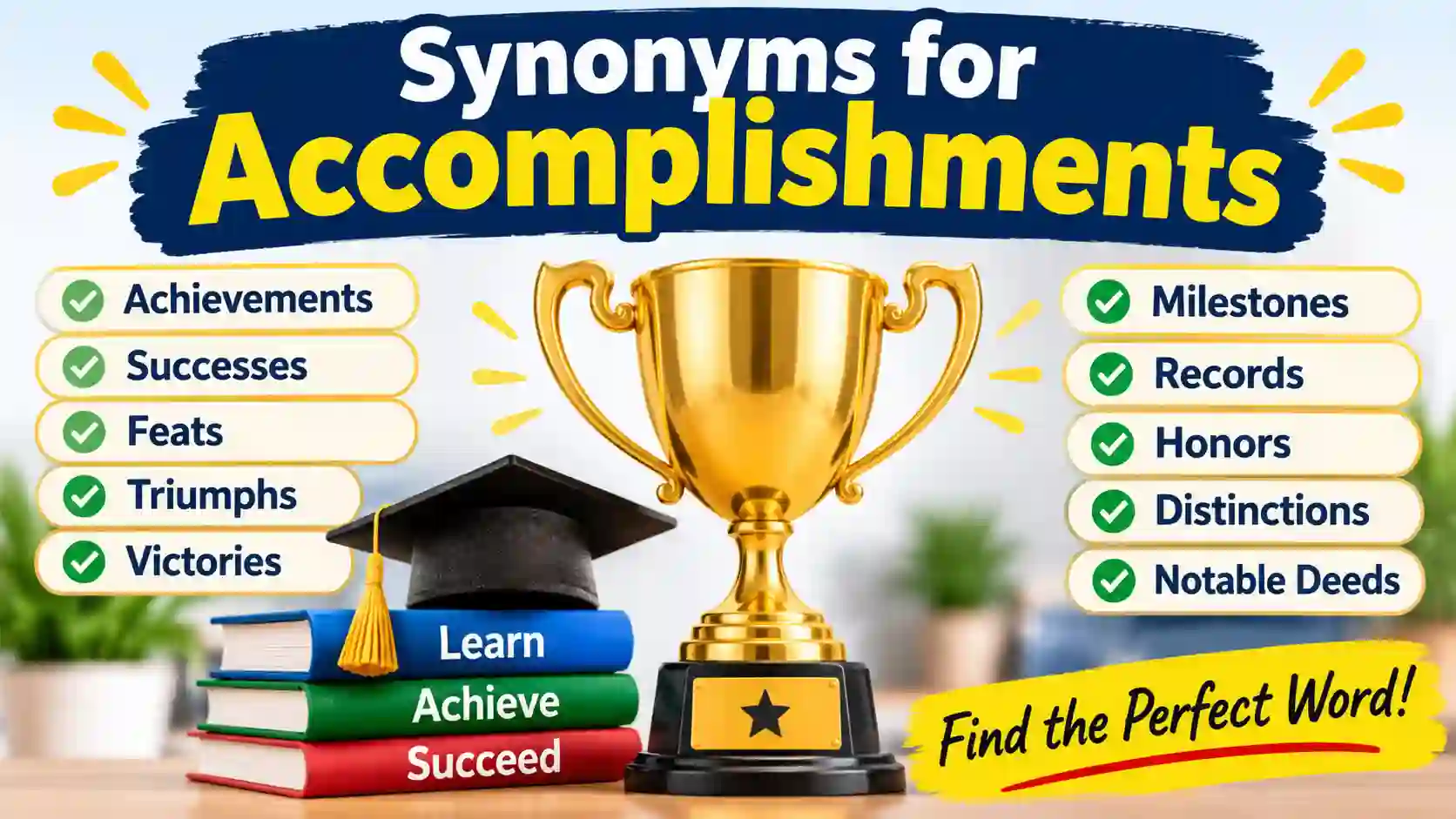
Synonyms for accomplishments include achievements, successes, attainments, feats, triumphs, victories, and milestones. Each word describes a different kind of success. Some focus on reaching a goal, while others highlight hard work, personal ability, or an impressive result.
For example, graduating from college is an achievement, winning a difficult competition is a victory, and reaching an important career goal is a milestone.
This guide explains 30 useful alternatives with meanings, examples, pronunciation, context, and usage tips. It also shows which words work best in professional writing, academic work, everyday conversations, and résumés.
Quick Answer: What Are Synonyms for Accomplishments?
The most useful synonyms for accomplishments are achievements, successes, attainments, feats, triumphs, victories, and milestones. These words describe successful results, important goals, or impressive actions. Achievement is the best general alternative, while feat emphasizes difficulty and milestone highlights an important stage of progress.
Pronunciation of Accomplishments
- American IPA: /əˈkɑːmplɪʃmənts/
- British IPA: /əˈkɒmplɪʃmənts/
- Easy pronunciation: uh-KOM-plish-ments
- Syllables: Four
- Word stress: Second syllable
The main pronunciation difference is the vowel sound in the stressed syllable. Accents vary within both countries.
Part of Speech and Meaning
Accomplishments is the plural form of the noun accomplishment.
| Word | Part of speech | Example |
| Accomplishment | Noun | Winning the prize was an accomplishment. |
| Accomplishments | Plural noun | Her accomplishments impressed everyone. |
| Accomplish | Verb | We want to accomplish our goals. |
| Accomplished | Adjective | She is an accomplished writer. |
| Accomplishing | Verb form | He is accomplishing important tasks. |
The noun has two useful meanings:
- A successful result: Something completed through effort, such as finishing a degree or building a business.
- An acquired skill: An ability developed through learning, such as speaking another language or playing an instrument.
This second meaning explains why words such as skill, talent, and proficiency sometimes appear in thesaurus lists.
Word Origin and Etymology
Accomplishment developed from the verb accomplish and the French word accomplissement, which relates to completing or fulfilling something. Its historical sense centers on bringing something to completion.
The modern noun can describe both a completed result and a developed personal ability. These meanings explain its use in expressions such as “career accomplishments” and “a list of accomplishments.”
Grammar: How to Use Accomplishments
Use these common sentence patterns:
- A major accomplishment: Publishing her first book was a major accomplishment.
- Personal accomplishments: He proudly discussed his personal accomplishments.
- Accomplishment in something: Her accomplishments in science earned recognition.
- Accomplishment of a goal: The accomplishment of this goal required patience.
- List of accomplishments: Add your strongest accomplishments to your résumé.
Remember that accomplishment is a noun. Use accomplish when you need a verb.
Incorrect: I want to accomplish my goals.
Correct: I want to accomplish my goals.
Quick Synonyms Overview
| Synonym | Strength | Formality |
| Achievement | Strongest | Neutral |
| Success | Strongest | Neutral |
| Attainment | Strong | Formal |
| Feat | Strongest | Neutral |
| Triumph | Strongest | Literary |
| Victory | Strong | Neutral |
| Milestone | Strong | Professional |
| Deed | Strong | Literary |
| Exploit | Strong | Literary |
| Performance | Contextual | Neutral |
| Fulfillment | Contextual | Formal |
| Realization | Contextual | Formal |
| Completion | Contextual | Neutral |
| Mastery | Skill-related | Academic |
| Proficiency | Skill-related | Formal |
| Expertise | Skill-related | Professional |
| Contribution | Related | Formal |
| Breakthrough | Strong | Academic |
| Distinction | Strong | Formal |
| Honor | Related | Formal |
| Award | Related | Neutral |
| Result | Related | Neutral |
| Progress | Related | Neutral |
| Execution | Contextual | Business |
| Creation | Related | Neutral |
| Production | Related | Business |
| Acquisition | Related | Academic |
| Coup | Contextual | Journalistic |
| Tour de force | Strong | Literary |
| Aptitude | Skill-related | Formal |
Strength indicates how closely a word fits a result-based meaning. It does not measure the importance of someone’s success.
30 Best Synonyms for Accomplishments
1. Achievement
Meaning: Something good that you successfully complete through effort.
Examples:
- Passing the final examination was her greatest achievement.
- Opening his own business became a major achievement.
Best used when: You need a natural replacement for accomplishment in everyday or professional writing.
Tone: Neutral, professional.
Collocations: Major achievement, personal achievement, outstanding achievement.
Learner guide: B1 | Very common.
When not to use: Avoid it when describing a skill rather than a completed result.
2. Success
Meaning: Reaching a goal or getting a positive result.
Examples:
- Her success came after years of practice.
- The new advertising campaign was a success.
Best used when: Discussing positive outcomes in life, education, or business.
Tone: Neutral, informal.
Collocations: Great success, business success, academic success.
Learner guide: A2 | Very common.
When not to use: Avoid it when you need to identify a particular task that was completed.
3. Attainment
Meaning: The achievement of a particular goal or level.
Examples:
- Educational attainment can influence career opportunities.
- The attainment of independence was an important moment.
Best used when: Discussing academic levels, qualifications, and long-term goals.
Tone: Formal, academic.
Collocations: Educational attainment, personal attainment, level of attainment.
Learner guide: C1 | Uncommon.
When not to use: Avoid it in casual conversation when achievement sounds more natural.
4. Feat
Meaning: An impressive action that requires great skill or effort.
Examples:
- Swimming across the lake was an incredible feat.
- Completing the project in one day was a remarkable feat.
Best used when: Describing something unusually difficult.
Tone: Neutral, expressive.
Collocations: Remarkable feat, physical feat, amazing feat.
Learner guide: B2–C1 | Common.
When not to use: Do not use it for ordinary daily activities.
5. Triumph
Meaning: A great success after a struggle or challenge.
Examples:
- Finishing her education was a personal triumph.
- The team’s victory became a triumph for the entire community.
Best used when: Highlighting success after difficulties.
Tone: Emotional, literary.
Collocations: Personal triumph, great triumph, major triumph.
Learner guide: B2 | Common.
When not to use: Avoid it for minor tasks without a meaningful challenge.
6. Victory
Meaning: Success in a competition, conflict, or struggle.
Examples:
- The players celebrated their victory.
- Winning the national competition was a proud victory.
Best used when: Discussing competitions, sports, elections, or opposition.
Tone: Neutral, powerful.
Collocations: Major victory, historic victory, decisive victory.
Learner guide: B1 | Very common.
When not to use: Do not use it for every personal goal that involves no opponent.
7. Milestone
Meaning: An important stage in a journey, career, or project.
Examples:
- Publishing her first article was a career milestone.
- Reaching 10,000 customers marked an important milestone.
Best used when: Describing significant stages of progress.
Tone: Neutral, professional.
Collocations: Major milestone, career milestone, important milestone.
Learner guide: B2 | Very common.
When not to use: Avoid it for small routine tasks.
8. Deed
Meaning: An action performed by someone, often a meaningful one.
Examples:
- Her brave deed inspired the entire village.
- Helping the family was a generous deed.
Best used when: Describing helpful, brave, or morally important actions.
Tone: Neutral, literary.
Collocations: Good deed, brave deed, noble deed.
Learner guide: B2 | Common.
When not to use: Avoid it for ordinary business targets or examination results.
9. Exploit
Meaning: A brave, unusual, or impressive action.
Examples:
- The explorer’s daring exploits became famous.
- The athlete’s remarkable exploits impressed the audience.
Best used when: Describing adventurous or heroic actions.
Tone: Literary, journalistic.
Collocations: Daring exploits, heroic exploits, military exploits.
Learner guide: C1 | Uncommon.
When not to use: Avoid it in ordinary résumé writing. The verb exploit can also mean taking unfair advantage of someone.
10. Performance
Meaning: The way someone carries out an activity or task.
Examples:
- Her excellent performance earned her a promotion.
- The student’s performance impressed the teachers.
Best used when: Describing how well someone performs.
Tone: Neutral, professional.
Collocations: Excellent performance, academic performance, outstanding performance.
Learner guide: B1 | Very common.
When not to use: Avoid it when you mean a finished result rather than the quality of someone’s work.
11. Fulfillment
Meaning: The completion of something or the satisfaction of reaching a goal.
Examples:
- Teaching children gave her a sense of fulfillment.
- The fulfillment of their dream took many years.
Best used when: Discussing completed promises, goals, and personal satisfaction.
Tone: Neutral, formal.
Collocations: Personal fulfillment, fulfillment of a goal, sense of fulfillment.
Learner guide: B2 | Common.
When not to use: Avoid it when you specifically mean winning a competition.
12. Realization
Meaning: The achievement of an idea, plan, or dream.
Examples:
- The realization of her dream took ten years.
- The new building represented the realization of a long-term vision.
Best used when: Describing an idea becoming real.
Tone: Formal, academic.
Collocations: Realization of a dream, full realization, realization of a vision.
Learner guide: B2 | Common.
When not to use: Do not confuse this meaning with realization as suddenly understanding something.
13. Completion
Meaning: The act of finishing something.
Examples:
- The completion of the building took three years.
- She received a certificate after the completion of her course.
Best used when: Discussing finished projects, courses, and tasks.
Tone: Neutral, formal.
Collocations: Successful completion, project completion, course completion.
Learner guide: B1 | Very common.
When not to use: Avoid it when you want to emphasize an exceptional result rather than simply finishing.
14. Mastery
Meaning: A high level of knowledge or ability.
Examples:
- Her mastery of English helped her become a successful writer.
- Years of practice gave him mastery of the instrument.
Best used when: Describing advanced knowledge or control of a skill.
Tone: Academic, professional.
Collocations: Mastery of a subject, complete mastery, technical mastery.
Learner guide: B2 | Common.
When not to use: Do not use it for a single ordinary completed task.
15. Proficiency
Meaning: The ability to do something well.
Examples:
- Her English proficiency improved through daily practice.
- The job requires proficiency in computer software.
Best used when: Discussing language skills and technical abilities.
Tone: Formal, academic.
Collocations: Language proficiency, professional proficiency, high proficiency.
Learner guide: B2 | Common.
When not to use: Avoid it when discussing a single award or completed project.
16. Expertise
Meaning: Advanced knowledge or skill in a particular subject.
Examples:
- Her expertise in digital marketing helped the company grow.
- The organization needed his expertise in financial planning.
Best used when: Describing specialized professional knowledge.
Tone: Formal, professional.
Collocations: Technical expertise, professional expertise, area of expertise.
Learner guide: B2 | Common.
When not to use: Avoid it for basic abilities or simple completed tasks.
17. Contribution
Meaning: Something useful that someone adds to a group or project.
Examples:
- Her contribution helped the research team finish its work.
- His contribution to the community deserves recognition.
Best used when: Describing valuable work that supports a shared result.
Tone: Neutral, formal.
Collocations: Valuable contribution, major contribution, contribution to society.
Learner guide: B2 | Very common.
When not to use: Do not use it when you specifically mean an individual victory.
18. Breakthrough
Meaning: An important discovery or development that solves a difficult problem.
Examples:
- The scientists made a breakthrough in medical research.
- The new technology marked a major breakthrough.
Best used when: Discussing discoveries, innovations, and important progress.
Tone: Neutral, professional.
Collocations: Major breakthrough, scientific breakthrough, medical breakthrough.
Learner guide: B2 | Very common.
When not to use: Avoid it for ordinary daily accomplishments.
19. Distinction
Meaning: Recognition for being especially good at something.
Examples:
- She graduated with distinction from the university.
- His research earned him distinction in the scientific community.
Best used when: Discussing academic honors and exceptional quality.
Tone: Formal, academic.
Collocations: Academic distinction, graduate with distinction, achieve distinction.
Learner guide: B2 | Common.
When not to use: Avoid it for a routine completed assignment.
20. Honor
Meaning: Special recognition or respect given to someone.
Examples:
- Receiving the award was a great honor.
- The school honored her for her academic achievements.
Best used when: Discussing recognition for service or good work.
Tone: Formal, neutral.
Collocations: Great honor, highest honor, receive an honor.
Learner guide: B1 | Very common.
When not to use: Do not use it as a replacement for every completed task.
21. Award
Meaning: A prize or official recognition given for good work.
Examples:
- She received an award for her research.
- His writing earned him a national award.
Best used when: Discussing prizes, certificates, and recognition.
Tone: Neutral, professional.
Collocations: Win an award, receive an award, prestigious award.
Learner guide: A2 | Very common.
When not to use: Avoid it when someone succeeds without receiving a prize.
22. Result
Meaning: Something that happens because of an action or effort.
Examples:
- The team’s hard work produced excellent results.
- Her improved grades were the result of regular study.
Best used when: Describing the outcome of work or planning.
Tone: Neutral.
Collocations: Positive result, successful result, impressive result.
Learner guide: A2 | Very common.
When not to use: Avoid it when you want to highlight exceptional effort or ability.
23. Progress
Meaning: Forward movement toward a goal.
Examples:
- Her progress in learning English has been impressive.
- The team made good progress on the project.
Best used when: Describing improvement and development.
Tone: Neutral, positive.
Collocations: Significant progress, steady progress, make progress.
Learner guide: B1 | Very common.
When not to use: Do not use it as a replacement for a completed achievement.
24. Execution
Meaning: The act of carrying out a plan or task.
Examples:
- The successful execution of the strategy increased sales.
- Good execution helped the team complete the project.
Best used when: Discussing how effectively a plan was carried out.
Tone: Formal, business.
Collocations: Successful execution, project execution, effective execution.
Learner guide: B2 | Common.
When not to use: Avoid it when you simply mean an award or personal victory.
25. Creation
Meaning: Something new that someone makes.
Examples:
- Her latest creation attracted thousands of readers.
- The team celebrated the creation of its new product.
Best used when: Discussing original work, ideas, and products.
Tone: Neutral, creative.
Collocations: Original creation, artistic creation, creative work.
Learner guide: B1 | Common.
When not to use: Avoid it for achievements that involve no new creation.
26. Production
Meaning: The process or amount of making something.
Examples:
- The production of the documentary required careful planning.
- Increased production helped the company meet demand.
Best used when: Discussing manufacturing, creative output, and business work.
Tone: Formal, professional.
Collocations: Film production, mass production, increased production.
Learner guide: B1 | Very common.
When not to use: Do not use it as a general replacement for personal success.
27. Acquisition
Meaning: The process of gaining or obtaining something.
Examples:
- The acquisition of new skills improved her career prospects.
- Language acquisition requires time and practice.
Best used when: Discussing knowledge, abilities, and business purchases.
Tone: Formal, academic.
Collocations: Skill acquisition, knowledge acquisition, business acquisition.
Learner guide: B2 | Common.
When not to use: Avoid it when describing a completed victory or impressive result.
28. Coup
Meaning: A clever or unexpected success that gives someone an advantage.
Examples:
- Securing the international partnership was a major coup.
- Signing the famous artist was a real coup for the festival.
Best used when: Describing an impressive move in business, politics, or negotiations.
Tone: Informal, journalistic.
Collocations: Major coup, diplomatic coup, real coup.
Learner guide: C2 | Uncommon.
When not to use: Avoid it when the context could suggest a military takeover.
29. Tour de force
Meaning: An impressive display of exceptional skill or ability.
Examples:
- Her first novel was a literary tour de force.
- The director’s latest film was a creative tour de force.
Best used when: Praising outstanding artistic, intellectual, or technical work.
Tone: Literary, formal.
Collocations: Literary tour de force, artistic tour de force, remarkable tour de force.
Learner guide: C2 | Rare.
When not to use: Avoid it in ordinary conversations when achievement is clearer.
30. Aptitude
Meaning: A natural ability to learn or do something well.
Examples:
- Her aptitude for mathematics became clear at school.
- He showed an aptitude for learning new languages.
Best used when: Discussing natural ability or potential.
Tone: Formal, academic.
Collocations: Natural aptitude, aptitude for learning, technical aptitude.
Learner guide: B2 | Common.
When not to use: Avoid it when describing a completed result. Aptitude describes potential or ability, not success itself.
Strongest, Strong, and Related Synonyms
Strongest Direct Alternatives
Use these when you mean something successfully achieved:
- Achievement
- Success
- Feat
- Triumph
- Attainment
- Victory
- Milestone
Contextual Alternatives
These work when the sentence emphasizes a particular kind of result:
- Deed
- Exploit
- Fulfillment
- Realization
- Completion
- Execution
- Breakthrough
- Distinction
- Coup
- Tour de force
Related Vocabulary
These describe skills, recognition, results, or development rather than always replacing accomplishment:
- Performance
- Mastery
- Proficiency
- Expertise
- Contribution
- Honor
- Award
- Result
- Progress
- Creation
- Production
- Acquisition
- Aptitude
Choose the Right Synonym: Side by Side Comparisons
| Word | What it emphasizes | Example |
| Achievement | A completed goal | Passing the exam was an achievement. |
| Success | A positive outcome | The campaign was a success. |
| Feat | Difficulty and skill | Crossing the desert was a feat. |
| Triumph | Winning after struggle | Her recovery was a triumph. |
| Milestone | An important stage | The promotion was a career milestone. |
| Attainment | Reaching a level | Educational attainment matters. |
| Proficiency | Developed ability | He has English proficiency. |
| Contribution | Valuable input | Her contribution helped the team. |
Quick selection guide:
- For general writing: Achievement.
- For business: Success or measurable result.
- For a difficult task: Feat.
- For an emotional victory: Triumph.
- For career progress: Milestone.
- For academic ability: Proficiency.
- For advanced knowledge: Expertise.
- For a completed project: Completion.
American vs. British English
Most common synonyms have the same spelling in American and British English. However, some related words have spelling differences.
| American English | British English |
| Accomplishment | Accomplishment |
| Fulfillment | Fulfilment |
| Realization | Realisation |
| Honor | Honour |
| Achievement | Achievement |
| Proficiency | Proficiency |
The noun accomplishment does not change spelling between the two varieties.
American English generally uses a stronger /ɑː/ sound in the stressed syllable, while standard British pronunciation commonly uses /ɒ/.
Commonly Confused Words
| Words | Difference | Example |
| Achievement vs. success | Achievement is a specific result; success is a positive outcome. | Completing the course was an achievement. |
| Feat vs. deed | A feat is impressive or difficult; a deed is an action. | Swimming across the lake was a feat. |
| Progress vs. accomplishment | Progress means moving forward; accomplishment means something achieved. | We made progress toward our goal. |
| Skill vs. achievement | Skill is an ability; achievement is a result. | Writing is a useful skill. |
| Award vs. honor | An award is a prize; an honor is recognition or respect. | She received an award for her research. |
Common Mistakes to Avoid
Mistake 1: Using progress for a completed result
Incorrect: She completed her progress.
Correct: She completed her project.
Progress describes movement toward a goal, not the finished task.
Mistake 2: Using skill for a successful result
Incorrect: Winning the competition was his greatest skill.
Correct: Winning the competition was his greatest achievement.
A skill is an ability, while an achievement is a result.
Mistake 3: Using award when no prize was received
Incorrect: Learning English was my biggest award.
Correct: Learning English was my biggest achievement.
An award is recognition given to someone.
Mistake 4: Using feat for an ordinary task
Incorrect: Making breakfast was an amazing feat.
Better: Making breakfast was part of my daily routine.
A feat usually describes something unusually difficult or impressive.
Mistake 5: Confusing the noun and verb
Incorrect: I want to accomplish my goals.
Correct: I want to accomplish my goals.
Accomplishment is a noun. Accomplish is a verb.
Best Synonyms for Professional Accomplishments and Résumés
When writing a résumé, choose words that describe real results. Employers need evidence of what you achieved, not just impressive vocabulary.
| Instead of a vague statement | Write a stronger statement |
| I had many accomplishments. | I delivered measurable business results. |
| I did good work. | I improved team performance. |
| I helped the company. | I contributed to a 20% increase in sales. |
| I completed many tasks. | I successfully completed 15 client projects. |
| I improved the website. | I increased website traffic by 35%. |
Useful résumé vocabulary includes:
- Key achievements
- Career milestones
- Measurable results
- Professional contributions
- Major projects completed
- Technical expertise
- Outstanding performance
Tip: Use real figures only when you can support them. Never invent percentages, awards, or business results.
Writing Tips: Use Synonyms Naturally
Essays: Use achievement, attainment, and contribution for academic discussions.
Emails: Use success, completion, and milestone for clear professional messages.
Blog posts: Use breakthrough, achievement, and result when explaining progress.
Stories: Use triumph, feat, and deed to create stronger descriptions.
Social media: Use achievement, milestone, and win for short, friendly updates.
Professional communication: Use expertise, performance, and contribution when discussing work.
Daily conversations: Prefer common words such as achievement, success, and result.
Do not change every occurrence of accomplishment. Repeating the clearest word is better than using an inaccurate alternative.
Related Vocabulary
Antonyms of Accomplishments
| Antonym | Meaning |
| Failure | Lack of success |
| Defeat | Losing a competition |
| Setback | A problem that delays progress |
| Fiasco | An embarrassing failure |
| Loss | Something lost or not won |
| Frustration | Disappointment caused by difficulty |
| Unfulfillment | Failure to meet a goal or expectation |
Related Expressions
- A sense of achievement
- A job well done
- Reaching a goal
- Making history
- Going above and beyond
- Setting a new record
- Overcoming challenges
- Making a difference
- Reaching new heights
- Reaping the rewards
Word Family
| Word | Part of speech | Meaning |
| Accomplish | Verb | Complete something successfully |
| Accomplishment | Noun | A successful result |
| Accomplishments | Plural noun | More than one successful result |
| Accomplished | Adjective | Skilled or successful |
| Accomplishing | Verb form | Carrying out a task |
Frequently Asked Questions
1. What are the best synonyms for accomplishments?
The best synonyms include achievements, successes, attainments, feats, triumphs, victories, and milestones. Achievement is the most flexible alternative for everyday writing. Feat highlights difficulty, triumph emphasizes success after a struggle, and milestone describes an important stage in a longer journey.
2. What is a professional word for accomplishments?
Professional alternatives include achievements, contributions, milestones, measurable results, and professional successes. These words work well in résumés, performance reviews, business reports, and LinkedIn profiles. Choose a word that accurately describes your work instead of using complicated vocabulary just to sound impressive.
3. What is another word for personal accomplishments?
Personal achievements, individual successes, personal milestones, and personal triumphs are useful alternatives. They describe goals reached through effort, learning, or determination. Examples include completing a degree, learning a language, developing a skill, and overcoming a difficult personal challenge.
4. What is a stronger word than accomplishment?
Triumph, feat, breakthrough, and tour de force can express a particularly impressive achievement. A triumph emphasizes success after difficulty, while a feat highlights an unusually difficult action. A breakthrough describes an important discovery or development that changes what is possible.
5. What are good synonyms for accomplishments on a résumé?
Achievement, contribution, milestone, result, and professional success are useful résumé alternatives. However, employers usually value specific evidence more than impressive words. Describe what you completed, how you helped the organization, and what measurable results your work produced.
6. What is the difference between accomplishments and achievements?
Accomplishments and achievements have very similar meanings. Both describe successful results. Achievement often emphasizes reaching a goal through effort, while accomplishment can also describe completed work or acquired abilities. In many everyday sentences, the two words can replace each other naturally.
7. Is accomplishment a noun or a verb?
Accomplishment is a noun, while accomplish is a verb. For example, “Finishing the course was a major accomplishment” uses the noun. “I want to accomplish my goals” uses the verb. The plural form is accomplishments, and accomplished can describe someone with developed skills.
8. What is the difference between accomplishment, success, and milestone?
An accomplishment is something successfully completed, success describes a positive outcome, and a milestone marks an important stage of progress. Completing a professional course is an accomplishment, passing it successfully is a success, and reaching an important career stage may be a milestone.
Vocabulary Practice: Test Your Knowledge
Exercise 1: Fill in the Blanks
Choose the best word for each sentence.
- Winning the national competition was a great ______.
- Reaching one million visitors was an important ______.
- Her English ______ improved through daily practice.
- The research team made a scientific ______.
- Completing the difficult journey was an impressive ______.
Word bank: breakthrough, feat, proficiency, victory, milestone.
Exercise 2: Rewrite the Sentences
Replace the bold word with a suitable alternative.
- Her achievement after years of hard work made her proud. (Use a word that emphasizes success after difficulty.)
- Reaching the company’s annual target was an achievement. (Use a word for an important stage.)
- His achievement in English helped him get the job. (Use a word describing ability.)
- The team’s achievement was a positive outcome. (Use a general alternative for success.)
Exercise 3: Match the Words
Match each word with its meaning.
| Word | Meaning |
| 1. Feat | A. An important stage |
| 2. Milestone | B. A developed ability |
| 3. Expertise | C. An impressive difficult action |
| 4. Triumph | D. Success after struggle |
Answer Key
Exercise 1:
- Victory
- Milestone
- Proficiency
- Breakthrough
- Feat
2:
- Triumph
- Milestone
- Proficiency
- Success
3:
- C
- A
- B
- D
Conclusion
Learning synonyms for accomplishments helps you describe success, effort, and personal progress more clearly. Words such as achievement, triumph, feat, and milestone can improve your writing when you use them in the right context.
Practice these alternatives in essays, emails, résumés, and everyday conversations. Remember, good vocabulary is not about using difficult words. It is about choosing the right word for the right situation.
References
- Cambridge Thesaurus: Accomplishment synonyms.
- Thesaurus.com: Accomplishment synonyms and antonyms.
- Collins Dictionary: Accomplishments synonyms.
- Merriam-Webster Dictionary: Accomplishment definition and usage.
- Oxford English Dictionary: Historical word meanings and etymology.

Synonorm is a trusted English vocabulary resource created to help readers find the right words and understand the differences between similar terms. We provide clear explanations of synonyms, meanings, examples, usage, and alternatives. Our content makes vocabulary easier to learn and apply in everyday, academic, and professional English. Synonorm is designed for students, writers, ESL learners, professionals, and anyone who wants to improve their English vocabulary and communicate more clearly.