Quick Answer: What Are Synonyms for Stand?
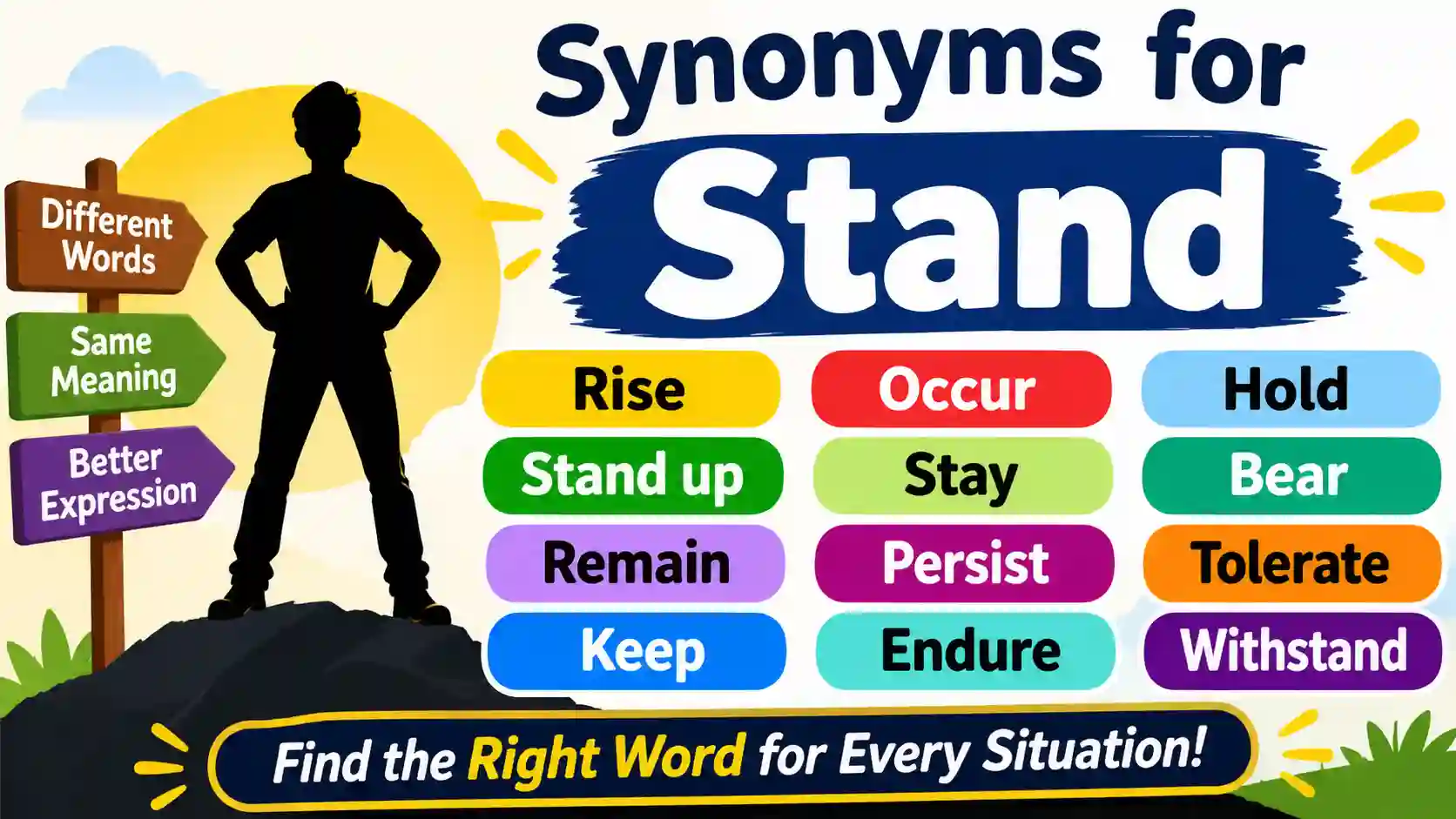
Common synonyms for stand include remain, stay, rise, stand up, get to your feet, tolerate, bear, endure, withstand, resist, and persist. Other alternatives include place, position, set, and support. The correct choice depends on whether the stand describes physical posture, location, resistance, tolerance, or an opinion.
Have you ever repeated the word stand several times while writing an essay or having a conversation? It is one of the most useful English words, but it has several meanings.
For example, you can stand beside a friend, stand against injustice, stand your ground, or say that you cannot stand loud music. Each sentence expresses a different idea.
Learning synonyms for stand helps you communicate these meanings more clearly. You can use remain to describe staying in a condition, rise to describe getting up, and tolerate to describe accepting something unpleasant.
However, these alternatives are not interchangeable. This guide explains 30 useful synonyms and related expressions, with original examples, pronunciation, grammar, collocations, and practical writing advice.
Pronunciation of Stand
- IPA: /stænd/
- Pronunciation: Stand
- Syllables: One
- Rhyming words: Hand, land, band
- Past tense: Stood
- Past participle: Stood
- Present participle: Standing
- Plural noun: Stands
American and British English use the same spelling and standard dictionary pronunciation, although regional accents may change the exact vowel sound.
What Does Stand Mean?
Stand has several important meanings:
- Physical posture: To be upright on your feet.
- Getting up: To move from sitting or lying into an upright position.
- Location: To be situated in a particular place.
- Remaining: To continue in a particular condition.
- Tolerance: To accept something unpleasant.
- Resistance: To remain firm against pressure or difficulty.
- Support: To defend or remain loyal to someone.
- Opinion: To express or maintain a firm position.
Understanding these meanings is the first step toward choosing an accurate synonym.
Part of Speech
Stand works mainly as a verb and a noun.
| Part of speech | Meaning | Example |
| Verb | Be upright | Please stand here. |
| Verb | Get to your feet | He stood up quickly. |
| Verb | Tolerate | I cannot stand the noise. |
| Verb | Remain firm | We stand by our decision. |
| Verb | Represent | The letters stand for peace. |
| Noun | Opinion or position | She took a firm stand. |
| Noun | Supporting structure | The lamp needs a stand. |
| Noun | Market booth | We visited a fruit stand. |
Standing can also work as an adjective, noun, or verb form.
Grammar Rules for Stand
Important Sentence Patterns
| Pattern | Example |
| Stand + place | Stand beside the door. |
| Stand + adjective | Stand still. |
| Stand up | Please stand up. |
| Stand by + person | I stand by my friend. |
| Stand for + noun | This symbol stands for hope. |
| Stand against + noun | They stood against injustice. |
| Cannot stand + noun | I cannot stand the noise. |
| Cannot stand + -ing | She cannot stand waiting. |
| Stand at + measurement | The building stands at 50 meters. |
Verb Forms
- Present: Stand
- Third-person singular: Stands
- Past: Stood
- Past participle: Stood
- Present participle: Standing
Remember: Stand is an irregular verb. Its past tense stands, not standard.
30 Synonyms for Stand With Examples and Explanations
The following alternatives are organized by meaning. Some are close synonyms, while others work only in particular contexts.
A. Synonyms for Being Upright or Getting Up
1. Be Upright
Meaning: To be in a straight, vertical position rather than sitting or lying.
Examples:
- The guard remained upright throughout his shift.
- Keep the bottle upright while carrying it.
Best used when: Describing someone’s or something’s vertical position.
Tone: Neutral | CEFR: B1 | Frequency: Common
Collocations: Remain upright, stand upright, upright position.
Nuance: This is a descriptive expression, not a replacement in every sentence. It emphasizes posture.
2. Rise
Meaning: To move upward or get into an upright position.
Examples:
- The guests rose when the speaker entered.
- She rose slowly after finishing her prayer.
Best used when: Someone moves from a lower position to a higher one.
Tone: Neutral, formal | CEFR: A2 | Frequency: Very common
Collocations: Rise from a chair, rise slowly, rise early.
Nuance: Rise focuses on movement, while stand often describes the resulting position.
3. Stand Up
Meaning: To move into an upright position.
Examples:
- Please stand up when your name is announced.
- The children stood up to welcome their teacher.
Best used when: Describing the physical action of getting onto your feet.
Tone: Neutral, spoken | CEFR: A1 | Frequency: Very common
Collocations: Stand up straight, stand up quickly, stand up from a chair.
Nuance: It can also mean defending someone in the expression stand up for.
4. Get to Your Feet
Meaning: To move from sitting or lying into a standing position.
Examples:
- The injured player slowly got to his feet.
- Everyone got to their feet after the performance.
Best used when: You want to emphasize the movement into an upright position.
Tone: Neutral | CEFR: B1 | Frequency: Common
Collocations: Get to your feet, struggle to your feet, jump to your feet.
Nuance: This expression often emphasizes effort or movement.
5. Straighten Up
Meaning: To make your body or back straight.
Examples:
- The teacher asked the students to straighten up.
- He straightened up before entering the room.
Best used when: Someone corrects a bent or poor posture.
Tone: Neutral, spoken | CEFR: B1 | Frequency: Common
Collocations: Straighten up your back, straighten up slowly, straighten your posture.
Nuance: It does not always mean getting up from a chair. It can simply mean correcting posture.
B. Synonyms for Remaining or Staying
6. Remain
Meaning: To continue in the same place or condition.
Examples:
- Please remain quiet during the examination.
- The old building remains in excellent condition.
Best used when: Something continues without changing.
Tone: Neutral, formal | CEFR: B1 | Frequency: Very common
Collocations: Remain calm, remain unchanged, remain in place.
Nuance: More formal than stay in many situations.
7. Stay
Meaning: To continue being in a place or condition.
Examples:
- Please stay beside the entrance.
- She stayed calm during the difficult conversation.
Best used when: Someone does not leave or change a condition.
Tone: Neutral, spoken | CEFR: A2 | Frequency: Very common
Collocations: Stay safe, stay still, stay strong.
Nuance: Stay is a natural everyday alternative, but it does not always describe physical posture.
8. Continue
Meaning: To keep something going without stopping.
Examples:
- The discussion continued after lunch.
- The tradition continues in several local communities.
Best used when: Describing an ongoing action or situation.
Tone: Neutral, academic | CEFR: A2 | Frequency: Very common
Collocations: Continue working, continue operating, continue a discussion.
Nuance: Use it when stand means remain in effect or continue to exist.
9. Persist
Meaning: To continue despite difficulties or opposition.
Examples:
- She persisted with her training despite the setbacks.
- The problem persisted for several weeks.
Best used when: An effort or situation continues despite challenges.
Tone: Formal, academic | CEFR: B2 | Frequency: Common
Collocations: Persist in trying, persist despite difficulties, problem persists.
Nuance: It emphasizes continuation, determination, or an unwanted condition that does not disappear.
10. Exist
Meaning: To be real or continue to be present.
Examples:
- These traditions still exist in rural communities.
- Several differences exist between the two systems.
Best used when: Stand means exist or remain present.
Tone: Neutral, academic | CEFR: A2 | Frequency: Very common
Collocations: Continue to exist, exist independently, problems exist.
Nuance: Exist describes being real, not physical posture.
C. Synonyms for Location and Placement
11. Be Situated
Meaning: To be located in a particular place.
Examples:
- The school is situated near the main road.
- Their office is situated in the city center.
Best used when: Describing the location of a building, place, or facility.
Tone: Formal, descriptive | CEFR: B2 | Frequency: Common
Collocations: Ideally situated, centrally situated, conveniently situated.
Nuance: More formal than saying a building stands somewhere.
12. Be Located
Meaning: To have a particular geographical position.
Examples:
- The hospital is located near the railway station.
- Their factory is located outside the city.
Best used when: Explaining where something is.
Tone: Neutral, formal | CEFR: B1 | Frequency: Very common
Collocations: Centrally located, conveniently located, located near.
Nuance: A clear choice for informational and professional writing.
13. Sit
Meaning: To be positioned or situated in a particular place.
Examples:
- Their farmhouse sits beside a quiet river.
- A small restaurant sits at the end of the street.
Best used when: Describing the location of buildings, objects, or landscapes.
Tone: Neutral, descriptive | CEFR: A2 | Frequency: Very common
Collocations: Sit beside, sit on a hill, sit near the entrance.
Nuance: This is a figurative location meaning, not the opposite posture of standing.
14. Place
Meaning: To put something in a particular position.
Examples:
- Please place the documents on my desk.
- She placed the flowers beside the window.
Best used when: Someone deliberately puts an object somewhere.
Tone: Neutral, professional | CEFR: A1 | Frequency: Very common
Collocations: Place an object, place an order, place a hand.
Nuance: Place is a suitable alternative when stand is used transitively, as in standing a plant upright.
15. Position
Meaning: To put someone or something in a particular location.
Examples:
- Position the camera above the entrance.
- The manager positioned the display near the counter.
Best used when: Describing deliberate placement or arrangement.
Tone: Neutral, business | CEFR: B1 | Frequency: Very common
Collocations: Position a camera, position yourself, position a product.
Nuance: Often suggests careful or strategic placement.
16. Set
Meaning: To put something down or arrange it in a particular place.
Examples:
- She set the glass on the kitchen counter.
- Set the box beside the cupboard.
Best used when: Describing the action of putting or arranging an object.
Tone: Neutral, spoken | CEFR: A2 | Frequency: Very common
Collocations: Set something down, set a table, set an object upright.
Nuance: Set has many other meanings, so use it only when the sentence refers to placement.
17. Mount
Meaning: To attach or fix something to a surface or support.
Examples:
- They mounted the television on the wall.
- The technician mounted a camera above the entrance.
Best used when: An object is attached to a wall, frame, or structure.
Tone: Neutral, technical | CEFR: B2 | Frequency: Common
Collocations: Mount a television, mount a camera, mount a display.
Nuance: More specific than stand or place.
18. Prop
Meaning: To support something by placing it against another object.
Examples:
- He propped the ladder against the wall.
- She propped the door open with a wooden block.
Best used when: Something needs support to remain in a position.
Tone: Neutral, spoken | CEFR: B2 | Frequency: Common
Collocations: Prop against a wall, prop open a door, prop something up.
Nuance: Prop describes supporting an object, not simply placing it upright.
D. Synonyms for Tolerating or Enduring
19. Tolerate
Meaning: To accept something unpleasant without reacting strongly or preventing it.
Examples:
- The school does not tolerate bullying.
- I cannot tolerate constant interruptions.
Best used when: Someone accepts or allows an unpleasant situation.
Tone: Formal, professional | CEFR: B2 | Frequency: Common
Collocations: Tolerate behavior, tolerate criticism, tolerate noise.
Nuance: Often sounds more formal than cannot stand.
20. Bear
Meaning: To accept or deal with something difficult or painful.
Examples:
- She could barely bear the pain.
- He bore the responsibility with courage.
Best used when: Describing emotional or physical hardship.
Tone: Neutral, literary | CEFR: B2 | Frequency: Very common
Collocations: Bear responsibility, bear the cost, bear the pain.
Nuance: Bear can also mean carry or support weight.
21. Endure
Meaning: To experience something difficult without giving up.
Examples:
- The family endured a difficult winter.
- She endured several years of financial hardship.
Best used when: Someone experiences prolonged difficulty.
Tone: Formal, literary | CEFR: B2 | Frequency: Common
Collocations: Endure hardship, endure pain, endure suffering.
Nuance: Usually emphasizes lasting through difficulty.
22. Abide
Meaning: To tolerate or accept something unpleasant.
Examples:
- I cannot abide dishonest behavior.
- She could not abide the constant interruptions.
Best used when: Expressing strong dislike or unwillingness to tolerate something.
Tone: Neutral, slightly formal | CEFR: C1 | Frequency: Common
Collocations: Cannot abide, abide by the rules, abide by an agreement.
Nuance: Notice the different meanings: abide noise means tolerate it, while abide by rules means follow them.
23. Stomach
Meaning: To accept or tolerate something unpleasant.
Examples:
- I cannot stomach his rude comments.
- She could not stomach the unfair treatment.
Best used when: Expressing strong emotional dislike or difficulty accepting something.
Tone: Informal, spoken | CEFR: C1 | Frequency: Common
Collocations: Cannot stomach, stomach the truth, stomach the idea.
Nuance: Often carries a stronger emotional reaction than tolerated.
24. Put Up With
Meaning: To accept or tolerate something unpleasant.
Examples:
- We cannot put up with unnecessary delays.
- He puts up with the traffic every morning.
Best used when: Talking about annoying or difficult situations.
Tone: Informal, spoken | CEFR: B1 | Frequency: Very common
Collocations: Put up with noise, put up with delays, put up with behavior.
Nuance: A natural conversational alternative to tolerate.
E. Synonyms for Resistance and Support
25. Withstand
Meaning: To remain strong against pressure, force, or damage.
Examples:
- The roof can withstand strong winds.
- The athlete withstood intense pressure during the competition.
Best used when: Something resists physical or emotional pressure.
Tone: Formal, technical | CEFR: C1 | Frequency: Common
Collocations: Withstand pressure, withstand heat, withstand criticism.
Nuance: Stronger and more specific than remain.
26. Resist
Meaning: To oppose something or refuse to give in.
Examples:
- The residents resisted the unfair proposal.
- She tried to resist the temptation to spend more money.
Best used when: Someone actively opposes an influence or pressure.
Tone: Neutral, academic | CEFR: B2 | Frequency: Very common
Collocations: Resist pressure, resist temptation, resist change.
Nuance: Resist describes active opposition rather than passive endurance.
27. Support
Meaning: To help, encourage, or defend someone or something.
Examples:
- Her colleagues supported her during the difficult project.
- The organization supports equal educational opportunities.
Best used when: Describing loyalty or help, especially in the expression stand by someone.
Tone: Neutral, professional | CEFR: A2 | Frequency: Very common
Collocations: Support a cause, support a decision, support a family.
Nuance: Support is not a general synonym for physical standing.
28. Uphold
Meaning: To defend or maintain a law, principle, or decision.
Examples:
- The court upheld the original decision.
- The organization works to uphold professional standards.
Best used when: Protecting rules, values, or established principles.
Tone: Formal, legal, academic | CEFR: C1 | Frequency: Common
Collocations: Uphold justice, uphold the law, uphold standards.
Nuance: More formal than support and especially useful in legal or institutional writing.
29. Hold Firm
Meaning: To refuse to change your position or decision.
Examples:
- The manager held firm during the negotiations.
- She held firm despite pressure from her competitors.
Best used when: Someone refuses to give in to pressure.
Tone: Neutral, business | CEFR: B2 | Frequency: Common
Collocations: Hold firm on a decision, hold firm against pressure, stand firm.
Nuance: This expression is especially useful for the idea of standing one’s ground.
30. Take a Stand
Meaning: To express a clear and firm position about an issue.
Examples:
- The students took a stand against discrimination.
- The organization took a stand for equal opportunities.
Best used when: Someone publicly supports or opposes an issue.
Tone: Neutral, formal, political | CEFR: B2 | Frequency: Very common
Collocations: Take a stand, take a firm stand, take a stand against injustice.
Nuance: This is an expression, not a single-word synonym. It is particularly useful for the noun sense of stand.
Quick Synonym Overview
| Synonym | Main meaning | Register |
| Be upright | Physical posture | Neutral |
| Rise | Get upward | Neutral |
| Stand up | Get onto your feet | Spoken |
| Get to your feet | Become upright | Neutral |
| Straighten up | Correct posture | Spoken |
| Remain | Continue in a state | Formal |
| Stay | Not leave or change | Neutral |
| Continue | Keep going | Neutral |
| Persist | Continue despite difficulty | Formal |
| Exist | Be present or real | Academic |
| Be situated | Have a location | Formal |
| Be located | Have a location | Neutral |
| Sit | Be positioned | Neutral |
| Place | Put something somewhere | Neutral |
| Position | Arrange something | Professional |
| Set | Put something down | Neutral |
| Mount | Attach something | Technical |
| Prop | Support against something | Neutral |
| Tolerate | Accept something unpleasant | Formal |
| Bear | Carry or accept hardship | Neutral |
| Endure | Experience hardship | Formal |
| Abide | Tolerate | Formal |
| Stomach | Tolerate unpleasant things | Informal |
| Put up with | Tolerate | Informal |
| Withstand | Resist force | Technical |
| Resist | Oppose | Neutral |
| Support | Help or defend | Neutral |
| Uphold | Defend a principle | Formal |
| Hold firm | Refuse to give in | Neutral |
| Take a stand | Express a firm position | Neutral |
Strongest Synonyms by Meaning
There is no single best synonym for every meaning of stand.
| Intended meaning | Best alternatives |
| Physical posture | Be upright, be on your feet |
| Getting up | Rise, stand up |
| Staying in a place | Stay, remain |
| Being situated | Be located, be situated, sit |
| Putting something upright | Place, set, position |
| Tolerating something | Bear, tolerate, put up with |
| Surviving pressure | Withstand, endure |
| Opposing something | Resist, hold firm |
| Supporting someone | Support, stand by |
| Expressing an opinion | Take a stand, stance |
Choose the Right Synonym: Side by Side Comparisons
| Word | Difference | Example |
| Stand vs. Rise | Stand describes posture; rise emphasizes upward movement. | Stand near the door. Rise from your seat. |
| Stand vs. Remain | Stand can describe posture; remain means continue in a state. | Stand still. Remain calm. |
| Stand vs. Stay | Stand can describe being upright; stay emphasizes not leaving. | Stand straight. Stay here. |
| Stand vs. Tolerate | Stand is conversational in this sense; tolerate is more formal. | I can’t stand noise. I cannot tolerate noise. |
| Stand vs. Endure | Endure emphasizes lasting through hardship. | They endured difficult conditions. |
| Stand vs. Withstand | Withstand emphasizes resisting force or pressure. | The roof withstood the storm. |
| Stand vs. Support | Support means help or defend. | We support the proposal. |
| Stand vs. Stance | Stand can be a noun or verb; stance is a noun for a firm position. | She took a firm stance. |
Word Origin and Etymology
The word stand comes from Old English standan, which meant to occupy a place, remain firm, or be upright.
It is related to other Germanic words, including Old Norse standa, Old Saxon standan, and Old High German stantan.
The word has a much older Indo-European connection with the root commonly reconstructed as sta-, meaning to stand or be firm.
Its meanings expanded over time. The physical meaning developed into ideas such as remaining, resisting, tolerating, and maintaining a position.
Historical records show that the verb existed in Old English, long before modern English developed.
The noun stand also developed meanings connected with a position, a place for selling goods, and a supporting structure.
Interesting fact: The expression stand one’s ground has been used for centuries to describe refusing to retreat or give up a position.
CEFR Levels for English Learners
The following levels are approximate learning guidance, not official CEFR classifications for every word.
| Level | Useful vocabulary |
| A1 | Stand, stand up, place |
| A2 | Rise, stay, continue, support, exist |
| B1 | Remain, position, get to your feet |
| B2 | Tolerate, endure, bear, resist, persist |
| C1 | Withstand, uphold, abide, stomach |
Start with simple alternatives and gradually learn more advanced expressions.
American vs. British English
The spelling of stand is identical in American and British English.
| Feature | American English | British English |
| Spelling | Stand | Stand |
| Past tense | Stood | Stood |
| Pronunciation | /stænd/ | /stænd/ |
| Get up | Stand up | Stand up |
| Election | Run for election | Stand for election |
| Waiting | Stand in line | Stand in a queue |
Examples
American English: She plans to run for office.
British English: She plans to stand for election.
Both sentences describe becoming a candidate in an election.
Another difference appears when describing people waiting:
- American: We stood in line for tickets.
- British: We stood in a queue for tickets.
There is no standard spelling difference between the two varieties.
Commonly Confused Words
| Word | Difference | Example |
| Stand | Be upright or maintain a position | Please stand here. |
| Sit | Rest on a seat or be situated | The house sits on a hill. |
| Rise | Move upward | The audience rose. |
| Remain | Continue in a condition | Remain quiet. |
| Stance | A firm opinion or position | She explained her stance. |
Common Mistakes When Using Stand
Mistake 1: Using standard
Incorrect: He stands beside the door.
Correct: He stood beside the door.
Explanation: Stand is irregular. Its past form is standing.
Mistake 2: Confusing stay and stand
Incorrect: Stay straight while taking the photograph.
Better: Stand straight while taking the photograph.
Explanation: Stand describes the upright posture.
Mistake 3: Using the wrong verb pattern
Incorrect: I cannot stand waiting.
Correct: I cannot stand waiting.
Explanation: Cannot stand can take a noun or an -ing form.
Mistake 4: Confusing stance and stand
Incorrect: Her stand on the issue was clearly explained (when you mean her general position).
Better: Her stance on the issue was clearly explained.
Explanation: Stance is a useful noun for a firmly held position.
Mistake 5: Using withstand incorrectly
Incorrect: I stand beside my friend.
Correct: I stand beside my friend.
Explanation: Withstand means resist force or pressure.
How to Use Synonyms for Stand in Writing
Essays
Use maintain, uphold, resist, and stance when writing about arguments and opinions.
Example:
Basic: Citizens should stand against injustice.
Improved: Citizens should resist injustice.
Professional Emails
Use remain, support, and maintain when appropriate.
Example:
Basic: We stand by our decision.
Alternative: We remain committed to our decision.
Blog Posts
Use simple alternatives such as stay, remain, and support.
Example:
Stay strong during difficult times.
Stories
Use rise, endure, and bear when they accurately describe an action or experience.
Example:
The old man rose slowly from his chair.
Social Media
Use simple expressions:
- Stand together.
- Stay strong.
- Support your friends.
- Take a stand for kindness.
Business Communication
Use uphold, maintain, and withstand where appropriate.
Example:
Our company upholds high professional standards.
Writing tip: Do not replace every occurrence of stand just to avoid repetition. Choose a synonym that preserves the original meaning.
Related Vocabulary
Antonyms of Stand
The opposite depends on the intended meaning.
| Meaning | Opposite words |
| Be upright | Sit, lie, kneel |
| Remain | Leave, depart |
| Tolerate | Reject, refuse |
| Support | Oppose, undermine |
| Resist pressure | Yield, surrender, give in |
Common Expressions
| Expression | Meaning |
| Stand by | Remain loyal or support |
| Stand up for | Defend someone or something |
| Stand out | Be noticeable |
| Stand firm | Refuse to change a position |
| Stand your ground | Refuse to retreat |
| Stand for | Represent or mean |
| Stand a chance | Have a possibility of success |
| Stand in the way | Prevent progress |
| Stand down | Step away from a position or duty |
| Stand in for | Replace someone temporarily |
Word Family
| Word | Part of speech | Meaning |
| Stand | Verb/noun | Be upright or take a position |
| Stood | Verb | Past form of stand |
| Standing | Noun/adjective/verb | Upright position or status |
| Standpoint | Noun | A person’s perspective |
| Standstill | Noun | A complete stop |
| Standing-room | Noun modifier | Space for people to stand |
Frequently Asked Questions
1. What are the 10 best synonyms for stand?
Ten useful alternatives are remain, stay, rise, stand up, tolerate, bear, endure, withstand, resist, and support. Their meanings differ, so choose one according to your sentence. For physical posture, use stand up or be upright. For difficulty, use endure or withstand.
2. What is another word for stand in a sentence?
The best alternative depends on context. Use rise for getting up, remain for continuing in a condition, and tolerate for accepting something unpleasant. For example, “She stood by her decision” can become “She remained committed to her decision.”
3. What is a formal synonym for stand?
Formal alternatives include remain, endure, withstand, uphold, and maintain. For example, uphold works when defending a law or principle, while withstand describes resisting pressure. Always check the meaning before replacing the original word.
4. What is another word for stand up?
Rise, get to your feet, and straighten up are useful alternatives. Rise is suitable for formal and everyday writing, while getting to your feet emphasizes the action of becoming upright. Stand up has a different meaning: to defend someone.
5. What is a synonym for stand when you mean tolerate?
Use tolerate, bear, endure, abide, stomach, or put up with. For example, “I cannot stand the noise” can become “I cannot tolerate the noise.” Put up is informal, while tolerate is more suitable for formal writing.
6. What is the difference between stand and remain?
Stand often describes an upright physical position, while remain means to continue in the same place or condition. For example, “Stand near the entrance” describes a person’s position, while “Remain calm” means continue to be calm.
7. What is the noun form of stand?
Stand is already a noun. It can mean a firm opinion, a supporting structure, a market booth, or a platform. For example, “She took a stand against unfair treatment.” The word stance is another noun that describes a firm opinion.
8. What are the opposite words of stand?
Opposites depend on the meaning. Use sit or lie for physical posture, leave or depart for remaining in a place, and reject or refuse for tolerating something. When stand means supporting an idea, oppose can express the opposite.
Vocabulary Quiz
Choose the correct answer for each question.
1. Which word means to resist physical pressure?
A. Remain
B. Withstand
C. Place
D. Opinion
2. Which word means getting into an upright position?
A. Rise
B. Tolerate
C. Uphold
D. Persist
3. Which word describes a firmly held opinion?
A. Mount
B. Stance
C. Place
D. Survive
4. Complete the sentence: I cannot _____ constant noise.
A. Position
B. Erect
C. Tolerate
D. Arise
5. Choose the correct past tense of stand.
A. Standed
B. Stands
C. Stood
D. Standing
Answer Key
- B. Withstand
- A. Rise
- B. Stance
- C. Tolerate
- C. Stood
Mini Practice Exercises
Exercise 1: Fill in the Blanks
Choose from: remain, withstand, rise, tolerate, support.
- The building can _____ strong winds.
- Please _____ quiet during the examination.
- We should _____ people who need help.
- He will _____ from his seat.
- I cannot _____ this constant noise.
Exercise 2: Rewrite the Sentences
Replace the highlighted word with a suitable alternative.
- She stood beside the entrance.
- They stood by their decision.
- He could not stand the pain.
- The workers stood against unfair treatment.
- The house stands on a hill.
Exercise 3: Match the Words
| Word | Meaning |
| 1. Uphold | A. Continue in a condition |
| 2. Remain | B. Defend a principle |
| 3. Resist | C. Oppose an influence |
| 4. Endure | D. Experience hardship |
| 5. Viewpoint | E. A way of thinking |
Practice Answer Key
Exercise 1: 1. withstand, 2. remain, 3. support, 4. rise, 5. tolerate.
Exercise 2: 1. Stayed, 2. Maintained, 3. Tolerate, 4. Resisted, 5. Is situated.
Exercise 3: 1-B, 2-A, 3-C, 4-D, 5-E.
Conclusion
Learning synonyms for stand helps you express ideas more clearly and improve your English vocabulary. Words such as remain, rise, tolerate, endure, and withstand each serve a different purpose.
Understanding their meanings will make your writing and speaking more natural. Practice these alternatives in essays, emails, schoolwork, and everyday conversations. Remember, the right word is always better than a complicated word.
References
- Cambridge Dictionary – https://dictionary.cambridge.org/dictionary/english/stand
- Merriam-Webster – https://www.merriam-webster.com/dictionary/stand
- Collins Dictionary – https://www.collinsdictionary.com/dictionary/english/stand
- Thesaurus.com – https://www.thesaurus.com/browse/stand
- Power Thesaurus – https://www.powerthesaurus.org/stand

Synonorm is a trusted English vocabulary resource created to help readers find the right words and understand the differences between similar terms. We provide clear explanations of synonyms, meanings, examples, usage, and alternatives. Our content makes vocabulary easier to learn and apply in everyday, academic, and professional English. Synonorm is designed for students, writers, ESL learners, professionals, and anyone who wants to improve their English vocabulary and communicate more clearly.