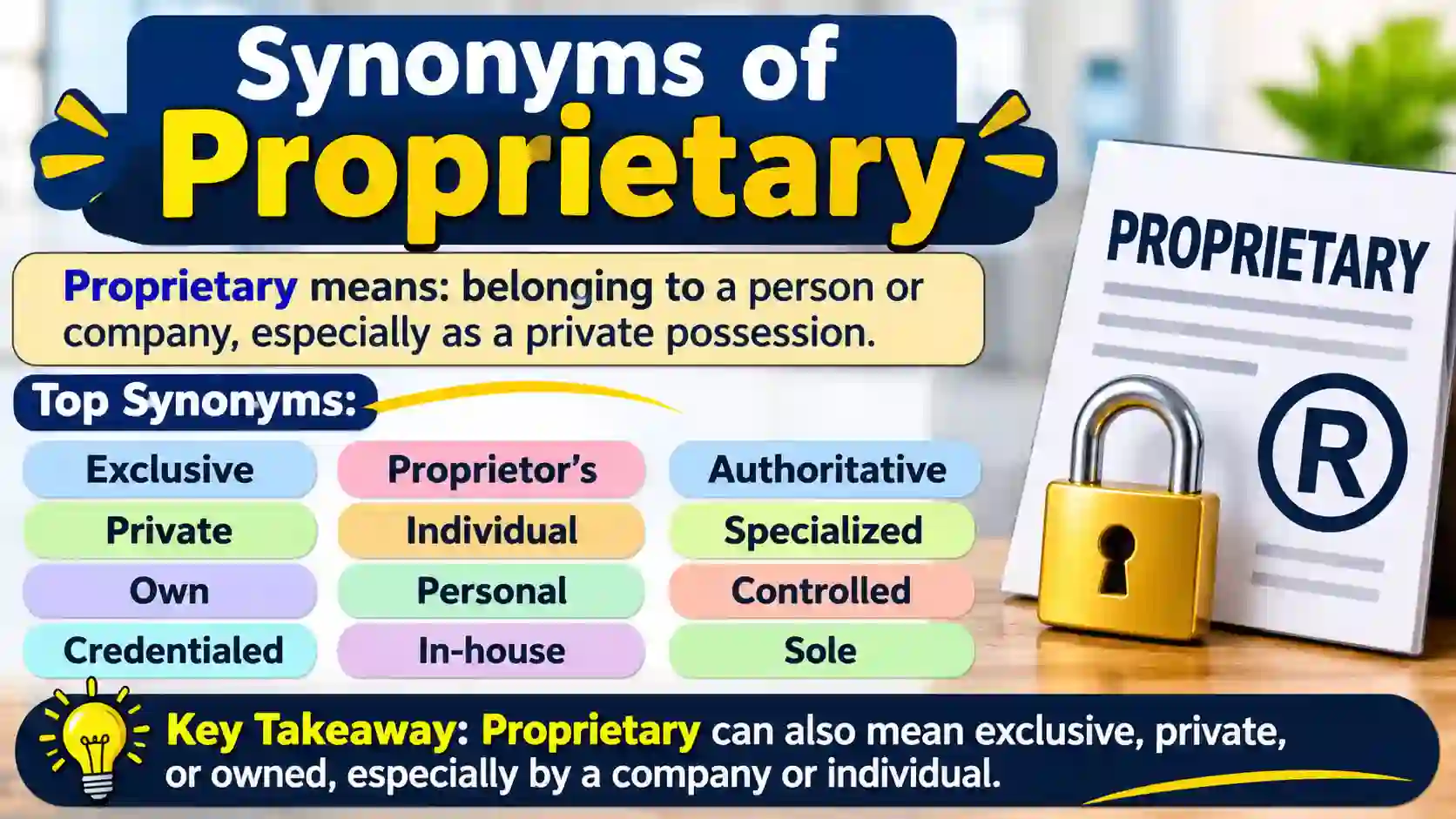
Quick Answer: What Are the Synonyms of Proprietary?
Common synonyms and alternatives for proprietary include exclusive, privately owned, privately controlled, company-owned, privately held, owner-controlled, and privately developed. Other words, such as patented, trademarked, and copyrighted, apply to specific types of legal protection. The best alternative depends on whether you mean ownership, control, branding, or restricted access.
Have you ever wanted to replace the word proprietary but struggled to find a word with the same meaning? This can happen when writing about business, technology, software, products, or intellectual property.
The word proprietary usually describes something owned or controlled by a particular person or company. It can also describe products made and sold under a company’s own brand.
For example, a business might use proprietary software that it owns or controls. You could describe it as company-controlled software, but the best replacement depends on the exact meaning.
This guide explores 30 synonyms and contextual alternatives to proprietary. You will learn their meanings, examples, differences, pronunciation, and natural usage. Whether you are a student, teacher, blogger, or professional, these alternatives can help you communicate more clearly.
Pronunciation of Proprietary
- American IPA: /prəˈpraɪəˌteri/
- British IPA: /prəˈpraɪətəri/
- Simple pronunciation: pruh-PRY-uh-ter-ee
- Syllables: Five
- Primary stress: Second syllable
The main pronunciation difference comes from the final syllables and regional accent patterns.
Part of Speech and Meaning
Proprietary is mainly an adjective. It usually appears before a noun.
Examples:
- Proprietary software
- Proprietary technology
- Proprietary products
- Proprietary information
- Proprietary rights
It has two important meanings:
- Ownership or control: Something belongs to or is controlled by a particular owner.
- Branded products: Something is made or sold under a particular company’s brand or trade name.
It can also describe a person’s attitude when they behave as if they own someone or something.
Word Family
| Word | Part of speech | Meaning |
| Proprietary | Adjective | Related to ownership or control |
| Proprietor | Noun | A person who owns something |
| Proprietorship | Noun | Ownership or a business ownership structure |
| Proprietarily | Adverb | In a way relating to ownership |
| Proprietorial | Adjective | Showing an owner’s attitude |
The adjective is much more common in everyday business and technology writing.
Grammar and Usage
Use proprietary before a noun in most modern sentences.
Correct examples:
- The company developed proprietary technology.
- We cannot share proprietary information.
- The business owns proprietary software.
Common sentence patterns:
- Proprietary + noun
- Proprietary rights to something
- A proprietary system developed by a company
Common mistake: Do not assume that proprietary always means secret, patented, or copyrighted. These words describe different ideas.
Quick Comparison: Synonyms of Proprietary
| Alternative | Main meaning | Register |
| Exclusive | Limited to one person or group | Formal |
| Privately owned | Belonging to a private owner | Neutral |
| Privately controlled | Managed by a private owner | Formal |
| Company-owned | Belonging to a company | Business |
| Privately held | Not publicly traded | Business |
| Owner-controlled | Managed by its owner | Formal |
| Company-specific | Made for one company | Business |
| Privately developed | Developed by a private organization | Formal |
| Patented | Protected by a patent | Legal |
| Trademarked | Protected as a brand identity | Legal |
| Copyrighted | Protected by copyright | Legal |
| Protected | Covered by some form of protection | Neutral |
| Branded | Carrying a brand identity | Marketing |
| Confidential | Intended to remain secret | Formal |
| Restricted | Limited in access or use | Formal |
| Private | Not public or privately owned | Neutral |
| Licensed | Authorized for use | Formal |
| In-house | Developed within an organization | Business |
| Bespoke | Specially made | British business |
| Custom-developed | Designed for particular needs | Technical |
30 Synonyms of Proprietary With Examples and Explanations
The following alternatives are grouped by meaning. Some are close substitutes, while others only work in particular situations.
Closest Alternatives
1. Exclusive
Meaning: Limited to one person, group, or organization.
Examples:
- The company has exclusive rights to distribute the product.
- Members receive exclusive access to the platform.
Best use: When discussing special access, ownership rights, or limited distribution.
Register: Formal, business. Frequency: Very common. CEFR: B1, approximate.
Collocations: Exclusive rights, exclusive access, exclusive agreement.
Avoid when: You simply want to describe ordinary ownership.
2. Privately Owned
Meaning: Belonging to an individual or private organization.
Examples:
- The business operates a privately owned research center.
- They purchased a privately owned software company.
Best use: When identifying who owns a business, building, or asset.
Register: Neutral. Frequency: Common. CEFR: B1, approximate.
Collocations: Privately owned business, privately owned property.
Avoid when: You specifically mean patent or copyright protection.
3. Privately Controlled
Meaning: Managed or directed by a private individual or organization.
Examples:
- The company operates a privately controlled network.
- A privately controlled organization manages the platform.
Best use: When control matters more than legal ownership.
Register: Formal. Frequency: Common. CEFR: B2, approximate.
Collocations: Privately controlled system, privately controlled business.
Avoid when: The important point is who legally owns an asset.
4. Company Owned
Meaning: Belonging to a particular company.
Examples:
- Employees must protect company-owned equipment.
- The company uses its company-owned database.
Best use: When describing business property or resources.
Register: Neutral, business. Frequency: Common. CEFR: B1, approximate.
Collocations: Company-owned software, company-owned property.
Avoid when: The owner is an individual rather than a company.
5. Privately Held
Meaning: Owned by private shareholders rather than publicly traded on a stock exchange.
Examples:
- The privately held company expanded into Europe.
- She works for a privately held technology business.
Best use: When discussing company structure.
Register: Business, formal. Frequency: Common. CEFR: C1, approximate.
Collocations: Privately held company, privately held corporation.
Avoid when: You want to describe ownership of a particular product.
6. Owner Controlled
Meaning: Managed by the person or organization that owns it.
Examples:
- The owner-controlled platform has strict access rules.
- They operate an owner-controlled business.
Best use: When emphasizing the owner’s authority.
Register: Formal. Frequency: Uncommon. CEFR: B2, approximate.
Collocations: Owner-controlled system, owner-controlled business.
Avoid when: The owner and manager are different people.
7. Privately Developed
Meaning: Created by a private individual or organization.
Examples:
- The company introduced privately developed technology.
- The research team built a privately developed application.
Best use: When discussing the origin of a product or system.
Register: Formal, technical. Frequency: Common. CEFR: B2, approximate.
Collocations: Privately developed software, privately developed technology.
Avoid when: You need to establish legal ownership rather than development.
8. Company Specific
Meaning: Designed for or related to one particular company.
Examples:
- The software contains company-specific features.
- Employees must follow company-specific security rules.
Best use: When describing internal business tools or processes.
Register: Business, neutral. Frequency: Common. CEFR: B2, approximate.
Collocations: Company-specific software, company-specific policies.
Avoid when: A product is available to many companies under the same terms.
9. Individually Owned
Meaning: Belonging to one individual rather than a group.
Examples:
- The individually owned store sells handmade products.
- Each individually owned property has separate records.
Best use: When explaining personal ownership.
Register: Neutral. Frequency: Common. CEFR: B2, approximate.
Collocations: Individually owned business, individually owned property.
Avoid when: A corporation owns the asset.
10. Independently Owned
Meaning: Owned and operated independently of a larger organization.
Examples:
- The independently owned bookstore supports local writers.
- She works for an independently owned publishing company.
Best use: When emphasizing business independence.
Register: Neutral, business. Frequency: Common. CEFR: B2, approximate.
Collocations: Independently owned store, independently owned business.
Avoid when: You specifically mean exclusive intellectual property rights.
Legal and Intellectual Property Alternatives
11. Patented
Meaning: Protected by a legally granted patent.
Examples:
- The company introduced a patented medical device.
- Its patented design improves the machine’s performance.
Best use: For inventions and qualifying technical innovations.
Register: Legal, technical. Frequency: Common. CEFR: B2, approximate.
Collocations: Patented invention, patented technology.
Avoid when: The product has no patent protection.
12. Trademarked
Meaning: Protected as a brand name, symbol, or identifying mark.
Examples:
- The company registered its trademarked logo.
- The trademarked name helps customers identify the brand.
Best use: For commercial names and brand identities.
Register: Legal, business. Frequency: Common. CEFR: C1, approximate.
Collocations: Trademarked logo, trademarked name.
Avoid when: Discussing copyright in creative works.
13. Copyrighted
Meaning: Protected by copyright law.
Examples:
- The publisher sells copyrighted educational materials.
- She cannot distribute copyrighted photographs without permission.
Best use: For original books, music, images, films, and software.
Register: Legal, formal. Frequency: Common. CEFR: B2, approximate.
Collocations: Copyrighted material, copyrighted content.
Avoid when: Discussing brand names or inventions as such.
14. Legally Protected
Meaning: Covered by legal rights or protection.
Examples:
- The company’s design is legally protected.
- The business uses legally protected technology.
Best use: When the exact type of legal protection is not important or is explained elsewhere.
Register: Formal, legal. Frequency: Common. CEFR: B2, approximate.
Collocations: Legally protected design, legally protected rights.
Avoid when: You know the specific protection and should name it.
15. Registered
Meaning: Officially recorded with an authorized organization.
Examples:
- The company owns a registered trademark.
- The business uses a registered brand name.
Best use: When registration is the key fact.
Register: Formal, legal. Frequency: Very common. CEFR: B1, approximate.
Collocations: Registered trademark, registered company.
Avoid when: Registration does not establish the type of ownership you mean.
Contextual and Related Alternatives
16. Branded
Meaning: Carrying a company’s name, logo, or identity.
Examples:
- The manufacturer sells branded cleaning products.
- Customers recognize the company’s branded packaging.
Best use: Marketing and product descriptions.
Register: Neutral, marketing. Frequency: Very common. CEFR: B1, approximate.
Collocations: Branded products, branded merchandise.
Avoid when: You mean legal ownership rather than brand identity.
17. Confidential
Meaning: Intended to remain private and not be shared freely.
Examples:
- The manager shared confidential business information.
- Employees must protect confidential customer records.
Best use: Business records and sensitive information.
Register: Formal, professional. Frequency: Very common. CEFR: B2, approximate.
Collocations: Confidential information, confidential documents.
Avoid when: The main idea is ownership rather than secrecy.
18. Restricted
Meaning: Limited to certain people, uses, or conditions.
Examples:
- Only approved employees can access the restricted database.
- The company keeps restricted documents in a secure folder.
Best use: Limited access or permission.
Register: Formal. Frequency: Common. CEFR: B1, approximate.
Collocations: Restricted access, restricted information.
Avoid when: You want to describe who owns something.
19. Private
Meaning: Not public, or belonging to an individual or private organization.
Examples:
- The company stores private business records.
- She uses a private platform for her work.
Best use: Everyday ownership and privacy discussions.
Register: Neutral. Frequency: Very common. CEFR: A2, approximate.
Collocations: Private property, private company.
Avoid when: You need to communicate specific intellectual property rights.
20. Licensed
Meaning: Authorized for use under particular terms.
Examples:
- The studio uses licensed editing software.
- The company sells licensed technology to other businesses.
Best use: Permission-based business and software situations.
Register: Formal, legal. Frequency: Common. CEFR: B2, approximate.
Collocations: Licensed software, licensed technology.
Avoid when: You mean ownership rather than permission.
21. Protected
Meaning: Kept safe through legal, technical, or practical measures.
Examples:
- The company keeps its protected data on secure servers.
- The design is protected by intellectual property law.
Best use: General protection contexts.
Register: Neutral, formal. Frequency: Very common. CEFR: A2, approximate.
Collocations: Protected information, protected technology.
Avoid when: The type of protection must be stated precisely.
22. Nonpublic
Meaning: Not available to the general public.
Examples:
- The company shared nonpublic financial information with its advisers.
- Access to nonpublic records requires permission.
Best use: Business, financial, and legal writing.
Register: Formal. Frequency: Common. CEFR: C1, approximate.
Collocations: Nonpublic information, nonpublic records.
Avoid when: Something is public but still privately owned.
23. In House
Meaning: Developed, produced, or managed within an organization.
Examples:
- The business created an in-house management system.
- Our team handles in-house software development.
Best use: Internal business activities.
Register: Business, spoken and written. Frequency: Very common. CEFR: B2, approximate.
Collocations: In-house software, in-house team.
Avoid when: The product was developed by an external supplier.
24. Custom Developed
Meaning: Created to meet particular needs.
Examples:
- The company uses custom-developed accounting software.
- The team built a custom-developed application for its client.
Best use: Specially designed technical products.
Register: Business, technical. Frequency: Common. CEFR: B2, approximate.
Collocations: Custom-developed software, custom-developed system.
Avoid when: You want to establish ownership rather than customization.
25. Bespoke
Meaning: Made specially for a particular person or purpose.
Examples:
- The agency created a bespoke software solution.
- The client requested a bespoke reporting system.
Best use: Custom products and services, particularly in British business English.
Register: Formal, business. Frequency: Common. CEFR: C1, approximate.
Collocations: Bespoke software, bespoke service.
Avoid when: A product is mass-produced rather than specially made.
26. Commercial
Meaning: Related to business, trade, or profit.
Examples:
- The company developed a commercial software product.
- The team released a commercial version of its application.
Best use: Business activities and products sold for profit.
Register: Neutral, business. Frequency: Very common. CEFR: B2, approximate.
Collocations: Commercial product, commercial software.
Avoid when: You specifically mean private ownership.
27. Proprietor Owned
Meaning: Owned by the person who operates a business.
Examples:
- The proprietor-owned shop has served the town for years.
- They prefer working with proprietor-owned businesses.
Best use: Specialized business descriptions.
Register: Formal. Frequency: Rare. CEFR: C1, approximate.
Collocations: Proprietor-owned business, proprietor-owned store.
Avoid when: A simpler expression such as owner-operated is more natural.
28. Owner Operated
Meaning: Run by the person who owns the business.
Examples:
- The owner-operated restaurant serves local customers.
- They purchased an owner-operated repair shop.
Best use: Small business descriptions.
Register: Neutral, business. Frequency: Common. CEFR: B2, approximate.
Collocations: Owner-operated business, owner-operated restaurant.
Avoid when: The owner does not personally manage the operation.
29. Trade Secret
Meaning: Relating to valuable business information kept secret.
Examples:
- The recipe is protected as a trade secret.
- The company keeps its manufacturing process a trade secret.
Best use: Secret formulas, methods, and business processes.
Register: Legal, business. Frequency: Common. CEFR: C1, approximate.
Collocations: Trade-secret protection, trade-secret information.
Avoid when: Discussing ordinary ownership without secrecy.
30. Reserved
Meaning: Kept for a particular person, group, or purpose.
Examples:
- The company reserved certain features for premium customers.
- The service offers reserved access to selected members.
Best use: Limited access or availability.
Register: Neutral, formal. Frequency: Common. CEFR: B1, approximate.
Collocations: Reserved rights, reserved access.
Avoid when: You mean that something is legally owned by a particular company.
Choose the Right Synonym: Side by Side Comparisons
The easiest way to select the right alternative is to identify the main idea in your sentence.
| If you mean… | Choose… | Example |
| Owned by a company | Company-owned | Company-owned software |
| Controlled by one owner | Owner-controlled | Owner-controlled system |
| Limited to selected users | Exclusive | Exclusive access |
| Protected by a patent | Patented | Patented invention |
| Protected as a brand | Trademarked | Trademarked name |
| Protected as creative work | Copyrighted | Copyrighted content |
| Kept secret | Confidential | Confidential records |
| Limited in use | Restricted | Restricted access |
| Made for one customer | Bespoke | Bespoke software |
| Made internally | In-house | In-house application |
Three Important Sentence Rewrites
Original: The company uses proprietary software.
- Company-owned software: emphasizes ownership.
- Company-controlled software: emphasizes control.
- Privately developed software: emphasizes development.
Original: The manufacturer sells proprietary products.
- Branded products: emphasizes brand identity.
- Exclusive products: emphasizes limited availability or rights.
- Privately owned products: emphasizes ownership.
Original: The business protects its proprietary information.
- Confidential information: emphasizes secrecy.
- Restricted information: emphasizes limited access.
- Protected business information: emphasizes protection.
Word Origin and Etymology
The word proprietary comes from Late Latin proprietarius, meaning a property owner or something relating to ownership. It is connected to proprietas, meaning property or ownership, and proprius, meaning one’s own or particular.
Oxford traces its historical use to Late Middle English. Etymological records place its noun use around 1400 and its adjective use in the mid-15th century. The sense of something held in private ownership is recorded from the 1580s.
The word gradually developed into a common term in business, law, medicine, and technology.
American vs. British English
The spelling of proprietary is the same in American and British English.
| Feature | American English | British English |
| Spelling | Proprietary | Proprietary |
| Pronunciation | /prəˈpraɪəˌteri/ | /prəˈpraɪətəri/ |
| Main usage | Software, business, ownership | Products, ownership, business |
| Common expression | Proprietary software | Proprietary medicine |
There is no major spelling difference. Both varieties use the word in business and technical contexts.
Synonym Categories
Strongest Alternatives
Use these when ownership or control is the main idea:
- Exclusive
- Privately owned
- Privately controlled
- Company-owned
- Privately held
- Owner-controlled
- Private
- Individually owned
- Independently owned
Strong Contextual Alternatives
Use these when discussing a specific legal or business situation:
- Patented
- Trademarked
- Copyrighted
- Licensed
- Protected
- Registered
- Confidential
- Restricted
- Nonpublic
- Trade-secret
Related Alternatives
These describe development, branding, business use, or availability:
- Branded
- In-house
- Bespoke
- Commercial
- Company-specific
- Privately developed
- Custom-developed
- Owner-operated
- Proprietor-owned
- Reserved
Remember that related alternatives do not always preserve the original meaning.
Commonly Confused Words
| Word | Difference | Example |
| Private | Describes something not public or privately owned | This is a private company. |
| Exclusive | Emphasizes limited rights or access | Members have exclusive access. |
| Confidential | Describes information that must remain secret | This is confidential information. |
| Patented | Describes an invention with patent protection | The device uses patented technology. |
| Generic | Describes a non-brand-specific product or name | The store sells generic medicine. |
Common Mistakes
Mistake 1: All proprietary products are patented.
Correction: Some proprietary products have patent protection, but others rely on trademarks, copyrights, contracts, or other rights.
Mistake 2: Proprietary means confidential.
Correction: Proprietary describes ownership or control. Confidential describes information that should remain private.
Mistake 3: Licensed and proprietary mean the same thing.
Correction: Licensed describes permission to use something. Proprietary describes ownership or control.
Mistake 4: Every commercial product is proprietary.
Correction: A commercial product can be open-source or proprietary.
Mistake 5: Branded and proprietary are interchangeable.
Correction: Branded describes a product’s identity. Proprietary describes ownership or control.
Antonyms of Proprietary
| Antonym or contrast | Meaning |
| Nonproprietary | Not proprietary or exclusively owned in the relevant sense |
| Open-source | Software distributed under an open-source license |
| Generic | Not tied to a particular protected brand |
| Public | Open to the public or belonging to a public authority |
| Shared | Used or owned by multiple people |
| Unrestricted | Not limited by specific access rules |
| Publicly available | Available for people to access |
Important: Open-source does not mean copyright-free. Open-source software can still have copyright owners and license conditions.
Related Vocabulary
These expressions help explain ownership and business rights:
- Intellectual property: Creations of the mind that may receive legal protection.
- Ownership rights: Legal rights over property or assets.
- Trade name: A name used by a business.
- Proprietary system: A system controlled by a particular owner.
- Exclusive license: Permission granted under exclusive conditions.
- Private property: Property belonging to a person or private organization.
- Open-source software: Software distributed under an open-source license.
Frequently Asked Questions
1. What are the best synonyms of proprietary?
The best alternatives include exclusive, privately owned, privately controlled, company-owned, and owner-controlled. The right choice depends on the sentence. Use patented for patent-protected inventions, copyrighted for creative works, and confidential for information that must remain private.
2. What is another word for proprietary in business?
In business writing, useful alternatives include company-owned, privately held, exclusive, company-controlled, and company-specific. For example, you can replace “proprietary business software” with “company-controlled software” when control is the main point.
3. What is the opposite of proprietary?
Nonproprietary is the most direct opposite. Other contextual contrasts include open-source, generic, public, and unrestricted. However, these words are not exact opposites in every situation because something can be privately owned while still being publicly accessible.
4. Is proprietary the same as copyrighted?
No. Proprietary describes ownership or control, while copyrighted describes a creative work protected by copyright law. A company may own proprietary software and hold its copyright, but these words describe different aspects of that software.
5. What does proprietary mean in technology?
In technology, proprietary usually describes software, hardware, systems, or tools owned or controlled by a particular company. The owner may set rules about access, modification, distribution, and use through intellectual property rights or licensing terms.
6. Is exclusive a synonym for proprietary?
Yes, in certain contexts. Exclusive emphasizes limited rights or availability, while proprietary emphasizes ownership or control. A company can have exclusive rights to distribute a product, but exclusive and proprietary do not mean exactly the same thing.
7. What is the difference between proprietary and private?
Private generally describes something that is not public or belongs to an individual or private organization. Proprietary places more emphasis on ownership or control. A private company can own proprietary software, use open-source tools, or purchase licensed technology.
8. What is a simple way to say proprietary?
You can say “owned by a company,” “controlled by a company,” or “made for a particular business.” For example, instead of saying “The company uses proprietary software,” you could say “The company uses software it owns and controls.”
Vocabulary Quiz
Choose the correct answer.
1. Which word describes an invention protected by a patent?
A. Confidential
B. Patented
C. Reserved
D. Generic
2. Which word describes information that must remain secret?
A. Commercial
B. Branded
C. Confidential
D. Bespoke
3. Which phrase describes a company that is not publicly traded?
A. Privately held
B. Copyrighted
C. Restricted
D. In-house
4. Which word describes a product made specially for a customer?
A. Generic
B. Bespoke
C. Nonpublic
D. Trademarked
5. Which word specifically relates to protection of a brand identity?
A. Patented
B. Licensed
C. Trademarked
D. Restricted
Answer Key
- B. Patented
- C. Confidential
- A. Privately held
- B. Bespoke
- C. Trademarked
Sentence Rewriting Practice
Rewrite each sentence using a suitable alternative.
- The company uses proprietary software.
- The business protects its proprietary information.
- The manufacturer sells proprietary products.
Suggested answers:
- The company uses company-owned software.
- The business protects its confidential information.
- The manufacturer sells branded products.
These alternatives are suitable when ownership, secrecy, and branding are the intended meanings.
Fill in the Blank Exercise
Choose from: exclusive, patented, confidential, bespoke, and privately held.
- The company developed a ______ medical device.
- Employees must protect ______ business records.
- The designer created a ______ website for the customer.
- The company is a ______ corporation.
- Members receive ______ access to the platform.
Answers:
- Patented
- Confidential
- Bespoke
- Privately held
- Exclusive
Conclusion
Learning synonyms of proprietary helps you communicate ownership, control, and legal protection more clearly. Words such as exclusive, privately owned, patented, and confidential each have a different purpose.
Choose an alternative that matches your intended meaning instead of replacing words without checking their context.
Practice these expressions in essays, emails, professional documents, and daily conversations to build a stronger English vocabulary.
References
- Oxford Learner’s Dictionaries: https://www.oxfordlearnersdictionaries.com/definition/english/proprietary
- Cambridge Dictionary: https://dictionary.cambridge.org/dictionary/english/proprietary
- Collins Dictionary: https://www.collinsdictionary.com/dictionary/english/proprietary
- Online Etymology Dictionary: https://www.etymonline.com/word/proprietary
- Thesaurus.com: https://www.thesaurus.com/browse/proprietary

Synonorm is a trusted English vocabulary resource created to help readers find the right words and understand the differences between similar terms. We provide clear explanations of synonyms, meanings, examples, usage, and alternatives. Our content makes vocabulary easier to learn and apply in everyday, academic, and professional English. Synonorm is designed for students, writers, ESL learners, professionals, and anyone who wants to improve their English vocabulary and communicate more clearly.